Enhanced Density Fluctuations Near a Disordered Chiral Topological Transition
Pith reviewed 2026-06-28 23:51 UTC · model grok-4.3
The pith
Wave-packet density fluctuations grow faster than usual near a disorder-driven chiral topological transition.
A machine-rendered reading of the paper's core claim, the machinery that carries it, and where it could break.
Core claim
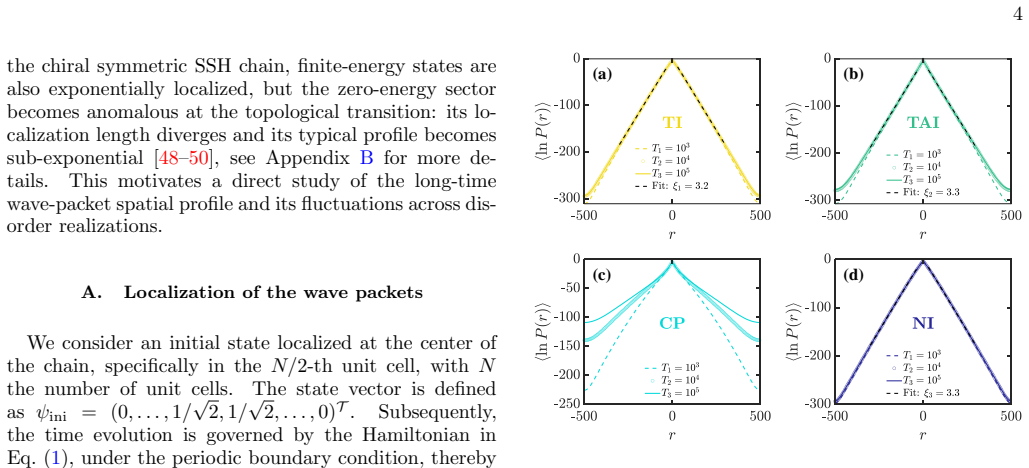
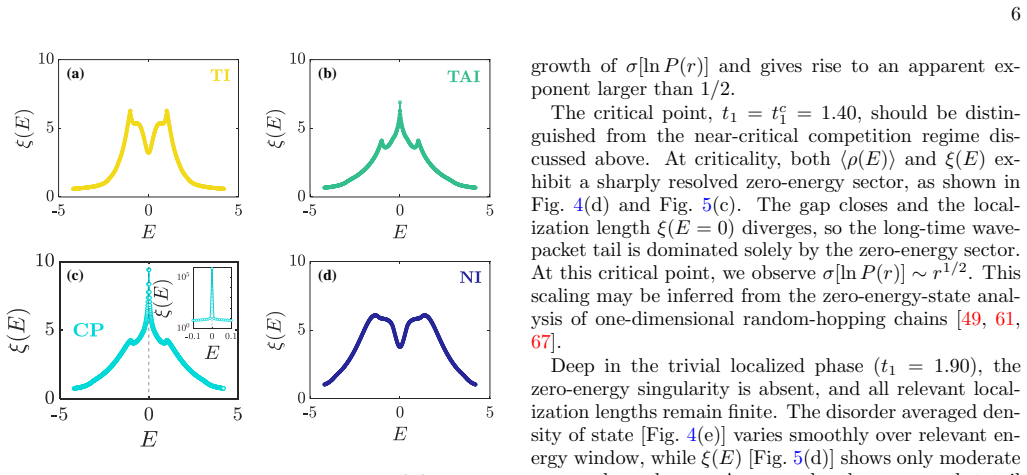
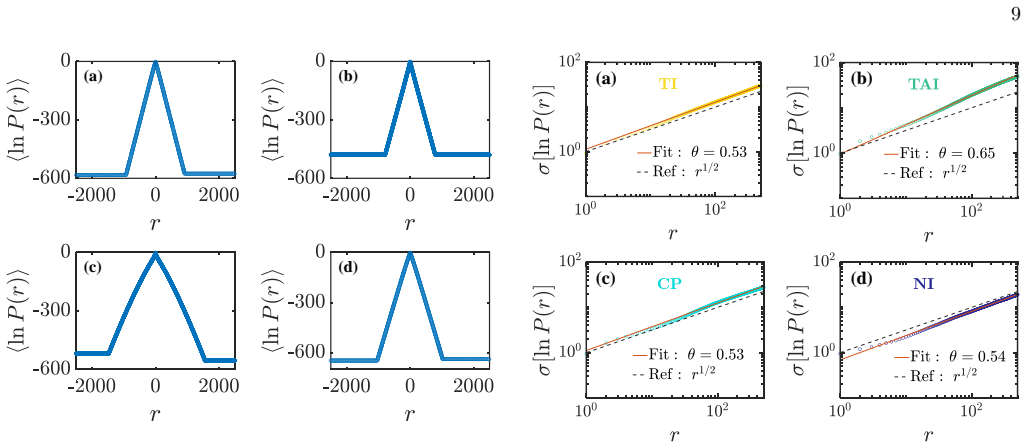
In the Su-Schrieffer-Heeger chain with off-diagonal disorder, the fluctuation exponent θ in σ[ln P(r)] ~ r^θ stays near 1/2 away from the topological transition but increases above 1/2 nonmonotonically near the transition before returning close to 1/2 at criticality. This occurs because multiple energy sectors possess appreciable spectral weight and exhibit competitive localization lengths, so a single scale cannot dominate the accessible wave-packet tail.
What carries the argument
The scaling exponent θ extracted from the standard deviation of ln P(r), read out via energy-resolved density of states and localization lengths that reveal competing decay rates.
If this is right
- Wave-packet fluctuation statistics function as a dynamical diagnostic for disordered chiral topological transitions.
- The nonmonotonic rise and return of θ supplies a concrete signature of competing localization scales across energy sectors.
- At the critical point the conventional one-dimensional scaling with θ = 1/2 is recovered.
- The same fluctuation analysis can be applied to other symmetry-protected disordered topological models.
Where Pith is reading between the lines
- Cold-atom or photonic-lattice experiments could map the nonmonotonic θ directly by tracking wave-packet spread at varying disorder strengths.
- The mechanism may generalize to transitions where multiple bands or sectors compete, even without chiral symmetry.
- Higher-dimensional or interacting versions could be tested to see whether the enhancement of θ persists or changes character.
Load-bearing premise
The enhancement of fluctuations is produced by several energy sectors simultaneously carrying appreciable spectral weight and showing comparable localization lengths near the transition.
What would settle it
Direct computation or measurement of energy-resolved localization lengths that shows only one dominant scale even near the transition point, or observation that θ remains fixed at 1/2 throughout the transition region.
Figures


read the original abstract
The universal statistics of density fluctuations of localized quantum states may offer unprecedented opportunities to probe and understand quantum transport in connection with dimensionality, coherence, symmetry and disorder. To date, the possible role of topological phase transitions in the fluctuation statistics is not studied yet. Using a Su-Schrieffer-Heeger chain subject to off-diagonal disorder (so that chiral symmetry is preserved), this work investigates how a disorder driven topological phase transition impacts on the spatial fluctuations of the logarithmic wave-packet density $\ln P(r)$ at distance $r$ from the initial excitation. Away from the transition, in both topological and trivial localized phases, the standard deviation follows the conventional one-dimensional scaling $\sigma[\ln P(r)]\sim r^{\theta}$ with $\theta\simeq 1/2$. Near the transition, however, the fluctuation growth is enhanced: the fitted exponent $\theta$ increases above $1/2$ in a nonmonotonic manner before returning close to $1/2$ at criticality. We interpret this behavior from the energy-resolved density of states and localization length. Near the transition, several energy sectors carry appreciable spectral weight and exhibit competitive decay rates, preventing a single localization scale from dominating the accessible wave-packet tail and thereby enhancing the fluctuations of $\ln P(r)$. Our results establish wave-packet fluctuation statistics as a dynamical diagnostic of disordered chiral topological transitions and motivate broader studies of fluctuation phenomena in disordered topological quantum systems.
Editorial analysis
A structured set of objections, weighed in public.
Referee Report
Summary. The manuscript investigates spatial fluctuations of the logarithmic wave-packet density ln P(r) in a Su-Schrieffer-Heeger chain with off-diagonal disorder that preserves chiral symmetry. It reports that in both the topological and trivial localized phases away from the disorder-driven transition, σ[ln P(r)] scales as r^θ with θ ≃ 1/2, but near the transition the fitted θ rises above 1/2 nonmonotonically before returning close to 1/2 at criticality. The enhancement is interpreted via energy-resolved density of states and localization lengths, with multiple energy sectors carrying spectral weight and exhibiting competitive decay rates.
Significance. If the numerical observation of enhanced θ holds under scrutiny, the work provides a dynamical diagnostic for disordered chiral topological transitions through fluctuation statistics, extending beyond conventional localization scaling. The symmetry-preserving model choice and energy-resolved analysis are positive features that ground the interpretation in the Hamiltonian structure.
major comments (2)
- [§4.2, Fig. 4] §4.2 and Fig. 4: The fitted exponent θ is reported to exceed 1/2 near the transition, but the manuscript provides no details on the r-range used for fitting, the number of disorder realizations averaged, or the method for estimating uncertainties on θ; without these, the statistical significance of the nonmonotonic deviation cannot be assessed.
- [§5] §5: The central interpretive claim that multiple energy sectors with comparable localization lengths enhance fluctuations rests on the energy-resolved DOS and ξ(E) analysis, yet no control simulation is presented in which the initial state is projected onto a narrow energy window around a single dominant sector to test whether θ reverts to 1/2; this leaves alternative explanations (fitting sensitivity or finite-size effects) unaddressed.
minor comments (2)
- [§2] The definition of P(r) as the site-resolved probability density should be stated explicitly in the methods section rather than assumed from context.
- A brief comparison to earlier works on ln P(r) fluctuations in non-topological 1D Anderson models would clarify the novelty of the topological aspect.
Simulated Author's Rebuttal
We thank the referee for the careful reading of our manuscript and the constructive comments. We address each major comment below and have revised the manuscript where appropriate to strengthen the presentation.
read point-by-point responses
-
Referee: [§4.2, Fig. 4] §4.2 and Fig. 4: The fitted exponent θ is reported to exceed 1/2 near the transition, but the manuscript provides no details on the r-range used for fitting, the number of disorder realizations averaged, or the method for estimating uncertainties on θ; without these, the statistical significance of the nonmonotonic deviation cannot be assessed.
Authors: We agree that these details are necessary to evaluate the results. In the revised manuscript we have added them explicitly in §4.2 and the caption of Fig. 4: fits are performed over the interval r ∈ [20, 100], data are averaged over 5000 independent disorder realizations, and uncertainties on θ are obtained from the covariance matrix of the linear regression on the log-log plot (with bootstrap confirmation). These additions confirm that the non-monotonic rise of θ above 1/2 remains statistically significant near the transition. revision: yes
-
Referee: [§5] §5: The central interpretive claim that multiple energy sectors with comparable localization lengths enhance fluctuations rests on the energy-resolved DOS and ξ(E) analysis, yet no control simulation is presented in which the initial state is projected onto a narrow energy window around a single dominant sector to test whether θ reverts to 1/2; this leaves alternative explanations (fitting sensitivity or finite-size effects) unaddressed.
Authors: We acknowledge that an explicit control simulation would provide additional support. However, the local initial excitation used throughout the study inherently populates a broad spectral range; artificially projecting onto a single narrow energy window would change the physical protocol under consideration. In the revised §5 we have added a quantitative decomposition of the spectral weights together with finite-size scaling checks that demonstrate the enhancement is robust against both fitting-range variations and system-size changes. These revisions directly address the alternative explanations while preserving the original physical setup. revision: partial
Circularity Check
No circularity: exponent obtained from direct numerical fitting on Hamiltonian
full rationale
The central result is the numerically measured and fitted exponent θ for σ[ln P(r)] ~ r^θ, obtained by direct simulation of the disordered SSH model with off-diagonal disorder. No equation in the provided text defines θ in terms of itself or renames a fitted input as a prediction; the energy-resolved DOS and localization-length analysis used for interpretation are computed independently from the same Hamiltonian but do not force the fluctuation scaling by construction. No self-citation chain or ansatz smuggling is present in the abstract or described claims.
Axiom & Free-Parameter Ledger
axioms (1)
- domain assumption The Su-Schrieffer-Heeger chain with off-diagonal disorder preserves chiral symmetry.
Reference graph
Works this paper leans on
-
[1]
We have also checked larger systems withN= 5000, finding re- sults consistent with those forN= 1000; further details are provided in Appendix C
This nonmonotonic behavior is the central observation of this work. We have also checked larger systems withN= 5000, finding re- sults consistent with those forN= 1000; further details are provided in Appendix C. IV. ENHANCED FLUCTUA TION SCALING FROM ENERGY-SECTOR SELECTION For a one-dimensional localized eigenstate at energyE, the logarithmic density at...
-
[2]
At the critical point, the density of states is dominated by a sharp zero- energy contribution
In the near-critical TAI regime, spectral weight appears both near zero energy and finite-energy sectors, indicating the coexistence of several relevant energy channels. At the critical point, the density of states is dominated by a sharp zero- energy contribution. Other parameters aret 2 = 1,N= 10 3, Nd = 104, andW= 1.43. whereξ(E) is the localization le...
2030
-
[3]
Li, R.-L
J. Li, R.-L. Chu, J. K. Jain, and S.-Q. Shen, Topological anderson insulator, Physical review letters102, 136806 (2009)
2009
-
[4]
E. J. Meier, F. A. An, A. Dauphin, M. Maffei, P. Massig- nan, T. L. Hughes, and B. Gadway, Observation of the topological anderson insulator in disordered atomic wires, Science362, 929 (2018)
2018
-
[5]
St¨ utzer, Y
S. St¨ utzer, Y. Plotnik, Y. Lumer, P. Titum, N. H. Lind- ner, M. Segev, M. C. Rechtsman, and A. Szameit, Pho- tonic topological anderson insulators, Nature560, 461 (2018)
2018
-
[6]
G.-G. Liu, Y. Yang, X. Ren, H. Xue, X. Lin, Y.-H. Hu, 10 H.-x. Sun, B. Peng, P. Zhou, Y. Chong,et al., Topolog- ical anderson insulator in disordered photonic crystals, Physical Review Letters125, 133603 (2020)
2020
-
[7]
Zangeneh-Nejad and R
F. Zangeneh-Nejad and R. Fleury, Disorder-induced sig- nal filtering with topological metamaterials, Advanced Materials32, 2001034 (2020)
2020
-
[8]
Zhang, D
W. Zhang, D. Zou, Q. Pei, W. He, J. Bao, H. Sun, and X. Zhang, Experimental observation of higher-order topological anderson insulators, Physical Review Letters 126, 146802 (2021)
2021
- [9]
-
[10]
Q. Lin, T. Li, L. Xiao, K. Wang, W. Yi, and P. Xue, Observation of non-hermitian topological anderson insu- lator in quantum dynamics, Nature Communications13, 3229 (2022)
2022
-
[11]
Chen, Z.-X
X.-D. Chen, Z.-X. Gao, X. Cui, H.-C. Mo, W.-J. Chen, R.-Y. Zhang, C. Chan, and J.-W. Dong, Realization of time-reversal invariant photonic topological anderson in- sulators, Physical Review Letters133, 133802 (2024)
2024
-
[12]
M. Ren, Y. Yu, B. Wu, X. Qi, Y. Wang, X. Yao, J. Ren, Z. Guo, H. Jiang, H. Chen,et al., Realization of gapped and ungapped photonic topological anderson insulators, Physical Review Letters132, 066602 (2024)
2024
-
[13]
X. Li, H. Xu, J. Wang, L.-Z. Tang, D.-W. Zhang, C. Yang, T. Su, C. Wang, Z. Mi, W. Sun,et al., Mapping the topology-localization phase diagram with quasiperi- odic disorder using a programmable superconducting simulator, Physical Review Research6, L042038 (2024)
2024
-
[14]
Khudaiberdiev, Z
D. Khudaiberdiev, Z. Kvon, M. Ryzhkov, D. Kozlov, N. Mikhailov, and A. Pimenov, Two-dimensional topo- logical anderson insulator in a hgte-based semimetal, Physical Review Research7, L022033 (2025)
2025
- [15]
-
[16]
M. Mannai, Y. Shu, S. Haddad, M. Ren, H. Chen, Y. Sun, and H. Sati, Realization of staircase topological ander- son phase transitions, arXiv preprint arXiv:2601.14769 (2026)
-
[17]
Groth, M
C. Groth, M. Wimmer, A. Akhmerov, J. Tworzyd lo, and C. Beenakker, Theory of the topological anderson insu- lator, Physical review letters103, 196805 (2009)
2009
-
[18]
Jiang, L
H. Jiang, L. Wang, Q.-f. Sun, and X. Xie, Numerical study of the topological anderson insulator in hgte/cdte quantum wells, Physical Review B—Condensed Matter and Materials Physics80, 165316 (2009)
2009
-
[19]
H.-M. Guo, G. Rosenberg, G. Refael, and M. Franz, Topological anderson insulator in three dimensions, Physical review letters105, 216601 (2010)
2010
-
[20]
Altland, D
A. Altland, D. Bagrets, L. Fritz, A. Kamenev, and H. Schmiedt, Quantum criticality of quasi-one- dimensional topological anderson insulators, Physical Re- view Letters112, 206602 (2014)
2014
-
[21]
Tang, L.-F
L.-Z. Tang, L.-F. Zhang, G.-Q. Zhang, and D.-W. Zhang, Topological anderson insulators in two-dimensional non- hermitian disordered systems, Physical Review A101, 063612 (2020)
2020
-
[22]
C. W. Beenakker, Random-matrix theory of quantum transport, Reviews of modern physics69, 731 (1997)
1997
-
[23]
P. A. Mello and N. Kumar,Quantum Transport in Mesoscopic Systems: Complexity and Statistical Fluctu- ations. A Maximum Entropy Viewpoint(Oxford Univer- sity Press, 2004)
2004
-
[24]
Evers and A
F. Evers and A. D. Mirlin, Anderson transitions, Reviews of Modern Physics80, 1355 (2008)
2008
-
[25]
M. L. Mehta,Random matrices, Vol. 142 (Elsevier, 2004)
2004
-
[26]
O. Dorokhov, Transmission coefficient and the localiza- tion length of an electron in n bound disordered chains, Soviet Journal of Experimental and Theoretical Physics Letters36, 318 (1982)
1982
-
[27]
Mello, P
P. Mello, P. Pereyra, and N. Kumar, Macroscopic ap- proach to multichannel disordered conductors, Annals of Physics181, 290 (1988)
1988
-
[28]
Muttalib and J
K. Muttalib and J. Klauder, Generalized fokker-planck equation for multichannel disordered quantum conduc- tors, Physical review letters82, 4272 (1999)
1999
-
[29]
Muttalib and V
K. Muttalib and V. A. Gopar, Generalization of the dmpk equation beyond quasi one dimension, Physical Review B 66, 115318 (2002)
2002
-
[30]
Douglas, P
A. Douglas, P. Markoˇ s, and K. Muttalib, The generalized dmpk equation revisited: towards a systematic deriva- tion, Journal of Physics A: Mathematical and Theoretical 47, 125103 (2014)
2014
-
[31]
Suslov, General form of dmpk equation, Journal of Ex- perimental and Theoretical Physics127, 131 (2018)
I. Suslov, General form of dmpk equation, Journal of Ex- perimental and Theoretical Physics127, 131 (2018)
2018
-
[32]
A. D. Mirlin, Statistics of energy levels and eigenfunc- tions in disordered systems, Physics Reports326, 259 (2000)
2000
-
[33]
P. W. Anderson, D. Thouless, E. Abrahams, and D. Fisher, New method for a scaling theory of localiza- tion, Physical Review B22, 3519 (1980)
1980
-
[34]
Kramer and A
B. Kramer and A. MacKinnon, Localization: theory and experiment, Reports on Progress in Physics56, 1469 (1993)
1993
-
[35]
Furstenberg, Noncommuting random products, Trans- actions of the American Mathematical Society108, 377 (1963)
H. Furstenberg, Noncommuting random products, Trans- actions of the American Mathematical Society108, 377 (1963)
1963
-
[36]
Kardar, G
M. Kardar, G. Parisi, and Y.-C. Zhang, Dynamic scaling of growing interfaces, Physical Review Letters56, 889 (1986)
1986
-
[37]
Somoza, M
A. Somoza, M. Ortuno, and J. Prior, Universal distri- bution functions in two-dimensional localized systems, Physical Review Letters99, 116602 (2007)
2007
-
[38]
Lemari´ e, Glassy properties of anderson localization: Pinning, avalanches, and chaos, Physical review letters 122, 030401 (2019)
G. Lemari´ e, Glassy properties of anderson localization: Pinning, avalanches, and chaos, Physical review letters 122, 030401 (2019)
2019
-
[39]
S. Mu, J. Gong, and G. Lemari´ e, Kardar-parisi-zhang physics in the density fluctuations of localized two- dimensional wave packets, Phys. Rev. Lett.132, 046301 (2024)
2024
-
[40]
Swain, S
N. Swain, S. Adam, and G. Lemari´ e, Two-dimensional anderson localization and kpz subuniversality classes: Sensitivity to boundary conditions and insensitivity to symmetry classes, Phys. Rev. Res.8, 013038 (2026)
2026
-
[41]
S. Mu, G. Lemari´ e, and J. Gong, Universal fluctuations of two localized interacting particles in one dimension, Phys. Rev. B112, 014201 (2025)
2025
- [42]
-
[43]
W.-P. Su, J. R. Schrieffer, and A. J. Heeger, Solitons in polyacetylene, Physical review letters42, 1698 (1979)
1979
-
[44]
P. W. Anderson, Absence of diffusion in certain random lattices, Physical review109, 1492 (1958). 11
1958
-
[45]
Lagendijk, B
A. Lagendijk, B. v. Tiggelen, and D. S. Wiersma, Fifty years of anderson localization, Physics today62, 24 (2009)
2009
-
[46]
N. F. Mott and W. Twose, The theory of impurity con- duction, Advances in physics10, 107 (1961)
1961
-
[47]
Abrahams, P
E. Abrahams, P. W. Anderson, D. C. Licciardello, and T. V. Ramakrishnan, Scaling theory of localization: Ab- sence of quantum diffusion in two dimensions, Physical Review Letters42, 673 (1979)
1979
-
[48]
Borland, The nature of the electronic states in disor- dered one-dimensional systems, Proceedings of the Royal Society of London
R. Borland, The nature of the electronic states in disor- dered one-dimensional systems, Proceedings of the Royal Society of London. Series A. Mathematical and Physical Sciences274, 529 (1963)
1963
-
[49]
Fleishman and D
L. Fleishman and D. Licciardello, Fluctuations and lo- calization in one dimension, Journal of Physics C: Solid State Physics10, L125 (1977)
1977
-
[50]
Soukoulis and E
C. Soukoulis and E. Economou, Off-diagonal disorder in one-dimensional systems, Physical Review B24, 5698 (1981)
1981
-
[51]
Mondragon-Shem, T
I. Mondragon-Shem, T. L. Hughes, J. Song, and E. Pro- dan, Topological criticality in the chiral-symmetric aiii class at strong disorder, Physical review letters113, 046802 (2014)
2014
-
[52]
De Tomasi, S
G. De Tomasi, S. Roy, and S. Bera, Generalized dyson model: Nature of the zero mode and its implication in dynamics, Physical Review B94, 144202 (2016)
2016
-
[53]
F. J. Dyson, The dynamics of a disordered linear chain, Physical Review92, 1331 (1953)
1953
-
[54]
Weissmann and N
M. Weissmann and N. Cohan, Density of states of a one- dimensional system with off-diagonal disorder, Journal of Physics C: Solid State Physics8, L145 (1975)
1975
-
[55]
Bush, On the anomalous behaviour at the band centre of a one-dimensional system with off-diagonal disorder, Journal of Physics C: Solid State Physics8, L547 (1975)
R. Bush, On the anomalous behaviour at the band centre of a one-dimensional system with off-diagonal disorder, Journal of Physics C: Solid State Physics8, L547 (1975)
1975
-
[56]
Theodorou and M
G. Theodorou and M. H. Cohen, Extended states in a one-demensional system with off-diagonal disorder, Phys- ical Review B13, 4597 (1976)
1976
-
[57]
Eggarter and R
T. Eggarter and R. Riedinger, Singular behavior of tight- binding chains with off-diagonal disorder, Physical Re- view B18, 569 (1978)
1978
-
[58]
T. A. Ziman, Localization with off-diagonal disorder: A qualitative theory, Physical Review B26, 7066 (1982)
1982
-
[59]
Hilke, The disordered su-schrieffer-heeger model, arXiv preprint arXiv:2512.24738 (2025)
M. Hilke, The disordered su-schrieffer-heeger model, arXiv preprint arXiv:2512.24738 (2025)
-
[60]
P. W. Brouwer, C. Mudry, and A. Furusaki, Density of states in coupled chains with off-diagonal disorder, Phys- ical Review Letters84, 2913 (2000)
2000
-
[61]
Balents and M
L. Balents and M. P. Fisher, Delocalization transition via supersymmetry in one dimension, Physical Review B56, 12970 (1997)
1997
-
[62]
Tang, S.-N
L.-Z. Tang, S.-N. Liu, G.-Q. Zhang, and D.-W. Zhang, Topological anderson insulators with different bulk states in quasiperiodic chains, Physical Review A105, 063327 (2022)
2022
-
[63]
J. K. Asb´ oth, L. Oroszl´ any, and A. P´ alyi,A short course on topological insulators, Vol. 919 (Springer, 2016)
2016
-
[64]
Billy, V
J. Billy, V. Josse, Z. Zuo, A. Bernard, B. Hambrecht, P. Lugan, D. Cl´ ement, L. Sanchez-Palencia, P. Bouyer, and A. Aspect, Direct observation of anderson localiza- tion of matter waves in a controlled disorder, Nature453, 891 (2008)
2008
-
[65]
Roati, C
G. Roati, C. D’Errico, L. Fallani, M. Fattori, C. Fort, M. Zaccanti, G. Modugno, M. Modugno, and M. In- guscio, Anderson localization of a non-interacting bose– einstein condensate, Nature453, 895 (2008)
2008
-
[66]
Prior, A
J. Prior, A. Somoza, and M. Ortuno, Conductance fluc- tuations and single-parameter scaling in two-dimensional disordered systems, Physical Review B—Condensed Matter and Materials Physics72, 024206 (2005)
2005
-
[67]
Prior, A
J. Prior, A. Somoza, and M. Ortuno, Conductance dis- tribution in two-dimensional localized systems with and without magnetic fields, The European Physical Journal B70, 513 (2009)
2009
-
[68]
Somoza, P
A. Somoza, P. Le Doussal, and M. Ortuno, Unbinding transition in semi-infinite two-dimensional localized sys- tems, Physical Review B91, 155413 (2015)
2015
-
[69]
Krishna and R
A. Krishna and R. N. Bhatt, Beyond universal behav- ior in the one-dimensional chain with random nearest- neighbor hopping, Physical Review B101, 224203 (2020)
2020
discussion (0)
Sign in with ORCID, Apple, or X to comment. Anyone can read and Pith papers without signing in.