Claim against Measurement: Statistical Artefacts in Quantum Error Mitigation Benchmarks
Pith reviewed 2026-06-29 07:06 UTC · model grok-4.3
The pith
Evaluation practices in quantum error mitigation can make performance gains appear more robust than the data support.
A machine-rendered reading of the paper's core claim, the machinery that carries it, and where it could break.
Core claim
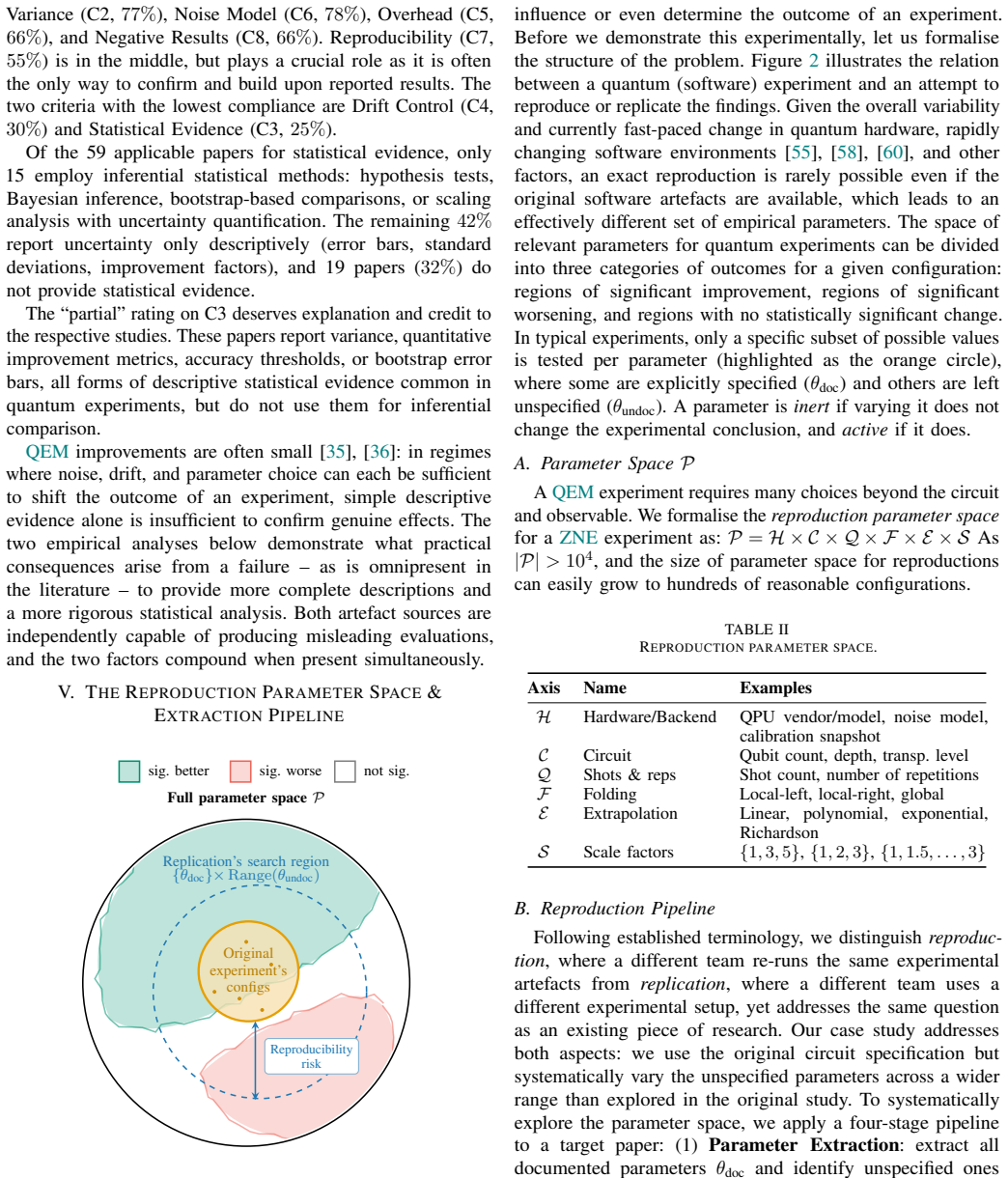
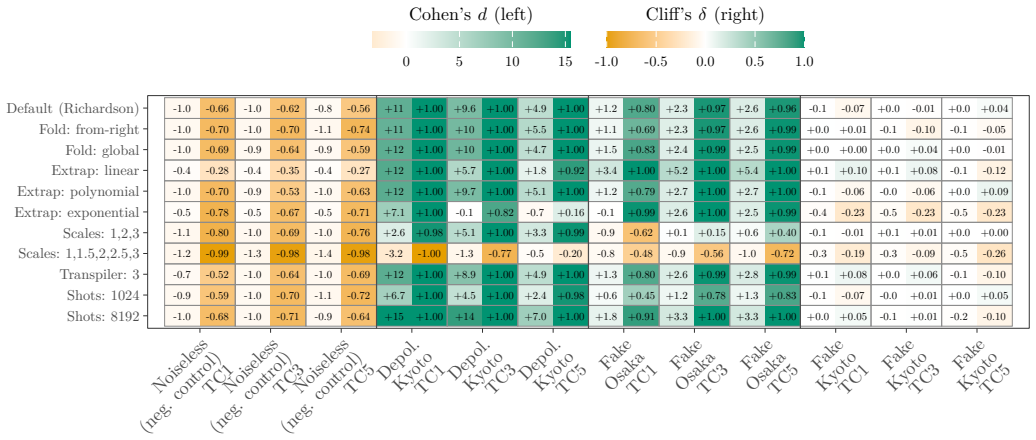
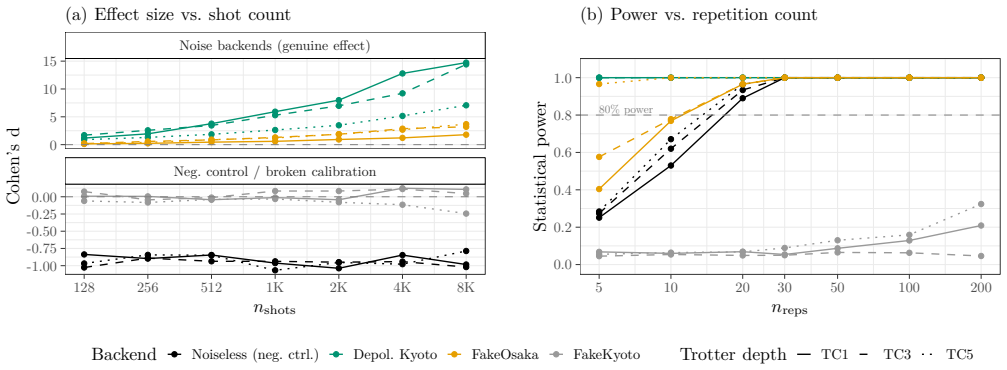
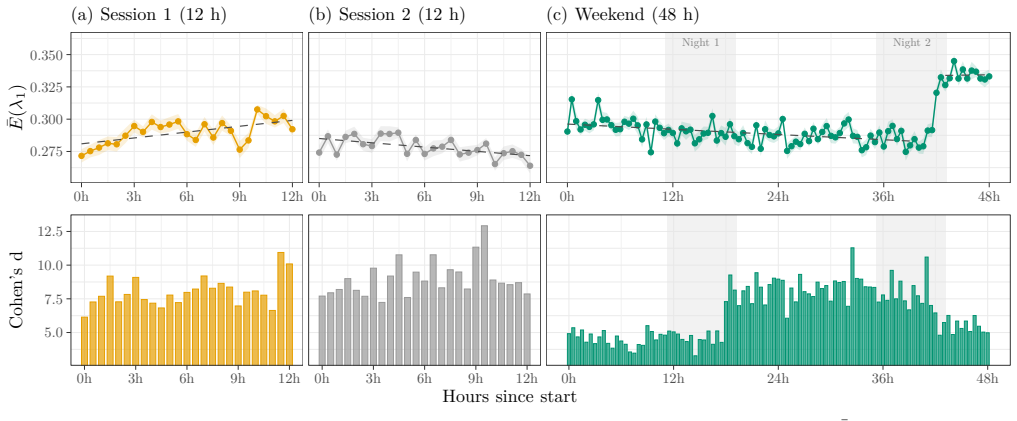
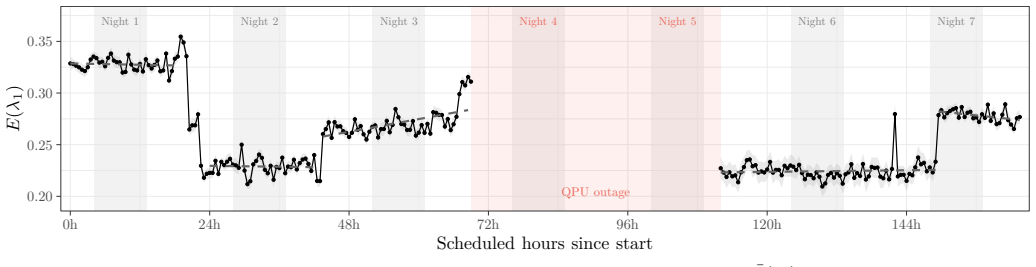
In a systematic review using an eight-criterion framework, only 15 of the applicable papers employed inferential statistics while 25 reported uncertainty descriptively without testing support for claimed effects. Targeted experiments on zero-noise extrapolation then isolate two artefact sources: parameter sensitivity, in which implicit choices alter conclusions across a 132-configuration sweep, and drift-induced illusion, in which a 72-hour longitudinal study shows the same configuration producing effect sizes differing by a factor of three solely due to execution timing, also reducing the number of independent observations.
What carries the argument
An eight-criterion framework that scores papers on statistical rigour, reproducibility, and reporting quality, used to surface artefacts in parameter sweeps and longitudinal hardware runs for zero-noise extrapolation.
If this is right
- Evaluations must document all scale factors, extrapolation methods, and calibration settings explicitly.
- Robustness checks across parameter variations become necessary before claiming mitigation benefits.
- Longitudinal runs are required to separate hardware drift from mitigation effects.
- Inferential statistics with effect-size reporting replace descriptive uncertainty in published results.
- New minimum reporting standards would allow direct comparison of mitigation techniques across studies.
Where Pith is reading between the lines
- Similar review frameworks could be applied to other near-term quantum techniques that rely on post-processing.
- Hardware vendors might incorporate automated drift logging into calibration routines to support cleaner benchmarks.
- If artefacts are widespread, reported progress toward useful error mitigation on NISQ devices could be slower than current literature suggests.
- Standardised test suites that include parameter and drift sweeps would make future claims easier to verify.
Load-bearing premise
The 81 papers form a representative sample of quantum error mitigation evaluation practice and the eight criteria capture the main dimensions of statistical validity.
What would settle it
A re-run of the 132-configuration and 72-hour experiments on multiple devices that applies mandatory inferential tests and finds that performance conclusions remain stable once parameter choices are fixed and drift is controlled.
Figures



read the original abstract
QEM is widely regarded as a plausible bridge from NISQ devices to FTQC. Yet the empirical studies used to assess the effectiveness of QEM techniques on concrete problems have received comparatively little scrutiny with respect to the validity of their conclusions. We systematically review 81 recent QEM papers using an eight-criterion framework covering statistical rigour, reproducibility, and reporting quality. Among the applicable papers, only 15 (25%) use inferential methods, while 25 (42%) report uncertainty only descriptively, without testing whether the claimed effects are statistically supported. To demonstrate the consequences of these omissions, we use ZNE as a representative and widely used case study and identify two compounding sources of artefacts in current QEM benchmarks. First, we observe parameter sensitivity: in a 132-configuration sweep, implicitly assumed choices such as scale factors, extrapolation method, and hardware calibration are not merely incidental but active, with variations changing conclusions from statistically significant improvement to statistically significant degradation. Second, we identify a drift-induced effectiveness illusion: in a 72-hour longitudinal study on real hardware, temporal drift alone can make the same ZNE configuration exhibit an effect size more than three times as large, depending solely on when it is executed, and also drastically reduces the effective number of independent observations. These findings do not imply that QEM methods are intrinsically unsound; rather, they show that current evaluation practice can make mitigation performance appear more robust than the evidence warrants. We therefore propose minimum reporting standards for QEM evaluations, including explicit parameter documentation, robustness checks, longitudinal drift assessment, and inferential statistical testing with effect-size reporting.
Editorial analysis
A structured set of objections, weighed in public.
Referee Report
Summary. The manuscript conducts a systematic review of 81 recent QEM papers via an eight-criterion framework on statistical rigour, reproducibility and reporting quality. It reports that only 15 of 60 applicable papers (25%) employ inferential statistics while 25 (42%) report uncertainty descriptively only. Using ZNE as a case study, a 132-configuration parameter sweep and a 72-hour longitudinal hardware experiment are presented to show that implicit choices (scale factors, extrapolation method, calibration) and temporal drift can reverse statistical conclusions or inflate effect sizes by more than 3 imes. The authors conclude that current evaluation practice can overstate QEM robustness and propose minimum reporting standards including explicit parameter documentation, robustness checks, drift assessment and inferential testing with effect sizes.
Significance. If the central claims hold, the work is significant for the QEM literature. The explicit counts (15/60, 25/60) from the review together with the quantified hardware results (132 configurations, >3 imes effect-size variation, reduced independent observations) supply concrete evidence that statistical artefacts can distort benchmark conclusions. The proposed reporting standards are directly motivated by these findings and could improve reproducibility across the field.
major comments (2)
- [Systematic review and framework definition] The eight-criterion framework and the claim that the 81-paper sample is representative of the QEM literature are load-bearing for generalizing the 25% inferential-statistics figure, yet the manuscript provides no external validation of the framework (e.g., against CONSORT or similar guidelines) and does not state the selection protocol; this assumption therefore requires explicit justification or sensitivity analysis.
- [ZNE case-study and discussion sections] The link between the artefacts identified in the ZNE sweeps (parameter sensitivity across 132 configurations and drift-induced >3 imes effect-size change) and the practices in the 81 reviewed papers remains inferential; the manuscript does not demonstrate that the specific artefacts are operative in the reviewed corpus, weakening the claim that current evaluation practice systematically inflates robustness.
minor comments (2)
- [Abstract] Clarify the exact denominator for the percentages (60 applicable papers) already in the abstract so that the 15/25 counts are unambiguous without cross-reference to the main text.
- [Longitudinal drift experiment] The 72-hour drift study reports effect-size variation but does not state the precise statistical test or multiple-comparison correction used; adding this detail would strengthen the inferential claim.
Simulated Author's Rebuttal
We thank the referee for the constructive comments. We address each major comment point by point below, indicating planned revisions where appropriate.
read point-by-point responses
-
Referee: [Systematic review and framework definition] The eight-criterion framework and the claim that the 81-paper sample is representative of the QEM literature are load-bearing for generalizing the 25% inferential-statistics figure, yet the manuscript provides no external validation of the framework (e.g., against CONSORT or similar guidelines) and does not state the selection protocol; this assumption therefore requires explicit justification or sensitivity analysis.
Authors: We agree that the selection protocol and external validation were insufficiently detailed. The framework is derived from core statistical reporting principles, but we will add an explicit subsection in the revised manuscript describing the literature search protocol (databases, keywords, date range, and inclusion/exclusion criteria) along with a sensitivity analysis showing how the 25% figure changes under alternative sampling assumptions. We will also reference alignment with guidelines such as CONSORT to justify the criteria. revision: yes
-
Referee: [ZNE case-study and discussion sections] The link between the artefacts identified in the ZNE sweeps (parameter sensitivity across 132 configurations and drift-induced >3 times effect-size change) and the practices in the 81 reviewed papers remains inferential; the manuscript does not demonstrate that the specific artefacts are operative in the reviewed corpus, weakening the claim that current evaluation practice systematically inflates robustness.
Authors: The ZNE case study functions as an existence proof illustrating the consequences of the statistical omissions identified in the review, not as a direct claim that every reviewed paper exhibited these exact artefacts. The review establishes that 75% of papers lack inferential testing and robustness checks—the very practices needed to detect parameter sensitivity and drift. We will revise the discussion to cross-reference specific framework criteria (e.g., absence of parameter documentation and drift assessment) with the demonstrated artefacts, clarifying the illustrative role while preserving the argument that such gaps create risk of overstated robustness. revision: partial
Circularity Check
No significant circularity; claims rest on independent review and direct experiments
full rationale
The paper's central claims—that only 25% of applicable QEM papers use inferential statistics and that ZNE benchmarks exhibit parameter sensitivity and drift artefacts—are supported by an explicit eight-criterion literature review of 81 papers plus new hardware measurements across 132 configurations and a 72-hour longitudinal study. These elements are not derived from or equivalent to any self-citation, fitted parameter, or prior ansatz by the same authors; the review criteria are stated outright, and the experimental outcomes (effect sizes, statistical significance) are measured directly on hardware rather than predicted from inputs. No self-definitional, fitted-input, or self-citation-load-bearing reductions appear in the derivation chain.
Axiom & Free-Parameter Ledger
axioms (2)
- domain assumption The 81 papers constitute a representative sample of recent QEM evaluation practice.
- ad hoc to paper The eight-criterion framework comprehensively measures statistical rigour, reproducibility, and reporting quality.
Reference graph
Works this paper leans on
-
[1]
Quantum Computing in the NISQ era and beyond
J. Preskill, “Quantum Computing in the NISQ era and beyond,” Quantum, vol. 2, p. 79, Aug. 2018, arXiv:1801.00862 [quant-ph]. [Online]. Available: http://arxiv.org/abs/1801.00862
work page internal anchor Pith review Pith/arXiv arXiv 2018
-
[2]
Effects of imperfections on quantum algorithms: A software engineering perspective,
F. Greiwe, T. Krüger, and W. Mauerer, “Effects of imperfections on quantum algorithms: A software engineering perspective,” inIEEE International Conference on Quantum Software (QSW). IEEE, 2023, pp. 31–42. [Online]. Available: https://doi.org/10.1109/QSW59989.2023. 00014
-
[3]
Approximating under the influence of quantum noise and compute power,
S. Thelen, H. Safi, and W. Mauerer, “Approximating under the influence of quantum noise and compute power,” inIEEE International Conference on Quantum Computing and Engineering (QCE). IEEE, 2024, pp. 274–
2024
-
[4]
Available: https://doi.org/10.1109/QCE60285.2024.10291
[Online]. Available: https://doi.org/10.1109/QCE60285.2024.10291
-
[5]
Noisy intermediate-scale quantum algorithms,
K. Bharti, A. Cervera-Lierta, T. H. Kyaw, T. Haug, S. Alperin- Leaet al., “Noisy intermediate-scale quantum algorithms,”Rev. Mod. Phys., vol. 94, p. 015004, Feb 2022. [Online]. Available: https://link.aps.org/doi/10.1103/RevModPhys.94.015004
-
[6]
Fault-tolerant quantum computation,
J. Preskill, “Fault-tolerant quantum computation,” Dec. 1997, arXiv:quant- ph/9712048. [Online]. Available: http://arxiv.org/abs/quant-ph/9712048
-
[7]
Beyond NISQ: The Megaquop Machine,
——, “Beyond NISQ: The Megaquop Machine,”ACM Transactions on Quantum Computing, vol. 6, no. 3, pp. 18:1–18:7, Apr. 2025. [Online]. Available: https://dl.acm.org/doi/10.1145/3723153
-
[8]
Surface code compilation via edge-disjoint paths,
M. Beverland, V . Kliuchnikov, and E. Schoute, “Surface code compilation via edge-disjoint paths,”PRX Quantum, vol. 3, no. 2, p. 020342, May 2022, arXiv:2110.11493 [quant-ph]. [Online]. Available: http://arxiv.org/abs/2110.11493
-
[9]
C. Gidney, M. Newman, P. Brooks, and C. Jones, “Yoked surface codes,” Dec. 2023, arXiv:2312.04522 [quant-ph]. [Online]. Available: http://arxiv.org/abs/2312.04522
-
[10]
Make some noise! measuring noise model quality in real-world quantum software,
L. Schmidbauer and W. Mauerer, “SAT strikes back: Parameter and path relations in quantum toolchains,” inProceedings of the IEEE International Conference on Quantum Software (QSW). IEEE, 2025, pp. 1–12. [Online]. Available: https://doi.org/10.1109/QSW67625.2025.00021
-
[11]
Polynomial reduction methods and their impact on QAOA circuits,
L. Schmidbauer, K. Wintersperger, E. Lobe, and W. Mauerer, “Polynomial reduction methods and their impact on QAOA circuits,” inIEEE International Conference on Quantum Software (QSW), 2024, pp. 35–45. [Online]. Available: https://doi.org/10.1109/QSW62656.2024.00018
-
[13]
Predict and conquer: Navigating algorithm trade-offs with quantum design automation,
S. Thelen and W. Mauerer, “Predict and conquer: Navigating algorithm trade-offs with quantum design automation,” inIEEE International Conference on Quantum Computing and Engineering (QCE). Los Alamitos, CA, USA: IEEE Computer Society, 2025, pp. 591–602. [Online]. Available: https://doi.ieeecomputersociety.org/10. 1109/QCE65121.2025.00071
-
[14]
The mqt handbook : A summary of design automation tools and software for quantum computing,
R. Wille, L. Berent, T. Forster, J. Kunasaikaran, K. Matoet al., “The mqt handbook : A summary of design automation tools and software for quantum computing,” in2024 IEEE International Conference on Quantum Software (QSW), 2024, pp. 1–8
2024
-
[15]
Make some noise! measuring noise model quality in real-world quantum software,
S. R. Maschek, J. Schwittalla, M. Franz, and W. Mauerer, “Make some noise! measuring noise model quality in real-world quantum software,” inProceedings of the IEEE International Conference on Quantum Software (QSW). IEEE, 2025, pp. 1–11. [Online]. Available: https://doi.org/10.1109/QSW67625.2025.00010
-
[16]
Error mitigation for short-depth quantum circuits
K. Temme, S. Bravyi, and J. M. Gambetta, “Error mitigation for short-depth quantum circuits,”Physical Review Letters, vol. 119, no. 18, p. 180509, Nov. 2017, arXiv:1612.02058 [quant-ph]. [Online]. Available: http://arxiv.org/abs/1612.02058
work page internal anchor Pith review Pith/arXiv arXiv 2017
-
[17]
Efficient variational quantum simulator incorporating active error minimization,
Y . Li and S. C. Benjamin, “Efficient variational quantum simulator incorporating active error minimization,”Physical Review X, vol. 7, p. 021050, 2017
2017
-
[18]
Practical quantum error mitigation for near-future applications,
S. Endo, S. C. Benjamin, and Y . Li, “Practical quantum error mitigation for near-future applications,”Physical Review X, vol. 8, p. 031027, 2018
2018
-
[19]
Quantum error mitigation,
Z. Cai, “Quantum error mitigation,”Reviews of Modern Physics, vol. 95, no. 4, 2023
2023
-
[20]
Probabilistic error cancellation with sparse Pauli-Lindblad models on noisy quantum processors,
E. v. d. Berg, Z. K. Minev, A. Kandala, and K. Temme, “Probabilistic error cancellation with sparse Pauli-Lindblad models on noisy quantum processors,”Nature Physics, vol. 19, no. 8, pp. 1116– 1121, Aug. 2023, arXiv:2201.09866 [quant-ph]. [Online]. Available: http://arxiv.org/abs/2201.09866
-
[21]
Error mitigation with Clifford quantum-circuit data,
P. Czarnik, A. Arrasmith, P. J. Coles, and L. Cincio, “Error mitigation with Clifford quantum-circuit data,”Quantum, vol. 5, p. 592, Nov. 2021, arXiv:2005.10189 [quant-ph]. [Online]. Available: http://arxiv.org/abs/2005.10189
-
[22]
Error mitigation extends the computational reach of a noisy quantum processor,
A. Kandala, K. Temme, A. D. Córcoles, A. Mezzacapo, J. M. Chow et al., “Error mitigation extends the computational reach of a noisy quantum processor,”Nature, vol. 567, pp. 491–495, 2019
2019
-
[23]
Cloud quantum computing of an atomic nucleus,
E. F. Dumitrescu, A. J. McCaskey, G. Hagen, G. R. Jansen, T. D. Morris et al., “Cloud quantum computing of an atomic nucleus,”Physical review letters, vol. 120, no. 21, p. 210501, 2018
2018
-
[24]
It’s quick to be square: Fast quadratisation for quantum toolchains,
L. Schmidbauer, E. Lobe, I. Schaefer, and W. Mauerer, “It’s quick to be square: Fast quadratisation for quantum toolchains,”ACM Transactions on Quantum Computing, vol. 7, no. 2, p. 46, 2026. [Online]. Available: https://doi.org/10.1145/3800943
-
[25]
A. Lucas, “Ising formulations of many np problems,”Frontiers in Physics, vol. 2, 2014. [Online]. Available: http://dx.doi.org/10.3389/fphy. 2014.00005
-
[26]
T. Krüger and W. Mauerer, “Out of the Loop: Structural Approximation of Optimisation Landscapes and non-Iterative Quantum Optimisation,” Quantum, vol. 9, p. 1903, Nov. 2025. [Online]. Available: https: //doi.org/10.22331/q-2025-11-06-1903
-
[27]
Predict and conquer: Navigating algorithm trade-offs with quantum design automation,
L. Schmidbauer, C. A. Riofrío, F. Heinrich, V . Junk, U. Schwenk et al., “Path matters: Industrial data meet quantum optimization,” inIEEE International Conference on Quantum Computing and Engineering (QCE). IEEE, 2025, pp. 2101–2111. [Online]. Available: https://doi.org/10.1109/QCE65121.2025.00230
-
[28]
Quantum-inspired digital annealing for join ordering,
M. Schönberger, I. Trummer, and W. Mauerer, “Quantum-inspired digital annealing for join ordering,”Proc. VLDB Endow., vol. 17, no. 3, p. 511–524, Nov. 2023. [Online]. Available: https://doi.org/10.14778/ 3632093.3632112
-
[29]
An introduction to quantum machine learning,
M. Schuld, I. Sinayskiy, and F. Petruccione, “An introduction to quantum machine learning,”Contemporary Physics, vol. 56, no. 2, pp. 172–185, 2015
2015
-
[30]
Hype or heuristic? quantum reinforcement learning for join order optimisation,
M. Franz, T. Winker, S. Groppe, and W. Mauerer, “Hype or heuristic? quantum reinforcement learning for join order optimisation,” inIEEE International Conference on Quantum Computing and Engineering (QCE), vol. 01, 2024, pp. 409–420
2024
-
[31]
Schuld and F
M. Schuld and F. Petruccione,Machine Learning with Quantum Computers, ser. Quantum Science and Technology. Springer Cham, 2021
2021
-
[32]
Wittek,Quantum Machine Learning: What Quantum Computing Means to Data Mining
P. Wittek,Quantum Machine Learning: What Quantum Computing Means to Data Mining. Boston: Academic Press, 2014
2014
-
[33]
Error- mitigated simulation of quantum many-body scars on quantum computers with pulse-level control,
I.-C. Chen, B. Burdick, Y . Yao, P. P. Orth, and T. Iadecola, “Error- mitigated simulation of quantum many-body scars on quantum computers with pulse-level control,”Physical Review Research, vol. 4, no. 4, p. 043027, 2022
2022
-
[34]
Evidence for the utility of quantum computing before fault tolerance,
Y . Kim, A. Eddins, S. Anand, K. X. Wei, E. Van Den Berget al., “Evidence for the utility of quantum computing before fault tolerance,” Nature, vol. 618, no. 7965, pp. 500–505, Jun. 2023. [Online]. Available: https://www.nature.com/articles/s41586-023-06096-3
2023
-
[35]
Hypothesis Testing for Error Mitigation: How to Evaluate Error Mitigation,
A. A. Saki, A. Katabarwa, S. Resch, and G. Umbrarescu, “Hypothesis Testing for Error Mitigation: How to Evaluate Error Mitigation,” Jan. 2023, arXiv:2301.02690 [quant-ph]. [Online]. Available: http://arxiv.org/abs/2301.02690
-
[36]
Testing Platform-Independent Quantum Error Mitigation on Noisy Quantum Computers,
V . Russo, A. Mari, N. Shammah, R. LaRose, and W. J. Zeng, “Testing Platform-Independent Quantum Error Mitigation on Noisy Quantum Computers,”IEEE Transactions on Quantum Engineering, vol. 4, pp. 1–18, 2023. [Online]. Available: https://ieeexplore.ieee.org/document/ 10219054/
2023
-
[37]
Error mitigation, optimization, and extrapolation on a trapped ion testbed,
O. G. Maupin, A. D. Burch, B. Ruzic, C. G. Yale, A. Russo et al., “Error mitigation, optimization, and extrapolation on a trapped ion testbed,”Physical Review A, vol. 110, no. 3, p. 032416, Sep. 2024, arXiv:2307.07027 [quant-ph]. [Online]. Available: http://arxiv.org/abs/2307.07027
-
[38]
Fundamental limits of quantum error mitigation,
R. Takagi, S. Endo, S. Minagawa, and M. Gu, “Fundamental limits of quantum error mitigation,”npj Quantum Information, vol. 8, no. 1, p. 114, Sep. 2022. [Online]. Available: https: //www.nature.com/articles/s41534-022-00618-z
2022
-
[39]
Exponentially tighter bounds on limitations of quantum error mitigation,
Y . Quek, D. Stilck França, S. Khatri, J. J. Meyer, and J. Eisert, “Exponentially tighter bounds on limitations of quantum error mitigation,” Nature Physics, vol. 20, no. 10, pp. 1648–1658, Oct. 2024. [Online]. Available: https://www.nature.com/articles/s41567-024-02536-7
2024
-
[40]
Optimization of Richardson extrapolation for quantum error mitigation,
M. Krebsbach, B. Trauzettel, and A. Calzona, “Optimization of Richardson extrapolation for quantum error mitigation,”Physical Review A, vol. 106, no. 6, p. 062436, Dec. 2022. [Online]. Available: https://link.aps.org/doi/10.1103/PhysRevA.106.062436
-
[41]
A Methodological Analysis of Empirical Studies in Quantum Software Testing
Y . Li, M. Shao, J. Zhao, and Q. Wang, “A methodological analysis of empirical studies in quantum software testing,” 2026, arXiv:2601.08367 [quant-ph]
work page internal anchor Pith review Pith/arXiv arXiv 2026
-
[42]
Quantum software experiments: A reporting and laboratory package structure guidelines,
E. Moguel, J. A. Parejo, A. Ruiz-Cortés, J. Garcia-Alonso, and J. M. Murillo, “Quantum software experiments: A reporting and laboratory package structure guidelines,” May 2024, arXiv:2405.04192 [cs]. [Online]. Available: http://arxiv.org/abs/2405.04192
-
[43]
P. Senapati, Z. Wang, W. Jiang, T. S. Humble, B. Fanget al., “Towards Redefining the Reproducibility in Quantum Computing: A Data Analysis Approach on NISQ Devices,” in2023 IEEE International Conference on Quantum Computing and Engineering (QCE), vol. 01, Sep. 2023, pp. 468–474. [Online]. Available: https://ieeexplore.ieee.org/document/10313593/
-
[44]
PQML: Enabling the Predictive Reproducibility on NISQ Machines for Quantum ML Applications,
P. Senapati, S. Y .-C. Chen, B. Fang, T. M. Athawale, A. Liet al., “PQML: Enabling the Predictive Reproducibility on NISQ Machines for Quantum ML Applications,” in2024 IEEE International Conference on Quantum Computing and Engineering (QCE), vol. 01, Sep. 2024, pp. 1413–1424. [Online]. Available: https://ieeexplore.ieee.org/document/10821454/
-
[45]
Detection of temporal fluctuation in superconducting qubits for quantum error mitigation,
Y . Hirasaki, S. Daimon, T. Itoko, N. Kanazawa, and E. Saitoh, “Detection of temporal fluctuation in superconducting qubits for quantum error mitigation,”Applied Physics Letters, vol. 123, no. 18, p. 184002, Nov. 2023. [Online]. Available: https://doi.org/10.1063/5.0166739
-
[46]
Best practices for quantum error mitigation with digital zero-noise extrapolation,
R. Majumdar, P. Rivero, F. Metz, A. Hasan, and D. S. Wang, “Best practices for quantum error mitigation with digital zero-noise extrapolation,” Jul. 2023, arXiv:2307.05203 [quant-ph]. [Online]. Available: http://arxiv.org/abs/2307.05203
-
[47]
Digital zero noise extrapolation for quantum error mitigation,
T. Giurgica-Tiron, Y . Hindy, R. LaRose, A. Mari, and W. J. Zeng, “Digital zero noise extrapolation for quantum error mitigation,”2020 IEEE International Conference on Quantum Computing and Engineering (QCE), pp. 306–316, 2020
2020
-
[48]
L. Hour, M. Go, and Y . Han, “Improving Zero-noise Extrapolation for Quantum-gate Error Mitigation using a Noise-aware Folding Method,” May 2024, arXiv:2401.12495 [quant-ph]. [Online]. Available: http://arxiv.org/abs/2401.12495
-
[49]
1-2-3 reproducibility for quantum software experiments,
W. Mauerer and S. Scherzinger, “1-2-3 reproducibility for quantum software experiments,” inIEEE International Conference on Software Analysis, Evolution and Reengineering, 2022, pp. 1247–1248
2022
-
[50]
Cohen,Statistical Power Analysis for the Behavioral Sciences, 2nd ed
J. Cohen,Statistical Power Analysis for the Behavioral Sciences, 2nd ed. Hillsdale, NJ: Lawrence Erlbaum Associates, 1988
1988
-
[51]
L. Fahrmeir, C. Heumann, R. Künstler, I. Pigeot, and G. Tutz,Statistik: Der Weg zur Datenanalyse. Berlin, Heidelberg: Springer, 2023. [Online]. Available: https://link.springer.com/10.1007/978-3-662-67526-7
-
[52]
Probability and statistics for engineering and the sciences,
J. L. Devore, “Probability and statistics for engineering and the sciences,” 2008
2008
-
[53]
The asa statement on p-values: context, process, and purpose,
R. L. Wasserstein and N. A. Lazar, “The asa statement on p-values: context, process, and purpose,” pp. 129–133, 2016
2016
-
[54]
New effect size rules of thumb,
S. S. Sawilowsky, “New effect size rules of thumb,”Journal of Modern Applied Statistical Methods, vol. 8, no. 2, pp. 597–599, 2009
2009
-
[55]
Quantum software engineering: Roadmap and challenges ahead,
J. M. Murillo, J. Garcia-Alonso, E. Moguel, J. Barzen, F. Leymann et al., “Quantum software engineering: Roadmap and challenges ahead,” ACM Trans. Softw. Eng. Methodol., vol. 34, no. 5, May 2025. [Online]. Available: https://doi.org/10.1145/3712002
-
[56]
C. Carbonelli, M. Felderer, M. Jung, E. Lobe, M. Lochauet al., Challenges for Quantum Software Engineering: An Industrial Application Scenario Perspective. Springer Nature Switzerland, 2024, p. 311–335. [Online]. Available: http://dx.doi.org/10.1007/978-3-031-64136-7_12
-
[57]
T. Yue, W. Mauerer, S. Ali, and D. Taibi,Challenges and Opportunities in Quantum Software Architecture. Springer Nature Switzerland, 2023, p. 1–
2023
-
[58]
Available: http://dx.doi.org/10.1007/978-3-031-36847-9_1
[Online]. Available: http://dx.doi.org/10.1007/978-3-031-36847-9_1
-
[59]
Reproducible builds for quantum computing,
I. M. Veiga and E. Hänggi, “Reproducible builds for quantum computing,” 2025. [Online]. Available: https://arxiv.org/abs/2510.02251
-
[60]
Qef: Reproducible and exploratory quantum software experiments,
V . Gierisch and W. Mauerer, “Qef: Reproducible and exploratory quantum software experiments,” 1 2026. [Online]. Available: https: //arxiv.org/pdf/2511.04563
-
[61]
Guidelines for performing systematic literature reviews in software engineering,
B. Kitchenham, S. Charterset al., “Guidelines for performing systematic literature reviews in software engineering,” 2007
2007
-
[62]
Quantum computing with Qiskit,
A. Javadi-Abhari, M. Treinish, K. Krsulich, C. J. Wood, J. Lishman et al., “Quantum computing with Qiskit,” 2024
2024
-
[63]
Error Mitigation in the NISQ Era: Applying Measurement Error Mitigation Techniques to Enhance Quantum Circuit Performance,
M. U. Khan, M. A. Kamran, W. R. Khan, M. M. Ibrahim, M. U. Aliet al., “Error Mitigation in the NISQ Era: Applying Measurement Error Mitigation Techniques to Enhance Quantum Circuit Performance,” Mathematics, vol. 12, no. 14, p. 2235, Jan. 2024. [Online]. Available: https://www.mdpi.com/2227-7390/12/14/2235
2024
-
[64]
Retired QPUs
IBM Quantum, “Retired QPUs.” [Online]. Avail- able: https://quantum.cloud.ibm.com/docs/en/guides/quantum.cloud.ibm. com/docs/en/guides/processor-types
-
[65]
OpenQASM 3: A broader and deeper quantum assembly language,
A. W. Cross, A. Javadi-Abhari, T. Alexander, N. d. Beaudrap, L. S. Bishopet al., “OpenQASM 3: A broader and deeper quantum assembly language,”ACM Transactions on Quantum Computing, vol. 3, no. 3, pp. 1–50, Sep. 2022, arXiv:2104.14722 [quant-ph]. [Online]. Available: http://arxiv.org/abs/2104.14722
-
[66]
A Bayesian Approach for Characterizing and Mitigating Gate and Measurement Errors,
M. Zheng, A. Li, T. Terlaky, and X. Yang, “A Bayesian Approach for Characterizing and Mitigating Gate and Measurement Errors,”ACM Transactions on Quantum Computing, vol. 4, no. 2, pp. 11:1–11:21, Feb
-
[67]
Available: https://dl.acm.org/doi/10.1145/3563397
[Online]. Available: https://dl.acm.org/doi/10.1145/3563397
-
[68]
Processor types
IBM Quantum, “Processor types.” [Online]. Avail- able: https://eu-de.quantum.cloud.ibm.com/docs/en/guides/eu-de. quantum.cloud.ibm.com/docs/en/guides/processor-types
-
[69]
Estimating the number of shots to improve results accuracy,
E. Desdentado, M. Polo, and C. Calero, “Estimating the number of shots to improve results accuracy,” 2025, preprint. [Online]. Available: https://github.com/GreenTeamAlarcos/ Estimating-The-Number-Of-Shots-To-Improve-Results-Accuracy
2025
-
[70]
Simon’s algorithm in the NISQ cloud,
R. Robertson, E. Doucet, E. Spicer, and S. Deffner, “Simon’s algorithm in the NISQ cloud,”Entropy, vol. 27, no. 7, p. 658, Jun. 2025, arXiv:2406.11771 [quant-ph]. [Online]. Available: http://arxiv.org/abs/2406.11771
-
[71]
Comparative study of quantum error correction strategies for the heavy-hexagonal lattice,
C. Benito, E. López, B. Peropadre, and A. Bermudez, “Comparative study of quantum error correction strategies for the heavy-hexagonal lattice,”Quantum, vol. 9, p. 1623, Feb. 2025, arXiv:2402.02185 [quant-ph]. [Online]. Available: http://arxiv.org/abs/2402.02185
-
[72]
Practical Fidelity Limits of Toffoli Gates in Superconducting Quantum Processors,
M. AbuGhanem, “Practical Fidelity Limits of Toffoli Gates in Superconducting Quantum Processors,” Sep. 2025, arXiv:2509.05395 [quant-ph] version: 1. [Online]. Available: http://arxiv.org/abs/2509.05395
-
[73]
First European quantum computer for Germany: Euro-Q-Exa starts operation at LRZ - Leibniz- Rechenzentrum
Leibniz Supercomputing Centre, “First European quantum computer for Germany: Euro-Q-Exa starts operation at LRZ - Leibniz- Rechenzentrum.” [Online]. Available: https://www.lrz.de/en/news/detail/ first-european-quantum-computer-for-germany-euro-q-exa-starts-operation-at-lrz
-
[74]
Kish,Survey Sampling
L. Kish,Survey Sampling. New York: John Wiley & Sons, 1965
1965
discussion (0)
Sign in with ORCID, Apple, or X to comment. Anyone can read and Pith papers without signing in.