High-S/N Quasar Observations with HST/COS: Deep Fields for Spectroscopy
Pith reviewed 2026-06-29 06:36 UTC · model grok-4.3
The pith
A deep HST/COS survey of 20 quasars would reach H I column densities of log N=12.6 in the CGM and IGM.
A machine-rendered reading of the paper's core claim, the machinery that carries it, and where it could break.
Core claim
The central claim is that a high-S/N UV spectroscopic survey with HST/COS targeting approximately 20 QSOs would produce a legacy dataset enabling frontier science programs in CGM and IGM studies at unparalleled sensitivity, covering a wide range of UV metal lines and reaching very low H I column densities of log N=12.6 and low metallicities near [Z/H]=-2, along with studies of Milky Way diffuse gas and AGN outflows in the EUV.
What carries the argument
High-S/N quasar spectra that act as background lights to reveal weak absorption features from intervening gas at low column densities.
If this is right
- Precision measurements of chemical abundances, ionization, and temperature in the CGM and IGM.
- Tighter constraints on the overall baryon and metal budgets of these gaseous media.
- Detailed mapping of high-velocity clouds and merger-related gas streams in the Milky Way and Local Group.
- New diagnostics of continuum generation and outflow gas in AGN accretion disks using rest-frame EUV lines.
Where Pith is reading between the lines
- The dataset could provide empirical benchmarks for planning UV spectroscopy with future space telescopes.
- Detection of gas at [Z/H] near -2 might identify a previously unseen reservoir of metal-poor material.
- The same sight lines could be cross-matched with galaxy surveys to link absorber properties directly to host environments.
Load-bearing premise
That the targeted quasars will supply enough independent lines of sight to reach the stated sensitivity to low-column-density absorbers.
What would settle it
Completion of the survey spectra followed by a check that the achieved noise floor still prevents secure identification of H I absorbers at log N=12.6.
Figures
read the original abstract
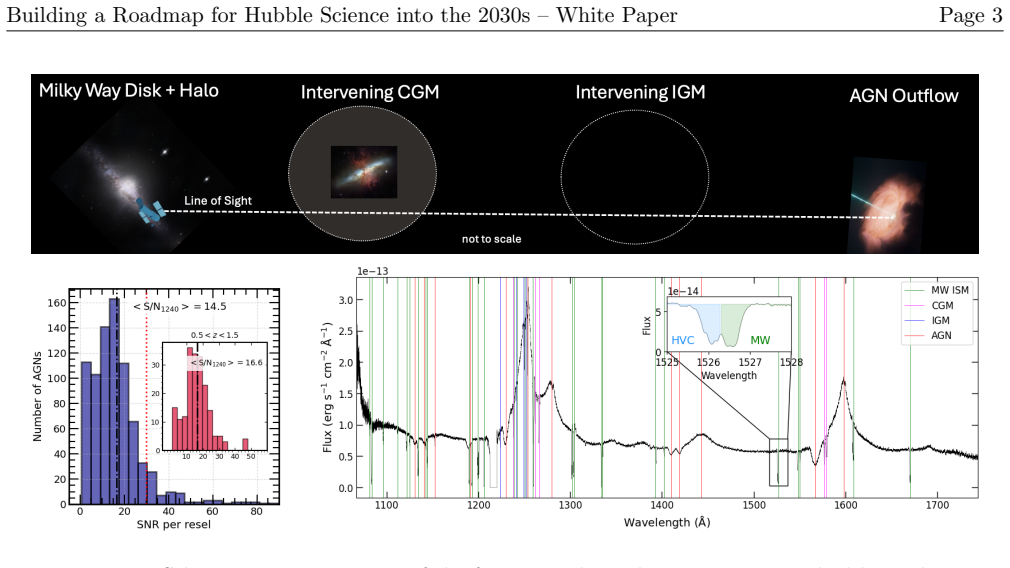
Hubble is still in prime observing condition for making transformative discoveries in UV astronomy. In this white paper we describe the science case for a deep (S/N>30) UV spectroscopic survey with HST/COS targeting approximately 20 QSOs at 0.5<z<1.5 at good resolution (20 km/s). This survey would capitalize on our current UV capability, produce a legacy dataset enabling community science in many areas of galactic and extragalactic research, and pioneer a path for future UV science with the Habitable Worlds Observatory. Such high-S/N spectra are largely missing from the MAST archives, and would be analogous to the deep Hubble imaging fields (HDF, UDF, Frontier Fields) that have been enormously successful and far-reaching in their science impact. This legacy dataset would enable frontier science programs in several areas, including (1) studies of the CGM and IGM at unparalleled sensitivity, covering a wide range of UV metal lines and reaching very low H I column densities of log N=12.6 and low metallicities near [Z/H]=-2, enabling precision studies of the chemical abundances, ionization, temperature, and baryon and metal budgets of the CGM and IGM; (2) diffuse gas in the Milky Way and Local Group, including high-velocity clouds and gas streams from satellite mergers; (3) AGN outflows, which would be probed in the rest-frame extreme ultraviolet (EUV), covering continuum-generation mechanisms and diagnostics of gas in accretion-disk outflows.
Editorial analysis
A structured set of objections, weighed in public.
Referee Report
Summary. The manuscript is a white paper proposing a deep (S/N > 30) UV spectroscopic survey with HST/COS targeting ~20 quasars at 0.5 < z < 1.5 and 20 km/s resolution. The survey is framed as a legacy dataset analogous to the HDF/UDF, enabling precision CGM/IGM studies down to log N(H I) = 12.6 and [Z/H] = -2, plus work on Milky Way high-velocity clouds and AGN outflows in the EUV.
Significance. If executed, the proposed high-S/N spectra would fill a clear gap in the MAST archive and could support community studies of low-column-density absorbers and metal budgets in the CGM/IGM. The paper correctly identifies the scientific value of such data but provides no quantitative simulations, exposure-time calculations, or error budgets to demonstrate that the stated sensitivity is achievable with the proposed sample and instrument settings.
major comments (1)
- [Abstract] Abstract: the central sensitivity claim (reaching log N(H I) = 12.6 and [Z/H] = -2) is asserted without any supporting calculation, simulation, or exposure-time estimate. This quantitative justification is load-bearing for the science case and is absent from the text.
Simulated Author's Rebuttal
We thank the referee for their constructive review of our white paper on a proposed high-S/N HST/COS quasar survey. We address the major comment below and will incorporate revisions to strengthen the quantitative basis of the science case.
read point-by-point responses
-
Referee: [Abstract] Abstract: the central sensitivity claim (reaching log N(H I) = 12.6 and [Z/H] = -2) is asserted without any supporting calculation, simulation, or exposure-time estimate. This quantitative justification is load-bearing for the science case and is absent from the text.
Authors: We agree that the sensitivity claims require explicit quantitative support to be fully convincing. The current manuscript presents these limits as the expected outcome of S/N > 30 spectra at 20 km/s resolution but does not include the supporting exposure-time estimates, COS ETC calculations, or error budgets. In the revised version we will add a dedicated subsection (likely in Section 2 or an appendix) that provides: (1) exposure-time calculations for representative quasars at 0.5 < z < 1.5 using the COS Exposure Time Calculator for the G130M and G160M gratings; (2) an error budget showing how S/N > 30 per resolution element is achieved for the proposed sample of ~20 targets; and (3) simple simulations or scaling arguments demonstrating that these data reach log N(H I) = 12.6 and [Z/H] = -2 for typical CGM/IGM absorbers. This addition will directly address the load-bearing nature of the claim. revision: yes
Circularity Check
No significant circularity; proposal document with no derivations
full rationale
This is a forward-looking white paper proposing an HST/COS survey. It contains no equations, fitted parameters, predictions, or derivation chains that could reduce to inputs by construction. Claims about sensitivity (log N=12.6) are stated as prospective outcomes conditional on execution, not derived results. No self-citations, uniqueness theorems, or ansatzes appear as load-bearing steps. The document is self-contained as a science case without internal circularity.
Axiom & Free-Parameter Ledger
Reference graph
Works this paper leans on
-
[1]
Arav, N., Xu, X., Miller, T., Kriss, G. A., & Plesha, R. 2020, ApJS, 247, 37, doi:10.3847/1538-4365/ab66af
-
[2]
Bordoloi, R., Tumlinson, J., Werk, J. K., & et al. 2014, ApJ, 796, 136, doi:10.1088/0004-637X/796/2/136
-
[3]
2015, ApJ, 813, 46, doi:10.1088/0004-637X/813/1/46
Borthakur, S., Heckman, T., Tumlinson, J., & et al. 2015, ApJ, 813, 46, doi:10.1088/0004-637X/813/1/46
-
[4]
Burchett, J. N., Tripp, T. M., Prochaska, J. X., & et al. 2019, ApJ, 877, L20, doi:10.3847/2041-8213/ab1f7f
-
[5]
Chen, H.-W., Zahedy, F. S., Boettcher, E., & et al. 2020, MNRAS, 497, 498, doi:10.1093/mnras/staa1773
-
[6]
Danforth, C. W., Keeney, B. A., Tilton, E. M., & et al. 2016, ApJ, 817, 111, doi:10.3847/0004-637X/817/2/111
-
[7]
Fox, A. J., Cashman, F. H., Kriss, G. A., & et al. 2023, ApJ, 946, L48, doi:10.3847/2041-8213/acc640
-
[8]
Kara, E., Mehdipour, M., Kriss, G. A., & et al. 2021, ApJ, 922, 151, doi:10.3847/1538-4357/ac2159
-
[9]
2018, MNRAS, 480, 1247, doi:10.1093/mnras/sty1890
Kubota, A., & Done, C. 2018, MNRAS, 480, 1247, doi:10.1093/mnras/sty1890
-
[10]
Monroe, T. R., Prochaska, J. X., Tejos, N., & et al. 2016, AJ, 152, 25, doi:10.3847/0004-6256/152/1/25
-
[11]
Richter, P., Savage, B. D., Sembach, K. R., & Tripp, T. M. 2006, A&A, 445, 827, doi:10.1051/0004-6361:20053636
-
[12]
Rosenwasser, B. E., Wakker, B. P., & Savage, B. D. 2025, ApJ, 985, 31, doi:10.3847/1538-4357/adc4ea
-
[13]
M., Danforth, C
Shull, J. M., Danforth, C. W., Tilton, E. M., Moloney, J., & Stevans, M. L. 2017, ApJ, 849, 106, doi:10.3847/ 1538-4357/aa9229
2017
-
[14]
M., Stevans, M., & Danforth, C
Shull, J. M., Stevans, M., & Danforth, C. W. 2012, ApJ, 752, 162, doi:10.1088/0004-637X/752/2/162
-
[15]
Stevans, M. L., Shull, J. M., Danforth, C. W., & Tilton, E. M. 2014, ApJ, 794, 75, doi:10.1088/0004-637X/794/ 1/75
-
[16]
Telfer, R. C., Zheng, W., Kriss, G. A., & Davidsen, A. F. 2002, ApJ, 565, 773, doi:10.1086/324689
-
[17]
Tumlinson, J., Thom, C., Werk, J. K., & et al. 2013, ApJ, 777, 59, doi:10.1088/0004-637X/777/1/59
-
[18]
2024, ApJS, 273, 21, doi:10.3847/1538-4365/ad58df
Werk, J., Tchernyshyov, K., Bish, H., & et al. 2024, ApJS, 273, 21, doi:10.3847/1538-4365/ad58df
-
[19]
Wotta, C. B., Lehner, N., Howk, J. C., et al. 2019, ApJ, 872, 81, doi:10.3847/1538-4357/aafb74
-
[20]
Zahedy, F. S., Chen, H.-W., Cooper, T. M., & et al. 2021, MNRAS, 506, 877, doi:10.1093/mnras/stab1661
-
[21]
Zheng, W., Kriss, G. A., Telfer, R. C., Grimes, J. P., & Davidsen, A. F. 1997, ApJ, 475, 469, doi:10.1086/303560 This preprint was prepared with the AAS L ATEX macros v5.0
discussion (0)
Sign in with ORCID, Apple, or X to comment. Anyone can read and Pith papers without signing in.