Q-ANCHOR: Federated Quantum Learning with ZNE-guided Correction
Pith reviewed 2026-06-29 09:02 UTC · model grok-4.3
The pith
Q-ANCHOR uses zero-noise extrapolation at the server and stateful client corrections to reduce the hardware bias floor in quantum federated learning.
A machine-rendered reading of the paper's core claim, the machinery that carries it, and where it could break.
Core claim
The central claim is that Q-ANCHOR, by applying zero-noise extrapolation to anchor server aggregation and stateful correction on clients, mitigates classical client drift while actively reducing the hardware-bias floor that standard averaging leaves uncorrected, as established by the convergence theory under non-IID data and noisy quantum gradients.
What carries the argument
Q-ANCHOR architecture that anchors server updates with zero-noise extrapolation while applying stateful client correction to suppress both client drift and hardware-induced bias.
If this is right
- The global model converges without a persistent hardware error floor under non-IID conditions.
- Training stability improves over standard FedAvg in the presence of quantum gradient noise.
- Both classical drift and hardware bias are addressed simultaneously by the same aggregation rule.
- The architecture remains compatible with low-communication federated protocols.
Where Pith is reading between the lines
- The same anchoring idea could be tested in classical federated learning with simulated gradient noise to isolate the extrapolation benefit.
- Real-device validation would require measuring bias reduction separately from statistical variance across multiple hardware runs.
- If ZNE overhead scales with circuit depth, the method may favor shallower quantum models over deeper ones.
Load-bearing premise
Zero-noise extrapolation applied at the server can measurably reduce hardware bias even when client data distributions are non-identical.
What would settle it
A run of Q-ANCHOR on real quantum hardware with non-IID client data that leaves the hardware-bias floor unchanged or higher than baseline FedAvg would falsify the central claim.
Figures

read the original abstract
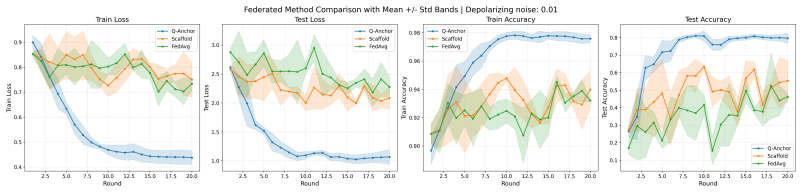
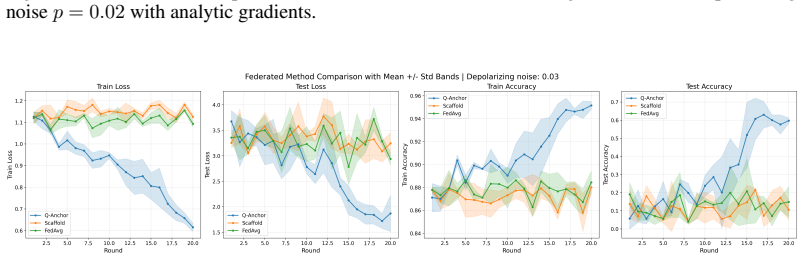
Quantum Federated Learning (QFL) offers a promising framework to train quantum models across distributed clients while keeping data strictly local. Due to its simplicity and low communication overhead, Federated Averaging (FedAvg) is the standard aggregation choice in QFL literature. However, deploying QFL on practical hardware exposes a severe double-drift phenomenon: the global model is simultaneously derailed by client drift from non-IID data and hardware bias from noisy quantum gradient estimates. In this work, we first analyze the convergence of FedAvg under these realistic conditions, mathematically demonstrating that quantum hardware bias creates a persistent error floor that standard averaging cannot correct. To overcome this limitation, we propose Q-ANCHOR, a quantum-aware federated aggregation architecture that anchors server updates with zero-noise extrapolation while applying stateful client correction to suppress both client drift and hardware-induced bias. Our convergence theory proves that Q-ANCHOR successfully mitigates classical client drift while actively reducing the hardware-bias floor. Experimental results demonstrate that Q-ANCHOR achieves significantly more stable training than conventional FL baselines.
Editorial analysis
A structured set of objections, weighed in public.
Referee Report
Summary. The paper claims that FedAvg in quantum federated learning exhibits a persistent error floor under combined non-IID client drift and hardware bias from noisy quantum gradient estimates. It proposes the Q-ANCHOR architecture, which applies zero-noise extrapolation (ZNE) to anchor server-side updates together with stateful client correction, and asserts a convergence theory proving that this mitigates client drift while actively reducing the hardware-bias floor. Experiments are stated to show more stable training than standard FL baselines.
Significance. If the convergence analysis is rigorous and the ZNE mechanism is shown to be implementable without additional unstated assumptions, the work would address a practically relevant barrier to deploying QFL on NISQ hardware. The explicit mathematical demonstration of FedAvg limitations under hardware noise would be a useful contribution if the derivation is independent and non-circular.
major comments (2)
- [Abstract] Abstract: the claim that 'our convergence theory proves that Q-ANCHOR successfully mitigates classical client drift while actively reducing the hardware-bias floor' supplies no equations, proof steps, or listed assumptions, preventing assessment of whether the bound on the bias-floor term is derived independently of the ZNE effectiveness or reduces to an oracle assumption on extrapolated updates.
- [Q-ANCHOR architecture description] Q-ANCHOR architecture description: server-side ZNE is presented as the mechanism that anchors updates and reduces hardware bias, yet ZNE requires multiple noise-scaled evaluations of the same observable (via gate folding or pulse stretching); the server receives only classical aggregates and the manuscript does not specify whether clients submit multi-noise runs per round or how a purely classical extrapolation rule is defined on averaged values, which is load-bearing for the claimed bias-floor reduction.
minor comments (1)
- [Abstract] The abstract references 'experimental results' demonstrating stability but provides no information on the quantum circuit model, noise model, number of clients, data partitioning, or quantitative metrics (e.g., test accuracy curves or bias-floor measurements).
Simulated Author's Rebuttal
We thank the referee for their constructive comments. We address each major point below with clarifications drawn from the manuscript and indicate where revisions will strengthen the presentation.
read point-by-point responses
-
Referee: [Abstract] Abstract: the claim that 'our convergence theory proves that Q-ANCHOR successfully mitigates classical client drift while actively reducing the hardware-bias floor' supplies no equations, proof steps, or listed assumptions, preventing assessment of whether the bound on the bias-floor term is derived independently of the ZNE effectiveness or reduces to an oracle assumption on extrapolated updates.
Authors: The abstract is a concise summary; the full convergence analysis appears in Section 4. We model hardware bias as an additive, noise-dependent term in the quantum gradient estimates and derive an explicit bound showing that the bias-floor term contracts with the ZNE extrapolation order while the client-drift term is controlled separately by the stateful correction. The derivation is independent of any oracle assumption on the extrapolated values. We will revise the abstract to reference the key assumptions and point to Section 4. revision: yes
-
Referee: [Q-ANCHOR architecture description] Q-ANCHOR architecture description: server-side ZNE is presented as the mechanism that anchors updates and reduces hardware bias, yet ZNE requires multiple noise-scaled evaluations of the same observable (via gate folding or pulse stretching); the server receives only classical aggregates and the manuscript does not specify whether clients submit multi-noise runs per round or how a purely classical extrapolation rule is defined on averaged values, which is load-bearing for the claimed bias-floor reduction.
Authors: Section 3.1 states that clients execute multiple noise-scaled circuit evaluations (via gate folding) for each local gradient and transmit the resulting classical estimates; the server then applies a standard polynomial extrapolation to the received aggregates. This is a purely classical post-processing step. We will insert an explicit protocol description in Section 3 to remove any ambiguity. revision: yes
Circularity Check
No significant circularity detected
full rationale
The provided abstract states that a convergence theory proves Q-ANCHOR mitigates client drift and reduces the hardware-bias floor via ZNE-guided anchoring, but contains no equations, derivations, or proof details that can be inspected for self-definitional reductions, fitted inputs renamed as predictions, or load-bearing self-citations. No specific step is shown to be equivalent to its inputs by construction. The architecture description and claims remain independent of any visible circular mechanism.
Axiom & Free-Parameter Ledger
axioms (1)
- domain assumption Quantum hardware bias creates a persistent error floor that standard averaging cannot correct.
invented entities (1)
-
Q-ANCHOR architecture
no independent evidence
Reference graph
Works this paper leans on
-
[1]
Córcoles, Kristan Temme, Aram W
V ojtˇech Havlíˇcek, Antonio D. Córcoles, Kristan Temme, Aram W. Harrow, Abhinav Kandala, Jerry M. Chow, and Jay M. Gambetta. Supervised learning with quantum-enhanced feature spaces.Nature, 567(7747):209–212, Mar 2019
2019
-
[2]
Communication-Efficient Learning of Deep Networks from Decentralized Data
Brendan McMahan, Eider Moore, Daniel Ramage, Seth Hampson, and Blaise Aguera y Arcas. Communication-Efficient Learning of Deep Networks from Decentralized Data. In Aarti Singh and Jerry Zhu, editors,Proceedings of the 20th International Conference on Artificial Intelligence and Statistics, volume 54 ofProceedings of Machine Learning Research, pages 1273–1...
2017
-
[3]
Federated quantum machine learning.Entropy, 23(4), 2021
Samuel Yen-Chi Chen and Shinjae Yoo. Federated quantum machine learning.Entropy, 23(4), 2021
2021
-
[4]
Quantumfed: A federated learning framework for collaborative quantum training
Qi Xia and Qun Li. Quantumfed: A federated learning framework for collaborative quantum training. In2021 IEEE Global Communications Conference (GLOBECOM), pages 1–6, 2021
2021
-
[5]
Quantum federated learning with quantum data
Mahdi Chehimi and Walid Saad. Quantum federated learning with quantum data. InICASSP 2022 - 2022 IEEE International Conference on Acoustics, Speech and Signal Processing (ICASSP), pages 8617–8621, 2022
2022
-
[6]
Chapter eight - federated quantum machine learning for drug discovery and healthcare
Mandeep Kaur Saggi, Amandeep Singh Bhatia, and Sabre Kais. Chapter eight - federated quantum machine learning for drug discovery and healthcare. volume 20 ofAnnual Reports in Computational Chemistry, pages 269–322. Elsevier, 2024
2024
-
[7]
Kastis, Nikolaos Doulamis, and Nicholas E
Sotirios Messinis, Ioannis Rallis, Nikolaos Temenos, Dimitrios Kalogeras, George A. Kastis, Nikolaos Doulamis, and Nicholas E. Protonotarios. Quantum neural networks meet federated learning for dna mutation prediction.Computational and Structural Biotechnology Journal, 30:122–133, 2025
2025
-
[8]
Hybrid quantum image classification and federated learning for hepatic steatosis diagnosis.Diagnostics, 14(5), 2024
Luca Lusnig, Asel Sagingalieva, Mikhail Surmach, Tatjana Protasevich, Ovidiu Michiu, Joseph McLoughlin, Christopher Mansell, Graziano de’ Petris, Deborah Bonazza, Fabrizio Zanconati, Alexey Melnikov, and Fabio Cavalli. Hybrid quantum image classification and federated learning for hepatic steatosis diagnosis.Diagnostics, 14(5), 2024
2024
-
[9]
Qfdsa: A quantum-secured federated learning system for smart grid dynamic security assessment.IEEE Internet of Things Journal, 11(5):8414–8426, 2024
Chao Ren, Rudai Yan, Minrui Xu, Han Yu, Yan Xu, Dusit Niyato, and Zhao Yang Dong. Qfdsa: A quantum-secured federated learning system for smart grid dynamic security assessment.IEEE Internet of Things Journal, 11(5):8414–8426, 2024
2024
-
[10]
Optimizing quantum federated learning based on federated quantum natural gradient descent
Jun Qi, Xiao-Lei Zhang, and Javier Tejedor. Optimizing quantum federated learning based on federated quantum natural gradient descent. InICASSP 2023 - 2023 IEEE International Conference on Acoustics, Speech and Signal Processing (ICASSP), pages 1–5, 2023. 10
2023
-
[11]
Non-iid quantum federated learning with one-shot communication complexity
Haimeng Zhao. Non-iid quantum federated learning with one-shot communication complexity. Quantum Machine Intelligence, 5(1):3, Jan 2023
2023
-
[12]
DiBrita, Daniel Leeds, Jianqiang Li, Jason Ludmir, and Tirthak Patel
Jason Han, Nicholas S. DiBrita, Daniel Leeds, Jianqiang Li, Jason Ludmir, and Tirthak Patel. Layerwise federated learning for heterogeneous quantum clients using quorus. InThe Fourteenth International Conference on Learning Representations, 2026
2026
-
[14]
Mitarai, M
K. Mitarai, M. Negoro, M. Kitagawa, and K. Fujii. Quantum circuit learning.Phys. Rev. A, 98:032309, Sep 2018
2018
-
[15]
General parameter-shift rules for quantum gradients.Quantum, 6:677, March 2022
David Wierichs, Josh Izaac, Cody Wang, and Cedric Yen-Yu Lin. General parameter-shift rules for quantum gradients.Quantum, 6:677, March 2022
2022
-
[16]
Quantum Computing in the NISQ era and beyond.Quantum, 2:79, August 2018
John Preskill. Quantum Computing in the NISQ era and beyond.Quantum, 2:79, August 2018
2018
-
[17]
Gambetta
Kristan Temme, Sergey Bravyi, and Jay M. Gambetta. Error mitigation for short-depth quantum circuits.Phys. Rev. Lett., 119:180509, Nov 2017
2017
-
[18]
Benjamin
Ying Li and Simon C. Benjamin. Efficient variational quantum simulator incorporating active error minimization.Phys. Rev. X, 7:021050, Jun 2017
2017
-
[19]
Fundamental limits of quantum error mitigation.npj Quantum Information, 8(1):114, 2022
Ryuji Takagi, Suguru Endo, Shintaro Minami, and Mile Gu. Fundamental limits of quantum error mitigation.npj Quantum Information, 8(1):114, 2022
2022
-
[20]
Federated learning with non-iid data
Yue Zhao, Meng Li, Liangzhen Lai, Naveen Suda, Damon Civin, and Vikas Chandra. Federated learning with non-iid data. 2018
2018
-
[21]
Federated optimization in heterogeneous networks
Tian Li, Anit Kumar Sahu, Manzil Zaheer, Maziar Sanjabi, Ameet Talwalkar, and Virginia Smith. Federated optimization in heterogeneous networks. In I. Dhillon, D. Papailiopoulos, and V . Sze, editors,Proceedings of Machine Learning and Systems, volume 2, pages 429–450, 2020
2020
-
[22]
SCAFFOLD: Stochastic controlled averaging for federated learning
Sai Praneeth Karimireddy, Satyen Kale, Mehryar Mohri, Sashank Reddi, Sebastian Stich, and Ananda Theertha Suresh. SCAFFOLD: Stochastic controlled averaging for federated learning. In Hal Daumé III and Aarti Singh, editors,Proceedings of the 37th International Conference on Machine Learning, volume 119 ofProceedings of Machine Learning Research, pages 5132...
2020
-
[23]
Measuring the effects of non-identical data distribution for federated visual classification, 2019
Tzu-Ming Harry Hsu, Hang Qi, and Matthew Brown. Measuring the effects of non-identical data distribution for federated visual classification, 2019
2019
-
[24]
Reddi, Zachary Charles, Manzil Zaheer, Zachary Garrett, Keith Rush, Jakub Koneˇcný, Sanjiv Kumar, and Hugh Brendan McMahan
Sashank J. Reddi, Zachary Charles, Manzil Zaheer, Zachary Garrett, Keith Rush, Jakub Koneˇcný, Sanjiv Kumar, and Hugh Brendan McMahan. Adaptive federated optimization. InInternational Conference on Learning Representations, 2021
2021
-
[25]
Waleed Yamany, Nour Moustafa, and Benjamin Turnbull. Oqfl: An optimized quantum- based federated learning framework for defending against adversarial attacks in intelligent transportation systems.IEEE Transactions on Intelligent Transportation Systems, 24(1):893– 903, 2023
2023
-
[26]
Qfnn-ffd: Quantum federated neural network for financial fraud detection
Nouhaila Innan, Alberto Marchisio, Mohamed Bennai, and Muhammad Shafique. Qfnn-ffd: Quantum federated neural network for financial fraud detection. In2025 IEEE International Conference on Quantum Software (QSW), pages 41–47, 2025
2025
-
[27]
Faehrmann, Barthélémy Meynard-Piganeau, and Jens Eisert
Ryan Sweke, Frederik Wilde, Johannes Meyer, Maria Schuld, Paul K. Faehrmann, Barthélémy Meynard-Piganeau, and Jens Eisert. Stochastic gradient descent for hybrid quantum-classical optimization.Quantum, 4:314, August 2020
2020
-
[28]
Bromley, and Nathan Killoran
Andrea Mari, Thomas R. Bromley, and Nathan Killoran. Estimating the gradient and higher- order derivatives on quantum hardware.Phys. Rev. A, 103:012405, Jan 2021
2021
-
[29]
Cerezo, Kunal Sharma, Akira Sone, Lukasz Cincio, and Patrick J
Samson Wang, Enrico Fontana, M. Cerezo, Kunal Sharma, Akira Sone, Lukasz Cincio, and Patrick J. Coles. Noise-induced barren plateaus in variational quantum algorithms.Nature Communications, 12(1):6961, Nov 2021. 11
2021
-
[30]
Limitations of optimization algorithms on noisy quantum devices.Nature Physics, 17(11):1221–1227, Nov 2021
Daniel Stilck França and Raul García-Patrón. Limitations of optimization algorithms on noisy quantum devices.Nature Physics, 17(11):1221–1227, Nov 2021
2021
-
[31]
Effect of data encoding on the expressive power of variational quantum-machine-learning models.Phys
Maria Schuld, Ryan Sweke, and Johannes Jakob Meyer. Effect of data encoding on the expressive power of variational quantum-machine-learning models.Phys. Rev. A, 103:032430, Mar 2021
2021
-
[32]
Binary blobs
Joseph Bowles and Shahnawaz Ahmed. Binary blobs. https://pennylane.ai/datasets/ other/binary-blobs, 2025
2025
-
[33]
Joseph Bowles, Shahnawaz Ahmed, and Maria Schuld. Better than classical? the subtle art of benchmarking quantum machine learning models.arXiv preprint arXiv:2403.07059, 2024
-
[34]
Ngo, Nhat Hoang-Xuan, Quan Minh Nguyen, Nguyen Hoang Khoi Do, Incheol Shin, and My T
Hoang M. Ngo, Nhat Hoang-Xuan, Quan Minh Nguyen, Nguyen Hoang Khoi Do, Incheol Shin, and My T. Thai. Q-shiftDP: A differentially private parameter-shift rule for quantum machine learning. InThe 29th International Conference on Artificial Intelligence and Statistics, 2026
2026
-
[35]
Train on classical, deploy on quantum: scaling generative quantum machine learning to a thousand qubits, 2026
Erik Recio-Armengol, Shahnawaz Ahmed, and Joseph Bowles. Train on classical, deploy on quantum: scaling generative quantum machine learning to a thousand qubits, 2026
2026
-
[36]
Quantum noise protects quantum classifiers against adversaries.Physical Review Research, 3(2):023153, 2021
Yuxuan Du, Min-Hsiu Hsieh, Tongliang Liu, Dacheng Tao, and Nana Liu. Quantum noise protects quantum classifiers against adversaries.Physical Review Research, 3(2):023153, 2021
2021
-
[37]
Quantum machine learning with differential privacy.Scientific Reports, 13(1):2453, 2023
William M Watkins, Samuel Yen-Chi Chen, and Shinjae Yoo. Quantum machine learning with differential privacy.Scientific Reports, 13(1):2453, 2023
2023
-
[38]
Hybrid quantum-classical-quantum convolutional neural networks.Scientific Reports, 15(1):31780, 2025
Changzhou Long, Meng Huang, Xiucai Ye, Yasunori Futamura, and Tetsuya Sakurai. Hybrid quantum-classical-quantum convolutional neural networks.Scientific Reports, 15(1):31780, 2025
2025
-
[39]
Evaluating analytic gradients on quantum hardware.Phys
Maria Schuld, Ville Bergholm, Christian Gogolin, Josh Izaac, and Nathan Killoran. Evaluating analytic gradients on quantum hardware.Phys. Rev. A, 99:032331, Mar 2019
2019
-
[40]
Nielsen and Isaac L
Michael A. Nielsen and Isaac L. Chuang.Quantum Computation and Quantum Information. Cambridge University Press, Cambridge, 10th anniversary edition edition, 2010
2010
-
[41]
Error mitigation extends the computational reach of a noisy quantum processor.Nature, 567(7749):491–495, 2019
Abhinav Kandala, Kristan Temme, Antonio D Corcoles, Antonio Mezzacapo, Jerry M Chow, and Jay M Gambetta. Error mitigation extends the computational reach of a noisy quantum processor.Nature, 567(7749):491–495, 2019
2019
-
[42]
Digital zero noise extrapolation for quantum error mitigation.2020 IEEE International Conference on Quantum Computing and Engineering (QCE), pages 306–316, 2020
Tudor Giurgica-Tiron, Yousef Hindy, Ryan LaRose, Andrea Mari, and William J Zeng. Digital zero noise extrapolation for quantum error mitigation.2020 IEEE International Conference on Quantum Computing and Engineering (QCE), pages 306–316, 2020
2020
-
[43]
PennyLane: Automatic differentiation of hybrid quantum-classical computations
Ville Bergholm, Josh Izaac, Maria Schuld, Christian Gogolin, Shahnawaz Ahmed, Vishnu Ajith, M Sohaib Alam, Guillermo Alonso-Linaje, Bharath AkashNarayanan, Ali Asadi, et al. Pennylane: Automatic differentiation of hybrid quantum-classical computations.arXiv preprint arXiv:1811.04968, 2018. 12 Appendix A Extended Preliminaries This section establishes the ...
work page internal anchor Pith review Pith/arXiv arXiv 2018
-
[44]
By choosing the absolute constant c0 sufficiently small, this factor is restricted to O(1). Applying a standard discrete Grönwall argument resolves the recursion uniformly for allk≤K: Dr i,k ≤Cη 2 ℓ K2 ∥∇fi(xr−1)∥2 +U 2 q +σ 2 +σ 2 q .(47) To compute the population drift energy Er, we average Dr i,k over all clients i∈ {1, . . . , N} and steps k. Applying...
1900
discussion (0)
Sign in with ORCID, Apple, or X to comment. Anyone can read and Pith papers without signing in.