bpK#: Delegatable Pseudonyms And Their Applications to National eID Systems
Pith reviewed 2026-06-29 06:40 UTC · model grok-4.3
The pith
Delegatable pseudonyms enable users and service providers to compute their own identifiers in national eID systems while preserving security guarantees.
A machine-rendered reading of the paper's core claim, the machinery that carries it, and where it could break.
Core claim
The paper establishes the first formal framework for delegatable pseudonym systems and gives a generic construction, accompanied by formal security proofs, that lets users compute their own pseudonyms and lets service-provider subsets compute pseudonyms only inside their own domain, thereby meeting all functional requirements of the centralized bPk system while reducing reliance on the central authority.
What carries the argument
Delegatable pseudonym systems, realized by a generic construction that securely transfers pseudonym-computation rights to users and authorized provider subsets.
Load-bearing premise
Delegation of pseudonym computation rights to users and service-provider subsets can be realized securely while still satisfying all functional requirements and authenticity guarantees of the existing centralized bPk system.
What would settle it
An attack that forges a valid pseudonym outside the intended delegation scope or links pseudonyms across domains in a way forbidden by the security model would disprove the claims.
Figures





read the original abstract
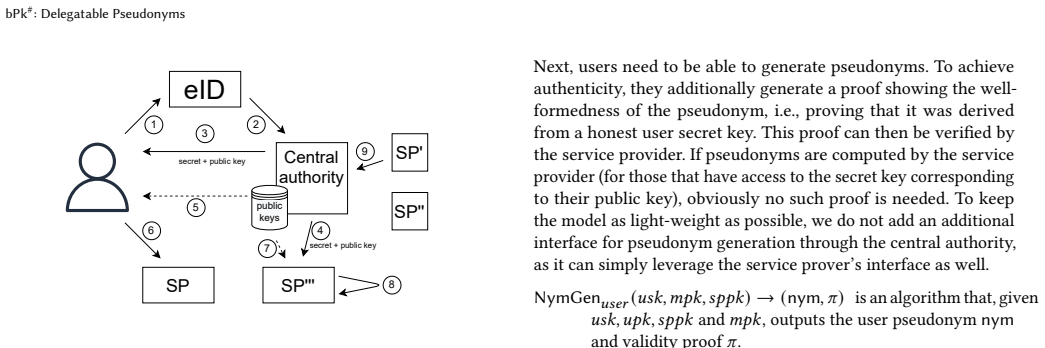
Electronic identities (eIDs) are crucial in an increasingly digitalized environment. Pseudonyms, as offered by Austria's governmental sector-specific personal identifiers (bPks), can significantly improve privacy by ensuring that personal data is not universally traceable across public services and private companies. However, the current architecture comes with several challenges regarding availability, privacy, and authenticity, due to a fully centralized design. This paper proposes bPk#, a distributed architecture to address these issues, reducing reliance on the central authority, while still providing all functional requirements to the existing bPk system. In particular, users are delegated the rights to compute their own pseudonyms, thereby minimizing metadata revealed to the central authority, while (subsets of) service providers may receive the right to compute pseudonyms only within their own domain, thereby reducing the availability needs of the central authority. To the best of our knowledge, we provide the first formal framework for such delegatable pseudonym systems, together with a generic construction for which we provide formal security proofs. Furthermore, we propose a concrete instantiation of our construction, together with a reference implementation demonstrating the practical efficiency.
Editorial analysis
A structured set of objections, weighed in public.
Referee Report
Summary. The paper proposes bPk#, a distributed architecture extending Austria's centralized bPk pseudonym system for eIDs. Users are delegated rights to compute their own pseudonyms (reducing metadata to the central authority), and subsets of service providers may compute pseudonyms only within their domains (reducing central availability needs). The central claims are that this is the first formal framework for delegatable pseudonym systems, accompanied by a generic construction with formal security proofs, a concrete instantiation, and a reference implementation demonstrating practical efficiency, all while preserving the functional and authenticity requirements of the original bPk system.
Significance. If the security proofs and delegation mechanics hold, the work could meaningfully advance privacy and availability in governmental eID infrastructures by enabling controlled decentralization without new authenticity gaps. The explicit provision of a formal framework, machine-checkable-style proofs (if present), and a working reference implementation would be notable strengths for a CR paper targeting real-world national systems.
major comments (2)
- [Abstract / Security Model section] The abstract states that the generic construction receives formal security proofs and that delegation satisfies all functional/authenticity requirements of the original bPk system, yet the provided text gives no indication of the security model definition, the precise delegation syntax, or the reduction steps. Without these, it is impossible to confirm that the delegation does not introduce new traceability or forgery vectors.
- [Construction / Security Definitions] The claim that subsets of service providers receive domain-restricted computation rights must be shown to preserve the cross-domain unlinkability property of bPks; the manuscript needs to state explicitly (with a theorem) whether the restriction is enforced cryptographically or only by policy, as the latter would not meet the stated authenticity guarantees.
minor comments (2)
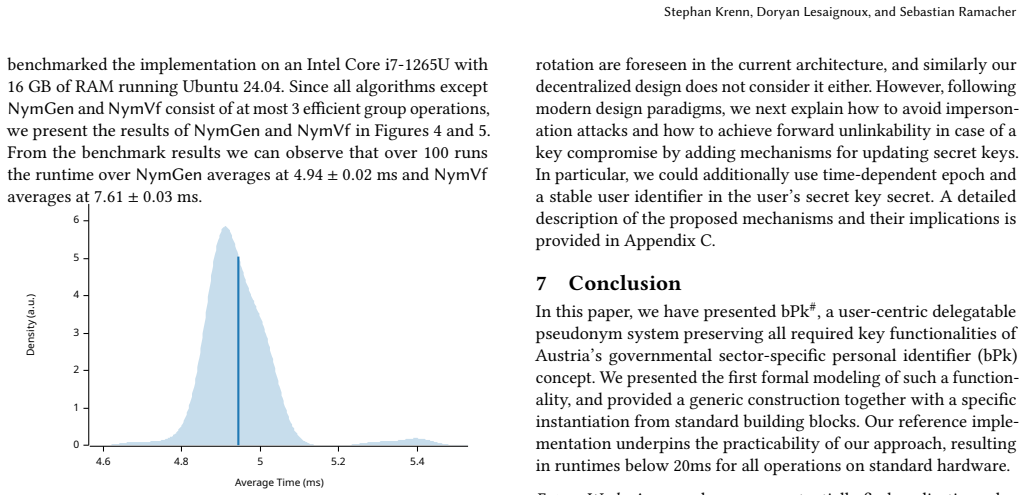
- [Implementation / Evaluation] The reference implementation is cited as demonstrating practical efficiency, but no concrete performance numbers, comparison baseline (e.g., original bPk latency), or hardware platform are given in the abstract; these should appear in the evaluation section with tables.
- [Preliminaries] Notation for the delegatable pseudonym computation (e.g., how a user or SP subset receives and uses the delegation token) should be introduced early and used consistently to aid readability.
Simulated Author's Rebuttal
We thank the referee for their careful review and constructive feedback. Below we respond point-by-point to the major comments, directing attention to the relevant sections of the full manuscript where the security model, delegation syntax, and proofs are defined, while agreeing to improve clarity and explicitness where needed.
read point-by-point responses
-
Referee: [Abstract / Security Model section] The abstract states that the generic construction receives formal security proofs and that delegation satisfies all functional/authenticity requirements of the original bPk system, yet the provided text gives no indication of the security model definition, the precise delegation syntax, or the reduction steps. Without these, it is impossible to confirm that the delegation does not introduce new traceability or forgery vectors.
Authors: The full manuscript defines the security model (including delegation syntax and security properties such as unlinkability and authenticity) in Section 3. The generic construction appears in Section 4, and the formal security proofs with reduction steps are given in Section 5 (Theorems 5.1–5.4). These sections establish that delegation introduces no new traceability or forgery vectors. We will revise the abstract and introduction to include explicit forward references to Sections 3–5. revision: yes
-
Referee: [Construction / Security Definitions] The claim that subsets of service providers receive domain-restricted computation rights must be shown to preserve the cross-domain unlinkability property of bPks; the manuscript needs to state explicitly (with a theorem) whether the restriction is enforced cryptographically or only by policy, as the latter would not meet the stated authenticity guarantees.
Authors: Domain restriction is enforced cryptographically via domain-specific delegation keys (see Construction 4.2). Theorem 5.3 proves that this preserves cross-domain unlinkability; the enforcement is not policy-based. We will revise the construction section to state this explicitly and highlight the theorem statement. revision: yes
Circularity Check
No significant circularity detected
full rationale
The paper introduces a new formal framework for delegatable pseudonym systems along with a generic construction, security proofs, concrete instantiation, and reference implementation. No load-bearing steps reduce by construction to fitted parameters, self-definitions, or self-citation chains; the derivation chain consists of independent cryptographic definitions and proofs that do not equate outputs to inputs via renaming or ansatz smuggling. The architecture description and claims remain self-contained against external benchmarks without internal reduction.
Axiom & Free-Parameter Ledger
axioms (1)
- domain assumption Standard cryptographic hardness assumptions underlying the security proofs of the generic construction
invented entities (1)
-
bPk# delegatable pseudonym architecture
no independent evidence
Reference graph
Works this paper leans on
-
[1]
A-SIT Plus GmbH. 2021. ID Austria: Technisches Whitepaper - Hintergrund- informationen. https://eid.egiz.gv.at/wp-content/uploads/2021/12/ID-Austria- Technische-Hintergrundinformationen-v1.4-1.pdf
2021
-
[2]
Andreas Abraham, Karl Koch, Stefan More, Sebastian Ramacher, and Miha Stopar
-
[3]
In TrustCom
Privacy-Preserving eID Derivation to Self-Sovereign Identity Systems with Offline Revocation. In TrustCom. IEEE, 506–513
-
[4]
Albrecht, Valerio Cini, Russell W
Martin R. Albrecht, Valerio Cini, Russell W. F. Lai, Giulio Malavolta, and Sri Aravinda Krishnan Thyagarajan. 2022. Lattice-Based SNARKs: Publicly Ver- ifiable, Preprocessing, and Recursively Composable - (Extended Abstract). In CRYPTO 2022, Part II (LNCS, Vol. 13508) , Yevgeniy Dodis and Thomas Shrimpton (Eds.). Springer, Cham, 102–132. doi:10.1007/978-3...
-
[5]
Foteini Baldimtsi, Jan Camenisch, Maria Dubovitskaya, Anna Lysyanskaya, Leonid Reyzin, Kai Samelin, and Sophia Yakoubov. 2017. Accumulators with bPk#: Delegatable Pseudonyms Applications to Anonymity-Preserving Revocation. In 2017 IEEE European Symposium on Security and Privacy . IEEE Computer Society Press, 301–315. doi:10.1109/EuroSP.2017.13
-
[6]
David Bernhard, Olivier Pereira, and Bogdan Warinschi. 2012. How Not to Prove Yourself: Pitfalls of the Fiat-Shamir Heuristic and Applications to Helios. In ASIACRYPT 2012 (LNCS, Vol. 7658) , Xiaoyun Wang and Kazue Sako (Eds.). Springer, Berlin, Heidelberg, 626–643. doi:10.1007/978-3-642-34961-4_38
-
[7]
Ward Beullens, Vadim Lyubashevsky, Ngoc Khanh Nguyen, and Gregor Seiler
-
[8]
In ACM CCS 2023, Weizhi Meng, Christian Damsgaard Jensen, Cas Cremers, and Engin Kirda (Eds.)
Lattice-Based Blind Signatures: Short, Efficient, and Round-Optimal. In ACM CCS 2023, Weizhi Meng, Christian Damsgaard Jensen, Cas Cremers, and Engin Kirda (Eds.). ACM Press, 16–29. doi:10.1145/3576915.3616613
-
[9]
Jan Bobolz, Fabian Eidens, Stephan Krenn, Sebastian Ramacher, and Kai Samelin
-
[10]
Issuer-Hiding Attribute-Based Credentials. In CANS 21 (LNCS, Vol. 13099) , Mauro Conti, Marc Stevens, and Stephan Krenn (Eds.). Springer, Cham, 158–178. doi:10.1007/978-3-030-92548-2_9
-
[11]
Jonathan Bootle, Andrea Cerulli, Pyrros Chaidos, Essam Ghadafi, and Jens Groth
-
[12]
In ACNS 16International Conference on Applied Cryptography and Network Security (LNCS, Vol
Foundations of Fully Dynamic Group Signatures. In ACNS 16International Conference on Applied Cryptography and Network Security (LNCS, Vol. 9696) , Mark Manulis, Ahmad-Reza Sadeghi, and Steve Schneider (Eds.). Springer, Cham, 117–136. doi:10.1007/978-3-319-39555-5_7
-
[13]
Julien Bringer, Hervé Chabanne, Roch Lescuyer, and Alain Patey. 2014. Efficient and Strongly Secure Dynamic Domain-Specific Pseudonymous Signatures for ID Documents. In Financial Cryptography and Data Security - 18th International Conference, FC 2014, Christ Church, Barbados, March 3-7, 2014, Revised Selected Pa- pers (Lecture Notes in Computer Science, V...
-
[14]
Jan Camenisch, Manu Drijvers, and Maria Dubovitskaya. 2017. Practical UC-Secure Delegatable Credentials with Attributes and Their Application to Blockchain. In ACM CCS 2017 , Bhavani M. Thuraisingham, David Evans, Tal Malkin, and Dongyan Xu (Eds.). ACM Press, 683–699. doi:10.1145/3133956. 3134025
-
[15]
Jan Camenisch, Markulf Kohlweiss, and Claudio Soriente. 2009. An Accumulator Based on Bilinear Maps and Efficient Revocation for Anonymous Credentials. In PKC 2009 (LNCS, Vol. 5443) , Stanislaw Jarecki and Gene Tsudik (Eds.). Springer, Berlin, Heidelberg, 481–500. doi:10.1007/978-3-642-00468-1_27
-
[16]
Jan Camenisch, Stephan Krenn, Anja Lehmann, Gert Læssøe Mikkelsen, Gregory Neven, and Michael Østergaard Pedersen. 2016. Formal Treatment of Privacy- Enhancing Credential Systems. In SAC 2015 (LNCS, Vol. 9566) , Orr Dunkelman and Liam Keliher (Eds.). Springer, Cham, 3–24. doi:10.1007/978-3-319-31301-6_1
-
[17]
Jan Camenisch and Anja Lehmann. 2015. (Un) linkable pseudonyms for gov- ernmental databases. In Proceedings of the 22nd ACM SIGSAC Conference on Computer and Communications Security . 1467–1479
2015
-
[18]
Jan Camenisch and Anja Lehmann. 2017. Privacy-preserving user-auditable pseudonym systems. In 2017 IEEE European Symposium on Security and Privacy (EuroS&P). IEEE, 269–284
2017
-
[19]
Jan Camenisch and Anna Lysyanskaya. 2002. Dynamic Accumulators and Appli- cation to Efficient Revocation of Anonymous Credentials. InCRYPTO 2002 (LNCS, Vol. 2442), Moti Yung (Ed.). Springer, Berlin, Heidelberg, 61–76. doi:10.1007/3- 540-45708-9_5
work page doi:10.1007/3- 2002
-
[20]
Jan Camenisch and Markus Stadler. 1997. Efficient Group Signature Schemes for Large Groups (Extended Abstract). In CRYPTO’97 (LNCS, Vol. 1294), Burton S. Kaliski, Jr. (Ed.). Springer, Berlin, Heidelberg, 410–424. doi:10.1007/BFb0052252
-
[21]
Jan Camenisch and Els Van Herreweghen. 2002. Design and Implementation of The Idemix Anonymous Credential System. In ACM CCS 2002, Vijayalakshmi Atluri (Ed.). ACM Press, 21–30. doi:10.1145/586110.586114
-
[22]
David Cash, Eike Kiltz, and Victor Shoup. 2008. The Twin Diffie-Hellman Problem and Applications. In EUROCRYPT 2008 (LNCS, Vol. 4965) , Nigel P. Smart (Ed.). Springer, Berlin, Heidelberg, 127–145. doi:10.1007/978-3-540-78967-3_8
- [23]
-
[24]
David Chaum and Eugène van Heyst. 1991. Group Signatures. InEUROCRYPT’91 (LNCS, Vol. 547), Donald W. Davies (Ed.). Springer, Berlin, Heidelberg, 257–265. doi:10.1007/3-540-46416-6_22
-
[25]
Özgür Dagdelen. 2013. The cryptographic security of the German electronic identity card. (2013)
2013
-
[26]
David Derler and Daniel Slamanig. 2019. Key-homomorphic signatures: def- initions and applications to multiparty signatures and non-interactive zero- knowledge. DCC 87, 6 (2019), 1373–1413. doi:10.1007/s10623-018-0535-9
-
[27]
Yves Deswarte and Sébastien Gambs. 2010. A Proposal for a Privacy-preserving National Identity Card. Trans. Data Priv. 3, 3 (2010), 253–276
2010
-
[28]
Whitfield Diffie and Martin E. Hellman. 1976. New Directions in Cryptography. IEEE Transactions on Information Theory 22, 6 (1976), 644–654. doi:10.1109/TIT. 1976.1055638
work page doi:10.1109/tit 1976
-
[29]
Taher ElGamal. 1984. A Public Key Cryptosystem and a Signature Scheme Based on Discrete Logarithms. In CRYPTO’84 (LNCS, Vol. 196), G. R. Blakley and David Chaum (Eds.). Springer, Berlin, Heidelberg, 10–18. doi:10.1007/3-540-39568-7_2
-
[30]
Sebastian Faust, Markulf Kohlweiss, Giorgia Azzurra Marson, and Daniele Venturi. 2012. On the Non-malleability of the Fiat-Shamir Transform. In IN- DOCRYPT 2012 (LNCS, Vol. 7668) , Steven D. Galbraith and Mridul Nandi (Eds.). Springer, Berlin, Heidelberg, 60–79. doi:10.1007/978-3-642-34931-7_5
-
[31]
Amos Fiat and Adi Shamir. 1987. How to Prove Yourself: Practical Solutions to Identification and Signature Problems. InCRYPTO’86 (LNCS, Vol. 263), Andrew M. Odlyzko (Ed.). Springer, Berlin, Heidelberg, 186–194. doi:10.1007/3-540-47721- 7_12
-
[32]
Eduarda S. V. Freire, Dennis Hofheinz, Eike Kiltz, and Kenneth G. Paterson
-
[33]
Non-Interactive Key Exchange. In PKC 2013 (LNCS, Vol. 7778) , Kaoru Kurosawa and Goichiro Hanaoka (Eds.). Springer, Berlin, Heidelberg, 254–271. doi:10.1007/978-3-642-36362-7_17
-
[34]
Shafi Goldwasser, Silvio Micali, and Charles Rackoff. 1985. The Knowledge Complexity of Interactive Proof-Systems (Extended Abstract). In 17th ACM STOC. ACM Press, 291–304. doi:10.1145/22145.22178
-
[35]
Jens Groth. 2015. Efficient Fully Structure-Preserving Signatures for Large Messages. In ASIACRYPT 2015, Part I (LNCS, Vol. 9452) , Tetsu Iwata and Jung Hee Cheon (Eds.). Springer, Berlin, Heidelberg, 239–259. doi:10.1007/978-3-662- 48797-6_11
-
[36]
Jens Groth and Amit Sahai. 2008. Efficient Non-interactive Proof Systems for Bilinear Groups. In EUROCRYPT 2008 (LNCS, Vol. 4965) , Nigel P. Smart (Ed.). Springer, Berlin, Heidelberg, 415–432. doi:10.1007/978-3-540-78967-3_24
-
[37]
Lucjan Hanzlik and Daniel Slamanig. 2021. With a Little Help from My Friends: Constructing Practical Anonymous Credentials. In ACM CCS 2021 , Giovanni Vigna and Elaine Shi (Eds.). ACM Press, 2004–2023. doi:10.1145/3460120.3484582
- [38]
-
[39]
Markulf Kohlweiss, Mary Maller, Janno Siim, and Mikhail Volkhov. 2021. Snarky Ceremonies. In ASIACRYPT 2021, Part III (LNCS, Vol. 13092) , Mehdi Tibouchi and Huaxiong Wang (Eds.). Springer, Cham, 98–127. doi:10.1007/978-3-030-92078- 4_4
-
[40]
Stephan Krenn, Kai Samelin, and Christoph Striecks. 2019. Practical Group- Signatures with Privacy-Friendly Openings. In Proceedings of the 14th Interna- tional Conference on A vailability, Reliability and Security, ARES 2019, Canterbury, UK, August 26-29, 2019. ACM, 10:1–10:10. doi:10.1145/3339252.3339256
-
[41]
Benoît Libert, Khoa Nguyen, Alain Passelègue, and Radu Titiu. 2020. Simulation- Sound Arguments for LWE and Applications to KDM-CCA2 Security. In ASI- ACRYPT 2020, Part I (LNCS, Vol. 12491) , Shiho Moriai and Huaxiong Wang (Eds.). Springer, Cham, 128–158. doi:10.1007/978-3-030-64837-4_5
-
[42]
Rivest, Amit Sahai, and Stefan Wolf
Anna Lysyanskaya, Ronald L. Rivest, Amit Sahai, and Stefan Wolf. 1999. Pseudo- nym Systems. In SAC 1999 (LNCS, Vol. 1758) , Howard M. Heys and Carlisle M. Adams (Eds.). Springer, Berlin, Heidelberg, 184–199. doi:10.1007/3-540-46513- 8_14
-
[43]
Vadim Lyubashevsky, Ngoc Khanh Nguyen, and Maxime Plançon. 2022. Lattice- Based Zero-Knowledge Proofs and Applications: Shorter, Simpler, and More General. In CRYPTO 2022, Part II (LNCS, Vol. 13508) , Yevgeniy Dodis and Thomas Shrimpton (Eds.). Springer, Cham, 71–101. doi:10.1007/978-3-031-15979-4_3
-
[44]
Deepak Maram, Harjasleen Malvai, Fan Zhang, Nerla Jean-Louis, Alexander Frolov, Tyler Kell, Tyrone Lobban, Christine Moy, Ari Juels, and Andrew Miller
-
[45]
CanDID: Can-Do Decentralized Identity with Legacy Compatibility, Sybil- Resistance, and Accountability. In 2021 IEEE Symposium on Security and Privacy . IEEE Computer Society Press, 1348–1366. doi:10.1109/SP40001.2021.00038
-
[46]
Toru Nakanishi, Hiroki Fujii, Yuta Hira, and Nobuo Funabiki. 2009. Revocable Group Signature Schemes with Constant Costs for Signing and Verifying. In PKC 2009 (LNCS, Vol. 5443) , Stanislaw Jarecki and Gene Tsudik (Eds.). Springer, Berlin, Heidelberg, 463–480. doi:10.1007/978-3-642-00468-1_26
-
[47]
Christian Paquin and Greg Zaverucha. 2023. U-Prove Cryptographic Specification V1.1 (Revision 5). Technical Report. Microsoft Corporation, Redmond, WA
2023
-
[48]
Karl-Christian Posch, Reinhard Posch, Arne Tauber, Thomas Zefferer, and Bernd Zwattendorfer. 2011. Secure and Privacy-Preserving eGovernment - Best Practice Austria. In Rainbow of Computer Science (LNCS, Vol. 6570) . Springer, 259–269
2011
-
[49]
Thomas Rössler. 2008. Giving an interoperable e-ID solution: Using foreign e-IDs in Austrian e-Government. Comput. Law Secur. Rev. 24, 5 (2008), 447–453
2008
-
[50]
Stammzahlregisterbehörde. 2025. Personal communication
2025
-
[51]
Arne Tauber and Thomas Rössler. 2009. Professional Presentation in Austrian E-Government. In EGOV (LNCS, Vol. 5693) . Springer, 388–398
2009
-
[52]
Kevin Theuermann. 2019. Selected Topics IT-Security 1 (E-Government) – Aus- trian E-Government Infrastructure. https://www.isec.tugraz.at/wp-content/ uploads/2019/09/L08-2019-E-Government-Infrastructure.pdf
2019
-
[53]
Bernd Zwattendorfer and Daniel Slamanig. 2013. On Privacy-Preserving Ways to Porting the Austrian eID System to the Public Cloud. In SEC (IFIP AICT, Vol. 405). Springer, 300–314
2013
-
[54]
Bernd Zwattendorfer and Daniel Slamanig. 2015. Design strategies for a privacy- friendly Austrian eID system in the public cloud. Comput. Secur. 52 (2015), 178–193
2015
-
[55]
bPk-as-a-service
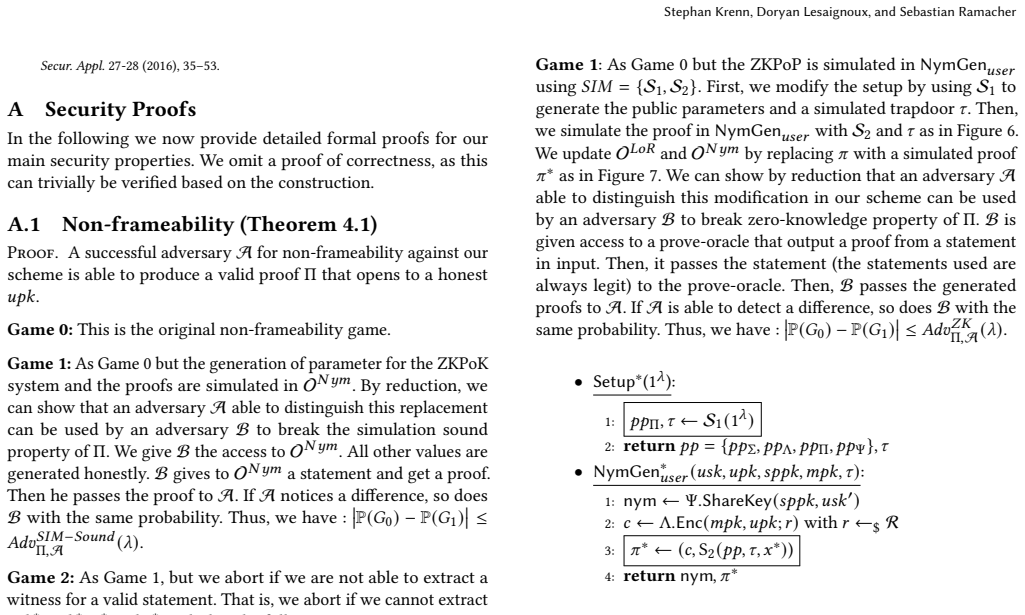
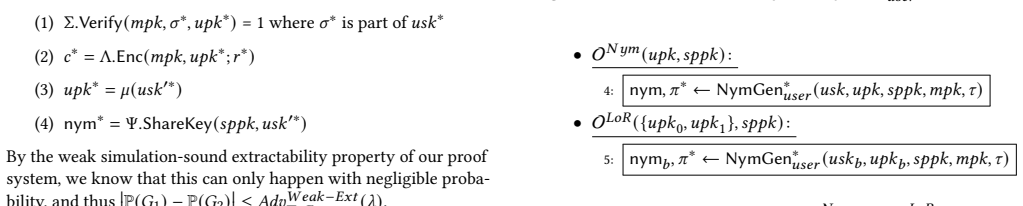
Bernd Zwattendorfer and Daniel Slamanig. 2016. The Austrian eID ecosystem in the public cloud: How to obtain privacy while preserving practicality. J. Inf. Stephan Krenn, Doryan Lesaignoux, and Sebastian Ramacher Secur. Appl. 27-28 (2016), 35–53. A Security Proofs In the following we now provide detailed formal proofs for our main security properties. We ...
2016
discussion (0)
Sign in with ORCID, Apple, or X to comment. Anyone can read and Pith papers without signing in.