Transformer-Based Source Detection and Morphological Classification in LOFAR Deep-Field Continuum Images
Pith reviewed 2026-06-29 00:14 UTC · model grok-4.3
The pith
Transformer-based detector detects and classifies radio sources in LOFAR deep fields at 91 percent F1 while treating multi-component galaxies as single objects.
A machine-rendered reading of the paper's core claim, the machinery that carries it, and where it could break.
Core claim
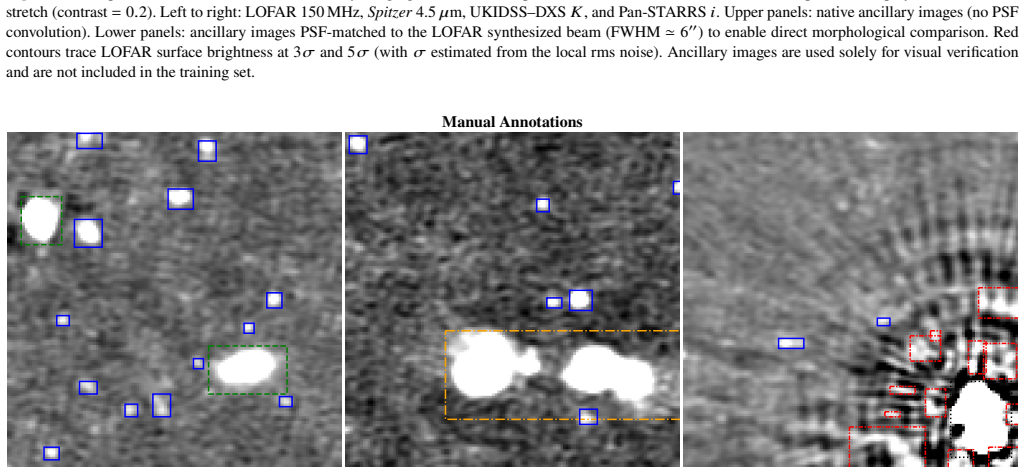
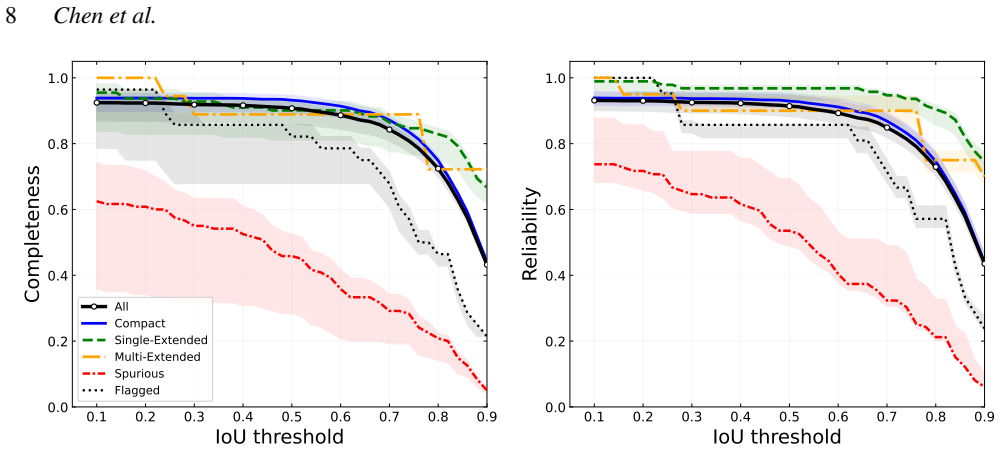
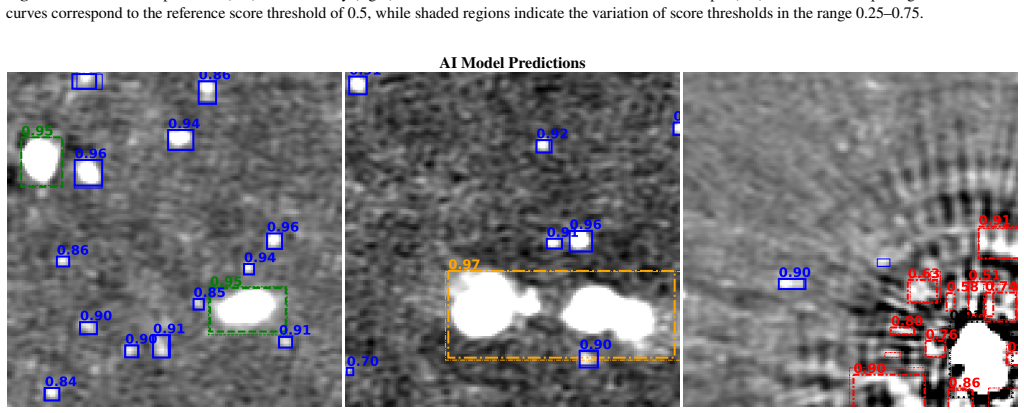
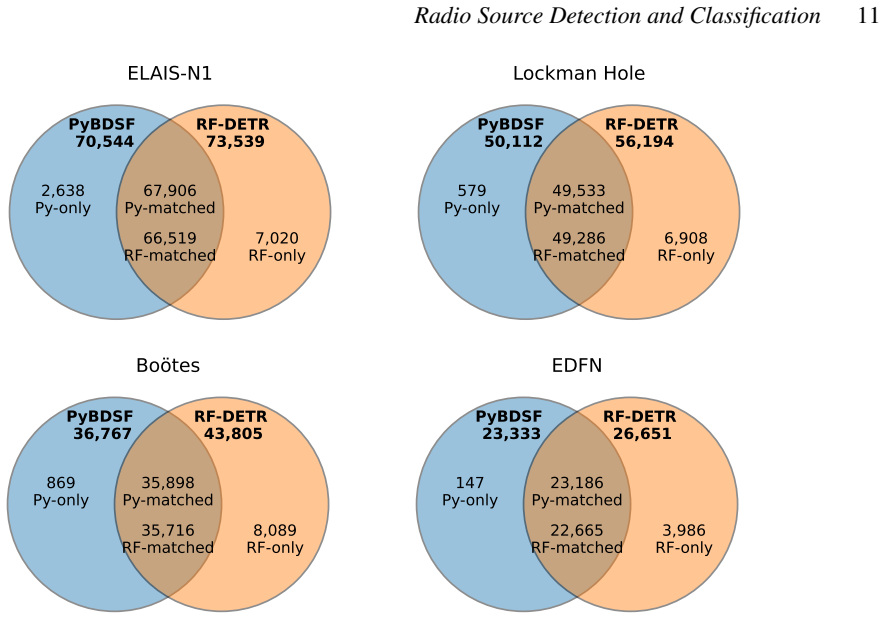
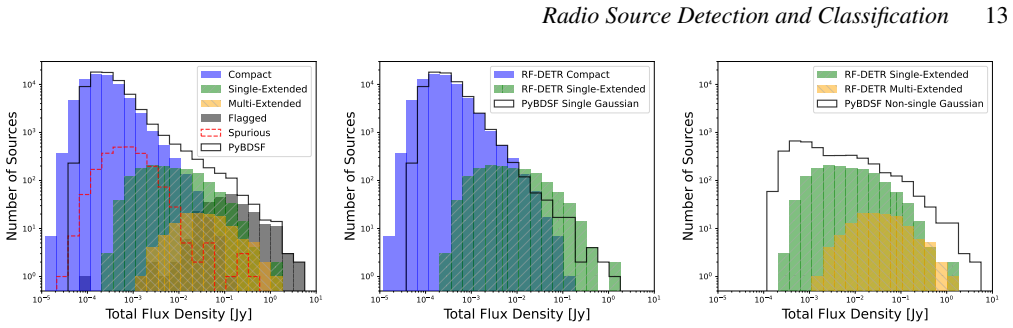
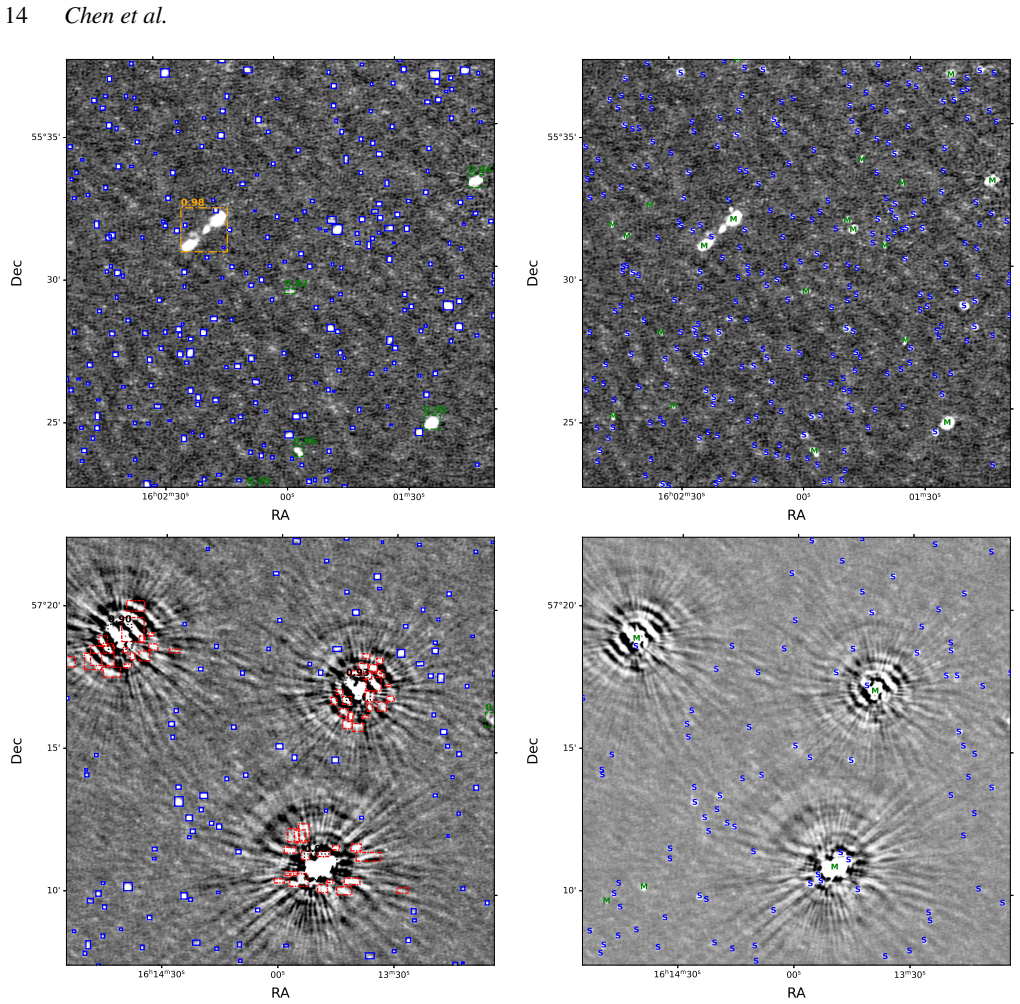
RF-DETR, adapted to multi-frequency-synthesis radio images and trained with a morphology-driven scheme on five mutually exclusive classes, achieves F1 approximately 91 percent on the ELAIS-N1 training field; when applied without retraining to the remaining three LOFAR Deep Fields it produces consistent catalogues that recover the majority of PyBDSF sources, represent multi-component galaxies as single detections, flag artefacts explicitly, and recover most visually identified extended and giant radio galaxies.
What carries the argument
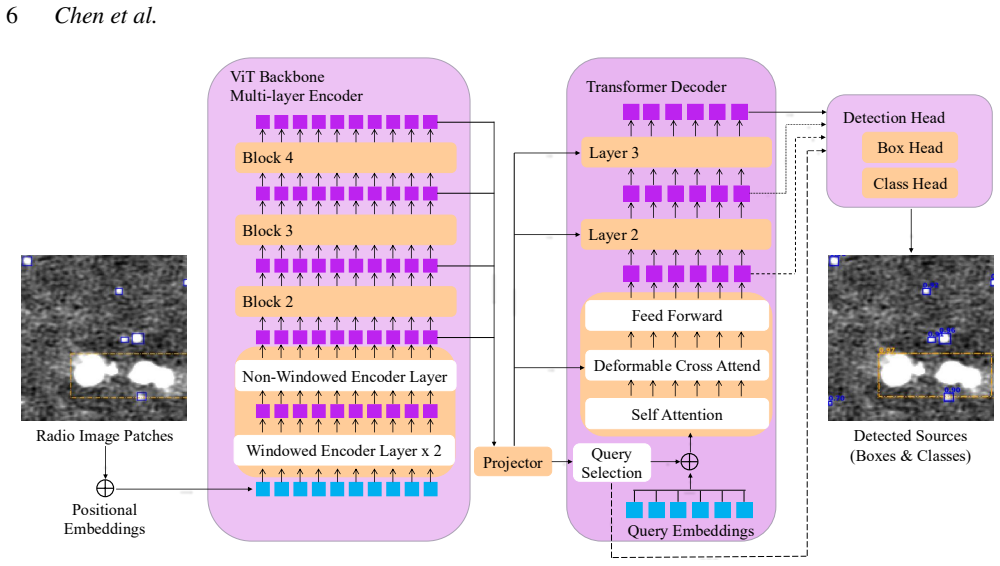
RF-DETR, a transformer-based set-prediction detector trained on morphology-driven labels for five classes and adapted to interferometric continuum images.
If this is right
- Catalogues distinguish artefact detections from astrophysical sources as separate classes.
- Multi-component radio galaxies appear as single source-level entries rather than fragmented components.
- The same model recovers the majority of visually identified extended and giant radio galaxies.
- Performance remains consistent across fields that differ in depth and calibration.
Where Pith is reading between the lines
- The approach could be tested on other radio surveys with different frequencies or resolutions to check how much retraining is actually required.
- If artefact classes are reliable, downstream statistical studies could exclude or weight sources by class without additional post-processing.
- Scaling the method to SKA-Low data volumes would require checking whether inference speed remains practical on the larger image sizes.
Load-bearing premise
A model trained solely on the ELAIS-N1 field can be applied directly to the other three fields without retraining and still maintain consistent performance despite differences in survey depth and calibration quality.
What would settle it
A clear drop in F1 score or a large increase in missed giant radio galaxies when the same trained model is evaluated on a new LOFAR field with measurably different noise or calibration properties.
Figures



read the original abstract
Radio source detection and morphological classification are fundamental for exploiting the scientific potential of modern radio continuum surveys. However, the rapidly increasing data volumes and the wide diversity of radio morphologies make traditional visual inspection infeasible and pose significant challenges for automated source finding. We apply a transformer-based set-prediction detector (RF-DETR) to 150\,MHz continuum images from the LOFAR Deep Fields for instance-level source detection and morphological classification. The method is adapted to multi-frequency-synthesis images of interferometric data and trained with a morphology-driven scheme using five mutually exclusive classes. The model is trained on the ELAIS-N1 Deep Field, where it achieves high detection and classification performance ($\mathrm{F1}\simeq 91$ per cent), and is then applied without retraining to the other three LOFAR Deep Fields. Across all four fields, the model yields consistent catalogues with modest field-to-field differences arising from survey depth and calibration. Compared with widely used PyBDSF catalogues, RF-DETR recovers the majority of PyBDSF sources while representing classical multi-component radio galaxies as single source-level detections rather than fragmented Gaussian components. Artefact-affected and spurious detections are identified as explicit classes, allowing these detections to be distinguished from general astrophysical sources in the resulting catalogues. As external validation, RF-DETR recovers the majority of visually identified extended and giant radio galaxies in the LOFAR Deep Fields and assigns them predominantly to extended morphological classes. These results indicate that transformer-based detectors provide a practical, scalable, morphology-aware approach to source finding in deep radio surveys, with clear relevance for forthcoming facilities such as SKA-Low.
Editorial analysis
A structured set of objections, weighed in public.
Referee Report
Summary. The paper applies a transformer-based set-prediction detector (RF-DETR) to 150 MHz LOFAR Deep Field continuum images for instance-level source detection and five-class morphological classification. The model is trained on the ELAIS-N1 field (reported F1 ≃ 91 %) and applied without retraining to the remaining three LOFAR Deep Fields; the resulting catalogues are described as consistent with modest field-to-field differences, recover most PyBDSF sources while treating multi-component galaxies as single detections, and identify artefacts as explicit classes. External validation against visually identified extended sources is also presented, with the conclusion that the approach is scalable and relevant for SKA-Low.
Significance. If the cross-field generalization and performance claims hold with quantitative support, the work would demonstrate a practical, morphology-aware alternative to traditional source finders for large radio surveys. The explicit handling of artefacts and multi-component sources as distinct classes, together with the set-prediction formulation, would be a clear methodological advance over component-based tools such as PyBDSF.
major comments (2)
- [Abstract / cross-field results] Abstract and the section on cross-field application: the central scalability claim requires that a single model trained on ELAIS-N1 maintains high performance on the other three fields without retraining. Only the F1 ≃ 91 % figure is supplied for the training field; the other fields are described only qualitatively as yielding “consistent catalogues with modest field-to-field differences” and recovering “the majority” of PyBDSF sources. No per-field precision, recall, or F1 values, nor any explicit cross-validation protocol or error bars, are reported. This absence directly weakens the quantitative basis for the generalization assertion.
- [Methods] Methods / training description: the manuscript states that the model is “trained with a morphology-driven scheme using five mutually exclusive classes” on multi-frequency-synthesis images, yet provides no quantitative details on training/validation splits, class-imbalance handling, loss weighting, or how the interferometric image properties affect the input representation. These omissions make it impossible to assess whether the reported F1 score is robust or sensitive to the specific data characteristics of the training field.
minor comments (2)
- [Abstract] The abstract and results text would benefit from explicit table or figure references for the per-class performance metrics and the catalogue comparison statistics.
- [Methods] Notation for the five morphological classes should be defined once in a dedicated table or subsection rather than introduced only in passing.
Simulated Author's Rebuttal
We thank the referee for the constructive feedback on our manuscript. The comments highlight important areas where additional quantitative support and methodological transparency would strengthen the presentation of our results. We address each major comment below and indicate the revisions we will make.
read point-by-point responses
-
Referee: [Abstract / cross-field results] Abstract and the section on cross-field application: the central scalability claim requires that a single model trained on ELAIS-N1 maintains high performance on the other three fields without retraining. Only the F1 ≃ 91 % figure is supplied for the training field; the other fields are described only qualitatively as yielding “consistent catalogues with modest field-to-field differences” and recovering “the majority” of PyBDSF sources. No per-field precision, recall, or F1 values, nor any explicit cross-validation protocol or error bars, are reported. This absence directly weakens the quantitative basis for the generalization assertion.
Authors: We agree that the absence of per-field quantitative metrics limits the strength of the generalization claim. Ground-truth labels for the five morphological classes exist only for ELAIS-N1; the other fields lack equivalent annotations, precluding direct computation of precision/recall/F1 without new labeling. In revision we will add quantitative cross-field statistics that are available without labels, including per-field source counts, overlap fractions with PyBDSF detections, class-distribution histograms, and artefact rates, together with the 5-fold cross-validation protocol and validation error bars already used on ELAIS-N1. These additions will provide a more rigorous basis for the consistency statement while remaining within the scope of existing data. revision: partial
-
Referee: [Methods] Methods / training description: the manuscript states that the model is “trained with a morphology-driven scheme using five mutually exclusive classes” on multi-frequency-synthesis images, yet provides no quantitative details on training/validation splits, class-imbalance handling, loss weighting, or how the interferometric image properties affect the input representation. These omissions make it impossible to assess whether the reported F1 score is robust or sensitive to the specific data characteristics of the training field.
Authors: We accept that the current Methods section is insufficiently detailed for reproducibility. The revised manuscript will expand this section to report: (i) the exact training/validation split (80/20) and any stratified sampling used, (ii) the class-imbalance mitigation strategy (weighted loss terms derived from inverse class frequencies), (iii) the full RF-DETR loss formulation with the relative weighting of classification, bounding-box, and set-prediction terms, and (iv) the image preprocessing pipeline, including per-image normalization, noise clipping, and handling of the synthesized-beam properties of the LOFAR multi-frequency-synthesis images. revision: yes
Circularity Check
No circularity: empirical ML application with independent training/evaluation
full rationale
The manuscript describes training an RF-DETR transformer detector on labeled ELAIS-N1 images, reporting F1≈91% there, then applying the fixed model to three other fields and comparing outputs to PyBDSF catalogues. No equations, derivations, or fitted-parameter predictions appear; performance metrics are computed directly from held-out or external labels rather than being redefined by the model's own outputs. No self-citation chains, ansatzes, or uniqueness theorems are invoked to justify the central claims. The reported generalization is an empirical claim whose quantitative support may be incomplete, but that is an evidence gap, not a circular reduction of the result to its inputs.
Axiom & Free-Parameter Ledger
free parameters (1)
- RF-DETR training hyperparameters and loss weights
axioms (1)
- domain assumption The five morphology classes are mutually exclusive and collectively cover the relevant source population in the LOFAR images.
Reference graph
Works this paper leans on
-
[1]
R., Vaccari M., 2018, MNRAS, 480, 2085 Alonso D., Bellini E., Hale C., Jarvis M
Alhassan W., Taylor A. R., Vaccari M., 2018, MNRAS, 480, 2085 Alonso D., Bellini E., Hale C., Jarvis M. J., Schwarz D. J., 2021, MNRAS, 502, 876 Banfield J. K., et al., 2015, MNRAS, 453, 2326 Baron Perez N., Brüggen M., Kasieczka G., Lucie-Smith L., 2025, A&A, 699, A302 Bendo G. J., Beswick R. J., D’Cruze M. J., Dickinson C., Fuller G. A., Muxlow T. W. B....
-
[2]
K., et al., 2025, MNRAS, 536, L32 Ndung’u S., Grobler T., Wijnholds S
Finder, Astrophysics Source Code Library, record ascl:1502.007 Morabito L. K., et al., 2025, MNRAS, 536, L32 Ndung’u S., Grobler T., Wijnholds S. J., Karastoyanova D., Azzopardi G., 2023, New Astron. Rev., 97, 101685 Ndung’u S., Grobler T., Wijnholds S. J., Karastoyanova D., Azzopardi G., 2024, MNRAS, 530, 783 Oquab M., et al., 2024, Transactions on Machi...
discussion (0)
Sign in with ORCID, Apple, or X to comment. Anyone can read and Pith papers without signing in.