A Theory-Guided LLM Pedagogical Agent for STEM+C Scaffolding Without Over-Reliance
Pith reviewed 2026-06-28 23:41 UTC · model grok-4.3
The pith
A theory-grounded multimodal LLM agent supports student confidence in STEM+C without causing dependence.
A machine-rendered reading of the paper's core claim, the machinery that carries it, and where it could break.
Core claim
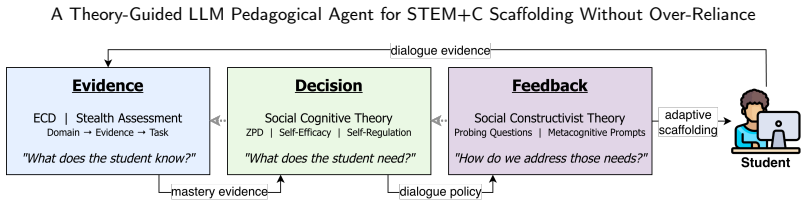
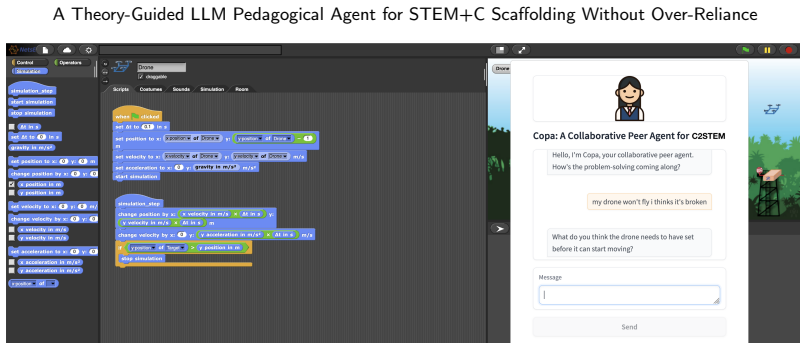
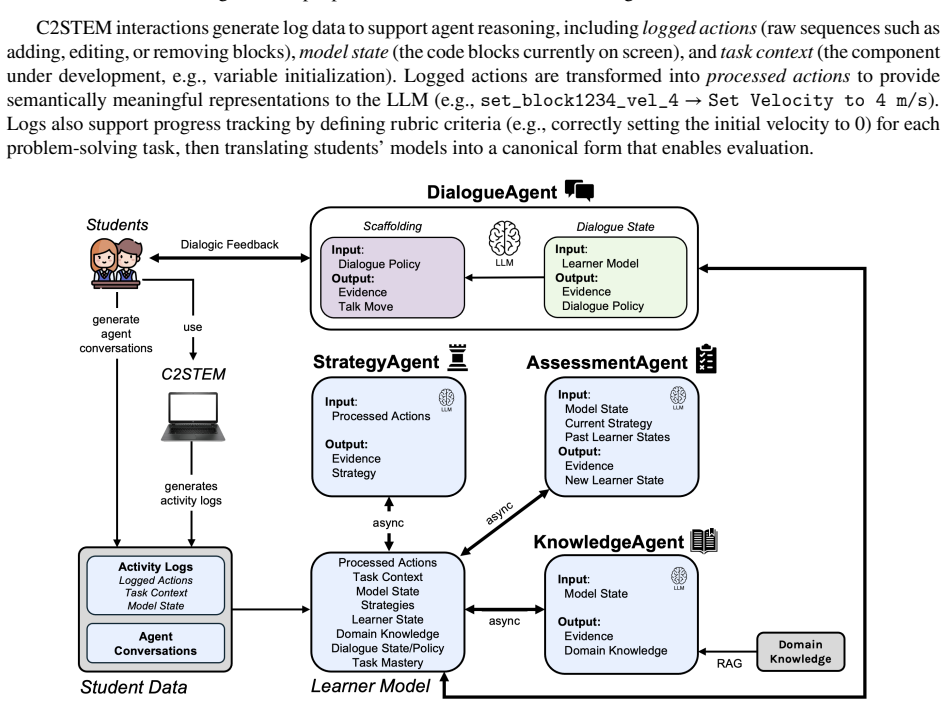
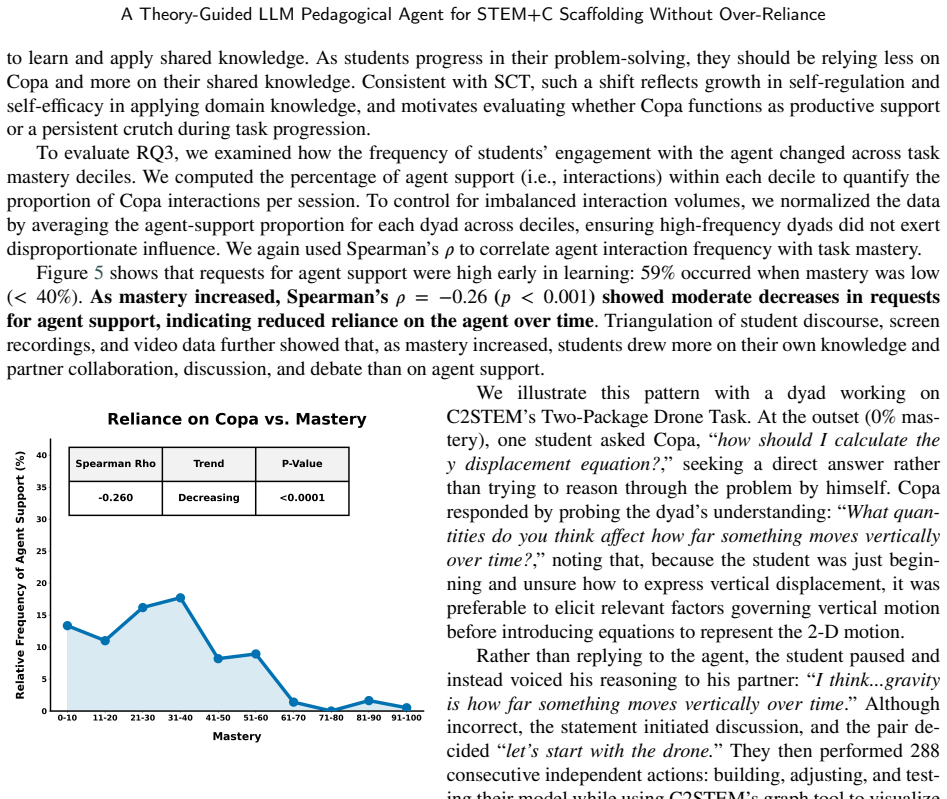
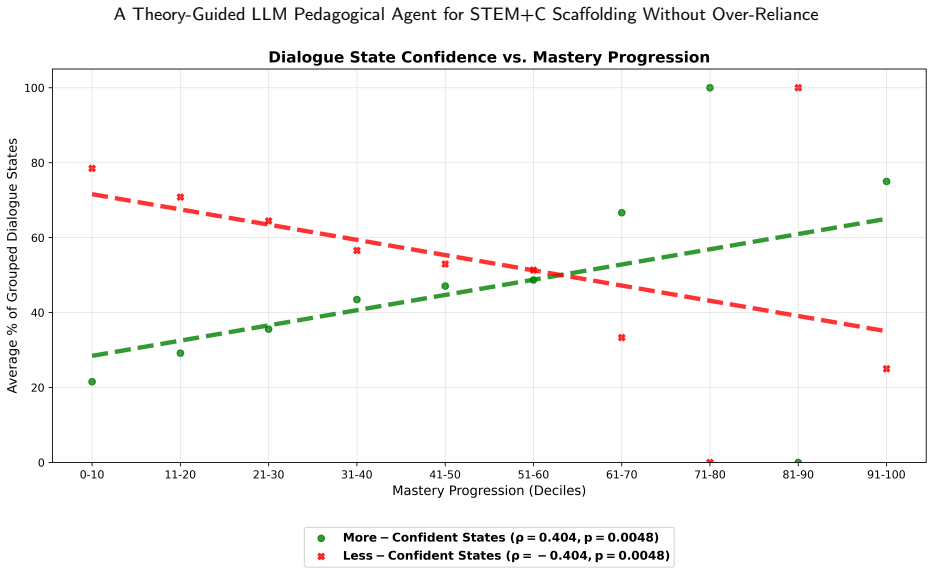
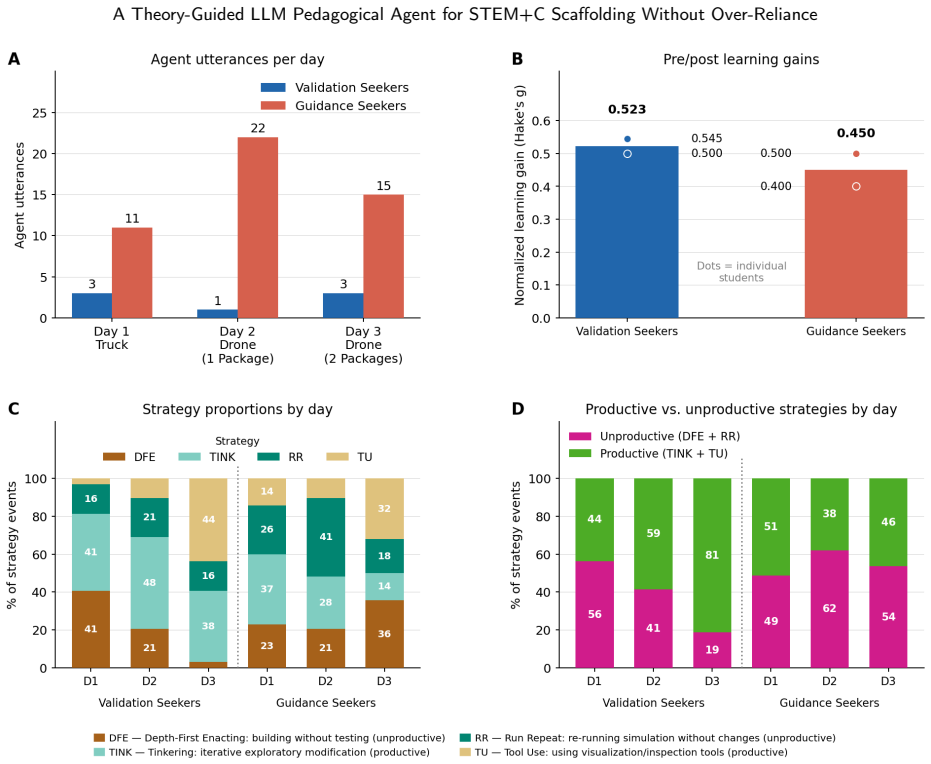
Copa demonstrates that an agentic, multi-agent, multimodal Collaborative Peer Agent, built on the Evidence-Decision-Feedback framework, can support students' confidence building and ability to verbalize conceptual understanding without causing dependence while providing adaptive feedback personalized to learners and interpretable with respect to their multimodal input data.
What carries the argument
The Evidence-Decision-Feedback (EDF) framework that structures the agent's interactions to promote sense-making through adaptive, dialogic support rather than answer-seeking.
If this is right
- Students build confidence in their STEM+C abilities through guided interactions.
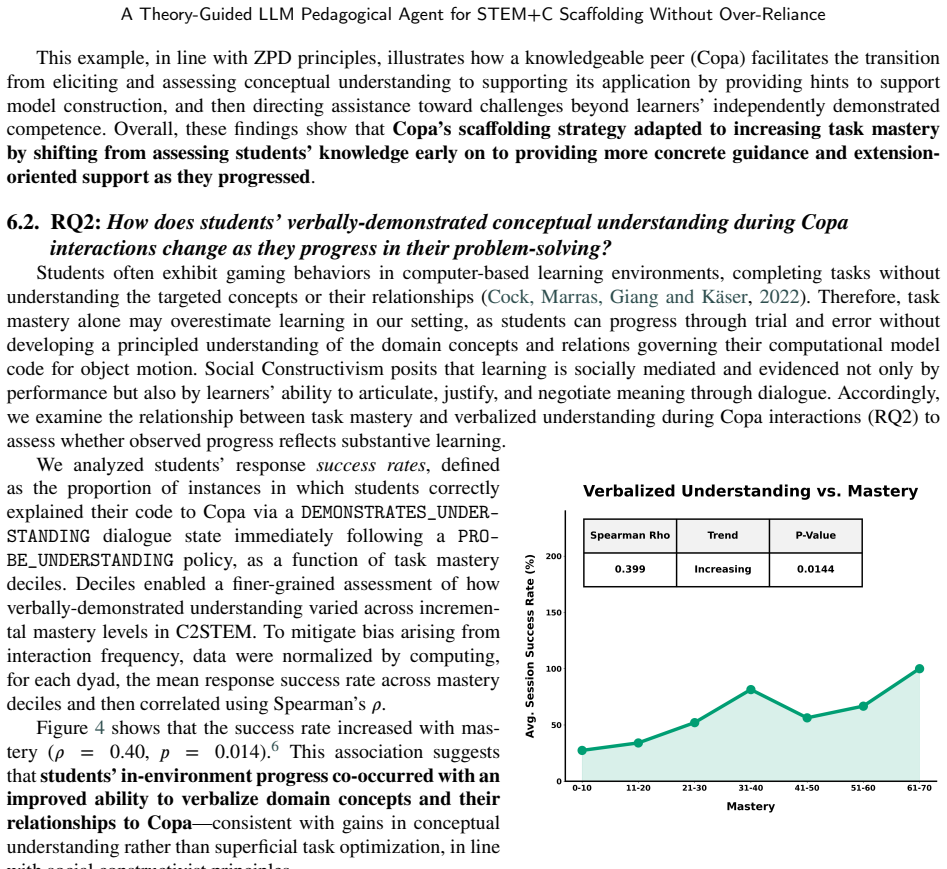
- Learners improve their ability to verbalize conceptual understanding.
- The agent delivers adaptive feedback based on students' multimodal inputs without fostering dependence.
- Such theory-guided agents offer a path for AI in classrooms that enhances rather than replaces student reasoning.
Where Pith is reading between the lines
- The EDF approach could be adapted for other AI tutoring systems to reduce over-reliance risks.
- Testing the agent in different subject areas might reveal its broader applicability.
- Long-term studies could check if students maintain independent problem-solving skills after using the agent.
- Combining the framework with additional data sources like eye-tracking could refine personalization further.
Load-bearing premise
That interactions grounded in the learning theories via the EDF framework sufficiently prevent cognitive offloading and over-reliance as measured in the study.
What would settle it
A replication study finding that students using Copa show increased dependence on the agent or reduced ability to solve problems independently compared to a control group.
Figures
read the original abstract
LLM pedagogical agents are proliferating, yet recent findings have raised questions about their adherence to established theories of learning and, by extension, their educational value. Concerns regarding cognitive offloading, over-reliance, and "gaming" behaviors persist and remain largely unaddressed. In response, we developed Copa, an agentic, multi-agent, multimodal Collaborative Peer Agent for STEM+C learning. Copa is built on top of the Evidence-Decision-Feedback (EDF) framework, grounding its interactions in Social Cognitive Theory and Social Constructivism and promoting sense-making through adaptive, dialogic support rather than answer-seeking. In an authentic high school computational-modeling study (n=33 dyads), we demonstrate that Copa (1) supports students' confidence building and ability to verbalize conceptual understanding without causing dependence; and (2) provides adaptive feedback personalized to learners that is interpretable with respect to students' multimodal input data. These findings position theory-guided, multimodal LLM agents as a promising path toward classroom AI integration that amplifies students' reasoning rather than replacing it.
Editorial analysis
A structured set of objections, weighed in public.
Referee Report
Summary. The manuscript introduces Copa, an agentic multi-agent multimodal Collaborative Peer Agent for STEM+C learning built on the Evidence-Decision-Feedback (EDF) framework, which grounds interactions in Social Cognitive Theory and Social Constructivism to promote sense-making through adaptive dialogic support. Based on an authentic high school computational-modeling study with n=33 dyads, the paper claims that Copa supports students' confidence building and ability to verbalize conceptual understanding without causing dependence, and provides adaptive feedback personalized to learners that is interpretable with respect to students' multimodal input data.
Significance. If the reported findings from the user study hold under rigorous scrutiny, this work could be significant in advancing the integration of LLM-based pedagogical agents in education. By explicitly grounding the agent in established learning theories via the EDF framework, it offers a potential solution to concerns about cognitive offloading and over-reliance, positioning theory-guided multimodal agents as a viable approach for amplifying student reasoning in classroom settings.
major comments (2)
- [Abstract] The abstract asserts empirical results from the 33-dyad study demonstrating that Copa supports confidence without dependence, but supplies no data, statistical methods, error bars, baseline comparisons, or exclusion criteria. This makes it impossible to determine whether the data support the claims as stated regarding the prevention of over-reliance.
- [User Study Description] The claim that the EDF framework prevents over-reliance is load-bearing for the central contribution, yet the manuscript provides no specifics on how dependence was operationalized or measured (e.g., independent post-test accuracy, usage frequency without prompts, or comparison to a no-agent control), leaving the isolation of the framework's effect from potential confounds unaddressed.
minor comments (1)
- The abstract could benefit from a brief mention of the specific STEM+C topic or computational modeling task used in the study to provide context for the claims.
Simulated Author's Rebuttal
We thank the referee for their constructive comments, which highlight opportunities to strengthen the clarity and transparency of our empirical claims. We address each major point below and indicate where revisions will be made.
read point-by-point responses
-
Referee: [Abstract] The abstract asserts empirical results from the 33-dyad study demonstrating that Copa supports confidence without dependence, but supplies no data, statistical methods, error bars, baseline comparisons, or exclusion criteria. This makes it impossible to determine whether the data support the claims as stated regarding the prevention of over-reliance.
Authors: We agree that the abstract, due to length constraints, presents high-level claims without the supporting statistical details. The full manuscript contains these elements in the Results section (including pre/post confidence measures, verbalization coding, dependence proxies via post-test accuracy and interaction logs, and baseline comparisons). To improve accessibility, we will revise the abstract to briefly note the study design (within-subjects dyad comparison with multimodal logging) and key statistical outcomes while preserving conciseness. revision: yes
-
Referee: [User Study Description] The claim that the EDF framework prevents over-reliance is load-bearing for the central contribution, yet the manuscript provides no specifics on how dependence was operationalized or measured (e.g., independent post-test accuracy, usage frequency without prompts, or comparison to a no-agent control), leaving the isolation of the framework's effect from potential confounds unaddressed.
Authors: The referee correctly identifies that the current manuscript text does not explicitly detail the operationalization of dependence in the User Study Description. Dependence was assessed via (1) independent post-test accuracy on modeling tasks without agent access, (2) frequency of agent queries versus self-initiated actions in logs, and (3) comparison against a no-agent control condition within the dyad design. We will expand this section with these metrics, exclusion criteria, and statistical methods to allow readers to evaluate isolation of the EDF effect from confounds. revision: yes
Circularity Check
No significant circularity; empirical study self-contained
full rationale
The paper reports empirical outcomes from an n=33 dyad high-school study on the Copa agent. No equations, fitted parameters, predictions, or derivations are present. Claims rest on observed student behaviors and feedback interpretability rather than any reduction to self-defined inputs or self-citation chains. The theory grounding (Social Cognitive Theory, Social Constructivism, EDF framework) is presented as design rationale, not as a mathematical premise that loops back to the results. This is the normal case of a non-circular empirical report.
Axiom & Free-Parameter Ledger
axioms (1)
- domain assumption Social Cognitive Theory and Social Constructivism provide effective grounding for designing LLM interactions that promote sense-making rather than answer-seeking.
Reference graph
Works this paper leans on
-
[1]
Computers and Education: Artificial Intelligence 6, 100215
Human-centred learning analytics and ai in education: A systematic literature review. Computers and Education: Artificial Intelligence 6, 100215. Aulia,F.E.,Hidayah,I.,Fauziati,S.,Anissa,S.,2025. Guidingself-regulatedlearningwithanllm-basedpedagogicalchatbot,in:2025International Seminar on Application for Technology of Information and Communication (iSema...
2025
-
[2]
Annual review of psychology 52, 1–26
Social cognitive theory: An agentic perspective. Annual review of psychology 52, 1–26. Birks,M., Chapman,Y.,Francis, K.,2008. Memoinginqualitative research:Probingdata andprocesses. Journalofresearch innursing13, 68–75. Bo, N.S.W.,
2008
-
[3]
Hungarian Educational Research Journal 15, 284–289
Oecd digital education outlook 2023: Towards an effective education ecosystem. Hungarian Educational Research Journal 15, 284–289. Chowrira, S.G., Smith, K.M., Dubois, P.J., Roll, I.,
2023
-
[4]
A LLM-Powered Automatic Grading Framework with Human-Level Guidelines Optimization, in: Educational Data Mining, International Educational Data Mining Society. p. n/a. URL: https://educationaldatamining.org/EDM2025/proceedings/2025.EDM.long-papers.80/index.html, doi:10.48550/arXiv. 2410.02165. Cock,J.M.,Marras,M.,Giang,C.,Käser,T.,2022. Generalisablemetho...
work page internal anchor Pith review doi:10.48550/arxiv 2025
-
[5]
Learning and Instruction 103, 102274
Analyzing embodied learning in classroom settings: A human-in-the-loop ai approach for multimodal learning analytics. Learning and Instruction 103, 102274. doi:https://doi.org/10.1016/j.learninstruc.2025.102274. Ganguly,A.,Mehjabin,N.,Malik,A.,Johri,A.,2026. Conversationalaiagentsineducation:Anumbrellareviewofcurrentutilization,challenges, and future dire...
-
[6]
Howarelearninganalyticsconsideringthesocietalvaluesoffairness,accountability,transparencyandhuman well-being?: A literature review
Hakami,E.,HernándezLeo,D.,2020. Howarelearninganalyticsconsideringthesocietalvaluesoffairness,accountability,transparencyandhuman well-being?: A literature review. Martínez-Monés A, Álvarez A, Caeiro-Rodríguez M, Dimitriadis Y, editors. LASI-SPAIN 2020: Learning Analytics Summer Institute Spain 2020: Learning Analytics. Time for Adoption?; 2020 Jun 15-16;...
2020
-
[7]
(Eds.), Artificial Intelligence in Education, Springer Nature Switzerland, Cham
An LLM-Enhanced Multi-agent Architecture for Conversation-Based Assessment, in: Cristea, A.I., Walker, E., Lu, Y., Santos, O.C., Isotani, S. (Eds.), Artificial Intelligence in Education, Springer Nature Switzerland, Cham. pp. 119–134. doi:10.1007/978-3-031-98417-4_9. Hutchins,N.M.,Biswas,G.,Maróti,M.,Lédeczi,Á.,Grover,S.,Wolf,R.,Blair,K.P.,Chin,D.,Conlin,...
-
[8]
Explainable artificial intelligence in education. Computers and education: artificial intelligence 3, 100074. Khosrawi-Rad,B.,Keller,P.F.,Benner,D.,Grogorick,L.,Borchers,A.,Janson,A.,Leimeister,J.M.,Robra-Bissantz,S.,2025. Promotingstudents’ motivation in language education with gamified pedagogical conversational agents. Computers & Education 238, 105374...
work page internal anchor Pith review Pith/arXiv arXiv 2025
-
[9]
EduMAS: A Novel LLM-Powered Multi-Agent Framework for Educational Support, in: 2024 IEEE International Conference on Big Data (BigData), pp. 8309–8316. URL:https://ieeexplore.ieee.org/abstract/document/ 10826103/authors, doi:10.1109/BigData62323.2024.10826103. ISSN: 2573-2978. Liu,B.,Zhang,J.,Lin,F.,Jia,X.,Peng,M.,2025a. Onesizedoesn’tfitall:Apersonalized...
-
[10]
Computers & Education 234, 105314
The role of teachable agents’ personality traits on student-ai interactions and math learning. Computers & Education 234, 105314. Memarian,B.,Doleck,T.,2024. Human-in-the-loopinartificialintelligenceineducation:Areviewandentity-relationship(er)analysis. Computers in Human Behavior: Artificial Humans 2, 100053. Mislevy, R.J., Almond, R.G., Lukas, J.F.,
2024
-
[11]
ETS Research Report Series 2003, i–29
A brief introduction to evidence-centered design. ETS Research Report Series 2003, i–29. Moos, D.C., Azevedo, R.,
2003
-
[12]
Review of educational research 79, 576–600
Learning with computer-based learning environments: A literature review of computer self-efficacy. Review of educational research 79, 576–600. Munshi,A.,Biswas,G.,Baker,R.,Ocumpaugh,J.,Hutt,S.,Paquette,L.,2023.Analysingadaptivescaffoldsthathelpstudentsdevelopself-regulated learning behaviours. Journal of Computer Assisted Learning 39, 351–368. Cohn et al....
2023
-
[13]
Measuring Agents in Production
Measuring agents in production. arXiv preprint arXiv:2512.04123 . Ponton,M.K.,Rhea,N.E.,2006. Autonomouslearningfromasocialcognitiveperspective. NewHorizonsinAdultEducationandHumanResource Development 20, 38–49. Ritter, F.E., Tehranchi, F., Oury, J.D.,
work page internal anchor Pith review Pith/arXiv arXiv 2006
-
[14]
Human-ai collaboration or obedient and often clueless ai in instruct, serve, repeat dynamics? TheInternetandHigherEducation70,101087. URL:https://www.sciencedirect.com/science/article/pii/S109675162600014X, doi:https://doi.org/10.1016/j.iheduc.2026.101087. Scholz,N.,Nguyen,M.H.,Singla,A.,Nagashima,T.,2025. Partneringwithai:Apedagogicalfeedbacksystemforllm...
-
[15]
EducationQ: Evaluating LLMs’ Teaching Capabilities Through Multi-Agent Dialogue Framework, in: Che, W., Nabende, J., Shutova, E., Pilehvar, M.T. (Eds.), Proceedings of the 63rd Annual Meeting of the Association for Computational Linguistics (Volume 1: Long Papers), Association for Computational Linguistics, Vienna, Austria. pp. 32799–32828. URL:https://ac...
-
[16]
Computer games and instruction 55, 503–524
Stealth assessment in computer-based games to support learning. Computer games and instruction 55, 503–524. Sinha,T.,Kapur,M.,2021. Whenproblemsolvingfollowedbyinstructionworks:Evidenceforproductivefailure. ReviewofEducationalResearch 91, 761–798. Sixu, A., Yu, Y., Yunsi, M., Guandong, X., et al.,
2021
-
[17]
Sun,E.,Tai,L.,2025
What is agentic ai? URL:https://www.ibm.com/think/topics/agentic-ai. Sun,E.,Tai,L.,2025. MultiTutor:CollaborativeLLMAgentsforMultimodalStudentSupport,in:ProceedingsoftheInnovationandResponsibility in AI-Supported Education Workshop, PMLR. pp. 174–190. URL:https://proceedings.mlr.press/v273/sun25a.html. ISSN: 2640-
2025
-
[18]
Timalsina,U.,Davalos_Anaya,E.,Sanda,N.,Zhang,Y.,Horn_Fonteles,J.,T_S,A.,Biswas,G.,2025.Syncflow:Ascalableplatformformultimodal learning analytics, in: US Research Software Engineering Conference (USRSE25), Zenodo. p. n/a. Tsai, Y.S., Whitelock-Wainwright, A., Gašević, D.,
2025
-
[19]
LLM-powered Multi-agent Framework for Goal-oriented Learning in Intelligent Tutoring System, in: Companion Proceedings of the ACM on Web Conference 2025, Association for Computing Machinery, New York, NY, USA. pp. 510–519. URL:https://dl.acm.org/doi/10.1145/3701716.3715244, doi:10.1145/3701716. 3715244. Wu,T.,Zhai,X.,Song,Y.,2025. Theeffectsofgai-enhanced...
-
[20]
Computers & Education , 105494
Investigating the effects of an llm-based socratic conversational agent on students’ academic performance and reflective thinking in higher education. Computers & Education , 105494. Xing,W.,Kim,T.,Song,Y.,Li,H.,Li,C.,Kim,J.,2026. Unveilinginteractionpatternsbetweenstudentsandgenerativeaiteachableagent:Focusing on students’ agency and ai agents’ authority...
2026
-
[21]
Mentigo: An Intelligent Agent for Mentoring Students in the Creative Problem SolvingProcess,in:Proceedingsofthe2025CHIConferenceonHumanFactorsinComputingSystems,AssociationforComputingMachinery, New York, NY, USA. pp. 1–22. URL:https://dl.acm.org/doi/10.1145/3706598.3713952, doi:10.1145/3706598.3713952. Zhang, J., Borchers, C., Cohn, C., Srivastava, N., S...
discussion (0)
Sign in with ORCID, Apple, or X to comment. Anyone can read and Pith papers without signing in.