Symmetry-Resolved Second Harmonic Generation in Quantum and Functional Materials
Pith reviewed 2026-06-29 06:06 UTC · model grok-4.3
The pith
Polarization-resolved rotational anisotropy SHG connects nonlinear susceptibility tensors to crystallographic and magnetic point groups for detecting hidden orders.
A machine-rendered reading of the paper's core claim, the machinery that carries it, and where it could break.
Core claim
Second harmonic generation has evolved from a probe of noncentrosymmetric crystals into a symmetry-resolved optical method for identifying order parameters in quantum and functional materials. Polarization-resolved rotational anisotropy measurements of SHG connect nonlinear susceptibility tensors to the crystallographic and magnetic point groups of the underlying materials. This capability is especially powerful when the ordered state is weak, spatially confined, multipolar, magnetic, or hidden from conventional linear probe techniques.
What carries the argument
The electric-dipole nonlinear susceptibility tensor whose symmetry-allowed components are fixed by the material point group via group theory.
If this is right
- RA-SHG can detect and map spatially confined or multipolar orders that linear probes miss.
- It distinguishes magnetic point groups from crystallographic ones in ordered states.
- Applications cover polar materials, magnetic orders, and hidden electronic phases.
- The method supports imaging and control of nonequilibrium and intertwined phases.
- Challenges remain in extending the technique to new classes of quantum materials.
Where Pith is reading between the lines
- Time-resolved variants could track how symmetry breaks during ultrafast transitions.
- Spatial resolution improvements would allow direct imaging of domain walls in hidden-order systems.
- Cross-checks with other nonlinear channels such as third-harmonic generation could test tensor completeness.
- The same symmetry-mapping logic might apply to higher-order multipole responses in engineered heterostructures.
Load-bearing premise
The group-theoretical assignment of allowed tensor components to specific order parameters stays valid and complete for weak, multipolar, or hidden orders.
What would settle it
Observation of a material whose known hidden order produces RA-SHG patterns that require a point group incompatible with independent structural or magnetic characterization.
Figures









read the original abstract
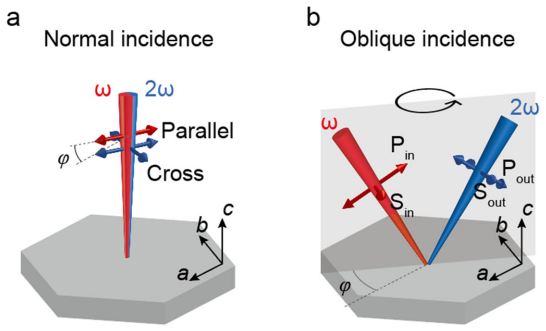
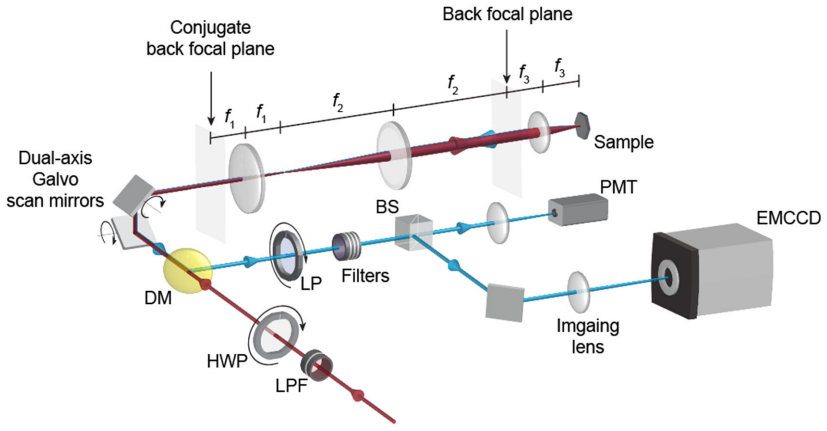
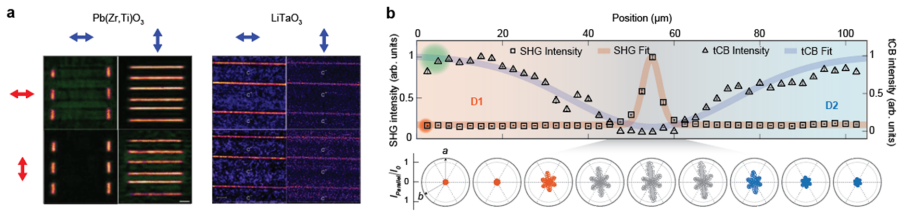
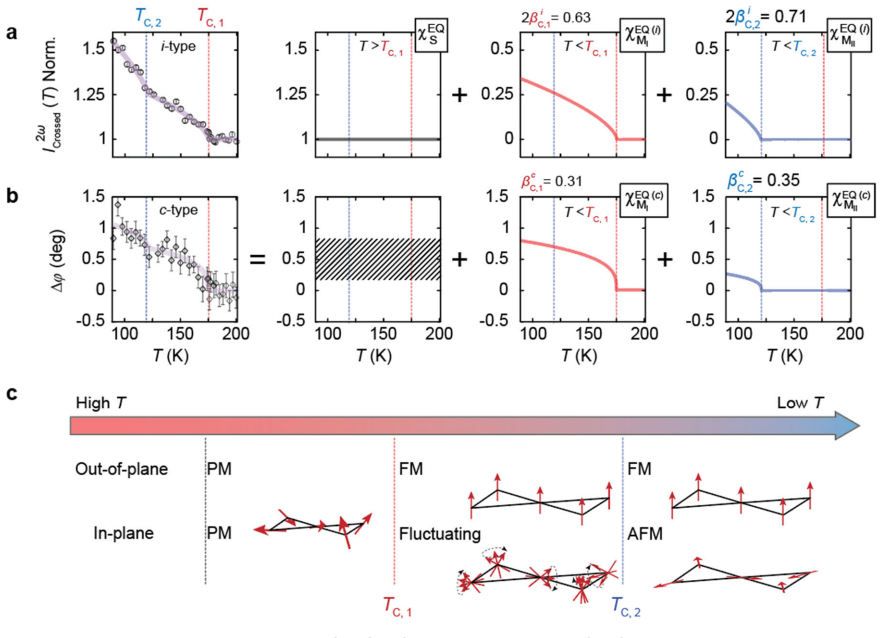
Second harmonic generation (SHG) has evolved from a probe of noncentrosymmetric crystals into a symmetry-resolved optical method for identifying order parameters in quantum and functional materials. In particular, polarization-resolved rotational anisotropy (RA) measurements of SHG can connect nonlinear susceptibility tensors to the crystallographic and magnetic point groups of the underlying materials. This capability is especially powerful when the ordered state is weak, spatially confined, multipolar, magnetic, or hidden from conventional linear probe techniques. In this review article, we provide a comprehensive overview of RA-SHG studies across a broad range of condensed matter systems. We begin with basic theoretical background for the multipole origins of SHG radiation, the construction of nonlinear susceptibility tensors, and group-theoretical framework connecting tensor components to order parameters. We then review the applications of RA-SHG to polar materials, magnetic orders, and other hidden electronic materials. Finally, we outline challenges and future research directions for using SHG to reveal, image, and control hidden, intertwined, and nonequilibrium phases in quantum and functional materials.
Editorial analysis
A structured set of objections, weighed in public.
Referee Report
Summary. This review article summarizes the evolution of second harmonic generation (SHG) into a symmetry-resolved probe, with emphasis on polarization-resolved rotational anisotropy (RA) measurements. It connects nonlinear susceptibility tensors to crystallographic and magnetic point groups via group theory, highlighting utility for weak, spatially confined, multipolar, magnetic, or hidden orders inaccessible to linear probes. The manuscript covers multipole origins of SHG, tensor construction, group-theoretical mappings, applications to polar materials, magnetic orders and hidden electronic states, plus challenges and future directions.
Significance. As a synthesis of established RA-SHG literature and standard group-theoretical mappings, the review consolidates precedents for probing hidden orders and could serve as a reference resource in condensed-matter optics, provided the cited applications accurately reflect the breadth of prior work. No new derivations or parameter-free results are presented; credit is due for framing the method's scope across multiple material classes.
Simulated Author's Rebuttal
We thank the referee for their positive assessment of our review and for recommending acceptance. The report accurately captures the manuscript's scope as a synthesis of RA-SHG methods and their applications to hidden orders.
Circularity Check
Review paper aggregates external literature; no internal derivation chain present
full rationale
This is a review article summarizing established RA-SHG methods, nonlinear susceptibility tensors, and group-theoretical mappings drawn from pre-existing external literature. The abstract and structure explicitly frame the work as an overview of prior studies on polar materials, magnetic orders, and hidden phases, with no new equations, fitted parameters, or predictions derived from the authors' own inputs. Central claims rest on cited precedents rather than self-referential reductions, satisfying the condition for a self-contained review against external benchmarks.
Axiom & Free-Parameter Ledger
Reference graph
Works this paper leans on
-
[1]
symmetry language
Outlook and challenges The role of SHG has expanded from detecting noncentrosymmetric crystals to resolving tensor signatures of broken symmetry in quantum and functional materials [2,3,22,70]. As reviewed above, SHG is no longer limited to identifying whether inversion symmetry is present or absent. Through polarization resolution, rotational anisotropy,...
-
[2]
Jackson 1925-2016., Classical electrodynamics, 3rd ed., Wiley, New York, 1999
J.D. Jackson 1925-2016., Classical electrodynamics, 3rd ed., Wiley, New York, 1999
1925
-
[3]
J. Orenstein, J.E. Moore, T. Morimoto, D.H. Torchinsky, J.W. Harter, D. Hsieh, Topology and Symmetry of Quantum Materials via Nonlinear Optical Responses, Annual Review of Condensed Matter Physics 12 (2021) 247–272. https://doi.org/10.1146/annurev-conmatphys- 031218-013712
-
[4]
Boyd author., Nonlinear optics, Fourth edition., Academic Press is an imprint of Elsevier, 2020
R.W. Boyd author., Nonlinear optics, Fourth edition., Academic Press is an imprint of Elsevier, 2020
2020
-
[5]
H.T. Stokes, D.M. Hatch, Coupled order parameters in the Landau theory of phase transitions in solids, Phase Transitions 34 (1991) 53–67. https://doi.org/10.1080/01411599108205192
-
[6]
Z. Wu, W. Xiong, Neumann’s principle based eigenvector approach for deriving non- vanishing tensor elements for nonlinear optics, The Journal of Chemical Physics 157 (2022) 134702. https://doi.org/10.1063/5.0118711
-
[7]
Kittel, Introduction to solid state physics, 8
C. Kittel, Introduction to solid state physics, 8. ed., [repr.], Wiley, Hoboken, NJ, 20
-
[8]
Aizu, Possible Species of Ferroelectrics, Phys
K. Aizu, Possible Species of Ferroelectrics, Phys. Rev. 146 (1966) 423–429. https://doi.org/10.1103/PhysRev.146.423
-
[9]
Aizu, Possible Species of Ferromagnetic, Ferroelectric, and Ferroelastic Crystals, Phys
K. Aizu, Possible Species of Ferromagnetic, Ferroelectric, and Ferroelastic Crystals, Phys. Rev. B 2 (1970) 754–772. https://doi.org/10.1103/PhysRevB.2.754
-
[10]
P . Tolédano, J.-C. Tolédano, Order-parameter symmetries for improper ferroelectric nonferroelastic transitions, Phys. Rev. B 14 (1976) 3097–3109. https://doi.org/10.1103/PhysRevB.14.3097
-
[11]
N.A. Benedek, C.J. Fennie, Hybrid Improper Ferroelectricity: A Mechanism for Controllable Polarization-Magnetization Coupling, Phys. Rev. Lett. 106 (2011) 107204. https://doi.org/10.1103/PhysRevLett.106.107204
-
[12]
S. Yoshida, H. Akamatsu, R. Tsuji, O. Hernandez, H. Padmanabhan, A. Sen Gupta, A.S. Gibbs, K. Mibu, S. Murai, J.M. Rondinelli, V. Gopalan, K. Tanaka, K. Fujita, Hybrid Improper Ferroelectricity in (Sr,Ca) 3 Sn2 O7 and Beyond: Universal Relationship between Ferroelectric Transition Temperature and Tolerance Factor in n = 2 Ruddlesden–Popper Phases, J. Am. ...
-
[13]
E. Bousquet, M. Dawber, N. Stucki, C. Lichtensteiger, P . Hermet, S. Gariglio, J.-M. Triscone, P . Ghosez, Improper ferroelectricity in perovskite oxide artificial superlattices, Nature 452 (2008) 732–736. https://doi.org/10.1038/nature06817
-
[14]
Y .S. Oh, X. Luo, F.-T. Huang, Y . Wang, S.-W. Cheong, Experimental demonstration of hybrid improper ferroelectricity and the presence of abundant charged walls in (Ca,Sr)3Ti2O7 crystals, Nature Mater 14 (2015) 407–413. https://doi.org/10.1038/nmat4168
-
[15]
P . Tolédano, M. Guennou, J. Kreisel, Order-parameter symmetries of domain walls in ferroelectrics and ferroelastics, Phys. Rev. B 89 (2014) 134104. https://doi.org/10.1103/PhysRevB.89.134104
-
[16]
W. Schranz, I. Rychetsky, J. Hlinka, Polarity of domain boundaries in nonpolar materials derived from order parameter and layer group symmetry, Phys. Rev. B 100 (2019) 184105. https://doi.org/10.1103/PhysRevB.100.184105
-
[17]
S. Van Aert, S. Turner, R. Delville, D. Schryvers, G. Van Tendeloo, E.K.H. Salje, Direct Observation of Ferrielectricity at Ferroelastic Domain Boundaries in CaTiO 3 by Electron Microscopy, Advanced Materials 24 (2012) 523–527. https://doi.org/10.1002/adma.201103717
-
[18]
P . Barone, D. Di Sante, S. Picozzi, Improper origin of polar displacements at CaTiO 3 and CaMnO 3 twin walls, Phys. Rev. B 89 (2014) 144104. https://doi.org/10.1103/PhysRevB.89.144104
-
[19]
P .A. Franken, A.E. Hill, C.W. Peters, G. Weinreich, Generation of Optical Harmonics, Phys. Rev. Lett. 7 (1961) 118–119. https://doi.org/10.1103/PhysRevLett.7.118
-
[20]
M. Flörsheimer, R. Paschotta, U. Kubitscheck, C. Brillert, D. Hofmann, L. Heuer, G. Schreiber, C. Verbeek, W. Sohler, H. Fuchs, Second-harmonic imaging of ferroelectric domains in LiNbO 3 with micron resolution in lateral and axial directions, Applied Physics B: Lasers and Optics 67 (1998) 593–599. https://doi.org/10.1007/s003400050552
-
[21]
J. Nordlander, G. De Luca, N. Strkalj, M. Fiebig, M. Trassin, Probing Ferroic States in Oxide Thin Films Using Optical Second Harmonic Generation, Applied Sciences 8 (2018) 570. https://doi.org/10.3390/app8040570
-
[22]
Y . Zhang, Y . Zhang, Q. Guo, X. Zhong, Y . Chu, H. Lu, G. Zhong, J. Jiang, C. Tan, M. Liao, Z. Lu, D. Zhang, J. Wang, J. Yuan, Y . Zhou, Characterization of domain distributions by second harmonic generation in ferroelectrics, Npj Comput Mater 4 (2018) 39. https://doi.org/10.1038/s41524-018-0095-6
-
[23]
S.A. Denev, T.T.A. Lummen, E. Barnes, A. Kumar, V. Gopalan, Probing Ferroelectrics Using Optical Second Harmonic Generation, Journal of the American Ceramic Society 94 (2011) 2699–2727. https://doi.org/10.1111/j.1551-2916.2011.04740.x
-
[24]
B. Kirbus, S.D. Seddon, I. Kiseleva, E. Beyreuther, M. Rüsing, L.M. Eng, Probing ferroelectric phase transitions in barium titanate single crystals via in situ second harmonic generation microscopy, Journal of Applied Physics 136 (2024) 154102. https://doi.org/10.1063/5.0237769
-
[25]
J. Kaneshiro, Y . Uesu, Domain Structure Analyses of Tetragonal BaTiO 3 Single Crystal by Scanning Second-Harmonic Generation Microscopy: Birefringence Effect on Second- Harmonic Generation Polarization Diagram, Jpn. J. Appl. Phys. 50 (2011) 09NE11. https://doi.org/10.1143/JJAP .50.09NE11
-
[26]
J. Wang, K. Jin, J. Gu, Q. Wan, H. Yao, G. Yang, Direct evidence of correlation between the second harmonic generation anisotropy patterns and the polarization orientation of perovskite ferroelectric, Sci Rep 7 (2017) 9051. https://doi.org/10.1038/s41598-017-09339-2
-
[27]
M.C. Weber, Y . Zemp, M. Trassin, A. Simonov, J. Schaab, B. Gao, S. Cheong, T. Lottermoser, M. Fiebig, Asymmetric Character of the Ferroelectric Phase Transition and Charged Domain Walls in a Hybrid Improper Ferroelectric, Adv Elect Materials 8 (2022) 2100434. https://doi.org/10.1002/aelm.202100434
-
[28]
Nordlander, M
J. Nordlander, M. Campanini, M.D. Rossell, R. Erni, Q.N. Meier, A. Cano, N.A. Spaldin, M. Fiebig, M. Trassin, The ultrathin limit of improper ferroelectricity, Nat Commun 10 (2019)
2019
-
[29]
https://doi.org/10.1038/s41467-019-13474-x
-
[30]
M. Fiebig, Th. Lottermoser, D. Fröhlich, A.V. Goltsev, R.V. Pisarev, Observation of coupled magnetic and electric domains, Nature 419 (2002) 818–820. https://doi.org/10.1038/nature01077
-
[31]
Roh, J.R
C.J. Roh, J.R. Kim, S. Park, Y .J. Shin, B.-J. Yang, T.W. Noh, J.S. Lee, Structural symmetry evolution in surface and interface of SrRuO3 thin films, Applied Surface Science 553 (2021) 149574
2021
-
[32]
A. Savoia, D. Paparo, P . Perna, Z. Ristic, M. Salluzzo, F. Miletto Granozio, U. Scotti Di Uccio, C. Richter, S. Thiel, J. Mannhart, L. Marrucci, Polar catastrophe and electronic reconstructions at the LaAlO 3 / SrTiO 3 interface: Evidence from optical second harmonic generation, Phys. Rev. B 80 (2009) 075110. https://doi.org/10.1103/PhysRevB.80.075110
-
[33]
T. Günter, A. Rubano, D. Paparo, M. Lilienblum, L. Marrucci, F. Miletto Granozio, U. Scotti Di Uccio, R. Jany, C. Richter, J. Mannhart, M. Fiebig, Spatial inhomogeneities at the LaAlO 3 /SrTiO 3 interface: Evidence from second harmonic generation, Phys. Rev. B 86 (2012) 235418. https://doi.org/10.1103/PhysRevB.86.235418
-
[34]
H. Yokota, Y . Uesu, Optical second-harmonic generation microscopy as a tool for ferroelastic domain wall exploration, Journal of Applied Physics 129 (2021) 014101. https://doi.org/10.1063/5.0032881
-
[35]
S. Cherifi-Hertel, H. Bulou, R. Hertel, G. Taupier, K.D. Dorkenoo, C. Andreas, J. Guyonnet, I. Gaponenko, K. Gallo, P . Paruch, Non-Ising and chiral ferroelectric domain walls revealed by nonlinear optical microscopy, Nat Commun 8 (2017) 15768. https://doi.org/10.1038/ncomms15768
-
[36]
W. Zhang, J.H. Yeo, X. Guo, T. Chiang, N. Agarwal, J.T. Heron, K. Sun, J. Yang, S.-W. Cheong, Y . Ahn, L. Zhao, Intertwined Polar, Chiral, and Ferro-Rotational Orders in a Homo- Ferro-Rotational Insulator, Phys. Rev. X 16 (2026) 021030. https://doi.org/10.1103/wkgv-lsj6
-
[37]
G. De Luca, M.D. Rossell, J. Schaab, N. Viart, M. Fiebig, M. Trassin, Domain Wall Architecture in Tetragonal Ferroelectric Thin Films, Advanced Materials 29 (2017) 1605145. https://doi.org/10.1002/adma.201605145
-
[38]
R. Xu, K.J. Crust, V. Harbola, R. Arras, K.Y . Patel, S. Prosandeev, H. Cao, Y . Shao, P . Behera, L. Caretta, W.J. Kim, A. Khandelwal, M. Acharya, M.M. Wang, Y. Liu, E.S. Barnard, A. Raja, L.W. Martin, X.W. Gu, H. Zhou, R. Ramesh, D.A. Muller, L. Bellaiche, H.Y . Hwang, Size- Induced Ferroelectricity in Antiferroelectric Oxide Membranes, Advanced Materia...
-
[39]
R. Xu, J. Huang, E.S. Barnard, S.S. Hong, P . Singh, E.K. Wong, T. Jansen, V. Harbola, J. Xiao, B.Y . Wang, S. Crossley, D. Lu, S. Liu, H.Y . Hwang, Strain-induced room-temperature ferroelectricity in SrTiO3 membranes, Nat Commun 11 (2020) 3141. https://doi.org/10.1038/s41467-020-16912-3
-
[40]
Segantini, L
G. Segantini, L. Tovaglieri, C.J. Roh, C.-Y . Hsu, S. Cho, R. Bulanadi, P . Ondrejkovic, P . Marton, J. Hlinka, S. Gariglio, others, Curvature-Controlled Polarization in Adaptive Ferroelectric Membranes, Small 21 (2025) e06338
2025
-
[41]
D. Li, X. Hou, F. Kong, K. Wang, X. Hong, Giant Modulation of Second-Harmonic Generation in CuInP 2 S6 by Interfacing with MoS2 Atomic Layers, ACS Nano 18 (2024) 32890– 32898. https://doi.org/10.1021/acsnano.4c12352
-
[42]
I. Abdelwahab, B. Tilmann, Y . Wu, D. Giovanni, I. Verzhbitskiy, M. Zhu, R. Berté, F. Xuan, L.D.S. Menezes, G. Eda, T.C. Sum, S.Y . Quek, S.A. Maier, K.P . Loh, Giant second-harmonic generation in ferroelectric NbOI2, Nat. Photon. 16 (2022) 644–650. https://doi.org/10.1038/s41566-022-01021-y
-
[43]
G. Yumoto, F. Harata, T. Nakamura, A. Wakamiya, Y . Kanemitsu, Electrically switchable chiral nonlinear optics in an achiral ferroelectric 2D van der Waals halide perovskite, Sci. Adv. 10 (2024) eadq5521. https://doi.org/10.1126/sciadv.adq5521
-
[44]
J. Mannhart, D.G. Schlom, Oxide Interfaces—An Opportunity for Electronics, Science 327 (2010) 1607–1611. https://doi.org/10.1126/science.1181862
-
[45]
De Luca, A
G. De Luca, A. Rubano, E. di Gennaro, A. Khare, F.M. Granozio, U.S. di Uccio, L. Marrucci, D. Paparo, Potential-well depth at amorphous-LaAlO3/crystalline-SrTiO3 interfaces measured by optical second harmonic generation, Applied Physics Letters 104 (2014)
2014
-
[46]
Jeong, I.H
S.G. Jeong, I.H. Choi, S. Nair, L. Buiarelli, B. Pourbahari, J.Y . Oh, B.Y . Lin, J.M. LeBeau, N. Bassim, D. Hirai, others, Altermagnetic polar metallic phase in ultrathin epitaxially strained RuO2 films, Proceedings of the National Academy of Sciences 123 (2026) e2526641123
2026
-
[47]
Roh, M.-C
C.J. Roh, M.-C. Jung, J.R. Kim, K.-J. Go, J. Kim, H.J. Oh, Y .-R. Jo, Y .J. Shin, J.G. Choi, B.-J. Kim, others, Polar metal phase induced by oxygen octahedral network relaxation in oxide thin films, Small 16 (2020) 2003055
2020
-
[48]
Kumar, S
N. Kumar, S. Najmaei, Q. Cui, F. Ceballos, P .M. Ajayan, J. Lou, H. Zhao, Second harmonic microscopy of monolayer MoS 2, Physical Review B—Condensed Matter and Materials Physics 87 (2013) 161403
2013
-
[49]
Malard, T.V
L.M. Malard, T.V. Alencar, A.P .M. Barboza, K.F. Mak, A.M. De Paula, Observation of intense second harmonic generation from MoS 2 atomic crystals, Physical Review B— Condensed Matter and Materials Physics 87 (2013) 201401
2013
-
[50]
Y . Li, Y . Rao, K.F. Mak, Y . You, S. Wang, C.R. Dean, T.F. Heinz, Probing Symmetry Properties of Few-Layer MoS2 and h-BN by Optical Second-Harmonic Generation, Nano Lett. 13 (2013) 3329–3333. https://doi.org/10.1021/nl401561r
-
[51]
Hsu, Z.-A
W.-T. Hsu, Z.-A. Zhao, L.-J. Li, C.-H. Chen, M.-H. Chiu, P .-S. Chang, Y .-C. Chou, W.-H. Chang, Second harmonic generation from artificially stacked transition metal dichalcogenide twisted bilayers, ACS Nano 8 (2014) 2951–2958
2014
-
[52]
Mennel, M.M
L. Mennel, M.M. Furchi, S. Wachter, M. Paur, D.K. Polyushkin, T. Mueller, Optical imaging of strain in two-dimensional crystals, Nature Communications 9 (2018) 516
2018
-
[53]
F. Liu, L. You, K.L. Seyler, X. Li, P . Yu, J. Lin, X. Wang, J. Zhou, H. Wang, H. He, others, Room-temperature ferroelectricity in CuInP2S6 ultrathin flakes, Nature Communications 7 (2016) 1–6
2016
-
[54]
J. Xiao, H. Zhu, Y . Wang, W. Feng, Y . Hu, A. Dasgupta, Y . Han, Y . Wang, D.A. Muller, L.W. Martin, others, Intrinsic two-dimensional ferroelectricity with dipole locking, Physical Review Letters 120 (2018) 227601
2018
-
[55]
J. Junquera, P . Ghosez, Critical thickness for ferroelectricity in perovskite ultrathin films, Nature 422 (2003) 506–509. https://doi.org/10.1038/nature01501
-
[56]
G. Gerra, A.K. Tagantsev, N. Setter, K. Parlinski, Ionic Polarizability of Conductive Metal Oxides and Critical Thickness for Ferroelectricity in BaTiO 3, Phys. Rev. Lett. 96 (2006) 107603. https://doi.org/10.1103/PhysRevLett.96.107603
-
[57]
Y .J. Shin, Y . Kim, S. Kang, H. Nahm, P . Murugavel, J.R. Kim, M.R. Cho, L. Wang, S.M. Yang, J. Yoon, J. Chung, M. Kim, H. Zhou, S.H. Chang, T.W. Noh, Interface Control of Ferroelectricity in an SrRuO 3 /BaTiO3 /SrRuO3 Capacitor and its Critical Thickness, Advanced Materials 29 (2017) 1602795. https://doi.org/10.1002/adma.201602795
-
[58]
Q. Song, C.A. Occhialini, E. Ergeçen, B. Ilyas, D. Amoroso, P. Barone, J. Kapeghian, K. Watanabe, T. Taniguchi, A.S. Botana, S. Picozzi, N. Gedik, R. Comin, Evidence for a single- layer van der Waals multiferroic, Nature 602 (2022) 601–605. https://doi.org/10.1038/s41586- 021-04337-x
-
[59]
S. Choo, S. Varshney, H. Liu, S. Sharma, R.D. James, B. Jalan, From oxide epitaxy to freestanding membranes: Opportunities and challenges, Sci. Adv. 10 (2024) eadq8561. https://doi.org/10.1126/sciadv.adq8561
-
[60]
D.H. Torchinsky, H. Chu, L. Zhao, N.B. Perkins, Y . Sizyuk, T. Qi, G. Cao, D. Hsieh, Structural Distortion-Induced Magnetoelastic Locking in Sr 2 IrO 4 Revealed through Nonlinear Optical Harmonic Generation, Phys. Rev. Lett. 114 (2015) 096404. https://doi.org/10.1103/PhysRevLett.114.096404
-
[61]
L. Zhao, D.H. Torchinsky, H. Chu, V. Ivanov, R. Lifshitz, R. Flint, T. Qi, G. Cao, D. Hsieh, Evidence of an odd-parity hidden order in a spin–orbit coupled correlated iridate, Nature Phys 12 (2016) 32–36. https://doi.org/10.1038/nphys3517
-
[62]
L. Zhao, C.A. Belvin, R. Liang, D.A. Bonn, W.N. Hardy, N.P . Armitage, D. Hsieh, A global inversion-symmetry-broken phase inside the pseudogap region of YBa2Cu3Oy, Nature Phys 13 (2017) 250–254. https://doi.org/10.1038/nphys3962
-
[63]
A. de la Torre, K.L. Seyler, L. Zhao, S.D. Matteo, M.S. Scheurer, Y . Li, B. Yu, M. Greven, S. Sachdev, M.R. Norman, D. Hsieh, Mirror symmetry breaking in a model insulating cuprate, Nat. Phys. 17 (2021) 777–781. https://doi.org/10.1038/s41567-021-01210-6
-
[64]
W. Jin, E. Drueke, S. Li, A. Admasu, R. Owen, M. Day, K. Sun, S.-W. Cheong, L. Zhao, Observation of a ferro-rotational order coupled with second-order nonlinear optical fields, Nat. Phys. 16 (2020) 42–46. https://doi.org/10.1038/s41567-019-0695-1
-
[65]
M. Trzeciecki, W. Hübner, Time-reversal symmetry in nonlinear optics, Phys. Rev. B 62 (2000) 13888–13891. https://doi.org/10.1103/PhysRevB.62.13888
-
[66]
R. Saatjian, S. Dovrén, K. Yamakawa, R.S. Russell, J.G. Analytis, J.W. Harter, Quantum decoherence by magnetic fluctuations in a magnetic topological insulator, Npj Quantum Mater. 10 (2025) 81. https://doi.org/10.1038/s41535-025-00795-y
-
[67]
K. Nouneh, R. Viennois, I.V. Kityk, F. Terki, S. Charar, S. Benet, S. Paschen, Photoinduced second harmonic generation of LaFe4Sb12 near spin fluctuated critical points, Physica Status Solidi (b) 241 (2004) 3069–3080. https://doi.org/10.1002/pssb.200402087
-
[68]
M. Fiebig, D. Fröhlich, B.B. Krichevtsov, R.V. Pisarev, Second Harmonic Generation and Magnetic-Dipole-Electric-Dipole Interference in Antiferromagnetic ${\mathrm{Cr}}_{2}$${\mathrm{O}}_{3}$, Phys. Rev. Lett. 73 (1994) 2127–2130. https://doi.org/10.1103/PhysRevLett.73.2127
-
[69]
C. Wang, X. Guo, Z. Zhai, M. Cheng, S.-W. Cheong, A.W. Tsen, B. Lv, L. Zhao, Tuning Coupled Toroidic and Polar Orders in a Bilayer Antiferromagnet, (2025). https://doi.org/10.48550/arXiv.2509.13542
-
[70]
R.-C. Xiao, D.-F. Shao, W. Gan, H.-W. Wang, H. Han, Z.G. Sheng, C. Zhang, H. Jiang, H. Li, Classification of second harmonic generation effect in magnetically ordered materials, Npj Quantum Mater. 8 (2023) 62. https://doi.org/10.1038/s41535-023-00594-3
-
[71]
Birss, Symmetry and magnetism, North-Holland Pub
R.R. Birss, Symmetry and magnetism, North-Holland Pub. Co.;, Amsterdam, 1966
1966
-
[72]
L. Zhao, D. Torchinsky, J. Harter, A. de la Torre, D. Hsieh, Second Harmonic Generation Spectroscopy of Hidden Phases, in: B.D. Guenther, D.G. Steel (Eds.), Encyclopedia of Modern Optics (Second Edition), Elsevier, Oxford, 2018: pp. 207–226. https://doi.org/10.1016/B978-0- 12-803581-8.09533-3
-
[73]
J. Reif, J.C. Zink, C.-M. Schneider, J. Kirschner, Effects of surface magnetism on optical second harmonic generation, Phys. Rev. Lett. 67 (1991) 2878–2881. https://doi.org/10.1103/PhysRevLett.67.2878
-
[74]
J. Reif, C. Rau, E. Matthias, Influence of magnetism on second harmonic generation, Phys. Rev. Lett. 71 (1993) 1931–1934. https://doi.org/10.1103/PhysRevLett.71.1931
-
[75]
M. Fiebig, D. Fröhlich, Th. Lottermoser, V.V. Pavlov, R.V. Pisarev, H.-J. Weber, Second Harmonic Generation in the Centrosymmetric Antiferromagnet NiO, Phys. Rev. Lett. 87 (2001) 137202. https://doi.org/10.1103/PhysRevLett.87.137202
-
[76]
V.N. Gridnev, V.V. Pavlov, R.V. Pisarev, A. Kirilyuk, Th. Rasing, Second harmonic generation in anisotropic magnetic films, Phys. Rev. B 63 (2001) 184407. https://doi.org/10.1103/PhysRevB.63.184407
-
[77]
F. Hansteen, Selective surface/interface characterization of thin garnet films by magnetization-induced second-harmonic generation, Phys. Rev. B 70 (2004). https://doi.org/10.1103/PhysRevB.70.094408
-
[78]
K.L. Seyler, A. de la Torre, Z. Porter, E. Zoghlin, R. Polski, M. Nguyen, S. Nadj-Perge, S.D. Wilson, D. Hsieh, Spin-orbit-enhanced magnetic surface second-harmonic generation in Sr 2 Ir O 4, Phys. Rev. B 102 (2020) 201113. https://doi.org/10.1103/PhysRevB.102.201113
-
[79]
A. de la Torre, S. Di Matteo, D. Hsieh, M.R. Norman, Implications of second harmonic generation for hidden order in ${\mathrm{Sr}}_{2}{\mathrm{CuO}}_{2}{\mathrm{Cl}}_{2}$, Phys. Rev. B 104 (2021) 035138. https://doi.org/10.1103/PhysRevB.104.035138
-
[80]
Y . Ahn, X. Guo, R. Xue, K. Qu, K. Sun, D. Mandrus, L. Zhao, Electric quadrupole second-harmonic generation revealing dual magnetic orders in a magnetic Weyl semimetal, Nat. Photon. (2023) 1–6. https://doi.org/10.1038/s41566-023-01300-2
discussion (0)
Sign in with ORCID, Apple, or X to comment. Anyone can read and Pith papers without signing in.