Structure-Induced Information for Rerooting Levin Tree Search
Pith reviewed 2026-06-29 06:33 UTC · model grok-4.3
The pith
Rerooting Levin tree search uses learned implicit decompositions to avoid explicit subgoal overhead.
A machine-rendered reading of the paper's core claim, the machinery that carries it, and where it could break.
Core claim
By using a learned rerooter through the sqrt LTS algorithm, the approach implicitly decomposes problems into soft subtasks. This sidesteps explicit subgoal reconstruction and verification, allowing scalable search effort allocation with lower overhead in deterministic single-agent settings.
What carries the argument
The rerooter, which induces implicit soft subtasks via clustering on state space, learned cost-to-go estimates, or both signals to direct search.
If this is right
- The methods scale to complex environments where subgoal-based policy tree search fails.
- They achieve state-of-the-art online training efficiency on the tested domains.
- Search effort is allocated scalably with significantly lower computational overhead.
Where Pith is reading between the lines
- The same rerooting signals could be tested inside other tree-search planners that already use policies.
- A hybrid rerooter might reduce sensitivity to the quality of any single signal source.
- Tighter coupling between rerooter training and policy updates could further cut overall training time.
Load-bearing premise
The three rerooter designs reliably produce useful implicit decompositions that guide search without explicit subgoal reconstruction.
What would settle it
A run on one of the complex test domains in which any rerooting variant requires more total computation or reaches lower success rates than the explicit subgoal baseline.
Figures

read the original abstract
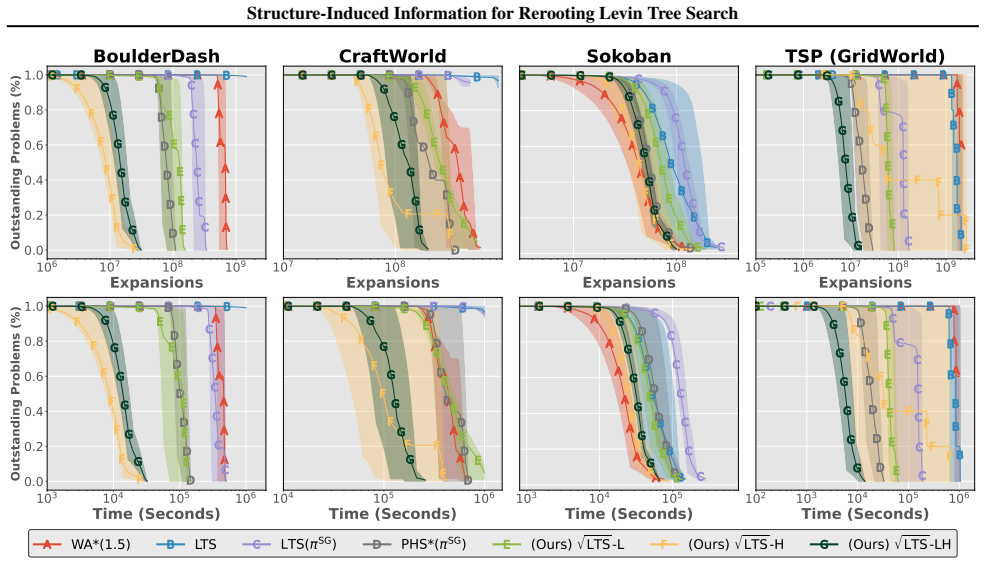
Subgoal-based policy tree search, which uses a policy to guide search, is effective for complex single-agent deterministic problems but often relies on explicit subgoal generation that can incur substantial overhead and hinders scalability. In this paper, we overcome these limitations by using a learned ``rerooter'' through the recently-introduced $\sqrt{\text{LTS}}$ algorithm. A rerooter implicitly decomposes the problem into soft subtasks. While previous work focused on the formal guarantees for given or handcrafted rerooters, in this work we propose three rerooter designs: (i) a clustering-based rerooter that exploits global state-space structure, (ii) a heuristic-based rerooter that leverages learned cost-to-go estimates, and (iii) a hybrid that combines both signals. Our framework avoids having to explicitly reconstruct and reason over generated subgoals, thereby enabling scalable allocation of search effort with significantly lower computational overhead. Empirically, our rerooting-based methods scale to complex environments where subgoal-based policy tree search fails, and achieve state-of-the-art online training efficiency on the domains tested.
Editorial analysis
A structured set of objections, weighed in public.
Referee Report
Summary. The manuscript introduces three learned rerooter designs (clustering-based exploiting global state-space structure, heuristic-based using learned cost-to-go estimates, and a hybrid) for the √LTS algorithm. These implicitly decompose problems into soft subtasks, avoiding explicit subgoal reconstruction and verification overhead. The central claim is that the resulting methods scale to complex environments where subgoal-based policy tree search fails and achieve state-of-the-art online training efficiency on the tested domains.
Significance. If the empirical claims are substantiated with proper isolation of the rerooting mechanism, the work could improve scalability of online search in deterministic single-agent settings by replacing explicit subgoal machinery with structure-induced signals. The explicit proposal of three distinct rerooter variants that combine different sources of information is a constructive addition to prior √LTS results.
major comments (2)
- [Abstract] Abstract: the assertion of empirical scaling and SOTA efficiency supplies no domains, metrics, baselines, statistical tests, or experimental protocol, so the support for the central claim cannot be verified from the provided text.
- [Empirical Evaluation] Empirical results: no ablations, search-tree visualizations, or decomposition-quality metrics are reported that disable the structure-induced rerooting signal while holding the rest of √LTS fixed; without such isolation it is impossible to confirm that performance gains are caused by the implicit decompositions rather than incidental implementation choices.
minor comments (1)
- The three rerooter designs would benefit from explicit pseudocode or equations showing how each maps states to rerooting decisions.
Simulated Author's Rebuttal
We thank the referee for the constructive feedback on our manuscript. We address each major comment below and indicate the revisions we will make to strengthen the paper.
read point-by-point responses
-
Referee: [Abstract] Abstract: the assertion of empirical scaling and SOTA efficiency supplies no domains, metrics, baselines, statistical tests, or experimental protocol, so the support for the central claim cannot be verified from the provided text.
Authors: We agree that the abstract is necessarily concise and omits these specifics. The domains, metrics (including online training efficiency), baselines (subgoal-based policy tree search and prior √LTS variants), and statistical protocol are fully described in the Experimental Evaluation section of the manuscript. To improve standalone readability of the abstract, we will revise it to briefly reference the tested domains and the primary efficiency metric while preserving length constraints. revision: yes
-
Referee: [Empirical Evaluation] Empirical results: no ablations, search-tree visualizations, or decomposition-quality metrics are reported that disable the structure-induced rerooting signal while holding the rest of √LTS fixed; without such isolation it is impossible to confirm that performance gains are caused by the implicit decompositions rather than incidental implementation choices.
Authors: This observation is correct and highlights a gap in causal attribution. The current experiments demonstrate that the three rerooter designs scale where explicit subgoal methods fail and outperform baselines on training efficiency, but they do not include controlled ablations that turn off the structure-induced rerooting signal while freezing all other √LTS components. We will add these ablations (e.g., a null rerooter variant) in the revised version, together with search-tree visualizations and any feasible decomposition-quality metrics, to isolate the contribution of the learned rerooters. revision: yes
Circularity Check
No circularity; empirical claims rest on novel designs evaluated externally
full rationale
The paper proposes three new rerooter designs (clustering, heuristic, hybrid) as additions to the existing √LTS framework from prior work. These designs are described as novel mechanisms for implicit decomposition without explicit subgoal overhead. The central claims are empirical performance gains in complex domains and SOTA training efficiency, which are benchmarked against subgoal-based methods rather than derived tautologically from fitted parameters or self-citations. No equations, predictions, or uniqueness theorems reduce by construction to the paper's own inputs. The cited prior work on formal guarantees serves as background and is not load-bearing for the new empirical results. This is a standard case of incremental empirical contribution with no detectable circular steps.
Axiom & Free-Parameter Ledger
Reference graph
Works this paper leans on
- [1]
-
[2]
J., Zilles, S., and Holte, R
Arfaee, S. J., Zilles, S., and Holte, R. C. Learning heuristic functions for large state spaces.Artificial Intelligence, 175(16-17):2075–2098,
2075
-
[3]
D., Guillaume, J.-L., Lambiotte, R., and Lefeb- vre, E
Blondel, V . D., Guillaume, J.-L., Lambiotte, R., and Lefeb- vre, E. Fast unfolding of communities in large networks. 9 Structure-Induced Information for Rerooting Levin Tree Search Journal of statistical mechanics: theory and experiment, 2008(10),
2008
-
[4]
Kingma, D. P. Adam: A method for stochastic optimization. arXiv preprint arXiv:1412.6980,
work page internal anchor Pith review Pith/arXiv arXiv
- [5]
-
[6]
Successor Options: An Option Discovery Framework for Reinforcement Learning
Ramesh, R., Tomar, M., and Ravindran, B. Successor op- tions: An option discovery framework for reinforcement learning.arXiv preprint arXiv:1905.05731,
work page internal anchor Pith review Pith/arXiv arXiv 1905
-
[7]
Merg- ing Cartesian abstractions for classical planning
Salerno, M., Fuentetaja, R., Speck, D., and Seipp, J. Merg- ing Cartesian abstractions for classical planning. In Lynce, I. and Murano, A. (eds.),Proceedings of the 28th Euro- pean Conference on Artificial Intelligence (ECAI 2025). IOS Press,
2025
-
[8]
Zawalski, M., Tyrolski, M., Czechowski, K., Odrzygó´ zd´ z, T., Stachura, D., Pi˛ ekos, P., Wu, Y ., Kuci ´nski, Ł., and Miło´s, P. Fast and precise: Adjusting planning horizon with adaptive subgoal search.arXiv preprint arXiv:2206.00702,
- [9]
-
[10]
Complete √ LTSAlgorithm with Leiden and Heuristic Rerooters Below details how the √ LTS-L , √ LTS-H , and √ LTS-LH rerooters are integrated into √ LTS search
11 Structure-Induced Information for Rerooting Levin Tree Search A. Complete √ LTSAlgorithm with Leiden and Heuristic Rerooters Below details how the √ LTS-L , √ LTS-H , and √ LTS-LH rerooters are integrated into √ LTS search. The policy πθ and heuristich ω are parameterized by neural networksθandωrespectively. Algorithm 1 √ LTS-L 1:Input:Root noden 1, bu...
2024
-
[11]
Algorithms which use both a policy and heuristic use a single network with two heads
networks. Algorithms which use both a policy and heuristic use a single network with two heads. The networks for W A*, √ LTS-L ,√ LTS-H and √ LTS-LH use 8 blocks of 128 ResNet channels, are trained using the Adam optimizer (Kingma, 2014), with learning rate of 3E-4 and L2-regularization of 1E-4. The baselines LTS(πSG) and PHS*(πSG) are trained following T...
2014
-
[12]
Under this metric, BoulderDash exhibits a clear progression as the domain becomes less structured, CraftWorld remains relatively low, Sokoban and TSP are substantially higher. In Sokoban, this helps explain why the clustering rerooter is less effective than the strongest baselines, and in TSP, the very large value is consistent with the strongest degradat...
2024
discussion (0)
Sign in with ORCID, Apple, or X to comment. Anyone can read and Pith papers without signing in.