Not All Roads Lead to Rome: How VPN Selection Alters What We Measure and Infer about Web Infrastructure
Pith reviewed 2026-06-28 20:34 UTC · model grok-4.3
The pith
Different VPN providers in the same country produce inconsistent measurements of web endpoint locations, hosting, and replicas.
A machine-rendered reading of the paper's core claim, the machinery that carries it, and where it could break.
Core claim
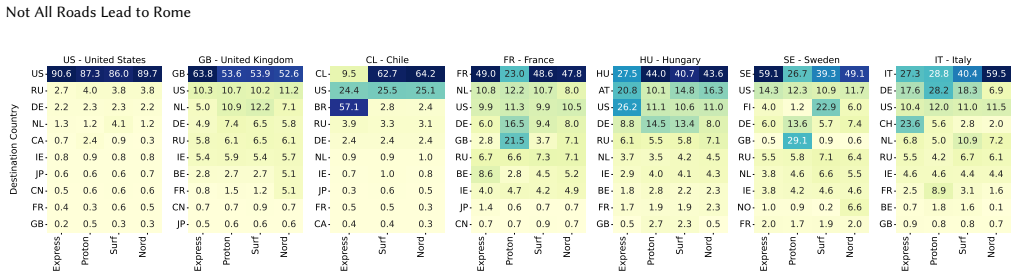
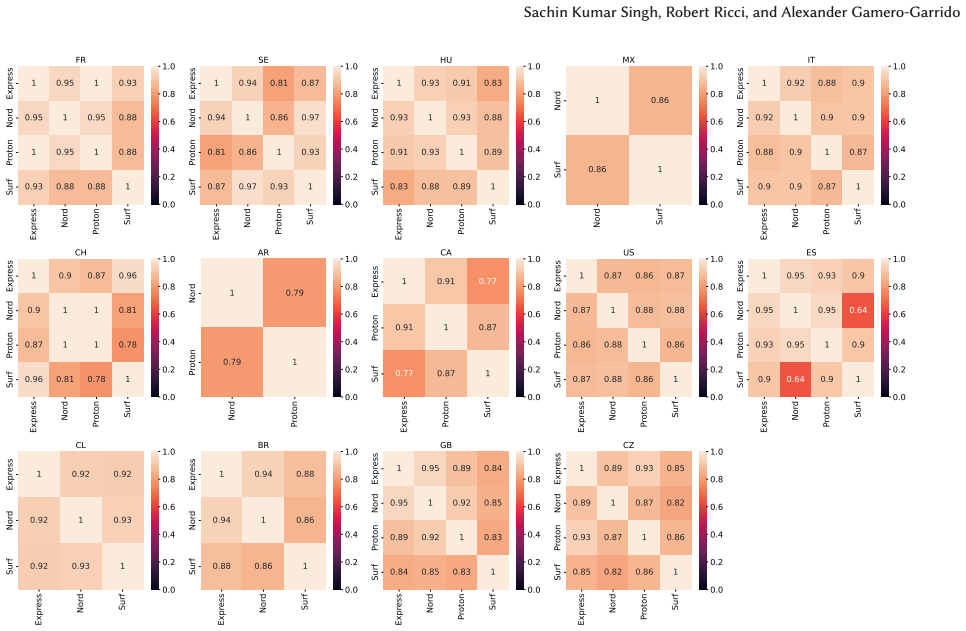
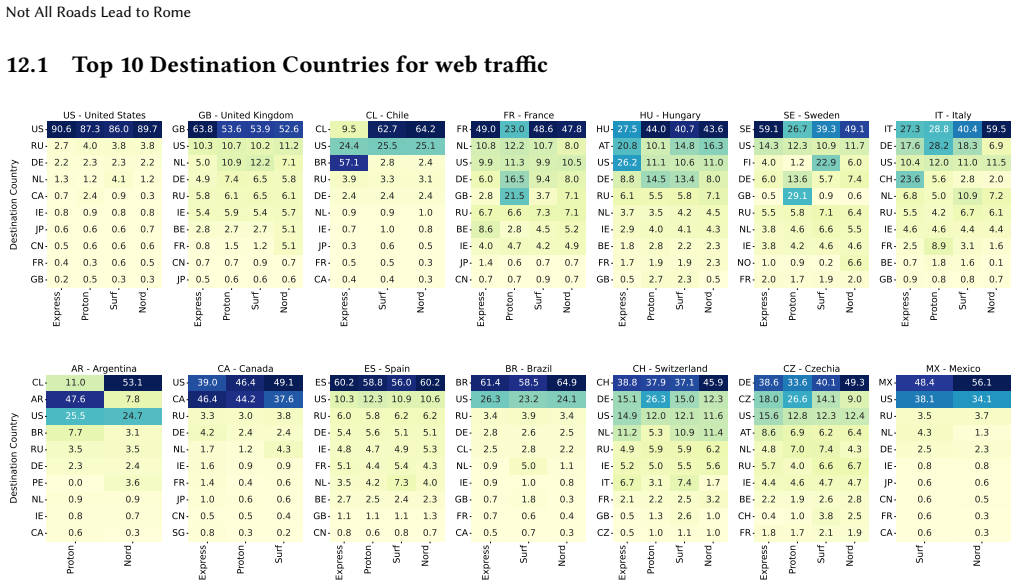
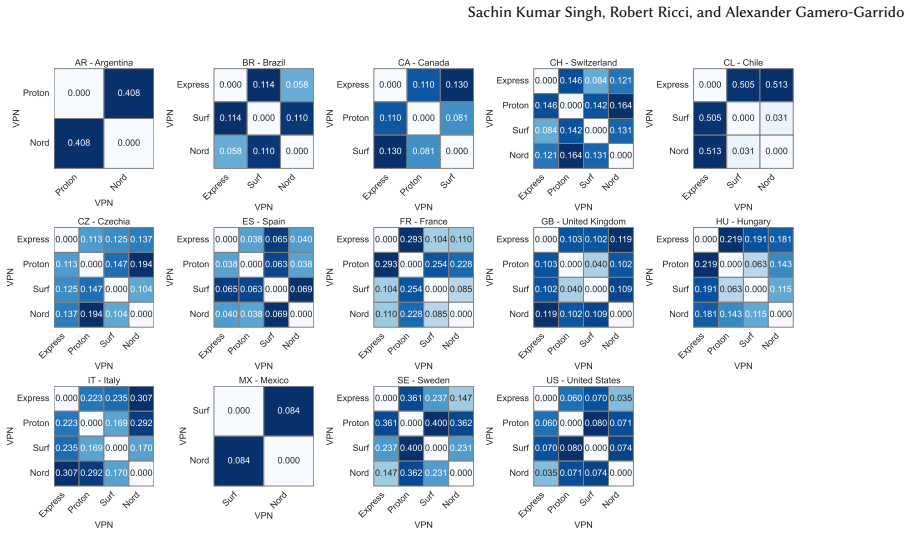
Commercial VPNs cannot be treated as interchangeable vantage points within a country. The same country measured through different providers yields different conclusions about endpoint locations, hosting entities, and physical replicas. This variability is driven primarily by layers below the client: commercial VPN providers operate their own in-country DNS infrastructure that often intercepts queries regardless of client configuration; CDNs steer on the exit network, sending identical queries to different replicas; and peering paths route identical DNS answers to different physical facilities.
What carries the argument
Variability across the vantage identity, name resolution, and replica selection layers of the VPN-to-endpoint path.
If this is right
- Web infrastructure studies that rely on a single VPN per country may reach incomplete or biased conclusions about endpoint distribution and hosting.
- DNS resolution for web queries is frequently controlled by the VPN provider's own infrastructure rather than client settings.
- CDN replica selection depends on the specific exit network of the chosen VPN.
- Peering paths can direct identical DNS responses to different physical facilities.
- Measurement reports should document the specific VPN providers used and consider testing multiple providers.
Where Pith is reading between the lines
- Studies of regional web performance or censorship that use only one VPN per country may systematically understate or overstate certain infrastructure patterns.
- Discrepancies between independent measurement campaigns of the same region could partly trace to unstated differences in VPN choice.
- Direct connections or non-VPN vantage points might be needed to cross-check results when precision about physical replica placement matters.
Load-bearing premise
The large-scale browser-based measurements and targeted probes accurately capture the contributions of vantage identity, name resolution, and replica selection without confounding effects from other parts of the network path.
What would settle it
Finding that different VPN providers in the same country consistently return the same endpoint locations, hosting providers, and replica selections for the same queries would falsify the claim.
Figures
read the original abstract
Web-measurement studies treat commercial VPNs as interchangeable vantage points within a country, assuming that any VPN in a particular country is as good as any other. We show that this assumption does not hold: the same country measured through different VPN providers yields materially different conclusions about where endpoints sit, who hosts them, and which physical replicas serve them. Using large-scale browser-based measurements across fourteen countries and four major VPN providers, complemented by targeted DNS and replica-selection probes, we examine sources of this variability across three layers of the VPN-to-endpoint path: vantage identity, name resolution, and replica selection. We find that the variability is driven primarily by layers below the client: commercial VPN providers operate their own in-country DNS infrastructure, often intercepting queries regardless of client configuration; CDNs steer on the exit network, sending identical queries to different replicas; and peering paths route identical DNS answers to different physical facilities. We distill these findings into a set of reporting practices for VPN-based Web measurement.
Editorial analysis
A structured set of objections, weighed in public.
Referee Report
Summary. The paper claims that commercial VPNs cannot be treated as interchangeable vantage points within the same country for web measurements. Large-scale browser-based measurements across 14 countries and 4 VPN providers, supplemented by targeted DNS and replica-selection probes, show that the same country yields materially different inferences about endpoint locations, hosting, and physical replicas. The authors decompose the variability into three layers (vantage identity, name resolution via VPN DNS interception, and replica selection via CDN exit-network steering and peering paths) and distill the results into recommended reporting practices.
Significance. If the empirical findings hold, the work has clear significance for the network measurement community by demonstrating that VPN choice systematically alters infrastructure inferences. The three-layer decomposition provides a concrete framework for localizing sources of variability, and the combination of browser-based measurements with targeted probes offers a replicable approach. This directly addresses a widespread methodological assumption and supplies actionable guidance for future studies.
major comments (1)
- [Abstract/Methodology] Abstract and methodology description: the claim that differences are driven by the three layers rests on the premise that browser measurements and probes isolate vantage identity, name resolution, and replica selection without confounding path effects, yet no quantitative details are provided on probe volume, statistical tests for cross-VPN differences, or controls for other network variables; this detail is load-bearing for attributing observed variability specifically to the named layers.
minor comments (2)
- The selection criteria for the four VPN providers and fourteen countries are not stated; adding this information would strengthen replicability without altering the central claims.
- Consider including a table summarizing per-country, per-VPN differences in inferred hosting and replica locations to make the scale of the effect more immediately visible.
Simulated Author's Rebuttal
We thank the referee for the constructive feedback and the recommendation of minor revision. We address the single major comment below and will incorporate the requested clarifications into the revised manuscript.
read point-by-point responses
-
Referee: [Abstract/Methodology] Abstract and methodology description: the claim that differences are driven by the three layers rests on the premise that browser measurements and probes isolate vantage identity, name resolution, and replica selection without confounding path effects, yet no quantitative details are provided on probe volume, statistical tests for cross-VPN differences, or controls for other network variables; this detail is load-bearing for attributing observed variability specifically to the named layers.
Authors: We agree that the abstract and methodology description would be strengthened by explicit quantitative details on how the three layers are isolated. The current text describes the browser-based measurements and targeted probes at a high level but does not report probe volumes, the specific statistical tests used, or the controls applied for path effects. In the revision we will add a dedicated paragraph (or subsection) in the methodology that states the total number of browser measurements and targeted probes performed, the statistical procedures (including any tests for cross-VPN differences), and the controls employed (such as fixed client resolver settings, latency measurements, and path tracing) to limit confounding. This addition will make the attribution to vantage identity, name resolution, and replica selection more transparent and reproducible. revision: yes
Circularity Check
No significant circularity
full rationale
The paper presents an empirical measurement study using browser-based tests and targeted DNS/replica probes across 14 countries and 4 VPN providers. No equations, derivations, fitted parameters, or predictions are introduced; all claims rest on direct observation of differences in vantage identity, name resolution, and replica selection. The methodology is constructed to isolate these layers without reducing any result to a self-definition, self-citation chain, or input-by-construction. The work is therefore self-contained against external benchmarks.
Axiom & Free-Parameter Ledger
axioms (1)
- domain assumption Standard assumptions in network measurement studies hold, such as that browser-based probes reflect real user experiences.
Reference graph
Works this paper leans on
-
[1]
Regulation (EU) 2016/679 of the European Parliament and of the Council of 27 April 2016 (General Data Protection Regulation)
2016. Regulation (EU) 2016/679 of the European Parliament and of the Council of 27 April 2016 (General Data Protection Regulation). Official Journal of the European Union L 119. https://eur-lex.europa .eu/eli/reg/2016/679/oj Accessed: 2025-10-01
2016
-
[2]
Regulation (EU) 2022/2065 on a Single Market for Digital Services (Digital Services Act)
2022. Regulation (EU) 2022/2065 on a Single Market for Digital Services (Digital Services Act). Official Journal of the European Union L 277. https://eur-lex.europa.eu/eli/reg/2022/2065/oj Accessed: 2025-10-01
2022
-
[3]
Sadia Afroz, Michael Carl Tschantz, Shaarif Sajid, Shoaib Asif Qazi, Mobin Javed, and Vern Paxson. 2018. Exploring server-side blocking of regions.arXiv preprint arXiv:1805.11606(2018)
work page internal anchor Pith review Pith/arXiv arXiv 2018
-
[4]
Ahrefs. 2025. Ahrefs-Marketing Intelligence Tools Powered by Big Data. https://ahrefs.com. Accessed: 2025-07-21
2025
-
[5]
Waqar Aqeel, Balakrishnan Chandrasekaran, Anja Feldmann, and Bruce M Maggs. 2020. On landing and internal web pages: The strange case of jekyll and hyde in web performance measurement. InProceed- ings of the ACM Internet Measurement Conference. 680–695
2020
-
[6]
RIPE Atlas. [n. d.]. RIPE NCC’s main Internet data measurement system. https://atlas.ripe.net/. Accessed 2025-05-05
2025
-
[7]
Vaibhav Bajpai, Steffie Jacob Eravuchira, and Jürgen Schönwälder
-
[8]
Lessons learned from using the ripe atlas platform for measure- ment research.ACM SIGCOMM Computer Communication Review45, 3 (2015), 35–42
2015
-
[9]
Timothy Barron and Nick Nikiforakis. 2017. Picky attackers: Quantify- ing the role of system properties on intruder behavior. InProceedings of the 33rd annual computer security applications conference. 387–398
2017
-
[10]
Ignacio Bermudez, Stefano Traverso, Marco Mellia, and Maurizio Mu- nafo. 2013. Exploring the cloud from passive measurements: The Amazon AWS case. In2013 Proceedings IEEE INFOCOM. IEEE, 230– 234
2013
-
[11]
2024.Measuring and Understanding TTL Violations in DNS Resolvers
Protick Bhowmick. 2024.Measuring and Understanding TTL Violations in DNS Resolvers. Ph. D. Dissertation. Virginia Tech
2024
-
[12]
Bright Data. 2025. Bright Data (formerly Luminati). https://brightda ta.com. Accessed: 2025-07-29
2025
-
[13]
Michael Butkiewicz, Harsha V Madhyastha, and Vyas Sekar. 2011. Understanding website complexity: measurements, metrics, and im- plications. InProceedings of the 2011 ACM SIGCOMM conference on Internet measurement conference. 313–328
2011
-
[14]
CAIDA. [n. d.]. Archipelago (Ark): CAIDA’s active measurement infrastructure serving the network research. https://www.caida.org/ projects/ark/locations/. Accessed 2025-05-05
2025
-
[15]
CAIDA. 2014. The CAIDA UCSD AS to Organization Mapping Dataset. https://www.caida.org/catalog/datasets/as-organizations/
2014
-
[16]
Patricia Callejo, Marco Gramaglia, Ruben Cuevas, and Angel Cuevas
-
[17]
A deep dive into the accuracy of IP Geolocation Databases and its impact on online advertising.IEEE Transactions on Mobile Computing22, 8 (2022), 4359–4373
2022
-
[18]
Darion Cassel, Su-Chin Lin, Alessio Buraggina, William Wang, An- drew Zhang, Lujo Bauer, Hsu-Chun Hsiao, Limin Jia, and Timothy Libert. 2022. Omnicrawl: Comprehensive measurement of web track- ing with real desktop and mobile browsers.Proceedings on Privacy Enhancing Technologies(2022)
2022
-
[19]
Rishabh Chhabra, Paul Murley, Deepak Kumar, Michael Bailey, and Gang Wang. 2021. Measuring DNS-over-HTTPS Performance around the World. InProceedings of the 21st ACM Internet Measurement Con- ference. 351–365
2021
-
[20]
Jinchun Choi, Mohammed Abuhamad, Ahmed Abusnaina, Afsah An- war, Sultan Alshamrani, Jeman Park, Daehun Nyang, and David Mo- haisen. 2020. Understanding the proxy ecosystem: A comparative analysis of residential and open proxies on the internet.IEEE Access8 (2020), 111368–111380
2020
-
[21]
2024.Overview of CrUX
Chrome for Developers. 2024.Overview of CrUX. https://developer. chrome.com/docs/crux
2024
-
[22]
Taejoong Chung, David Choffnes, and Alan Mislove. 2016. Tunneling for transparency: A large-scale analysis of end-to-end violations in the internet. InProceedings of the 2016 Internet Measurement Conference. 199–213
2016
-
[23]
Danilo Cicalese, Jordan Augé, Diana Joumblatt, Timur Friedman, and Dario Rossi. 2015. Characterizing IPv4 anycast adoption and deploy- ment. InProceedings of the 11th ACM Conference on Emerging Network- ing Experiments and Technologies. 1–13
2015
-
[24]
Cloudflare. 2025. Cloudflare Radar - Domain Rankings. https://radar. cloudflare.com/domains. Accessed: 2025-07-21
2025
-
[25]
Carlo Contavalli, Wilmer van der Gaast, David C Lawrence, and Warren Kumari. 2016. Client Subnet in DNS Queries. RFC 7871. doi:10.17487/RFC7871
-
[26]
Casey Deccio, Jeff Sedayao, Krishna Kant, and Prasant Mohapatra
-
[27]
In2010 Proceedings IEEE INFOCOM
Measuring availability in the domain name system. In2010 Proceedings IEEE INFOCOM. IEEE, 1–5
-
[28]
Martin Degeling, Christine Utz, Christopher Lentzsch, Henry Hosseini, Florian Schaub, and Thorsten Holz. 2018. We value your privacy... now take some cookies: Measuring the GDPR’s impact on web privacy. arXiv preprint arXiv:1808.05096(2018)
work page internal anchor Pith review Pith/arXiv arXiv 2018
-
[29]
Trinh Viet Doan, Roland van Rijswijk-Deij, Oliver Hohlfeld, and Vaib- hav Bajpai. 2022. An empirical view on consolidation of the web.ACM Transactions on Internet Technology (TOIT)22, 3 (2022), 1–30
2022
-
[30]
Dmitry Duplyakin, Robert Ricci, Aleksander Maricq, Gary Wong, Jonathon Duerig, Eric Eide, Leigh Stoller, Mike Hibler, David John- son, Kirk Webb, Aditya Akella, Kuangching Wang, Glenn Ricart, Larry Landweber, Chip Elliott, Michael Zink, Emmanuel Cecchet, Snigdhaswin Kar, and Prabodh Mishra. 2019. The Design and Op- eration of CloudLab. InProceedings of th...
2019
-
[31]
Rob van Eijk, Hadi Asghari, Philipp Winter, and Arvind Narayanan
-
[32]
InWorkshop on Technology and Consumer Protection (ConPro’19)
The impact of user location on cookie notices (inside and outside of the European union). InWorkshop on Technology and Consumer Protection (ConPro’19)
-
[33]
Alexander Gamero-Garrido, Kicho Yu, Sumukh Vasisht Shankar, Sachin Kumar Singh, Sindhya Balasubramanian, Alexander Wilcox, and David Choffnes. 2025. Empirically Measuring Data Localization in the EU. InProceedings on Privacy Enhancing Technologies (PoPETs)
2025
-
[34]
Andreas Guillot, Romain Fontugne, Philipp Winter, Pascal Merindol, Alistair King, Alberto Dainotti, and Cristel Pelsser. 2019. Chocolatine: Outage detection for internet background radiation. In2019 Network Traffic Measurement and Analysis Conference (TMA). IEEE, 1–8
2019
-
[35]
Muhammad Yasir Muzayan Haq, Mattijs Jonker, Rol Van Rijswijk-Deij, Kimberly C Claffy, Lambert JM Nieuwenhuis, and Abhishta Abhishta
-
[36]
In2022 IEEE European Sympo- sium on Security and Privacy Workshops (EuroS&PW)
No time for downtime: understanding post-attack behaviors by customers of managed DNS providers. In2022 IEEE European Sympo- sium on Security and Privacy Workshops (EuroS&PW). IEEE, 322–331
-
[37]
Nguyen Phong Hoang, Sadie Doreen, and Michalis Polychronakis
-
[38]
In9th USENIX Workshop on Free and Open Communications on the Internet (FOCI 19)
Measuring {I2P} censorship at a global scale. In9th USENIX Workshop on Free and Open Communications on the Internet (FOCI 19)
-
[39]
Bradley Huffaker, Marina Fomenkov, and KC Claffy. 2011. Geocom- pare: a comparison of public and commercial geolocation databases. Proc. NMMC(2011), 1–12
2011
-
[40]
Costas Iordanou, Georgios Smaragdakis, Ingmar Poese, and Nikolaos Laoutaris. 2018. Tracing cross border web tracking. InProceedings of 14 Not All Roads Lead to Rome the internet measurement conference 2018. 329–342
2018
-
[41]
2025.IPinfo - The Trusted Source For IP Address Data
IPinfo.io. 2025.IPinfo - The Trusted Source For IP Address Data. https: //ipinfo.io
2025
-
[42]
Lin Jin, Shuai Hao, Haining Wang, and Chase Cotton. 2021. Under- standing the practices of global censorship through accurate, end- to-end measurements.Proceedings of the ACM on Measurement and Analysis of Computing Systems5, 3 (2021), 1–25
2021
-
[43]
Jordan Jueckstock, Shaown Sarker, Peter Snyder, Panagiotis Pa- padopoulos, Matteo Varvello, Benjamin Livshits, and Alexandros Kapravelos. 2019. The blind men and the internet: Multi-vantage point web measurements.arXiv preprint arXiv:1905.08767(2019)
work page internal anchor Pith review Pith/arXiv arXiv 2019
-
[44]
Arash Molavi Kakhki, Samuel Jero, David Choffnes, Cristina Nita- Rotaru, and Alan Mislove. 2017. Taking a long look at QUIC: an ap- proach for rigorous evaluation of rapidly evolving transport protocols. Inproceedings of the 2017 internet measurement conference. 290–303
2017
-
[45]
Aqsa Kashaf, Vyas Sekar, and Yuvraj Agarwal. 2020. Analyzing third party service dependencies in modern web services: Have we learned from the mirai-dyn incident?. InProceedings of the ACM Internet Mea- surement Conference. 634–647
2020
-
[46]
Ethan Katz-Bassett, John P John, Arvind Krishnamurthy, David Wetherall, Thomas Anderson, and Yatin Chawathe. 2006. Towards IP geolocation using delay and topology measurements. InProceedings of the 6th ACM SIGCOMM conference on Internet measurement. 71–84
2006
-
[47]
Etienne Khan, Anna Sperotto, Jeroen van der Ham, and Roland van Rijswijk-Deij. 2023. Stranger VPNs: Investigating the geo-unblocking capabilities of commercial VPN providers. InInternational Conference on Passive and Active Network Measurement. Springer, 46–68
2023
-
[48]
Mohammad Taha Khan, Joe DeBlasio, Geoffrey M Voelker, Alex C Snoeren, Chris Kanich, and Narseo Vallina-Rodriguez. 2018. An em- pirical analysis of the commercial vpn ecosystem. InProceedings of the internet measurement conference 2018. 443–456
2018
-
[49]
Rashna Kumar, Sana Asif, Elise Lee, and Fabián E. Bustamante. 2023. Each at its Own Pace: Third-Party Dependency and Centralization Around the World. InProceedings of the ACM SIGMETRICS Interna- tional Conference on Measurement and Modeling of Computer Systems. ACM. doi:10.1145/3579437
-
[50]
Rashna Kumar, Esteban Carisimo, Lukas De Angelis Riva, Mauricio Buzzone, Fabi’an E Bustamante, Ihsan Ayyub Qazi, and Mariano G Beiró. 2024. Of Choices and Control-A Comparative Analysis of Government Hosting. InProceedings of the 2024 ACM on Internet Mea- surement Conference. 462–479
2024
-
[51]
Hyunwoo Lee, Doowon Kim, and Yonghwi Kwon. 2021. TLS 1.3 in practice: How TLS 1.3 contributes to the internet. InProceedings of the Web Conference 2021. 70–79
2021
-
[52]
Kevin Lee, Sten Sjöberg, and Arvind Narayanan. 2022. Password policies of most top websites fail to follow best practices. InEighteenth Symposium on Usable Privacy and Security (SOUPS 2022). 561–580
2022
-
[53]
Timothy Libert. 2015. Exposing the hidden web: An analysis of third-party HTTP requests on 1 million websites.arXiv preprint arXiv:1511.00619(2015)
work page internal anchor Pith review Pith/arXiv arXiv 2015
-
[54]
Aniss Maghsoudlou, Lukas Vermeulen, Ingmar Poese, and Oliver Gasser. 2023. Characterizing the VPN Ecosystem in the Wild. In International Conference on Passive and Active Network Measurement. Springer, 18–45
2023
-
[55]
Allison McDonald, Matthew Bernhard, Luke Valenta, Benjamin Van- derSloot, Will Scott, Nick Sullivan, J Alex Halderman, and Roya Ensafi
-
[56]
InProceedings of the Internet Measurement Conference 2018
403 forbidden: a global view of CDN geoblocking. InProceedings of the Internet Measurement Conference 2018. 218–230
2018
-
[57]
MeasurementLab. [n. d.]. Measurement Lab: Measure the Internet, save the data, and make it universally accessible and useful. https: //www.measurementlab.net/status/. Accessed 2025-05-05
2025
-
[58]
Xianghang Mi, Xuan Feng, Xiaojing Liao, Baojun Liu, XiaoFeng Wang, Feng Qian, Zhou Li, Sumayah Alrwais, Limin Sun, and Ying Liu. 2019. Resident evil: Understanding residential ip proxy as a dark service. In 2019 IEEE symposium on security and privacy (SP). IEEE, 1185–1201
2019
-
[59]
Ricky KP Mok, Hongyu Zou, Rui Yang, Tom Koch, Ethan Katz-Bassett, and Kimberly C Claffy. 2021. Measuring the network performance of google cloud platform. InProceedings of the 21st ACM internet measurement conference. 54–61
2021
-
[60]
Arian Akhavan Niaki, Shinyoung Cho, Zachary Weinberg, Nguyen Phong Hoang, Abbas Razaghpanah, Nicolas Christin, and Phillipa Gill. 2020. ICLab: A global, longitudinal internet censorship measurement platform. In2020 IEEE symposium on security and privacy (SP). IEEE, 135–151
2020
-
[61]
NLNOG. [n. d.]. NLNOG RING. https://ring.nlnog.net/nodes/. Accessed 2025-05-05
2025
-
[62]
Daiyuu Nobori and Yasushi Shinjo. 2014. VPN Gate: A Volunteer Organized Public VPN Relay System with Blocking Resistance for Bypassing Government Censorship Firewalls. In11th USENIX Sym- posium on Networked Systems Design and Implementation (NSDI 14). 229–241
2014
-
[63]
OpenAI. 2023. ChatGPT. https://openai.com/chatgpt. Accessed: 2025-07-29
2023
-
[64]
Oxylabs. 2025. Oxylabs - High Quality Proxy Service to Gather Data at Scale. https://oxylabs.io. Accessed: 2025-07-29
2025
-
[65]
Paul Pearce, Ben Jones, Frank Li, Roya Ensafi, Nick Feamster, Nick Weaver, and Vern Paxson. 2017. Global measurement of {DNS} ma- nipulation. In26th USENIX Security Symposium (USENIX Security 17). 307–323
2017
-
[66]
PlanetLab. [n. d.]. PlanetLab EU Testbed. https://www.planet-lab.eu/. Accessed 2025-05-05
2025
-
[67]
Reethika Ramesh, Leonid Evdokimov, Diwen Xue, and Roya Ensafi
-
[68]
InProceedings of the 29th Network and Distributed System Security Symposium (NDSS)
VPNalyzer: Systematic Investigation of the VPN Ecosystem. InProceedings of the 29th Network and Distributed System Security Symposium (NDSS). Internet Society. doi:10.14722/ndss.2022.24285
-
[69]
Reethika Ramesh, Philipp Winter, Sam Korman, and Roya Ensafi. 2024. CalcuLatency: Leveraging Cross-Layer Network Latency Measure- ments to Detect Proxy-Enabled Abuse. InProceedings of the 33rd USENIX Security Symposium. USENIX Association. https://www. usenix.org/conference/usenixsecurity24/presentation/ramesh
2024
-
[70]
Philipp Richter, Ramakrishna Padmanabhan, Neil Spring, Arthur Berger, and David Clark. 2018. Advancing the art of internet edge out- age detection. InProceedings of the Internet Measurement Conference
2018
-
[71]
Sebastian Roth, Stefano Calzavara, Moritz Wilhelm, Alvise Rabitti, and Ben Stock. 2022. The Security Lottery: Measuring {Client-Side} Web Security Inconsistencies. In31st USENIX Security Symposium (USENIX Security 22). 2047–2064
2022
-
[72]
Tomer Schwartz, Ofir Manor, and Andikan Otung. 2025. SNITCH: Leveraging IP Geolocation for Active VPN Detection. InWorkshop on Measurements, Attacks, and Defenses for the Web (MADWeb). NDSS Symposium. doi:10.14722/madweb.2025.23008
-
[73]
Semrush. 2025. Semrush: Data-Driven Marketing Tools to Grow Your Business. https://www.semrush.com. Accessed: 2025-07-21
2025
-
[74]
Pavlos Sermpezis, Lars Prehn, Sofia Kostoglou, Marcel Flores, Athena Vakali, and Emile Aben. 2023. Bias in internet measurement plat- forms. In2023 7th Network Traffic Measurement and Analysis Confer- ence (TMA). IEEE, 1–10
2023
-
[75]
Similarweb. 2025. Similarweb: AI-Powered Digital Data Intelligence Solutions. https://www.similarweb.com. Accessed: 2025-07-21
2025
-
[76]
Rachee Singh, Arun Dunna, and Phillipa Gill. 2018. Characterizing the deployment and performance of multi-cdns. InProceedings of the Internet Measurement Conference 2018. 168–174. 15 Sachin Kumar Singh, Robert Ricci, and Alexander Gamero-Garrido
2018
-
[77]
Sachin Kumar Singh, Robert Ricci, and Alexander Gamero-Garrido
-
[78]
InProceedings of the 2025 ACM Internet Measurement Conference
Where in the World Are My Trackers? Mapping Web Tracking Flow Across Diverse Geographic Regions. InProceedings of the 2025 ACM Internet Measurement Conference. 692–708
2025
-
[79]
2024.Page Weight
Dave Smart and Jamie Indigo. 2024.Page Weight. HTTP Archive. https://almanac.httparchive.org/en/2024/page-weight Accessed: 2025-10-01
2024
-
[80]
Raffaele Sommese, Leandro Bertholdo, Gautam Akiwate, Mattijs Jonker, Roland van Rijswijk-Deij, Alberto Dainotti, Kimberly C Claffy, and Anna Sperotto. 2020. Manycast2: Using anycast to measure any- cast. InProceedings of the ACM Internet Measurement Conference. 456– 463
2020
discussion (0)
Sign in with ORCID, Apple, or X to comment. Anyone can read and Pith papers without signing in.