Where's Waldo Library? Using Reverse IP Geolocation to Identify Library IPs
Pith reviewed 2026-06-28 20:29 UTC · model grok-4.3
The pith
Reverse IP geolocation maps roughly half of US public libraries to their IP prefixes from street addresses
A machine-rendered reading of the paper's core claim, the machinery that carries it, and where it could break.
Core claim
The authors show that combining IP geolocation databases with library street addresses yields candidate IP sets that can be refined with PTR records, WHOIS registrations, provider data, and active probes to correctly identify the IP prefixes serving libraries in approximately half of cases, with geographic coverage spanning all US states and both urban and rural settings.
What carries the argument
Reverse IP Geolocation, which starts from known physical addresses to locate matching IP ranges in geolocation databases and validates the assignment to the specific institution using DNS, WHOIS, and measurements.
If this is right
- Scalable remote measurement of internet service quality at libraries across the US becomes possible without individual site cooperation.
- Policy evaluation of broadband access for unserved communities gains a new source of data based on library connectivity.
- The same address-to-IP mapping process can be applied to other community anchor institutions that have publicly known addresses.
- Repeated runs of the method can track changes in which IP prefixes are assigned to libraries over time.
Where Pith is reading between the lines
- The technique could be tested on schools or community centers if their address lists are similarly public and complete.
- Higher accuracy in commercial geolocation databases would directly raise the fraction of libraries that can be mapped.
- Once the IPs are known, the same addresses could support ongoing passive monitoring of performance at these sites.
Load-bearing premise
Commercial geolocation databases produce candidate IP sets that are sufficiently accurate and complete to allow reliable identification of IPs serving specific known physical addresses of libraries.
What would settle it
A validation study that checks the candidate IPs against independent records or active probes and finds correct library matches in substantially fewer than half the cases would falsify the reported success rate.
Figures

read the original abstract
Community anchor institutions (CAIs), such as libraries, schools, and community centers, are critical for providing Internet access to un- or under-served individuals and communities. Because many of these institutions are themselves under-provisioned, analyzing the reliability and quality of their Internet service is important. Doing so at scale requires knowing the IP addresses of these institutions so that broadband measurement and policy evaluation can occur. Unfortunately, these IPs are not systematically documented. As a first step towards widespread, scalable evaluation of CAI Internet connectivity, this paper presents Reverse IP Geolocation (RG), a new framework to infer IP addresses from physical address data. A key insight is that CAI street addresses are publicly known, which allows us to identify a candidate set of IPs from commercial geolocation that are likely serving the location associated with a CAI. In this paper, \textbf{we focus on US public libraries}, which offer both geographic diversity across thousands of locations, and some publicly available institutional records (\eg{}WHOIS registrations) that enable systematic validation of our approach. Our approach offers a novel integration of IP geolocation databases, DNS PTR records, WHOIS registrations, broadband provider data, and active measurements to identify IPs likely assigned to libraries and validate them. Based on evaluations, our approach can map a library to its IP prefix approx. half of the time, with coverage across all US states, as well as urban and rural areas. Our results highlight the feasibility of mapping CAI presence in IP space and offer a foundation for large-scale, remote broadband infrastructure evaluation.
Editorial analysis
A structured set of objections, weighed in public.
Referee Report
Summary. The paper introduces Reverse IP Geolocation (RG), a framework to infer IP addresses of US public libraries from known physical street addresses. It queries commercial geolocation databases to generate candidate IP sets, then integrates DNS PTR records, WHOIS registrations, broadband provider data, and active measurements to identify and validate library-assigned IPs. The central claim is that this maps a library to its IP prefix approximately half the time, with coverage across all US states and both urban and rural areas.
Significance. If the results hold, the work offers a scalable approach to identify IP addresses for community anchor institutions, enabling large-scale remote evaluation of their broadband connectivity and supporting policy analysis in underserved regions. The integration of multiple data sources and the choice of libraries (with available WHOIS records for validation) are appropriate strengths; the claimed geographic breadth adds to potential utility.
major comments (2)
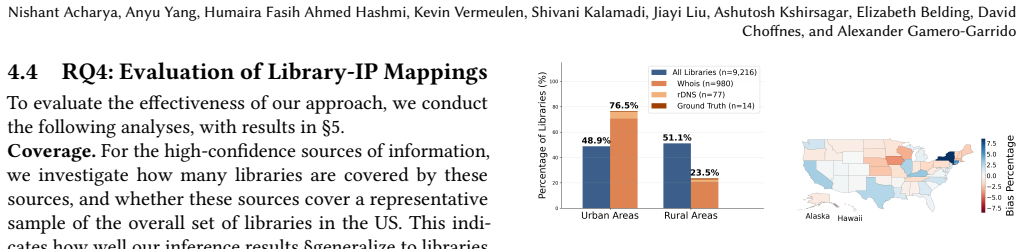
- [Abstract and evaluation section] Abstract and evaluation section: The claim of an approximately 50% mapping success rate is presented without details on the total number of libraries considered, the criteria for selecting candidates from commercial geolocation databases, the validation methodology against ground truth, error analysis, or dataset characteristics. This prevents verification of the data-to-claim linkage and is load-bearing for the paper's primary contribution.
- [Framework description (likely §3)] Framework description (likely §3): The method begins by querying commercial geolocation databases with library addresses to produce candidate IP sets. No analysis, quantification, or discussion is provided of the accuracy, completeness, or error rates of these databases for library locations (e.g., due to coarse granularity or outdated records). This assumption is load-bearing because the subsequent DNS/WHOIS/active measurement steps cannot recover correct mappings if the true library IPs are absent from the initial candidate sets.
minor comments (1)
- [Abstract] The abstract uses the acronym CAI without spelling it out on first use, though it is expanded later in the text.
Simulated Author's Rebuttal
We thank the referee for the constructive review and the opportunity to clarify and strengthen the manuscript. We address each major comment below, agreeing that additional details are needed for verifiability, and commit to revisions that directly incorporate the requested information without altering the core claims or methodology.
read point-by-point responses
-
Referee: [Abstract and evaluation section] Abstract and evaluation section: The claim of an approximately 50% mapping success rate is presented without details on the total number of libraries considered, the criteria for selecting candidates from commercial geolocation databases, the validation methodology against ground truth, error analysis, or dataset characteristics. This prevents verification of the data-to-claim linkage and is load-bearing for the paper's primary contribution.
Authors: We agree that the abstract and evaluation section require expanded details to support verification of the ~50% success rate. In the revised manuscript, we will update the abstract and add a dedicated evaluation subsection specifying: the total number of libraries considered (all US public libraries with publicly listed street addresses), candidate selection criteria from commercial geolocation databases (IPs within a fixed radius of the address, ranked by proximity), the validation methodology (cross-check against WHOIS records for libraries with documented institutional ownership as ground truth), a summary error analysis (false positive/negative rates from the multi-source filtering), and dataset characteristics (geographic distribution across states and urban/rural splits). This directly addresses the data-to-claim linkage. revision: yes
-
Referee: [Framework description (likely §3)] Framework description (likely §3): The method begins by querying commercial geolocation databases with library addresses to produce candidate IP sets. No analysis, quantification, or discussion is provided of the accuracy, completeness, or error rates of these databases for library locations (e.g., due to coarse granularity or outdated records). This assumption is load-bearing because the subsequent DNS/WHOIS/active measurement steps cannot recover correct mappings if the true library IPs are absent from the initial candidate sets.
Authors: We acknowledge the gap in analyzing the commercial geolocation databases' accuracy, completeness, and error rates for library locations, which is a load-bearing assumption. In the revised framework description (§3), we will add a new subsection quantifying database performance on our library address set (e.g., fraction of libraries yielding at least one candidate IP, precision estimates from validated cases), discussing error sources such as coarse granularity (particularly in rural areas) and outdated records, and explaining the impact on downstream steps. We will also note limitations where true IPs may be absent from candidates and how the integration of DNS PTR, WHOIS, and active measurements provides partial mitigation. revision: yes
Circularity Check
No circularity; method integrates external commercial databases and records without self-referential definitions or fitted predictions.
full rationale
The paper presents a framework (RG) that queries commercial geolocation databases with known library street addresses to generate candidate IP sets, then integrates DNS PTR, WHOIS, broadband provider data, and active measurements for validation. No equations, parameters fitted to subsets of data, or predictions that reduce to inputs by construction appear. Central claim (mapping ~50% of libraries to IP prefixes with broad coverage) rests on the external accuracy of commercial geo DBs rather than any self-definition or self-citation chain. This is a standard data-integration approach whose validity is falsifiable against ground-truth library records outside the paper.
Axiom & Free-Parameter Ledger
axioms (1)
- domain assumption Commercial IP geolocation databases produce candidate IP sets that are sufficiently accurate and complete to allow reliable identification of IPs serving specific known physical addresses of libraries.
Reference graph
Works this paper leans on
-
[1]
American Registry for Internet Numbers. 2026. Whois-RWS API documentation. https://www.arin.net/resources/registry/whois/rws/ api/. (Accessed on 04/15/2026)
2026
-
[2]
Michael Bailey, David Dittrich, Erin Kenneally, and Doug Maughan
-
[3]
The menlo report.IEEE Security & Privacy10, 2 (2012), 71–75
2012
-
[4]
Annika Baumann and Benjamin Fabian. 2014. Who Runs the Internet? - Classifying Autonomous Systems into Industries. InWEBIST
2014
-
[5]
Census Beurau
U.S. Census Beurau. 2022. Urban and Rural. (2022). https://www.ce nsus.gov/programs-surveys/geography/guidance/geo-areas/urban- rural.html
2022
-
[6]
Bloomberg Law. 2022. Lack of Internet, Web Accessibility Harm Employment for Disabled. https://news.bloomberglaw.com/daily- labor-report/lack-of-internet-web-accessibility-harm-employment- for-disabled. (Accessed on 04/15/2026)
2022
-
[7]
Census Bureau
U.S. Census Bureau. 2024. TIGER/Line Shapefiles. https://www.census .gov/geographies/mapping-files/time-series/geo/tiger-line-file.html
2024
-
[8]
Esteban Carisimo, Alexander Gamero-Garrido, Alex C Snoeren, and Alberto Dainotti. 2021. Identifying ASes of State-Owned Internet Oper- ators. InProceedings of the 21st ACM Internet Measurement Conference. 687–702
2021
-
[9]
Bhaskar Chakravorti. 2021. How to Close the Digital Divide in the U.S.Harvard Business Review(Jul 2021). https://hbr.org/2021/07/how- to-close-the-digital-divide-in-the-u-s (Accessed on 04/14/2026)
2021
-
[10]
Leslie Daigle. 2004. WHOIS Protocol Specification. RFC 3912. doi:10 .17487/RFC3912
2004
-
[11]
Ovidiu Dan, Vaibhav Parikh, and Brian D Davison. 2021. IP geolo- cation using traceroute location propagation and IP range location interpolation. InCompanion Proceedings of the Web Conference 2021. 332–338
2021
-
[12]
Omar Darwich, Hugo Rimlinger, Milo Dreyfus, Matthieu Gouel, and Kevin Vermeulen. 2023. Replication: Towards a Publicly Available Internet Scale IP Geolocation Dataset. InProceedings of the 2023 ACM on Internet Measurement Conference. 1–15
2023
- [13]
-
[14]
Lisa J Dettling. 2017. Broadband in the labor market: The impact of residential high-speed internet on married women’s labor force participation.Ilr Review70, 2 (2017), 451–482
2017
-
[15]
Amogh Dhamdhere, David D Clark, Alexander Gamero-Garrido, Matthew Luckie, Ricky KP Mok, Gautam Akiwate, Kabir Gogia, Vaib- hav Bajpai, Alex C Snoeren, and Kc Claffy. 2018. Inferring persistent interdomain congestion. InProceedings of the 2018 Conference of the ACM Special Interest Group on Data Communication. 1–15
2018
-
[16]
2015.Anchor Institutions
Nevena Dragicevic. 2015.Anchor Institutions. Technical Report. Mowat Centre, University of Toronto. https://tspace.library.utoronto.ca/han dle/1807/80124
2015
-
[17]
Chaiyachati, and Daniel Polsky
Coleman Drake, Yuehan Zhang, Krisda H. Chaiyachati, and Daniel Polsky. 2019. The Limitations of Poor Broadband Internet Access for Telemedicine Use in Rural America: An Observational Study.Annals of internal medicine171, 5 (2019), 382–384
2019
-
[18]
Ben Du, Massimo Candela, Bradley Huffaker, Alex C Snoeren, and KC Claffy. 2020. RIPE IPmap active geolocation: Mechanism and performance evaluation.ACM SIGCOMM Computer Communication Review50, 2 (2020), 3–10
2020
-
[19]
Ben Du, Romain Fontugne, Cecilia Testart, Alex C Snoeren, and kc claffy. 2024. Sublet Your Subnet: Inferring IP Leasing in the Wild. InProceedings of the 2024 ACM on Internet Measurement Conference. 328–336
2024
-
[20]
Arun Dunna, Zachary Bischof, and Romain Fontugne. 2020. Sanitizing a View of Consumer Broadband in the United States. In2020 Network Traffic Measurement and Analysis Conference (TMA). 1–9
2020
-
[21]
Exactly Labs. 2025. Exactly Labs. https://www.exactlylabs.com/. Accessed: 2026-04-23
2025
-
[22]
Federal Communications Commission. 2025. Broadband Data Collec- tion. https://www.fcc.gov/BroadbandData. Accessed: 2025-06-05
2025
-
[23]
Federal Communications Commission. 2026. Measuring Broadband America. https://www.fcc.gov/general/measuring-broadband- america. (Accessed on 04/14/2026). 14 Where’s Waldo Library?
2026
-
[24]
Federal Communications Commission. 2026. National Broadband Map. https://broadbandmap.fcc.gov/. Snapshot: June 2025 BDC, Accessed: 2026-04-26
2026
-
[25]
Manaf Gharaibeh, Anant Shah, Bradley Huffaker, Han Zhang, Roya Ensafi, and Christos Papadopoulos. 2017. A look at router geolocation in public and commercial databases. InProceedings of the 2017 Internet Measurement Conference. 463–469
2017
-
[26]
Bamba Gueye, Artur Ziviani, Mark Crovella, and Serge Fdida. 2004. Constraint-based geolocation of internet hosts. InProceedings of the 4th ACM SIGCOMM conference on Internet measurement. 288–293
2004
-
[27]
Ken Harrenstien, Mary Stahl, and Elizabeth Feinler. 1985. NIC- NAME/WHOIS. RFC 954. doi:10.17487/RFC0954
-
[28]
Bracey Harris. 2020. Homework in a McDonald’s Parking Lot: Inside One Mother’s Fight to Help Her Kids Get an Education During Coro- navirus.HuffPost(Jun 2020). https://www.huffpost.com/entry/missis sippi-delta-coronavirus_n_5ef5120cc5b612083c4ae75b (Accessed on 04/14/2026.)
2020
-
[29]
Zi Hu, John Heidemann, and Yuri Pradkin. 2012. Towards geoloca- tion of millions of IP addresses. InProceedings of the 2012 Internet Measurement Conference. 123–130
2012
-
[30]
Institute of Museum and Library Services. 2021. FY 2019 Public Libraries Survey (PLS) Data. https://www.imls.gov/research- evaluation/surveys-data/public-libraries-survey/report-your- pls-data/fy-2019-pls-data. Accessed: June 5, 2025
2021
-
[31]
Institute of Museum and Library Services. 2026. Institute of Museum and Library Services. https://www.imls.gov. Accessed: April 7, 2026
2026
-
[32]
IPinfo. 2026. Internet-connected service hosting IP address. https: //ipinfo.io/tags/hosting. (Accessed on 04/15/2026)
2026
-
[33]
IPinfo. 2026. Reverse DNS IP Lookup API. https://ipinfo.io/products/ip- to-hosted-domains-api. Accessed: 2026-04-29
2026
-
[34]
IPinfo. 2026. The Trusted Source For IP Address Data. https://ipinfo.io/. (Accessed on 04/15/2026)
2026
- [35]
-
[36]
Katherine Izhikevich, Ben Du, Sumanth Rao, Alisha Ukani, and Liz Izhikevich. 2025. https://github.com/kizhikevich/violating_ripe_prob es
2025
-
[37]
Cecilia Kang. 2016. Bridging a Digital Divide That Leaves Schoolchil- dren Behind.The New York Times(Feb 2016). https://www.nytimes.co m/2016/02/23/technology/fcc-internet-access-school.html (Accessed on 04/14/2026)
2016
-
[38]
Ethan Katz-Bassett, John P John, Arvind Krishnamurthy, David Wetherall, Thomas Anderson, and Yatin Chawathe. 2006. Towards IP geolocation using delay and topology measurements. InProceedings of the 6th ACM SIGCOMM conference on Internet measurement. 71–84
2006
-
[39]
Dan Komosny, Miroslav Voznak, and Saeed Ur Rehman. 2017. Location accuracy of commercial IP address geolocation databases.Information technology and control46, 3 (2017), 333–344
2017
-
[40]
Ioana Livadariu, Kevin Vermeulen, Maxime Mouchet, and Vasilis Giot- sas. 2024. Geofeeds: Revolutionizing IP Geolocation or Illusionary Promises?Proceedings of the ACM on Networking2, CoNEXT3 (2024), 1–21
2024
-
[41]
MaxMind, Inc. 2026. Maxmind Geolocation Data. https://www.maxm ind.com/en/geoip2-services-and-databases. (Accessed on 04/14/2026)
2026
-
[42]
MCNC. 2026. Our Community Map. https://www.mcnc.org/who-we- serve/our-community-map/. (Accessed on 04/14/2026)
2026
-
[43]
Merit Network. 2026. Michigan Moonshot Program. https://www.me rit.edu/initiatives/moonshot/. (Accessed on 04/14/2026)
2026
-
[44]
Ingmar Poese, Steve Uhlig, Mohamed Ali Kaafar, Benoit Donnet, and Bamba Gueye. 2011. IP geolocation databases: Unreliable?ACM SIGCOMM Computer Communication Review41, 2 (2011), 53–56
2011
-
[45]
Hugo Rimlinger, Olivier Fourmaux, Timur Friedman, and Kevin Ver- meulen. 2025. GeoResolver: An Accurate, Scalable, and Explainable Geolocation Technique Using DNS Redirection.Proceedings of the ACM on Networking3, CoNEXT3 (2025), 1–21
2025
-
[46]
RIPE NCC. 2015. About RIPE Atlas Anchors. https://www-static.r ipe.net/static/rnd-ui/atlas/media/brochures/RIPE-Atlas-anchors- 2015.pdf. (Accessed on 04/15/2026)
2015
-
[47]
Chris Ritzo, Colin Rhinesmith, and Jie Jiang. 2022. Measuring Library Broadband Networks to Address Knowledge Gaps and Data Caps. Information Technology and Libraries41, 3 (2022)
2022
-
[48]
Bustamante, and J
Carlos Selmo, Esteban Carisimo, Fabián E. Bustamante, and J. Ignacio Alvarez-Hamelin. 2025. Learning AS-to-Organization Mappings with Borges. InProc. of ACM IMC
2025
-
[49]
Esther Showalter, Nicole Moghaddas, Morgan Vigil-Hayes, Ellen Ze- gura, and Elizabeth Belding. 2019. Indigenous Internet: Nuances of Native American Internet Use. InProceedings of the Tenth Inter- national Conference on Information and Communication Technolo- gies and Development(Ahmedabad, India)(ICTD ’19). Association for Computing Machinery, New York, ...
-
[50]
Aaron Smith. 2015. Searching for Work in the Digital Era. https: //www.pewresearch.org/internet/2015/11/19/searching-for-work- in-the-digital-era/. (Accessed on 04/15/2026)
2015
-
[51]
Srikanth Sundaresan, Walter de Donato, Nick Feamster, Renata Teix- eira, Sam Crawford, and Antonio Pescapè. 2011. Broadband Internet Performance: A View from the Gateway.SIGCOMM Comput. Commun. Rev.41, 4 (aug 2011), 134–145. doi:10.1145/2043164.2018452
-
[52]
Telehealth Broadband Pilot Program. 2025. Understanding and Im- proving Rural Broadband. https://telehealthbroadbandproject.com/o verview/. Accessed: 2026-04-23
2025
-
[53]
The Democracy Collaborative. 2026. Anchor Institutions. https: //community-wealth.org/strategies/panel/anchors/index.html. (Accessed on 04/14/2026)
2026
-
[54]
Sipat Triukose, Sebastien Ardon, Anirban Mahanti, and Aaditeshwar Seth. 2012. Geolocating IP addresses in cellular data networks. In International Conference on Passive and Active Network Measurement. Springer, 158–167
2012
-
[55]
University of California, San Francisco. 2026. UCSF Anchor Institution Mission. https://anchor.ucsf.edu/. (Accessed on 04/14/2026)
2026
-
[56]
Altice USA. 2015. Altice Completes Acquisition of Cablevision Systems Corporation. https://www.optimum.com/about-us/news/articles/p ress-release/corporate/altice-completes-acquisition-cablevision- systems-corporation. Accessed: 2025-11-18
2015
-
[57]
USC/ISI ANT Project. 2026. ISI IP Hitlist Dataset. https://ant.isi.edu/ datasets/. (Accessed on 04/15/2026)
2026
-
[58]
Virginia Tech. 2022. Enhanced map shows broadband coverage in Virginia.Virginia Tech News(Apr 2022). https://vtx.vt.edu/articles/20 22/04/cnre-cgit-broadband-map.html (Accessed on 04/14/2026)
2022
-
[59]
Yong Wang, Daniel Burgener, Marcel Flores, Aleksandar Kuzmanovic, and Cheng Huang. 2011. Towards street-level client-independent IP geolocation. InProceedings of the 8th USENIX Conference on Networked Systems Design and Implementation(Boston, MA)(NSDI’11). USENIX Association, USA, 365–379
2011
-
[60]
Weidmann, Suso Benitez-Baleato, Philipp Hunziker, Eduard Glatz, and Xenofontas Dimitropoulos
Nils B. Weidmann, Suso Benitez-Baleato, Philipp Hunziker, Eduard Glatz, and Xenofontas Dimitropoulos. 2016. Digital discrimination: Political bias in Internet service provision across ethnic groups.Science 353, 6304 (2016), 1151–1155
2016
-
[61]
WhoFI. 2020. Why Libraries Need High Speed Internet. https://tinyur l.com/mutjcw74
2020
-
[62]
Windstream Holdings, Inc. 2019. Windstream Holdings, Inc. files for voluntary reorganization under Chapter 11 of the U.S. Bankruptcy Code following Judge Furman’s decision. https://news.windstrea 15 Nishant Acharya, Anyu Yang, Humaira Fasih Ahmed Hashmi, Kevin Vermeulen, Shivani Kalamadi, Jiayi Liu, Ashutosh Kshirsagar, Elizabeth Belding, David Choffnes, ...
2019
-
[63]
Bernard Wong, Ivan Stoyanov, and Emin Gün Sirer. 2007. Octant: A Comprehensive Framework for the Geolocalization of Internet Hosts.. InNSDI, Vol. 7. 23–23
2007
-
[64]
Maya Ziv, Liz Izhikevich, Kimberly Ruth, Katherine Izhikevich, and Zakir Durumeric. 2021. ASdb: A System for Classifying Owners of Autonomous Systems. InProceedings of the 21st ACM Internet Mea- surement Conference (IMC ’21). Association for Computing Machinery, New York, NY, USA, 703–719. doi:10.1145/3487552.3487853 A Ethics Our study does not involve th...
discussion (0)
Sign in with ORCID, Apple, or X to comment. Anyone can read and Pith papers without signing in.