MADS: Model-Aware Diverse Core Set Selection for Instruction Tuning
Pith reviewed 2026-06-28 22:51 UTC · model grok-4.3
The pith
A 15% core set of instruction data, chosen using a small model's neural activation states, improves fine-tuning of larger models by 2.5% over the full dataset on average.
A machine-rendered reading of the paper's core claim, the machinery that carries it, and where it could break.
Core claim
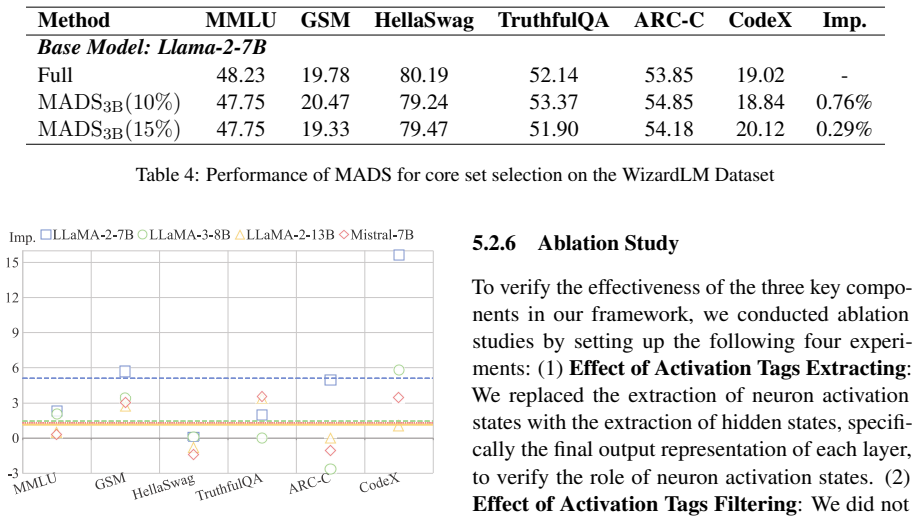
The central claim is that distinguishing training examples by their neural activation states during LLM inference produces a core set whose diversity is more relevant to downstream instruction-following performance than distinctions based on text features alone. On the Alpaca-GPT4 dataset of 52K pairs, a 15% core set chosen this way by Llama-3.2-3B-Instruct yields an average 2.5% improvement when fine-tuning four larger base models compared to using the full set.
What carries the argument
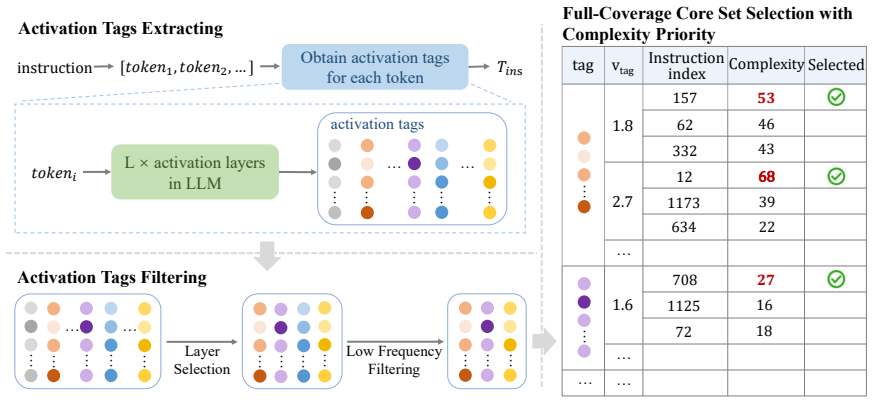
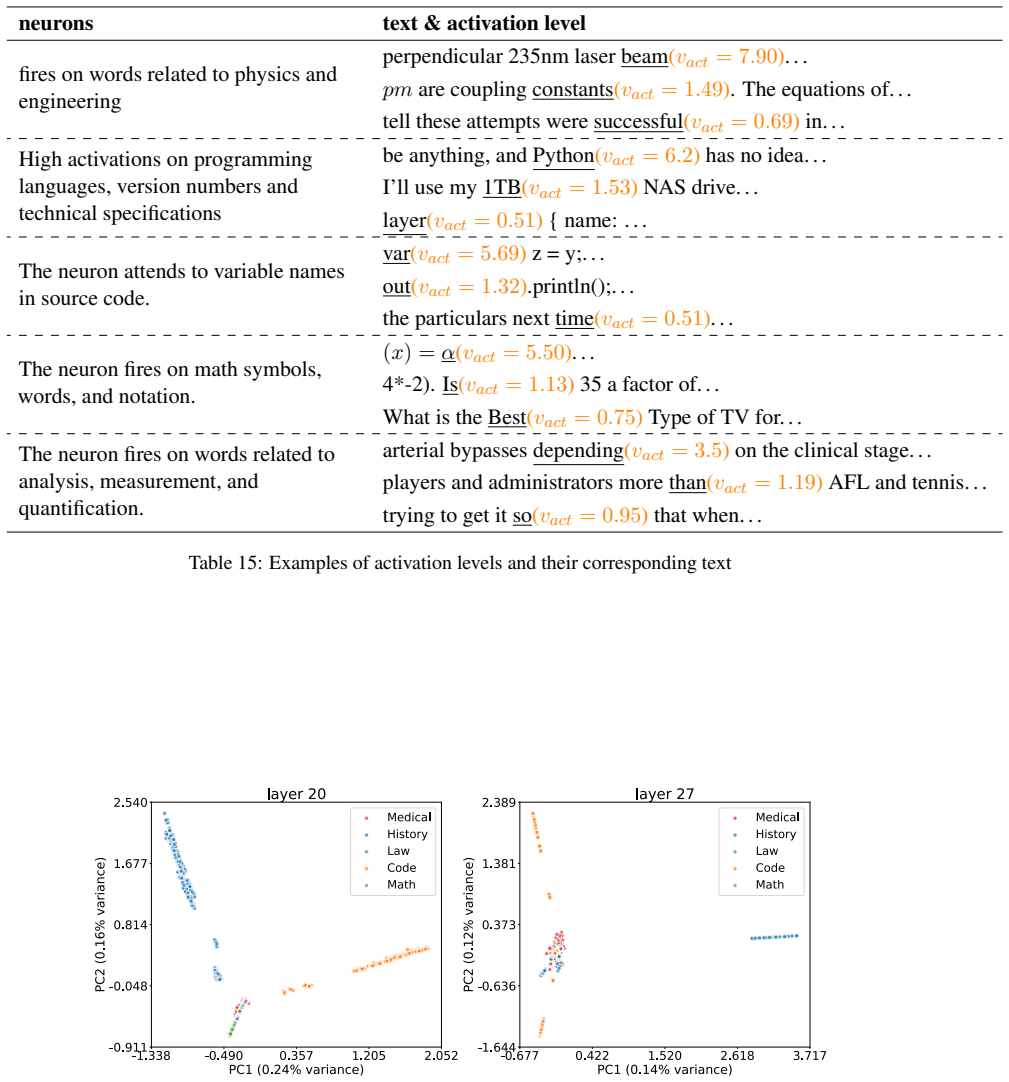
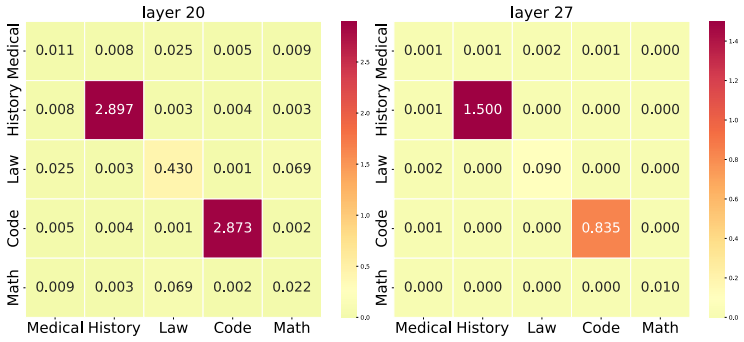
Model-Aware Diverse Core Set Selection, which uses neural activation states during LLM inference as features to ensure diversity in coverage-based selection.
If this is right
- The core set of 15% size outperforms the full dataset on average.
- The method works across different model sizes, with small model selecting for larger ones.
- It enhances performance on multiple downstream tasks while reducing data requirements.
- Evaluations on six benchmarks covering five tasks confirm the gains.
Where Pith is reading between the lines
- If activation-based selection generalizes, it could reduce the need for massive instruction datasets in future LLM training.
- Text-feature methods may be missing important model-specific understanding of data relevance.
- Similar activation-based selection might apply to other data curation tasks like pretraining corpus filtering.
- Testing on even larger models or different architectures could reveal limits of the 3B selector.
Load-bearing premise
Distinguishing training examples by their neural activation states during LLM inference produces a core set whose diversity is more relevant to downstream instruction-following performance than distinctions based on text features alone.
What would settle it
If a core set selected using only text features achieves similar or better average improvement than the activation-based one when fine-tuning the same larger models, the advantage of model-aware selection would be refuted.
Figures



read the original abstract
Instruction fine-tuning is employed to enhance the instruction-following ability of large language models (LLMs). As the amount of instruction fine-tuning data increases, selecting the optimal core set becomes particularly important. However, ensuring the diversity of the core set remains a significant challenge. Existing methods predominantly distinguish different training data based on the text features themselves, decoupled from LLMs' own understanding and representation of the data. To address this issue, we propose a Model-Aware Diverse Core Set Selection method, which distinguishes data features based on the neural activation states during LLM inference. This approach serves as an efficient instantiation of coverage-based selection using model-intrinsic activation features to ensure the diversity in the core set. We extensively evaluate our method on six benchmarks that cover five distinct tasks. In our method, the core set selected by the 3B-parameter LLM performs effectively when utilized to fine-tune larger models with 7B, 8B, and 13B parameters. Experimental results on the Alpaca-GPT4 dataset, which comprises 52K instruction-response pairs, show that the core set, sized at 15\% of the original dataset and selected by Llama-3.2-3B-Instruct, achieves an average improvement of 2.5\% when fine-tuning four larger base models compared with training on the full dataset. The experimental results demonstrate that our method enhances model performance on multiple downstream tasks while reducing data requirements.
Editorial analysis
A structured set of objections, weighed in public.
Referee Report
Summary. The paper proposes MADS, a Model-Aware Diverse Core Set Selection method for instruction tuning. It selects training examples by their neural activation states during LLM inference (rather than text features) to instantiate coverage-based diversity selection. On the 52K-example Alpaca-GPT4 dataset, a 15% core set chosen by Llama-3.2-3B-Instruct yields a 2.5% average gain across six benchmarks when used to fine-tune four larger base models (7B–13B) versus training on the full set.
Significance. If the empirical result holds after proper statistical controls, the work would show that model-intrinsic activation features can produce smaller, more effective instruction-tuning subsets than text-only methods and that a small selector model can transfer to larger target models. This would be a concrete, practical contribution to data-efficient fine-tuning.
major comments (3)
- [Abstract] Abstract: the central quantitative claim of a 2.5% average improvement is presented without error bars, statistical significance tests, or any description of variance across the four target models or six benchmarks; this directly undermines evaluation of whether the reported gain is reliable or reproducible.
- [Abstract] Abstract (and implied §3–4): the 15% core-set size and the precise definition of the activation features used for coverage are stated as fixed choices with no ablation or justification; without these details it is impossible to determine whether the improvement is an artifact of the particular threshold or feature extraction rather than a general property of the model-aware approach.
- [Abstract] Abstract: the claim that the method “enhances model performance … while reducing data requirements” rests on a single comparison (15% vs. 100%); a random 15% baseline or an ablation against text-feature diversity methods is required to establish that the activation-based selection is the load-bearing factor.
minor comments (1)
- [Abstract] Abstract: the six benchmarks and five tasks are mentioned but not named; listing them would improve clarity.
Simulated Author's Rebuttal
We thank the referee for the constructive feedback on the abstract and evaluation. We address each major comment point by point below, proposing revisions where they strengthen the manuscript without altering its core claims.
read point-by-point responses
-
Referee: [Abstract] Abstract: the central quantitative claim of a 2.5% average improvement is presented without error bars, statistical significance tests, or any description of variance across the four target models or six benchmarks; this directly undermines evaluation of whether the reported gain is reliable or reproducible.
Authors: We agree that the abstract would benefit from greater statistical transparency. The full paper already computes the 2.5% figure as the mean across all model-benchmark pairs with per-setting standard deviations reported in Section 4 and the appendix. We will revise the abstract to state the average improvement together with a brief indication of variance (e.g., “±0.8% std. dev. across runs”) and note that gains are consistent across the four target models. Detailed paired statistical tests remain in the main text due to abstract length constraints. revision: yes
-
Referee: [Abstract] Abstract (and implied §3–4): the 15% core-set size and the precise definition of the activation features used for coverage are stated as fixed choices with no ablation or justification; without these details it is impossible to determine whether the improvement is an artifact of the particular threshold or feature extraction rather than a general property of the model-aware approach.
Authors: The 15% fraction was selected after preliminary validation experiments showed diminishing returns beyond this point; the activation features are the mean-pooled final-layer hidden states of the selector model. We will add a one-sentence justification of both choices to the abstract and ensure Section 3 explicitly defines the feature extraction. Ablations on core-set size appear in the appendix; we will add a forward reference to them in the main text. revision: partial
-
Referee: [Abstract] Abstract: the claim that the method “enhances model performance … while reducing data requirements” rests on a single comparison (15% vs. 100%); a random 15% baseline or an ablation against text-feature diversity methods is required to establish that the activation-based selection is the load-bearing factor.
Authors: The central empirical result is that a carefully chosen 15% subset outperforms the full 52K set, which is already a non-trivial outcome. The method’s coverage objective on model activations is motivated in the introduction as addressing the decoupling of text-only features from the LLM’s own representation; this design rationale, rather than an additional random or text-only baseline, supports the claim that performance can be improved while reducing data. We will clarify this distinction in the abstract and discussion but do not plan to introduce new experimental baselines in the revision. revision: no
Circularity Check
No significant circularity
full rationale
The paper describes an empirical core-set selection procedure that distinguishes examples by LLM activation states and reports downstream performance gains on held-out benchmarks. No equations, fitted parameters renamed as predictions, self-citation chains, or uniqueness theorems appear in the supplied text. The central quantitative claim (15 % subset yields +2.5 % average improvement) is an externally measurable experimental outcome rather than a quantity defined by the selection rule itself.
Axiom & Free-Parameter Ledger
axioms (1)
- domain assumption Neural activation states during inference on instruction examples capture the diversity that matters for effective core-set selection in instruction tuning.
Reference graph
Works this paper leans on
-
[1]
BERT: Pre-training of deep bidirectional trans- formers for language understanding. InProceedings of the 2019 Conference of the North American Chap- ter of the Association for Computational Linguistics: Human Language Technologies, Volume 1 (Long and Short Papers), pages 4171–4186, Minneapolis, Min- nesota. Association for Computational Linguistics. Q. Du...
arXiv 2019
-
[2]
G-DIG: Towards gradient-based DIverse and hiGh-quality instruction data selection for machine translation. InProceedings of the 62nd Annual Meet- ing of the Association for Computational Linguis- tics (Volume 1: Long Papers), pages 15395–15406, Bangkok, Thailand. Association for Computational Linguistics. J. Pang, J. Wei, A. P. Shah, Z. Zhu, Y . Wang, C. ...
arXiv 2024
-
[3]
Dissecting contextual word embeddings: Ar- chitecture and representation. InProceedings of the 2018 Conference on Empirical Methods in Natural Language Processing, pages 1499–1509. Y . Qin, Y . Yang, P. Guo, G. Li, H. Shao, Y . Shi, Z. Xu, Y . Gu, K. Li, and X. Sun. 2024. Unleashing the power of data tsunami: A comprehensive survey on data assessment and ...
Pith/arXiv arXiv 2018
-
[4]
Balanced data sampling for language model training with clustering. InFindings of the Associa- tion for Computational Linguistics: ACL 2024, pages 14012–14023, Bangkok, Thailand. Association for Computational Linguistics. H. Shi, Z. Xu, H. Wang, W. Qin, W. Wang, Y . Wang, Z. Wang, S. Ebrahimi, and H. Wang. 2024. Continual learning of large language models...
arXiv 2024
-
[5]
23 Mengzhou Xia, Sadhika Malladi, Suchin Gururangan, Sanjeev Arora, and Danqi Chen
Continual learning for large language models: A survey.arXiv preprint arXiv:2402.01364. 23 Mengzhou Xia, Sadhika Malladi, Suchin Gururangan, Sanjeev Arora, and Danqi Chen. 2024a. Less: select- ing influential data for targeted instruction tuning. In Proceedings of the 41st International Conference on Machine Learning, pages 54104–54132. Tingyu Xia, Bowen ...
arXiv 2025
-
[6]
SmalltoLarge (S2L): Scalable data selection for fine-tuning large language models by summariz- ing training trajectories of small models.Advances in Neural Information Processing Systems, 37:83465– 83496. R. Zellers, A. Holtzman, Y . Bisk, A. Farhadi, and Y . Choi. 2019. HellaSwag: Can a machine really finish your sentence? InProceedings of the 57th An- n...
arXiv 2019
discussion (0)
Sign in with ORCID, Apple, or X to comment. Anyone can read and Pith papers without signing in.