Learning to Solve and Optimize by Evolving Code
Pith reviewed 2026-06-28 23:41 UTC · model grok-4.3
The pith
CHECKMATE evolves code from formal correctness specifications and natural language descriptions alone to produce algorithms that outperform state-of-the-art solvers on configuration and scheduling problems.
A machine-rendered reading of the paper's core claim, the machinery that carries it, and where it could break.
Core claim
CHECKMATE shows that algorithm generation via code evolution, relying solely on a formal specification for correctness and a natural language description for guidance, produces programs that consistently outperform state-of-the-art solvers on configuration and scheduling problems without expert-designed heuristics or solver knowledge.
What carries the argument
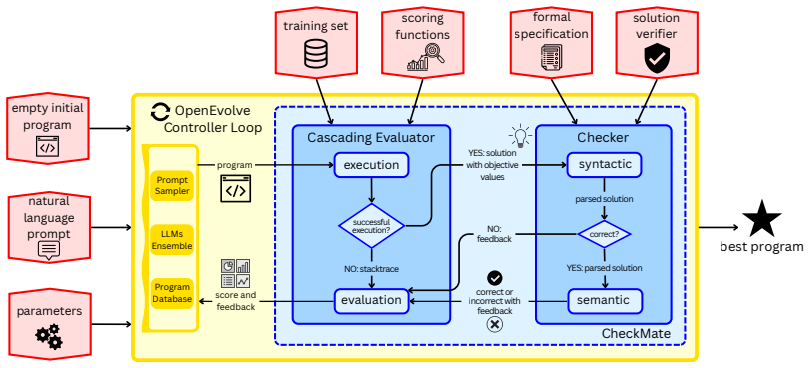
CHECKMATE, an evolutionary search system that generates and evaluates programs against a formal correctness specification while using natural language to steer the process.
If this is right
- Eliminates the need for experts to specify solution derivation methods in addition to problem definitions.
- Enables systematic performance evaluation of generated programs through the formal specification.
- Demonstrates consistent outperformance over state-of-the-art solvers on selected configuration and scheduling problems.
- Applies the same generation process across two distinct industrial domains without domain-specific tuning.
Where Pith is reading between the lines
- The approach could extend to other combinatorial domains such as vehicle routing if equivalent formal specifications can be written.
- It might reduce the expertise barrier for creating custom solvers for niche problems.
- Results may vary with the precision of the natural language descriptions supplied to the system.
Load-bearing premise
The combination of a formal correctness specification and a natural language description is sufficient to guide evolutionary search to both correct and high-performing algorithms without any additional domain-specific heuristics or solver knowledge.
What would settle it
An industrial configuration or scheduling instance where every program produced by the evolutionary process either violates the formal specification or performs worse than current state-of-the-art solvers.
Figures
read the original abstract
Combinatorial and optimization problems are fundamental to many industrial AI applications. Solving large-scale real-world instances of such problems typically requires careful problem formalization, specialized solvers, and expert-designed heuristics. Thus, experts need to specify not only what solutions are, but also how they are derived. By introducing the tool CHECKMATE, we show that algorithm generation via code evolution represents a paradigm shift by eliminating the need to formulate the how. CHECKMATE solely relies on the what. Specifically, a formal specification ensures solutions' correctness and enables systematic performance evaluation of the generated programs, while a natural language description guides the evolutionary process. The effectiveness of our method is demonstrated on selected problems from two industrial domains: configuration and scheduling. In all cases, the evolved algorithms consistently outperform state-of-the-art solvers. This underscores the potential of formal methods in guiding code evolution for automatically solving complex real-world problems.
Editorial analysis
A structured set of objections, weighed in public.
Referee Report
Summary. The paper introduces CHECKMATE, a tool for generating algorithms via code evolution to solve combinatorial and optimization problems. It claims that only a formal correctness specification (to ensure solution validity and enable performance evaluation) and a natural language description (to guide evolution) are needed, eliminating the requirement for expert-designed heuristics on how solutions are derived. Effectiveness is demonstrated on configuration and scheduling problems from industrial domains, with the claim that evolved algorithms consistently outperform state-of-the-art solvers.
Significance. If the performance claims are substantiated with detailed, reproducible experiments, the work could mark a notable shift toward automated, specification-driven algorithm synthesis in optimization and industrial AI, reducing dependence on specialized solvers and domain expertise while highlighting the role of formal methods in guiding evolutionary search.
major comments (1)
- [Abstract] Abstract: the assertion that 'in all cases, the evolved algorithms consistently outperform state-of-the-art solvers' is presented without quantitative results, any description of the evolutionary operators, details on how correctness is enforced during evolution, test instance sizes, or statistical significance. This information is load-bearing for the central empirical claim and its evaluation.
minor comments (1)
- [Abstract] The abstract would benefit from a concise statement of the specific problem instances or benchmark sizes used in the demonstrations.
Simulated Author's Rebuttal
We thank the referee for their constructive feedback on our manuscript. The comment highlights an important point about the abstract's presentation of the central empirical claim. We address it below and commit to revisions that strengthen the manuscript without altering its core contributions.
read point-by-point responses
-
Referee: [Abstract] Abstract: the assertion that 'in all cases, the evolved algorithms consistently outperform state-of-the-art solvers' is presented without quantitative results, any description of the evolutionary operators, details on how correctness is enforced during evolution, test instance sizes, or statistical significance. This information is load-bearing for the central empirical claim and its evaluation.
Authors: We agree that the abstract, as currently written, presents the performance claim in a manner that would benefit from additional context to stand alone more effectively. The full manuscript substantiates the claim with quantitative results (e.g., average improvements and comparisons in the experimental sections), descriptions of the evolutionary operators (detailed in the method section), enforcement of correctness via formal specifications (in the problem formulation), test instance sizes (specified per domain in the evaluation), and statistical significance testing. However, we recognize that abstracts have length constraints and traditionally avoid exhaustive technical details. To directly address the concern, we will revise the abstract to include a concise quantitative summary of the performance gains (e.g., relative improvements and consistency across cases) while retaining the high-level description. This revision will make the claim more informative without requiring a full methods recap in the abstract itself. revision: yes
Circularity Check
No significant circularity; empirical claims rest on external benchmarks
full rationale
The paper describes an evolutionary code-generation method (CHECKMATE) that takes a formal correctness specification plus natural-language problem description as inputs and produces solver code whose performance is measured against independent state-of-the-art solvers. No equations, fitted parameters, uniqueness theorems, or self-citational load-bearing steps appear in the abstract or the described methodology. The performance claim is therefore an empirical comparison rather than a derivation that reduces to its own inputs by construction. This is the normal, non-circular case for an experimental systems paper.
Axiom & Free-Parameter Ledger
Reference graph
Works this paper leans on
-
[1]
CodeEvolve: an open source evolutionary coding agent for algorithmic discovery and optimization
[Assumpc ¸˜aoet al., 2025 ] Henrique S. Assumpc ¸ ˜ao, Diego Ferreira, Leandro Lacerda Campos, and Fabricio Mu- rai. Codeevolve: An open source evolutionary coding agent for algorithm discovery and optimization.CoRR, abs/2510.14150,
work page internal anchor Pith review Pith/arXiv arXiv 2025
-
[2]
Machine learning for combinatorial op- timization: a methodological tour d’horizon.EJOR, 290(2):405–421,
[Bengioet al., 2021 ] Yoshua Bengio, Andrea Lodi, and An- toine Prouvost. Machine learning for combinatorial op- timization: a methodological tour d’horizon.EJOR, 290(2):405–421,
2021
-
[3]
Combin- ing constraint programming and machine learning: From current progress to future opportunities.JAIR, 84,
[Cappartet al., 2025 ] Quentin Cappart, Tias Guns, Michele Lombardi, Gilles Pesant, and Dimos Tsouros. Combin- ing constraint programming and machine learning: From current progress to future opportunities.JAIR, 84,
2025
-
[4]
Domain-specific heuristics in answer set pro- gramming: A declarative non-monotonic approach.JAIR, 76:59–114,
[Comploi-Taupeet al., 2023 ] Richard Comploi-Taupe, Ger- hard Friedrich, Konstantin Schekotihin, and Antonius Weinzierl. Domain-specific heuristics in answer set pro- gramming: A declarative non-monotonic approach.JAIR, 76:59–114,
2023
-
[5]
Industrial-size job shop scheduling with con- straint programming.Oper
[Da Col and Teppan, 2022] Giacomo Da Col and Erich C Teppan. Industrial-size job shop scheduling with con- straint programming.Oper. Res. Perspect., 9:100249,
2022
-
[6]
The Lean theorem prover (system de- scription)
[de Mouraet al., 2015 ] Leonardo Mendonc ¸a de Moura, Soonho Kong, Jeremy Avigad, Floris van Doorn, and Jakob von Raumer. The Lean theorem prover (system de- scription). In25th Int’l Conf. on Automated Deduction (CADE), Lecture Notes in Computer Science, pages 378–
2015
-
[7]
Operating room scheduling via answer set programming: Improved encoding and test on real data.JLC, 34(8):1556–1579,
[Dodaroet al., 2024 ] Carmine Dodaro, Giuseppe Galat `a, Martin Gebser, Marco Maratea, Cinzia Marte, Marco Mochi, and Marco Scanu. Operating room scheduling via answer set programming: Improved encoding and test on real data.JLC, 34(8):1556–1579,
2024
-
[8]
[El-Kholanyet al., 2025 ] Mohammed M. S. El-Kholany, Martin Gebser, and Konstantin Schekotihin. Decompo- sition strategies and multi-shot ASP solving for job-shop scheduling.LMCS, 21(3),
2025
-
[9]
Falkner, Gerhard Friedrich, Alois Haselb ¨ock, Gottfried Schenner, and Herwig Schreiner
[Falkneret al., 2016 ] Andreas A. Falkner, Gerhard Friedrich, Alois Haselb ¨ock, Gottfried Schenner, and Herwig Schreiner. Twenty-five years of successful appli- cation of constraint technologies at Siemens.AI Mag., 37(4),
2016
-
[10]
Falkner, Gerhard Friedrich, Konstantin Schekotihin, Richard Taupe, and Erich Christian Teppan
[Falkneret al., 2018 ] Andreas A. Falkner, Gerhard Friedrich, Konstantin Schekotihin, Richard Taupe, and Erich Christian Teppan. Industrial applications of answer set programming.KI, 32(2-3):165–176,
2018
-
[11]
Configuring large systems using gen- erative constraint satisfaction.IEEE Intell
[Fleischanderlet al., 1998 ] Gerhard Fleischanderl, Gerhard Friedrich, Alois Haselb ¨ock, Herwig Schreiner, and Markus Stumptner. Configuring large systems using gen- erative constraint satisfaction.IEEE Intell. Syst., 13(4):59– 68,
1998
-
[12]
[Freuder, 2018] Eugene C. Freuder. Progress towards the holy grail.Constraints, 23(2):158–171,
2018
-
[13]
Falkner, Alois Haselb¨ock, Gottfried Schenner, and Herwig Schreiner
[Friedrichet al., 2011 ] Gerhard Friedrich, Anna Ryabokon, Andreas A. Falkner, Alois Haselb¨ock, Gottfried Schenner, and Herwig Schreiner. (re)configuration based on model generation. InSecond Workshop on Logics for Component Configuration, volume 65 ofEPTCS, pages 26–35,
2011
-
[14]
Synthesis Lectures on Artificial Intelligence and Machine Learning
[Gebseret al., 2012 ] Martin Gebser, Roland Kaminski, Ben- jamin Kaufmann, and Torsten Schaub.Answer Set Solving in Practice. Synthesis Lectures on Artificial Intelligence and Machine Learning. Morgan & Claypool,
2012
-
[15]
Solving combined configuration prob- lems: a heuristic approach
[Gebseret al., 2015 ] Martin Gebser, Anna Ryabokon, and Gottfried Schenner. Solving combined configuration prob- lems: a heuristic approach. In17th Int’l Configuration Workshop, CEUR Workshop Proceedings, pages 55–59. CEUR-WS.org,
2015
-
[16]
The sixth answer set programming com- petition.JAIR, 60:41–95,
[Gebseret al., 2017 ] Martin Gebser, Marco Maratea, and Francesco Ricca. The sixth answer set programming com- petition.JAIR, 60:41–95,
2017
-
[17]
Potassco guide version 2.2.0,
[Gebseret al., 2019 ] Martin Gebser, Roland Kaminski, Ben- jamin Kaufmann, Marius Lindauer, Max Ostrowski, Javier Romero, Torsten Schaub, Sven Thiele, and Philipp Wanko. Potassco guide version 2.2.0,
2019
-
[18]
Mathematical exploration and discovery at scale
Retrieved from https: //github.com/potassco/guide/releases/tag/v2.2.0. [Georgievet al., 2025 ] Bogdan Georgiev, Javier G ´omez- Serrano, Terence Tao, and Adam Zsolt Wagner. Math- ematical exploration and discovery at scale.CoRR, abs/2511.02864,
work page internal anchor Pith review Pith/arXiv arXiv 2025
-
[19]
A new double flexible job-shop scheduling problem integrating processing time, green production, and human factor indicators.J
[Gonget al., 2018 ] Guiliang Gong, Qianwang Deng, Xuran Gong, Wei Liu, and Qinghua Ren. A new double flexible job-shop scheduling problem integrating processing time, green production, and human factor indicators.J. Clean. Prod., 174:560–576,
2018
-
[20]
[Hubertet al., 2026 ] Thomas Hubert, Rishi Mehta, Laurent Sartran, Mikl´os Z. Horv´ath, Goran ˇZuˇzi´c, Eric Wieser, Aja Huang, Julian Schrittwieser, Yannick Schroecker, Hussain Masoom, Ottavia Bertolli, Tom Zahavy, Amol Mandhane, Jessica Yung, Iuliya Beloshapka, Borja Ibarz, Vivek Vee- riah, Lei Yu, Oliver Nash, Paul Lezeau, Salvatore Mercuri, Calle S ¨o...
2026
-
[21]
Grounding and solving in answer set programming.AI Mag., 37(3):25–32,
[Kaufmannet al., 2016 ] Benjamin Kaufmann, Nicola Leone, Simona Perri, and Torsten Schaub. Grounding and solving in answer set programming.AI Mag., 37(3):25–32,
2016
-
[22]
End-to-end constrained optimization learning: A survey
[Kotaryet al., 2021 ] James Kotary, Ferdinando Fioretto, Pascal Van Hentenryck, and Bryan Wilder. End-to-end constrained optimization learning: A survey. In30th Int’l Joint Conf. on Artificial Intelligence, pages 4475–4482. ij- cai.org,
2021
-
[23]
Algorithm selection for combinatorial search problems: A survey
[Kotthoff, 2016] Lars Kotthoff. Algorithm selection for combinatorial search problems: A survey. InData Min- ing and Constraint Programming, volume 10101 ofLNCS, pages 149–190. Springer,
2016
-
[24]
IBM ILOG CP Optimizer for scheduling - 20+ years of scheduling with constraints at IBM/ILOG.Constraints, 23(2):210–250,
[Laborieet al., 2018 ] Philippe Laborie, Jerome Rogerie, Paul Shaw, and Petr Vil´ım. IBM ILOG CP Optimizer for scheduling - 20+ years of scheduling with constraints at IBM/ILOG.Constraints, 23(2):210–250,
2018
-
[25]
ShinkaEvolve: Towards Open-Ended And Sample-Efficient Program Evolution
[Langeet al., 2025 ] Robert Tjarko Lange, Yuki Imajuku, and Edoardo Cetin. Shinkaevolve: Towards open- ended and sample-efficient program evolution.CoRR, abs/2509.19349,
work page internal anchor Pith review Pith/arXiv arXiv 2025
-
[26]
Evolution of heuristics: towards efficient au- tomatic algorithm design using large language model
[Liuet al., 2024 ] Fei Liu, Xialiang Tong, Mingxuan Yuan, Xi Lin, Fu Luo, Zhenkun Wang, Zhichao Lu, and Qingfu Zhang. Evolution of heuristics: towards efficient au- tomatic algorithm design using large language model. In41st Int’l Conf. on Machine Learning, ICML’24. JMLR.org,
2024
-
[27]
Scientific algorithm discovery by augmenting al- phaevolve with deep research.CoRR, abs/2510.06056,
[Liuet al., 2025 ] Gang Liu, Yihan Zhu, Jie Chen, and Meng Jiang. Scientific algorithm discovery by augmenting al- phaevolve with deep research.CoRR, abs/2510.06056,
-
[28]
On learning and branching: a survey.TOP: An Official Journal of the Spanish Society of Statistics and Operations Research, 25(2):207–236,
[Lodi and Zarpellon, 2017] Andrea Lodi and Giulia Zarpel- lon. On learning and branching: a survey.TOP: An Official Journal of the Spanish Society of Statistics and Operations Research, 25(2):207–236,
2017
-
[29]
Illuminating search spaces by mapping elites
[Mouret and Clune, 2015] Jean-Baptiste Mouret and Jeff Clune. Illuminating search spaces by mapping elites. CoRR, abs/1504.04909,
work page internal anchor Pith review Pith/arXiv arXiv 2015
-
[30]
[Novikovet al., 2025 ] Alexander Novikov, Ng ˆan Vu, Mar- vin Eisenberger, Emilien Dupont, Po-Sen Huang, Adam Zsolt Wagner, Sergey Shirobokov, Borislav Ko- zlovskii, Francisco J. R. Ruiz, Abbas Mehrabian, M. Pawan Kumar, Abigail See, Swarat Chaudhuri, George Holland, Alex Davies, Sebastian Nowozin, Pushmeet Kohli, and Matej Balog. Alphaevolve: A coding ag...
work page internal anchor Pith review Pith/arXiv arXiv 2025
-
[31]
The CP-SAT-LP solver (invited talk)
[Perronet al., 2023 ] Laurent Perron, Fr ´ed´eric Didier, and Steven Gay. The CP-SAT-LP solver (invited talk). In 29th Int’l Conf. on Principles and Practice of Constraint Programming, CP 2023, Toronto, Canada, August 27-31, 2023, LIPIcs, pages 3:1–3:2. Schloss Dagstuhl - Leibniz- Zentrum f¨ur Informatik,
2023
-
[32]
Pawan Kumar, Emilien Dupont, Francisco J
[Romera-Paredeset al., 2024 ] Bernardino Romera-Paredes, Mohammadamin Barekatain, Alexander Novikov, Matej Balog, M. Pawan Kumar, Emilien Dupont, Francisco J. R. Ruiz, Jordan S. Ellenberg, Pengming Wang, Omar Fawzi, Pushmeet Kohli, and Alhussein Fawzi. Mathematical dis- coveries from program search with large language models. Nature, 625(7995):468–475,
2024
-
[33]
Constraint programming
[Rossiet al., 2008 ] Francesca Rossi, Peter van Beek, and Toby Walsh. Constraint programming. InHandb. Knowl. Represent., volume 3 ofFoundations of Artificial Intelli- gence, pages 181–211. Elsevier,
2008
-
[34]
A heuristic algorithm based on beam search and iterated local search for the maritime inventory routing problem
[Sanghikianet al., 2026 ] Nathalie Sanghikian, Rafael Meirelles, Anand Subramanian, and Rafael Martinelli. A heuristic algorithm based on beam search and iterated local search for the maritime inventory routing problem. Comput. Oper. Res., 188:107347,
2026
-
[35]
[Schlenkrich and Parragh, 2022] Manuel Schlenkrich and Sophie N. Parragh. Solving large scale industrial pro- duction scheduling problems with complex constraints: an overview of the state-of-the-art. In4th Int’l Conf. on In- dustry 4.0 and Smart Manufacturing, Procedia Computer Science, pages 1028–1037. Elsevier,
2022
-
[36]
Investigating the grounding bot- tleneck for a large-scale configuration problem: Existing tools and constraint-aware guessing
[Semmelrock and Friedrich, 2025] Veronika Semmelrock and Gerhard Friedrich. Investigating the grounding bot- tleneck for a large-scale configuration problem: Existing tools and constraint-aware guessing. In41st Int’l Conf. on Logic Programming, EPTCS, pages 482–495, January
2025
-
[37]
Checkmate project
[Semmelrocket al., 2026 ] Veronika Semmelrock, Benedetta Strizzolo, Francesco Zuccato, Gerhard Friedrich, Patrick Rodler, and Konstantin Schekotihin. Checkmate project. https://git-ainf.aau.at/checkmate/ijcai26,
2026
-
[38]
Openevolve: an open-source evolutionary coding agent
[Sharma, 2025] Asankhaya Sharma. Openevolve: an open-source evolutionary coding agent. https://github. com/algorithmicsuperintelligence/openevolve,
2025
-
[39]
PhD thesis, University of Michi- gan, USA,
[Tanese, 1989] Reiko Tanese.Distributed genetic algorithms for function optimization. PhD thesis, University of Michi- gan, USA,
1989
-
[40]
Learning to break symmetries for efficient optimization in answer set pro- gramming
[Tarzariolet al., 2023 ] Alice Tarzariol, Martin Gebser, Kon- stantin Schekotihin, and Mark Law. Learning to break symmetries for efficient optimization in answer set pro- gramming. InAAAI, pages 6541–6549. AAAI Press,
2023
-
[41]
Conflict generalisation in ASP: learn- ing correct and effective non-ground constraints.Theory Pract
[Taupeet al., 2020 ] Richard Taupe, Antonius Weinzierl, and Gerhard Friedrich. Conflict generalisation in ASP: learn- ing correct and effective non-ground constraints.Theory Pract. Log. Program., 20(5):799–814,
2020
-
[42]
John Wiley & Sons,
[Wolsey, 2020] Laurence A Wolsey.Integer programming. John Wiley & Sons,
2020
-
[43]
[Yager, 2009] Ronald R. Yager. Prioritized OW A aggrega- tion.Fuzzy Optim. Decis. Mak., 8(3):245–262,
2009
-
[44]
Autonomous code evolution meets np- completeness.CoRR, abs/2509.07367,
[Yuet al., 2025 ] Cunxi Yu, Rongjian Liang, Chia-Tung Ho, and Haoxing Ren. Autonomous code evolution meets np- completeness.CoRR, abs/2509.07367,
-
[45]
Energy-aware double-flexible job shop scheduling with machine modes and setup times: A real- world industrial case study using constraint programming
[Zuccatoet al., 2025 ] Francesco Zuccato, Patrick Rodler, Gerhard Friedrich, Konstantin Schekotihin, and Richard Comploi-Taupe. Energy-aware double-flexible job shop scheduling with machine modes and setup times: A real- world industrial case study using constraint programming. InECAI Workshop on AI-based Planning for Complex Real-World Applications (CAIP...
2025
discussion (0)
Sign in with ORCID, Apple, or X to comment. Anyone can read and Pith papers without signing in.