BIAS-ID: A Framework for Analyzing Transformation Biases in AI-Generated Image Detectors
Pith reviewed 2026-06-28 22:44 UTC · model grok-4.3
The pith
BIAS-ID framework shows many state-of-the-art AI image detectors rely on transformation biases rather than true forensic signals.
A machine-rendered reading of the paper's core claim, the machinery that carries it, and where it could break.
Core claim
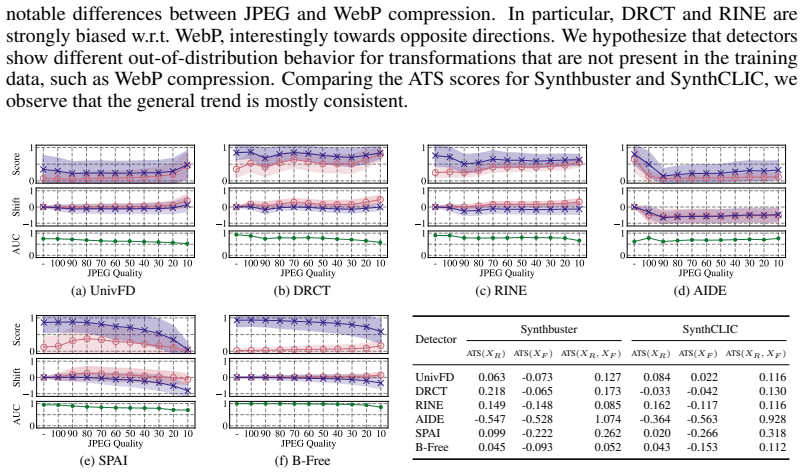
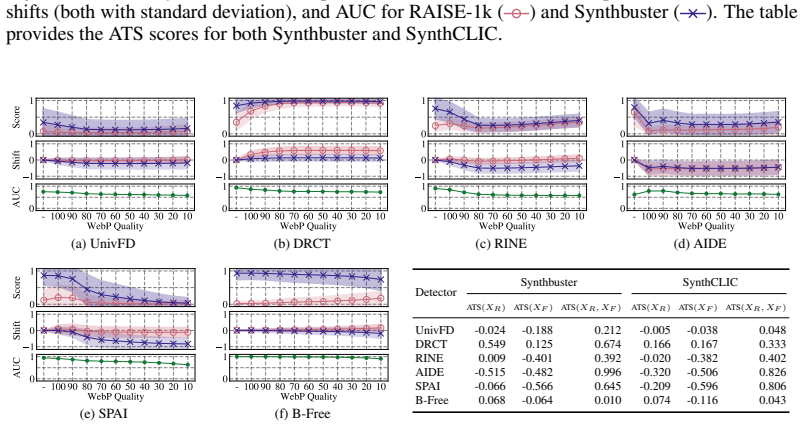
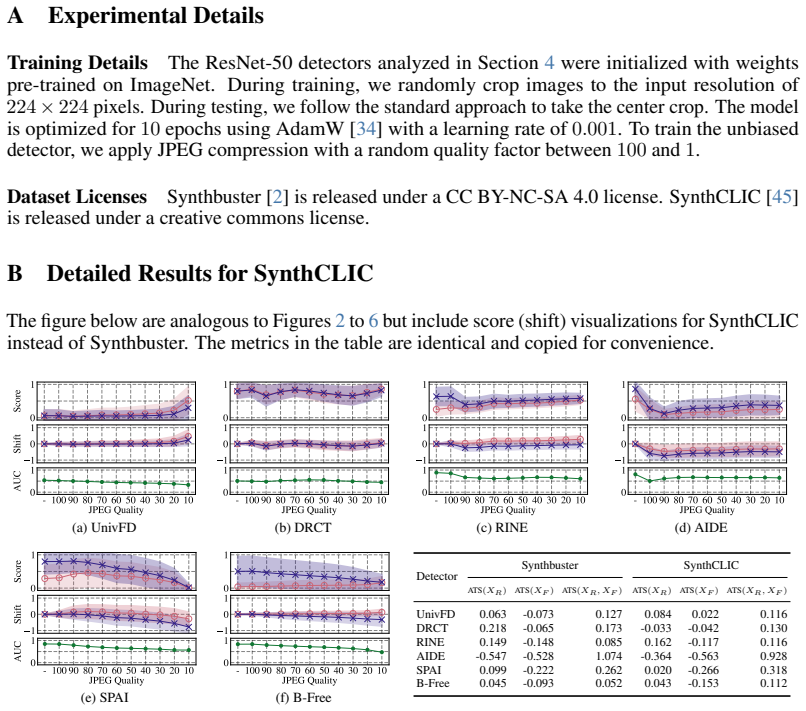
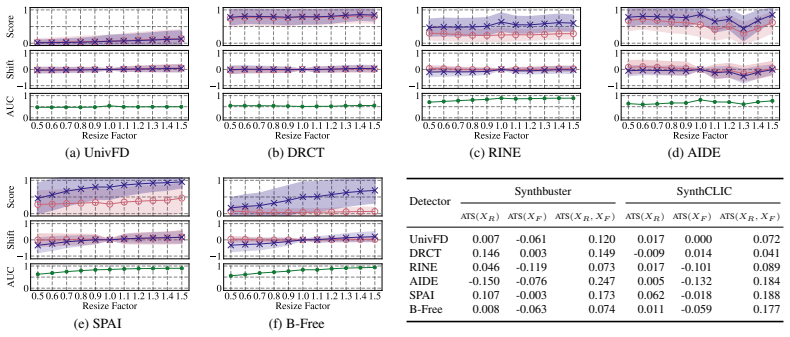
The BIAS-ID framework provides a transparent protocol to quantify transformation biases in AI-generated image detectors by testing performance shifts under controlled transformations, separating this from general robustness failures. Validation across six detectors and two datasets shows that several state-of-the-art methods exhibit strong dependence on these biases.
What carries the argument
BIAS-ID, a framework that applies systematic transformations to input images and measures resulting changes in detector performance to isolate bias from other robustness issues.
If this is right
- Detectors must undergo bias-aware testing before claims of reliability can be accepted.
- Training data and procedures need adjustment to reduce dependence on transformation-specific cues.
- Benchmarks should incorporate transformation analysis to avoid overestimating real-world performance.
- New detector designs should target features that remain stable across transformations.
Where Pith is reading between the lines
- The same bias-measurement approach could be applied to detectors for other media such as video or audio.
- Developers could use BIAS-ID results to prioritize which transformations to mitigate during training.
- As generation tools evolve, periodic re-evaluation with BIAS-ID would track whether new biases emerge.
Load-bearing premise
The chosen transformations and datasets capture the real-world variations that cause detectors to fail, and the framework can cleanly separate transformation bias from other generalization problems.
What would settle it
A detector that passes BIAS-ID tests with low bias scores but still collapses on diverse real-world images, or conversely one that shows high bias scores yet maintains performance when transformations are controlled.
Figures






read the original abstract
Given the surge of harmful AI-generated imagery online, reliably distinguishing authentic images from generated ones has become an urgent research topic. While many proposed detection methods perform well under controlled settings, they often collapse when tested on real-world data. A potential root cause are subtle biases in the detectors' training data. As a result, detectors may rely on spurious correlations instead of learning true forensic artifacts. While a recent line of work has identified the problem, there is not yet an established protocol to evaluate how biased a detector actually is. In this work, we therefore take a step back: First, we discuss what it means for a detector to be biased, and how this differs from a lack of robustness. Second, we propose BIAS-ID, a transparent framework for analyzing and quantifying the presence of transformation biases in AI-generated image detectors. We validate our framework by performing an evaluation of six detectors across two datasets, revealing that several state-of-the-art detection methods are strongly affected by biases. Our results highlight the importance of bias-aware evaluation for developing reliable AI-generated image detectors.
Editorial analysis
A structured set of objections, weighed in public.
Referee Report
Summary. The paper distinguishes transformation bias (spurious correlations from training data transformations) from general lack of robustness in AI-generated image detectors. It proposes the BIAS-ID framework as a transparent protocol to quantify such biases via controlled evaluations, then applies it to six detectors across two datasets and concludes that several state-of-the-art methods are strongly affected by biases.
Significance. If the framework successfully isolates transformation bias and the evaluations are reproducible, the work supplies a needed evaluation protocol that could improve the reliability of forensic detectors. The multi-detector, multi-dataset validation provides concrete evidence supporting the central claim and gives credit for addressing a practical gap in the literature.
minor comments (2)
- The abstract states that BIAS-ID 'quantifies the presence of transformation biases' but does not name the exact bias metric or the controlled transformation set; adding these definitions in §3 would improve clarity without altering the central claim.
- The validation section reports results on six detectors and two datasets; including the precise list of detectors, datasets, and the bias scores in a table would make the 'strongly affected' conclusion easier to verify.
Simulated Author's Rebuttal
We thank the referee for their positive summary of our work and the recommendation for minor revision. The provided summary accurately captures the distinction between transformation bias and general robustness, as well as the BIAS-ID framework and its validation on six detectors across two datasets.
Circularity Check
No significant circularity detected
full rationale
The paper proposes BIAS-ID as an evaluation framework that distinguishes transformation bias from general lack of robustness, then applies it via controlled experiments on six detectors across two datasets. No equations, derivations, fitted parameters, or predictions are described that could reduce to inputs by construction. The abstract and outline reference prior work only in passing without load-bearing self-citations or uniqueness theorems. The central contribution is an empirical protocol whose validity rests on the experimental design rather than self-referential definitions or renamings.
Axiom & Free-Parameter Ledger
Reference graph
Works this paper leans on
-
[1]
PyTorch 2: Faster machine learning through dynamic python bytecode transformation and graph compi- lation
Jason Ansel, Edward Yang, Horace He, Natalia Gimelshein, Animesh Jain, Michael V oznesen- sky, Bin Bao, Peter Bell, David Berard, Evgeni Burovski, Geeta Chauhan, Anjali Chourdia, Will Constable, Alban Desmaison, Zachary DeVito, Elias Ellison, Will Feng, Jiong Gong, Michael Gschwind, Brian Hirsh, Sherlock Huang, Kshiteej Kalambarkar, Laurent Kirsch, Michae...
2024
-
[2]
Synthbuster: Towards detection of diffusion model generated images.IEEE Open Journal of Signal Processing (OJSP), 2023
Quentin Bammey. Synthbuster: Towards detection of diffusion model generated images.IEEE Open Journal of Signal Processing (OJSP), 2023
2023
-
[3]
Recognition in terra incognita
Sara Beery, Grant Van Horn, and Pietro Perona. Recognition in terra incognita. InEuropean Conference on Computer Vision (ECCV), 2018
2018
-
[4]
Vbench: Comprehensive benchmark suite for video generative models
George Cazenavette, Avneesh Sud, Thomas Leung, and Ben Usman. FakeInversion: Learning to detect images from unseen text-to-image models by inverting Stable Diffusion. InIEEE/CVF Conference on Computer Vision and Pattern Recognition (CVPR), 2024.https://doi.org/ 10.1109/CVPR52733.2024.01023
-
[5]
What makes fake images detectable? Understanding properties that generalize
Lucy Chai, David Bau, Ser-Nam Lim, and Phillip Isola. What makes fake images detectable? Understanding properties that generalize. InEuropean Conference on Computer Vision (ECCV), 2020
2020
-
[6]
DRCT: Diffusion reconstruction contrastive training towards universal detection of diffusion generated images
Baoying Chen, Jishen Zeng, Jianquan Yang, and Rui Yang. DRCT: Diffusion reconstruction contrastive training towards universal detection of diffusion generated images. InInternational Conference on Machine Learning (ICML), 2024
2024
-
[7]
Hyeongjun Choi, Inho Jung, and Simon S. Woo. Combating dataset misalignment for robust AI-generated image detection in the real world. InWorkshop on Security Implications of Deepfakes and Cheapfakes, 2025
2025
-
[8]
Workshop and challenge on learned image compression
CLIC2020. Workshop and challenge on learned image compression. https://archive.co mpression.cc/, 2020. Accessed May 5, 2026
2020
-
[9]
C2PA.https://c2pa.org/
Coalition for Content Provenance and Authenticity (C2PA). C2PA.https://c2pa.org/
-
[10]
Unveiling the impact of image transformations on deepfake detection: An experimental analysis
Federico Cocchi, Lorenzo Baraldi, Samuele Poppi, Marcella Cornia, Lorenzo Baraldi, and Rita Cucchiara. Unveiling the impact of image transformations on deepfake detection: An experimental analysis. InInternational Conference on Image Analysis and Processing (ICIAP), 2023
2023
-
[11]
As good as a coin toss: Human detection of AI-generated images, videos, audio, and audiovisual stimuli.arXiv Preprint, 2025
Di Cooke, Abigail Edwards, Sophia Barkoff, and Kathryn Kelly. As good as a coin toss: Human detection of AI-generated images, videos, audio, and audiovisual stimuli.arXiv Preprint, 2025
2025
-
[12]
Intrigu- ing properties of synthetic images: From generative adversarial networks to diffusion models
Riccardo Corvi, Davide Cozzolino, Giovanni Poggi, Koki Nagano, and Luisa Verdoliva. Intrigu- ing properties of synthetic images: From generative adversarial networks to diffusion models. InIEEE/CVF Conference on Computer Vision and Pattern Recognition (CVPR) Workshops, 2023
2023
-
[13]
RAISE: A raw images dataset for digital image forensics
Duc-Tien Dang-Nguyen, Cecilia Pasquini, Valentina Conotter, and Giulia Boato. RAISE: A raw images dataset for digital image forensics. InACM International Conference on Multimedia (MM), 2015.https://dl.acm.org/doi/10.1145/2713168.2713194
-
[14]
ImageNet: A large- scale hierarchical image database
Jia Deng, Wei Dong, Richard Socher, Li-Jia Li, Kai Li, and Li Fei-Fei. ImageNet: A large- scale hierarchical image database. InIEEE/CVF Conference on Computer Vision and Pattern Recognition (CVPR), 2009
2009
-
[15]
AMMeBa: A large-scale survey and dataset of media-based misinformation in-the-wild.arXiv Preprint, 2024
Nicholas Dufour, Arkanath Pathak, Pouya Samangouei, Nikki Hariri, Shashi Deshetti, Andrew Dudfield, Christopher Guess, Pablo Hernández Escayola, Bobby Tran, Mevan Babakar, and Christoph Bregler. AMMeBa: A large-scale survey and dataset of media-based misinformation in-the-wild.arXiv Preprint, 2024
2024
-
[16]
A survey on bias in visual datasets.Computer Vision and Image Understanding, 2022
Simone Fabbrizzi, Symeon Papadopoulos, Eirini Ntoutsi, and Ioannis Kompatsiaris. A survey on bias in visual datasets.Computer Vision and Image Understanding, 2022
2022
-
[17]
Malicious actors almost certainly will leverage synthetic content for cyber and foreign influence operations, 2021
Federal Bureau of Investigation (FBI). Malicious actors almost certainly will leverage synthetic content for cyber and foreign influence operations, 2021. https://www.ic3.gov/Media/Ne ws/2021/210310-2.pdf, Accessed May 5, 2026. 10
2021
-
[18]
Criminals use generative artificial intelligence to facilitate financial fraud, 2024
Federal Bureau of Investigation (FBI). Criminals use generative artificial intelligence to facilitate financial fraud, 2024. https://www.ic3.gov/PSA/2024/PSA241203 , Accessed May 5, 2026
2024
-
[19]
The stable signature: Rooting watermarks in latent diffusion models
Pierre Fernandez, Guillaume Couairon, Hervé Jégou, Matthijs Douze, and Teddy Furon. The stable signature: Rooting watermarks in latent diffusion models. InIEEE/CVF International Conference on Computer Vision (ICCV), 2023
2023
-
[20]
Leveraging frequency analysis for deep fake image recognition
Joel Frank, Thorsten Eisenhofer, Lea Schönherr, Asja Fischer, Dorothea Kolossa, and Thorsten Holz. Leveraging frequency analysis for deep fake image recognition. InInternational Confer- ence on Machine Learning (ICML), 2020
2020
-
[21]
A representative study on human detection of artificially generated media across countries
Joel Frank, Franziska Herbert, Jonas Ricker, Lea Schönherr, Thorsten Eisenhofer, Asja Fischer, Markus Dürmuth, and Thorsten Holz. A representative study on human detection of artificially generated media across countries. InIEEE Symposium on Security and Privacy (SP), 2024
2024
-
[22]
Wichmann
Robert Geirhos, Jörn-Henrik Jacobsen, Claudio Michaelis, Richard Zemel, Wieland Brendel, Matthias Bethge, and Felix A. Wichmann. Shortcut learning in deep neural networks.Nature Machine Intelligence, 2020
2020
-
[23]
Gragnaniello, D
D. Gragnaniello, D. Cozzolino, F. Marra, G. Poggi, and L. Verdoliva. Are GAN generated images easy to detect? A critical analysis of the state-of-the-art. InIEEE International Conference on Multimedia and Expo (ICME), 2021
2021
-
[24]
Will AI-generated images create a new crisis for fact-checkers? Experts are not so sure.Reuters Institute for the Study of Journalism, 2023
Gretel Kahn. Will AI-generated images create a new crisis for fact-checkers? Experts are not so sure.Reuters Institute for the Study of Journalism, 2023. https://reutersinstitute .politics.ox.ac.uk/news/will-ai-generated-images-create-new-crisis-fac t-checkers-experts-are-not-so-sure, Accessed May 5, 2026
2023
-
[25]
Fake or JPEG? Revealing common biases in generated image detection datasets
Patrick Grommelt, Louis Weiss, Franz-Josef Pfreundt, and Janis Keuper. Fake or JPEG? Revealing common biases in generated image detection datasets. InEuropean Conference on Computer Vision (ECCV) Workshops, 2024
2024
-
[26]
A bias-free training paradigm for more general AI-generated image detection
Fabrizio Guillaro, Giada Zingarini, Ben Usman, Avneesh Sud, Davide Cozzolino, and Luisa Verdoliva. A bias-free training paradigm for more general AI-generated image detection. In IEEE/CVF Conference on Computer Vision and Pattern Recognition (CVPR), 2025
2025
-
[27]
An undetectable watermark for generative image models
Sam Gunn, Xuandong Zhao, and Dawn Song. An undetectable watermark for generative image models. InInternational Conference on Learning Representations (ICLR), 2025
2025
-
[28]
Reducing the content bias for AI-generated image detection
Seoyeon Gye, Junwon Ko, Hyounguk Shon, Minchan Kwon, and Junmo Kim. Reducing the content bias for AI-generated image detection. InIEEE/CVF Winter Conference on Applications of Computer Vision (WACV), 2025
2025
-
[29]
Deep residual learning for image recognition
Kaiming He, Xiangyu Zhang, Shaoqing Ren, and Jian Sun. Deep residual learning for image recognition. InIEEE/CVF Conference on Computer Vision and Pattern Recognition (CVPR), 2016
2016
-
[30]
Any-resolution AI-generated image detection by spectral learning
Dimitrios Karageorgiou, Symeon Papadopoulos, Ioannis Kompatsiaris, and Efstratios Gavves. Any-resolution AI-generated image detection by spectral learning. InIEEE/CVF Conference on Computer Vision and Pattern Recognition (CVPR), 2025
2025
-
[31]
Leveraging representations from intermediate encoder-blocks for synthetic image detection
Christos Koutlis and Symeon Papadopoulos. Leveraging representations from intermediate encoder-blocks for synthetic image detection. InEuropean Conference on Computer Vision (ECCV), 2025
2025
-
[32]
Improving synthetic image detection towards generalization: An image transformation perspective
Ouxiang Li, Jiayin Cai, Yanbin Hao, Xiaolong Jiang, Yao Hu, and Fuli Feng. Improving synthetic image detection towards generalization: An image transformation perspective. In ACM SIGKDD Conference on Knowledge Discovery and Data Mining, 2025
2025
-
[33]
Landscape more secure than portrait? Zooming into the directionality of digital images with security implications
Benedikt Lorch and Rainer Böhme. Landscape more secure than portrait? Zooming into the directionality of digital images with security implications. InUSENIX Security Symposium, 2024. 11
2024
-
[34]
Decoupled weight decay regularization
Ilya Loshchilov and Frank Hutter. Decoupled weight decay regularization. InInternational Conference on Learning Representations (ICLR), 2019
2019
-
[35]
Nightingale and Hany Farid
Sophie J. Nightingale and Hany Farid. AI-synthesized faces are indistinguishable from real faces and more trustworthy.Proceedings of the National Academy of Sciences (PNAS), 2022
2022
-
[36]
Towards universal fake image detectors that generalize across generative models
Utkarsh Ojha, Yuheng Li, and Yong Jae Lee. Towards universal fake image detectors that generalize across generative models. InIEEE/CVF Conference on Computer Vision and Pattern Recognition (CVPR), 2023
2023
-
[37]
Learning transferable visual models from natural language supervision
Alec Radford, Jong Wook Kim, Chris Hallacy, Aditya Ramesh, Gabriel Goh, Sandhini Agar- wal, Girish Sastry, Amanda Askell, Pamela Mishkin, Jack Clark, Gretchen Krueger, and Ilya Sutskever. Learning transferable visual models from natural language supervision. InInterna- tional Conference on Machine Learning (ICML), 2021
2021
-
[38]
Aligned datasets improve detection of latent diffusion-generated images
Anirudh Sundara Rajan, Utkarsh Ojha, Jedidiah Schloesser, and Yong Jae Lee. Aligned datasets improve detection of latent diffusion-generated images. InInternational Conference on Learning Representations (ICLR), 2025
2025
-
[39]
AI- generated faces in the real world: A large-scale case study of Twitter profile images
Jonas Ricker, Dennis Assenmacher, Thorsten Holz, Asja Fischer, and Erwin Quiring. AI- generated faces in the real world: A large-scale case study of Twitter profile images. In International Symposium on Research in Attacks, Intrusions and Defenses (RAID), 2024
2024
-
[40]
High- resolution image synthesis with latent diffusion models
Robin Rombach, Andreas Blattmann, Dominik Lorenz, Patrick Esser, and Björn Ommer. High- resolution image synthesis with latent diffusion models. InIEEE/CVF Conference on Computer Vision and Pattern Recognition (CVPR), 2022
2022
-
[41]
How generative AI is boosting the spread of disinformation and propaganda
Tate Ryan-Mosley. How generative AI is boosting the spread of disinformation and propaganda. MIT Technology Review, 2023. https://www.technologyreview.com/2023/10/04/10 80801/generative-ai-boosting-disinformation-and-propaganda-freedom-hou se/, Accessed May 5, 2026
2023
-
[42]
On the robustness and generalizability of face synthesis detection methods
Johan Sabel and Fredrik Johansson. On the robustness and generalizability of face synthesis detection methods. InIEEE/CVF Conference on Computer Vision and Pattern Recognition (CVPR) Workshops, 2021
2021
-
[43]
Antonio Torralba and Alexei A. Efros. Unbiased look at dataset bias. InIEEE/CVF Conference on Computer Vision and Pattern Recognition (CVPR), 2011
2011
-
[44]
Sheng-Yu Wang, Oliver Wang, Richard Zhang, Andrew Owens, and Alexei A. Efros. CNN- generated images are surprisingly easy to spot... for now. InIEEE/CVF Conference on Computer Vision and Pattern Recognition (CVPR), 2020
2020
-
[45]
Synthetic image detection with CLIP: Understanding and assessing predictive cues.arXiv Preprint, 2026
Marco Willi, Melanie Mathys, and Michael Graber. Synthetic image detection with CLIP: Understanding and assessing predictive cues.arXiv Preprint, 2026
2026
-
[46]
On the generalization of GAN image forensics
Xinsheng Xuan, Bo Peng, Wei Wang, and Jing Dong. On the generalization of GAN image forensics. InChinese Conference on Biometric Recognition (CCBR), 2019
2019
-
[47]
A sanity check for AI-generated image detection
Shilin Yan, Ouxiang Li, Jiayin Cai, Yanbin Hao, Xiaolong Jiang, Yao Hu, and Weidi Xie. A sanity check for AI-generated image detection. InInternational Conference on Learning Representations (ICLR), 2025
2025
-
[48]
Breaking semantic artifacts for generalized AI-generated image detection
Chende Zheng, Chenhao Lin, Zhengyu Zhao, Hang Wang, Xu Guo, Shuai Liu, and Chao Shen. Breaking semantic artifacts for generalized AI-generated image detection. InAdvances in Neural Information Processing Systems (NeurIPS), 2024
2024
-
[49]
HiDDeN: Hiding data with deep networks
Jiren Zhu, Russell Kaplan, Justin Johnson, and Li Fei-Fei. HiDDeN: Hiding data with deep networks. InEuropean Conference on Computer Vision (ECCV), 2018
2018
-
[50]
GenImage: A million-scale benchmark for detecting AI-generated image.Advances in Neural Information Processing Systems (NeurIPS), 2023
Mingjian Zhu, Hanting Chen, Qiangyu Yan, Xudong Huang, Guanyu Lin, Wei Li, Zhijun Tu, Hailin Hu, Jie Hu, and Yunhe Wang. GenImage: A million-scale benchmark for detecting AI-generated image.Advances in Neural Information Processing Systems (NeurIPS), 2023. 12 A Experimental Details Training DetailsThe ResNet-50 detectors analyzed in Section 4 were initial...
2023
discussion (0)
Sign in with ORCID, Apple, or X to comment. Anyone can read and Pith papers without signing in.