q-Exponential Random Graphs: higher-order networks from simple constraints
Pith reviewed 2026-06-28 19:54 UTC · model grok-4.3
The pith
Maximizing Uffink entropies under fixed link counts or degree sequences produces q-exponential ensembles with dependent edges and higher-order features.
A machine-rendered reading of the paper's core claim, the machinery that carries it, and where it could break.
Core claim
Maximizing a Uffink entropy subject only to the expected number of links or the degree sequence yields a q-exponential random-graph ensemble whose edges are no longer independent; the induced correlations produce a phase transition between sparse and dense regimes together with clustering and assortativity profiles that permit the simultaneous occurrence of link sparsity and triadic closure.
What carries the argument
The q-exponential distribution obtained from Uffink entropy maximization, which encodes edge dependence while the constraints on link number or degree sequence remain exactly the same as in the classical models.
If this is right
- The Erdős–Rényi model acquires a phase transition between sparse and dense regimes.
- The configuration model acquires tunable clustering and assortativity while preserving the prescribed degree sequence.
- Sparsity and triadic closure can coexist without any explicit triangle-counting constraint.
- Higher-order network statistics emerge directly from the choice of entropy rather than from the choice of constraint.
Where Pith is reading between the lines
- Many empirical higher-order patterns may be reproducible by varying only the entropy functional rather than by adding new observables to the constraint set.
- The same construction could be applied to other simple constraints, such as fixed number of triangles or fixed community sizes, to test whether further non-Shannon effects appear.
- If the phase transition survives in large-N limits, it offers a parameter-light route to modeling abrupt changes in network density observed in social and biological systems.
Load-bearing premise
Maximizing a Uffink entropy under the original link-number or degree-sequence constraints is enough to generate the reported edge dependencies and phase transition without extra parameters or post-hoc adjustments.
What would settle it
Numerical sampling of the derived q-exponential ensembles under fixed mean degree should reveal whether a sharp sparse-dense transition and nonzero clustering coefficients appear at the same parameter values predicted by the analytic expressions.
Figures




read the original abstract
Exponential Random Graphs (ERGs) are among the most widely used network models, derived as principled least-bias graph ensembles that maximize Shannon entropy under constraints on the expected values of given structural properties. However, it has been recently (re)discovered that, in the absence of additional information privileging Shannon entropy, the most agnostic inferential construction should maximize the broader class of Uffink entropies. The resulting entropy-maximizing distribution changes from the exponential (Boltzmann-Gibbs) to the so-called q-exponential one. Since maximizing Shannon entropy may produce an unjustified independence between degrees of freedom, here we investigate how the most popular ERGs with independent edges (namely, the Erdos-Renyi and configuration models) generalize to higher-order q-Exponential Random Graphs with dependent edges in the non-Shannon case, while keeping their defining constraints (number of links and degree sequence, respectively) unchanged. We find features, such as a phase transition between sparse and dense regimes, that are absent in the original ERGs but typical of higher-order networks, plus novel phenomena such as richer assortativity and clustering profiles, which allow for the coexistence of link sparsity and triadic closure. These results show that higher-order networks do not necessarily require higher-order constraints, as they naturally arise from simpler ones in a framework that is even more agnostic than Shannon's.
Editorial analysis
A structured set of objections, weighed in public.
Referee Report
Summary. The paper claims that maximizing Uffink entropies (rather than Shannon entropy) subject only to the standard expected-link or degree-sequence constraints produces q-exponential random graph ensembles whose edge dependencies induce a sparse-dense phase transition and enhanced clustering/assortativity profiles (including coexistence of sparsity and triadic closure). These features are absent from the corresponding exponential random graphs, supporting the conclusion that higher-order network structure need not require higher-order constraints when a more agnostic entropy family is used.
Significance. If the derivations and numerical evidence hold, the result would be significant: it supplies a concrete mechanism by which complex network phenomenology emerges from the simplest constraints once the entropy functional is relaxed beyond Shannon, and it explicitly credits the Uffink construction for enabling this without additional fitting parameters beyond q. The work thereby broadens the inferential foundations of random-graph modeling while remaining within the maximum-entropy paradigm.
major comments (2)
- [Abstract] Abstract and the central derivation (presumably §3–4): the claim that the reported phase transition and clustering 'naturally arise' from the Uffink choice under unchanged constraints is load-bearing. The manuscript must demonstrate that these signatures persist for a wide interval of the free parameter q while the link-number or degree-sequence constraints remain exactly the same; otherwise the phenomena may appear only inside a narrow q-window that effectively encodes the desired higher-order statistics rather than emerging generically.
- [The q-exponential ensemble derivation] The q-exponential measure (Eq. defining the ensemble): because the q-exponential is a one-parameter deformation of the ordinary exponential, an explicit comparison is required showing that the edge-correlation functions and the location of the sparse-dense transition are independent of any post-hoc adjustment of q once the constraints are fixed. Without this, the 'more agnostic than Shannon' framing risks circularity.
minor comments (2)
- [Introduction] Notation for the Uffink entropy and the q-exponential distribution should be introduced with a short self-contained paragraph early in the text so that readers unfamiliar with the recent rediscovery can follow the subsequent derivations without external references.
- [Results] Figure captions for the phase-transition and clustering plots should state the precise range of q values examined and whether any q values were excluded because they produced numerical instabilities.
Simulated Author's Rebuttal
We thank the referee for the constructive and detailed comments. We agree that additional explicit demonstrations are needed to substantiate the generic emergence of the reported features and will revise the manuscript accordingly to address both points.
read point-by-point responses
-
Referee: [Abstract] Abstract and the central derivation (presumably §3–4): the claim that the reported phase transition and clustering 'naturally arise' from the Uffink choice under unchanged constraints is load-bearing. The manuscript must demonstrate that these signatures persist for a wide interval of the free parameter q while the link-number or degree-sequence constraints remain exactly the same; otherwise the phenomena may appear only inside a narrow q-window that effectively encodes the desired higher-order statistics rather than emerging generically.
Authors: We agree that robustness across a wide q interval is necessary to support the claim of generic emergence. The original manuscript focused on representative values (primarily q=1.5), but the revised version will include a systematic parameter scan over q ∈ [0.8, 2.5] with fixed link-number and degree-sequence constraints. New figures in §4 will show that the sparse-dense transition and enhanced clustering/assortativity persist for all q > 1. The abstract will be updated to state the explored range explicitly. revision: yes
-
Referee: [The q-exponential ensemble derivation] The q-exponential measure (Eq. defining the ensemble): because the q-exponential is a one-parameter deformation of the ordinary exponential, an explicit comparison is required showing that the edge-correlation functions and the location of the sparse-dense transition are independent of any post-hoc adjustment of q once the constraints are fixed. Without this, the 'more agnostic than Shannon' framing risks circularity.
Authors: q is not tuned post-hoc to reproduce target statistics; it indexes the entropy functional itself within the Uffink family, with the constraints alone determining the ensemble for any fixed q. We will add a dedicated comparison subsection to §3 that computes the two-point edge correlations and locates the sparse-dense transition for several q values under identical constraints. This will demonstrate that the qualitative appearance of edge dependencies is generic for q ≠ 1 while the quantitative location of the transition varies continuously with q, thereby removing any appearance of circularity in the 'more agnostic' claim. revision: yes
Circularity Check
No significant circularity in the derivation chain
full rationale
The paper derives q-exponential random graphs directly by maximizing the Uffink entropy family subject only to the unchanged link-number or degree-sequence constraints; the resulting distribution and its induced edge dependencies (including phase transitions and clustering) follow mathematically from that maximization step rather than being presupposed, fitted to target statistics, or reduced to a self-citation. The Uffink construction is invoked as the more general starting point, but the subsequent analysis of ensemble properties is independent of any load-bearing self-reference or ansatz that encodes the reported higher-order features. No quoted step equates a prediction to its input by construction, and the central claim that such features arise without higher-order constraints is a consequence of the model rather than a tautology.
Axiom & Free-Parameter Ledger
free parameters (1)
- q
axioms (1)
- domain assumption In the absence of additional information, the most agnostic inferential construction maximizes a Uffink entropy rather than Shannon entropy.
Reference graph
Works this paper leans on
-
[1]
(57) Thus, the second term in ( 56) becomes negligible for large N , and the behavior of Φq and Zq,N (θ) is determined entirely by the binary entropy term
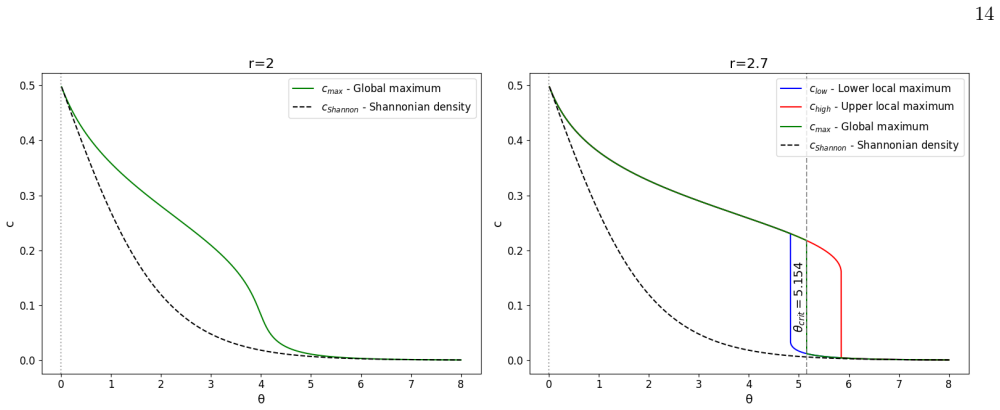
Fixed q Assuming fixed θ and q as N → ∞, we have lim N →∞ 1 (1 − q)N ln (1 + (1 − q)N θc) = 0 . (57) Thus, the second term in ( 56) becomes negligible for large N , and the behavior of Φq and Zq,N (θ) is determined entirely by the binary entropy term. In the large N limit (for fixed θ and q), we thus obtain for the free entropy density lim N →∞ Φq(θ, N ) ...
-
[2]
( 56), as a conse- quence of the concentration of measure
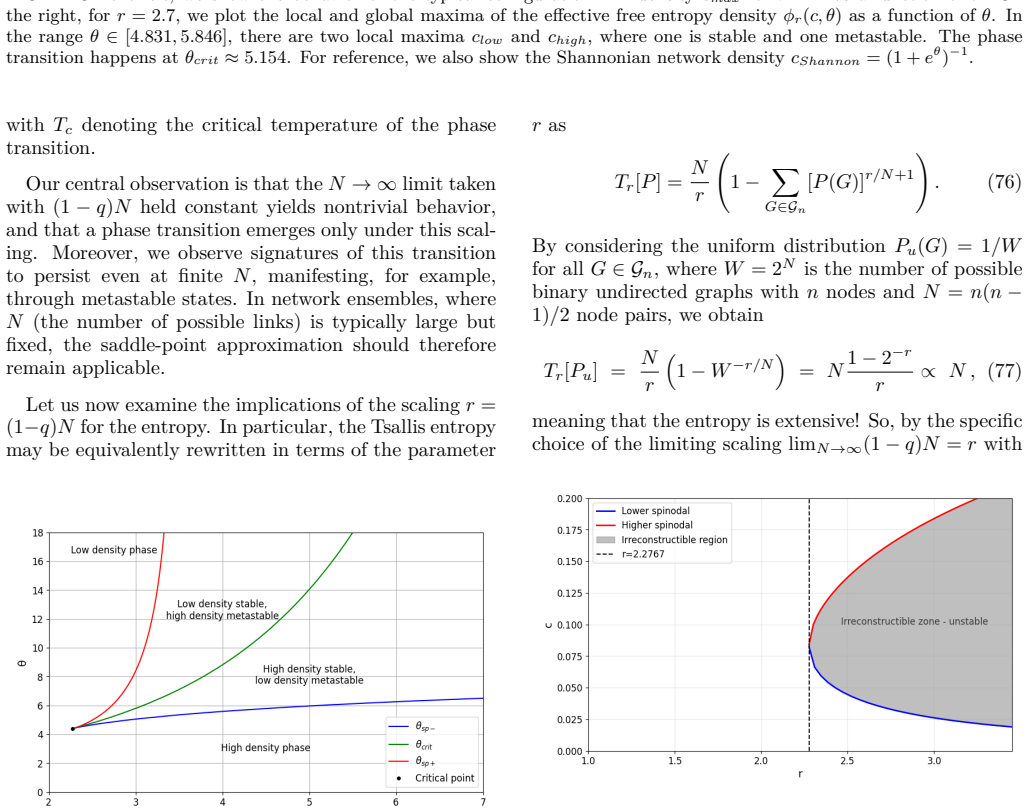
Scaled q As shown in our previous analysis, the entire large- N behavior of the q-exponential model is encoded in the function ϕq(c, θ, N) appearing in Eq. ( 56), as a conse- quence of the concentration of measure. We have just shown that, in the large N limit, ϕq(c, θ, N) approaches a trivial limit regardless of q, if the latter remains fixed as N grows....
-
[3]
Such non-analyticities, however, arise only in the thermodynamic limit N → ∞
Note on the order of limits In statistical physics, phase transitions are typically characterized by the non-analytic behavior of thermo- dynamic potentials, such as the Helmholtz or Gibbs free energy. Such non-analyticities, however, arise only in the thermodynamic limit N → ∞. Consider again Eq. ( 55): indeed, the non-analyticity is caused by the maximi...
-
[4]
The first one is a pertur- bative approach based on Eq
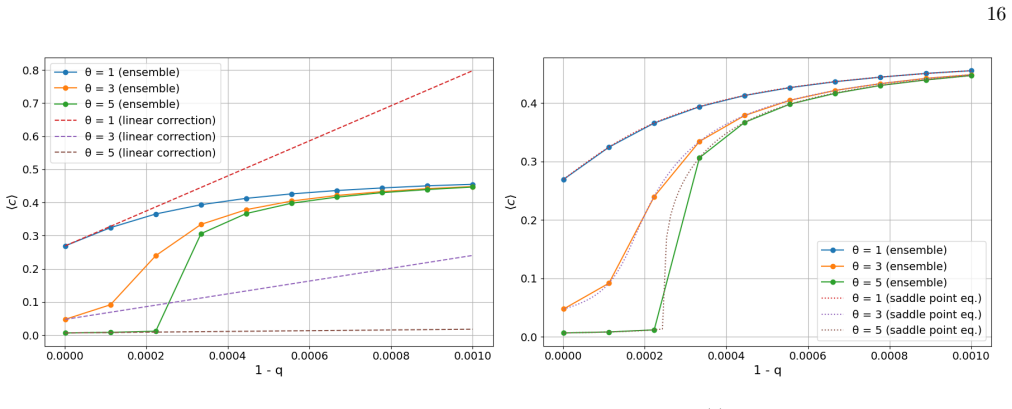
Link density and percolation We considered two complementary methods for ap- proximating the link density. The first one is a pertur- bative approach based on Eq. ( 91), while the second one involved solving the saddle-point equation ( 71). Fig. 5 compares the predictions of these approaches with nu- merical simulations. For 10 values of (1−q) evenly spac...
-
[5]
1 − q − 1 q 1 Z 1−q q (θ) KX i=1 θi(ci(G) − ⟨ci⟩) !#1/(q−1) + = 1 Zq(θ)
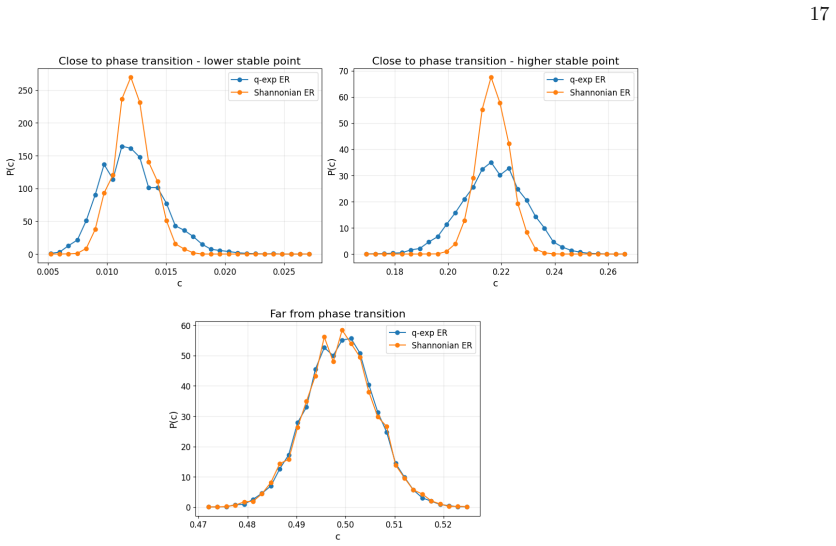
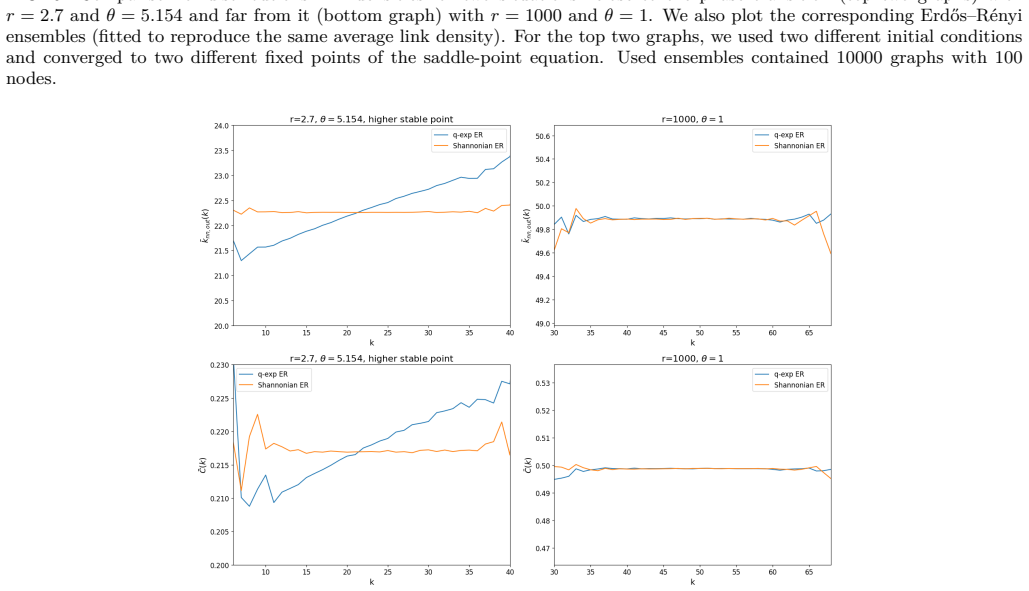
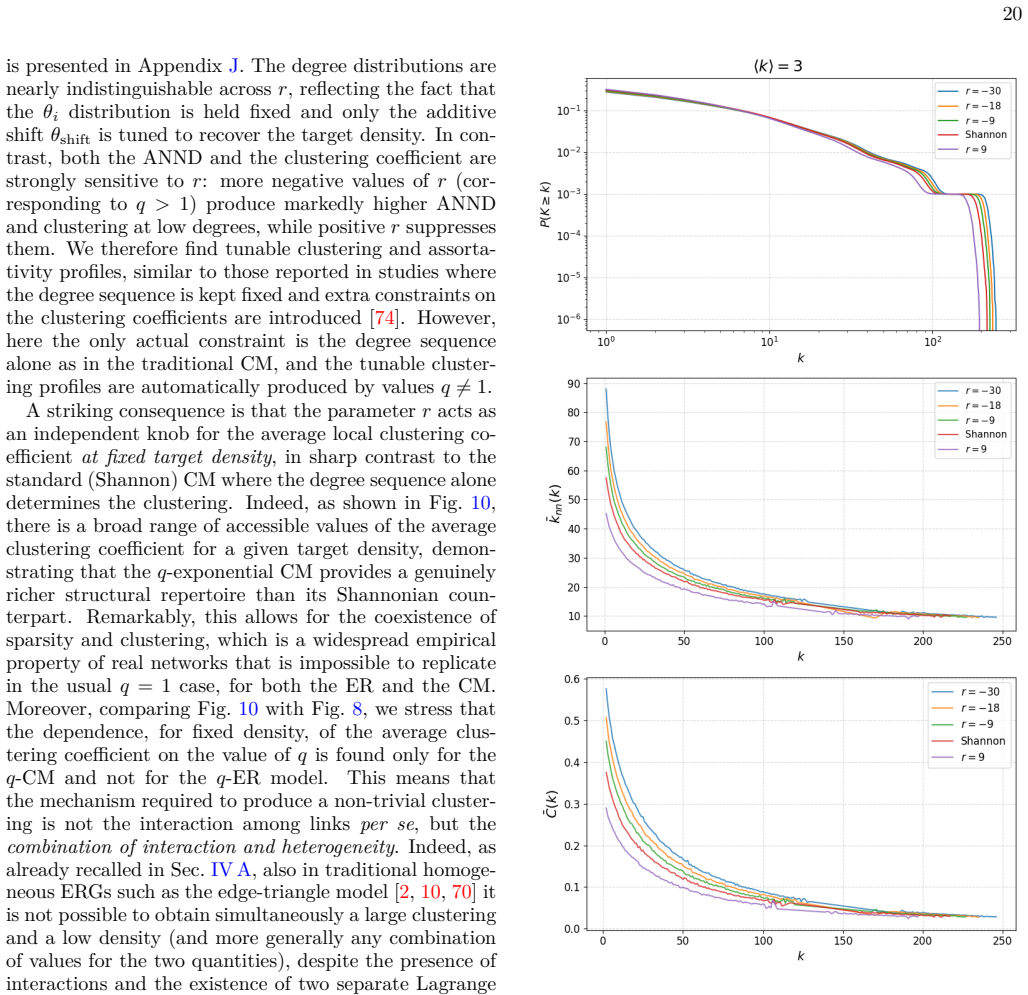
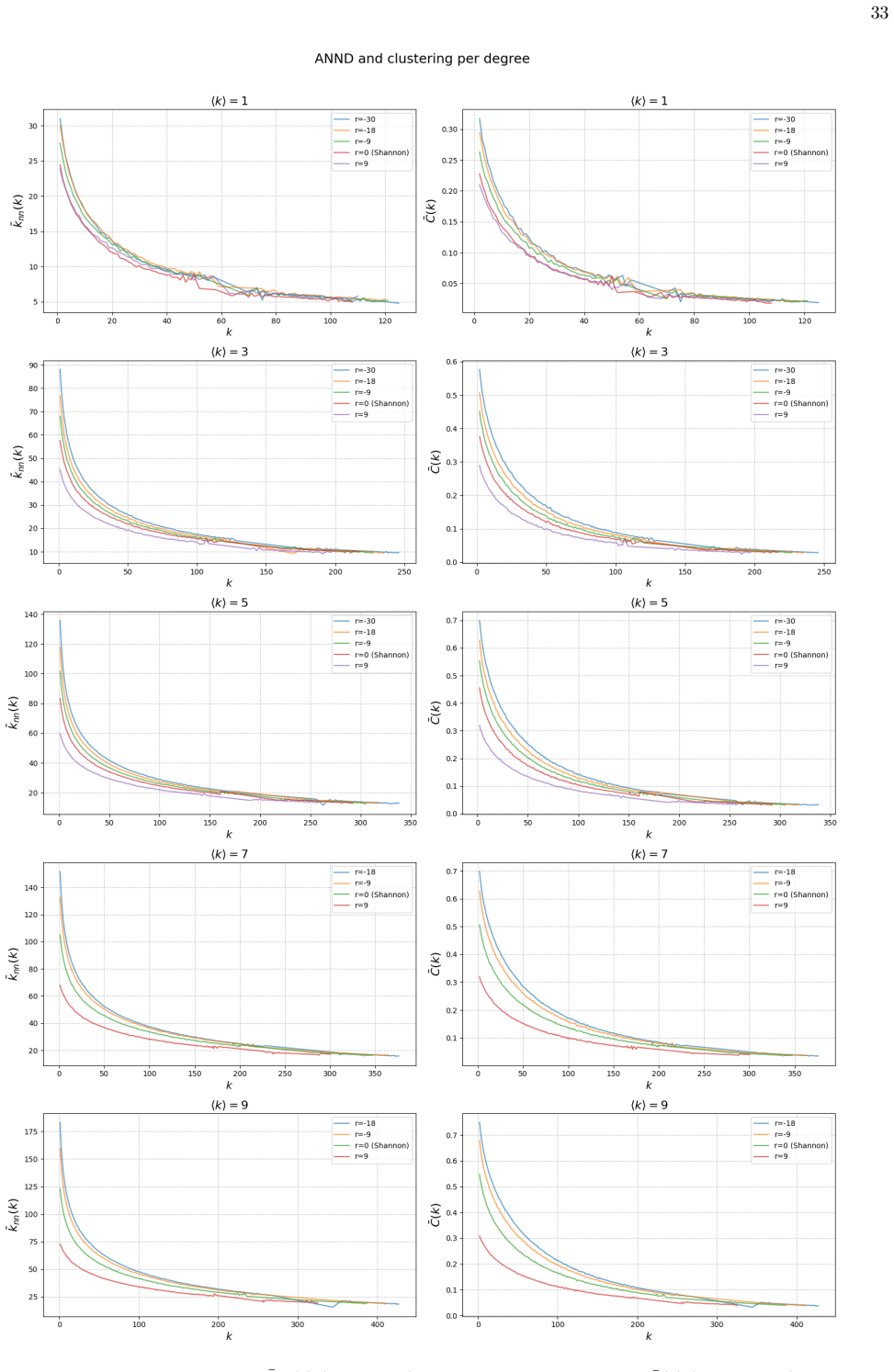
Average nearest-neighbor degree and clustering Let us now compare additional structural properties of the networks. We find no significant differences in the degree distributions between the q-exponential and exponential (Shannon) ensembles. In contrast, the av- erage nearest-neighbor degree (ANND) and the cluster- ing coefficient exhibit notable differenc...
-
[6]
As shown in Fig
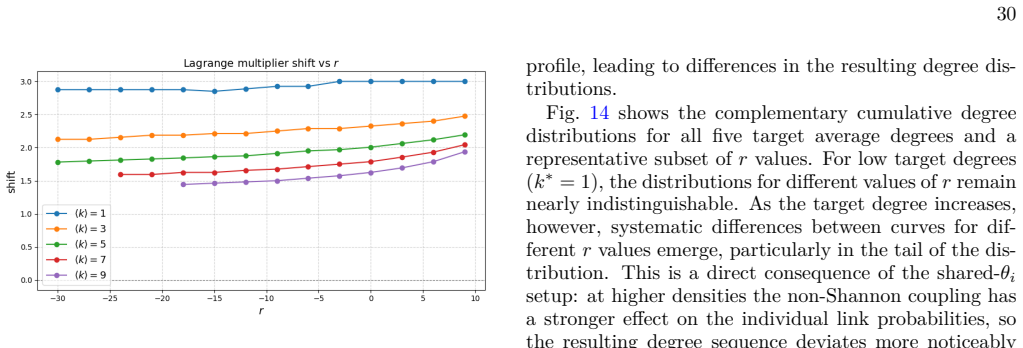
Fitting the shift parameter Before comparing structural properties, it is instruc- tive to examine how the required Lagrange multiplier shift θshift depends on r. As shown in Fig. 13, the shift increases monotonically with r for all target average de- grees k∗ ∈ {1, 3, 5, 7, 9}: moving from negative to positive r (i.e. from q > 1 toward q < 1) requires a ...
-
[7]
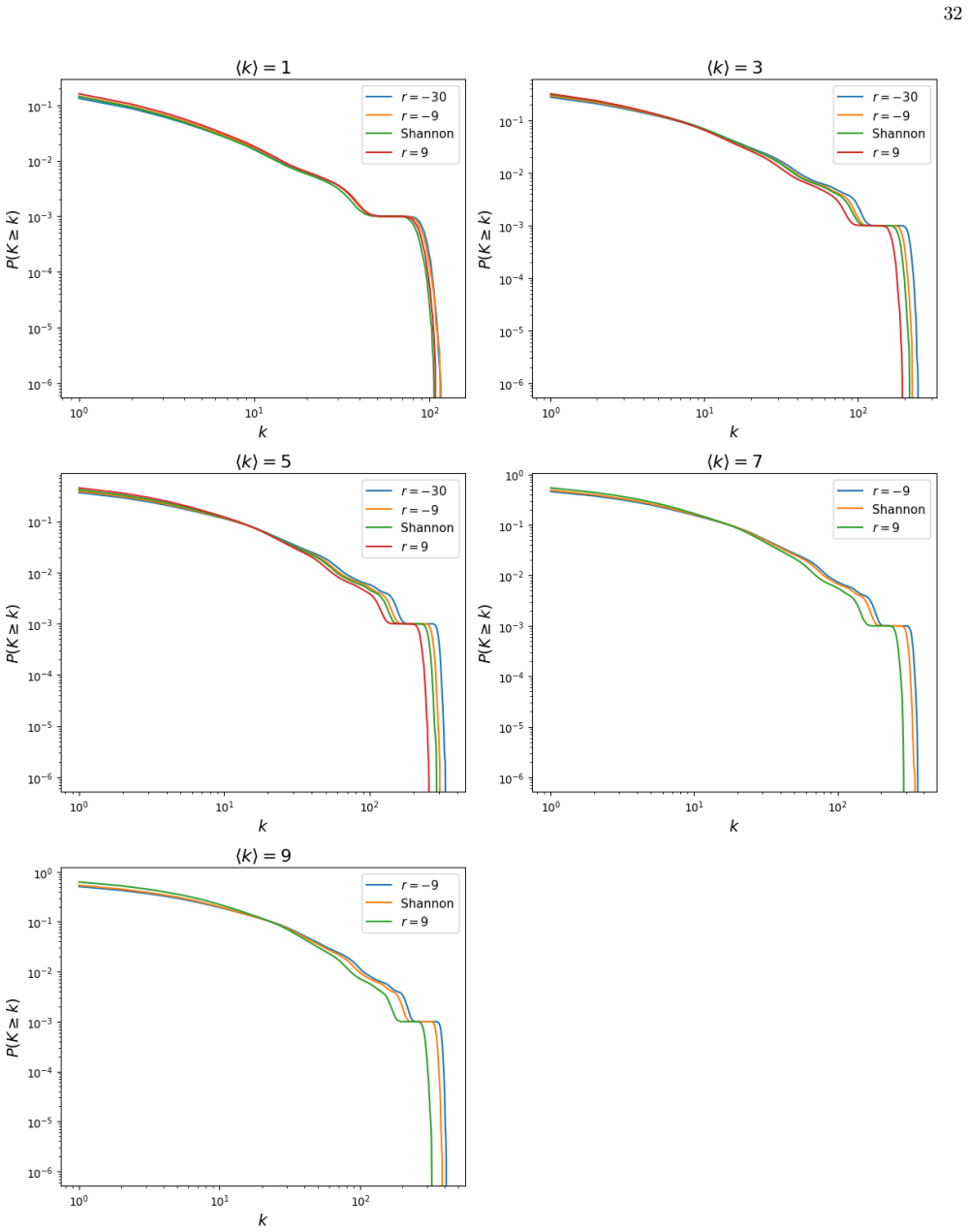
Degree distributions An important aspect of our experimental setup is that the parameters θi are not fitted individually for each node and each value of r. Instead, a single set of θi values is sampled from the normal distribution (with σ = 2 .28, µ = σ2/2) and then kept fixed across all values of r; only the common additive shift θshift is adjusted to re...
-
[8]
15 displays the average clustering coefficient ⟨C⟩ as a function of r for each target average degree
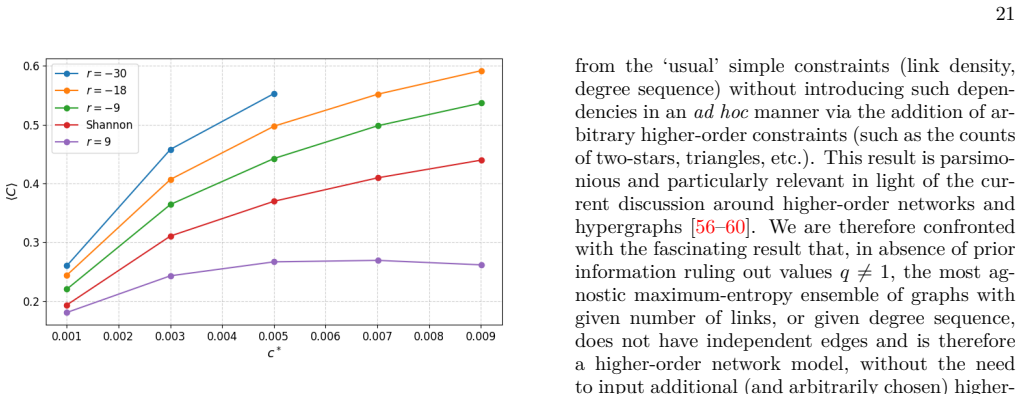
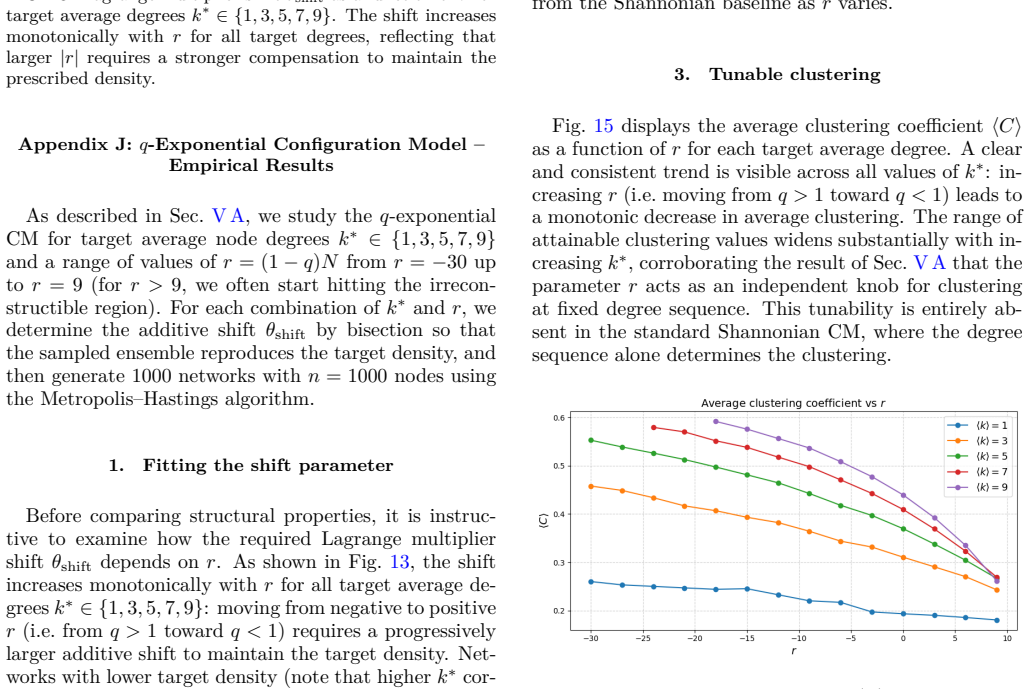
T unable clustering Fig. 15 displays the average clustering coefficient ⟨C⟩ as a function of r for each target average degree. A clear and consistent trend is visible across all values of k∗: in- creasing r (i.e. moving from q > 1 toward q < 1) leads to a monotonic decrease in average clustering. The range of attainable clustering values widens substantial...
-
[9]
Degree-resolved network properties Finally, Fig. 16 shows the average nearest-neighbor de- gree ¯knn(k) and the local clustering coefficient ¯C(k) as functions of node degree k, for all five target average degrees and several values of r. Both profiles exhibit a systematic shift with varying r: networks with more 31 negative r (deeper into the q > 1 regime...
-
[10]
P. W. Holland and S. Leinhardt, Journal of the American Statistical Association 76, 33 (1981), ISSN 1537-274X
1981
-
[11]
Strauss, SIAM review 28, 513 (1986)
D. Strauss, SIAM review 28, 513 (1986)
1986
-
[12]
Wasserman, Social network analysis: Methods and ap- plications, vol
S. Wasserman, Social network analysis: Methods and ap- plications, vol. 8 (Cambridge university press, 1994)
1994
-
[13]
C. J. Anderson, S. Wasserman, and B. Crouch, Social networks 21, 37 (1999)
1999
-
[14]
Robins, P
G. Robins, P. Pattison, Y. Kalish, and D. Lusher, Social networks 29, 173 (2007)
2007
-
[15]
Park and M
J. Park and M. E. J. Newman, Physical Review E 70, 066117 (2004), ISSN 1550–2376
2004
-
[16]
Bianconi, Physical Review E 79, 036114 (2009)
G. Bianconi, Physical Review E 79, 036114 (2009)
2009
-
[17]
Exponential random graph models
A. Fronczak, arXiv preprint arXiv:1210.7828 (2012)
work page internal anchor Pith review Pith/arXiv arXiv 2012
-
[18]
Squartini and D
T. Squartini and D. Garlaschelli, Maximum-Entropy Net- works: Pattern Detection, Network Reconstruction and Graph Combinatorics (Springer International Publishing, 2017), ISBN 9783319694382
2017
-
[19]
A. C. Coolen, A. Annibale, and E. S. Roberts, Generating random networks and graphs (Oxford university press, 2017)
2017
-
[20]
Cimini, T
G. Cimini, T. Squartini, F. Saracco, D. Garlaschelli, A. Gabrielli, and G. Caldarelli, Nature Reviews Physics 1, 58 (2019), ISSN 2522–5820
2019
-
[21]
C. E. Shannon, Bell System Technical Journal 27, 379 (1948), ISSN 0005-8580
1948
-
[22]
Erdős and A
P. Erdős and A. Rényi, Publicationes Mathematicae De- brecen 6, 290–297 (1959)
1959
-
[23]
Erdős, A
P. Erdős, A. Rényi, et al., Publications of the (1960)
1960
-
[24]
Park and M
J. Park and M. E. J. Newman, Phys. Rev. E 68, 026112 (2003)
2003
-
[25]
Fronczak, A
P. Fronczak, A. Fronczak, and M. Bujok, Physical Re- view E 88 (2013)
2013
-
[26]
Karrer and M
B. Karrer and M. E. J. Newman, Physical Review E 83, 016107 (2011)
2011
-
[27]
T. P. Peixoto, Advances in network clustering and block- modeling pp. 289–332 (2019)
2019
-
[28]
C. J. Anderson, S. Wasserman, and K. Faust, Social net- works 14, 137 (1992)
1992
-
[29]
Garlaschelli and M
D. Garlaschelli and M. I. Loffredo, Physical Review Let- ters 93, 268701 (2004)
2004
-
[30]
Squartini, F
T. Squartini, F. Picciolo, F. Ruzzenenti, and D. Gar- laschelli, Scientific reports 3, 2729 (2013)
2013
-
[31]
Gallo, F
A. Gallo, F. Saracco, R. Lambiotte, D. Garlaschelli, and T. Squartini, Physical Review E 111, 024312 (2025)
2025
-
[32]
M. E. J. Newman, SIAM Review 45, 167 (2003)
2003
-
[33]
Fronczak, A
P. Fronczak, A. Fronczak, and J. A. Hołyst, The Euro- pean Physical Journal B 59, 133 (2007)
2007
-
[34]
R. Milo, S. Shen-Orr, S. Itzkovitz, N. Kashtan, D. Chklovskii, and U. Alon, Science 298, 824 (2002)
2002
-
[35]
Holme, Physical Review E—Statistical, Nonlinear, and Soft Matter Physics 72, 046111 (2005)
P. Holme, Physical Review E—Statistical, Nonlinear, and Soft Matter Physics 72, 046111 (2005)
2005
-
[36]
M. E. Newman, Proceedings of the national academy of sciences 103, 8577 (2006)
2006
-
[37]
Saracco, M
F. Saracco, M. J. Straka, R. D. Clemente, A. Gabrielli, G. Caldarelli, and T. Squartini, New Journal of Physics 19, 053022 (2017)
2017
-
[38]
Gallo, F
A. Gallo, F. Saracco, and T. Squartini, npj Complexity 2, 22 (2025)
2025
-
[39]
D. R. Hunter, M. S. Handcock, C. T. Butts, S. M. Goodreau, and M. Morris, Journal of statistical software 24, 1 (2008)
2008
-
[40]
Squartini and D
T. Squartini and D. Garlaschelli, New Journal of Physics 13, 083001 (2011), ISSN 1367-2630
2011
-
[41]
Squartini, G
T. Squartini, G. Caldarelli, G. Cimini, A. Gabrielli, and D. Garlaschelli, Physics Reports 757, 1 (2018), ISSN 0370-1573
2018
-
[42]
Cimini, R
G. Cimini, R. Mastrandrea, and T. Squartini, Recon- structing networks (Cambridge University Press, 2021)
2021
-
[43]
R. W. Krause, M. Huisman, C. Steglich, and T. A. Snijders, in 2018 IEEE/ACM international conference on advances in social networks analysis and mining (ASONAM) (IEEE, 2018), pp. 159–163
2018
-
[44]
E. T. Jaynes, Physical Review 106, 620 (1957), ISSN 0031-899X
1957
-
[45]
E. T. Jaynes, Physical Review 108, 171 (1957), ISSN 1536-6065
1957
-
[46]
J. E. Shore and R. W. Johnson, IEEE Transactions on Information Theory 26, 26 (1980)
1980
-
[47]
J. E. Shore and R. W. Johnson, IEEE Trans. Inf. Theory 27, 472 (1981)
1981
-
[48]
Khinchin, Mathematical Foundations of Information Theory (Dover Publications, New York„ 1957)
A. Khinchin, Mathematical Foundations of Information Theory (Dover Publications, New York„ 1957)
1957
-
[49]
T. M. Cover and J. A. Thomas, Elements of information theory (Wiley-Interscience, Hoboken, N.J, 2006), second edition ed., ISBN 9780471748823, includes bibliographi- cal references (pages 689-721) and index
2006
-
[50]
J. W. Gibbs, Elementary principles in statistical mechan- ics (Courier Corporation, 2014)
2014
-
[51]
Boltzmann, Sitzungsberichte der Kaiserlichen Akademie der Wissenschaften in Wien 66, 275 (1872)
L. Boltzmann, Sitzungsberichte der Kaiserlichen Akademie der Wissenschaften in Wien 66, 275 (1872)
-
[52]
Uffink, Stud
J. Uffink, Stud. Hist. Phil. Mod. Phys. 26, 223 (1995)
1995
-
[53]
Jizba and J
P. Jizba and J. Korbel, Physical Revivew Letters 122, 120601 (2019)
2019
-
[54]
Jizba and J
P. Jizba and J. Korbel, Physical Review E 101, 042126 (2020)
2020
-
[55]
Thurner, R
S. Thurner, R. Hanel, and P. Klimekl, Introduction to the Theory of Complex Systems (Oxford University Press, 2018), ISBN 9780198821939
2018
-
[56]
Tsallis, Introduction to Nonextensive Statistical Me- chanics, SpringerLink (Springer New York, New York, NY, 2009), ISBN 9780387853598
C. Tsallis, Introduction to Nonextensive Statistical Me- chanics, SpringerLink (Springer New York, New York, NY, 2009), ISBN 9780387853598
2009
-
[57]
Tsallis, Journal of Statistical Physics 52, 479 (1988), ISSN 1572-9613
C. Tsallis, Journal of Statistical Physics 52, 479 (1988), ISSN 1572-9613
1988
-
[58]
A. Rényi, in Proceedings of the Fourth Berkeley Sympo- sium on Mathematical Statistics and Probability, Volume 1: Contributions to the Theory of Statistics (University of California Press, 1961), pp. 547–561
1961
-
[59]
Rényi, Selected Papers of Alfred Rényi, Vol
A. Rényi, Selected Papers of Alfred Rényi, Vol. 2 (Akadémia Kiado, 1976)
1976
-
[60]
A. N. Kolmogorov and G. Castelnuovo, Sur la notion de la moyenne (G. Bardi, tip. della R. Accad. dei Lincei, 1930)
1930
-
[61]
Nagumo, in Japanese journal of mathematics: trans- actions and abstracts (The Mathematical Society of Japan, 1930), vol
M. Nagumo, in Japanese journal of mathematics: trans- actions and abstracts (The Mathematical Society of Japan, 1930), vol. 7, pp. 71–79
1930
-
[62]
Somazzi and D
A. Somazzi and D. Garlaschelli, Physical Review Re- search 7, 033087 (2025)
2025
-
[63]
Jizba and J
P. Jizba and J. Korbel, Physical Review E 100, 026101 (2019)
2019
-
[64]
P. A. Morales and F. E. Rosas, Physical Review Research 3, 033216 (2021)
2021
-
[65]
Battiston and G
F. Battiston and G. Petri, Higher-order systems 35 (Springer, 2022)
2022
-
[66]
C. Bick, E. Gross, H. A. Harrington, and M. T. Schaub, SIAM review 65, 686 (2023)
2023
-
[67]
Bianconi, Higher-order networks (Cambridge Univer- sity Press, 2021)
G. Bianconi, Higher-order networks (Cambridge Univer- sity Press, 2021)
2021
-
[68]
Boccaletti, P
S. Boccaletti, P. De Lellis, C. I. del Genio, K. Alfaro- Bittner, R. Criado, S. Jalan, and M. Romance, Physics Reports 1018, 1 (2023)
2023
- [69]
-
[70]
T. A. Snijders et al., Journal of Social Structure 3, 1 (2002)
2002
-
[71]
Vallarano, M
N. Vallarano, M. Bruno, E. Marchese, G. Trapani, F. Saracco, G. Cimini, M. Zanon, and T. Squartini, Sci- entific Reports 11, 15227 (2021)
2021
-
[72]
Garlaschelli and M
D. Garlaschelli and M. I. Loffredo, Physical Review E—Statistical, Nonlinear, and Soft Matter Physics 78, 015101 (2008)
2008
-
[73]
E. M. F. Curado and C. Tsallis, Journal of Physics A: Mathematical and General 24, L69 (1991)
1991
-
[74]
Tsallis, R
C. Tsallis, R. D. Mendes, and A. R. Plastino, Physica A: Statistical Mechanics and its Applications 261, 534 (1998), ISSN 0378-4371
1998
-
[75]
G. L. Ferri, S. S. Martínez, and A. R. Plastino, Journal of Statistical Mechanics: Theory and Experiment 2005, P04009 (2005), ISSN 1742-5468
2005
-
[76]
Jizba, J
P. Jizba, J. Korbel, and V. Zatloukal, Physical Review E 95, 022103 (2017)
2017
-
[77]
Park and M
J. Park and M. E. Newman, Physical Review E— Statistical, Nonlinear, and Soft Matter Physics 70, 066146 (2004)
2004
-
[78]
Annibale and O
A. Annibale and O. T. Courtney, Journal of Physics A: Mathematical and Theoretical 48, 365001 (2015)
2015
-
[79]
Park and M
J. Park and M. E. Newman, Physical Review E— Statistical, Nonlinear, and Soft Matter Physics 72, 026136 (2005)
2005
-
[80]
Touchette, Physical Reports 478, 1 (2009)
H. Touchette, Physical Reports 478, 1 (2009)
2009
discussion (0)
Sign in with ORCID, Apple, or X to comment. Anyone can read and Pith papers without signing in.