Emergence of spin entanglement with the pseudogap onset in the Fermi-Hubbard model
Pith reviewed 2026-06-28 21:00 UTC · model grok-4.3
The pith
Spin-singlet entanglement between nearest-neighbor sites appears exactly when the pseudogap opens in the two-dimensional Fermi-Hubbard model.
A machine-rendered reading of the paper's core claim, the machinery that carries it, and where it could break.
Core claim
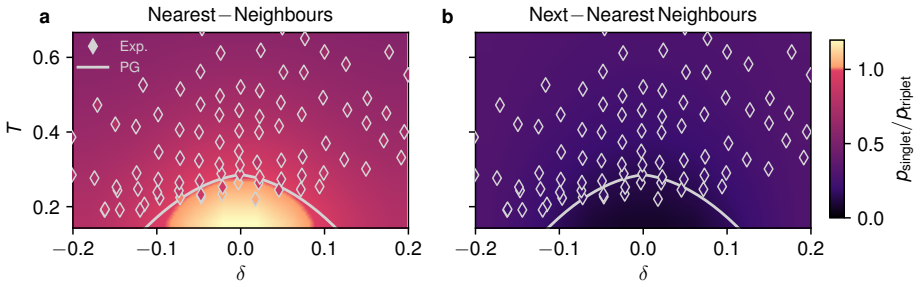
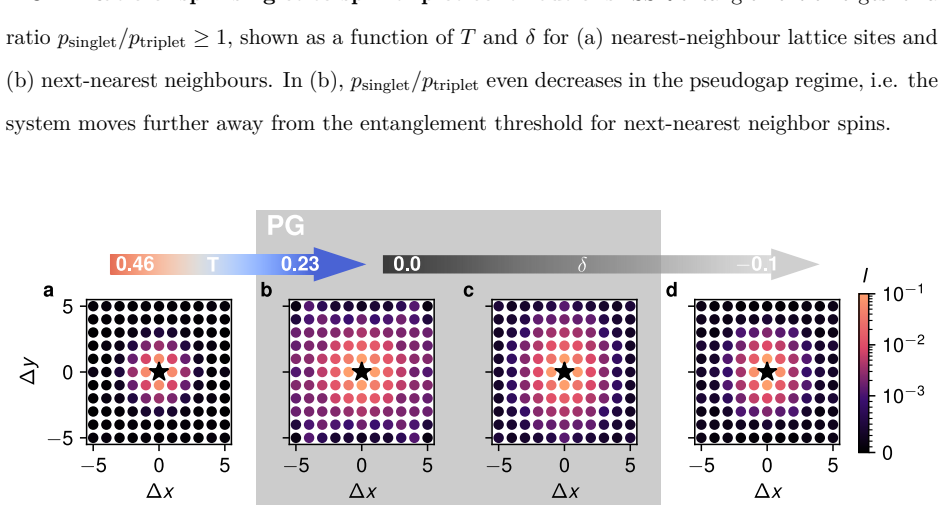
Using both an ultracold-atom quantum simulator and dynamical vertex approximation simulations, the authors find that spin-singlet entanglement emerges only as the pseudogap sets in and, unlike classical correlations, remains confined to nearest-neighbour sites in this regime. This observation disfavours purely classical-fluctuation theories of the pseudogap and constrains microscopic models to those that develop nearest-neighbour spin-singlet entanglement at the pseudogap onset.
What carries the argument
Direct measurement of spin-singlet entanglement via ultracold-atom protocols combined with dynamical vertex approximation calculations, which together track the temperature at which entanglement appears relative to the pseudogap crossover.
If this is right
- The pseudogap cannot be explained by classical spin fluctuations alone.
- Microscopic theories must generate nearest-neighbor spin singlets at the pseudogap temperature.
- Entanglement remains short-ranged even while longer-range classical correlations may exist.
- Quantum simulators can now probe entanglement as a diagnostic for the pseudogap regime.
Where Pith is reading between the lines
- If the pseudogap is tied to local singlets, doping studies might show how entanglement evolves into d-wave pairing.
- The same protocol could be applied to other models suspected of having pseudogap physics to test universality.
- Numerical methods beyond dynamical vertex approximation could be benchmarked by whether they reproduce the entanglement onset.
Load-bearing premise
Both the dynamical vertex approximation and the ultracold-atom entanglement measurement faithfully reflect the true spin entanglement without large biases from the method or from finite-size or detection limitations.
What would settle it
An experiment or calculation that measures nearest-neighbor spin entanglement at temperatures well above the pseudogap onset temperature would falsify the claim.
Figures

read the original abstract
Despite decades of intense theoretical and experimental investigation, the two-dimensional Fermi-Hubbard model still resists a complete microscopic understanding. Conventional approaches typically probe global observables and locally resolved correlation functions. Here, we develop a complementary perspective based on the measurement of entanglement. Using both an ultracold-atom quantum simulator and numerical simulations based on the dynamical vertex approximation, we find that entanglement is closely tied to the onset of the enigmatic pseudogap regime: spin-singlet entanglement emerges only as the pseudogap sets in and, in contrast to classical correlations, remains confined to nearest-neighbour sites in this regime. Our results, therefore, disfavour purely classical-fluctuation theories of the pseudogap and constrain microscopic models to those that develop nearest-neighbour spin-singlet entanglement at the pseudogap onset.
Editorial analysis
A structured set of objections, weighed in public.
Referee Report
Summary. The manuscript claims that in the 2D Fermi-Hubbard model, spin-singlet entanglement (witnessed by nearest-neighbor spin correlations <Si·Sj> < −1/4) emerges precisely at the onset of the pseudogap regime. This is shown via agreement between ultracold-atom quantum simulation and dynamical vertex approximation (DVA) calculations; unlike classical correlations, the entanglement remains confined to nearest-neighbor sites, disfavoring purely classical-fluctuation theories of the pseudogap.
Significance. If the central claim holds, the work supplies a new diagnostic linking the pseudogap directly to quantum entanglement rather than classical fluctuations, thereby constraining microscopic models of the Hubbard Hamiltonian. The deployment of two independent methods (experiment and DVA) is a clear strength that enhances credibility when quantitative agreement is demonstrated.
major comments (2)
- [DVA methods and results sections] The central claim that spin-singlet entanglement emerges exactly at pseudogap onset and remains NN-confined rests on DVA producing accurate local spin correlations below the pseudogap temperature. DVA approximates the two-particle vertex while treating the self-energy self-consistently; once the vertex becomes strongly momentum-dependent in the pseudogap regime, short-range antiferromagnetic fluctuations can be under- or overestimated. Because the entanglement witness is a sharp threshold on the same correlator (<Si·Sj> near −0.25), even modest systematic error can shift the apparent onset temperature or permit spurious longer-range entanglement. The manuscript should supply benchmarks of DVA spin correlators against exact methods or larger-cluster references in the relevant temperature window.
- [Abstract and main results] The abstract states that two independent methods agree on the entanglement-pseudogap link, yet provides no quantitative details on how the entanglement witness is extracted from either the ultracold-atom data or the DVA output, including error bars, finite-size scaling, or the precise temperature window used to identify the pseudogap onset. Without these, the reported coincidence of onsets cannot be assessed for robustness.
minor comments (2)
- [Introduction or methods] Notation for the spin correlator <Si·Sj> should be defined explicitly at first use, including the normalization convention (e.g., whether S are spin-1/2 operators).
- [Figure captions] Figure captions should state the lattice size, filling, and interaction strength U/t used for each data set to allow direct comparison between experiment and DVA.
Simulated Author's Rebuttal
Thank you for the referee's thoughtful review and valuable suggestions. We have carefully considered the comments and provide point-by-point responses below. We will make revisions to enhance the clarity and robustness of our presentation.
read point-by-point responses
-
Referee: [DVA methods and results sections] The central claim that spin-singlet entanglement emerges exactly at pseudogap onset and remains NN-confined rests on DVA producing accurate local spin correlations below the pseudogap temperature. DVA approximates the two-particle vertex while treating the self-energy self-consistently; once the vertex becomes strongly momentum-dependent in the pseudogap regime, short-range antiferromagnetic fluctuations can be under- or overestimated. Because the entanglement witness is a sharp threshold on the same correlator (<Si·Sj> near −0.25), even modest systematic error can shift the apparent onset temperature or permit spurious longer-range entanglement. The manuscript should supply benchmarks of DVA spin correlators against exact methods or larger-cluster references in the relevant temperature window.
Authors: We appreciate the referee pointing out the potential limitations of DVA when the vertex develops strong momentum dependence. The manuscript relies on quantitative agreement between DVA and the ultracold-atom experiment for the local spin correlations as the primary validation. To strengthen the presentation, we will revise the methods section to include references to existing DVA benchmarks against exact diagonalization and cluster methods in the relevant temperature and doping range for the Hubbard model, and we will add a short discussion of why local correlators remain reliable even when longer-range fluctuations are approximated. This addresses the concern about possible shifts in the apparent onset without requiring new large-scale computations. revision: yes
-
Referee: [Abstract and main results] The abstract states that two independent methods agree on the entanglement-pseudogap link, yet provides no quantitative details on how the entanglement witness is extracted from either the ultracold-atom data or the DVA output, including error bars, finite-size scaling, or the precise temperature window used to identify the pseudogap onset. Without these, the reported coincidence of onsets cannot be assessed for robustness.
Authors: We agree that the abstract is too concise on these points and that explicit quantification improves assessability. The main text already describes the witness as nearest-neighbor <Si·Sj> < −1/4 and identifies the pseudogap onset via the temperature where the antinodal spectral function develops a gap, but we will revise both the abstract and the results section to state the error bars on the correlations, note the system sizes used for finite-size checks, and specify the temperature window (e.g., the range over which the pseudogap temperature is determined from the DVA self-energy and from the experimental compressibility or spectroscopy). These additions will make the coincidence of onsets more transparent without altering the central claim. revision: yes
Circularity Check
No circularity; results from independent experiment and DVA simulation
full rationale
The paper derives its claim that spin-singlet entanglement (witnessed by nearest-neighbor spin correlations below -1/4) emerges precisely at pseudogap onset from direct outputs of ultracold-atom measurements and dynamical vertex approximation calculations. These produce the underlying correlators without any fitted parameter that is then relabeled as a prediction, without self-definitional loops, and without load-bearing self-citations that would make the central result tautological. The distinction from classical correlations is likewise obtained from the same independent data streams rather than imposed by construction. This is the normal case of a self-contained numerical/experimental study.
Axiom & Free-Parameter Ledger
axioms (1)
- domain assumption Dynamical vertex approximation is sufficiently accurate for the Fermi-Hubbard model in the pseudogap regime
Reference graph
Works this paper leans on
-
[1]
P. W. Anderson, Resonating valence bonds: A new kind of insulator?, Materials Research Bulletin8, 153 (1973)
1973
-
[2]
P.W.Anderson,TheresonatingvalencebondstateinLa 2CuO4 andsuperconductivity,Science 235, 1196 (1987)
1987
-
[3]
M. K. Joshi, C. Kokail, R. van Bijnen, F. Kranzl, T. V. Zache, R. Blatt, C. F. Roos, and P. Zoller, Exploring large-scale entanglement in quantum simulation, Nature624, 539 (2023)
2023
-
[4]
Kokail, R
C. Kokail, R. van Bijnen, A. Elben, B. Vermersch, and P. Zoller, Entanglement hamiltonian tomography in quantum simulation, Nat. Phys.17, 936 (2021)
2021
-
[5]
Amico, R
L. Amico, R. Fazio, A. Osterloh, and V. Vedral, Entanglement in many-body systems, Rev. Mod. Phys.80, 517 (2008)
2008
-
[6]
Subrahmanyam, Quantum entanglement in Heisenberg antiferromagnets, Phys
V. Subrahmanyam, Quantum entanglement in Heisenberg antiferromagnets, Phys. Rev. A69, 022311 (2004)
2004
-
[7]
Islam, R
R. Islam, R. Ma, P. M. Preiss, M. Eric Tai, A. Lukin, M. Rispoli, and M. Greiner, Measuring entanglement entropy in a quantum many-body system, Nature528, 77 (2015)
2015
-
[8]
T.Grover,EntanglementofInteractingFermionsinQuantumMonteCarloCalculations,Phys. Rev. Lett.111, 130402 (2013)
2013
-
[9]
N.M.Linke, S.Johri, C.Figgatt, K.A.Landsman, A.Y.Matsuura,andC.Monroe,Measuring the Rényi entropy of a two-site Fermi-Hubbard model on a trapped ion quantum computer, Phys. Rev. A98, 052334 (2018)
2018
-
[10]
Cocchi, L
E. Cocchi, L. A. Miller, J. H. Drewes, C. F. Chan, D. Pertot, F. Brennecke, and M. Köhl, Measuring entropy and short-range correlations in the two-dimensional Hubbard model, Phys. Rev. X7, 031025 (2017). 10
2017
-
[11]
Walsh, P
C. Walsh, P. Sémon, D. Poulin, G. Sordi, and A.-M. S. Tremblay, Local entanglement entropy and mutual information across the Mott transition in the two-dimensional Hubbard model, Phys. Rev. Lett.122, 067203 (2019)
2019
-
[12]
Ehlers, J
G. Ehlers, J. Sólyom, O. Legeza, and R. M. Noack, Entanglement structure of the Hubbard model in momentum space, Phys. Rev. B92, 235116 (2015)
2015
-
[13]
Phys.12, 778 (2016)
P.Hauke, M.Heyl, L.Tagliacozzo,andP.Zoller,Measuringmultipartiteentanglementthrough dynamic susceptibilities, Nat. Phys.12, 778 (2016)
2016
-
[14]
Laurell, A
P. Laurell, A. Scheie, E. Dagotto, and D. A. Tennant, Witnessing entanglement and quantum correlations in condensed matter: A review, Advanced Quantum Technologies8, 2400196 (2025)
2025
-
[15]
Mathew, S
G. Mathew, S. L. L. Silva, A. Jain, A. Mohan, D. T. Adroja, V. G. Sakai, C. V. Tomy, A. Banerjee, R. Goreti, A. V. N., R. Singh, and D. Jaiswal-Nagar, Experimental realization of multipartite entanglement via quantum Fisher information in a uniform antiferromagnetic quantum spin chain, Phys. Rev. Res.2, 043329 (2020)
2020
-
[16]
Laurell, A
P. Laurell, A. Scheie, C. J. Mukherjee, M. M. Koza, M. Enderle, Z. Tylczynski, S. Okamoto, R. Coldea, D. A. Tennant, and G. Alvarez, Quantifying and Controlling Entanglement in the Quantum Magnet Cs2CoCl4, Phys. Rev. Lett.127, 037201 (2021)
2021
-
[17]
A. O. Scheie, E. A. Ghioldi, J. Xing, J. A. M. Paddison, N. E. Sherman, M. Dupont, L. D. Sanjeewa, S. Lee, A. J. Woods, D. Abernathy, D. M. Pajerowski, T. J. Williams, S.-S. Zhang, L. O. Manuel, A. E. Trumper, C. D. Pemmaraju, A. S. Sefat, D. S. Parker, T. P. Devereaux, R. Movshovich, J. E. Moore, C. D. Batista, and D. A. Tennant, Proximate spin liquid an...
2024
-
[18]
F. Mazza, S. Biswas, X. Yan, A. Prokofiev, P. Steffens, Q. Si, F. F. Assaad, and S. Paschen, Quantum Fisher information in a strange metal (2024), arXiv:2403.12779
Pith/arXiv arXiv 2024
-
[19]
Bałut, X
D. Bałut, X. Guo, N. de Vries, D. Chaudhuri, B. Bradlyn, P. Abbamonte, and P. W. Phillips, Quantum fisher information reveals UV-IR mixing in the strange metal, Phys. C: Supercond. Appl.635, 1354750 (2025)
2025
-
[20]
Bippus, J
F. Bippus, J. Krsnik, M. Kitatani, L. Akšamović, A. Kauch, N. Barišić, and K. Held, En- tanglement in the pseudogap regime of cuprate superconductors, Phys. Rev. B112, L081110 (2025). 11
2025
-
[21]
Roósz, A
G. Roósz, A. Kauch, F. Bippus, D. Wieser, and K. Held, Two-site reduced density matrix from one- and two-particle Green’s functions, Phys. Rev. B110, 075115 (2024)
2024
-
[23]
L. Ding, G. Dünnweber, and C. Schilling, Physical entanglement between localized orbitals, Quantum Sci. Technol.9, 015005 (2023)
2023
-
[24]
Bellomia, A
G. Bellomia, A. Amaricci, and M. Capone, Local classical correlations between physical elec- trons in Hubbard systems, Phys. Rev. B113, 155158 (2026)
2026
-
[25]
Bellomia,Quantum information insights into strongly correlated electrons, Ph.D
G. Bellomia,Quantum information insights into strongly correlated electrons, Ph.D. thesis, SISSA (2024)
2024
-
[27]
Bañuls, J
M.-C. Bañuls, J. I. Cirac, and M. M. Wolf, Entanglement in fermionic systems, Phys. Rev. A 76, 022311 (2007)
2007
-
[28]
Friis, Reasonable fermionic quantum information theories require relativity, New J
N. Friis, Reasonable fermionic quantum information theories require relativity, New J. Phys. 18, 033014 (2016)
2016
-
[29]
Szalay, Z
S. Szalay, Z. Zimborás, M. Máté, G. Barcza, C. Schilling, and Ö. Legeza, Fermionic systems for quantum information people, J. Phys. A: Math. Theor.54, 393001 (2021)
2021
-
[30]
Bloch, J
I. Bloch, J. Dalibard, and W. Zwerger, Many-body physics with ultracold gases, Rev. Mod. Phys.80, 885 (2008)
2008
-
[31]
Chalopin, P
T. Chalopin, P. Bojović, D. Bourgund, S. Wang, T. Franz, I. Bloch, and T. Hilker, Optical superlattice for engineering Hubbard couplings in quantum simulation, Phys. Rev. Lett.134, 053402 (2025)
2025
-
[34]
M. F. Parsons, A. Mazurenko, C. S. Chiu, G. Ji, D. Greif, and M. Greiner, Site-resolved measurement of the spin-correlation function in the Fermi-Hubbard model, Science353, 1253 (2016). 12
2016
-
[35]
M. Boll, T. A. Hilker, G. Salomon, A. Omran, J. Nespolo, L. Pollet, I. Bloch, and C. Gross, Spin- and density-resolved microscopy of antiferromagnetic correlations in Fermi-Hubbard chains, Science353, 1257 (2016)
2016
-
[36]
L. W. Cheuk, M. A. Nichols, K. R. Lawrence, M. Okan, H. Zhang, E. Khatami, N. Trivedi, T. Paiva, M. Rigol, and M. W. Zwierlein, Observation of spatial charge and spin correlations in the 2d Fermi-Hubbard model, Science353, 1260 (2016)
2016
-
[37]
Koepsell, J
J. Koepsell, J. Vijayan, P. Sompet, F. Grusdt, T. A. Hilker, E. Demler, G. Salomon, I. Bloch, and C. Gross, Imaging magnetic polarons in the doped Fermi–Hubbard model, Nature572, 358 (2019)
2019
-
[38]
Hirthe, T
S. Hirthe, T. Chalopin, D. Bourgund, P. Bojović, A. Bohrdt, E. Demler, F. Grusdt, I. Bloch, and T. A. Hilker, Magnetically mediated hole pairing in fermionic ladders of ultracold atoms, Nature613, 463 (2023)
2023
- [39]
-
[40]
P. T. Brown, D. Mitra, E. Guardado-Sanchez, R. Nourafkan, A. Reymbaut, C.-D. Hébert, S. Bergeron, A.-M. S. Tremblay, J. Kokalj, D. A. Huse, P. Schauß, and W. S. Bakr, Bad metallic transport in a cold atom Fermi-Hubbard system, Science363, 379 (2019)
2019
-
[41]
M. L. Prichard, Z. Ba, I. Morera, B. M. Spar, D. A. Huse, E. Demler, and W. S. Bakr, Magnon-polarons in the Fermi–Hubbard model, Nature Physics21, 1548 (2025)
2025
-
[42]
L. H. Kendrick, A. Kale, Y. Gang, A. D. Deters, M. Lebrat, A. W. Young, and M. Greiner, Pseudogap in a Fermi-Hubbard quantum simulator (2025), arXiv:2509.18075
arXiv 2025
-
[44]
Georges, G
A. Georges, G. Kotliar, W. Krauth, and M. J. Rozenberg, Dynamical mean-field theory of strongly correlated fermion systems and the limit of infinite dimensions, Rev. Mod. Phys.68, 13 (1996)
1996
-
[45]
Schäfer, N
T. Schäfer, N. Wentzell, F. Šimkovic, Y.-Y. He, C. Hille, M. Klett, C. J. Eckhardt, B. Arzhang, V. Harkov, F. m. c.-M. Le Régent, A. Kirsch, Y. Wang, A. J. Kim, E. Kozik, E. A. Stepanov, 13 A. Kauch, S. Andergassen, P. Hansmann, D. Rohe, Y. M. Vilk, J. P. F. LeBlanc, S. Zhang, A.-M. S. Tremblay, M. Ferrero, O. Parcollet, and A. Georges, Tracking the footp...
2021
-
[46]
Kitatani, L
M. Kitatani, L. Si, O. Janson, R. Arita, Z. Zhong, and K. Held, Nickelate superconductors—a renaissance of the one-band Hubbard model, npj Quantum Mater.5, 59 (2020)
2020
-
[47]
K. Lee, B. Y. Wang, M. Osada, B. H. Goodge, T. C. Wang, Y. Lee, S. Harvey, W. J. Kim, Y. Yu, C. Murthy,et al., Linear-in-temperature resistivity for optimally superconducting (Nd, Sr) NiO2, Nature619, 288 (2023)
2023
-
[48]
Horodecki, P
M. Horodecki, P. Horodecki, and R. Horodecki, Separability of mixed states: Necessary and sufficient conditions, Phys. Lett. A223, 1 (1996)
1996
-
[49]
M. B. Plenio, Logarithmic negativity: A full entanglement monotone that is not convex, Phys. Rev. Lett.95, 090503 (2005)
2005
-
[50]
Vidal and R
G. Vidal and R. F. Werner, Computable measure of entanglement, Phys. Rev. A65, 032314 (2002)
2002
-
[51]
Schuch, F
N. Schuch, F. Verstraete, and J. I. Cirac, Nonlocal resources in the presence of superselection rules, Phys. Rev. Lett.92, 087904 (2004)
2004
-
[52]
Bellomia, C
G. Bellomia, C. Mejuto-Zaera, M. Capone, and A. Amaricci, Symmetry-resolved quasilocal entanglement as a key to Mott and pseudogap physics inplaquetteCDMFT (in preparation)
-
[53]
Henderson and V
L. Henderson and V. Vedral, Classical, quantum and total correlations, J. Phys. A: Math. Gen.34, 6899 (2001)
2001
-
[54]
Here, the estimated uncertainty is obtained from Gaussian error propagation of the bootstrap uncertainties of the relevant density matrix elements. Owing to the particle–hole symmetry of the model, theoretical data was computed only in the hole-doped regime (negativeδ), the exact data points are shown in Supplementary Information S.5
-
[55]
That is, all 18 black and colored elements in Fig. 1(c)
-
[56]
Gull and A
E. Gull and A. Millis, Numerical models come of age, Nat. Phys.11, 808 (2015)
2015
-
[57]
A.Damascelli, Z.Hussain,andZ.-X.Shen,Angle-resolvedphotoemissionstudiesofthecuprate superconductors, Rev. Mod. Phys.75, 473 (2003)
2003
-
[58]
Pavarini, I
E. Pavarini, I. Dasgupta, T. Saha-Dasgupta, O. Jepsen, and O. K. Andersen, Band-structure trend in hole-doped cuprates and correlation withtcmax, Phys. Rev. Lett.87, 047003 (2001). 14
2001
-
[59]
Xu, C.-M
H. Xu, C.-M. Chung, M. Qin, U. Schollwöck, S. R. White, and S. Zhang, Coexistence of superconductivity with partially filled stripes in the Hubbard model, Science384, eadh7691 (2024)
2024
-
[60]
C. Roth, A. Chen, A. Sengupta, and A. Georges, Superconductivity in the two-dimensional Hubbard model revealed by neural quantum states (2025), arXiv:2511.07566
arXiv 2025
-
[61]
Haule and G
K. Haule and G. Kotliar, Strongly correlated superconductivity: A plaquette dynamical mean- field theory study, Phys. Rev. B76, 104509 (2007)
2007
-
[62]
Ferrero, P
M. Ferrero, P. S. Cornaglia, L. De Leo, O. Parcollet, G. Kotliar, and A. Georges, Valence bond dynamical mean-field theory of doped mott insulators with nodal/antinodal differentiation, EPL85, 57009 (2009)
2009
-
[63]
Ferrero, P
M. Ferrero, P. S. Cornaglia, L. D. Leo, O. Parcollet, G. Kotliar, and A. Georges, Pseudogap opening and formation of fermi arcs as an orbital-selective mott transition in momentum space, Phys. Rev. B80, 064501 (2009)
2009
-
[64]
M. Punk, A. Allais, and S. Sachdev, Quantum dimer model for the pseudogap metal, PNAS 112, 9552–9557 (2015)
2015
-
[65]
Y. Yu, S. Iskakov, E. Gull, K. Held, and F. Krien, Unambiguous fluctuation decomposition of the self-energy: Pseudogap physics beyond spin fluctuations, Phys. Rev. Lett.132, 216501 (2024)
2024
-
[66]
Müller, R
T. Müller, R. Thomale, S. Sachdev, and Y. Iqbal, Polaronic correlations from optimized ancilla wave functions for the Fermi–Hubbard model, PNAS122, e2504261122 (2025)
2025
-
[67]
Schlömer, A
H. Schlömer, A. Bohrdt, and F. Grusdt, Geometric orthogonal metals: Hidden antiferromag- netism and the pseudogap from fluctuating stripes, PRX Quantum6, 030342 (2025)
2025
-
[68]
P. M. Bonetti, M. Christos, A. Nikolaenko, A. A. Patel, and S. Sachdev, Fractionalized Fermi liquids and the cuprate phase diagram, Rep. Prog. Phys.89, 044501 (2026)
2026
-
[69]
Rohshap, M
S. Rohshap, M. K. Ritter, H. Shinaoka, J. von Delft, M. Wallerberger, and A. Kauch, Two- particle calculations with quantics tensor trains: Solving the parquet equations, Phys. Rev. Res.7, 023087 (2025)
2025
-
[70]
H. Eßl, M. Reitner, E. Kozik, and A. Toschi, Origin of misleading convergence in self- consistent many-electron theories: Fundamental aspects and practical implications (2026), arXiv:2502.01420. 15
Pith/arXiv arXiv 2026
-
[71]
J.-M.Lihm, D.Kiese, S.-S.B.Lee,andF.B.Kugler,Thefinite-differenceparquetmethod: En- hanced electron–paramagnon scattering opens a pseudogap, PNAS123, e2525308123 (2026)
2026
-
[72]
Mazurenko, C
A. Mazurenko, C. S. Chiu, G. Ji, M. F. Parsons, M. Kanász-Nagy, R. Schmidt, F. Grusdt, E. Demler, D. Greif, and M. Greiner, A cold-atom Fermi–Hubbard antiferromagnet, Nature 545, 462 (2017)
2017
-
[73]
Gross and W
C. Gross and W. S. Bakr, Quantum gas microscopy for single atom and spin detection, Nat. Phys.17, 1316 (2021)
2021
-
[74]
Bourgund, T
D. Bourgund, T. Chalopin, P. Bojović, H. Schlömer, S. Wang, T. Franz, S. Hirthe, A. Bohrdt, F. Grusdt, I. Bloch, and T. A. Hilker, Formation of individual stripes in a mixed-dimensional cold-atom Fermi–Hubbard system, Nature637, 57 (2025)
2025
-
[75]
Blankenbecler, D
R. Blankenbecler, D. J. Scalapino, and R. L. Sugar, Monte Carlo calculations of coupled boson-fermion systems. I, Phys. Rev. D24, 2278 (1981)
1981
-
[76]
C. N. Varney, C.-R. Lee, Z. J. Bai, S. Chiesa, M. Jarrell, and R. T. Scalettar, Quantum Monte Carlo study of the two-dimensional fermion Hubbard model, Phys. Rev. B80, 075116 (2009)
2009
-
[78]
Wallerberger, A
M. Wallerberger, A. Hausoel, P. Gunacker, A. Kowalski, N. Parragh, F. Goth, K. Held, and G. Sangiovanni, w2dynamics: Local one- and two-particle quantities from dynamical mean field theory, Comp. Phys. Comm.235, 388 (2019)
2019
-
[79]
Worm,Numerical analysis of many-body effects in cuprate and nickelate superconductors, PhD Thesis, TU Wien (2023)
P. Worm,Numerical analysis of many-body effects in cuprate and nickelate superconductors, PhD Thesis, TU Wien (2023)
2023
-
[81]
L. Ding, S. Mardazad, S. Das, S. Szalay, U. Schollwöck, Z. Zimborás, and C. Schilling, Concept of orbital entanglement and correlation in quantum chemistry, J. Chem. Theory Comput.17, 79 (2021). 16 Methods Both experiment and theory simulate the 2D Fermi-Hubbard model H=−t ∑ ⟨ij⟩,σ ( ˆc† iσˆcjσ+h.c. ) +U ∑ i ˆni↑ˆni↓−µ ∑ i,σ ˆni,σ (4) with only nearest-ne...
2021
-
[82]
Kaufmann and K
J. Kaufmann and K. Held, ana_cont: Python package for analytic continuation, Comput. Phys. Commun282, 108519 (2023)
2023
-
[83]
Chalopin, P
T. Chalopin, P. Bojović, S. Wang, T. Franz, A. Sinha, Z. Wang, D. Bourgund, J. Obermeyer, F. Grusdt, A. Bohrdt, L. Pollet, A. Wietek, A. Georges, T. Hilker, and I. Bloch, Observation of emergent scaling of spin–charge correlations at the onset of the pseudogap, PNAS123, e2525539123 (2026)
2026
-
[84]
Wietek, Y.-Y
A. Wietek, Y.-Y. He, S. R. White, A. Georges, and E. M. Stoudenmire, Stripes, Antiferro- magnetism, and the Pseudogap in the Doped Hubbard Model at Finite Temperature, Phys. Rev. X11, 031007 (2021)
2021
-
[85]
D. C. Johnston, Magnetic susceptibility scaling in La2−xSrxCuO4−y, Phys. Rev. Lett.62, 957 (1989)
1989
-
[86]
Alloul, T
H. Alloul, T. Ohno, and P. Mendels, 89Y NMR evidence for a Fermi-liquid behavior in YBa2Cu3O6+x, Phys. Rev. Lett.63, 1700 (1989)
1989
-
[87]
L. Ding, Z. Zimboras, and C. Schilling, Quantifying electron entanglement faithfully (2022), arXiv:2207.03377
arXiv 2022
discussion (0)
Sign in with ORCID, Apple, or X to comment. Anyone can read and Pith papers without signing in.