GETA: Generalized Encrypted Traffic Analysis
Pith reviewed 2026-06-28 21:47 UTC · model grok-4.3
The pith
GETA classifies encrypted traffic from metadata alone by modeling flows as multivariate time series and adapting in few shots to new domains.
A machine-rendered reading of the paper's core claim, the machinery that carries it, and where it could break.
Core claim
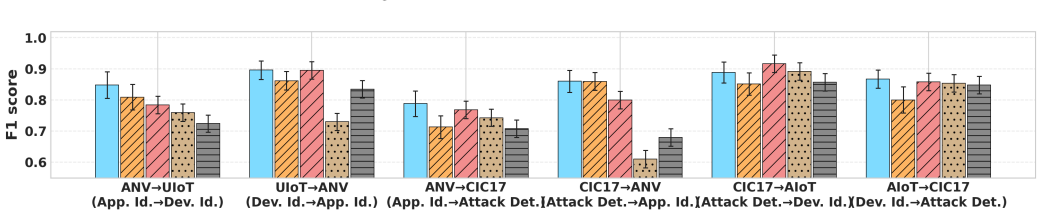
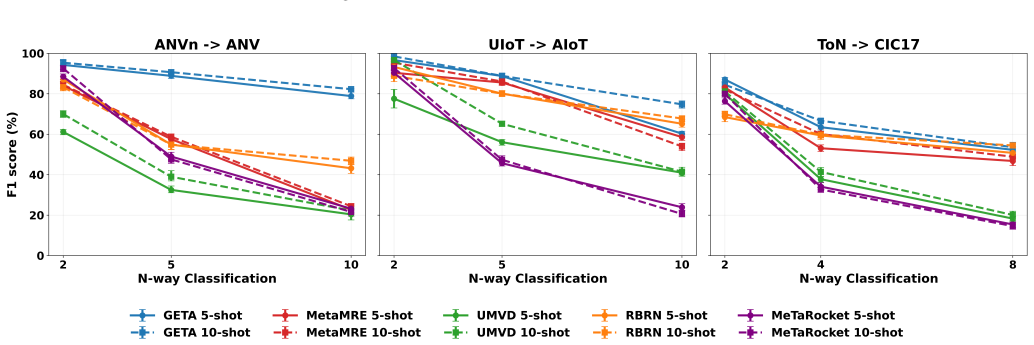
GETA is a protocol-agnostic framework that models network flows as multivariate time series using only traffic metadata, combines meta-learning, embedding refinement, and self-attention to support few-shot adaptation to previously unseen domains with minimal labelled data, and consistently outperforms state-of-the-art baselines across nine public datasets spanning application identification, VPN traffic classification, IoT device fingerprinting, and attack detection.
What carries the argument
GETA, the framework that represents flows as multivariate time series from metadata and fuses meta-learning with embedding refinement plus self-attention to enable few-shot cross-domain adaptation.
If this is right
- Encrypted traffic analysis can operate without access to payloads or protocol header semantics.
- Models can transfer to new network environments using only a small number of labeled examples.
- One framework can address multiple distinct tasks including VPN detection and IoT fingerprinting.
- Performance holds when encryption and tunneling hide traditional distinguishing features.
Where Pith is reading between the lines
- Timing and volume patterns in metadata appear to carry the main discriminatory signals for these security tasks.
- The approach may reduce the cost of collecting fresh labels when network conditions or applications change.
- It could be tested on live high-volume links where domain shifts occur continuously.
Load-bearing premise
Traffic metadata alone, when turned into multivariate time series, holds enough information to drive accurate classification and the meta-learning components allow reliable adaptation to new domains without protocol-specific features.
What would settle it
A new encrypted traffic dataset from an unseen domain in which the metadata-only time series produce classification accuracy no better than chance after the meta-learning and adaptation steps are applied.
Figures




read the original abstract
Traditional traffic analysis is being fundamentally challenged by the rapid adoption of encryption, tunnelling, and privacy-preserving protocols, which increasingly obscure packet payloads and limit the usefulness of Deep Packet Inspection (DPI). Although machine learning has advanced encrypted traffic analysis, existing approaches often remain tied to protocol-specific header features, depend on large labelled datasets, and degrade when deployed across heterogeneous network environments. We present GETA, a protocol-agnostic framework for encrypted traffic analysis that models network flows as multivariate time series using only traffic metadata, thereby avoiding reliance on packet payloads or header semantics. GETA combines meta-learning, embedding refinement, and self-attention to support few-shot adaptation to previously unseen domains with minimal labelled data. Across nine public datasets spanning application identification, VPN traffic classification, IoT device fingerprinting, and attack detection, GETA consistently outperforms state-of-the-art baselines. These results show that GETA offers a practical and generalisable foundation for robust traffic analysis in modern encrypted networks.
Editorial analysis
A structured set of objections, weighed in public.
Referee Report
Summary. The paper presents GETA, a protocol-agnostic framework for encrypted traffic analysis. It models network flows as multivariate time series using only traffic metadata (avoiding payloads and header semantics), combines meta-learning, embedding refinement, and self-attention for few-shot cross-domain adaptation, and reports consistent outperformance over state-of-the-art baselines across nine public datasets covering application identification, VPN classification, IoT fingerprinting, and attack detection.
Significance. If the empirical results hold, GETA would provide a practical, generalizable foundation for robust traffic analysis in encrypted networks, reducing dependence on protocol-specific features and large labeled datasets while supporting adaptation to unseen domains.
major comments (1)
- [Experimental evaluation] The provided manuscript consists only of the abstract; no experimental section, dataset descriptions, implementation details, ablation studies, or statistical tests are available, making it impossible to assess whether the reported outperformance is supported by the data or methods (§4 or equivalent experimental evaluation).
Simulated Author's Rebuttal
We thank the referee for their feedback. We acknowledge that the version provided for review contained only the abstract and will revise the submission to include the complete manuscript with all experimental details.
read point-by-point responses
-
Referee: [Experimental evaluation] The provided manuscript consists only of the abstract; no experimental section, dataset descriptions, implementation details, ablation studies, or statistical tests are available, making it impossible to assess whether the reported outperformance is supported by the data or methods (§4 or equivalent experimental evaluation).
Authors: We agree that the experimental section is required to evaluate the claims. The full manuscript contains §4 with descriptions of the nine datasets, implementation details for the meta-learning, embedding refinement, and self-attention components, ablation studies, and statistical tests supporting the reported results. We will submit the complete manuscript in the revision so that the outperformance can be properly assessed. revision: yes
Circularity Check
No significant circularity
full rationale
The paper is an empirical report of a protocol-agnostic framework (GETA) that models flows as multivariate time series from metadata only, then applies meta-learning plus self-attention for few-shot adaptation. Its central claim is consistent outperformance on nine public datasets for application identification, VPN classification, IoT fingerprinting and attack detection. No equations, derivations, fitted-parameter predictions, self-definitional loops, or load-bearing self-citations are present in the provided text. The results are externally falsifiable against the cited public datasets and baselines, satisfying the criteria for a self-contained empirical argument.
Axiom & Free-Parameter Ledger
Reference graph
Works this paper leans on
-
[1]
Time series analysis for encrypted traffic classification: A deep learning approach,
L. Vuet al., “Time series analysis for encrypted traffic classification: A deep learning approach,” inIEEE ISCIT, 2018
2018
-
[2]
Analysis of encrypted traffic with time-based features and time frequency analysis,
G. Baldini, “Analysis of encrypted traffic with time-based features and time frequency analysis,” inIEEE GIoTS, 2020
2020
-
[3]
A survey on encrypted network traffic analysis applications, techniques, and countermeasures,
E. Papadogiannaki, “A survey on encrypted network traffic analysis applications, techniques, and countermeasures,”ACM CSUR, 2021
2021
-
[4]
HTTPS encryption on the web - google transparency report,
Google, “HTTPS encryption on the web - google transparency report,”
-
[5]
Available: https://transparencyreport.google.com/https/ overview?hl=en
[Online]. Available: https://transparencyreport.google.com/https/ overview?hl=en
-
[6]
Few-shot encrypted traffic classification: A survey,
C. Yanget al., “Few-shot encrypted traffic classification: A survey,” in IEEE IPEC, 2024
2024
-
[7]
Umvd-fsl: Unseen malware variants detection using few- shot learning,
C. Ronget al., “Umvd-fsl: Unseen malware variants detection using few- shot learning,” inIEEE IJCNN, 2021
2021
-
[8]
ET-BERT: A contextualized datagram representation with pre-training transformers for encrypted traffic classification,
X. Linet al., “ET-BERT: A contextualized datagram representation with pre-training transformers for encrypted traffic classification,” inACM WWW, 2022
2022
-
[9]
Appsniffer: Towards robust mobile app fingerprinting against vpn,
S. Ohet al., “Appsniffer: Towards robust mobile app fingerprinting against vpn,” inACM WWW, 2023
2023
-
[10]
Machine learning-powered encrypted network traffic analysis: A comprehensive survey,
M. Shenet al., “Machine learning-powered encrypted network traffic analysis: A comprehensive survey,”IEEE Communications Surveys & Tutorials, vol. 25, 2023
2023
-
[11]
An encrypted network traffic classification strategy: Com- bining locality-sensitive hashing with transformer encoder and cnn,
J. Wuet al., “An encrypted network traffic classification strategy: Com- bining locality-sensitive hashing with transformer encoder and cnn,” in IEEE ICNP, 2024
2024
-
[12]
Deep learning for encrypted traffic classification in the face of data drift: An empirical study,
N. Malekghainiet al., “Deep learning for encrypted traffic classification in the face of data drift: An empirical study,”Elsevier Computer Networks, 2023
2023
-
[13]
Flow-MAE: Leveraging masked autoencoder for accurate, efficient and robust malicious traffic classification,
Z. Hanget al., “Flow-MAE: Leveraging masked autoencoder for accurate, efficient and robust malicious traffic classification,” inRAID, 2023
2023
-
[14]
Netmamba: Efficient network traffic classification via pre-training unidirectional mamba,
T. Wanget al., “Netmamba: Efficient network traffic classification via pre-training unidirectional mamba,” inIEEE ICNP, 2024
2024
-
[15]
Sok: Decoding the enigma of encrypted network traffic classifiers,
N. Wickramasingheet al., “Sok: Decoding the enigma of encrypted network traffic classifiers,” inIEEE SP, 2025
2025
-
[16]
Network traffic classification based on single flow time series analysis,
J. Koumaret al., “Network traffic classification based on single flow time series analysis,” inIEEE CNSM, 2023, pp. 1–7
2023
-
[17]
Detection of doh tunnels using time-series classification of encrypted traffic,
M. MontazeriShatooriet al., “Detection of doh tunnels using time-series classification of encrypted traffic,” inIEEE DASC/PiCom/CBDCom/CyberSciTech, 2020
2020
-
[18]
Var-cnn: A data-efficient website fingerprinting attack based on deep learning,
S. Bhatet al., “Var-cnn: A data-efficient website fingerprinting attack based on deep learning,”PETs, 2019
2019
-
[19]
Towards robust multi-tab website fingerprinting,
X. Denget al., “Towards robust multi-tab website fingerprinting,” 2025. [Online]. Available: http://arxiv.org/abs/2501.12622
-
[20]
A few-shot learning based approach to IoT traffic classification,
Z. Zhaoet al., “A few-shot learning based approach to IoT traffic classification,”IEEE Communications Letters, 2022
2022
-
[21]
Few-shot encrypted traffic classification via multi-task representation enhanced meta-learning,
C. Yanget al., “Few-shot encrypted traffic classification via multi-task representation enhanced meta-learning,”Computer Networks, vol. 228, 6 2023
2023
-
[22]
Metarocketc: Adaptive encrypted traffic classification in complex network environments via time series analysis and meta- learning,
J. Zhaoet al., “Metarocketc: Adaptive encrypted traffic classification in complex network environments via time series analysis and meta- learning,”IEEE TNSM, 2024
2024
-
[23]
Model-agnostic meta-learning for fast adaptation of deep networks,
C. Finnet al., “Model-agnostic meta-learning for fast adaptation of deep networks,” inICML, 2017
2017
-
[24]
Zest: Attention-based zero-shot learning for unseen iot device classification,
B. Wuet al., “Zest: Attention-based zero-shot learning for unseen iot device classification,” inIEEE NOMS, 2024
2024
-
[25]
C. W. Tanet al., “MultiRocket: Multiple pooling operators and transformations for fast and effective time series classification,”arXiv preprint, 2022. [Online]. Available: https://arxiv.org/abs/2102.00457
-
[26]
Transformers in time series: a survey,
Q. Wenet al., “Transformers in time series: a survey,” inIJCAI, 2023
2023
-
[27]
Time series classification with large language models via linguistic scaffolding,
H. Janget al., “Time series classification with large language models via linguistic scaffolding,”IEEE Access, 2024
2024
-
[28]
One fits all: Power general time series analysis by pretrained lm,
T. Zhouet al., “One fits all: Power general time series analysis by pretrained lm,”NeurIPS, 2023
2023
-
[29]
UniTS: A unified multi-task time series model,
S. Gaoet al., “UniTS: A unified multi-task time series model,” in NeurIPS, 2024
2024
-
[30]
Prototypical networks for few-shot learning,
J. Snellet al., “Prototypical networks for few-shot learning,”Advances in neural information processing systems, vol. 30, 2017
2017
-
[31]
“GETA: Code and Data,” https://zenodo.org/records/19962549, 2025, zenodo. Code and data for reproducibility
-
[32]
Classifying IoT devices in smart environments using network traffic characteristics,
A. Sivanathanet al., “Classifying IoT devices in smart environments using network traffic characteristics,”IEEE TMC, 2019
2019
-
[33]
IoT Devices Captures,
S. Marchal, “IoT Devices Captures,” https://doi.org/10.24342/ 285a9b06-de31-4d8b-88e9-5bdba46cc161, 2017
2017
-
[34]
Toward generating a new intrusion detection dataset and intrusion traffic characterization,
I. Sharafaldinet al., “Toward generating a new intrusion detection dataset and intrusion traffic characterization,” inSciTePress ICISSP, 2018
2018
-
[35]
TON IoT telemetry dataset: A new generation dataset of iot and iiot for data-driven intrusion detection systems,
A. Alsaediet al., “TON IoT telemetry dataset: A new generation dataset of iot and iiot for data-driven intrusion detection systems,”IEEE Access, 2020
2020
-
[36]
The point-to-point protocol (ppp),
W. Simpson, “The point-to-point protocol (ppp),” https://www.rfc-editor. org/rfc/rfc1548, 1993, accessed on 2025-04-25
1993
-
[37]
Microsoft point-to-point compression (MPPC) protocol,
G. Pall, “Microsoft point-to-point compression (MPPC) protocol,” https: //www.rfc-editor.org/rfc/rfc3078, 1997
1997
-
[38]
Internet key exchange protocol version 2 (IKEv2),
C. Kaufmanet al., “Internet key exchange protocol version 2 (IKEv2),” https://www.rfc-editor.org/rfc/rfc7296, 2014
2014
-
[39]
IP encapsulating security payload (ESP),
S. Kent, “IP encapsulating security payload (ESP),” https://www. rfc-editor.org/rfc/rfc4303, 2005
2005
-
[40]
Wireguard: Next generation kernel network tunnel,
J. A. Donenfeld, “Wireguard: Next generation kernel network tunnel,” in NDSS, 2017
2017
-
[41]
Learning to classify: A flow-based relation network for encrypted traffic classification,
W. Zhenget al., “Learning to classify: A flow-based relation network for encrypted traffic classification,” inACM WWW, 2020. APPENDIX Key Findings:GETA demonstrates robust performance across diverse encrypted traffic classification tasks, outperform- ing metadata-based baselines (MetaMRE, RBRN) and header- dependent methods (UMVD). Its incorporation of in...
2020
discussion (0)
Sign in with ORCID, Apple, or X to comment. Anyone can read and Pith papers without signing in.