A Theoretical Study of DBLog: Certified Virtual Cuts for a Snapshot-Equivalent Replay of Live Databases
Pith reviewed 2026-06-28 19:50 UTC · model grok-4.3
The pith
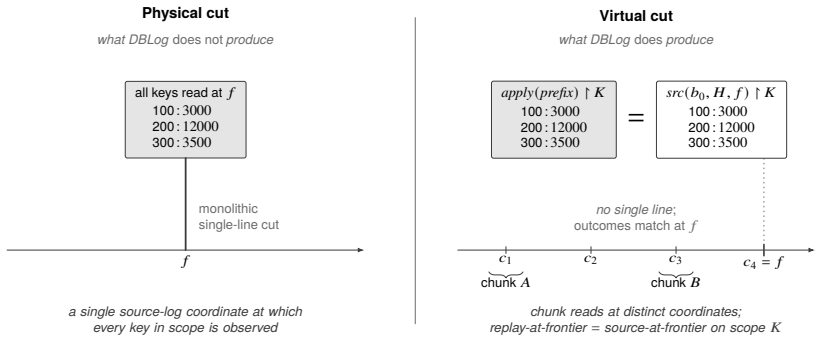
DBLog constructs a certified virtual cut that achieves snapshot-equivalent per-key replay of a live database without a single physical snapshot read.
A machine-rendered reading of the paper's core claim, the machinery that carries it, and where it could break.
Core claim
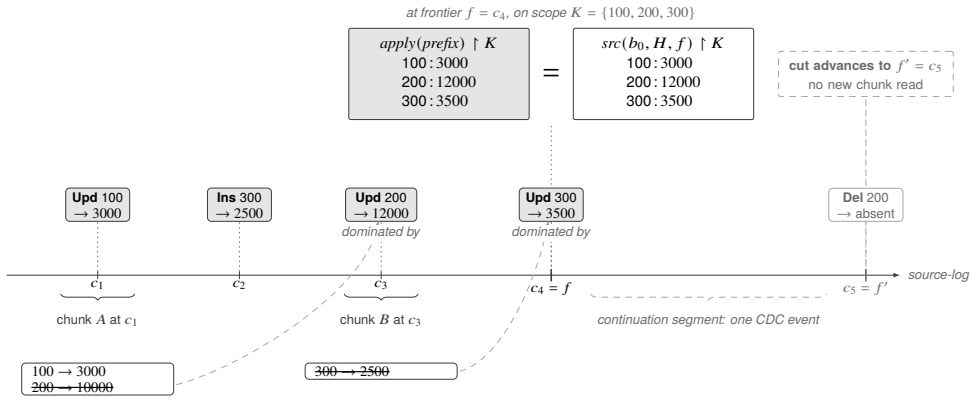
DBLog constructs a snapshot-equivalent replay certificate without requiring a single physical snapshot read. The central formal object is a certified virtual cut: a finite evidence bundle whose certified replay reaches the same per-key state as the source at a chosen frontier on a chosen key scope. The paper proves per-key replay equality for every wellformed DBLog run at its frontier and scope, and that an accepted certificate, evaluated against faithful source observation, witnesses such a run and yields a virtual cut. It also proves that on the same scope a cut advances to later frontiers by appending the scope-filtered faithful CDC segment committed in between, and that a cut restricts t
What carries the argument
The certified virtual cut, a finite evidence bundle whose certified replay equals the source per-key state at a frontier and scope.
If this is right
- Per-key replay equality holds for every wellformed DBLog run at its frontier and scope.
- An accepted certificate against faithful observations yields a virtual cut.
- On the same scope a cut advances to a later frontier by appending the scope-filtered faithful CDC segment.
- A cut on a given scope restricts to any sub-scope while preserving the equality property.
Where Pith is reading between the lines
- The virtual-cut construction may apply to other chunked CDC mechanisms that interleave range scans with log reads.
- The restriction and advancement facts could support incremental maintenance of multiple overlapping scopes in a single deployment.
- Machine-checked proofs in Isabelle/HOL make the conditional results amenable to reuse in verified CDC implementations.
Load-bearing premise
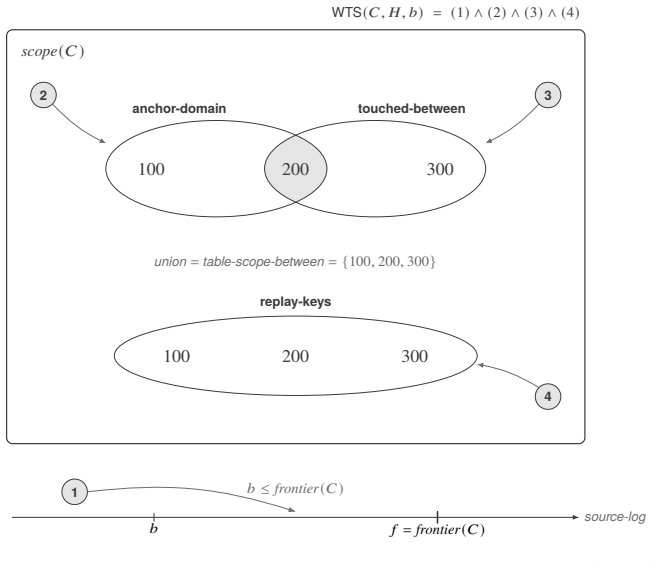
The run must be wellformed and the source observation must be faithful for the per-key equality and certificate acceptance results to hold.
What would settle it
A concrete wellformed DBLog run at its frontier and scope where the replayed per-key state differs from the faithful source state at that frontier.
Figures

read the original abstract
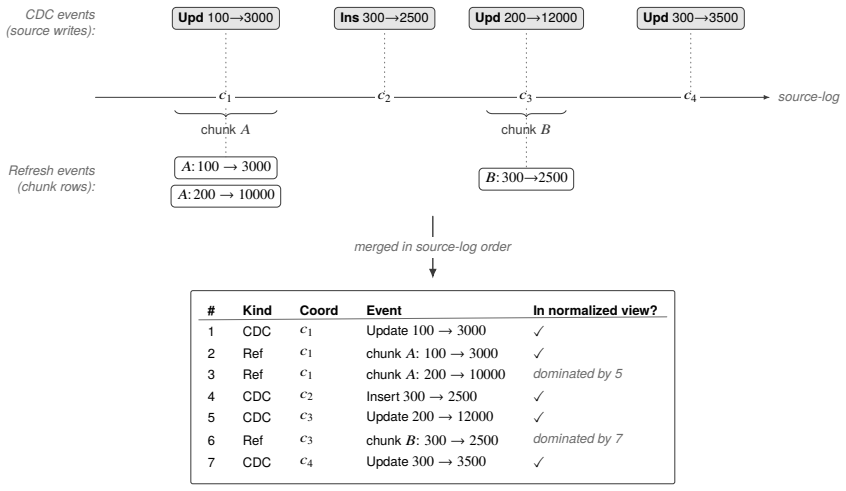
This paper is a theoretical follow-up to the 2020 DBLog paper, which described a change-data-capture (CDC) mechanism for backfilling a downstream system from a live source database and streaming its ongoing changes, while the source keeps accepting writes. DBLog reads the table in primary-key range scans (chunks) interleaved with the source change log: watermarks locate each chunk in log order, chunk rows become refresh events, and CDC events repair stale chunk observations. The mechanism requires no table lock, no pause in writes, and no global read transaction, and is now adopted by Debezium and Apache Flink CDC. The 2020 paper described the mechanism operationally but did not formalize its correctness object. This paper formalizes that object: DBLog constructs a snapshot-equivalent replay certificate without requiring a single physical snapshot read. The central formal object is a certified virtual cut: a finite evidence bundle whose certified replay reaches the same per-key state as the source at a chosen frontier on a chosen key scope. A virtual cut is extensional: replay equality at a frontier, not a physical snapshot read, and asserts no single source timestamp across chunk rows. The paper proves per-key replay equality for every wellformed DBLog run at its frontier and scope, and that an accepted certificate, evaluated against faithful source observation, witnesses such a run and yields a virtual cut. It also proves two source-side algebra facts: on the same scope, a cut advances to later frontiers by appending the scope-filtered faithful CDC segment committed in between, and a cut restricts to sub-scopes. Each result is Conditional on premises stated where it appears. Whole-table correctness, exactly-once delivery, sink-state convergence, and transfer to named deployments are not consequences of certificate acceptance alone. All proofs are machine-checked in Isabelle/HOL.
Editorial analysis
A structured set of objections, weighed in public.
Referee Report
Summary. This paper is a theoretical follow-up to the 2020 DBLog work on change-data-capture. It formalizes the correctness object as a certified virtual cut: a finite evidence bundle whose certified replay reaches the same per-key state as the source at a chosen frontier on a chosen key scope. The central results are proofs that every wellformed DBLog run achieves per-key replay equality at its frontier and scope, and that an accepted certificate evaluated against faithful source observation witnesses such a run and yields a virtual cut. Two source-side algebra facts are also proved: on the same scope a cut advances by appending the scope-filtered faithful CDC segment, and a cut restricts to sub-scopes. All results are explicitly conditional on the stated premises, whole-table correctness and exactly-once delivery are not claimed as consequences, and every proof is machine-checked in Isabelle/HOL.
Significance. If the results hold, the work supplies a machine-checked formal foundation for the snapshot-equivalent replay property of DBLog without a physical snapshot read. The Isabelle/HOL proofs constitute direct evidence that the stated theorems follow from their premises and therefore strengthen confidence in the mechanism now used by Debezium and Apache Flink CDC. The explicit separation of what certificate acceptance does and does not imply adds precision that is valuable for subsequent formal work on CDC and streaming replication.
Simulated Author's Rebuttal
We thank the referee for their positive assessment of the manuscript, for recognizing the value of the machine-checked proofs, and for recommending acceptance. The explicit separation of what the results do and do not imply is intentional and we are glad it was noted as a strength.
Circularity Check
No significant circularity
full rationale
The paper's central results (per-key replay equality and certificate acceptance) are explicitly conditional on premises such as wellformed runs and faithful observations, and are machine-checked in Isabelle/HOL. This external verification makes the derivation self-contained and independent of any self-referential definitions or fitted inputs. No load-bearing self-citation reduces the claims to prior work by the same authors; the 2020 reference is only for operational context. With only the abstract available, no equations or reductions to inputs by construction are detectable.
Axiom & Free-Parameter Ledger
axioms (2)
- domain assumption Wellformed DBLog run
- domain assumption Faithful source observation
invented entities (1)
-
certified virtual cut
no independent evidence
Reference graph
Works this paper leans on
-
[1]
DBLog: Awatermarkbasedchange-data-captureframe- work, 2019
Andreas Andreakis and Ioannis Papapanagiotou. DBLog: Awatermarkbasedchange-data-captureframe- work, 2019. Preprint arXiv:2010.12597 (2020)
-
[2]
IncrementalsnapshotsinDebez- ium
DebeziumCommunity. IncrementalsnapshotsinDebez- ium. Debezium Blog, https://debezium.io/blog/2021/ 10/07/incremental-snapshots/, 2021
2021
-
[3]
Flink CDC MySQL CDC connector: How incremental snapshot reading works
Apache Flink Community. Flink CDC MySQL CDC connector: How incremental snapshot reading works. Apache Flink CDC documentation (release-3.6), https: //nightlies.apache.org/flink/flink-cdc-docs-release- 3.6/docs/connectors/flink-sources/mysql-cdc/#how- incremental-snapshot-reading-works, 2024
2024
-
[4]
DBLog: A generic change-data-capture frame- work
Andreas Andreakis and Ioannis Papapanagiotou. DBLog: A generic change-data-capture frame- work. Netflix Tech Blog, https://netflixtechblog. com/dblog-a-generic-change-data-capture-framework- 69351fb9099b, 2019
2019
-
[5]
MySQL8.0referencemanual: The binary log
OracleCorporation. MySQL8.0referencemanual: The binary log. https://dev.mysql.com/doc/refman/8.0/en/ binary-log.html; https://dev.mysql.com/doc/refman/8.0/ en/replication-gtids.html, 2026
2026
-
[6]
MariaDB knowledge base: Bi- nary log; global transaction id
MariaDB Foundation. MariaDB knowledge base: Bi- nary log; global transaction id. https://mariadb.com/kb/ en/binary-log/; https://mariadb.com/kb/en/gtid/, 2026
2026
-
[7]
Chapter 49: Logical decoding
PostgreSQL Global Development Group. Chapter 49: Logical decoding. https://www.postgresql.org/docs/ current/logicaldecoding.html; https://www.postgresql. org/docs/current/logicaldecoding-output-plugin.html, 2026
2026
-
[8]
Lightweight Asynchronous Snapshots for Distributed Dataflows
Paris Carbone, Gyula Fóra, Stephan Ewen, Seif Haridi, and Kostas Tzoumas. Lightweight asynchronous snapshots for distributed dataflows, 2015. Preprint arXiv:1506.08603
work page internal anchor Pith review Pith/arXiv arXiv 2015
-
[9]
Time,clocks,andtheorderingofevents in a distributed system.Communications of the ACM, 21(7):558–565, 1978
LeslieLamport. Time,clocks,andtheorderingofevents in a distributed system.Communications of the ACM, 21(7):558–565, 1978
1978
-
[10]
Mani Chandy and Leslie Lamport
K. Mani Chandy and Leslie Lamport. Distributed snap- shots: Determining global states of distributed systems. ACM Transactions on Computer Systems, 3(1):63–75, 1985
1985
-
[11]
Virtual time and global states of distributed systems
Friedemann Mattern. Virtual time and global states of distributed systems. InParallel and Distributed Algorithms, pages 215–226. North-Holland, 1989
1989
-
[12]
Colin J. Fidge. Timestamps in message-passing systems that preserve the partial ordering. InProceedings of the 11th Australian Computer Science Conference (ACSC), pages 56–66, 1988
1988
-
[13]
On-the-fly,incremental,consistentreadingof entire databases.Algorithmica, 1(1–4):271–287, 1986
CaltonPu. On-the-fly,incremental,consistentreadingof entire databases.Algorithmica, 1(1–4):271–287, 1986. doi: 10.1007/BF01840448
-
[14]
Fernández-Moctezuma, Reuven Lax, Sam McVeety, Daniel Mills, Frances Perry, Eric Schmidt, and Sam Whittle
Tyler Akidau, Robert Bradshaw, Craig Chambers, Slava Chernyak, Rafael J. Fernández-Moctezuma, Reuven Lax, Sam McVeety, Daniel Mills, Frances Perry, Eric Schmidt, and Sam Whittle. The dataflow model: A practical approach to balancing correctness, latency, and cost in massive-scale, unbounded, out-of-order data processing.Proceedings of the VLDB Endowment, ...
2015
-
[15]
Derek G. Murray, Frank McSherry, Rebecca Isaacs, MichaelIsard,PaulBarham,andMartínAbadi.Naiad: A timelydataflowsystem. InProceedingsofthe24thACM Symposium on Operating Systems Principles (SOSP), pages 439–455, 2013. doi: 10.1145/2517349.2522738
-
[16]
All aboard the Databus! LinkedIn’s scalable consistent change data capture platform
ShirshankaDas,ChavdarBotev,KapilSurlaker,Bhaskar Ghosh, Balaji Varadarajan, Sunil Nagaraj, David Zhang, Lei Gao, Jemiah Westerman, Phanindra Ganti, Boris Shkolnik, Sajid Topiwala, Alexander Pachev, Naveen Somasundaram, and Subbu Subramaniam. All aboard the Databus! LinkedIn’s scalable consistent change data capture platform. InProceedings of the 3rd ACM S...
-
[17]
Li, Jun Li, Evgeniy Makeev, Kowshik Prakasam, Robbert van Re- nesse, Sabyasachi Roy, Pratyush Seth, Yee Jiun Song, BenjaminWester,KaushikVeeraraghavan,andPeterXie
Yogeshwer Sharma, Philippe Ajoux, Petchean Ang, David Callies, Abhishek Choudhary, Laurent Demailly, Thomas Fersch, Liat Atsmon Guz, Andrzej Kotulski, Sachin Kulkarni, Sanjeev Kumar, Harry C. Li, Jun Li, Evgeniy Makeev, Kowshik Prakasam, Robbert van Re- nesse, Sabyasachi Roy, Pratyush Seth, Yee Jiun Song, BenjaminWester,KaushikVeeraraghavan,andPeterXie. W...
2015
-
[18]
Kafka: A distributed messaging system for log processing
Jay Kreps, Neha Narkhede, and Jun Rao. Kafka: A distributed messaging system for log processing. In Proceedings of the NetDB Workshop, 2011
2011
-
[19]
JDBC source connector for Confluent Plat- form
Confluent. JDBC source connector for Confluent Plat- form. https://docs.confluent.io/kafka-connectors/jdbc/ current/source-connector/overview.html; https://docs. confluent.io/kafka-connectors/jdbc/current/source- connector/source_config_options.html, 2026
2026
-
[20]
Junqueira, and Benjamin Reed
Patrick Hunt, Mahadev Konar, Flavio P. Junqueira, and Benjamin Reed. ZooKeeper: Wait-free coordination for internet-scale systems. InProceedings of the USENIX Annual Technical Conference, pages 145–158, 2010. 29
2010
-
[21]
Chapter 29: Logical replication and architecture
PostgreSQL Global Development Group. Chapter 29: Logical replication and architecture. https:// www.postgresql.org/docs/current/logical-replication. html; https://www.postgresql.org/docs/current/logical- replication-architecture.html, 2026
2026
-
[22]
CockroachDB changefeeds: CRE- ATE CHANGEFEED, changefeed messages, how does a changefeed work
Cockroach Labs. CockroachDB changefeeds: CRE- ATE CHANGEFEED, changefeed messages, how does a changefeed work. https://www.cockroachlabs. com/docs/stable/create-changefeed; https://www. cockroachlabs.com/docs/stable/changefeed-messages; https://www.cockroachlabs.com/docs/stable/how-does- a-changefeed-work, 2026
2026
-
[23]
AmazonWebServices.AWSdatabasemigrationservice: Full-loadandCDCtasks. https://docs.aws.amazon.com/ dms/latest/userguide/CHAP_Task.CDC.html; https: //docs.aws.amazon.com/dms/latest/userguide/CHAP_ Tasks.CustomizingTasks.TaskSettings.FullLoad.html, 2026
2026
-
[24]
Datastream: Manage backfill for the objects of a stream
Google Cloud. Datastream: Manage backfill for the objects of a stream. https://docs.cloud.google.com/ datastream/docs/manage-backfill-for-the-objects-of-a- stream; https://docs.cloud.google.com/datastream/docs/ faq; https://docs.cloud.google.com/datastream/docs, 2026
2026
-
[25]
Oracle GoldenGate online migration: Ini- tial load plus CDC
Oracle. Oracle GoldenGate online migration: Ini- tial load plus CDC. https://docs.oracle.com/en- us/iaas/database-migration/doc/set-oracle-goldengate- online-migrations.html; https://blogs.oracle.com/ dataintegration/online-migration-leveraging-oracle- goldengate, 2026
2026
-
[26]
Striim: Initial-load and CDC replication
Striim. Striim: Initial-load and CDC replication. https: //www.striim.com/docs/en/getting-started.html; https: //www.cockroachlabs.com/docs/stable/striim, 2026
2026
-
[27]
Materialize PostgreSQL CDC source: Ingest data
Materialize. Materialize PostgreSQL CDC source: Ingest data. https://materialize.com/docs/ingest- data/postgres/; https://materialize.com/docs/ingest- data/postgres/postgres-debezium/, 2026
2026
-
[28]
Lakeflow declarative pipelines: Change data capture and snapshots / AUTO CDC apis
Databricks. Lakeflow declarative pipelines: Change data capture and snapshots / AUTO CDC apis. https:// docs.databricks.com/aws/en/ldp/what-is-change-data- capture; https://docs.databricks.com/aws/en/ldp/cdc, 2026
2026
-
[29]
What is change data capture (CDC)? – SQL Server
Microsoft. What is change data capture (CDC)? – SQL Server. https://learn.microsoft.com/en-us/sql/relational- databases/track-changes/about-change-data-capture- sql-server, 2025
2025
-
[30]
C.Mohan,DonHaderle,BruceLindsay,HamidPirahesh, and Peter Schwarz. ARIES: A transaction recovery method supporting fine- granularity locking and partial rollbacks using write-ahead logging.ACM Transactions on Database Systems, 17(1):94–162, 1992. doi: 10. 1145/128765.128770
-
[31]
Contin- uous archiving and point-in-time recovery (PITR)
PostgreSQL Global Development Group. Contin- uous archiving and point-in-time recovery (PITR). https://www.postgresql.org/docs/current/continuous- archiving.html, 2026
2026
-
[32]
Abadi, and AlexanderThomson.Low-overheadasynchronouscheck- pointinginmain-memorydatabasesystems
Kun Ren, Thaddeus Diamond, Daniel J. Abadi, and AlexanderThomson.Low-overheadasynchronouscheck- pointinginmain-memorydatabasesystems. InProceed- ings of the 2016 ACM SIGMOD International Confer- ence on Management of Data, pages 1539–1551, 2016. doi: 10.1145/2882903.2915966
-
[33]
Hal Berenson, Phil Bernstein, Jim Gray, Jim Melton, ElizabethO’Neil,andPatrickO’Neil.AcritiqueofANSI SQL isolation levels. InProceedings of the 1995 ACM SIGMOD International Conference on Management of Data, pages 1–10, 1995. doi: 10.1145/223784.223785
-
[34]
AtulAdya,BarbaraLiskov,andPatrickO’Neil. General- izedisolationleveldefinitions.InProceedingsofthe16th International Conference on Data Engineering (ICDE), pages 67–78, 2000. doi: 10.1109/ICDE.2000.839388
-
[35]
Using oracle flashback technology: Flash- back query / AS OF SCN
Oracle. Using oracle flashback technology: Flash- back query / AS OF SCN. https://docs.oracle.com/ en/database/oracle/oracle-database/19/adfns/flashback. html, 2026
2026
-
[36]
gh-ost: GitHub’s online schema-migration tool for MySQL
GitHub. gh-ost: GitHub’s online schema-migration tool for MySQL. https://github.com/github/gh-ost; https://github.blog/news-insights/company-news/gh- ost-github-s-online-migration-tool-for-mysql/, 2016
2016
-
[37]
Online, asynchronous schema change in F1.Proceedings of the VLDB Endowment, 6(11): 1045–1056, 2013
Ian Rae, Eric Rollins, Jeff Shute, Sukhdeep Sodhi, and Radek Vingralek. Online, asynchronous schema change in F1.Proceedings of the VLDB Endowment, 6(11): 1045–1056, 2013. doi: 10.14778/2536222.2536230
-
[38]
SLSM: An efficient strategy for lazy schema migra- tion on shared-nothing databases, 2024
Tianxun Hu, Tianzheng Wang, and Qingqing Zhou. SLSM: An efficient strategy for lazy schema migra- tion on shared-nothing databases, 2024. Preprint arXiv:2404.03929
-
[39]
The existence of refinementmappings.TheoreticalComputerScience,82 (2):253–284, 1991
Martín Abadi and Leslie Lamport. The existence of refinementmappings.TheoreticalComputerScience,82 (2):253–284, 1991. doi: 10.1016/0304-3975(91)90224- P
-
[40]
GeorgeC.Necula. Proof-carryingcode. InProceedings of the 24th ACM SIGPLAN-SIGACT Symposium on Principles of Programming Languages (POPL), pages 106–119, 1997. doi: 10.1145/263699.263712. 30
-
[41]
Trans- lation validation
Amir Pnueli, Michael Siegel, and Eli Singerman. Trans- lation validation. InTools and Algorithms for the Con- structionandAnalysisofSystems(TACAS),volume1384 ofLecture Notes in Computer Science, pages 151–166,
-
[42]
doi: 10.1007/BFb0054170
-
[43]
Donaldson, John Wickerson, and Manuel Rigger
Jack Clark, Alastair F. Donaldson, John Wickerson, and Manuel Rigger. Validating database system isolation level implementations with version certificate recovery. InProceedings of the Nineteenth European Conference on Computer Systems (EuroSys), pages 754–768, 2024. doi: 10.1145/3627703.3650080
-
[44]
ShabnamGhasemirad,SiLiu,ChristophSprenger,Luca Multazzu, and David A. Basin. VerIso: Verifiable isola- tion guarantees for database transactions.Proceedings of the VLDB Endowment, 18(5):1362–1375, 2025. doi: 10.14778/3718057.3718065
-
[45]
seL4: Formal verification of an OS kernel
Gerwin Klein, Kevin Elphinstone, Gernot Heiser, June Andronick, DavidCock, PhilipDerrin, DhammikaElka- duwe, Kai Engelhardt, Rafal Kolanski, Michael Norrish, Thomas Sewell, Harvey Tuch, and Simon Winwood. seL4: Formal verification of an OS kernel. InProceed- ings of the 22nd ACM Symposium on Operating Systems Principles (SOSP), pages 207–220, 2009
2009
-
[46]
Formalverificationofarealisticcompiler
XavierLeroy. Formalverificationofarealisticcompiler. Communications of the ACM, 52(7):107–115, 2009
2009
-
[47]
Addison-Wesley, 2002
Leslie Lamport.Specifying Systems: The TLA+ Lan- guage and Tools for Hardware and Software Engineers. Addison-Wesley, 2002. ISBN 978-0-321-14306-8
2002
-
[48]
Verdi: Aframeworkforimplementingandformally verifyingdistributedsystems
JamesR.Wilcox,DougWoos,PavelPanchekha,Zachary Tatlock,XiWang,MichaelD.Ernst,andThomasAnder- son. Verdi: Aframeworkforimplementingandformally verifyingdistributedsystems. InProceedingsofthe36th ACM SIGPLAN Conference on Programming Language Design and Implementation (PLDI), pages 357–368,
-
[49]
doi: 10.1145/2737924.2737958
-
[50]
Lorch, Bryan Parno, Michael L
ChrisHawblitzel,JonHowell,ManosKapritsos,JacobR. Lorch, Bryan Parno, Michael L. Roberts, Srinath Setty, and Brian Zill. IronFleet: Proving practical distributed systems correct. InProceedings of the 25th Symposium on Operating Systems Principles (SOSP), pages 1–17,
-
[51]
doi: 10.1145/2815400.2815428
-
[52]
Daniel Jackson. Alloy: A lightweight object modelling notation.ACM Transactions on Software Engineering and Methodology (TOSEM), 11(2):256–290, 2002. doi: 10.1145/505145.505149
-
[53]
A Theoretical Study of DBLog
Andreas Andreakis. DBLog_Virtual_Cuts: Is- abelle/HOL formal development for “A Theoretical Study of DBLog”, 2026. URL https://doi.org/10.5281/ zenodo.20389697. Software, BSD 3-Clause License. 31
2026
discussion (0)
Sign in with ORCID, Apple, or X to comment. Anyone can read and Pith papers without signing in.