Photostationary Lifshitz transition in High Tc superconductor Bi2Sr2CaCu2O8+{δ}
Pith reviewed 2026-06-28 20:58 UTC · model grok-4.3
The pith
Ultrafast optical excitation drives a Lifshitz transition from hole-like to electron-like Fermi surface in Bi2Sr2CaCu2O8+δ at high pump fluences.
A machine-rendered reading of the paper's core claim, the machinery that carries it, and where it could break.
Core claim
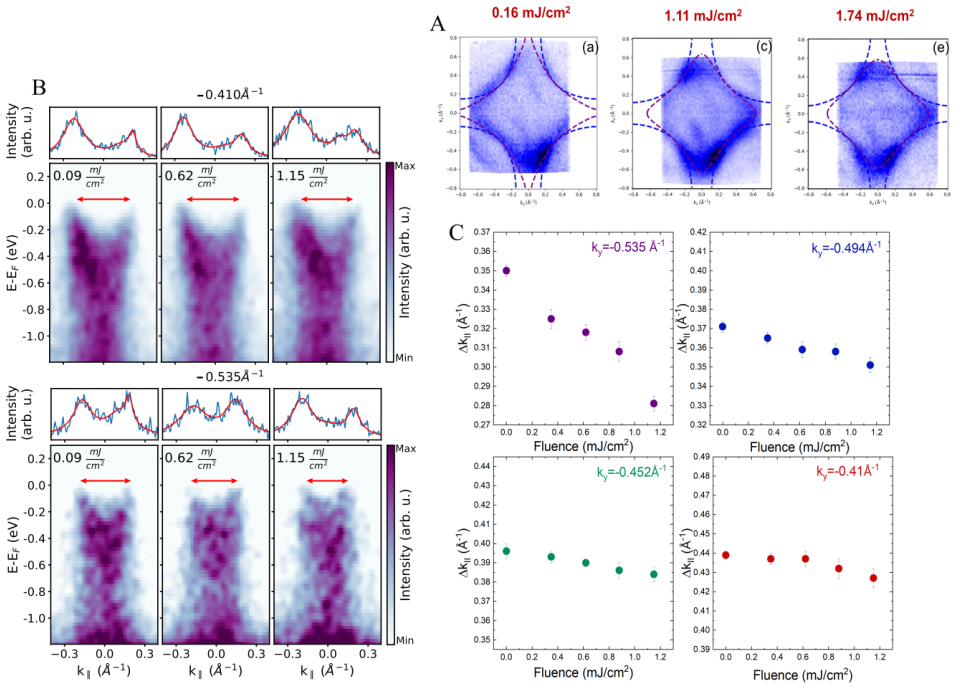
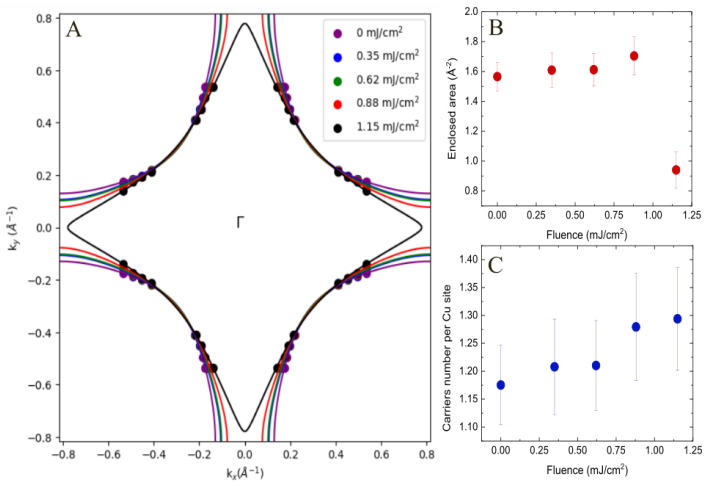
At sufficiently high pump fluences, 1.6 eV photoexcitation drives Bi2Sr2CaCu2O8+δ into a photostationary long-lived excited state whose Fermi surface undergoes a Lifshitz transition from hole-like to electron-like topology; the band evolutions are analogous to those from chemical doping and arise from a cooperative photodoping process involving charge transfer, effective-correlation renormalization, and defect-assisted trapping.
What carries the argument
The photostationary excited state created by ultrafast optical pumping, which sustains the Lifshitz transition long enough for time-resolved photoemission to map its band structure.
If this is right
- Optical fluence becomes a reversible tuning knob that reaches doping levels otherwise inaccessible by chemical means.
- The Lifshitz transition occurs inside a long-lived state, implying thermalization timescales comparable to the laser repetition period.
- Band-structure evolution under light matches chemical doping, suggesting shared microscopic physics between the two routes.
- Ultrafast control can place the material in regions of the phase diagram that are unstable under equilibrium conditions.
Where Pith is reading between the lines
- The same fluence-tunable mechanism could transiently stabilize other doping-dependent phases such as charge-density waves or pseudogap states.
- Material defects that assist trapping may be engineered to lengthen the photostationary lifetime.
- If the state survives multiple pulses, pump-probe sequences could map how Fermi-surface topology directly influences superconducting pairing strength.
Load-bearing premise
The observed band-structure changes arise from a stable cooperative photodoping effect rather than from transient heating or other non-equilibrium processes that would relax before the next laser pulse.
What would settle it
A time-resolved measurement in which the Fermi-surface topology returns to hole-like within the laser repetition period, or an equilibrium heating experiment at the same lattice temperature that produces no Lifshitz transition.
Figures
read the original abstract
To date, controlling the steady-state electronic band structure in high-Tc cuprate superconductors has been achieved primarily through chemical doping or magnetic fields. Here, we present that ultrafast optical excitation can instead drive the electronic band structure of Bi2Sr2CaCu2O8+{\delta} into a photostationary, long-lived excited state. At sufficiently high pump fluences, this state undergoes a Lifshitz transition of the Fermi surface, characterized by a change in topology from hole-like to electron-like. Time- and angle-resolved photoemission spectroscopy, supported by single-band tight-binding calculations, reveals that 1.6 eV photoexcitation induces band-structure evolutions closely analogous to those produced by chemical doping. These results point to an efficient photodoping mechanism involving cooperative effects, including charge transfer, renormalization of effective electronic correlations, and defect-assisted charge trapping. Our findings raise fundamental questions regarding thermalization processes occurring on timescales comparable to the laser repetition period in cuprates. More broadly, ultrafast optical control enables access to otherwise inaccessible regions of the phase diagram by tuning the pump fluence.
Editorial analysis
A structured set of objections, weighed in public.
Referee Report
Summary. The manuscript reports TAR-PES measurements on optimally doped Bi2Sr2CaCu2O8+δ showing that above a threshold pump fluence, 1.6 eV optical excitation drives the system into a long-lived photostationary excited state whose Fermi surface undergoes a Lifshitz transition from hole-like to electron-like topology. Single-band tight-binding calculations are used to interpret the observed band shifts as analogous to those produced by chemical doping, and the authors attribute the effect to cooperative photodoping involving charge transfer, correlation renormalization, and defect-assisted trapping. The work also notes open questions about thermalization on laser-repetition-period timescales.
Significance. If the central claim holds, the result would establish a route to optically access otherwise inaccessible regions of the cuprate phase diagram via fluence-tuned photodoping, providing a new experimental handle on Fermi-surface topology and correlation effects in high-Tc materials. The experimental observation of a long-lived non-equilibrium state with doping-like band-structure changes is potentially impactful for ultrafast control of quantum materials.
major comments (3)
- [Abstract and Results (Fermi-surface maps and fluence dependence)] The central claim that the observed Lifshitz transition arises from a cooperative photodoping mechanism in a photostationary state (rather than cumulative heating or incomplete relaxation between pulses) is load-bearing but rests on an assumption flagged as open in the abstract. The manuscript does not report repetition-rate-dependent measurements, fluence-dependent lattice-temperature estimates, or time-delay scans extending to the full repetition period that would directly test this assumption.
- [Methods and Discussion (tight-binding comparison)] The single-band tight-binding calculations demonstrate qualitative analogy to chemical doping but do not independently constrain the microscopic origin of the band shifts (e.g., via self-consistent treatment of photodoping or correlation renormalization). This leaves the interpretation of the topology change as photodoping-supported but not uniquely established by the data.
- [Results (TAR-PES data presentation)] The abstract and results sections state that band-structure evolutions are observed at high fluences, yet the manuscript provides neither raw fluence-dependent spectra with error bars nor a quantitative assessment of momentum-resolution and background subtraction effects on the reported Fermi-surface topology change. These details are required to evaluate the robustness of the Lifshitz-transition claim.
minor comments (2)
- [Abstract and Figure 1] Notation for the photostationary state and the definition of the critical fluence threshold should be made consistent between the abstract, main text, and figure captions.
- [Experimental Methods] The manuscript would benefit from an explicit statement of the laser repetition rate and the temporal window over which the photostationary state is claimed to persist.
Simulated Author's Rebuttal
We thank the referee for the detailed and constructive report. We address each major comment below, indicating revisions where the manuscript will be updated to improve clarity and robustness while maintaining the integrity of the presented results.
read point-by-point responses
-
Referee: The central claim that the observed Lifshitz transition arises from a cooperative photodoping mechanism in a photostationary state (rather than cumulative heating or incomplete relaxation between pulses) is load-bearing but rests on an assumption flagged as open in the abstract. The manuscript does not report repetition-rate-dependent measurements, fluence-dependent lattice-temperature estimates, or time-delay scans extending to the full repetition period that would directly test this assumption.
Authors: We agree that the photostationary character is presented as an assumption, as already flagged by the open questions on thermalization timescales in the abstract. Our time-delay data demonstrate that the band shifts persist well beyond typical electron-phonon relaxation times, and the sharp fluence threshold is inconsistent with gradual heating. Nevertheless, we lack repetition-rate-dependent measurements and full-period scans in the current dataset. We will expand the discussion section to explicitly address this limitation, include any available fluence-dependent temperature estimates from supporting measurements, and clarify the supporting evidence from the existing time-resolved traces. revision: partial
-
Referee: The single-band tight-binding calculations demonstrate qualitative analogy to chemical doping but do not independently constrain the microscopic origin of the band shifts (e.g., via self-consistent treatment of photodoping or correlation renormalization). This leaves the interpretation of the topology change as photodoping-supported but not uniquely established by the data.
Authors: The tight-binding model is used solely to demonstrate the qualitative similarity between the observed band shifts and those induced by chemical doping; the manuscript does not claim that it independently establishes the microscopic mechanism or rules out alternatives. The cooperative photodoping interpretation is presented as a plausible scenario consistent with the data. No revision is required on this point, as the framing already treats the calculations as an illustrative analogy rather than a unique proof. revision: no
-
Referee: The abstract and results sections state that band-structure evolutions are observed at high fluences, yet the manuscript provides neither raw fluence-dependent spectra with error bars nor a quantitative assessment of momentum-resolution and background subtraction effects on the reported Fermi-surface topology change. These details are required to evaluate the robustness of the Lifshitz-transition claim.
Authors: We will add a supplementary figure showing the raw fluence-dependent spectra together with error bars derived from multiple scans. In the revised methods and results sections we will include a quantitative discussion of momentum resolution and background subtraction procedures, together with an assessment of how variations in these parameters affect the determined Fermi-surface topology. revision: yes
- Repetition-rate-dependent measurements, extended time-delay scans to the full laser repetition period, and detailed fluence-dependent lattice-temperature estimates are not available in the existing experimental dataset.
Circularity Check
No significant circularity: experimental observation with interpretive modeling
full rationale
The paper's central claim rests on direct experimental observation via time- and angle-resolved photoemission spectroscopy of band-structure changes under optical pumping, interpreted via single-band tight-binding calculations that map the observed shifts to an analogy with chemical doping. No load-bearing derivation reduces by construction to fitted inputs, self-citations, or ansatzes; the tight-binding serves only for qualitative comparison rather than predicting the Lifshitz transition from parameters extracted from the same dataset. The work is self-contained against external benchmarks (ARPES data and standard TB models) with no self-definitional loops or renamed empirical patterns presented as derivations.
Axiom & Free-Parameter Ledger
axioms (1)
- domain assumption Single-band tight-binding model accurately captures the Fermi surface topology changes
Reference graph
Works this paper leans on
-
[1]
De La Torre, D
A. De La Torre, D. M. Kennes, M. Claassen, S. Gerber, J. W. McIver, M. A. Sentef, Colloquium: Nonthermal pathways to ultrafast control in quantum materials. Rev. Mod. Phys. 93, 041002 (2021)
2021
-
[2]
Y. H. Wang, H. Steinberg, P. Jarillo-Herrero, N. Gedik, Observation of Floquet-Bloch States on the Surface of a Topological Insulator. Science 342, 453–457 (2013)
2013
-
[3]
M. Liu, H. Y. Hwang, H. Tao, A. C. Strikwerda, K. Fan, G. R. Keiser, A. J. Sternbach, K. G. West, S. Kittiwatanakul, J. Lu, S. A. Wolf, F. G. Omenetto, X. Zhang, K. A. Nelson, R. D. Averitt, Terahertz-field- induced insulator-to-metal transition in vanadium dioxide metamaterial. Nature 487, 345–348 (2012)
2012
-
[4]
Perfetti, P
L. Perfetti, P. A. Loukakos, M. Lisowski, U. Bovensiepen, M. Wolf, H. Berger, S. Biermann, A. Georges, Femtosecond dynamics of electronic states in the Mott insulator 1T-TaS ₂ by time resolved photoelectron spectroscopy. New J. Phys. 10, 053019 (2008)
2008
-
[5]
Stojchevska, I
L. Stojchevska, I. Vaskivskyi, T. Mertelj, P. Kusar, D. Svetin, S. Brazovskii, D. Mihailovic, Ultrafast Switching to a Stable Hidden Quantum State in an Electronic Crystal. Science 344, 177–180 (2014)
2014
-
[6]
X. Li, I. Esin, Y. Han, Y. Liu, H. Zhao, H. Ning, C. Barrett, J.-Y. Shan, K. Seyler, G. Cao, G. Refael, D. Hsieh, Time-hidden magnetic order in a multi-orbital Mott insulator. Nat. Phys. 21, 451–457 (2025)
2025
-
[7]
Fausti, R
D. Fausti, R. I. Tobey, N. Dean, S. Kaiser, A. Dienst, M. C. Hoffmann, S. Pyon, T. Takayama, H. Takagi, A. Cavalleri, Light-Induced Superconductivity in a Stripe-Ordered Cuprate. Science 331, 189–191 (2011)
2011
-
[8]
Mitrano, A
M. Mitrano, A. Cantaluppi, D. Nicoletti, S. Kaiser, A. Perucchi, S. Lupi, P. Di Pietro, D. Pontiroli, M. Riccò, S. R. Clark, D. Jaksch, A. Cavalleri, Possible light-induced superconductivity in K3C60 at high temperature. Nature 530, 461–464 (2016)
2016
-
[9]
Mansart, J
B. Mansart, J. Lorenzana, A. Mann, A. Odeh, M. Scarongella, M. Chergui, F. Carbone, Coupling of a high- energy excitation to superconducting quasiparticles in a cuprate from coherent charge fluctuation spectroscopy. Proceedings of the National Academy of Sciences 110, 4539–4544 (2013)
2013
-
[10]
Matsunaga, N
R. Matsunaga, N. Tsuji, H. Fujita, A. Sugioka, K. Makise, Y. Uzawa, H. Terai, Z. Wang, H. Aoki, R. Shimano, Light-induced collective pseudospin precession resonating with Higgs mode in a superconductor. Science 345, 1145–1149 (2014)
2014
-
[11]
Aeschlimann, J
M. Aeschlimann, J. P. Bange, M. Bauer, U. Bovensiepen, H.-J. Elmers, T. Fauster, L. Gierster, U. Höfer, R. Huber, A. Li, X. Li, S. Mathias, K. Morgenstern, H. Petek, M. Reutzel, K. Rossnagel, G. Schönhense, M. Scholz, B. Stadtmüller, J. Stähler, S. Tan, B. Wang, Z. Wang, M. Weinelt, Time-resolved photoelectron spectroscopy at surfaces. Surface Science 753...
2025
-
[12]
B. Truc, P. Usai, F. Pennacchio, G. Berruto, R. Claude, I. Madan, V. Sala, T. LaGrange, G. M. Vanacore, S. Benhabib, F. Carbone, Ultrafast generation of hidden phases via energy-tuned electronic photoexcitation in magnetite. Proceedings of the National Academy of Sciences 121, e2316438121 (2024)
2024
-
[13]
M. R. Norman, H. Ding, M. Randeria, J. C. Campuzano, T. Yokoya, T. Takeuchi, T. Takahashi, T. Mochiku, K. Kadowaki, P. Guptasarma, D. G. Hinks, Destruction of the Fermi surface in underdoped high-Tc superconductors. Nature 392, 157–160 (1998)
1998
-
[14]
Kanigel, U
A. Kanigel, U. Chatterjee, M. Randeria, M. R. Norman, S. Souma, M. Shi, Z. Z. Li, H. Raffy, J. C. Campuzano, Protected Nodes and the Collapse of Fermi Arcs in High-{T}_{c}\ Cuprate Superconductors. Phys. Rev. Lett. 99, 157001 (2007)
2007
-
[15]
Platé, J
M. Platé, J. D. F. Mottershead, I. S. Elfimov, D. C. Peets, R. Liang, D. A. Bonn, W. N. Hardy, S. Chiuzbaian, M. Falub, M. Shi, L. Patthey, A. Damascelli, Fermi Surface and Quasiparticle Excitations of Overdoped Tl2Ba2CuO6+\textbackslashdelta. Phys. Rev. Lett. 95, 077001 (2005)
2005
-
[16]
Vignolle, A
B. Vignolle, A. Carrington, R. A. Cooper, M. M. J. French, A. P. Mackenzie, C. Jaudet, D. Vignolles, C. Proust, N. E. Hussey, Quantum oscillations in an overdoped high-Tc superconductor. Nature 455, 952–955 (2008)
2008
-
[17]
Photoemission in the High-TcSuperconductors
J. C. Campuzano, M. R. Norman, M. Randeria, “Photoemission in the High-TcSuperconductors” in The Physics of Superconductors: Vol. II. Superconductivity in Nanostructures, High-Tc and Novel Superconductors, Organic Superconductors, K. H. Bennemann, J. B. Ketterson, Eds. (Springer, Berlin, Heidelberg, 2004; https://doi.org/10.1007/978-3-642-18914-2_5), pp. 167–273
-
[18]
Extended
K. Gofron, J. C. Campuzano, A. A. Abrikosov, M. Lindroos, A. Bansil, H. Ding, D. Koelling, B. Dabrowski, Observation of an “Extended” Van Hove Singularity in YBa2Cu4O8 by Ultrahigh Energy Resolution Angle- Resolved Photoemission. Phys. Rev. Lett. 73, 3302–3305 (1994)
1994
-
[19]
D. S. Dessau, Z.-X. Shen, D. M. King, D. S. Marshall, L. W. Lombardo, P. H. Dickinson, A. G. Loeser, J. DiCarlo, C.-H. Park, A. Kapitulnik, W. E. Spicer, Key features in the measured band structure of Bi2Sr2CaCu2O8+\textbackslashdelta: Flat bands at \E_F\ and Fermi surface nesting. Phys. Rev. Lett. 71, 2781– 2784 (1993)
1993
-
[20]
Kaminski, S
A. Kaminski, S. Rosenkranz, H. M. Fretwell, M. R. Norman, M. Randeria, J. C. Campuzano, J.-M. Park, Z. Z. Li, H. Raffy, Change of Fermi-surface topology in Bi2Sr2CaCu2O8+\textbackslashdelta with doping. Phys. Rev. B 73, 174511 (2006)
2006
-
[21]
Benhabib, A
S. Benhabib, A. Sacuto, M. Civelli, I. Paul, M. Cazayous, Y. Gallais, M.-A. Méasson, R. D. Zhong, J. Schneeloch, G. D. Gu, D. Colson, A. Forget, Collapse of the Normal-State Pseudogap at a Lifshitz Transition in the {\textbackslashmathrm{Bi}}_{2}{\textbackslashmathrm{Sr}}_{2}{\textbackslashmathrm{CaCu}}_{2}{\textba ckslashmathrm{O}}_{8+\textbackslashensur...
2015
-
[22]
A. Ino, C. Kim, M. Nakamura, T. Yoshida, T. Mizokawa, A. Fujimori, Z.-X. Shen, T. Kakeshita, H. Eisaki, S. Uchida, Doping-dependent evolution of the electronic structure of La2-xSrxCuO4 in the superconducting and metallic phases. Phys. Rev. B 65, 094504 (2002)
2002
-
[23]
C. E. Matt, C. G. Fatuzzo, Y. Sassa, M. Månsson, S. Fatale, V. Bitetta, X. Shi, S. Pailhès, M. H. Berntsen, T. Kurosawa, M. Oda, N. Momono, O. J. Lipscombe, S. M. Hayden, J.-Q. Yan, J.-S. Zhou, J. B. Goodenough, S. Pyon, T. Takayama, H. Takagi, L. Patthey, A. Bendounan, E. Razzoli, M. Shi, N. C. Plumb, M. Radovic, M. Grioni, J. Mesot, O. Tjernberg, J. Cha...
2015
-
[24]
Lifshitz, Anomalies of electron characteristics of a metal in the high pressure region
M. Lifshitz, Anomalies of electron characteristics of a metal in the high pressure region. Sov. Phys. JETP 11, 1130–1135 (1960)
1960
-
[25]
S.-D. Chen, M. Hashimoto, Y. He, D. Song, K.-J. Xu, J.-F. He, T. P. Devereaux, H. Eisaki, D.-H. Lu, J. Zaanen, Z.-X. Shen, Incoherent strange metal sharply bounded by a critical doping in Bi2212. Science 366, 1099–1102 (2019)
2019
-
[26]
R. A. Cooper, Y. Wang, B. Vignolle, O. J. Lipscombe, S. M. Hayden, Y. Tanabe, T. Adachi, Y. Koike, M. Nohara, H. Takagi, C. Proust, N. E. Hussey, Anomalous Criticality in the Electrical Resistivity of La2– xSrxCuO4. Science 323, 603–607 (2009)
2009
-
[27]
Michon, C
B. Michon, C. Girod, S. Badoux, J. Kačmarčík, Q. Ma, M. Dragomir, H. A. Dabkowska, B. D. Gaulin, J.-S. Zhou, S. Pyon, T. Takayama, H. Takagi, S. Verret, N. Doiron-Leyraud, C. Marcenat, L. Taillefer, T. Klein, Thermodynamic signatures of quantum criticality in cuprate superconductors. Nature 567, 218–222 (2019)
2019
-
[28]
J. D. Rameau, S. Freutel, L. Rettig, I. Avigo, M. Ligges, Y. Yoshida, H. Eisaki, J. Schneeloch, R. D. Zhong, Z. J. Xu, G. D. Gu, P. D. Johnson, U. Bovensiepen, Photoinduced changes in the cuprate electronic structure revealed by femtosecond time- and angle-resolved photoemission. Phys. Rev. B 89, 115115 (2014)
2014
-
[29]
Hellmann, K
S. Hellmann, K. Rossnagel, M. Marczynski-Bühlow, L. Kipp, Vacuum space-charge effects in solid-state photoemission. Phys. Rev. B 79, 035402 (2009)
2009
-
[30]
R. S. Markiewicz, S. Sahrakorpi, M. Lindroos, H. Lin, A. Bansil, One-band tight-binding model parametrization of the high-{T}_{c}\ cuprates including the effect of {k}_{z}\ dispersion. Phys. Rev. B 72, 054519 (2005)
2005
-
[31]
P. V. Bogdanov, A. Lanzara, X. J. Zhou, S. A. Kellar, D. L. Feng, E. D. Lu, H. Eisaki, J.-I. Shimoyama, K. Kishio, Z. Hussain, Z. X. Shen, Photoemission study of Pb doped {\textbackslashmathrm{Bi}}_{2}{\textbackslashmathrm{Sr}}_{2}{\textbackslashmathrm{CaCu}}_{2}{\textba ckslashmathrm{O}}_{8}:\ A Fermi surface picture. Phys. Rev. B 64, 180505 (2001)
2001
-
[32]
J. M. Luttinger, Fermi Surface and Some Simple Equilibrium Properties of a System of Interacting Fermions. Phys. Rev. 119, 1153–1163 (1960)
1960
-
[33]
Loret, Y
B. Loret, Y. Gallais, M. Cazayous, R. D. Zhong, J. Schneeloch, G. D. Gu, A. Fedorov, T. K. Kim, S. V. Borisenko, A. Sacuto, Raman and ARPES combined study on the connection between the existence of the pseudogap and the topology of the Fermi surface in {\textbackslashmathrm{Bi}}_{2}{\textbackslashmathrm{Sr}}_{2}{\textbackslashmathrm{CaCu}}_{2}{\textba cks...
2018
-
[34]
Badoux, W
S. Badoux, W. Tabis, F. Laliberté, G. Grissonnanche, B. Vignolle, D. Vignolles, J. Béard, D. A. Bonn, W. N. Hardy, R. Liang, N. Doiron-Leyraud, L. Taillefer, C. Proust, Change of carrier density at the pseudogap critical point of a cuprate superconductor. Nature 531, 210–214 (2016)
2016
-
[35]
D. Pelc, P. Popčević, M. Požek, M. Greven, N. Barišić, Unusual behavior of cuprates explained by heterogeneous charge localization. Science Advances 5, eaau4538 (2019)
2019
-
[36]
Putzke, S
C. Putzke, S. Benhabib, W. Tabis, J. Ayres, Z. Wang, L. Malone, S. Licciardello, J. Lu, T. Kondo, T. Takeuchi, N. E. Hussey, J. R. Cooper, A. Carrington, Reduced Hall carrier density in the overdoped strange metal regime of cuprate superconductors. Nat. Phys. 17, 826–831 (2021)
2021
-
[37]
Imada, A
M. Imada, A. Fujimori, Y. Tokura, Metal-insulator transitions. Rev. Mod. Phys. 70, 1039–1263 (1998)
1998
-
[38]
Uchida, T
S. Uchida, T. Ido, H. Takagi, T. Arima, Y. Tokura, S. Tajima, Optical spectra of La2-xSrxCuO4: Effect of carrier doping on the electronic structure of the CuO2 plane. Phys. Rev. B 43, 7942–7954 (1991)
1991
-
[39]
F. C. Zhang, T. M. Rice, Effective Hamiltonian for the superconducting Cu oxides. Phys. Rev. B 37, 3759–3761 (1988)
1988
-
[40]
Eskes, M
H. Eskes, M. B. J. Meinders, G. A. Sawatzky, Anomalous transfer of spectral weight in doped strongly correlated systems. Phys. Rev. Lett. 67, 1035–1038 (1991)
1991
-
[41]
Cilento, S
F. Cilento, S. Dal Conte, G. Coslovich, S. Peli, N. Nembrini, S. Mor, F. Banfi, G. Ferrini, H. Eisaki, M. K. Chan, C. J. Dorow, M. J. Veit, M. Greven, D. van der Marel, R. Comin, A. Damascelli, L. Rettig, U. Bovensiepen, M. Capone, C. Giannetti, F. Parmigiani, Photo-enhanced antinodal conductivity in the pseudogap state of high-Tc cuprates. Nat Commun 5, ...
2014
-
[42]
Cilento, G
F. Cilento, G. Manzoni, A. Sterzi, S. Peli, A. Ronchi, A. Crepaldi, F. Boschini, C. Cacho, R. Chapman, E. Springate, H. Eisaki, M. Greven, M. Berciu, A. F. Kemper, A. Damascelli, M. Capone, C. Giannetti, F. Parmigiani, Dynamics of correlation-frozen antinodal quasiparticles in superconducting cuprates. Science Advances 4, eaar1998 (2018)
2018
-
[43]
Puntel, D
D. Puntel, D. Kutnyakhov, L. Wenthaus, M. Scholz, N. O. Wind, M. Heber, G. Brenner, G. Gu, R. J. Cava, W. Bronsch, F. Cilento, F. Parmigiani, F. Pressacco, Out-of-equilibrium charge redistribution in a copper-oxide based superconductor by time-resolved X-ray photoelectron spectroscopy. Sci Rep 14, 8775 (2024)
2024
-
[44]
D. R. Baykusheva, H. Jang, A. A. Husain, S. Lee, S. F. R. TenHuisen, P. Zhou, S. Park, H. Kim, J.-K. Kim, H.- D. Kim, M. Kim, S.-Y. Park, P. Abbamonte, B. J. Kim, G. D. Gu, Y. Wang, M. Mitrano, Ultrafast Renormalization of the On-Site Coulomb Repulsion in a Cuprate Superconductor. Phys. Rev. X 12, 011013 (2022)
2022
-
[45]
Beaulieu, S
S. Beaulieu, S. Dong, N. Tancogne-Dejean, M. Dendzik, T. Pincelli, J. Maklar, R. P. Xian, M. A. Sentef, M. Wolf, A. Rubio, L. Rettig, R. Ernstorfer, Ultrafast dynamical Lifshitz transition. Science Advances 7, eabd9275 (2021)
2021
-
[46]
Gedik, D.-S
N. Gedik, D.-S. Yang, G. Logvenov, I. Bozovic, A. H. Zewail, Nonequilibrium Phase Transitions in Cuprates Observed by Ultrafast Electron Crystallography. Science 316, 425–429 (2007)
2007
-
[47]
Carbone, D.-S
F. Carbone, D.-S. Yang, E. Giannini, A. H. Zewail, Direct role of structural dynamics in electron-lattice coupling of superconducting cuprates. Proceedings of the National Academy of Sciences 105, 20161–20166 (2008)
2008
-
[48]
Perfetti, P
L. Perfetti, P. A. Loukakos, M. Lisowski, U. Bovensiepen, H. Eisaki, M. Wolf, Ultrafast Electron Relaxation in Superconducting {\textbackslashmathrm{Bi}}_{2}{\textbackslashmathrm{Sr}}_{2}{\textbackslashmathrm{CaCu}}_{2}{\textba ckslashmathrm{O}}_{8+\textbackslashensuremath{\textbackslashdelta}}\ by Time-Resolved Photoelectron Spectroscopy. Phys. Rev. Lett...
2007
-
[49]
Cortés, L
R. Cortés, L. Rettig, Y. Yoshida, H. Eisaki, M. Wolf, U. Bovensiepen, Momentum-Resolved Ultrafast Electron Dynamics in Superconducting \mathrmBi_2\mathrmSr_2\mathrmCaCu_2\mathbfO_8+\ensuremath\delta. Phys. Rev. Lett. 107, 097002 (2011)
2011
-
[50]
Giannetti, G
C. Giannetti, G. Coslovich, F. Cilento, G. Ferrini, H. Eisaki, N. Kaneko, M. Greven, F. Parmigiani, Discontinuity of the ultrafast electronic response of underdoped superconducting \textBi_2\textSr_2\textCaCu_2\textO_8+\ensuremath\delta strongly excited by ultrashort light pulses. Phys. Rev. B 79, 224502 (2009)
2009
-
[51]
Massee, Y
F. Massee, Y. K. Huang, M. S. Golden, M. Aprili, Noisy defects in the high-Tc superconductor Bi2Sr2CaCu2O8+x. Nature Communications 10, 544 (2019)
2019
-
[52]
Y. He, T. S. Nunner, P. J. Hirschfeld, H.-P. Cheng, Local Electronic Structure of \mathrmBi_2\mathrmSr_2\mathrmCaCu_2\mathrmO_8 near Oxygen Dopants: A Window on the High-T_c Pairing Mechanism. Phys. Rev. Lett. 96, 197002 (2006)
2006
-
[53]
McElroy, J
K. McElroy, J. Lee, J. A. Slezak, D.-H. Lee, H. Eisaki, S. Uchida, J. C. Davis, Atomic-Scale Sources and Mechanism of Nanoscale Electronic Disorder in Bi2Sr2CaCu2O8+δ Science 309, 1048–1052 (2005)
2005
-
[54]
V. I. Kudinov, Mechanisms for the persistent photoconductivity of oxygen deficient YBa2Cu3O6+x. Physica B: Condensed Matter 194–196, 1187–1188 (1994)
1994
-
[55]
V. I. Kudinov, I. L. Chaplygin, A. I. Kirilyuk, N. M. Kreines, R. Laiho, E. Lähderanta, C. Ayache, Persistent photoconductivity in {\textbackslashmathrm{YBa}}_{2}\{\textbackslashmathrm{Cu}}_{3}\{\textbackslashmathrm{O}}_{6+\textba ckslashmathit{x}}\ films as a method of photodoping toward metallic and superconducting phases. Phys. Rev. B 47, 9017–9028 (1993)
1993
-
[56]
El Hage, D
R. El Hage, D. Sánchez-Manzano, V. Humbert, S. Carreira, V. Rouco, A. Sander, F. Cuellar, K. Seurre, A. Lagarrigue, S. Mesoraca, J. Briatico, J. Trastoy, J. Santamaría, J. E. Villegas, Disentangling Photodoping, Photoconductivity, and Photosuperconductivity in the Cuprates. Phys. Rev. Lett. 132, 066001 (2024)
2024
-
[57]
Poccia, M
N. Poccia, M. Fratini, A. Ricci, G. Campi, L. Barba, A. Vittorini-Orgeas, G. Bianconi, G. Aeppli, A. Bianconi, Evolution and control of oxygen order in a cuprate superconductor. Nature Mater 10, 733–736 (2011)
2011
-
[58]
Doiron-Leyraud, O
N. Doiron-Leyraud, O. Cyr-Choinière, S. Badoux, A. Ataei, C. Collignon, A. Gourgout, S. Dufour-Beauséjour, F. F. Tafti, F. Laliberté, M.-E. Boulanger, M. Matusiak, D. Graf, M. Kim, J.-S. Zhou, N. Momono, T. Kurosawa, H. Takagi, L. Taillefer, Pseudogap phase of cuprate superconductors confined by Fermi surface topology. Nat Commun 8, 2044 (2017)
2044
-
[59]
W. Wu, M. S. Scheurer, S. Chatterjee, S. Sachdev, A. Georges, M. Ferrero, Pseudogap and Fermi-Surface Topology in the Two-Dimensional Hubbard Model. Phys. Rev. X 8, 021048 (2018)
2018
-
[60]
C. A. Arrell, M. Grioni, M. Drabbels, F. Van Mourik, A. Clark, G. Gatti, S. Roth, A. Crepaldi, L. Longetti, J. Ojeda, M. Chergui, Harmonium: An Ultrafast Vacuum Ultraviolet Facility. Chimia 71, 268 (2017). Figures Fig. 1. The photo-stationary states in Bi2212. (A): Schematic illustration of the evolution of the Fermi surface topology of Bi2212. The antibo...
2017
discussion (0)
Sign in with ORCID, Apple, or X to comment. Anyone can read and Pith papers without signing in.