Error bounds for approximate posteriors from likelihood-informed reduced-order models
Pith reviewed 2026-06-28 21:05 UTC · model grok-4.3
The pith
Reduced-order models recover exact posteriors when rank matches the intrinsic dimension of the inverse problem
A machine-rendered reading of the paper's core claim, the machinery that carries it, and where it could break.
Core claim
In linear Gaussian inverse problems with possibly singular prior covariance, a reduced-order model that employs a Petrov-Galerkin projection onto likelihood-informed subspaces bounds the error incurred in approximating the root prior-preconditioned Hessian of the data misfit; the same bounds control the errors in the approximate posterior covariance and mean. The model recovers the exact posterior whenever its rank equals the intrinsic dimension, defined as the rank of the prior-preconditioned Hessian.
What carries the argument
Petrov-Galerkin projection onto likelihood-informed subspaces obtained from optimal low-rank approximations of the posterior covariance matrix
If this is right
- Error bounds hold for the approximation of the root prior-preconditioned Hessian of the data misfit.
- Error bounds hold for the approximate posterior covariance and mean.
- Exact posterior recovery occurs precisely when the reduced-order rank equals the rank of the prior-preconditioned Hessian.
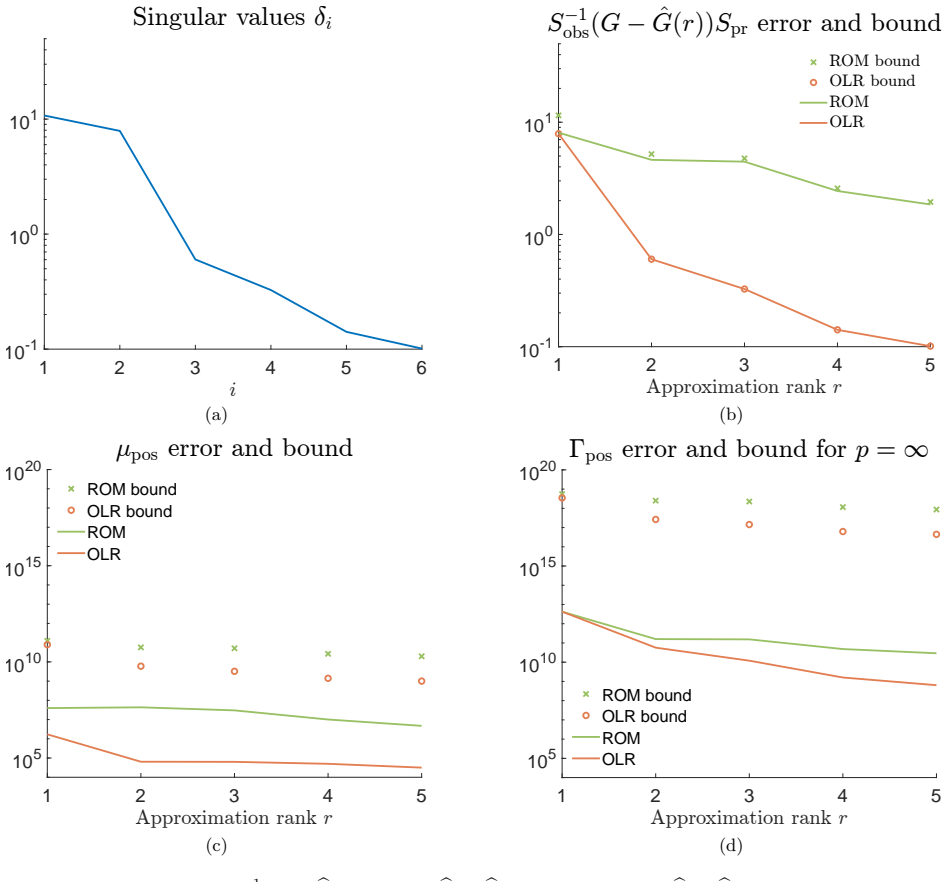
- The bounds are illustrated numerically on structural-engineering inverse problems.
Where Pith is reading between the lines
- The recovery result suggests a practical stopping criterion for choosing the rank in expensive sampling or optimization tasks.
- The same subspace construction could be tested as a dimension-reduction device in related uncertainty-quantification settings that are not strictly linear.
- The error bounds may be combined with existing sampling algorithms to certify the accuracy of low-rank posterior approximations.
Load-bearing premise
The analysis assumes the inverse problem is linear and Gaussian, possibly with a singular prior covariance matrix.
What would settle it
A linear Gaussian inverse problem in which the reduced-order posterior fails to match the exact posterior once the reduced-order rank equals the rank of the prior-preconditioned Hessian would falsify the recovery result.
Figures

read the original abstract
In the design of computational methods for Bayesian inverse problems, costly forward model evaluations make it difficult to sample from or compute the posterior. This motivates the need for approximate forward models that are cheaper to evaluate. We consider reduced-order forward models which exploit the lower-dimensional structure in the Bayesian inverse problem by projecting to the "likelihood-informed subspace" of the parameter space where the prior-to-posterior update is significant. However, the theoretical properties of these reduced-order forward models and their impact on the solution of the Baysian inverse problem are not always well-understood. In this work we consider linear Gaussian inverse problems with a possibly singular prior covariance matrix. We analyse a recently proposed reduced-order model which uses a Petrov-Galerkin projection to likelihood-informed subspaces that arise in optimal low-rank approximations of the posterior covariance matrix. We bound the error in the resulting approximation of the root prior-preconditioned Hessian of the data misfit. Based on this we also bound the errors of the approximate posterior covariance and mean. Our analysis shows that this reduced-order model recovers the exact posterior when the rank of the reduced-order model is equal to the "intrinsic dimension" of the inverse problem, i.e. the rank of the prior-preconditioned Hessian. Two numerical experiments from structural engineering illustrate the performance of our bounds.
Editorial analysis
A structured set of objections, weighed in public.
Referee Report
Summary. The paper analyzes error bounds for a Petrov-Galerkin reduced-order model (ROM) applied to linear Gaussian Bayesian inverse problems, including cases with singular prior covariances. The ROM projects onto likelihood-informed subspaces derived from optimal low-rank approximations of the posterior covariance. The authors bound the error in the root prior-preconditioned Hessian of the data misfit, and from this derive bounds on the approximate posterior covariance and mean. They prove that the ROM recovers the exact posterior precisely when its rank equals the intrinsic dimension (rank of the prior-preconditioned Hessian). Two numerical experiments from structural engineering are used to illustrate the bounds.
Significance. If the derivations hold, the work supplies explicit, vanishing error bounds for likelihood-informed ROMs in the linear-Gaussian setting, together with a clean characterization of exact recovery at the intrinsic dimension. This is useful for guiding reduced-rank selection in computational inverse problems. The explicit treatment of singular priors and the direct link between the subspace rank and the prior-preconditioned Hessian rank are strengths of the analysis.
minor comments (2)
- §2.2: the notation for the prior-preconditioned Hessian operator H and its low-rank factors could be introduced with an explicit reference to the eigenvalue decomposition used later in the bounds.
- The numerical experiments section would benefit from a short table summarizing the observed versus predicted error decay rates for the covariance and mean as a function of reduced rank.
Simulated Author's Rebuttal
We thank the referee for their positive assessment of the manuscript, accurate summary of its contributions, and recommendation to accept. We are pleased that the explicit error bounds, treatment of singular priors, and exact recovery result at the intrinsic dimension were viewed as strengths.
Circularity Check
Derivation is self-contained mathematical analysis with no circularity
full rationale
The paper derives error bounds on the root prior-preconditioned Hessian, posterior covariance, and mean for a Petrov-Galerkin reduced-order model in linear Gaussian inverse problems (including singular priors). The central observation that the approximate posterior recovers the exact posterior when the reduced rank equals the rank of the prior-preconditioned Hessian follows directly from the definition of the likelihood-informed subspace as the range of that operator; once the subspace is full-rank, the projection is the identity on the relevant space and the bounds vanish by standard linear algebra. No fitted parameters are renamed as predictions, no self-citations are invoked as load-bearing uniqueness theorems, and the analysis remains independent of any external fitted quantities or prior self-referential results. This is the expected outcome for a rigorous a-priori error analysis in numerical analysis.
Axiom & Free-Parameter Ledger
Reference graph
Works this paper leans on
-
[1]
Aziznejad, Shayan and Unser, Michael , title =. Numer. Funct. Anal. Optim. , volume =. 2021 , doi =
2021
-
[2]
Case of equality in spectral norm matrix triangle inequality , NOTE =
-
[3]
Likelihood-informed Model Reduction for Bayesian Inference of Static Structural Loads
Scheffels, Jakob and Qian, Elizabeth and Papaioannou, Iason and Ullmann, Elisabeth , year =. doi:10.48550/arXiv.2510.07950 , note =
work page internal anchor Pith review Pith/arXiv arXiv doi:10.48550/arxiv.2510.07950
-
[4]
Carere, G. and Lie, H. C. , year =. Optimal low-rank posterior covariance approximation in linear. doi:10.48550/arXiv.2411.01112 , note =
-
[5]
Inverse Probl
Giuseppe Carere and Han Cheng Lie , fjournal =. Inverse Probl. Imag. , pages =. 2026 , doi =
2026
-
[6]
Flath, H. P. and Wilcox, L. C. and Akcelik, V. and Hill, J. and Van Bloemen Waanders, B. and Ghattas, O. , title =. SIAM J. Sci. Comput. , volume =. 2011 , doi =
2011
-
[7]
Spantini, Alessio and Solonen, Antti and Cui, Tiangang and Martin, James and Tenorio, Luis and Marzouk, Youssef , title =. SIAM J. Sci. Comput. , volume =. 2015 , doi =
2015
-
[8]
Henderson, H. V. and Searle, S. R. , title =. SIAM Review , volume =. 1981 , doi =
1981
-
[9]
Eiermann, Michael and Ernst, Oliver G. , year =. Geometric aspects of the theory of. doi:10.1017/S0962492901000046 , journal =
-
[10]
2025 , doi =
Posterior error bounds for prior-driven balancing , author =. 2025 , doi =
2025
-
[11]
Choosing Observation Operators to Mitigate Model Error in
Cvetkovi\'. Choosing Observation Operators to Mitigate Model Error in. SIAM/ASA J. Uncertain. Quantif. , volume =. 2024 , doi =
2024
-
[12]
The stochastic finite element method in structural reliability , author=. PEM , volume=. doi:10.1016/0266-8920(88)90019-7 , year=
-
[13]
Hsein and Zhang, Dongming and Wang, Lei , month = mar, year =
Huang, Hongwei and Gong, Wenping and Khoshnevisan, Sara and Juang, C. Hsein and Zhang, Dongming and Wang, Lei , month = mar, year =. Simplified procedure for finite element analysis of the longitudinal performance of shield tunnels considering spatial soil variability in longitudinal direction , volume =. doi:10.1016/j.compgeo.2014.11.010 , journal =
-
[14]
Vittorio Erba, Emanuele Troiani, Lenka Zdeborová, and Florent Krzakala
The. Psychometrika , author =. 1936 , pages =. doi:10.1007/BF02288367 , number =
-
[15]
König, Josie and Qian, Elizabeth and Freitag, Melina A. , year =. Dimension and model reduction approaches for linear. doi:10.48550/arXiv.2506.23892 , publisher =
work page internal anchor Pith review Pith/arXiv arXiv doi:10.48550/arxiv.2506.23892
-
[16]
twiddle” operation and bounds on derivatives of pro- jectors A.1 The “twiddle
Bhatia, Rajendra , TITLE =. 1997 , PAGES =. doi:10.1007/978-1-4612-0653-8 , URL =
-
[17]
Stuart, A. M. , year =. Inverse problems:. doi:10.1017/S0962492910000061 , journal =
-
[18]
Sprungk, Björn , year =. On the local. doi:10.1088/1361-6420/ab6f43 , journal =
-
[19]
Adaptive multi-fidelity polynomial chaos approach to
Yan, Liang and Zhou, Tao , year =. Adaptive multi-fidelity polynomial chaos approach to. doi:10.1016/j.jcp.2018.12.025 , journal =
-
[20]
Novák, Lukáš and Sharma, Himanshu and Shields, Michael D. , year =. Physics-informed polynomial chaos expansions , volume =. doi:10.1016/j.jcp.2024.112926 , journal =
-
[21]
Lu, Fei and Morzfeld, Matthias and Tu, Xuemin and Chorin, Alexandre J. , year =. Limitations of polynomial chaos expansions in the. doi:10.1016/j.jcp.2014.11.010 , journal =
-
[22]
Dinkel, Maximilian and Geitner, Carolin M and Rei, Gil Robalo and Nitzler, Jonas and Wall, Wolfgang A , journal=. Solving. 2024 , publisher=
2024
-
[23]
Villani, Paolo and Unger, Jörg and Weiser, Martin , year =. Adaptive. doi:10.48550/arXiv.2404.19459 , publisher =
-
[24]
Deep surrogate accelerated delayed-acceptance
Deveney, Teo and Mueller, Eike and Shardlow, Tony , year =. Deep surrogate accelerated delayed-acceptance. doi:https://doi.org/10.1137/22M1513113 , journal =
-
[25]
An adaptive surrogate modeling based on deep neural networks for large-scale
Yan, Liang , year =. An adaptive surrogate modeling based on deep neural networks for large-scale. doi:10.4208/cicp.OA-2020-0186 , journal =
-
[26]
and Graham-Brady, Lori and Shields, Michael D
Pasparakis, George D. and Graham-Brady, Lori and Shields, Michael D. , year =. Bayesian neural networks for predicting uncertainty in full-field material response , volume =. doi:10.1016/j.cma.2024.117486 , journal =
-
[27]
Pf. Physics-informed. arXiv preprint arXiv:2212.12474 , year=. doi:10.48550/arXiv.2212.12474 , note =
-
[28]
Antoulas , title =
Athanasios C. Antoulas , title =. 2005 , publisher =
2005
-
[29]
SIAM review , volume=
A survey of projection-based model reduction methods for parametric dynamical systems , author=. SIAM review , volume=. 2015 , doi=
2015
-
[30]
, booktitle=
Bui-Thanh, Tan and Burstedde, Carsten and Ghattas, Omar and Martin, James and Stadler, Georg and Wilcox, Lucas C. , booktitle=. Extreme-scale. 2012 , volume=
2012
-
[31]
A. J. Sci. Comput. , author =. 2013 , pages =. doi:10.1137/12089586X , number =
-
[32]
Likelihood-informed dimension reduction for nonlinear inverse problems , volume =. Inverse Problems , author =. 2014 , pages =. doi:10.1088/0266-5611/30/11/114015 , number =
-
[33]
Certified dimension reduction in nonlinear
Zahm, Olivier and Cui, Tiangang and Law, Kody and Spantini, Alessio and Marzouk, Youssef , journal=. Certified dimension reduction in nonlinear. doi:10.1090/mcom/3737 , year=
-
[34]
Model. J. Sci. Comput. , author =. 2022 , pages =. doi:10.1007/s10915-022-01798-8 , number =
-
[35]
Time-. J. Sci. Comput. , author =. 2023 , pages =. doi:10.1007/s10915-023-02358-4 , number =
-
[36]
Stavrinides, Pavlos and Qian, Elizabeth , year =. An ensemble. doi:10.48550/arXiv.2507.03207 , publisher =
-
[37]
Inference-. PAMM , author =. 2024 , pages =. doi:10.1002/pamm.202400051 , number =
-
[38]
Lumley, J. L. , month = jan, year =. Coherent. Transition and. doi:10.1016/B978-0-12-493240-1.50017-X , pages =
-
[39]
Turbulence and the dynamics of coherent structures
Sirovich, Lawrence , journal=. Turbulence and the dynamics of coherent structures. doi:10.1090/qam/910462 , year=
-
[40]
Ghattas, Omar and Willcox, Karen , year =. Learning physics-based models from data: perspectives from inverse problems and model reduction , volume =. doi:10.1017/S0962492921000064 , journal =
-
[41]
Model order reduction for. Asia Pac. J. Comput. Eng. , author =. 2014 , pages =. doi:10.1186/2196-1166-1-2 , number =
-
[42]
and Willcox, Karen , title =
Cui, Tiangang and Marzouk, Youssef M. and Willcox, Karen , title =. Int. J. Numer. Meth. Engng , volume =. 2015 , doi =
2015
-
[43]
Accelerating the. Electron. Res. Arch. , author =. 2021 , pages =. doi:10.3934/era.2021044 , number =
-
[44]
Rao, Preetham P. , year =. Inverse parameter estimation using compressed sensing and. doi:10.1016/j.cma.2024.116820 , journal =
-
[45]
Acta Numerica , volume=
Reduced basis methods for time-dependent problems , author=. Acta Numerica , volume=. 2022 , doi=
2022
-
[46]
SISSA springer series, Springer Cham , year=
Real time reduced order computational mechanics , author=. SISSA springer series, Springer Cham , year=. doi:10.1007/978-3-031-49892-3 , publisher=
-
[47]
Stein. J. Sci. Comput. , author =. 2021 , pages =. doi:10.1137/20M1321589 , number =
-
[48]
A reduced basis ensemble. GEM Int. J. Geomath. , author =. 2023 , pages =. doi:10.1007/s13137-023-00235-8 , number =
-
[49]
Cotter, S. L. and Dashti, M. and Stuart, A. M. , year =. Approximation of. doi:10.1137/090770734 , journal =
discussion (0)
Sign in with ORCID, Apple, or X to comment. Anyone can read and Pith papers without signing in.