Explaining the B to Kμ^+μ^- Anomaly in the Left-Right Inverse Seesaw Model
Pith reviewed 2026-06-28 18:46 UTC · model grok-4.3
The pith
The left-right inverse seesaw model generates the observed B to K mu mu anomaly via a non-decoupling charged-scalar and heavy-neutrino box diagram.
A machine-rendered reading of the paper's core claim, the machinery that carries it, and where it could break.
Core claim
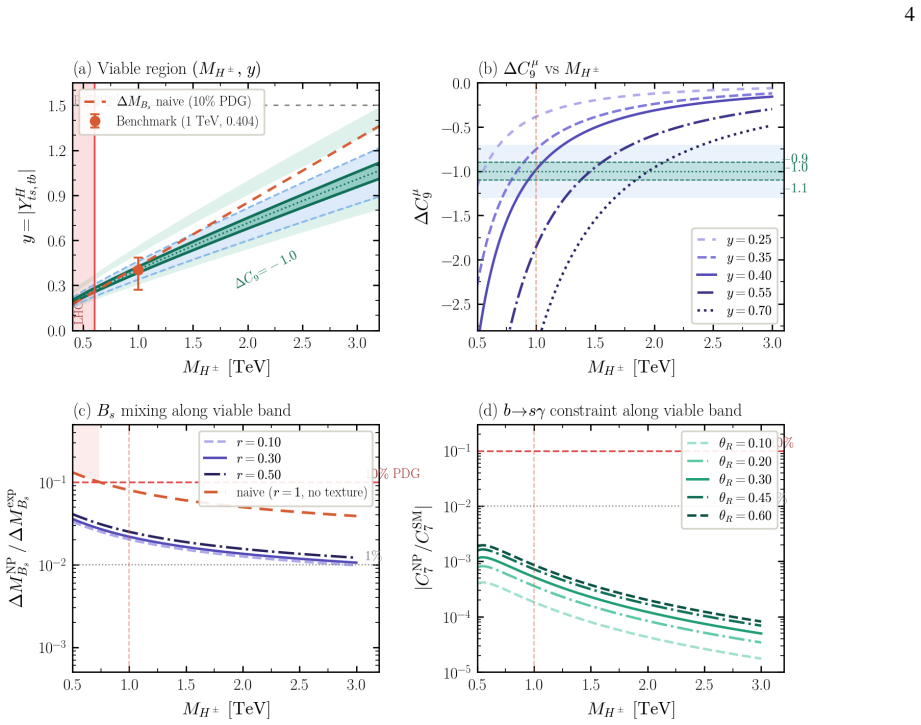
A charged-scalar/heavy-neutrino box diagram in the LRIS model naturally generates this pattern through a non-decoupling mechanism: the right-handed coupling produces a contribution to ΔC9 that is unsuppressed in the heavy-neutrino limit, while the simultaneous presence of a comparable left-handed Dirac Yukawa coupling ensures the automatic cancellation ΔC10 ≈ 0. The otherwise large contribution to Bs–B̄s mixing is suppressed by several orders of magnitude through a GIM-like phase structure in the right-handed quark mixing matrix. A numerical scan over the model parameter space identifies a viable region consistent with all current flavor and collider constraints.
What carries the argument
charged-scalar/heavy-neutrino box diagram whose right-handed couplings remain non-decoupling while a GIM-like phase structure in the right-handed quark mixing matrix suppresses Bs mixing
If this is right
- The diagram produces ΔC9 ≈ -1 with ΔC10 remaining consistent with zero.
- Bs-Bsbar mixing receives a contribution suppressed by several orders of magnitude.
- The b to s gamma constraint holds throughout the viable band with two orders of magnitude margin.
- A viable region of parameter space exists that satisfies all flavor and collider limits.
- The scenario predicts correlated signals for the charged scalar and heavy right-handed neutrinos at the LHC.
Where Pith is reading between the lines
- The same non-decoupling box could be checked against data on other rare b to s transitions such as B to K* mu mu angular observables.
- Because the model already incorporates the inverse seesaw for neutrino masses, the same heavy neutrinos may produce additional testable signatures in lepton-flavor violation.
- Future high-luminosity LHCb runs could distinguish this contribution from other explanations by measuring the precise correlation between ΔC9 and any small residual ΔC10.
- Extensions that relax the assumed phase structure while retaining the non-decoupling feature could be explored to enlarge the viable space.
Load-bearing premise
The right-handed quark mixing matrix possesses a GIM-like phase structure that suppresses the contribution to Bs-Bsbar mixing by several orders of magnitude.
What would settle it
A measurement of Bs-Bsbar mixing significantly larger than the suppressed value predicted by the model, or the absence of both the charged scalar and heavy neutrinos in LHC searches, would rule out the proposed explanation.
Figures
read the original abstract
We investigate the long-standing anomaly in the rare decay B into Kll within the Left-Right Inverse Seesaw (LRIS) model. Global analyses of the B into s mu mu data consistently indicate a significant negative shift in the vector Wilson coefficient, $\Delta C{9} \approx -1$, while the axial coefficient $\Delta C{10}$ remains consistent with zero. We show that a charged-scalar/heavy-neutrino box diagram in the LRIS model naturally generates this pattern through a \emph{non-decoupling} mechanism: the right-handed coupling produces a contribution to $\Delta C{9}$ that is unsuppressed in the heavy-neutrino limit, while the simultaneous presence of a comparable left-handed Dirac Yukawa coupling ensures the automatic cancellation $\Delta C{10} \approx 0$. The otherwise large contribution to $B_s$--$\bar{B}_s$ mixing is suppressed by several orders of magnitude through a GIM-like phase structure in the right-handed quark mixing matrix. A numerical scan over the model parameter space identifies a viable region, consistent with all current flavor and collider constraints. The $b \to s\gamma$ constraint is satisfied with two orders of magnitude to spare throughout the viable band. These results motivate correlated searches for the charged scalar and the heavy right-handed neutrinos at the LHC and future high-luminosity experiments.
Editorial analysis
A structured set of objections, weighed in public.
Referee Report
Summary. The manuscript proposes an explanation for the B → Kμ⁺μ⁻ anomaly within the Left-Right Inverse Seesaw (LRIS) model. It argues that a charged-scalar/heavy-neutrino box diagram produces a non-decoupling contribution to ΔC9 ≈ −1 while automatically canceling ΔC10 through comparable left- and right-handed couplings. The large contribution to Bs–B̄s mixing is claimed to be suppressed by a GIM-like phase structure in the right-handed quark mixing matrix, with a numerical scan identifying a viable parameter region consistent with constraints.
Significance. If the central mechanism holds, the result would be significant as it offers a model-specific resolution to the observed pattern in b→sℓℓ data (ΔC9 negative, ΔC10 zero) without conflicting with Bs mixing or b→sγ constraints. The non-decoupling feature and automatic cancellation are potentially attractive features, and the motivation for LHC searches for the charged scalar and heavy neutrinos is a positive aspect.
major comments (2)
- [Abstract] Abstract: The suppression of the Bs–B̄s mixing contribution by 'several orders of magnitude through a GIM-like phase structure in the right-handed quark mixing matrix' is presented as a key feature, but the abstract provides no derivation showing how this phase structure emerges from the LRIS Lagrangian or whether it requires tuning of the free parameters (right-handed Yukawa couplings, heavy neutrino masses, right-handed quark mixing phases). This assumption is load-bearing for the viability claim.
- [Abstract] Abstract: No explicit equations or derivation steps are provided for the box diagram contributions to the Wilson coefficients or the mixing suppression, making it impossible to verify the non-decoupling mechanism or the automatic ΔC10 cancellation from the given text.
minor comments (1)
- The abstract mentions a numerical scan but does not specify the scanned parameters or the range, nor any error analysis or fit quality metrics.
Simulated Author's Rebuttal
We thank the referee for the thoughtful comments on our manuscript. The points raised concern the level of detail provided in the abstract regarding the GIM-like suppression mechanism and the box-diagram derivations. We agree these aspects of the abstract can be strengthened for clarity while preserving its summary nature, and we have revised the manuscript accordingly.
read point-by-point responses
-
Referee: [Abstract] Abstract: The suppression of the Bs–B̄s mixing contribution by 'several orders of magnitude through a GIM-like phase structure in the right-handed quark mixing matrix' is presented as a key feature, but the abstract provides no derivation showing how this phase structure emerges from the LRIS Lagrangian or whether it requires tuning of the free parameters (right-handed Yukawa couplings, heavy neutrino masses, right-handed quark mixing phases). This assumption is load-bearing for the viability claim.
Authors: We agree the abstract is too concise on this point. The phase structure originates directly from the right-handed quark mixing matrix defined by the LRIS Lagrangian (see Section 3), where the GIM-like cancellations arise from the specific texture of the right-handed Yukawa couplings without additional tuning. The numerical scan in Section 5 confirms the suppression holds generically in the viable region. We will revise the abstract to briefly note the Lagrangian origin of the phase structure and reference the relevant section. revision: yes
-
Referee: [Abstract] Abstract: No explicit equations or derivation steps are provided for the box diagram contributions to the Wilson coefficients or the mixing suppression, making it impossible to verify the non-decoupling mechanism or the automatic ΔC10 cancellation from the given text.
Authors: The abstract is a high-level overview and omits equations by design. The explicit box-diagram expressions for ΔC9 and ΔC10 (including the non-decoupling limit and left-right cancellation), the relevant Feynman rules, and the loop functions are derived in Section 2. The Bs mixing suppression is quantified with explicit formulas in Section 4. To improve accessibility, we will update the abstract to include a short reference to these sections for the key mechanisms. revision: yes
Circularity Check
No significant circularity; derivation relies on explicit model calculations and parameter scan.
full rationale
The paper calculates contributions to Wilson coefficients from a specific box diagram in the LRIS model, attributes ΔC9 generation to non-decoupling right-handed couplings, and notes ΔC10 cancellation when left-handed Yukawa is comparable (a parameter choice within the scanned space). Bs mixing suppression is ascribed to phases in the right-handed quark mixing matrix, also part of the scanned parameters. No quoted equation or step reduces a claimed prediction to an input by construction, nor does any load-bearing claim rest solely on unverified self-citation. The viable region is identified numerically rather than forced by definition. This is a standard model accommodation analysis.
Axiom & Free-Parameter Ledger
free parameters (3)
- right-handed Yukawa couplings
- heavy neutrino masses
- right-handed quark mixing phases
axioms (2)
- domain assumption The Left-Right Inverse Seesaw model is a valid extension of the Standard Model.
- domain assumption Numerical scan over model parameters can identify regions consistent with all constraints.
invented entities (2)
-
charged scalar
no independent evidence
-
heavy right-handed neutrinos
no independent evidence
Forward citations
Cited by 1 Pith paper
-
Torsional four-fermion interaction for Majorana neutrinos
Torsion-induced four-fermion interactions modify effective masses and mixing parameters for Majorana neutrinos with sterile partners in matter.
Reference graph
Works this paper leans on
-
[1]
Consequently, neither chi- ral structure alone can naturally reproduce the pattern in Eq. (5). Instead, the preferred scenario requires an approx- imatelyvector-likemuon current with comparable left- and right-handed couplings,g µ L ≃g µ R. In this case, ∆C µ 9 ∝ |g µ L|2 +|g µ R|2 ̸= 0,(6) ∆C µ 10 ∝ |g µ R|2 − |gµ L|2 ≈0,(7) arXiv:2606.00513v1 [hep-ph] 3...
work page internal anchor Pith review Pith/arXiv arXiv 2026
-
[2]
The electroweak precision boundv R ≳3TeV is also satisfied throughout the viable region [24]. We perform a numerical scan over the relevant LRIS pa- rameter space, varying the effective quark couplings and phases, while fixing the leptonic couplings to|Y L µN |= |Y R µN |= 0.8in order to realize the suppression of∆C µ 10. The loop amplitudes are evaluated...
-
[3]
S. L. Glashow, J. Iliopoulos, and L. Maiani, Weak interac- tions with lepton–hadron symmetry, Phys. Rev. D2, 1285 (1970), DOI:10.1103/PhysRevD.2.1285
-
[4]
R. Aaijet al.[LHCb], “Measurement ofCP-averaged observables in theB 0 →K ∗0µ+µ− decay,” Phys. Rev. Lett.125, no.1, 011802 (2020), 10.1103/Phys- RevLett.125.011802, [arXiv:2003.04831 [hep-ex]]
-
[5]
R. Aaijet al.(LHCb Collaboration), Test of lepton univer- sality in beauty-quark decays, Nature Phys.18, 277 (2022), arXiv:2103.11769 [hep-ex], 10.1038/s41567-021-01478-8
-
[6]
R. Aaijet al.(LHCb Collaboration), Measurement of lepton universality parameters inB + →K +ℓ+ℓ− andB 0 →K ∗0ℓ+ℓ− decays, Phys. Rev. D 108, 032002 (2023), arXiv:2212.09153 [hep-ex], DOI:10.1103/PhysRevD.108.032002
-
[7]
R. Aaijet al.(LHCb Collaboration), Differential branch- ing fractions and isospin asymmetries ofB→K (∗)µ+µ− decays, JHEP06, 133 (2014), arXiv:1403.8044 [hep-ex], DOI:10.1007/JHEP06(2014)133
work page internal anchor Pith review Pith/arXiv arXiv doi:10.1007/jhep06(2014)133 2014
-
[8]
More on the first-order ther- modynamics of scalar-tensor and Horndeski gravity,
W. Altmannshofer and P. Stangl, New physics in rareB decays after Moriond 2021, Eur. Phys. J. C81, 952 (2021), 5 arXiv:2103.13370 [hep-ph], DOI:10.1140/epjc/s10052- 021-09725-1
-
[9]
More indications for lepton nonuniversality inb→sℓ +ℓ−,
T. Hurth, F. Mahmoudi, D. M. Santos and S. Ne- shatpour, “More indications for lepton nonuniversality inb→sℓ +ℓ−,” Phys. Lett. B824, 136838 (2022), doi:10.1016/j.physletb.2021.136838 [arXiv:2104.10058 [hep-ph]]
-
[10]
Constraints on lepton universality viola- tion from rareBdecays,
M. Ciuchini, M. Fedele, E. Franco, A. Paul, L. Silvestrini and M. Valli, “Constraints on lepton universality viola- tion from rareBdecays,” Phys. Rev. D107, no.5, 055036 (2023),10.1103/PhysRevD.107.055036, [arXiv:2212.10516 [hep-ph]]
-
[11]
J. C. Pati and A. Salam, Lepton number as the fourth color, Phys. Rev. D10, 275 (1974), DOI:10.1103/PhysRevD.10.275
-
[12]
R. N. Mohapatra and J. C. Pati, Left-right gauge symmetry and an isoconjugate model of CP violation, Phys. Rev. D11, 566 (1975), DOI:10.1103/PhysRevD.11.566
-
[13]
G. Senjanovi ´c and R. N. Mohapatra, Exact left-right sym- metry and spontaneous violation of parity, Phys. Rev. D12, 1502 (1975), DOI:10.1103/PhysRevD.12.1502
-
[14]
P. S. B. Dev, R. Franceschini, and R. N. Mohapatra, Bounds on TeV seesaw models from LHC Higgs data, Phys. Rev. D86, 093010 (2012), arXiv:1207.2756 [hep-ph], DOI:10.1103/PhysRevD.86.093010
work page internal anchor Pith review Pith/arXiv arXiv doi:10.1103/physrevd.86.093010 2012
-
[15]
R. N. Mohapatra and J. W. F. Valle, Neutrino mass and baryon-number nonconservation in super- string models, Phys. Rev. D34, 1642 (1986), DOI:10.1103/PhysRevD.34.1642
-
[16]
D. Wyler and L. Wolfenstein, Massless neutrinos in left- right asymmetric gauge models, Nucl. Phys. B218, 205 (1983), DOI:10.1016/0550-3213(83)90482-0
-
[17]
A. Pilaftsis, Radiatively induced neutrino masses and large Higgs–neutrino couplings in the Standard Model with Ma- jorana fields, Z. Phys. C55, 275 (1992), arXiv:hep- ph/9901206, DOI:10.1007/BF01482590
-
[18]
T. Inami and C. S. Lim, Effects of superheavy quarks and leptons in low-energy weak processes, Prog. Theor. Phys.65, 297 (1981);ibid.65, 1772(E) (1981), DOI:10.1143/PTP.65.297
-
[19]
Weak Decays Beyond Leading Logarithms
G. Buchalla, A. J. Buras, and M. E. Lautenbacher, Weak decays beyond leading logarithms, Rev. Mod. Phys.68, 1125 (1996), arXiv:hep-ph/9512380, DOI:10.1103/RevModPhys.68.1125
work page internal anchor Pith review Pith/arXiv arXiv doi:10.1103/revmodphys.68.1125 1996
-
[20]
A. J. Buras, M. Misiak, M. M ¨unz, and S. Poko- rski, Weak Hamiltonian, CP violation and rare decays, Nucl. Phys. B424, 374 (1994), arXiv:hep-ph/9311345, DOI:10.1016/0550-3213(94)90299-2
work page internal anchor Pith review Pith/arXiv arXiv doi:10.1016/0550-3213(94)90299-2 1994
-
[21]
J. P. Leeset al.(BaBar Collaboration), Precision Measure- ment of theB→X sγPhoton Energy Spectrum, Branching Fraction, and DirectCPAsymmetryA CP (B→X s+dγ), Phys. Rev. Lett.109, 191801 (2012), arXiv:1207.2520 [hep- ex], DOI:10.1103/PhysRevLett.109.191801
work page internal anchor Pith review Pith/arXiv arXiv doi:10.1103/physrevlett.109.191801 2012
-
[22]
A. M. Sirunyanet al.(CMS Collaboration), Search for a charged Higgs boson decaying into top and bottom quarks in events with electrons or muons in proton-proton collisions at √s= 13TeV, JHEP01, 096 (2020), arXiv:1908.09206 [hep-ex], DOI:10.1007/JHEP01(2020)096
-
[23]
M. Aaboudet al.(ATLAS Collaboration), Search for charged Higgs bosons decaying into top and bottom quarks at √s= 13TeV with the ATLAS detec- tor, JHEP11, 085 (2018), arXiv:1808.03599 [hep-ex], DOI:10.1007/JHEP11(2018)085
work page internal anchor Pith review Pith/arXiv arXiv doi:10.1007/jhep11(2018)085 2018
-
[24]
’t Hooft’s Consistency Condition as a Consequence of Analyticity and Unitarity,
G. Passarino and M. J. G. Veltman, One-loop correc- tions fore +e− annihilation intoµ +µ− in the Weinberg model, Nucl. Phys. B160, 151 (1979), DOI:10.1016/0550- 3213(79)90234-7
-
[25]
D. Delepine and S. Khalil, CP asymmetry inτ→Kπν τ in the Left-Right Inverse Seesaw Model, arXiv:2604.24924 [hep-ph] (2026)
work page internal anchor Pith review Pith/arXiv arXiv 2026
-
[26]
R. L. Workmanet al.(Particle Data Group), Review of Par- ticle Physics, Prog. Theor. Exp. Phys.2022, 083C01 (2022), DOI:10.1093/ptep/ptac097
-
[27]
Aaijet al.(LHCb Collaboration), Precise determi- nation of theB 0s– ¯B0s oscillation frequency,, Nat
R. Aaijet al.(LHCb Collaboration), Precise determi- nation of theB 0s– ¯B0s oscillation frequency,, Nat. Phys. 18, no.1, 54-58 (2022), arXiv:2104.04421 [hep-ex], DOI:10.1038/s41567-021-01394-x
-
[28]
T. Saitoet al.(Belle Collaboration), ‘Measure- ment of the ¯B→X sγbranching fraction with a sum of exclusive decays, Phys. Rev. D91, no.5, 052004 (2015), arXiv:1411.7198 [hep-ex], DOI:10.1103/PhysRevD.91.052004
work page internal anchor Pith review Pith/arXiv arXiv doi:10.1103/physrevd.91.052004 2015
-
[29]
Y . S. Amhiset al.(HFLA V Collaboration), Averages ofb- hadron,c-hadron, andτ-lepton properties as of 2021, Phys. Rev. D107, 052008 (2023), arXiv:2206.07501 [hep-ex], DOI:10.1103/PhysRevD.107.052008
-
[30]
A. M. Sirunyanet al.[CMS],, Search for aW ′ boson decaying to aτlepton and a neutrino in proton-proton collisions at √s= 13TeV, Phys. Lett. B792, 107-131 (2019), arXiv:1807.11421 [hep-ex], DOI:10.1016/j.physletb.2019.01.069
work page internal anchor Pith review Pith/arXiv arXiv doi:10.1016/j.physletb.2019.01.069 2019
-
[31]
G. Aadet al.(ATLAS Collaboration), Search for a heavy charged boson in events with a charged lepton and missing transverse momentum fromppcollisions at√s= 13TeV with the ATLAS detector, Phys. Rev. D100, no.5, 052013 (2019), arXiv:1906.05609 [hep-ex], DOI:10.1103/PhysRevD.100.052013
discussion (0)
Sign in with ORCID, Apple, or X to comment. Anyone can read and Pith papers without signing in.