High-Synchrotron-Peaked BL Lacs as Multi-Messenger Sources: Connecting Ultra-High-Energy Cosmic Rays and Neutrinos
Pith reviewed 2026-06-28 18:01 UTC · model grok-4.3
The pith
HSP BL Lacs can accelerate cosmic rays above 10^19 eV and neutrinos above 100 TeV but require extreme baryonic loading that conflicts with composition and isotropy data.
A machine-rendered reading of the paper's core claim, the machinery that carries it, and where it could break.
Core claim
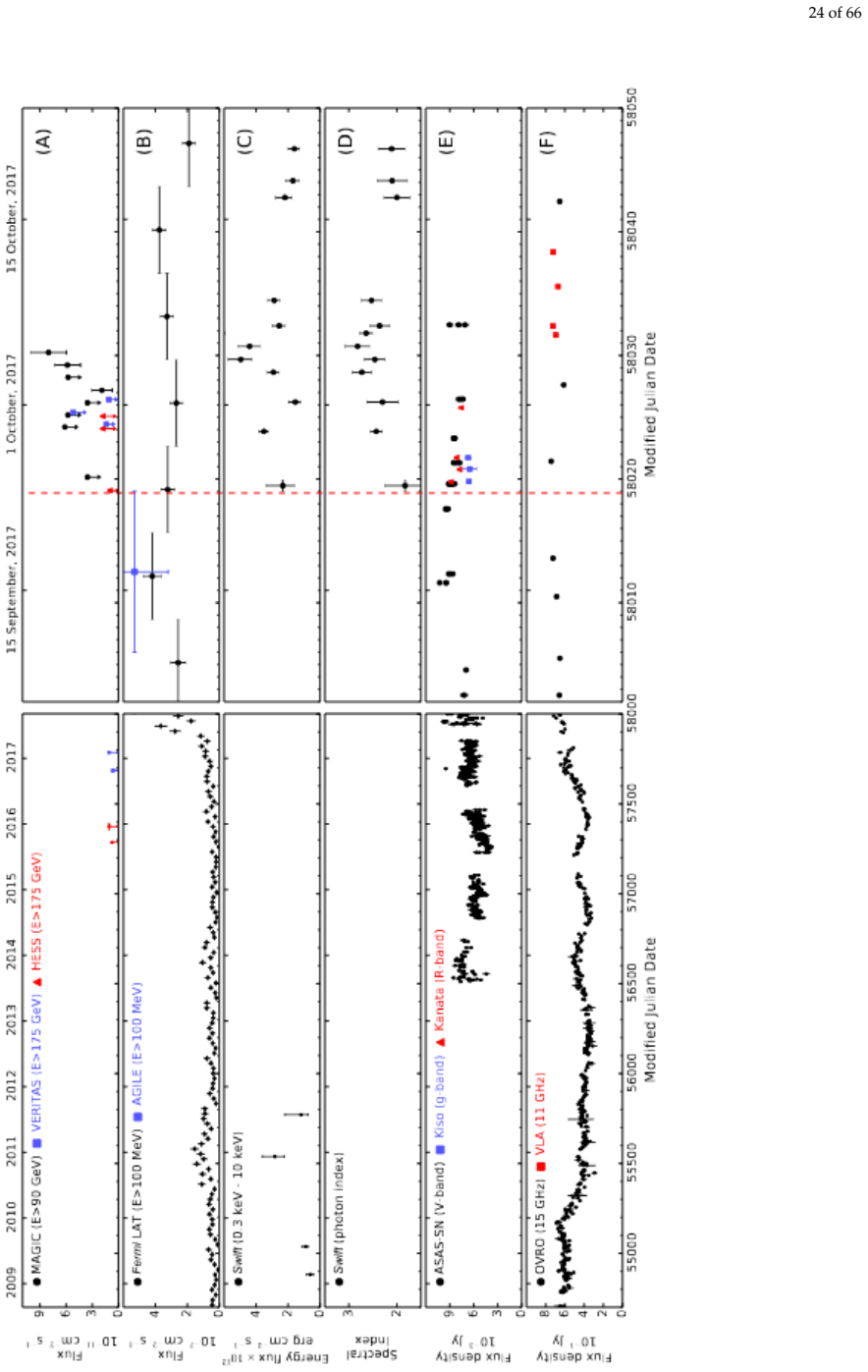
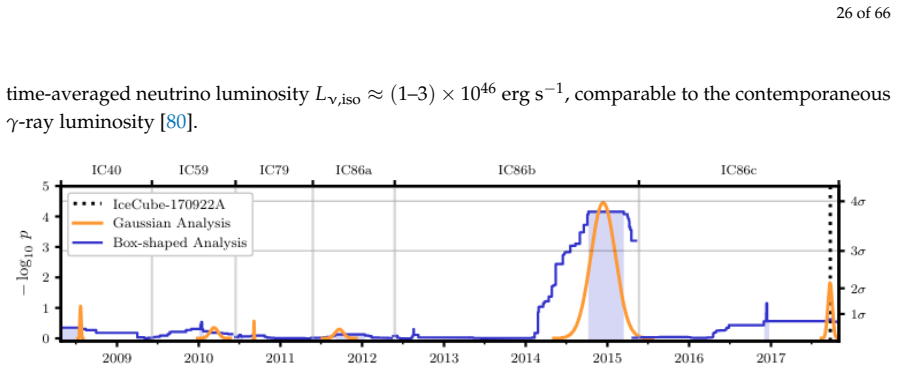
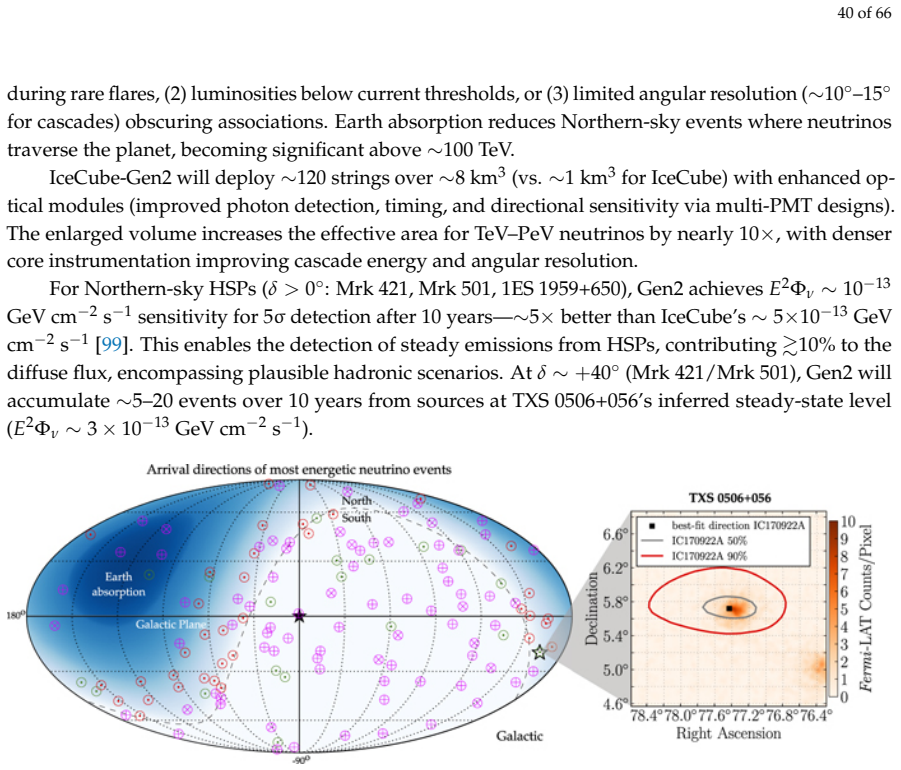
High-synchrotron-peaked BL Lacs, selected via infrared catalogs containing approximately 2000 sources, emerge as prime candidates for accelerating ultra-high-energy cosmic rays beyond 10^19 eV and producing neutrinos above 100 TeV owing to their proximity, clean environments, and extreme particle energies, with support from the 2017 IceCube-170922A association and the 2014-2015 archival flare, although this picture requires extreme baryonic loading that strains energetic budgets, conflicts with heavy-nuclei composition preferences, and clashes with the observed near-isotropy of arrival directions.
What carries the argument
The baryonic loading factor L_p/L_e in hadronic emission models, which sets the proton energy budget relative to electrons and determines whether HSP BL Lacs can match observed neutrino and UHECR fluxes.
If this is right
- Extreme baryonic loading of 10^3 to 10^5 strains the energetic budgets of HSP BL Lacs as multi-messenger sources.
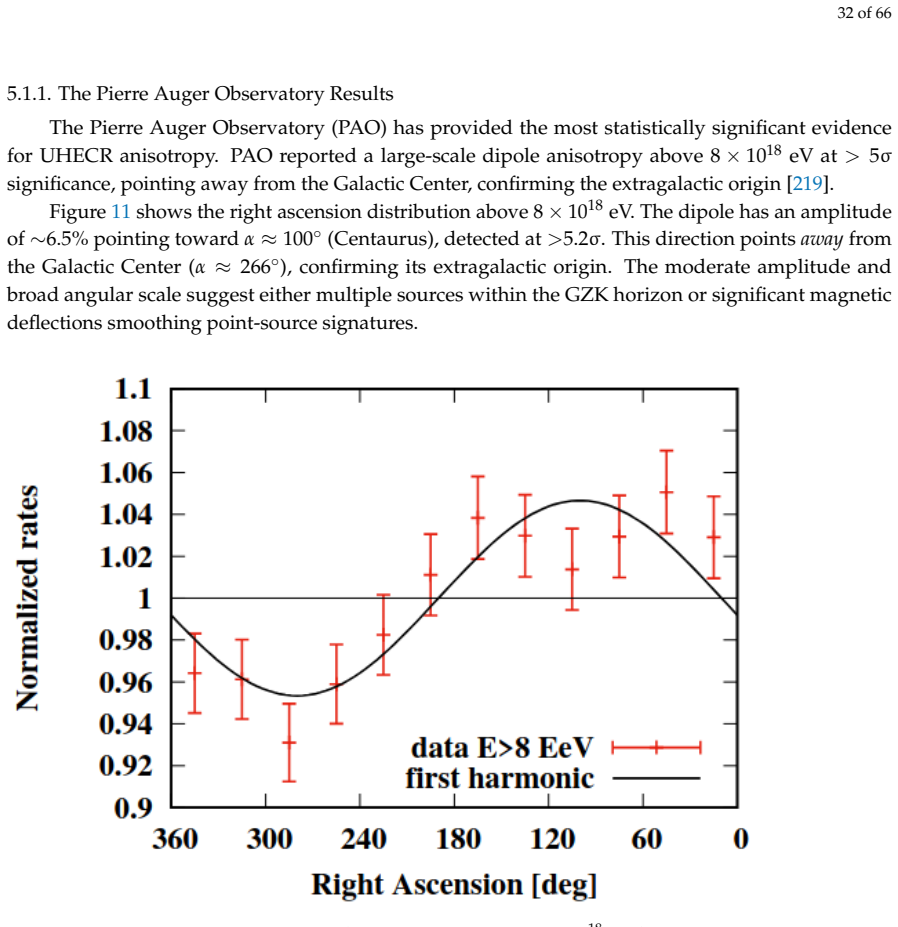
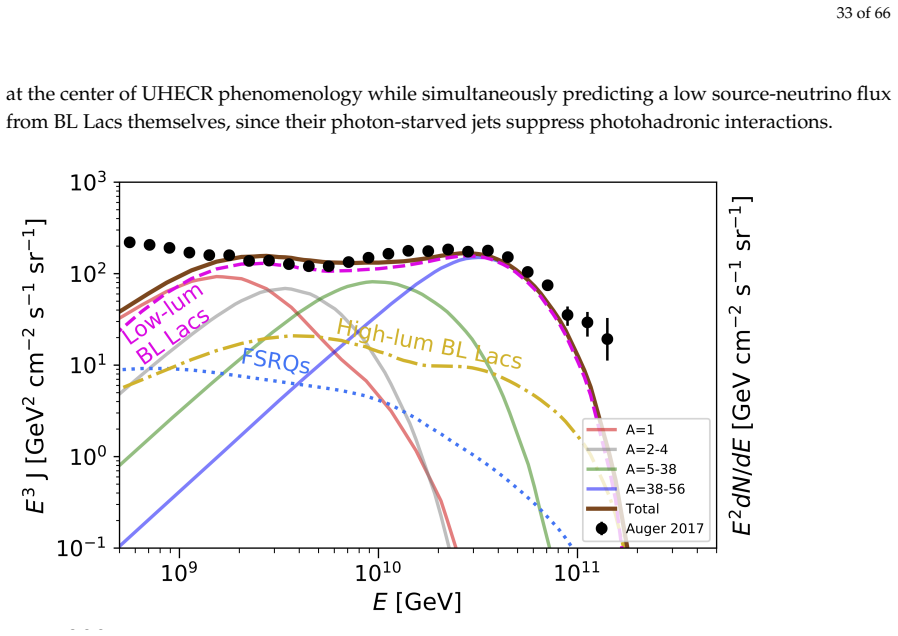
- Auger composition measurements favoring heavy nuclei challenge proton-dominated acceleration in these objects.
- Near-isotropy of UHECR arrival directions is difficult to reconcile with the rarity and beaming of blazar sources.
- Magnetic reconnection, structured jets, and duty cycle effects offer potential ways to ease the tensions with observations.
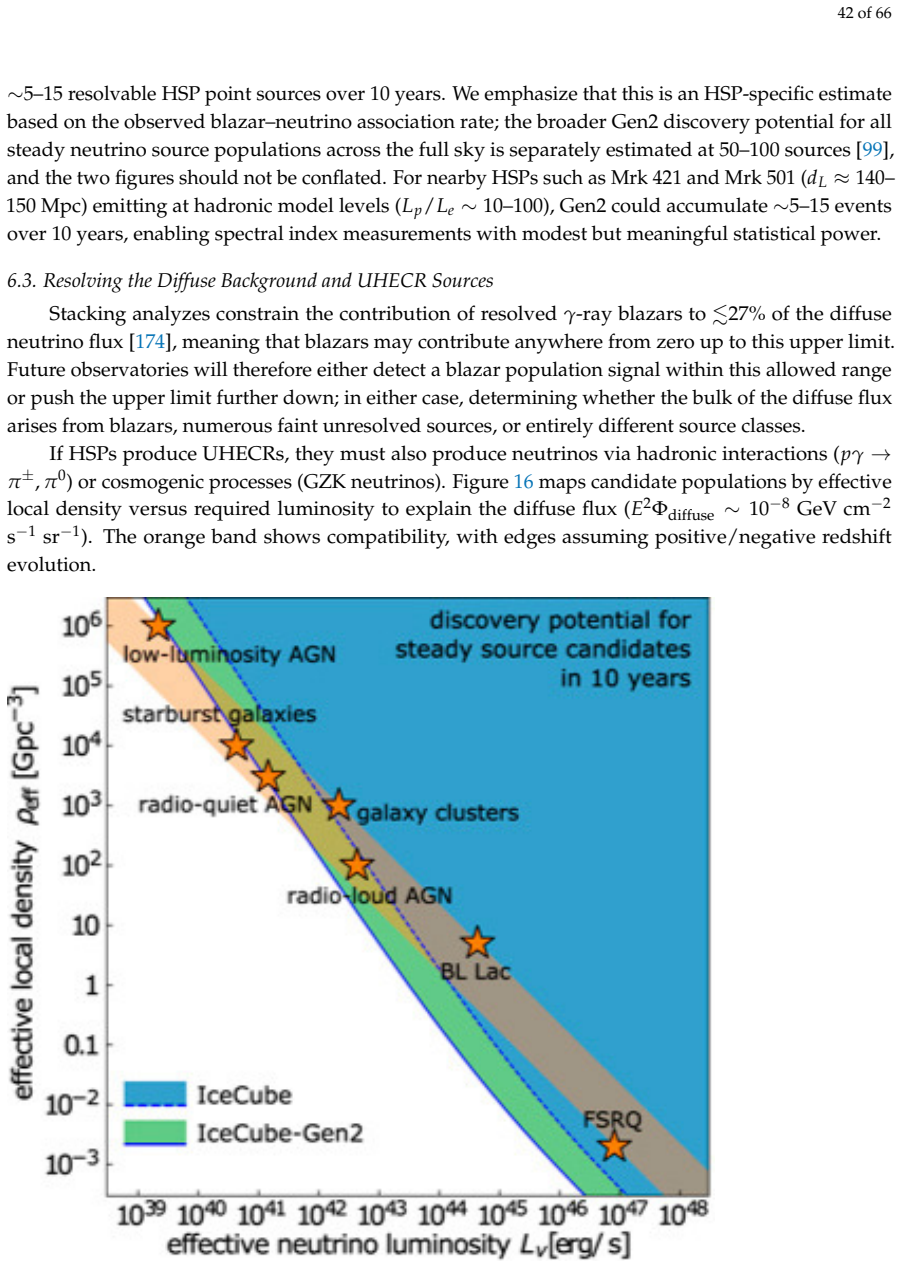
- Facilities such as IceCube-Gen2, KM3NeT, CTAO, IXPE, and AugerPrime will measure key observables to confirm or rule out HSP BL Lacs as the dominant accelerators.
Where Pith is reading between the lines
- If HSP BL Lacs cannot supply the full UHECR flux without violating isotropy, attention may shift toward more isotropic accelerator populations such as radio galaxies or clusters.
- Duty cycle effects could allow a larger effective population of HSP sources to contribute over cosmic time without contradicting current directional data.
- Structured jets might permit acceleration of heavy nuclei in some regions while enabling the observed neutrino production in flares.
Load-bearing premise
The specific IceCube neutrino events can be directly attributed to HSP BL Lacs and Auger composition results can be applied to these sources without major selection biases or uncertainties in hadronic modeling.
What would settle it
IceCube-Gen2 measurements showing no statistical excess of neutrinos correlated with HSP flares at the rates required by the high baryonic loading, or AugerPrime data revealing a shift to heavy nuclei composition at energies above 10^19 eV inconsistent with proton acceleration in these objects.
Figures







read the original abstract
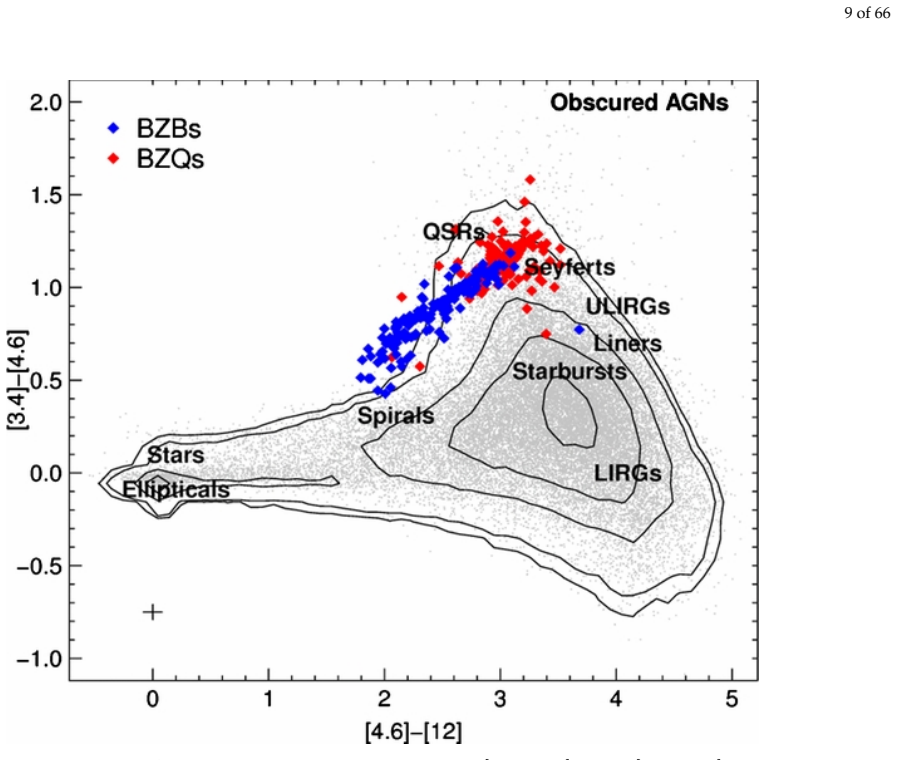
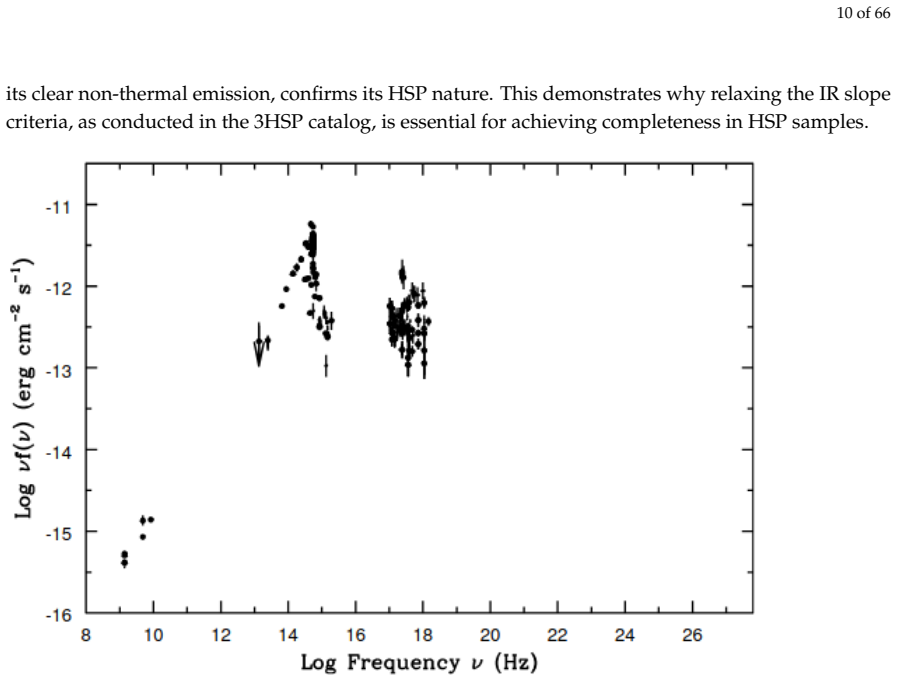
High-synchrotron-peaked (HSP) BL Lac objects are extreme particle accelerators whose synchrotron emission peaks at high frequencies, typically in the UV-to-X-ray band ($\nu_{\rm peak} > 10^{15}$ Hz; $\nu_{\rm peak} \geq 10^{17}$ for EHSPs), implying electron Lorentz factors of order $10^5-10^6$. Their relative proximity ($z \geq 0.5$), clean radiation environments, and favorable Hillas parameters make them prime candidates for ultra-high-energy cosmic ray (UHECR) acceleration beyond $10^{19}$ eV and for neutrino production above 100 TeV. The 2017 association of IceCube-170922A with the flaring blazar TXS 0506+056 provided compelling evidence for blazars as neutrino sources, while an archival neutrino flare from 2014-2015 with no clear electromagnetic counterpart (13 events) revealed additional complexity in the emission mechanism. This review examines HSP physical properties, identifies them through WISE-based infrared selection (the 2WHSP and 3HSP catalogs, approximately 2000 sources), and contrasts leptonic synchrotron self-Compton models with hadronic alternatives. We assess the observational evidence linking HSPs to high-energy neutrinos and UHECRs, finding that extreme baryonic loading ($L_p/L_e \sim 10^3-10^5$) strains energetic budgets, Auger composition measurements favor heavy nuclei over proton-dominated scenarios, and the near-isotropy of UHECR arrival directions is difficult to reconcile with rare beamed sources. Potential resolutions involving magnetic reconnection, structured jets, and duty cycle effects are discussed. Next-generation facilities, including IceCube-Gen2, KM3NeT, CTAO, IXPE, and AugerPrime/TA x 4, will probe key observables to either establish HSP BL Lacs as sources of the highest-energy cosmic particles or redirect the search toward alternative accelerator classes.
Editorial analysis
A structured set of objections, weighed in public.
Referee Report
Summary. The manuscript is a literature review synthesizing properties of high-synchrotron-peaked (HSP) BL Lac objects, their selection via WISE-based catalogs (2WHSP, 3HSP), leptonic vs. hadronic emission models, and multi-messenger connections to UHECRs above 10^19 eV and neutrinos above 100 TeV. It cites the 2017 IceCube-170922A association with TXS 0506+056 and the 2014-2015 archival flare, while explicitly noting tensions from extreme baryonic loading (L_p/L_e ~ 10^3-10^5), Auger preference for heavy nuclei, and UHECR isotropy conflicting with beamed sources. Potential resolutions (magnetic reconnection, structured jets, duty cycles) and prospects for IceCube-Gen2, KM3NeT, CTAO, IXPE, and AugerPrime are discussed without advancing new quantitative models or fits.
Significance. If the synthesis is accurate, the review provides a balanced consolidation of observational constraints and open questions in linking HSP BL Lacs to UHECRs and neutrinos, useful for guiding multi-messenger studies. It earns credit for transparently flagging the same energetic, compositional, and directional tensions highlighted in the literature rather than asserting HSPs as established sources.
minor comments (2)
- [Abstract] Abstract: the parenthetical 'z ≥ 0.5' for relative proximity should be tied to a specific catalog selection criterion or sample statistic to avoid implying all HSPs lie at this distance.
- The review would benefit from a dedicated table summarizing the key IceCube associations, their electromagnetic counterparts, and associated model parameters for quick reference.
Simulated Author's Rebuttal
We thank the referee for their positive assessment of the manuscript as a balanced literature review that transparently highlights key tensions in linking HSP BL Lacs to UHECRs and neutrinos. We appreciate the recommendation to accept.
Circularity Check
No significant circularity; review draws on external literature
full rationale
This is a review paper that synthesizes existing literature on HSP BL Lacs, IceCube neutrino associations, Auger UHECR data, and hadronic/leptonic models. No new quantitative derivations, parameter fits, or equations are introduced that could reduce to self-referential inputs. All key claims (e.g., baryonic loading estimates, composition preferences, isotropy issues) are attributed to external citations rather than derived from the authors' own prior work in a load-bearing way. The paper flags the same tensions noted in the reader's summary without asserting novel predictions. Per the hard rules, a self-contained review against external benchmarks receives score 0.
Axiom & Free-Parameter Ledger
axioms (2)
- domain assumption Synchrotron peak frequencies above 10^15 Hz imply electron Lorentz factors of order 10^5-10^6
- domain assumption The 2017 IceCube-170922A association and 2014-2015 archival flare provide evidence linking blazars to neutrinos
Reference graph
Works this paper leans on
-
[1]
Galactic Nuclei as Collapsed Old Quasars.Nature1969,223, 690–694
Lynden-Bell, D. Galactic Nuclei as Collapsed Old Quasars.Nature1969,223, 690–694. https://doi.org/10.1038/223690a0
-
[2]
Black Hole Models for Active Galactic Nuclei.Annu
Rees, M.J. Black Hole Models for Active Galactic Nuclei.Annu. Rev. Astron. Astrophys.1984,22, 471–506. https://doi.org/10.1146/annurev.aa.22.090184.002351
-
[3]
Accretion of Interstellar Matter by Massive Objects.Astrophys
Salpeter, E.E. Accretion of Interstellar Matter by Massive Objects.Astrophys. J.1964,140, 796–800. https://doi.org/10.1086/147973
-
[4]
The Fate of a Star and the Evolution of Gravitational Energy Upon Accretion.Sov
Zel’dovich, Y.B. The Fate of a Star and the Evolution of Gravitational Energy Upon Accretion.Sov. Phys. Dokl.1964,9, 195
1964
-
[5]
Blandford, R.D.; Königl, A. Relativistic jets as compact radio sources.Astrophys. J.1979,232, 34–48. https://doi.org/10.1086/157262
-
[6]
Electromagnetic extraction of energy from Kerr black holes.Mon
Blandford, R.D.; Znajek, R.L. Electromagnetic extraction of energy from Kerr black holes.Mon. Not. R. Astron. Soc.1977,179, 433–456. https://doi.org/10.1093/mnras/179.3.433
-
[7]
Theory of extragalactic radio sources.Rev
Begelman, M.C.; Blandford, R.D.; Rees, M.J. Theory of extragalactic radio sources.Rev. Mod. Phys.1984, 56, 255–351. https://doi.org/10.1103/RevModPhys.56.255
-
[8]
Bridle, A.H.; Perley, R.A. Extragalactic Radio Jets.Annu. Rev. Astron. Astrophys.1984,22, 319–358. https://doi.org/10.1146/annurev.aa.22.090184.001535
-
[9]
Hydromagnetic flows from accretion disks and the production of radio jets
Blandford, R.D.; Payne, D.G. Hydromagnetic flows from accretion disks and the production of radio jets. Mon. Not. R. Astron. Soc.1982,199, 883–903. https://doi.org/10.1093/mnras/199.4.883
-
[10]
Semidynamical models of radio jets: relativistic beaming and source counts
Lind, K.R.; Blandford, R.D. Semidynamical models of radio jets: relativistic beaming and source counts. Astrophys. J.1985,295, 358–367. https://doi.org/10.1086/163380
-
[11]
Jet opening angles and gamma-ray brightness of AGN.Astron
Pushkarev, A.B.; Kovalev, Y.Y.; Lister, M.L.; Savolainen, T. Jet opening angles and gamma-ray brightness of AGN.Astron. Astrophys.2009,507, L33–L36. https://doi.org/10.1051/0004-6361/200913422
-
[12]
Jorstad, S.G.; Marscher, A.P .; Lister, M.L.; Stirling, A.M.; Cawthorne, T.V .; Gear, W.K.; Gómez, J.L.; Stevens, J.A.; Smith, P .S.; Forster, J.R.; et al. Polarimetric Observations of 15 Active Galactic Nuclei at High Frequencies: Jet Kinematics from Bimonthly Monitoring with the Very Long Baseline Array.Astron. J.2005, 130, 1418–1465. https://doi.org/10...
-
[13]
Unified Schemes for Radio-Loud Active Galactic Nuclei
Urry, C.M.; Padovani, P . Unified Schemes for Radio-Loud Active Galactic Nuclei.Publ. Astron. Soc. Pac. 1995,107, 803. https://doi.org/10.1086/133630
work page internal anchor Pith review doi:10.1086/133630 1995
-
[14]
Hovatta, T.; Valtaoja, E.; Tornikoski, M.; Lahteenmaki, A. Doppler factors, Lorentz factors and viewing angles for quasars, BL Lacertae objects and radio galaxies.Astron. Astrophys.2009,494, 527. https://doi.org/10.1051/0004-6361:200811150
-
[15]
Unified models for active galactic nuclei and quasars.Annu
Antonucci, R. Unified models for active galactic nuclei and quasars.Annu. Rev. Astron. Astrophys.1993, 31, 473–521. https://doi.org/10.1146/annurev.aa.31.090193.002353
-
[16]
The Complete Sample of 1 Jansky BL Lacertae Objects
Stickel, M.; Padovani, P .; Urry, C.M.; Fried, J.W.; Kuehr, H. The Complete Sample of 1 Jansky BL Lacertae Objects. I. Summary Properties.Astrophys. J.1991,374, 431. https://doi.org/10.1086/170133
-
[17]
The Einstein Observatory Extended Medium-Sensitivity Survey
Stocke, J.T.; Morris, S.L.; Gioia, I.M.; Maccacaro, T.; Schild, R.; Wolter, A.; Fleming, T.A.; Henry, J.P . The Einstein Observatory Extended Medium-Sensitivity Survey. II. The Optical Identifications.Astron. Astrophys. Suppl. Ser.1991,76, 813. https://doi.org/10.1086/191582
-
[18]
Marcha, M.J.M.; Browne, I.W.A.; Impey, C.D.; Smith, P .S. Optical spectroscopy and polarization of a new sample of optically bright flat radio spectrum sources.Mon. Not. R. Astron. Soc.1996,281, 425–448. https://doi.org/10.1093/mnras/281.2.425
-
[19]
The hard TeV spectrum of 1ES 0229+200: New clues from Swift.Mon
Ghisellini, G.; Maraschi, L.; Tavecchio, F. The Fermi blazars’ divide.Mon. Not. R. Astron. Soc.2009, 396, L105–L109. https://doi.org/10.1111/j.1745-3933.2009.00673.x
-
[20]
Ghisellini, G.; Tavecchio, F.; Foschini, L.; Ghirlanda, G. The transition between BL Lac objects and flat spectrum radio quasars.Mon. Not. R. Astron. Soc.2011,414, 2674–2689. https://doi.org/10.1111/j.1365-2966.2011.18578.x
-
[21]
Fossati, G.; Maraschi, L.; Celotti, A.; Comastri, A.; Ghisellini, G. A unifying view of the spectral energy distributions of blazars.Mon. Not. R. Astron. Soc.1998,299, 433–448. https://doi.org/10.1046/j.1365-8711.1998.01828.x. 55 of 66
-
[22]
Hard X-ray properties of blazars.Astron
Donato, D.; Ghisellini, G.; Tagliaferri, G.; Fossati, G. Hard X-ray properties of blazars.Astron. Astrophys. 2001,375, 739–751. https://doi.org/10.1051/0004-6361:20010675
-
[23]
Ghisellini, G.; Righi, C.; Costamante, L.; Tavecchio, F. The Fermi blazar sequence.Mon. Not. R. Astron. Soc. 2017,469, 255–266. https://doi.org/10.1093/mnras/stx806
-
[24]
Rybicki, G.B.; Lightman, A.P .Radiative Processes in Astrophysics; Wiley: Hoboken, NJ, USA, 1986
1986
-
[25]
The Connection between X-Ray– and Radio-selected BL Lacertae Objects
Padovani, P .; Giommi, P . The Connection between X-Ray– and Radio-selected BL Lacertae Objects. Astrophys. J.1995,444, 567. https://doi.org/10.1086/175631
-
[26]
The Spectral Energy Distribution of Fermi Bright Blazars.Astrophys
Abdo, A.A.; Ackermann, M.; Agudo, I.; Ajello, M.; Aller, H.D.; Aller, M.F.; Angelakis, E.; Arkharov, A.A.; Axelsson, M.; Bach, U.; et al. The Spectral Energy Distribution of Fermi Bright Blazars.Astrophys. J.2010, 716, 30–70. https://doi.org/10.1088/0004-637X/716/1/30
-
[27]
Giommi, P .; Padovani, P .; Polenta, G.; Turriziani, S.; D’Elia, V .; Piranomonte, S. A simplified view of blazars: Clearing the fog around long-standing selection effects.Mon. Not. R. Astron. Soc.2012,420, 2899–2911. https://doi.org/10.1111/j.1365-2966.2011.20044.x
-
[28]
Ghisellini, G.; Celotti, A.; Fossati, G.; Maraschi, L.; Comastri, A. A theoretical unifying scheme for gamma-ray bright blazars.Mon. Not. R. Astron. Soc.1998,301, 451–468. https://doi.org/10.1046/j.1365-8711.1998.02032.x
-
[29]
The blazar sequence: validity and predictions.Astrophys
Padovani, P . The blazar sequence: validity and predictions.Astrophys. Space Sci.2007,309, 63–71. https://doi.org/10.1007/s10509-007-9455-2
-
[30]
A simplified view of blazars: Theγ-ray case.Mon
Giommi, P .; Padovani, P .; Polenta, G. A simplified view of blazars: Theγ-ray case.Mon. Not. R. Astron. Soc. 2013,431, 1914–1922. https://doi.org/10.1093/mnras/stt305
-
[31]
Compton Dominance and the Blazar Sequence.Astrophys
Finke, J.D. Compton Dominance and the Blazar Sequence.Astrophys. J.2013,763, 134. https://doi.org/10.1088/0004-637X/763/2/134
-
[32]
Chang, Y.L.; Arsioli, B.; Giommi, P .; Padovani, P . 2WHSP: A multi-frequency selected catalogue of high energy and very high energyγ-ray blazars and blazar candidates.Astron. Astrophys.2017,598, A17. https://doi.org/10.1051/0004-6361/201629487
-
[33]
Extreme synchrotron BL Lac objects
Costamante, L.; Ghisellini, G.; Giommi, P .; Tagliaferri, G.; Celotti, A.; Chiaberge, M.; Fossati, G.; Maraschi, L.; Tavecchio, F.; Treves, A.; et al. Extreme synchrotron BL Lac objects. Stretching the blazar sequence.Astron. Astrophys.2001,371, 512–526. https://doi.org/10.1051/0004-6361:20010412
-
[34]
HI distribution, mass functions and HI deficient galaxies
Tavecchio, F.; Ghisellini, G.; Ghirlanda, G.; Foschini, L.; Maraschi, L. TeV BL Lac objects at the dawn of the Fermi era.Mon. Not. R. Astron. Soc.2010,401, 1570–1586. https://doi.org/10.1111/j.1365-2966.2009.15784.x
-
[35]
A Jet Model for the Gamma-Ray–emitting Blazar 3C 279.Astrophys
Maraschi, L.; Ghisellini, G.; Celotti, A. A Jet Model for the Gamma-Ray–emitting Blazar 3C 279.Astrophys. J. Lett.1992,397, L5. https://doi.org/10.1086/186531
-
[36]
Constraints on the Physical Parameters of TeV Blazars.Astrophys
Tavecchio, F.; Maraschi, L.; Ghisellini, G. Constraints on the Physical Parameters of TeV Blazars.Astrophys. J. 1998,509, 608–619. https://doi.org/10.1086/306526
-
[37]
Diagnostics of Inverse-Compton models for the γ-ray emission of 3C 279 and MKN 421.Astron
Ghisellini, G.; Maraschi, L.; Dondi, L. Diagnostics of Inverse-Compton models for the γ-ray emission of 3C 279 and MKN 421.Astron. Astrophys. Suppl. Ser.1996,120, 503–506
1996
-
[38]
The multifrequency emission of Mrk 501
Katarzy ´ nski, K.; Sol, H.; Kus, A. The multifrequency emission of Mrk 501. From radio to TeV gamma-rays. Astron. Astrophys.2001,367, 809–825. https://doi.org/10.1051/0004-6361:20000538
-
[39]
Synchrotron Self-Compton Analysis of TeV X-Ray-Selected BL Lacertae Objects.Astrophys
Finke, J.D.; Dermer, C.D.; Böttcher, M. Synchrotron Self-Compton Analysis of TeV X-Ray-Selected BL Lacertae Objects.Astrophys. J.2008,686, 181–194. https://doi.org/10.1086/590900
-
[40]
Multiwavelength Observations of Strong Flares from the TeV Blazar 1ES 1959+650.Astrophys
Krawczynski, H.; Hughes, S.B.; Horan, D.; Aharonian, F.; Aller, M.F.; Aller, H.; Boltwood, P .; Buckley, J.; Coppi, P .; Fossati, G.; et al. Multiwavelength Observations of Strong Flares from the TeV Blazar 1ES 1959+650.Astrophys. J.2004,601, 151–164. https://doi.org/10.1086/380393
-
[41]
High energy neutrinos from the TeV blazar 1ES 1959+650.Astropart
Halzen, F.; Hooper, D. High energy neutrinos from the TeV blazar 1ES 1959+650.Astropart. Phys.2005, 23, 537–542. https://doi.org/10.1016/j.astropartphys.2005.03.007
-
[42]
Daniel, M.K.; Badran, H.M.; Bond, I.H.; Boyle, P .J.; Bradbury, S.M.; Buckley, J.H.; Carter-Lewis, D.A.; Catanese, M.; Celik, O.; Cogan, P .; et al. Spectrum of Very High Energy Gamma-Rays from the blazar 1ES 1959+650 during Flaring Activity in 2002.Astrophys. J.2005,621, 181–187. https://doi.org/10.1086/427406
-
[43]
Bła˙zejowski, M.; Blaylock, G.; Bond, I.H.; Bradbury, S.M.; Buckley, J.H.; Carter-Lewis, D.A.; Celik, O.; Cogan, P .; Cui, W.; Daniel, M.; et al. A Multiwavelength View of the TeV Blazar Markarian 421: Correlated Variability, Flaring, and Spectral Evolution.Astrophys. J.2005,630, 130–141. https://doi.org/10.1086/431925
-
[44]
Aharonian, F.; Akhperjanian, A.G.; Anton, G.; Barres de Almeida, U.; Bazer-Bachi, A.R.; Becherini, Y.; Behera, B.; Bernlöhr, K.; Boisson, C.; Bochow, A.; et al. Simultaneous Observations of PKS 2155-304 with 56 of 66 HESS, Fermi, RXTE, and Atom: Spectral Energy Distributions and Variability in a Low State.Astrophys. J. Lett.2009,696, L150–L155. https://do...
-
[45]
A Hadronic Synchrotron Mirror Model for the “Orphan” TeV Flare in 1ES 1959+650.Astrophys
Böttcher, M. A Hadronic Synchrotron Mirror Model for the “Orphan” TeV Flare in 1ES 1959+650.Astrophys. J.2005,621, 176–180. https://doi.org/10.1086/427430
-
[46]
Leptonic and Hadronic Modeling of Fermi-detected Blazars.Astrophys
Böttcher, M.; Reimer, A.; Sweeney, K.; Prakash, A. Leptonic and Hadronic Modeling of Fermi-detected Blazars.Astrophys. J.2013,768, 54. https://doi.org/10.1088/0004-637X/768/1/54
-
[47]
Reimer, A.; Böttcher, M.; Postnikov, S. Neutrino Emission in the Hadronic Synchrotron Mirror Model: The “Orphan” TeV Flare from 1ES 1959+650.Astrophys. J.2005,630, 186–190. https://doi.org/10.1086/431948
-
[48]
On the Minimum Jet Power of TeV BL Lac Objects in the p–γModel.Astrophys
Xue, R.; Liu, R.Y.; Wang, X.Y.; Yan, H.; Böttcher, M. On the Minimum Jet Power of TeV BL Lac Objects in the p–γModel.Astrophys. J.2019,871, 81. https://doi.org/10.3847/1538-4357/aaf720
-
[49]
Xue, R.; Liu, R.Y.; Petropoulou, M.; Oikonomou, F.; Wang, Z.R.; Wang, K.; Wang, X.Y. A two-zone model for blazar emission: Implications for TXS 0506+056 and the neutrino event IceCube-170922A.strophys. J.2019, 886, 23. https://doi.org/10.3847/1538-4357/ab4b44
-
[50]
Time-dependent leptohadronic modeling of Markarian 421.Eur
Xue, R.; Wang, Z.R.; Hu, H.B. Time-dependent leptohadronic modeling of Markarian 421.Eur. Phys. J. C 2025,85, 779. https://doi.org/10.1140/epjc/s10052-025-14468-4
-
[51]
Mannheim, K. The proton blazar.Astron. Astrophys.1993,269, 67–76. https://doi.org/10.48550/arXiv.astro-ph/9302006
work page internal anchor Pith review Pith/arXiv arXiv doi:10.48550/arxiv.astro-ph/9302006 1993
-
[52]
A proton synchrotron blazar model for flaring in Markarian 501.Astropart
Mücke, A.; Protheroe, R.J. A proton synchrotron blazar model for flaring in Markarian 501.Astropart. Phys. 2001,15, 121–136. https://doi.org/10.1016/S0927-6505(00)00141-9
-
[53]
BL Lac objects in the synchrotron proton blazar model.Astropart
Mücke, A.; Protheroe, R.J.; Engel, R.; Rachen, J.P .; Stanev, T. BL Lac objects in the synchrotron proton blazar model.Astropart. Phys.2003,18, 593–613. https://doi.org/10.1016/S0927-6505(02)00185-8
-
[54]
Aharonian, F.A. TeV gamma rays from BL Lac objects due to synchrotron radiation of extremely high energy protons.New Astron.2000,5, 377–395. https://doi.org/10.1016/S1384-1076(00)00039-7
-
[55]
Kelner, S.R.; Aharonian, F.A. Energy spectra of gamma rays, electrons, and neutrinos produced at interactions of relativistic protons with low energy radiation.Phys. Rev. D2008,78, 034013. https://doi.org/10.1103/PhysRevD.78.034013
-
[56]
On high-energy neutrino radiation of quasars and active galactic nuclei
Berezinskii, V .S.; Ginzburg, V .L. On high-energy neutrino radiation of quasars and active galactic nuclei. Mon. Not. R. Astron. Soc.1981,194, 3–14. https://doi.org/10.1093/mnras/194.1.3
-
[57]
Relativistic Jets in Active Galactic Nuclei and Microquasars.Space Sci
Romero, G.E.; Boettcher, M.; Markoff, S.; Tavecchio, F. Relativistic Jets in Active Galactic Nuclei and Microquasars.Space Sci. Rev.2017,207, 5–61. https://doi.org/10.1007/s11214-016-0328-2
-
[58]
Das, S.; Gupta, N.; Razzaque, S. Ultrahigh-energy cosmic ray interactions as the origin of very high energy γ−rays from BL Lacs.Astrophys. J.2020,889, 149. https://doi.org/10.3847/1538-4357/ab6131
-
[59]
Evidence for a Primary Cosmic-Ray Particle with Energy 10 20 eV.Phys
Linsley, J. Evidence for a Primary Cosmic-Ray Particle with Energy 10 20 eV.Phys. Rev. Lett.1963, 10, 146–148. https://doi.org/10.1103/PhysRevLett.10.146
-
[60]
The Origin of Ultra-High-Energy Cosmic Rays.Annu
Hillas, A.M. The Origin of Ultra-High-Energy Cosmic Rays.Annu. Rev. Astron. Astrophys.1984,22, 425–444. https://doi.org/10.1146/annurev.aa.22.090184.002233
-
[61]
Cosmological Gamma-Ray Bursts and the Highest Energy Cosmic Rays.Phys
Waxman, E. Cosmological Gamma-Ray Bursts and the Highest Energy Cosmic Rays.Phys. Rev. Lett.1995, 75, 386–389. https://doi.org/10.1103/PhysRevLett.75.386
-
[62]
The Origin of Cosmic Rays above 10 18.5 eV.Astrophys
Norman, C.A.; Melrose, D.B.; Achterberg, A. The Origin of Cosmic Rays above 10 18.5 eV.Astrophys. J.1995, 454, 60. https://doi.org/10.1086/176465
-
[63]
Observation of the Suppression of the Flux of Cosmic Rays above 4×10 19eV.Phys
Abraham, J.; Abreu, P .; Aglietta, M.; Aguirre, C.; Allard, D.; Allekotte, I.; Allen, J.; Allison, P .; Alvarez-Muñiz, J.; Ambrosio, M.; et al. Observation of the Suppression of the Flux of Cosmic Rays above 4×10 19eV.Phys. Rev. Lett.2008,101, 061101. https://doi.org/10.1103/PhysRevLett.101.061101
-
[64]
Abu-Zayyad, T.; Aida, R.; Allen, M.; Anderson, R.; Azuma, R.; Barcikowski, E.; Belz, J.W.; Bergman, D.R.; Blake, S.A.; Cady, R.; et al. The Cosmic-Ray Energy Spectrum Observed with the Surface Detector of the Telescope Array Experiment.Astrophys. J. Lett.2013,768, L1. https://doi.org/10.1088/2041-8205/768/1/L1
-
[65]
End to the Cosmic-Ray Spectrum?Phys
Greisen, K. End to the Cosmic-Ray Spectrum?Phys. Rev. Lett.1966,16, 748–750. https://doi.org/10.1103/PhysRevLett.16.748
-
[66]
Upper Limit of the Spectrum of Cosmic Rays.Sov
Zatsepin, G.T.; Kuz’min, V .A. Upper Limit of the Spectrum of Cosmic Rays.Sov. J. Exp. Theor. Phys. Lett. 1966,4, 78
1966
-
[67]
Depth of maximum of air-shower profiles at the Pierre Auger Observatory
Aab, A.; Abreu, P .; Aglietta, M.; Ahn, E.J.; Al Samarai, I.; Albuquerque, I.F.M.; Allekotte, I.; Allen, J.; Allison, P .; Almela, A.; et al. Depth of maximum of air-shower profiles at the Pierre Auger Observatory. II. Composition implications.Phys. Rev. D2014,90, 122006. https://doi.org/10.1103/PhysRevD.90.122006. 57 of 66
-
[68]
Depth of maximum of air-shower profiles at the Pierre Auger Observatory: Measurements above 10ˆ{17.2} eV and Composition Implications
Bellido, J.; Pierre Auger Collaboration. Depth of maximum of air-shower profiles at the Pierre Auger Observatory: Measurements above 10ˆ{17.2} eV and Composition Implications. In Proceedings of the 35th International Cosmic Ray Conference (ICRC2017), Busan, Republic of Korea, 12–20 July 2017; Volume 301, p
2017
-
[69]
https://doi.org/10.22323/1.301.0506
-
[70]
Sikora, M.; Begelman, M.C.; Rees, M.J. Comptonization of Diffuse Ambient Radiation by a Relativistic Jet: The Source of Gamma Rays from Blazars?Astrophys. J.1994,421, 153. https://doi.org/10.1086/173633
-
[71]
Dermer, C.D.; Menon, G.High Energy Radiation from Black Holes: Gamma Rays, Cosmic Rays, and Neutrinos; Princeton University Press: Princeton, NJ, USA, 2009
2009
-
[72]
Murase, K.; Dermer, C.D.; Takami, H.; Migliori, G. Blazars as Ultra-high-energy Cosmic-ray Sources: Implications for TeV Gamma-Ray Observations.Astrophys. J.2012,749, 63. https://doi.org/10.1088/0004-637X/749/1/63
-
[73]
Murase, K.; Inoue, Y.; Dermer, C.D. Diffuse neutrino intensity from the inner jets of active galactic nuclei: Impacts of external photon fields and the blazar sequence.Phys. Rev. D2014,90, 023007. https://doi.org/10.1103/PhysRevD.90.023007
-
[74]
On the hadronic cascade scenario for extreme BL Lacs.Mon
Tavecchio, F. On the hadronic cascade scenario for extreme BL Lacs.Mon. Not. R. Astron. Soc.2014, 438, 3255–3262. https://doi.org/10.1093/mnras/stt2437
-
[75]
Connecting blazars with ultrahigh-energy cosmic rays and astrophysical neutrinos.Mon
Resconi, E.; Coenders, S.; Padovani, P .; Giommi, P .; Caccianiga, L. Connecting blazars with ultrahigh-energy cosmic rays and astrophysical neutrinos.Mon. Not. R. Astron. Soc.2017,468, 597–606. https://doi.org/10.1093/mnras/stx498
-
[76]
High-Energy Neutrinos from Photomeson Processes in Blazars.Phys
Atoyan, A.; Dermer, C.D. High-Energy Neutrinos from Photomeson Processes in Blazars.Phys. Rev. Lett. 2001,87, 221102. https://doi.org/10.1103/PhysRevLett.87.221102
-
[77]
High-Energy Neutrinos from Active Galactic Nuclei
Murase, K.; Stecker, F.W. High-Energy Neutrinos from Active Galactic Nuclei. InThe Encyclopedia of Cosmology. Set 2: Frontiers in Cosmology. Volume 2: Neutrino Physics and Astrophysics; Stecker, F.W., Ed.; World Scientific Publishing: Singapore, 2023; pp. 483–540. https://doi.org/10.1142/9789811282645_0010
-
[78]
Evidence for High-Energy Extraterrestrial Neutrinos at the IceCube Detector
IceCube Collaboration. Evidence for High-Energy Extraterrestrial Neutrinos at the IceCube Detector. Science2013,342, 1242856. https://doi.org/10.1126/science.1242856
-
[79]
Evidence for Astrophysical Muon Neutrinos from the Northern Sky with IceCube.Phys
Aartsen, M.G.; Abraham, K.; Ackermann, M.; Adams, J.; Aguilar, J.A.; Ahlers, M.; Ahrens, M.; Altmann, D.; Anderson, T.; Archinger, M.; et al. Evidence for Astrophysical Muon Neutrinos from the Northern Sky with IceCube.Phys. Rev. Lett.2015,115, 081102. https://doi.org/10.1103/PhysRevLett.115.081102
-
[80]
G., Ackermann, M., Adams, J., et al
IceCube Collaboration.; Aartsen, M.G.; Ackermann, M.; Adams, J.; Aguilar, J.A.; Ahlers, M.; Ahrens, M.; Al Samarai, I.; Altmann, D.; Andeen, K.; et al. Multimessenger observations of a flaring blazar coincident with high-energy neutrino IceCube-170922A.Science2018,361, eaat1378. https://doi.org/10.1126/science.aat1378
discussion (0)
Sign in with ORCID, Apple, or X to comment. Anyone can read and Pith papers without signing in.