Measurements of jet quenching with semi-inclusive hadron-jet correlations in Ru+Ru and Zr+Zr collisions at sqrt{s_NN}=200 GeV
Pith reviewed 2026-06-28 16:22 UTC · model grok-4.3
The pith
Suppression of the recoil jet yield is observed in central Ru+Ru and Zr+Zr collisions at 200 GeV, indicating medium-induced partonic energy loss.
A machine-rendered reading of the paper's core claim, the machinery that carries it, and where it could break.
Core claim
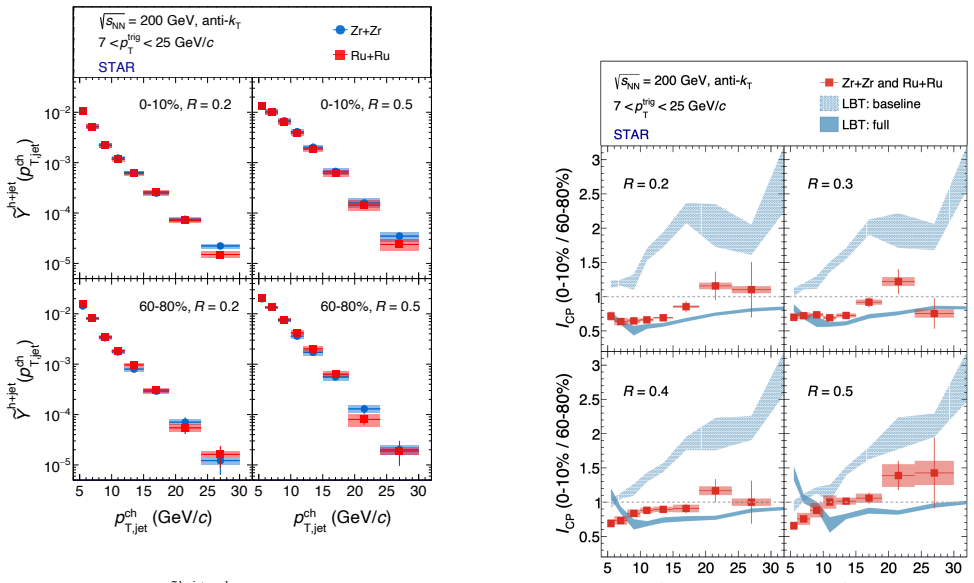
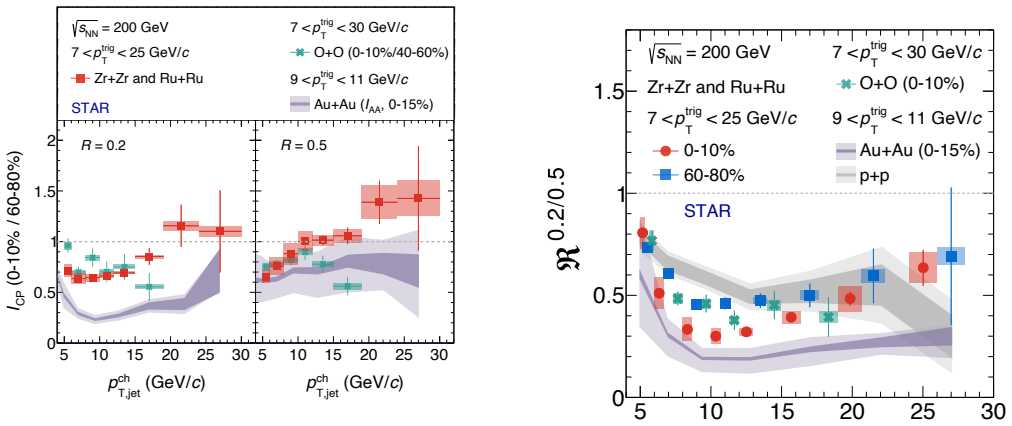
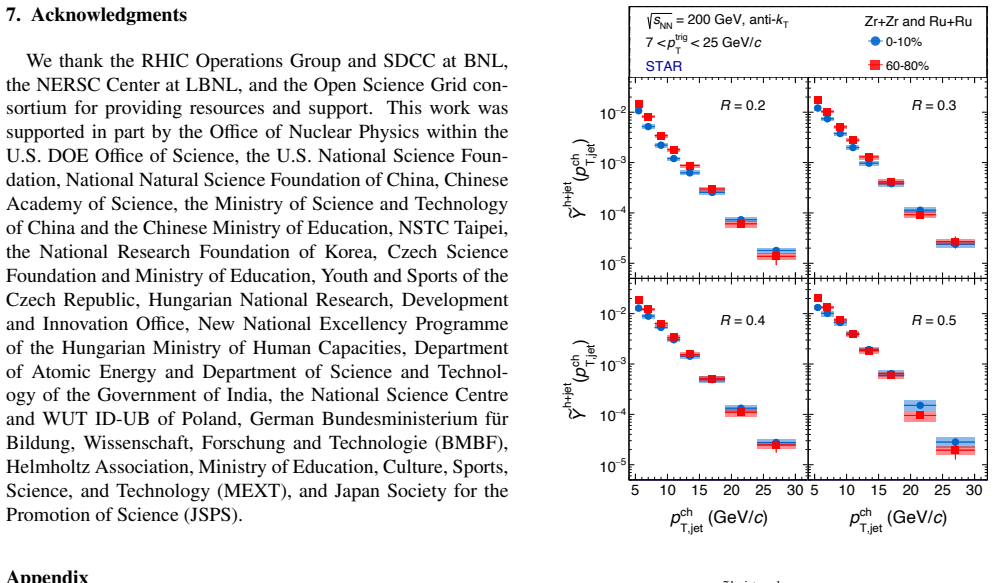
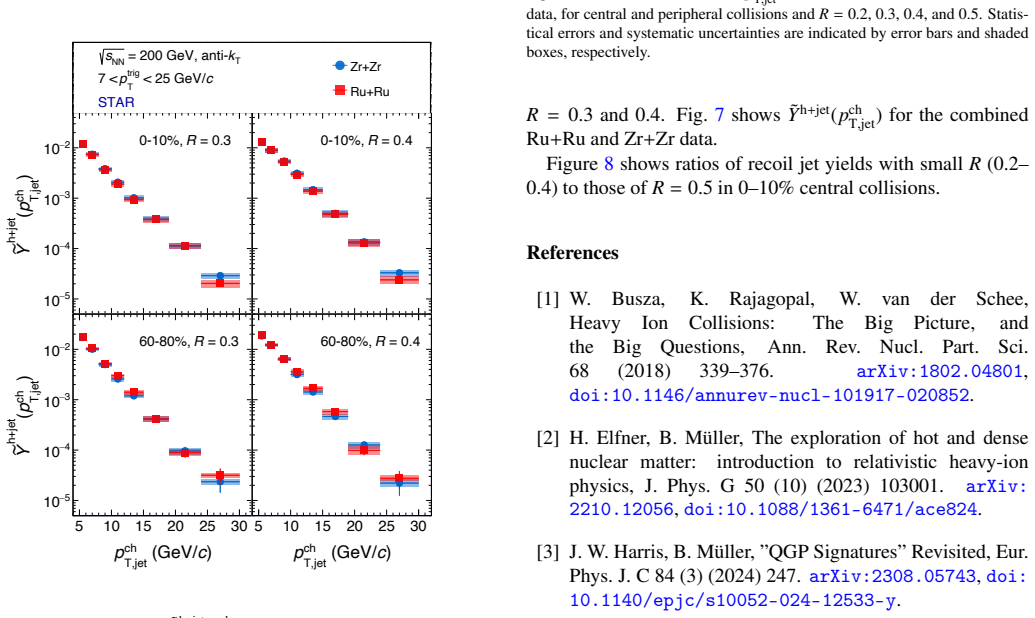
Measurements show suppression of the trigger-normalized recoil jet yield in central relative to peripheral Ru+Ru and Zr+Zr collisions, indicating medium-induced partonic energy loss due to quenching. The ratio of recoil jet yields for small and large resolution parameters is suppressed in central relative to peripheral collisions, characteristic of medium-induced intra-jet broadening.
What carries the argument
Semi-inclusive hadron-jet correlations, with recoil jet yields normalized to the number of high-pT hadron triggers and compared across centrality classes at different resolution parameters.
Load-bearing premise
Observed differences between central and peripheral collisions arise primarily from medium-induced jet quenching rather than from initial-state nuclear effects, trigger biases, or choices in centrality selection and background subtraction.
What would settle it
No suppression of the normalized recoil jet yield in central collisions relative to peripheral ones, after background subtraction, would falsify the claim of medium-induced energy loss.
Figures

read the original abstract
The STAR experiment at RHIC reports measurements of the semi-inclusive yield of charged-particle jets recoiling from high transverse momentum charged-hadron triggers in centrality-selected Ru+Ru and Zr+Zr collisions at the nucleon-nucleon center-of-mass energy of 200 GeV. The effects of jet quenching, arising from the interaction of jets with the quark-gluon plasma, are quantified by comparing trigger-normalized recoil yields in central and peripheral collisions. Such measurements with intermediate-mass beams provide unique insight into spatial and temporal aspects of jet quenching. Suppression of the recoil yield in central collisions is observed, indicating medium-induced partonic energy loss due to quenching. The ratio of recoil jet yields for small and large resolution parameter is found to be suppressed in central relative to peripheral collisions, characteristic of medium-induced intra-jet broadening. The results are compared to similar measurements in smaller and larger collision systems.
Editorial analysis
A structured set of objections, weighed in public.
Referee Report
Summary. The STAR experiment reports measurements of semi-inclusive charged-particle jet yields recoiling from high-pT hadron triggers in centrality-selected Ru+Ru and Zr+Zr collisions at √s_NN=200 GeV. Jet quenching is quantified via trigger-normalized recoil yields, with suppression observed in central relative to peripheral collisions interpreted as medium-induced partonic energy loss; the ratio of yields for small versus large resolution parameter is also suppressed in central collisions, taken as evidence for medium-induced intra-jet broadening. Results are compared to measurements in smaller and larger systems.
Significance. If the central-peripheral contrast is shown to arise from medium effects rather than initial-state or analysis artifacts, the work supplies new data on jet quenching in intermediate-mass isobar systems, offering constraints on the path-length and time dependence of energy loss and broadening in the QGP at RHIC energies.
major comments (2)
- [§IV (Results)] §IV (Results): the attribution of recoil-yield suppression to medium-induced quenching is load-bearing for the central claim, yet the manuscript provides no quantitative estimate or dedicated comparison demonstrating that initial-state nuclear modifications (e.g., nPDF differences between Ru and Zr) are subdominant to the observed central-peripheral difference.
- [§III (Analysis)] §III (Analysis): the background-subtraction and underlying-event correction procedures for the semi-inclusive correlations are not shown to be free of centrality-dependent biases; without explicit tests (e.g., variation of subtraction parameters or comparison to peripheral baselines), the quenching interpretation cannot be isolated from possible analysis artifacts.
minor comments (2)
- Figure captions should explicitly state the pT ranges of the trigger hadrons and the resolution parameters R used for the jet reconstruction.
- The abstract could note the integrated luminosity or number of events analyzed to allow readers to gauge statistical precision.
Simulated Author's Rebuttal
We thank the referee for the careful review and constructive comments. We respond to each major comment below.
read point-by-point responses
-
Referee: [§IV (Results)] §IV (Results): the attribution of recoil-yield suppression to medium-induced quenching is load-bearing for the central claim, yet the manuscript provides no quantitative estimate or dedicated comparison demonstrating that initial-state nuclear modifications (e.g., nPDF differences between Ru and Zr) are subdominant to the observed central-peripheral difference.
Authors: The central-peripheral comparison is performed separately within each isobar system (Ru+Ru and Zr+Zr). Nuclear PDFs are properties of the colliding nuclei and are therefore identical for central and peripheral collisions in a given system; any nPDF modifications cancel in the central-to-peripheral ratio. Differences between the Ru and Zr nPDFs are consequently irrelevant to the observed suppression. We will add an explicit clarifying statement in the revised Section IV. revision: yes
-
Referee: [§III (Analysis)] §III (Analysis): the background-subtraction and underlying-event correction procedures for the semi-inclusive correlations are not shown to be free of centrality-dependent biases; without explicit tests (e.g., variation of subtraction parameters or comparison to peripheral baselines), the quenching interpretation cannot be isolated from possible analysis artifacts.
Authors: We agree that explicit tests are needed to demonstrate robustness. In the revised manuscript we will add dedicated validation studies, including variation of the subtraction parameters and comparison of the corrected peripheral yields against expectations from smaller collision systems, to confirm the absence of significant centrality-dependent biases. revision: yes
Circularity Check
Direct experimental measurement report with no circular derivations
full rationale
This is an experimental paper reporting measured semi-inclusive hadron-jet yields and their central-peripheral ratios in Ru+Ru/Zr+Zr collisions. No derivations, model equations, fitted parameters renamed as predictions, or self-citation chains are present in the abstract or described analysis. The claims rest on direct data comparisons, with external benchmarks (other collision systems) providing independent context. No load-bearing steps reduce to inputs by construction.
Axiom & Free-Parameter Ledger
Reference graph
Works this paper leans on
-
[1]
Heavy Ion Collisions: The Big Picture, and the Big Questions
W. Busza, K. Rajagopal, W. van der Schee, Heavy Ion Collisions: The Big Picture, and the Big Questions, Ann. Rev. Nucl. Part. Sci. 68 (2018) 339–376.arXiv:1802.04801, doi:10.1146/annurev-nucl-101917-020852
work page internal anchor Pith review Pith/arXiv arXiv doi:10.1146/annurev-nucl-101917-020852 2018
-
[2]
H. Elfner, B. Müller, The exploration of hot and dense nuclear matter: introduction to relativistic heavy-ion physics, J. Phys. G 50 (10) (2023) 103001.arXiv: 2210.12056,doi:10.1088/1361-6471/ace824
-
[3]
J. W. Harris, B. Müller, ”QGP Signatures” Revisited, Eur. Phys. J. C 84 (3) (2024) 247.arXiv:2308.05743,doi: 10.1140/epjc/s10052-024-12533-y
-
[4]
D. J. Schwarz, The first second of the universe, Annalen Phys. 12 (2003) 220–270.arXiv:astro-ph/0303574, doi:10.1002/andp.200310010
work page internal anchor Pith review Pith/arXiv arXiv doi:10.1002/andp.200310010 2003
-
[5]
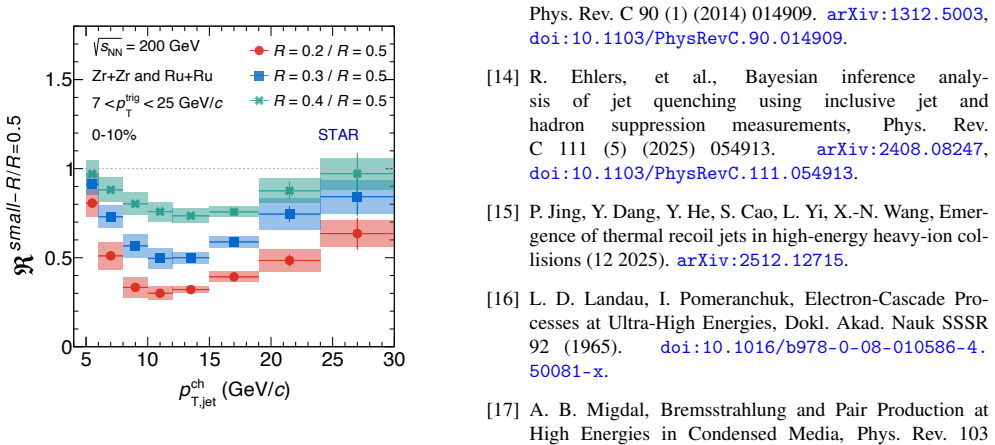
U. Heinz, R. Snellings, Collective flow and viscosity in relativistic heavy-ion collisions, Ann. Rev. Nucl. Part. Sci. 8 5 10 15 20 25 30 )c (GeV/ch T,jetp 0 0.5 1 1.5 STAR = 200 GeVNNs Zr+Zr and Ru+Ru c < 25 GeV/trig Tp7 < 0-10% = 0.5R = 0.2 / R = 0.5R = 0.3 / R = 0.5R = 0.4 / R Figure 8: Distributions of recoil jet yield ratios between smallR(0.2–0.4) a...
Pith/arXiv arXiv 2013
-
[6]
J. Chen, Z. Chen, M. Nie, H. Qiu, S. Shi, Z. Tang, Q. Xu, C. Yang, S. Yang, Z. Ye, L. Yi, W. Zha, C. Zhang, J. Zhang, Y . Zhang, X. Zhu, Selected highlights from STAR experiment, Chin. Phys. Lett. 43 (3) (2026) 030102.doi:10.1088/0256-307X/43/3/030102
-
[7]
G. F. Sterman, S. Weinberg, Jets from Quantum Chro- modynamics, Phys. Rev. Lett. 39 (1977) 1436.doi: 10.1103/PhysRevLett.39.1436
-
[8]
G. P. Salam, Towards Jetography, Eur. Phys. J. C 67 (2010) 637–686.arXiv:0906.1833,doi:10.1140/ epjc/s10052-010-1314-6
Pith/arXiv arXiv 2010
-
[9]
A. Majumder, M. Van Leeuwen, The Theory and Phe- nomenology of Perturbative QCD Based Jet Quenching, Prog. Part. Nucl. Phys. 66 (2011) 41–92.arXiv:1002. 2206,doi:10.1016/j.ppnp.2010.09.001
-
[10]
X.-N. Wang, U. A. Wiedemann, QGP@50: More than Four Decades of Jet Quenching, 2025.arXiv:2508. 18794
2025
-
[12]
L. Apolinário, Y .-J. Lee, M. Winn, Heavy quarks and jets as probes of the QGP, Prog. Part. Nucl. Phys. 127 (2022) 103990.arXiv:2203.16352,doi:10.1016/j.ppnp. 2022.103990
-
[13]
K. M. Burke, et al., Extracting the jet transport coefficient from jet quenching in high-energy heavy-ion collisions, Phys. Rev. C 90 (1) (2014) 014909.arXiv:1312.5003, doi:10.1103/PhysRevC.90.014909
work page internal anchor Pith review Pith/arXiv arXiv doi:10.1103/physrevc.90.014909 2014
-
[14]
R. Ehlers, et al., Bayesian inference analy- sis of jet quenching using inclusive jet and hadron suppression measurements, Phys. Rev. C 111 (5) (2025) 054913.arXiv:2408.08247, doi:10.1103/PhysRevC.111.054913
-
[15]
P. Jing, Y . Dang, Y . He, S. Cao, L. Yi, X.-N. Wang, Emer- gence of thermal recoil jets in high-energy heavy-ion col- lisions (12 2025).arXiv:2512.12715
arXiv 2025
-
[16]
L. D. Landau, I. Pomeranchuk, Electron-Cascade Pro- cesses at Ultra-High Energies, Dokl. Akad. Nauk SSSR 92 (1965).doi:10.1016/b978-0-08-010586-4. 50081-x
-
[17]
A. B. Migdal, Bremsstrahlung and Pair Production at High Energies in Condensed Media, Phys. Rev. 103 (1956) 1811–1820.doi:10.1103/PhysRev.103.1811
-
[18]
Y . He, M. Zhang, M. Nie, S. Cao, L. Yi, Exploring sys- tem size dependence of jet modification in heavy-ion col- lisions, Phys. Rev. C 110 (3) (2024) 034902.arXiv: 2404.18115,doi:10.1103/PhysRevC.110.034902
-
[19]
B. Abelev, et al., Transverse momentum distribution and nuclear modification factor of charged particles inp- Pb collisions at √sNN =5.02 TeV, Phys. Rev. Lett. 110 (8) (2013) 082302.arXiv:1210.4520,doi:10. 1103/PhysRevLett.110.082302
Pith/arXiv arXiv 2013
-
[21]
Charged-particle nuclear modification factors in PbPb and pPb collisions at sqrt(s[NN]) = 5.02 TeV
V . Khachatryan, et al., Charged-particle nuclear modi- fication factors in PbPb and pPb collisions at √sNN = 5.02 TeV, JHEP 04 (2017) 039.arXiv:1611.01664, doi:10.1007/JHEP04(2017)039
work page internal anchor Pith review Pith/arXiv arXiv doi:10.1007/jhep04(2017)039 2017
-
[22]
M. Abdulhamid, et al., Correlations of event activity with hard and soft processes in p+Au collisions at √sNN = 200 GeV at the RHIC STAR experiment, Phys. Rev. C 110 (4) (2024) 044908.arXiv:2404.08784,doi:10. 1103/PhysRevC.110.044908
arXiv 2024
-
[23]
N. J. Abdulameer, et al., Disentangling Centrality Bias and Final-State Effects in the Production of High-pT Neutral Pions Using Direct Photon in d+Au Colli- sions at √sNN =200 GeV, Phys. Rev. Lett. 134 (2) (2025) 022302.arXiv:2303.12899,doi:10.1103/ PhysRevLett.134.022302
arXiv 2025
-
[24]
D. V . Perepelitsa, Contribution to differentialπ0 andγ dir modification in small systems from color fluctuation ef- fects, Phys. Rev. C 110 (1) (2024) L011901.arXiv: 2404.17660,doi:10.1103/PhysRevC.110.L011901. 9
-
[25]
S. Acharya, et al., Constraints on jet quenching in p-Pb collisions at √sNN =5.02 TeV measured by the event- activity dependence of semi-inclusive hadron-jet distribu- tions, Phys. Lett. B 783 (2018) 95–113.arXiv:1712. 05603,doi:10.1016/j.physletb.2018.05.059
-
[26]
G. Aad, et al., Strong Constraints on Jet Quench- ing in Centrality-Dependent p+Pb Collisions at 5.02 TeV from ATLAS, Phys. Rev. Lett. 131 (7) (2023) 072301.arXiv:2206.01138, doi:10.1103/PhysRevLett.131.072301
-
[27]
V . Chekhovsky, et al., Search for jet quenching with di- jets from high-multiplicity pPb collisions at √sNN =8.16 TeV, JHEP 07 (2025) 118.arXiv:2504.08507,doi: 10.1007/JHEP07(2025)118
-
[28]
A. Hayrapetyan, et al., Discovery of suppressed charged- particle production in ultrarelativistic oxygen-oxygen col- lisions (2025).arXiv:2510.09864
Pith/arXiv arXiv 2025
-
[29]
Measurement of jet quenching in O+O collisions at√sNN =200 GeV by the STAR experiment at RHIC (2026).arXiv:2604.13935
Pith/arXiv arXiv 2026
-
[30]
M. Abdallah, et al., Search for the chiral magnetic ef- fect with isobar collisions at √sNN =200 GeV by the STAR Collaboration at the BNL Relativistic Heavy Ion Collider, Phys. Rev. C 105 (1) (2022) 014901.arXiv: 2109.00131,doi:10.1103/PhysRevC.105.014901
-
[31]
J. Adam, et al., Measurement of jet quenching with semi- inclusive hadron-jet distributions in central Pb-Pb colli- sions at √sNN =2.76 TeV, JHEP 09 (2015) 170.arXiv: 1506.03984,doi:10.1007/JHEP09(2015)170
work page internal anchor Pith review Pith/arXiv arXiv doi:10.1007/jhep09(2015)170 2015
-
[32]
L. Adamczyk, et al., Measurements of jet quenching with semi-inclusive hadron+jet distributions in Au+Au collisions at √sNN =200 GeV, Phys. Rev. C 96 (2) (2017) 024905.arXiv:1702.01108,doi:10.1103/ PhysRevC.96.024905
Pith/arXiv arXiv 2017
-
[33]
S. Acharya, et al., Measurements of inclusive jet spectra in pp and central Pb-Pb collisions at√sNN =5.02 TeV, Phys. Rev. C 101 (3) (2020) 034911.arXiv:1909.09718, doi:10.1103/PhysRevC.101.034911
-
[34]
S. Acharya, et al., Measurements of jet quenching us- ing semi-inclusive hadron+jet distributions in pp and cen- tral Pb-Pb collisions at √sNN =5.02 TeV, Phys. Rev. C 110 (1) (2024) 014906.arXiv:2308.16128,doi: 10.1103/PhysRevC.110.014906
-
[35]
S. Acharya, et al., Observation of Medium-Induced Yield Enhancement and Acoplanarity Broadening of Low-p T Jets from Measurements in pp and Central Pb-Pb Col- lisions at √sNN =5.02 TeV, Phys. Rev. Lett. 133 (2) (2024) 022301.arXiv:2308.16131,doi:10.1103/ PhysRevLett.133.022301
arXiv 2024
-
[36]
B. E. Aboona, et al., Semi-inclusive direct photon+jet and π0+jet correlations measured in p+p and central Au+Au collisions at √sNN =200 GeV, Phys. Rev. C 111 (6) (2025) 064907.arXiv:2309.00145,doi:10.1103/ 8b8y-98yh
arXiv 2025
-
[37]
B. E. Aboona, et al., Measurement of In-Medium Jet Modification Using Direct Photon+Jet andπ 0+Jet Correlations in p+p and Central Au+Au Collisions at √sNN =200 GeV, Phys. Rev. Lett. 134 (23) (2025) 232301.arXiv:2309.00156,doi:10.1103/ PhysRevLett.134.232301
arXiv 2025
-
[38]
B. E. Aboona, et al., Measurement of medium-induced acoplanarity in central Au-Au and pp collisions at √sNN =200 GeV using direct-photon+jet andπ 0+jet correla- tions, Phys. Rev. C 113 (1) (2026) 014902.arXiv: 2505.05789,doi:10.1103/k29c-d5ry
-
[39]
K. H. Ackermann, et al., STAR detector overview, Nucl. Instrum. Meth. A 499 (2003) 624–632.doi:10.1016/ S0168-9002(02)01960-5
2003
-
[40]
M. Anderson, et al., The Star time projection cham- ber: A Unique tool for studying high multiplicity events at RHIC, Nucl. Instrum. Meth. A 499 (2003) 659–678.arXiv:nucl-ex/0301015,doi:10.1016/ S0168-9002(02)01964-2
Pith/arXiv arXiv 2003
-
[41]
W. J. Llope, The large-area time-of-flight upgrade for STAR, Nucl. Instrum. Meth. B 241 (2005) 306–310.doi: 10.1016/j.nimb.2005.07.089
-
[42]
W. J. Llope, et al., The STAR Vertex Position Detector, Nucl. Instrum. Meth. A 759 (2014) 23–28.arXiv:1403. 6855,doi:10.1016/j.nima.2014.04.080
-
[43]
Sampling-Based Risk-Aware Path Planning Around Dynamic Engagement Zones,
C. Adler, A. Denisov, E. Garcia, M. Murray, H. Strobele, S. White, The RHIC zero-degree calorimeters, Nucl. In- strum. Meth. A 499 (2003) 433–436.doi:10.1016/j. nima.2003.08.112
work page doi:10.1016/j 2003
-
[44]
M. L. Miller, K. Reygers, S. J. Sanders, P. Stein- berg, Glauber modeling in high energy nu- clear collisions, Ann. Rev. Nucl. Part. Sci. 57 (2007) 205–243.arXiv:nucl-ex/0701025, doi:10.1146/annurev.nucl.57.090506.123020
work page internal anchor Pith review Pith/arXiv arXiv doi:10.1146/annurev.nucl.57.090506.123020 2007
-
[45]
R. E. Kalman, A New Approach to Linear Filtering and Prediction Problems, J. Fluids Eng. 82 (1) (1960) 35–45. doi:10.1115/1.3662552
-
[46]
Fruhwirth, Application of Kalman filtering to track and vertex fitting, Nucl
R. Fruhwirth, Application of Kalman filtering to track and vertex fitting, Nucl. Instrum. Meth. A 262 (1987) 444– 450.doi:10.1016/0168-9002(87)90887-4
-
[47]
S. Catani, Y . L. Dokshitzer, M. H. Seymour, B. R. Web- ber, Longitudinally invariantK t clustering algorithms for hadron hadron collisions, Nucl. Phys. B 406 (1993) 187– 224.doi:10.1016/0550-3213(93)90166-M. 10
-
[48]
Dispelling the N^3 myth for the Kt jet-finder
M. Cacciari, G. P. Salam, Dispelling theN 3 myth for the kt jet-finder, Phys. Lett. B 641 (2006) 57–61.arXiv: hep-ph/0512210,doi:10.1016/j.physletb.2006. 08.037
work page internal anchor Pith review Pith/arXiv arXiv doi:10.1016/j.physletb.2006 2006
-
[49]
M. Cacciari, G. P. Salam, G. Soyez, FastJet User Manual, Eur. Phys. J. C 72 (2012) 1896.arXiv:1111.6097,doi: 10.1140/epjc/s10052-012-1896-2
work page internal anchor Pith review Pith/arXiv arXiv doi:10.1140/epjc/s10052-012-1896-2 2012
-
[50]
M. Cacciari, G. P. Salam, Pileup subtraction using jet ar- eas, Phys. Lett. B 659 (2008) 119–126.arXiv:0707. 1378,doi:10.1016/j.physletb.2007.09.077
-
[51]
The anti-k_t jet clustering algorithm
M. Cacciari, G. P. Salam, G. Soyez, The anti-kt jet cluster- ing algorithm, JHEP 04 (2008) 063.arXiv:0802.1189, doi:10.1088/1126-6708/2008/04/063
work page internal anchor Pith review Pith/arXiv arXiv doi:10.1088/1126-6708/2008/04/063 2008
-
[52]
Jet Reconstruction in Heavy Ion Collisions
M. Cacciari, J. Rojo, G. P. Salam, G. Soyez, Jet Re- construction in Heavy Ion Collisions, Eur. Phys. J. C 71 (2011) 1539.arXiv:1010.1759,doi:10.1140/epjc/ s10052-011-1539-z
work page internal anchor Pith review Pith/arXiv arXiv doi:10.1140/epjc/ 2011
-
[53]
L. Brenner, R. Balasubramanian, C. Burgard, W. Verk- erke, G. Cowan, P. Verschuuren, V . Croft, Comparison of unfolding methods using RooFitUnfold, Int. J. Mod. Phys. A 35 (24) (2020) 2050145.arXiv:1910.14654, doi:10.1142/S0217751X20501456
-
[54]
J. K. Adkins, Studying Transverse Momentum Depen- dent Distributions in Polarized Proton Collisions via Az- imuthal Single Spin Asymmetries of Charged Pions in Jets, Ph.D. thesis, Kentucky U. (2015).arXiv:1907. 11233
2015
-
[55]
D’Agostini, A Multidimensional unfolding method based on Bayes’ theorem, Nucl
G. D’Agostini, A Multidimensional unfolding method based on Bayes’ theorem, Nucl. Instrum. Meth. A 362 (1995) 487–498.doi:10.1016/0168-9002(95) 00274-X
-
[56]
RooUnfold, Root Unfolding Framework,https:// gitlab.cern.ch/RooUnfold/RooUnfold
-
[57]
Y . Dang, W.-J. Xing, S. Cao, G.-Y . Qin, Improved linear Boltzmann transport model for hadron and jet suppression in ultra-relativistic heavy-ion collisions (2 2026).arXiv: 2602.10395
arXiv 2026
-
[58]
P. Jing, S. Cao, Private communication (2026)
2026
-
[59]
R. Baier, Jet quenching, Nucl. Phys. A 715 (2003) 209–218.arXiv:hep-ph/0209038,doi:10.1016/ S0375-9474(02)01429-X
Pith/arXiv arXiv 2003
-
[60]
Leading-particle suppression in high energy nucleus-nucleus collisions
A. Dainese, C. Loizides, G. Paic, Leading-particle sup- pression in high energy nucleus-nucleus collisions, Eur. Phys. J. C 38 (2005) 461–474.arXiv:hep-ph/0406201, doi:10.1140/epjc/s2004-02077-x
work page internal anchor Pith review Pith/arXiv arXiv doi:10.1140/epjc/s2004-02077-x 2005
-
[61]
Renk, Highp T hadrons as probes of the central region of Au-Au collisions at √sNN =200 GeV, Phys
T. Renk, Highp T hadrons as probes of the central region of Au-Au collisions at √sNN =200 GeV, Phys. Rev. C 74 (2006) 024903.arXiv:hep-ph/0602045,doi:10. 1103/PhysRevC.74.024903
Pith/arXiv arXiv 2006
-
[62]
Dihadron Tomography of High-Energy Nuclear Collisions in NLO pQCD
H. Zhang, J. F. Owens, E. Wang, X.-N. Wang, Dihadron tomography of high-energy nuclear collisions in NLO pQCD, Phys. Rev. Lett. 98 (2007) 212301.arXiv: nucl-th/0701045,doi:10.1103/PhysRevLett.98. 212301
work page internal anchor Pith review Pith/arXiv arXiv doi:10.1103/physrevlett.98 2007
-
[63]
S. Cao, T. Luo, G.-Y . Qin, X.-N. Wang, Linearized Boltz- mann transport model for jet propagation in the quark- gluon plasma: Heavy quark evolution, Phys. Rev. C 94 (1) (2016) 014909.arXiv:1605.06447,doi:10.1103/ PhysRevC.94.014909
Pith/arXiv arXiv 2016
-
[64]
T. Luo, Y . He, S. Cao, X.-N. Wang, Linear Boltzmann transport for jet propagation in the quark-gluon plasma: Inelastic processes and jet modification, Phys. Rev. C 109 (3) (2024) 034919.arXiv:2306.13742,doi:10. 1103/PhysRevC.109.034919
arXiv 2024
-
[65]
Y . He, M. Nie, S. Cao, R. Ma, L. Yi, H. Caines, De- ciphering yield modification of hadron-triggered semi- inclusive recoil jets in heavy-ion collisions, Phys. Lett. B 854 (2024) 138739.arXiv:2401.05238,doi:10. 1016/j.physletb.2024.138739
arXiv 2024
-
[66]
M. Zhang, Y . He, S. Cao, L. Yi, Effects of the forma- tion time of parton shower on jet quenching in heavy-ion collisions, Chin. Phys. C 47 (2) (2023) 024106.arXiv: 2208.13331,doi:10.1088/1674-1137/aca4c1
-
[67]
Jet-like Correlations with Direct-Photon and Neutral-Pion Triggers at $\sqrt{s_{_{NN}}} = 200$ GeV
L. Adamczyk, et al., Jet-like Correlations with Direct- Photon and Neutral-Pion Triggers at √sNN =200 GeV, Phys. Lett. B 760 (2016) 689–696.arXiv:1604.01117, doi:10.1016/j.physletb.2016.07.046. 11
work page internal anchor Pith review Pith/arXiv arXiv doi:10.1016/j.physletb.2016.07.046 2016
discussion (0)
Sign in with ORCID, Apple, or X to comment. Anyone can read and Pith papers without signing in.