MelT: GEMM-Native NDFT for Efficient Single-Stage Audio Frontends on Modern Accelerators
Pith reviewed 2026-06-28 16:50 UTC · model grok-4.3
The pith
MelT computes Mel-spaced spectral features as a single dense matrix multiplication on accelerators.
A machine-rendered reading of the paper's core claim, the machinery that carries it, and where it could break.
Core claim
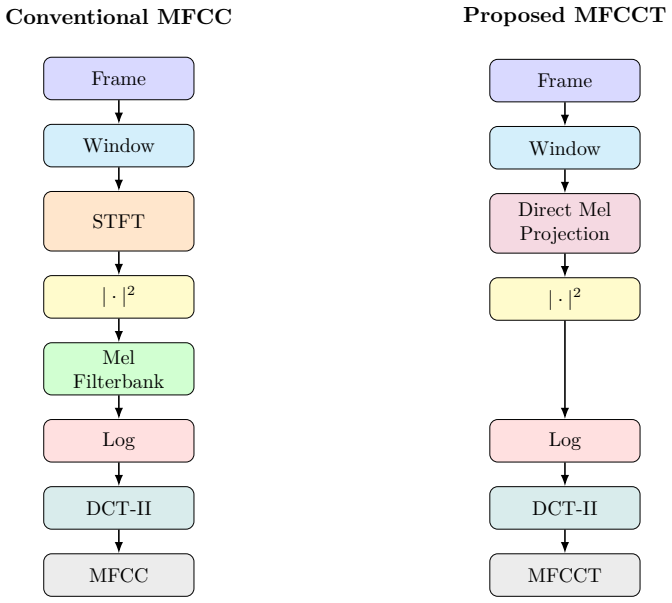
MelT formulates Mel-spaced NDFT bases as a precomputed dense matrix that is applied to acoustic frames via GEMM, creating a single-stage frontend that serves as a hardware-efficient alternative to the conventional STFT-plus-Mel pipeline.
What carries the argument
Mel-spaced NDFT projection applied to time-domain frames through dense GEMM operations.
If this is right
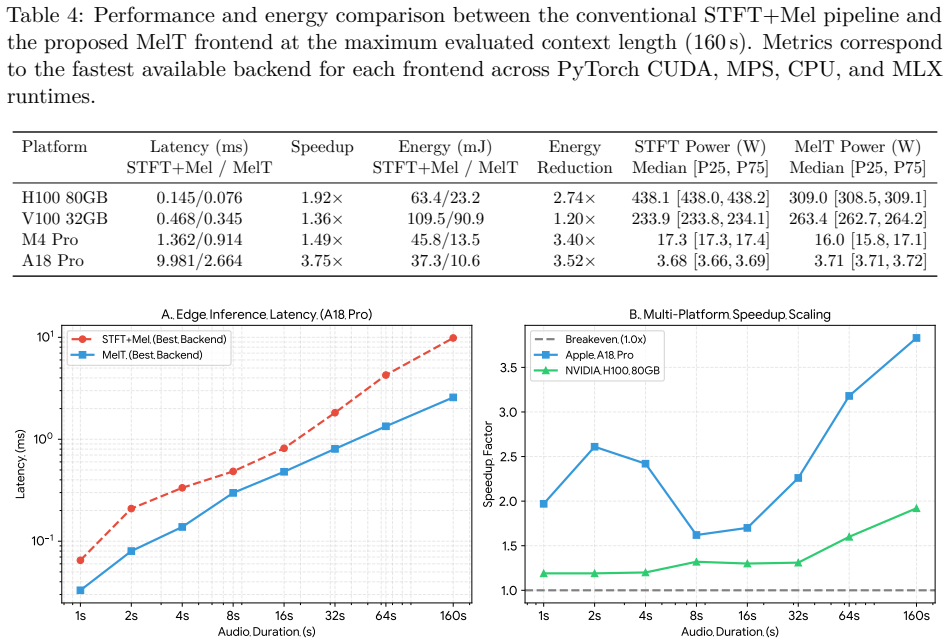
- Inference latency is reduced by up to 3.75 times on tested accelerators.
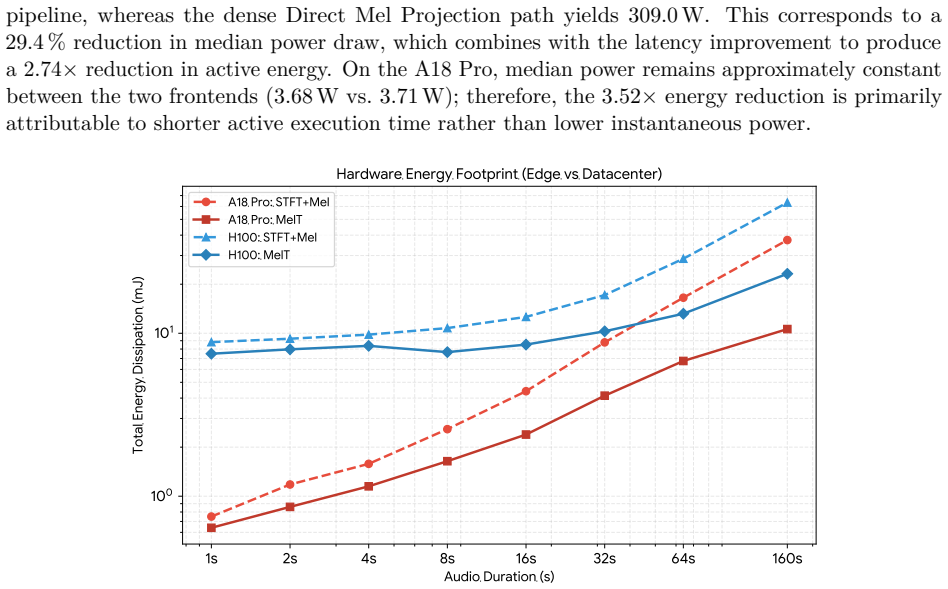
- Energy consumption is reduced by up to 3.52 times while accuracy holds.
- The single-stage design works on both edge hardware such as the Apple A18 Pro and datacenter GPUs such as the NVIDIA H100.
- The approach eliminates intermediate memory allocations and dispatch overhead associated with heterogeneous frontends.
Where Pith is reading between the lines
- Making the NDFT bases learnable parameters could allow joint optimization of the frontend with the rest of the network.
- The GEMM-native formulation may transfer to other signal-processing pipelines that currently rely on non-uniform transforms.
- Further fusion of this matrix multiplication with subsequent network layers could compound the efficiency gains.
Load-bearing premise
The acoustic features obtained from the GEMM-based Mel NDFT match those from the standard STFT followed by Mel aggregation closely enough to support the same downstream classification accuracy.
What would settle it
A measurable drop in classification accuracy on standard audio datasets when the MelT frontend replaces the STFT-plus-Mel pipeline.
Figures
read the original abstract
Modern audio processing networks are commonly deployed on accelerators whose peak throughput is obtained through dense linear algebra, whereas conventional acoustic frontends -- a Short-Time Fourier Transform (STFT) followed by sparse Mel aggregation -- remain structurally heterogeneous. This mismatch can introduce memory-bandwidth, dispatch, and intermediate-allocation overheads on contemporary accelerator backends. This work introduces MelT, a single-stage frontend framework in which Mel-spaced Non-Uniform Discrete Fourier Transform (NDFT) bases are precomputed and applied to time-domain acoustic frames through dense General Matrix Multiplication (GEMM) operations. The contribution is not the NDFT operator itself; rather, it is the formulation of Mel-spaced NDFT projection as a GEMM-native audio frontend and its evaluation as a hardware-efficient alternative to conventional STFT+Mel pipelines. Evaluated across platforms ranging from Apple A18 Pro edge hardware to NVIDIA H100 datacenter acceleration, MelT attains up to a $3.75\times$ speedup in inference latency and a $3.52\times$ reduction in energy consumption while maintaining downstream classification accuracy.
Editorial analysis
A structured set of objections, weighed in public.
Referee Report
Summary. The manuscript introduces MelT, a single-stage audio frontend that formulates Mel-spaced Non-Uniform Discrete Fourier Transform (NDFT) bases as a precomputed dense matrix and applies them to time-domain frames via General Matrix Multiplication (GEMM). It positions this as a hardware-efficient alternative to the conventional two-stage STFT-plus-Mel-filterbank pipeline, claiming up to 3.75× inference latency speedup and 3.52× energy reduction across platforms (Apple A18 Pro to NVIDIA H100) while preserving downstream classification accuracy.
Significance. If the claimed functional equivalence between the Mel-NDFT projection and the STFT+Mel pipeline holds with negligible impact on downstream tasks, the work would offer a practical unification of audio frontends with accelerator-optimized dense linear algebra, reducing dispatch and memory overheads in edge and datacenter deployments. The cross-platform timing and energy measurements constitute a concrete strength if accompanied by reproducible code and full experimental details.
major comments (1)
- [Abstract] Abstract: the central claim that MelT 'maintains downstream classification accuracy' rests on an unverified assumption of functional equivalence between the single-stage Mel-spaced NDFT (via dense GEMM) and the conventional STFT-then-Mel pipeline. Because the NDFT samples directly at Mel-spaced frequencies rather than performing uniform DFT followed by triangular integration, any differences in frequency response, normalization, or phase handling could affect feature quality; the manuscript provides no L2 divergence metrics, perceptual distances, or ablation studies quantifying this equivalence, making the reported speedups and energy figures dependent on an untested premise.
Simulated Author's Rebuttal
We thank the referee for the constructive feedback and for recognizing the potential hardware benefits of unifying the audio frontend with dense GEMM operations. We address the single major comment below.
read point-by-point responses
-
Referee: [Abstract] Abstract: the central claim that MelT 'maintains downstream classification accuracy' rests on an unverified assumption of functional equivalence between the single-stage Mel-spaced NDFT (via dense GEMM) and the conventional STFT-then-Mel pipeline. Because the NDFT samples directly at Mel-spaced frequencies rather than performing uniform DFT followed by triangular integration, any differences in frequency response, normalization, or phase handling could affect feature quality; the manuscript provides no L2 divergence metrics, perceptual distances, or ablation studies quantifying this equivalence, making the reported speedups and energy figures dependent on an untested premise.
Authors: We agree that direct quantification of feature-level differences would strengthen the manuscript. The current evaluation demonstrates that MelT produces equivalent downstream classification accuracy on standard benchmarks (e.g., ESC-50, UrbanSound8K) when the same classifier is trained on either frontend, which we view as the operationally relevant metric for the claimed speedups. However, the referee correctly notes the absence of explicit L2 divergence, frequency-response, or normalization comparisons between the Mel-NDFT matrix and the STFT+Mel pipeline. In the revised version we will add (i) L2-norm statistics between the two feature representations on a held-out set of audio clips, (ii) a short frequency-response plot contrasting the effective filters, and (iii) an ablation confirming that accuracy remains unchanged even when the downstream model is trained from scratch on each frontend. These additions will make the functional-equivalence claim explicit rather than implicit. revision: yes
Circularity Check
No significant circularity; claims rest on empirical hardware measurements
full rationale
The paper proposes reformulating Mel-spaced NDFT as a dense GEMM operation for accelerator efficiency and reports measured speedups/energy reductions plus maintained classification accuracy on downstream tasks. No equations, fitted parameters, or self-citations are shown that would reduce any reported result to its inputs by construction. The central contribution is an implementation choice evaluated against external benchmarks (STFT+Mel pipelines on real hardware), satisfying the self-contained criterion. The functional-equivalence assumption is an empirical claim, not a definitional or fitted-input reduction.
Axiom & Free-Parameter Ledger
Reference graph
Works this paper leans on
-
[1]
Robust Speech Recognition via Large-Scale Weak Supervision
A. Radford, J. W. Kim, C. Hallacy, A. Ramesh, G. Goh, S. Agarwal, G. Sastry, A. Askell, P. Mishkin, J. Clark, G. Krueger, and I. Sutskever, “Robust speech recognition via large-scale weak supervision,”arXiv preprint arXiv:2212.04356, 2022
work page internal anchor Pith review Pith/arXiv arXiv 2022
-
[2]
CNN architectures for large-scale audio classification,
S. Hershey, S. Chaudhuri, D. P. W. Elliset al., “CNN architectures for large-scale audio classification,” inIEEE International Conference on Acoustics, Speech and Signal Processing (ICASSP), 2017, pp. 131–135
2017
-
[3]
PANNs: Large-scale pretrained audio neural networks for audio pattern recognition,
Q. Kong, Y. Cao, T. Iqbal, Y. Wang, W. Wang, and M. D. Plumbley, “PANNs: Large-scale pretrained audio neural networks for audio pattern recognition,”IEEE/ACM Transactions on Audio, Speech, and Language Processing, vol. 28, pp. 2880–2894, 2020
2020
-
[4]
wav2vec 2.0: A framework for self-supervised learning of speech representations,
A. Baevski, H. Zhou, A. Mohamed, and M. Auli, “wav2vec 2.0: A framework for self-supervised learning of speech representations,” inAdvances in Neural Information Processing Systems (NeurIPS), vol. 33, 2020, pp. 12449–12460
2020
-
[5]
An algorithm for the machine calculation of complex Fourier series,
J. W. Cooley and J. W. Tukey, “An algorithm for the machine calculation of complex Fourier series,”Mathematics of Computation, vol. 19, no. 90, pp. 297–301, 1965
1965
-
[6]
NVIDIA tensor core programmability, performance and precision,
S. Markidis, J. A. Der Chien, E. Laure, A. Podobas, and J. S. Vetter, “NVIDIA tensor core programmability, performance and precision,” inIEEE International Parallel and Distributed Processing Symposium Workshops (IPDPSW), 2018, pp. 522–531
2018
-
[7]
In-datacenter performance analysis of a tensor processing unit,
N. P. Jouppi, C. Young, N. Patilet al., “In-datacenter performance analysis of a tensor processing unit,” inACM/IEEE Annual International Symposium on Computer Architecture (ISCA), 2017, pp. 1–12
2017
-
[8]
Fast fourier transforms for nonequispaced data: A tutorial,
D. Potts, G. Steidl, and M. Tasche, “Fast fourier transforms for nonequispaced data: A tutorial,” inModern Sampling Theory: Mathematics and Applications, J. J. Benedetto and P. J. S. G. Ferreira, Eds. Boston, MA: Birkhäuser Boston, 2001, pp. 247–270
2001
-
[9]
Comparison of parametric representations for monosyllabic word recognition in continuously spoken sentences,
S. Davis and P. Mermelstein, “Comparison of parametric representations for monosyllabic word recognition in continuously spoken sentences,”IEEE Transactions on Acoustics, Speech, and Signal Processing, vol. 28, no. 4, pp. 357–366, 1980
1980
-
[10]
Speaker recognition from raw waveform with SincNet,
M. Ravanelli and Y. Bengio, “Speaker recognition from raw waveform with SincNet,” inIEEE Spoken Language Technology Workshop (SLT), 2018, pp. 1021–1028
2018
-
[11]
LEAF: A learnable frontend for audio classification,
N. Zeghidour, O. Teboul, F. de Chaumont Quitry, and M. Tagliasacchi, “LEAF: A learnable frontend for audio classification,” inInternational Conference on Learning Representations (ICLR), 2021
2021
-
[12]
EfficientLEAF: A faster LEArnable audio frontend of questionable use,
J. Schlüter and G. Gutenbrunner, “EfficientLEAF: A faster LEArnable audio frontend of questionable use,” inEuropean Signal Processing Conference (EUSIPCO), 2022. 12
2022
-
[13]
Audio signal processing using time domain mel-frequency wavelet coefficient,
R. Sebastian, S. O’Keefe, and M. Trefzer, “Audio signal processing using time domain mel-frequency wavelet coefficient,”arXiv preprint arXiv:2510.24519, 2025. [Online]. Available: https://arxiv.org/abs/2510.24519
-
[14]
Bagchi and S
S. Bagchi and S. K. Mitra,The Nonuniform Discrete Fourier Transform and Its Applications in Signal Processing. Boston, MA: Springer, 1999
1999
-
[15]
Nonuniform fast fourier transform,
A. J. W. Duijndam and M. A. Schonewille, “Nonuniform fast fourier transform,”Geophysics, vol. 64, no. 2, pp. 539–551, 1999
1999
-
[16]
Python Non-Uniform Fast Fourier Transform (PyNUFFT): An accelerated non- cartesian MRI package on a heterogeneous platform,
J.-M. Lin, “Python Non-Uniform Fast Fourier Transform (PyNUFFT): An accelerated non- cartesian MRI package on a heterogeneous platform,”Journal of Imaging, vol. 4, no. 3, p. 51, 2018
2018
-
[17]
Green AI,
R. Schwartz, J. Dodge, N. A. Smith, and O. Etzioni, “Green AI,”Communications of the ACM, vol. 63, no. 12, pp. 54–63, 2020
2020
-
[18]
Precise energy consumption measurements of heterogeneous artificial intelligence workloads,
R. Caspart, S. Ziegler, A. Weyrauchet al., “Precise energy consumption measurements of heterogeneous artificial intelligence workloads,”arXiv preprint arXiv:2212.01698, 2022
-
[19]
librosa: Audio and music signal analysis in Python,
B. McFee, C. Raffel, D. Lianget al., “librosa: Audio and music signal analysis in Python,” in Python in Science Conference (SciPy), 2015, pp. 18–25
2015
-
[20]
VoxCeleb: A large-scale speaker identification dataset,
A. Nagrani, J. S. Chung, and A. Zisserman, “VoxCeleb: A large-scale speaker identification dataset,” inProceedings of Interspeech, 2017, pp. 2616–2620. 13
2017
discussion (0)
Sign in with ORCID, Apple, or X to comment. Anyone can read and Pith papers without signing in.