Child-directed speech facilitates production, not comprehension, in BabyLMs
Pith reviewed 2026-06-28 17:26 UTC · model grok-4.3
The pith
Child-directed speech helps BabyLMs produce grammatical completions earlier but does not improve comprehension
A machine-rendered reading of the paper's core claim, the machinery that carries it, and where it could break.
Core claim
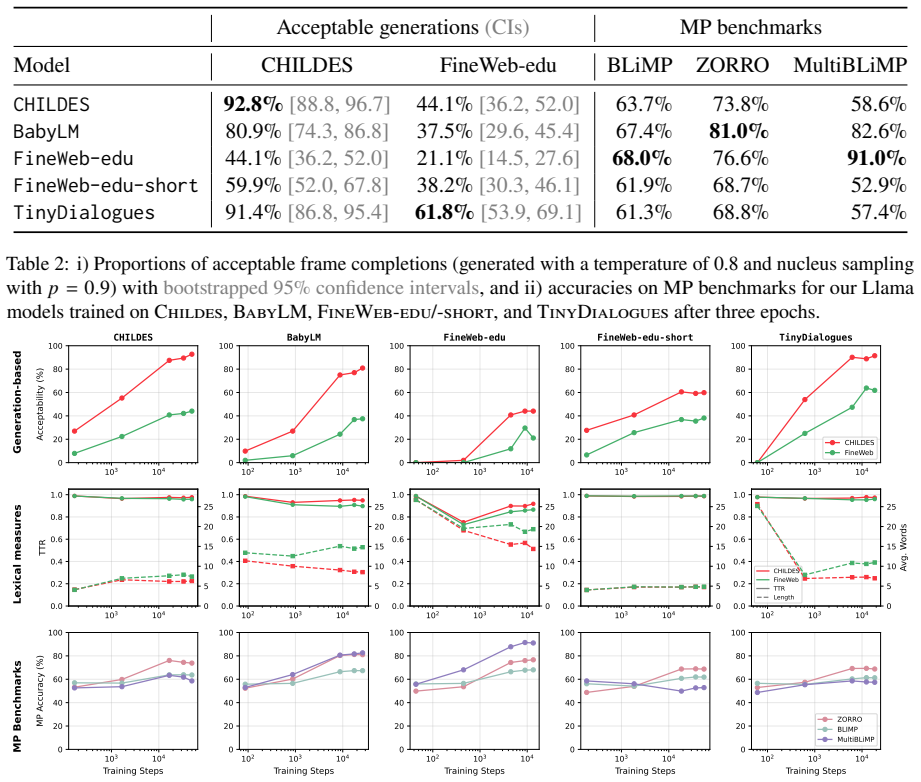
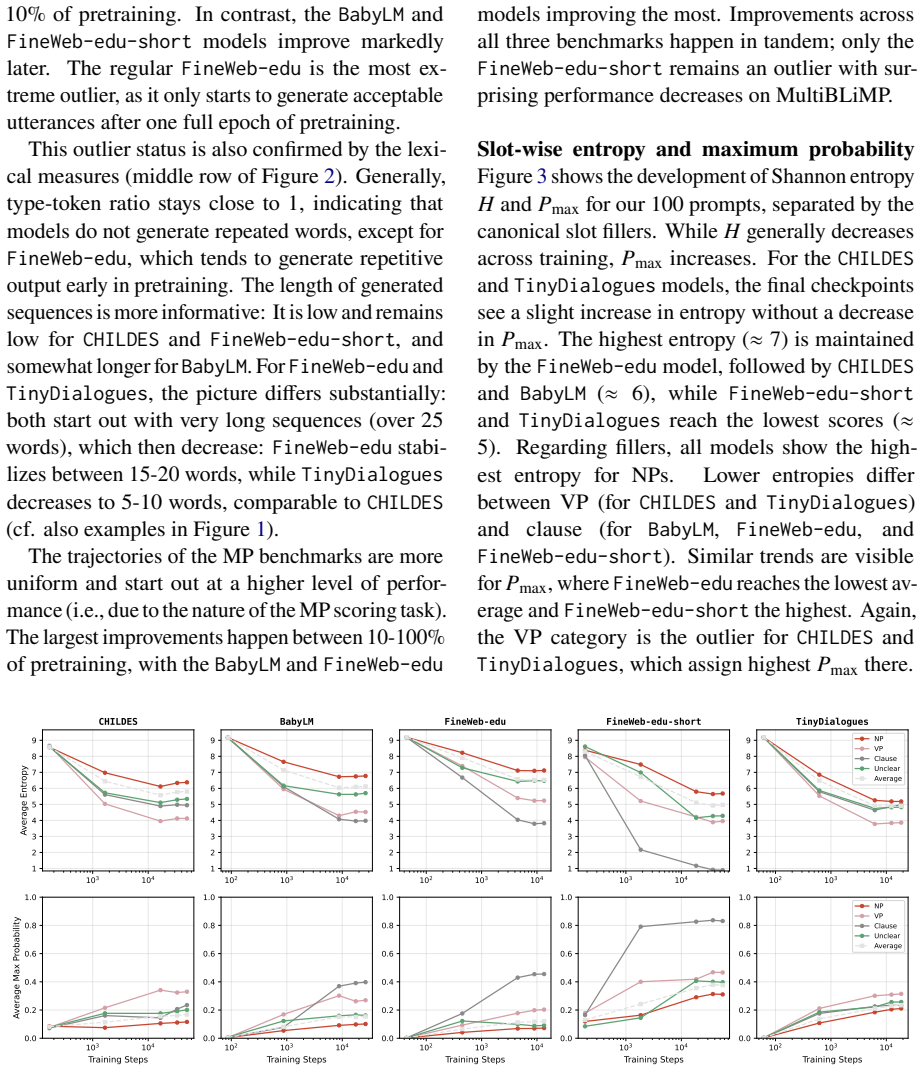
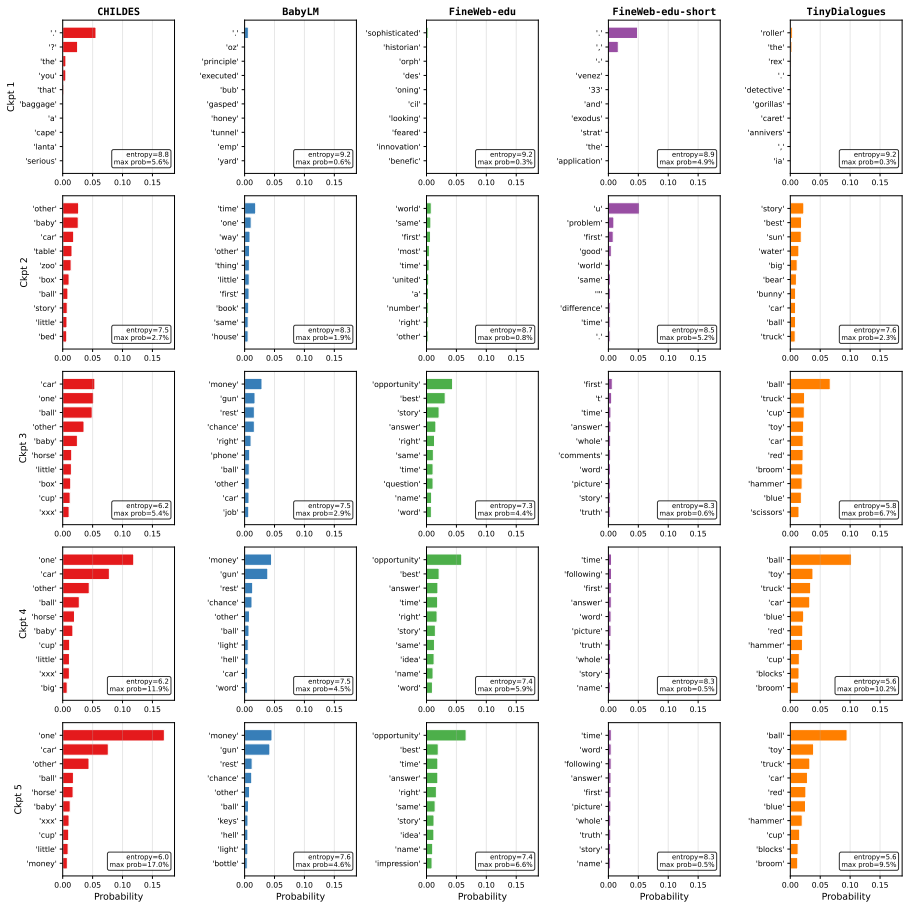
Models trained on child-directed speech produce grammatical completions in the frame-completion task substantially earlier in training and concentrate probability mass on appropriate slot-fillers, while models trained on FineWeb-edu excel at minimal-pair comprehension benchmarks; the dissociation demonstrates that comprehension benchmarks underestimate what child-directed speech affords BabyLMs.
What carries the argument
frame-completion task that tests production by requiring models to complete constructional frames consisting of frequent lexical patterns with open slots
If this is right
- CDS-trained models reach grammatical production capabilities sooner than models trained on larger web-crawl data.
- Comprehension benchmarks such as minimal pairs favor web-trained models over CDS-trained models.
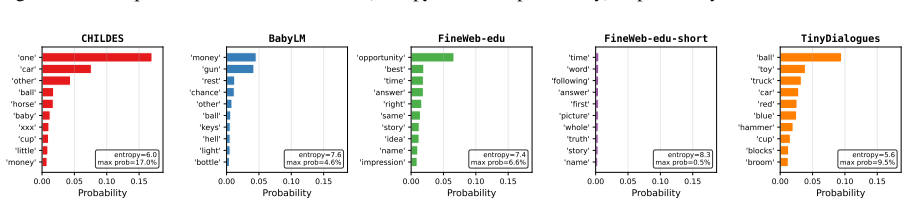
- Probability mass in CDS-trained models concentrates on contextually suitable slot-fillers during production.
- Benefits of child-directed speech for BabyLMs become visible only when production rather than comprehension is measured.
Where Pith is reading between the lines
- Different training corpora may optimize distinct language abilities, so hybrid data mixes could support both production and comprehension.
- Similar production-oriented tasks could be applied to evaluate other model scales or domains beyond BabyLMs.
- The results suggest that real-world generation applications might gain more from CDS-style data than comprehension scores alone indicate.
Load-bearing premise
The frame-completion task accurately measures production capabilities in a way that matches usage-based theories of language acquisition.
What would settle it
If CDS-trained models show no earlier grammatical completions and no greater probability concentration on appropriate fillers than web-trained models on the frame-completion task, the claimed dissociation would not hold.
Figures

read the original abstract
Recent studies suggest that child-directed speech is not conducive to language learning in BabyLMs. However, current evaluations focus predominantly on comprehension and not production, which is central to usage-based theories of language acquisition which argue how CDS facilitates early language use through constructional ''frames'' (frequent lexical patterns with open slots). We introduce a novel generation-based evaluation inspired by such theories in form of a frame-completion task, and compare Llama models trained with CDS, the BabyLM corpus, and web-crawl data (FineWeb-edu) on comprehension benchmarks and our novel framework. Our results reveal a clear dissociation between models' comprehension and production capabilities: while FineWeb-trained models excel at minimal pairs, CDS-trained models produce grammatical completions substantially earlier in training and concentrate probability mass on appropriate slot-fillers. These findings show that comprehension benchmarks underestimate what CDS affords to BabyLMs.
Editorial analysis
A structured set of objections, weighed in public.
Referee Report
Summary. The paper claims that child-directed speech (CDS) facilitates production more than comprehension in BabyLMs. While models trained on web-crawl data (FineWeb-edu) outperform on standard minimal-pair comprehension benchmarks, CDS-trained Llama models show advantages on a novel frame-completion task, producing grammatical completions earlier and concentrating probability on appropriate slot-fillers. This dissociation implies that comprehension-focused evaluations underestimate CDS benefits, consistent with usage-based theories emphasizing constructional frames.
Significance. If the dissociation holds under proper controls and the frame-completion task validly isolates production, the work would be significant for BabyLM research by highlighting limitations of current benchmarks and providing empirical support for usage-based acquisition theories. The introduction of a generation-inspired evaluation task is a positive contribution, though details on reproducibility are absent from the provided abstract.
major comments (2)
- [Abstract] Abstract: The frame-completion task is presented as a 'generation-based evaluation' measuring production, yet it is implemented via next-token likelihood (probability concentration on slot-fillers) rather than sampling or free generation of constructions. This makes it comparable to the minimal-pair comprehension benchmark, undermining the claimed dissociation between comprehension and production. If the CDS advantage disappears under sampling-based metrics, the central conclusion that comprehension benchmarks underestimate CDS would not follow.
- [Abstract] Abstract: No details are supplied on model sizes, training steps, data-volume controls, statistical tests, or error bars for the reported dissociation. Without these, it is not possible to judge whether the data support the claim that CDS models 'produce grammatical completions substantially earlier.'
Simulated Author's Rebuttal
We thank the referee for the careful reading and constructive feedback. We address each major comment below, clarifying our approach and indicating revisions where appropriate to strengthen the claims.
read point-by-point responses
-
Referee: [Abstract] Abstract: The frame-completion task is presented as a 'generation-based evaluation' measuring production, yet it is implemented via next-token likelihood (probability concentration on slot-fillers) rather than sampling or free generation of constructions. This makes it comparable to the minimal-pair comprehension benchmark, undermining the claimed dissociation between comprehension and production. If the CDS advantage disappears under sampling-based metrics, the central conclusion that comprehension benchmarks underestimate CDS would not follow.
Authors: We acknowledge that the frame-completion task, as described, relies on next-token likelihood to measure concentration of probability mass on appropriate slot-fillers rather than on sampled or freely generated output. This design choice provides a direct, controlled comparison to the minimal-pair comprehension benchmarks while targeting the probabilistic knowledge of constructional frames central to usage-based theories. To address the concern that the dissociation may not hold under generative metrics, we will add new experiments in the revision that apply nucleus sampling to generate completions and evaluate them for grammaticality and appropriateness using both automatic metrics and human judgments. revision: yes
-
Referee: [Abstract] Abstract: No details are supplied on model sizes, training steps, data-volume controls, statistical tests, or error bars for the reported dissociation. Without these, it is not possible to judge whether the data support the claim that CDS models 'produce grammatical completions substantially earlier.'
Authors: The full manuscript reports that all models are 124M-parameter Llamas trained for a maximum of 10,000 steps on datasets controlled to 100M tokens each. The dissociation is supported by error bars computed over three independent runs and by Wilcoxon signed-rank tests (p < 0.01 on key frame-completion comparisons). We will add a brief summary of these controls and statistical details to the abstract in the revised version. revision: yes
Circularity Check
No circularity: empirical comparison of distinct training regimes and evaluation tasks
full rationale
The paper reports an empirical study in which separate Llama models are trained on CDS, BabyLM, and FineWeb-edu corpora, then evaluated on standard minimal-pair comprehension benchmarks versus a new frame-completion task. No equations, parameter-fitting steps, or self-citations are described that would reduce the central dissociation claim to a definitional identity or to a fitted input renamed as a prediction. The frame-completion metric is introduced as a distinct generation-based probe inspired by usage-based theory; its results are presented as observed outcomes rather than forced by construction from the training data or from prior self-citations. The derivation chain is therefore self-contained against external benchmarks.
Axiom & Free-Parameter Ledger
axioms (1)
- domain assumption Usage-based theories of language acquisition argue that CDS facilitates early language use through constructional frames (frequent lexical patterns with open slots).
Reference graph
Works this paper leans on
-
[1]
Abdelali, Ahmed and Guzman, Francisco and Sajjad, Hassan and Vogel, Stephan , year = 2014, month = may, pages =. The. Proceedings of the Ninth International Conference on Language Resources and Evaluation (
2014
-
[2]
and Sussman, Julie , year = 1996, publisher =
Abelson, Harold and Sussman, Gerald J. and Sussman, Julie , year = 1996, publisher =. Structure and
1996
-
[3]
Developmental Science , volume =
Children Learn Words Easier When They Are Interested in the Category to Which the Word Belongs , author =. Developmental Science , volume =. doi:10.1111/desc.12915 , url =
-
[4]
Adger, David , year = 2003, month = mar, publisher =. Core. doi:10.1093/oso/9780199243709.001.0001 , url =
-
[5]
Agarwal, Ananth and Jian, Jasper and Manning, Christopher D and Murty, Shikhar , year = 2025, pages =. Mechanisms vs. Proceedings of the 2025. doi:10.18653/v1/2025.emnlp-main.1712 , url =
-
[6]
A Study on Similarity and Relatedness Using Distributional and
Agirre, Eneko and Alfonseca, Enrique and Hall, Keith and Kravalova, Jana and Pa. A Study on Similarity and Relatedness Using Distributional and. Proceedings of Human Language Technologies:
-
[7]
Agirrezabal, Manex and Boldsen, Sidsel and Hollenstein, Nora , year = 2023, pages =. The. Proceedings of the. doi:10.18653/v1/2023.cawl-1.2 , url =
-
[8]
Automatic Coding of Contingency in Child-Caregiver Conversations , booktitle =
Agrawal, Abhishek and Nikolaus, Mitja and Favre, Benoit and Fourtassi, Abdellah , editor =. Automatic Coding of Contingency in Child-Caregiver Conversations , booktitle =
-
[9]
Ag. What. Antikythera Digital Journal , doi =
-
[10]
and Hayase, Jonathan and Srinivasa, Siddhartha , year = 2023, month = mar, number =
Ainsworth, Samuel K. and Hayase, Jonathan and Srinivasa, Siddhartha , year = 2023, month = mar, number =. Git. doi:10.48550/arXiv.2209.04836 , url =. arXiv , keywords =:2209.04836 , primaryclass =
-
[11]
Albright, Adam and Hayes, Bruce , year = 2003, month = dec, journal =. Rules vs. Analogy in. doi:10.1016/S0010-0277(03)00146-X , url =
-
[12]
Joyce's Deplurabel Muttertongues:
Alexandrova, Boriana , year = 2016, url =. Joyce's Deplurabel Muttertongues:
2016
- [13]
-
[14]
and Rowland, Caroline and Kidd, Evan , year = 2020, pages =
Alhama, Raquel G. and Rowland, Caroline and Kidd, Evan , year = 2020, pages =. Evaluating. Proceedings of the. doi:10.18653/v1/2020.cmcl-1.4 , url =
-
[15]
and Alishahi, Afra , year = 2025, month = apr, edition =
Alhama, Raquel G. and Alishahi, Afra , year = 2025, month = apr, edition =. Computational. Open. doi:10.21428/e2759450.a23858f4 , url =
-
[16]
AlKhamissi, Badr and Tuckute, Greta and Tang, Yingtian and Binhuraib, Taha and Bosselut, Antoine and Schrimpf, Martin , year = 2025, publisher =. From. doi:10.48550/ARXIV.2503.01830 , url =
-
[17]
SmolLM2: When Smol Goes Big -- Data-Centric Training of a Small Language Model
Allal, Loubna Ben and Lozhkov, Anton and Bakouch, Elie and Bl. doi:10.48550/arXiv.2502.02737 , url =. arXiv , keywords =:2502.02737 , primaryclass =
work page internal anchor Pith review Pith/arXiv arXiv doi:10.48550/arxiv.2502.02737
-
[18]
Allen, Philip A. and Smith, Albert F. and Lien, Mei-Ching and Grabbe, Jeremy and Murphy, Martin D. , year = 2005, journal =. Evidence for an. doi:10.1037/0096-1523.31.4.713 , url =
-
[19]
Journal of Child Language , volume =
The Association between Screen Media Quantity, Content, and Context and Language Development , author =. Journal of Child Language , volume =. doi:10.1017/S0305000922000265 , url =
-
[20]
doi:10.48550/ARXIV.2512.20757 , url =
Alt. doi:10.48550/ARXIV.2512.20757 , url =
-
[21]
Ambridge, Ben and Rowland, Caroline F. and Theakston, Anna L. and Tomasello, Michael , year = 2006, month = aug, journal =. Comparing Different Accounts of Inversion Errors in Children's Non-Subject Wh-Questions: `. doi:10.1017/S0305000906007513 , url =
-
[22]
Child Language Acquisition: Contrasting Theoretical Approaches , shorttitle =
Ambridge, Ben and Lieven, Elena , year = 2011, publisher =. Child Language Acquisition: Contrasting Theoretical Approaches , shorttitle =
2011
-
[23]
Journal of Child Language , volume =
The Ubiquity of Frequency Effects in First Language Acquisition , author =. Journal of Child Language , volume =. doi:10.1017/S030500091400049X , url =
-
[24]
Journal of Child Language , volume =
Testable Theories of Core First Language Acquisition , author =. Journal of Child Language , volume =. doi:10.1017/S0305000921000581 , url =
-
[25]
Theoretical Linguistics , volume =
Large Language Models Are Better than Theoretical Linguists at Theoretical Linguistics , author =. Theoretical Linguistics , volume =. doi:10.1515/tl-2024-2002 , url =
-
[26]
doi:10.5281/zenodo.5879544 , url =
Andonian, Alex and Anthony, Quentin and Biderman, Stella and Black, Sid and Gali, Preetham and Gao, Leo and Hallahan, Eric and. doi:10.5281/zenodo.5879544 , url =
-
[27]
Andrews, Mel , year = 2023, publisher =. The. doi:10.13140/RG.2.2.28311.75685/1 , url =
-
[28]
Andrews, Mel , year = 2025, month = sep, journal =. The. doi:10.1007/s10670-025-01010-x , url =
-
[29]
Ansara, Y Gavriel and Hegarty, Peter , year = 2013, month = aug, journal =. Misgendering in. doi:10.5172/mra.2013.7.2.160 , url =
-
[30]
Argyle, Lisa P. and Busby, Ethan C. and Fulda, Nancy and Gubler, Joshua and Rytting, Christopher and Wingate, David , year = 2022, month = sep, number =. Out of. arXiv , keywords =:2209.06899 , primaryclass =
arXiv 2022
-
[31]
Why Do Language Models Perform Worse for Morphologically Complex Languages? , booktitle =
Arnett, Catherine and Bergen, Benjamin , editor =. Why Do Language Models Perform Worse for Morphologically Complex Languages? , booktitle =
-
[32]
and Losongco, Anthony and Wasow, Thomas and Ginstrom, Ryan , year = 2000, journal =
Arnold, Jennifer E. and Losongco, Anthony and Wasow, Thomas and Ginstrom, Ryan , year = 2000, journal =. Heaviness vs. Newness:. doi:10.1353/lan.2000.0045 , url =
-
[33]
Arnon, Inbal , year = 2010, month = jan, journal =. Rethinking Child Difficulty:. doi:10.1017/S030500090900943X , url =
-
[34]
Arnon, Inbal , editor =. The Nature of. Trends in. doi:10.1075/tilar.19.07arn , url =
-
[35]
Arnon, Inbal , year = 2021, month = sep, journal =. The. doi:10.1017/S0305000921000386 , url =
-
[36]
Arnon, Inbal and Carmel, Liran and Claidi. What Enables Human Language?. Science , volume =. doi:10.1126/science.adq8303 , url =
-
[37]
Arora, Aryaman and Jurafsky, Dan and Potts, Christopher , year = 2024, pages =. Proceedings of the 62nd. doi:10.18653/v1/2024.acl-long.785 , url =
-
[38]
Arps, David and Sajjad, Hassan and Kallmeyer, Laura , year = 2025, publisher =. Understanding. doi:10.48550/ARXIV.2508.07969 , url =
-
[39]
Uncovering Syllable Constituents in the Self-Attention-Based Speech Representations of Whisper , booktitle =
A Shams, Erfan and Gessinger, Iona and. Uncovering Syllable Constituents in the Self-Attention-Based Speech Representations of Whisper , booktitle =
-
[40]
Askari, Raha and Zarrie. Are. Proceedings of the First. doi:10.18653/v1/2025.babylm-main.4 , url =
-
[41]
Probing Subphonemes in Morphology Models , booktitle =
Astrach, Gal and Pinter, Yuval , editor =. Probing Subphonemes in Morphology Models , booktitle =
-
[42]
Do Language Models Lack Communicative Intentions? , author =. Synthese , volume =. doi:10.1007/s11229-025-05022-6 , url =
-
[43]
doi:10.35111/GS6S-GM48 , url =
Baayen, Harald and R, Piepenbrock and L, Gulikers , year = 1995, pages =. doi:10.35111/GS6S-GM48 , url =
-
[44]
Analyzing
Baayen, Harald , year = 2008, publisher =. Analyzing
2008
-
[45]
Corpus Linguistics and Linguistic Theory , issn =
The Wompom , author =. Corpus Linguistics and Linguistic Theory , issn =. doi:10.1515/cllt-2024-0053 , url =
-
[46]
Baddeley, Alan and Emslie, Hazel and Nimmo-Smith, Ian , year = 1993, month = feb, journal =. The. doi:10.1111/j.2044-8260.1993.tb01027.x , url =
-
[47]
Journal of Linguistics , volume =
Toward a Model of Grammaticality Judgments , author =. Journal of Linguistics , volume =. doi:10.1017/S0022226709990260 , url =
-
[48]
and Cross, Keith , year = 2021, month = jul, number =
Baria, Alexis T. and Cross, Keith , year = 2021, month = jul, number =. The Brain Is a Computer Is a Brain: Neuroscience's Internal Debate and the Social Significance of the. arXiv , keywords =:2107.14042 , primaryclass =
arXiv 2021
-
[49]
Baronchelli, Andrea and. Networks in. Trends in Cognitive Sciences , volume =. doi:10.1016/j.tics.2013.04.010 , file =
-
[50]
Distributions in Text , booktitle =
Baroni, Marco , editor =. Distributions in Text , booktitle =. doi:10.1515/9783110213881.2.803 , url =
-
[51]
Baroni, Marco and Bernardini, Silvia and Ferraresi, Adriano and Zanchetta, Eros , year = 2009, journal =. The. doi:10.1007/s10579-009-9081-4 , file =
-
[52]
Baroni, Marco , year = 2022, month = nov, edition =. On the. Algebraic. doi:10.1201/9781003205388-1 , url =
-
[53]
Barski, Conrad , year = 2011, publisher =. Land of
2011
-
[54]
Bates, Elizabeth and MacWhinney, Brian and Caselli, Cristina and Devescovi, Antonella and Natale, Francesco and Venza, Valeria , year = 1984, month = apr, journal =. A. doi:10.2307/1129947 , url =. 1129947 , eprinttype =
-
[55]
Bates, Elizabeth A. and Elman, Jeffrey L. , editor =. Connectionism and the. Brain. doi:10.1002/9780470753507.ch21 , url =
-
[56]
doi:10.1515/9783110203325 , url =
Computational. doi:10.1515/9783110203325 , url =
-
[57]
Bauwens, Thomas and Delobelle, Pieter , year = 2024, pages =. Proceedings of the 2024. doi:10.18653/v1/2024.naacl-long.324 , url =
-
[58]
Bavaresco, Anna and Bernardi, Raffaella and Bertolazzi, Leonardo and Elliott, Desmond and Fern. Proceedings of the 63rd. doi:10.18653/v1/2025.acl-short.20 , url =
-
[59]
Our Exagmination Round His Factification for Incamination of Work in Progress , author =
-
[60]
Encoding of Speech in Convolutional Layers and the Brain Stem Based on Language Experience , author =. Scientific Reports , volume =. doi:10.1038/s41598-023-33384-9 , url =
-
[61]
Begu. Large. doi:10.48550/arXiv.2305.00948 , url =. arXiv , keywords =:2305.00948 , primaryclass =
-
[62]
Begu. Basic Syntax from Speech:. arXiv , keywords =:2305.01626 , primaryclass =
-
[63]
Begu. Large. IEEE Transactions on Artificial Intelligence , volume =. doi:10.1109/TAI.2025.3575745 , url =
-
[64]
Begu. Latent. Antikythera Digital Journal , doi =
-
[65]
Von Deutscher
Behaghel, Otto , year = 1930, journal =. Von Deutscher
1930
-
[66]
The Acquisition of Argument Structure , booktitle =
Behrens, Heike , editor =. The Acquisition of Argument Structure , booktitle =. doi:10.1515/9783110198775.2.193 , url =
-
[67]
Usage-Based and Emergentist Approaches to Language Acquisition , author =. Linguistics , volume =. doi:10.1515/LING.2009.014 , url =
-
[68]
Behrens, Heike , year = 2021, month = sep, journal =. Constructivist. doi:10.1017/S0305000921000556 , url =
-
[69]
Beinborn, Lisa and Pinter, Yuval , year = 2023, pages =. Analyzing. Proceedings of the 2023. doi:10.18653/v1/2023.emnlp-main.272 , url =
-
[70]
Beinborn, Lisa and Hollenstein, Nora , year = 2024, series =. Cognitive. doi:10.1007/978-3-031-43260-6 , url =
-
[71]
Writing Your Journal Article in Twelve Weeks: A Guide to Academic Publishing Success , shorttitle =
Belcher, Wendy Laura , year = 2019, series =. Writing Your Journal Article in Twelve Weeks: A Guide to Academic Publishing Success , shorttitle =
2019
-
[72]
Belinkov, Yonatan and Glass, James , year = 2019, month = apr, journal =. Analysis. doi:10.1162/tacl_a_00254 , url =
-
[73]
Belinkov, Yonatan , year = 2022, month = apr, journal =. Probing. doi:10.1162/coli_a_00422 , url =
work page internal anchor Pith review doi:10.1162/coli_a_00422 2022
-
[74]
and Gleason, Jean Berko , year = 1982, journal =
Bellinger, David C. and Gleason, Jean Berko , year = 1982, journal =. Sex
1982
-
[75]
Eliciting Latent Predictions from Transformers with the Tuned Lens
Belrose, Nora and Furman, Zach and Smith, Logan and Halawi, Danny and Ostrovsky, Igor and McKinney, Lev and Biderman, Stella and Steinhardt, Jacob , year = 2023, month = nov, number =. Eliciting. doi:10.48550/arXiv.2303.08112 , url =. arXiv , keywords =:2303.08112 , primaryclass =
work page internal anchor Pith review Pith/arXiv arXiv doi:10.48550/arxiv.2303.08112 2023
-
[76]
and Koller, Alexander , title =
Bender, Emily M. and Koller, Alexander , year = 2020, publisher =. Climbing towards. Proceedings of the 58th. doi:10.18653/v1/2020.acl-main.463 , file =
-
[77]
Bender, Emily M. and Gebru, Timnit and. On the. Proceedings of the 2021. doi:10.1145/3442188.3445922 , url =
-
[78]
Bengio, Yoshua and Ducharme, R. A. Journal of Machine Learning Research , volume =
-
[79]
Bengio, Yoshua and Louradour, J. Curriculum Learning , booktitle =. doi:10.1145/1553374.1553380 , url =
-
[80]
Proceedings of the National Academy of Sciences , volume =
At 6--9 Months, Human Infants Know the Meanings of Many Common Nouns , author =. Proceedings of the National Academy of Sciences , volume =. doi:10.1073/pnas.1113380109 , url =
discussion (0)
Sign in with ORCID, Apple, or X to comment. Anyone can read and Pith papers without signing in.