TextFake: Benchmarking AI-Generated Image Detection on Text-Rich Images
Pith reviewed 2026-06-28 17:13 UTC · model grok-4.3
The pith
No AI-generated image detector exceeds 80% accuracy on text-rich forgeries such as documents and screenshots.
A machine-rendered reading of the paper's core claim, the machinery that carries it, and where it could break.
Core claim
TextFake benchmark demonstrates that specialized AIGI detectors and frontier VLMs achieve at most 80% accuracy on text-rich images, a significant drop from natural image performance, due to issues like text density, rendering fidelity, and threshold collapse.
What carries the argument
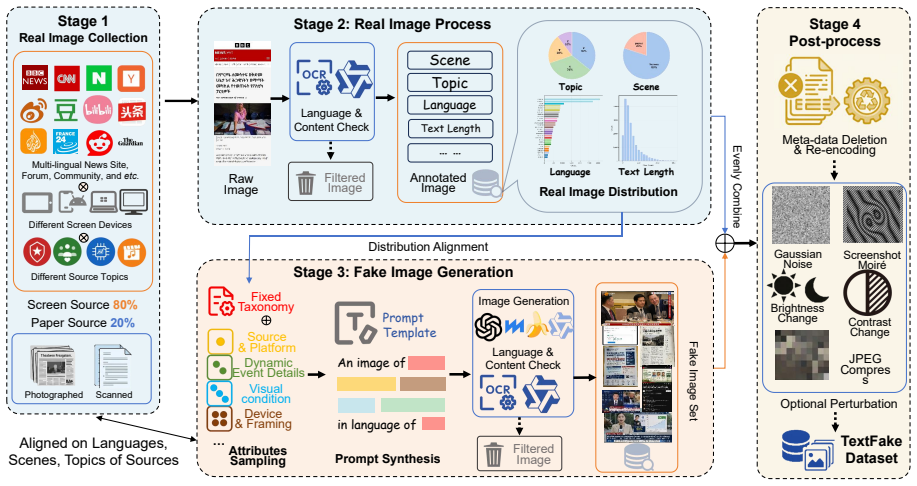
Four-stage pipeline that annotates real images along three controlled dimensions and generates counterparts through distribution-aligned structured prompting.
If this is right
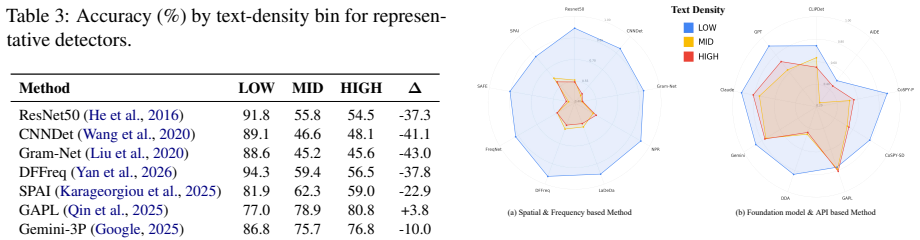
- Detectors must overcome the Text Density Curse to process dense glyphs effectively.
- Generators that render text with higher fidelity can suppress detectable generative artifacts.
- Routine perturbations on text-rich images drive detectors to chance-level performance.
- New methods tailored to text-rich scenes are required beyond those optimized for natural images.
Where Pith is reading between the lines
- Automated systems may currently miss fabricated documents and news pages in real misinformation campaigns.
- Adding explicit text-processing components could address the identified failure modes in future detectors.
- The same performance drops likely appear in other structured image types such as charts or infographics.
Load-bearing premise
The controlled annotation and prompting pipeline truly eliminates covariate shortcuts between real and generated text-rich images.
What would settle it
Re-evaluating the 17 tested detectors on TextFake and finding any one exceeds 80% zero-shot accuracy would falsify the reported performance gap.
Figures



read the original abstract
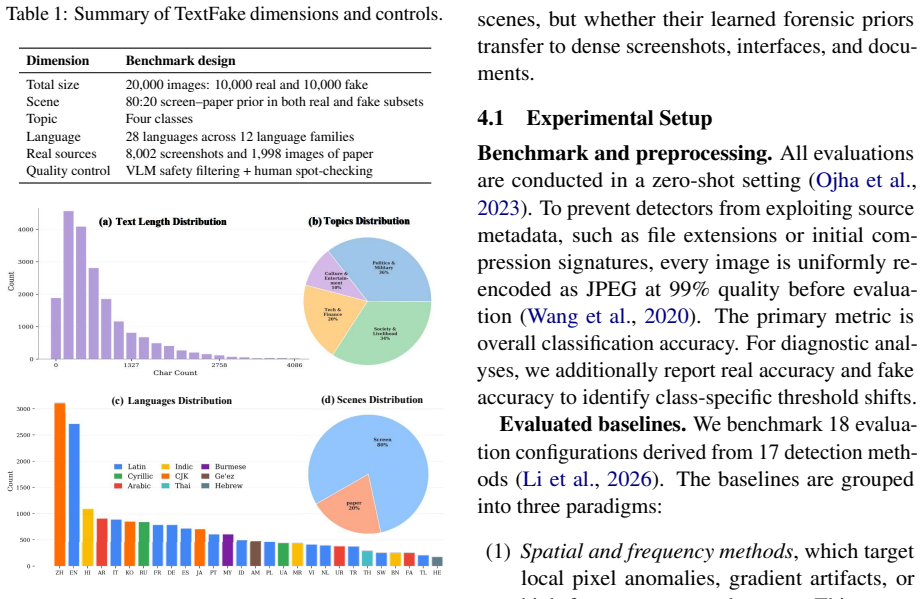
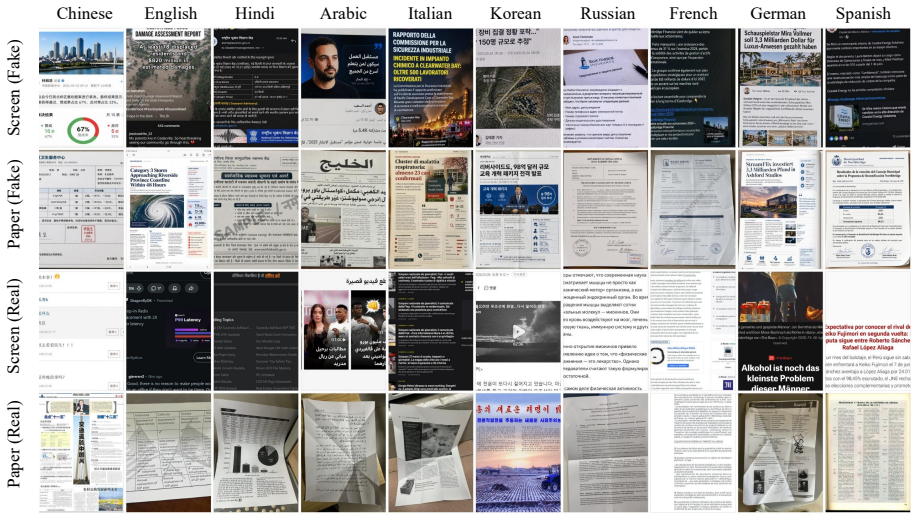
Recent AI-generated image (AIGI) detectors perform well on natural-image benchmarks, but their behavior on text-rich forgeries, such as fabricated screenshots, documents, and news pages prevalent in misinformation, remains untested. We introduce TextFake, a 20,000-image benchmark for text-rich AIGI detection spanning 28 languages, 4 topic categories, and 2 scene modalities. Fake images are synthesized via a four-stage pipeline that annotates real images along three controlled dimensions and generates counterparts through distribution-aligned structured prompting, ruling out covariate shortcuts. Zero-shot evaluation of 14 specialized detectors and 3 frontier VLM APIs reveals a large systematic gap: no method exceeds 80% accuracy, with some dropping over 60% from natural-image benchmarks. Diagnostic evaluations identify three failure modes: the Text Density Curse, where dense glyphs overwhelm low-level detectors; Cloaking via Rendering Fidelity, where stronger text rendering suppresses enerative artifacts; and Threshold Collapse, where routine perturbations drive detectors toward chance-level performance.
Editorial analysis
A structured set of objections, weighed in public.
Referee Report
Summary. The paper introduces TextFake, a 20,000-image benchmark for AI-generated image detection focused on text-rich content (screenshots, documents, news pages) spanning 28 languages, 4 topics, and 2 modalities. Fake images are created via a four-stage pipeline that annotates real images along three controlled dimensions and uses distribution-aligned structured prompting to generate counterparts. Zero-shot tests on 14 specialized detectors and 3 frontier VLMs show no method exceeds 80% accuracy, with drops exceeding 60% relative to natural-image benchmarks; three failure modes are diagnosed: Text Density Curse, Cloaking via Rendering Fidelity, and Threshold Collapse.
Significance. If the benchmark construction is verified to isolate text-specific effects, the work would be significant for misinformation detection research by exposing systematic weaknesses of current detectors on prevalent text-rich forgeries and providing a multilingual, controlled testbed. The explicit enumeration of three failure modes and the scale of the evaluation (17 systems) are strengths; the absence of any machine-checked elements or parameter-free derivations is noted but does not detract from the empirical contribution.
major comments (3)
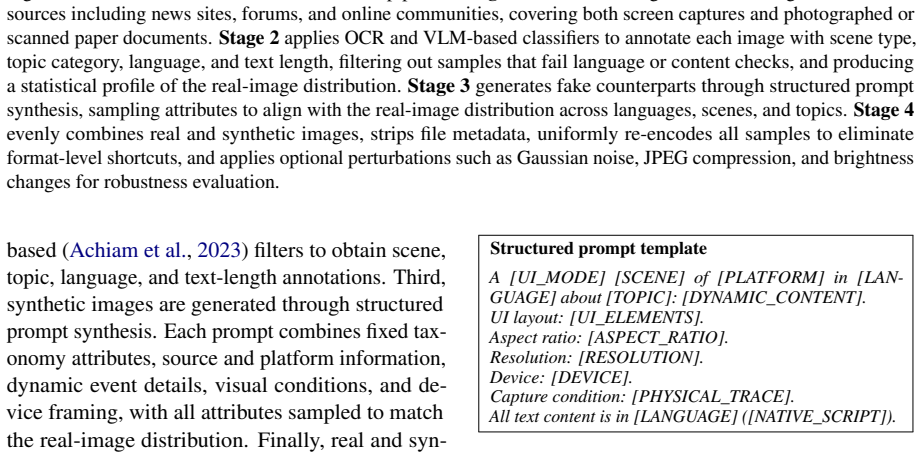
- [Abstract / pipeline section] Abstract and pipeline description (four-stage synthesis): the claim that 'distribution-aligned structured prompting rules out covariate shortcuts' is load-bearing for attributing the >60% accuracy drops to text-rich content rather than generation artifacts, yet no quantitative verification (e.g., Kolmogorov-Smirnov tests on edge histograms, Fourier spectra, or CLIP embedding distances between matched real/fake pairs) is reported. Without such checks the central performance-gap result cannot be confidently isolated to the three annotated dimensions.
- [Evaluation section] Evaluation results (zero-shot accuracy table): headline numbers (no detector >80%, drops >60%) are presented without per-method confidence intervals, statistical significance tests against natural-image baselines, or ablation on the three controlled dimensions; this makes it impossible to determine whether the 'large systematic gap' is robust or sensitive to unstated implementation choices in the synthesis pipeline.
- [Diagnostic evaluations] Diagnostic evaluations of failure modes: the three named modes (Text Density Curse, Cloaking via Rendering Fidelity, Threshold Collapse) are identified but the manuscript does not report controlled experiments that vary only one dimension while holding others fixed, leaving open whether these modes are causal or correlated with residual distribution shifts.
minor comments (2)
- [Abstract] Abstract contains a clear typo: 'suppresses enerative artifacts' should read 'generative artifacts'.
- [Methods] The manuscript provides no details on implementation, random seeds, or exact prompting templates used in the four-stage pipeline, which would aid reproducibility.
Simulated Author's Rebuttal
We thank the referee for the detailed and constructive feedback. We address each major comment below and will revise the manuscript accordingly to incorporate the suggested analyses and experiments.
read point-by-point responses
-
Referee: [Abstract / pipeline section] Abstract and pipeline description (four-stage synthesis): the claim that 'distribution-aligned structured prompting rules out covariate shortcuts' is load-bearing for attributing the >60% accuracy drops to text-rich content rather than generation artifacts, yet no quantitative verification (e.g., Kolmogorov-Smirnov tests on edge histograms, Fourier spectra, or CLIP embedding distances between matched real/fake pairs) is reported. Without such checks the central performance-gap result cannot be confidently isolated to the three annotated dimensions.
Authors: We agree that explicit quantitative verification would strengthen the isolation of effects to the annotated dimensions. In the revised manuscript we will add Kolmogorov-Smirnov tests on edge histograms and Fourier spectra together with CLIP embedding distance statistics between matched real/fake pairs to document the degree of distribution alignment achieved by the prompting procedure. revision: yes
-
Referee: [Evaluation section] Evaluation results (zero-shot accuracy table): headline numbers (no detector >80%, drops >60%) are presented without per-method confidence intervals, statistical significance tests against natural-image baselines, or ablation on the three controlled dimensions; this makes it impossible to determine whether the 'large systematic gap' is robust or sensitive to unstated implementation choices in the synthesis pipeline.
Authors: We accept that the original evaluation section lacks these statistical safeguards. The revision will include per-method bootstrap confidence intervals, paired significance tests against the corresponding natural-image benchmark results, and ablations that isolate each of the three controlled dimensions. revision: yes
-
Referee: [Diagnostic evaluations] Diagnostic evaluations of failure modes: the three named modes (Text Density Curse, Cloaking via Rendering Fidelity, Threshold Collapse) are identified but the manuscript does not report controlled experiments that vary only one dimension while holding others fixed, leaving open whether these modes are causal or correlated with residual distribution shifts.
Authors: We acknowledge that the current diagnostics are primarily observational. The revised version will add controlled experiments that hold two dimensions fixed while systematically varying the third (text density, rendering fidelity, and perturbation strength) and report the resulting accuracy curves to demonstrate causality. revision: yes
Circularity Check
No circularity: purely empirical benchmark with external test results
full rationale
The paper introduces TextFake as an empirical benchmark dataset and evaluates existing detectors zero-shot on it. The four-stage pipeline is described as a data-generation method that annotates and prompts to control dimensions, but no equations, fitted parameters, or predictions are defined in terms of each other. No self-citation chains, uniqueness theorems, or ansatzes are invoked as load-bearing. Central claims rest on reported accuracies from external models and APIs rather than internal reductions. This matches the default expectation of a self-contained empirical study.
Axiom & Free-Parameter Ledger
axioms (1)
- domain assumption The four-stage pipeline rules out covariate shortcuts in the generated images
Reference graph
Works this paper leans on
-
[1]
Detecting and Simulating Artifacts in
Xu Zhang and Svebor Karaman and Shih. Detecting and Simulating Artifacts in
-
[2]
Proceedings of the 37th International Conference on Neural Information Processing Systems , year =
Zeyu Lu and Di Huang and Lei Bai and Jingjing Qu and Chengyue Wu and Xihui Liu and Wanli Ouyang , title =. Proceedings of the 37th International Conference on Neural Information Processing Systems , year =
-
[3]
ACM computing surveys (CSUR) , volume=
The creation and detection of deepfakes: A survey , author=. ACM computing surveys (CSUR) , volume=. 2021 , publisher=
2021
-
[4]
International Journal of Data Science and Analytics , volume=
Document forgery detection: a comprehensive review , author=. International Journal of Data Science and Analytics , volume=. 2025 , publisher=
2025
-
[5]
European Conference on Computer Vision , pages=
Thinking in Frequency: Face Forgery Detection by Mining Frequency-Aware Clues , author=. European Conference on Computer Vision , pages=
-
[6]
Gpt-4 technical report , author=. arXiv preprint arXiv:2303.08774 , year=
work page internal anchor Pith review Pith/arXiv arXiv
-
[7]
Shortcut learning in deep neural networks , journal =
Robert Geirhos and J. Shortcut learning in deep neural networks , journal =
-
[8]
Science China Information Sciences , volume=
Ocrbench: on the hidden mystery of ocr in large multimodal models , author=. Science China Information Sciences , volume=. 2024 , publisher=
2024
-
[9]
International Conference on Document Analysis and Recognition , pages=
KIEval: Evaluation metric for document key information extraction , author=. International Conference on Document Analysis and Recognition , pages=. 2025 , organization=
2025
-
[10]
Ricard Durall and Margret Keuper and Janis Keuper , title =. 2020
2020
-
[11]
arXiv preprint arXiv:2009.09941 (2020)
Pp-ocr: A practical ultra lightweight ocr system , author=. arXiv preprint arXiv:2009.09941 , year=
-
[12]
arXiv preprint arXiv:2302.14475 , year=
Benchmarking deepart detection , author=. arXiv preprint arXiv:2302.14475 , year=
-
[13]
In Ictu Oculi: Exposing
Yuezun Li and Ming. In Ictu Oculi: Exposing
-
[14]
Yinan He and Bei Gan and Siyu Chen and Yichun Zhou and Guojun Yin and Luchuan Song and Lu Sheng and Jing Shao and Ziwei Liu , title =
-
[15]
Bird and Ahmad Lotfi , title =
Jordan J. Bird and Ahmad Lotfi , title =
-
[16]
Proceedings of the 37th International Conference on Neural Information Processing Systems , year=
GenImage: a million-scale benchmark for detecting AI-generated image , author=. Proceedings of the 37th International Conference on Neural Information Processing Systems , year=
-
[17]
Advances in Neural Information Processing Systems , year=
Is artificial intelligence generated image detection a solved problem? , author=. Advances in Neural Information Processing Systems , year=
-
[18]
CoRR , volume =
You Hu and Chenzhuo Zhao and Changfa Mo and Haotian Liu and Xiaobai Li , title =. CoRR , volume =
-
[19]
Kaiming He and Xiangyu Zhang and Shaoqing Ren and Jian Sun , title =
-
[20]
CNN-Generated Images Are Surprisingly Easy to Spot
Sheng. CNN-Generated Images Are Surprisingly Easy to Spot... for Now , booktitle =
-
[21]
Zhengzhe Liu and Xiaojuan Qi and Philip H. S. Torr , title =. 2020
2020
-
[22]
Chuangchuang Tan and Yao Zhao and Shikui Wei and Guanghua Gu and Yunchao Wei , title =
-
[23]
Chuangchuang Tan and Huan Liu and Yao Zhao and Shikui Wei and Guanghua Gu and Ping Liu and Yunchao Wei , title =
-
[24]
Thirty-Eighth
Chuangchuang Tan and Yao Zhao and Shikui Wei and Guanghua Gu and Ping Liu and Yunchao Wei , title =. Thirty-Eighth
-
[25]
arXiv preprint arXiv:2406.09398 , year=
Real-time deepfake detection in the real-world , author=. arXiv preprint arXiv:2406.09398 , year=
-
[26]
The Thirteenth International Conference on Learning Representations , year =
Shilin Yan and Ouxiang Li and Jiayin Cai and Yanbin Hao and Xiaolong Jiang and Yao Hu and Weidi Xie , title =. The Thirteenth International Conference on Learning Representations , year =
-
[27]
Siyuan Cheng and Lingjuan Lyu and Zhenting Wang and Xiangyu Zhang and Vikash Sehwag , title =
-
[28]
arXiv preprint arXiv:2508.01603 , year=
Towards generalizable ai-generated image detection via image-adaptive prompt learning , author=. arXiv preprint arXiv:2508.01603 , year=
-
[29]
IEEE Transactions on Information Forensics and Security , year=
Dual frequency branch framework with reconstructed sliding windows attention for ai-generated image detection , author=. IEEE Transactions on Information Forensics and Security , year=
-
[30]
Proceedings of the 31st
Ouxiang Li and Jiayin Cai and Yanbin Hao and Xiaolong Jiang and Yao Hu and Fuli Feng , title =. Proceedings of the 31st
-
[31]
Dimitrios Karageorgiou and Symeon Papadopoulos and Ioannis Kompatsiaris and Efstratios Gavves , title =
-
[32]
Thirty-Ninth
Chuangchuang Tan and Renshuai Tao and Huan Liu and Guanghua Gu and Baoyuan Wu and Yao Zhao and Yunchao Wei , title =. Thirty-Ninth
-
[33]
The Thirty-ninth Annual Conference on Neural Information Processing Systems , year=
Dual Data Alignment Makes AI-Generated Image Detector Easier Generalizable , author=. The Thirty-ninth Annual Conference on Neural Information Processing Systems , year=
-
[34]
Yingjian Chen and Lei Zhang and Yakun Niu , title =
-
[35]
Scaling Up AI-Generated Image Detection with Generator-Aware Prototypes
Scaling Up AI-Generated Image Detection via Generator-Aware Prototypes , author=. arXiv preprint arXiv:2512.12982 , year=
work page internal anchor Pith review Pith/arXiv arXiv
-
[36]
Utkarsh Ojha and Yuheng Li and Yong Jae Lee , title =
-
[37]
2025 , url =
Gemini 3: Introducing the latest Gemini AI model from Google , author =. 2025 , url =
2025
-
[38]
2026 , url =
Introducing GPT-5.4 , author =. 2026 , url =
2026
-
[39]
2026 , url =
Introducing Claude Sonnet 4.6 , author =. 2026 , url =
2026
-
[40]
2026 , url =
GPT Image 2 , author =. 2026 , url =
2026
-
[41]
2026 , url =
Introducing Seedream 5.0 Lite , author =. 2026 , url =
2026
-
[42]
2026 , url =
Nano Banana 2: Combining Pro capabilities with lightning-fast speed , author =. 2026 , url =
2026
-
[43]
2026 , url =
Qwen-Image-2.0: Professional infographics, exquisite textures, and native 2K resolution , author =. 2026 , url =
2026
discussion (0)
Sign in with ORCID, Apple, or X to comment. Anyone can read and Pith papers without signing in.