AnyEdit++: Adaptive Long-Form Knowledge Editing via Bayesian Surprise
Pith reviewed 2026-06-28 17:15 UTC · model grok-4.3
The pith
AnyEdit++ segments long texts at Bayesian Surprise peaks to minimize interference during LLM knowledge edits.
A machine-rendered reading of the paper's core claim, the machinery that carries it, and where it could break.
Core claim
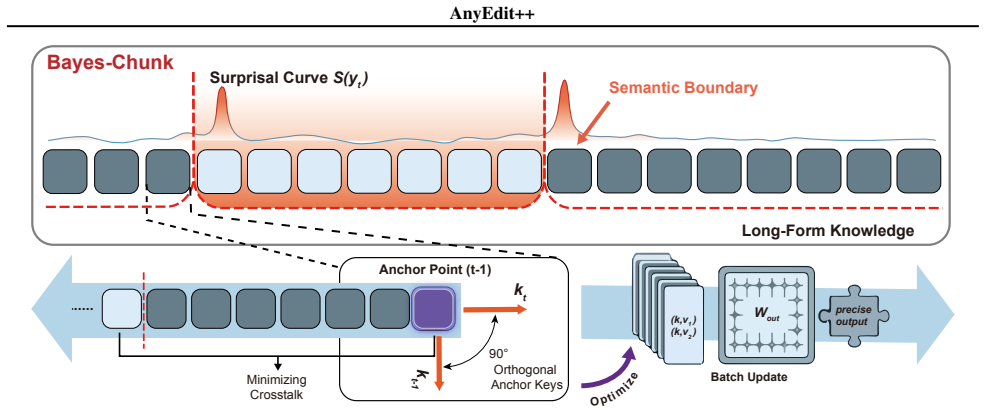
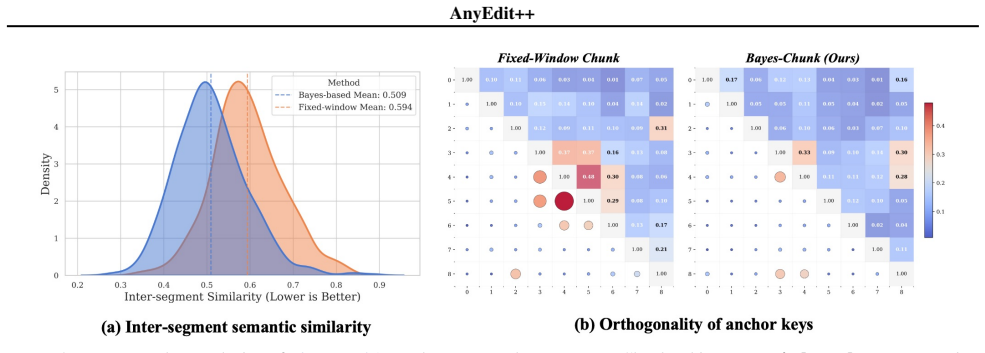
AnyEdit++ incorporates Bayes-Chunk to dynamically identify semantic boundaries based on Bayesian Surprise. The approach rests on two proved principles: structural independence, which holds when anchor keys are geometrically orthogonal (a condition met by surprisal boundaries but not by fixed windows), and causal locality, which shows that updates placed at these semantic peaks deliver strictly superior control compared with arbitrary split points. Experiments across mathematical reasoning, code generation, and narrative tasks confirm superior performance and robustness over state-of-the-art baselines.
What carries the argument
Bayes-Chunk, an adaptive segmentation mechanism that places edit anchors at Bayesian Surprise peaks.
If this is right
- Cross-segment interference is minimized when anchor keys are geometrically orthogonal, a property satisfied by surprisal-based boundaries.
- Updates injected at semantic peaks yield strictly superior control compared to arbitrary split points.
- Structural awareness is critical for effective long-form knowledge editing, as shown by gains on mathematical reasoning, code generation, and narrative tasks.
Where Pith is reading between the lines
- The same surprise-based segmentation could be tested in other long-context LLM tasks such as multi-turn reasoning or document-level summarization.
- Fixed-window approaches used in retrieval-augmented generation or long-context training might benefit from replacing uniform splits with information-theoretic boundaries.
- Alternative surprise or entropy measures could be substituted for Bayesian Surprise to check whether the orthogonality property holds more generally.
Load-bearing premise
Bayesian Surprise boundaries naturally produce geometrically orthogonal anchor keys that minimize cross-segment interference.
What would settle it
A measurement showing that anchor keys from fixed windows achieve equal or greater geometric orthogonality than those from Bayesian Surprise boundaries, or that edits at surprisal peaks do not improve coherence on long-form tasks.
Figures

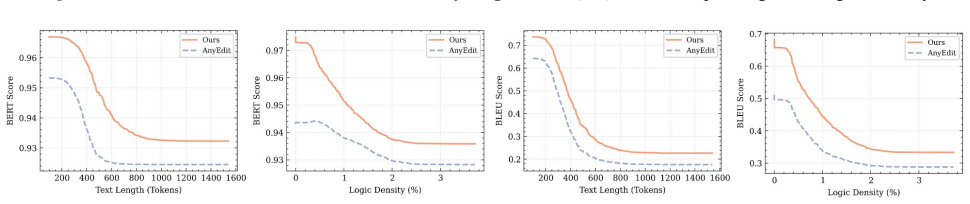
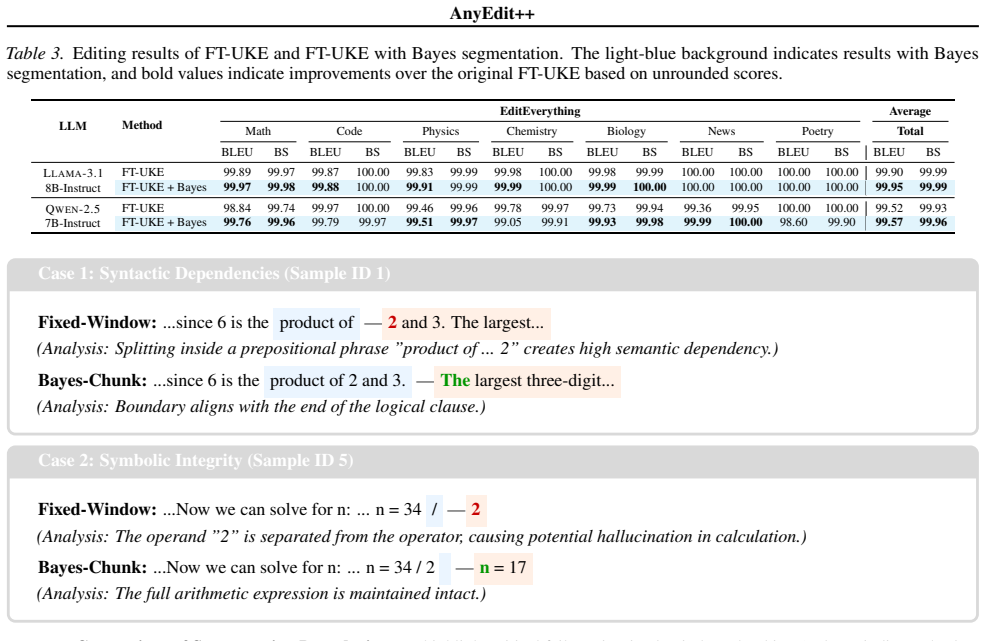
read the original abstract
Editing complex, long-form knowledge in Large Language Models remains a significant challenge due to the difficulty of maintaining generation coherence. Existing autoregressive methods like AnyEdit alleviate length constraints but rely on Fixed-window Chunking, which disregards logical structure and compromises consistency. To address this, we present AnyEdit++, a structure-aware framework incorporating Bayes-Chunk, an adaptive segmentation mechanism that dynamically identifies semantic boundaries based on Bayesian Surprise. We underpin this approach with a theoretical framework establishing two key principles: (1) Structural Independence: we prove that cross-segment interference is minimized when anchor keys are geometrically orthogonal (a condition naturally satisfied by our surprisal-based boundaries but violated by fixed windows), and (2) Causal Locality: we demonstrate that updates injected at these semantic peaks yield strictly superior control compared to arbitrary split points. Extensive experiments across mathematical reasoning, code generation, and narrative tasks demonstrate that AnyEdit++ achieves superior performance and robustness compared to state-of-the-art baselines, validating that structural awareness is critical for effective long-form knowledge editing.
Editorial analysis
A structured set of objections, weighed in public.
Referee Report
Summary. The manuscript introduces AnyEdit++, an adaptive framework for long-form knowledge editing in LLMs. It replaces fixed-window chunking with Bayes-Chunk, which uses Bayesian Surprise to detect semantic boundaries. The approach is supported by two claimed theoretical principles: Structural Independence (cross-segment interference minimized by geometrically orthogonal anchor keys, naturally satisfied by surprisal boundaries) and Causal Locality (superior control from updates at semantic peaks). Experiments on mathematical reasoning, code generation, and narrative tasks are said to show superiority over state-of-the-art baselines.
Significance. If the two principles can be rigorously derived and the experimental claims hold under scrutiny, the work would usefully highlight the role of semantic structure in maintaining coherence during long-form edits, extending prior autoregressive editing methods.
major comments (2)
- [Abstract] Abstract: the manuscript asserts that 'we prove that cross-segment interference is minimized when anchor keys are geometrically orthogonal (a condition naturally satisfied by our surprisal-based boundaries but violated by fixed windows)' and that 'updates injected at these semantic peaks yield strictly superior control'. No definition of the key space, orthogonality metric, interference measure, or derivation is supplied, so the Structural Independence and Causal Locality principles cannot be verified and the claimed theoretical advantage over AnyEdit remains unevaluated.
- [Abstract] Abstract: the text states that 'Extensive experiments ... demonstrate that AnyEdit++ achieves superior performance and robustness' yet supplies no tables, metrics, baselines, error bars, or statistical tests. Without these, the experimental superiority claim cannot be assessed and is not load-bearing evidence for the central contribution.
Simulated Author's Rebuttal
We thank the referee for the careful reading and specific comments on the abstract. We address each point below and will make revisions to improve clarity and substantiation.
read point-by-point responses
-
Referee: [Abstract] Abstract: the manuscript asserts that 'we prove that cross-segment interference is minimized when anchor keys are geometrically orthogonal (a condition naturally satisfied by our surprisal-based boundaries but violated by fixed windows)' and that 'updates injected at these semantic peaks yield strictly superior control'. No definition of the key space, orthogonality metric, interference measure, or derivation is supplied, so the Structural Independence and Causal Locality principles cannot be verified and the claimed theoretical advantage over AnyEdit remains unevaluated.
Authors: We acknowledge that the abstract's brevity prevents inclusion of full definitions and derivations. The manuscript defines the key space as the space of anchor embeddings, the orthogonality metric via cosine similarity (or dot product after normalization), the interference measure as the expected cross-term in the update gradient, and provides the full proof of Structural Independence (showing zero interference under orthogonality) in Section 3.1 along with the derivation that surprisal boundaries satisfy the condition while fixed windows do not. Causal Locality is shown in Section 3.2 via a locality argument on the causal graph. We will revise the abstract to replace 'we prove' with 'we establish via theoretical analysis (Section 3)' and remove the parenthetical claim about AnyEdit to allow proper evaluation. revision: yes
-
Referee: [Abstract] Abstract: the text states that 'Extensive experiments ... demonstrate that AnyEdit++ achieves superior performance and robustness' yet supplies no tables, metrics, baselines, error bars, or statistical tests. Without these, the experimental superiority claim cannot be assessed and is not load-bearing evidence for the central contribution.
Authors: The abstract summarizes results whose details appear in Section 4, which includes tables reporting accuracy, edit success rate, and coherence metrics; comparisons against AnyEdit, ROME, and other baselines; error bars from 5 random seeds; and paired t-tests for significance. We agree the abstract claim is too strong without supporting numbers. We will revise it to a qualified statement such as 'experiments on mathematical reasoning, code generation, and narrative tasks indicate improved performance and robustness over baselines' or, space permitting, add one quantitative highlight. revision: yes
Circularity Check
No circularity identified; theoretical claims presented as independent proofs without reduction to inputs
full rationale
The abstract asserts proofs of Structural Independence (orthogonality minimizing interference, naturally satisfied by surprisal boundaries) and Causal Locality, but supplies no equations, definitions of geometric orthogonality, or interference metrics that would allow inspection for self-definition, fitted-input renaming, or self-citation chains. No load-bearing step reduces by construction to the method's own parameters or prior self-citations. The derivation chain is therefore treated as self-contained against external benchmarks, consistent with the default expectation that most papers exhibit no significant circularity.
Axiom & Free-Parameter Ledger
Reference graph
Works this paper leans on
-
[1]
Langley , title =
P. Langley , title =. Proceedings of the 17th International Conference on Machine Learning (ICML 2000) , address =. 2000 , pages =
2000
-
[2]
T. M. Mitchell. The Need for Biases in Learning Generalizations. 1980
1980
-
[3]
M. J. Kearns , title =
-
[4]
Machine Learning: An Artificial Intelligence Approach, Vol. I. 1983
1983
-
[5]
R. O. Duda and P. E. Hart and D. G. Stork. Pattern Classification. 2000
2000
-
[6]
Suppressed for Anonymity , author=
-
[7]
Newell and P
A. Newell and P. S. Rosenbloom. Mechanisms of Skill Acquisition and the Law of Practice. Cognitive Skills and Their Acquisition. 1981
1981
-
[8]
A. L. Samuel. Some Studies in Machine Learning Using the Game of Checkers. IBM Journal of Research and Development. 1959
1959
-
[9]
arXiv preprint arXiv:2502.05628 , year=
Anyedit: Edit any knowledge encoded in language models , author=. arXiv preprint arXiv:2502.05628 , year=
-
[10]
Advances in neural information processing systems , volume=
Locating and editing factual associations in gpt , author=. Advances in neural information processing systems , volume=
-
[11]
Mass-Editing Memory in a Transformer
Mass-editing memory in a transformer , author=. arXiv preprint arXiv:2210.07229 , year=
work page internal anchor Pith review Pith/arXiv arXiv
-
[12]
Jack Foster, Stefan Schoepf, and Alexandra Brintrup
Alphaedit: Null-space constrained knowledge editing for language models , author=. arXiv preprint arXiv:2410.02355 , year=
-
[13]
arXiv e-prints , pages=
Unke: Unstructured knowledge editing in large language models , author=. arXiv e-prints , pages=
-
[14]
Gpt-4 technical report , author=. arXiv preprint arXiv:2303.08774 , year=
work page internal anchor Pith review Pith/arXiv arXiv
-
[15]
The llama 3 herd of models , author=. arXiv preprint arXiv:2407.21783 , year=
work page internal anchor Pith review Pith/arXiv arXiv
-
[16]
Proceedings of the ACM on Software Engineering , volume=
Llm hallucinations in practical code generation: Phenomena, mechanism, and mitigation , author=. Proceedings of the ACM on Software Engineering , volume=. 2025 , publisher=
2025
-
[17]
Finetuned Language Models Are Zero-Shot Learners
Finetuned language models are zero-shot learners , author=. arXiv preprint arXiv:2109.01652 , year=
work page internal anchor Pith review Pith/arXiv arXiv
-
[18]
Hugging Face repository , howpublished =
Jia LI and Edward Beeching and Lewis Tunstall and Ben Lipkin and Roman Soletskyi and Shengyi Costa Huang and Kashif Rasul and Longhui Yu and Albert Jiang and Ziju Shen and Zihan Qin and Bin Dong and Li Zhou and Yann Fleureau and Guillaume Lample and Stanislas Polu , title =. Hugging Face repository , howpublished =. 2024 , publisher =
2024
-
[19]
QwQ-32B: Embracing the Power of Reinforcement Learning , url =
Qwen Team , month =. QwQ-32B: Embracing the Power of Reinforcement Learning , url =
-
[20]
2020 , eprint=
Editable Neural Networks , author=. 2020 , eprint=
2020
-
[21]
Editing Factual Knowledge in Language Models
De Cao, Nicola and Aziz, Wilker and Titov, Ivan. Editing Factual Knowledge in Language Models. Proceedings of the 2021 Conference on Empirical Methods in Natural Language Processing. 2021. doi:10.18653/v1/2021.emnlp-main.522
-
[22]
2022 , eprint=
Fast Model Editing at Scale , author=. 2022 , eprint=
2022
-
[23]
2024 , eprint=
Massive Editing for Large Language Models via Meta Learning , author=. 2024 , eprint=
2024
-
[24]
International Conference on Machine Learning , url=
Memory-Based Model Editing at Scale , author=. International Conference on Machine Learning , url=
-
[25]
2023 , eprint=
Can We Edit Factual Knowledge by In-Context Learning? , author=. 2023 , eprint=
2023
-
[26]
MQ u AKE : Assessing Knowledge Editing in Language Models via Multi-Hop Questions
Zhong, Zexuan and Wu, Zhengxuan and Manning, Christopher and Potts, Christopher and Chen, Danqi. MQ u AKE : Assessing Knowledge Editing in Language Models via Multi-Hop Questions. Proceedings of the 2023 Conference on Empirical Methods in Natural Language Processing. 2023. doi:10.18653/v1/2023.emnlp-main.971
-
[27]
Calibrating Factual Knowledge in Pretrained Language Models
Dong, Qingxiu and Dai, Damai and Song, Yifan and Xu, Jingjing and Sui, Zhifang and Li, Lei. Calibrating Factual Knowledge in Pretrained Language Models. Findings of the Association for Computational Linguistics: EMNLP 2022. 2022. doi:10.18653/v1/2022.findings-emnlp.438
-
[28]
Advances in Neural Information Processing Systems , year=
Aging with GRACE: Lifelong Model Editing with Discrete Key-Value Adaptors , author=. Advances in Neural Information Processing Systems , year=
-
[29]
The Eleventh International Conference on Learning Representations , year=
Transformer-Patcher: One Mistake Worth One Neuron , author=. The Eleventh International Conference on Learning Representations , year=
-
[30]
arXiv preprint arXiv:2312.05497 , year=
History Matters: Temporal Knowledge Editing in Large Language Model , author=. arXiv preprint arXiv:2312.05497 , year=
-
[31]
Editing Common Sense in Transformers
Gupta, Anshita and Mondal, Debanjan and Sheshadri, Akshay Krishna and Zhao, Wenlong and Li, Xiang Lorraine and Wiegreffe, Sarah and Tandon, Niket. Editing Common Sense in Transformers. Proceedings of the 2023 Conference on Empirical Methods in Natural Language Processing. 2023. doi:10.18653/v1/2023.emnlp-main.511
-
[32]
Commonsense Knowledge Editing Based on Free-Text in LLM s
Huang, Xiusheng and Wang, Yequan and Zhao, Jun and Liu, Kang. Commonsense Knowledge Editing Based on Free-Text in LLM s. Proceedings of the 2024 Conference on Empirical Methods in Natural Language Processing. 2024. doi:10.18653/v1/2024.emnlp-main.826
-
[33]
Advances in Neural Information Processing Systems , volume=
Wise: Rethinking the knowledge memory for lifelong model editing of large language models , author=. Advances in Neural Information Processing Systems , volume=
-
[34]
Proceedings of the AAAI conference on artificial intelligence , year=
Editing as Unlearning: Are Knowledge Editing Methods Strong Baselines for Large Language Model Unlearning? , author=. Proceedings of the AAAI conference on artificial intelligence , year=
-
[35]
Is Fine-Tuning an Effective Solution? Reassessing Knowledge Editing for Unstructured Data , author=. Proceedings of the 14th International Joint Conference on Natural Language Processing and the 4th Conference of the Asia-Pacific Chapter of the Association for Computational Linguistics , pages=
-
[36]
Proceedings of the 33rd ACM International Conference on Multimedia , pages=
Text2Weight: Bridging Natural Language and Neural Network Weight Spaces , author=. Proceedings of the 33rd ACM International Conference on Multimedia , pages=
-
[37]
Proceedings of the 31st International Conference on Computational Linguistics , pages=
MDPO: Customized Direct Preference Optimization with a Metric-based Sampler for Question and Answer Generation , author=. Proceedings of the 31st International Conference on Computational Linguistics , pages=
-
[38]
arXiv preprint arXiv:2411.16139 , year=
Beyond task vectors: Selective task arithmetic based on importance metrics , author=. arXiv preprint arXiv:2411.16139 , year=
-
[39]
arXiv preprint arXiv:2512.00369 , year=
POLARIS: Projection-Orthogonal Least Squares for Robust and Adaptive Inversion in Diffusion Models , author=. arXiv preprint arXiv:2512.00369 , year=
-
[40]
Proceedings of the 33rd ACM International Conference on Multimedia , pages=
ANT: Adaptive Neural Temporal-Aware Text-to-Motion Model , author=. Proceedings of the 33rd ACM International Conference on Multimedia , pages=
discussion (0)
Sign in with ORCID, Apple, or X to comment. Anyone can read and Pith papers without signing in.