Rotating traversable wormholes and particle dynamics in f(R,T) gravity
Pith reviewed 2026-06-28 16:40 UTC · model grok-4.3
The pith
Rotating traversable wormholes in f(R,T) gravity can be supported by matter that satisfies the null and strong energy conditions.
A machine-rendered reading of the paper's core claim, the machinery that carries it, and where it could break.
Core claim
Stationary and axisymmetric wormhole solutions in f(R,T) gravity supported by an anisotropic fluid are regular, asymptotically flat, horizonless, satisfy the flare-out condition, and have matter that satisfies both the null and strong energy conditions.
What carries the argument
The slow-rotation approximation applied to a stationary axisymmetric metric in f(R,T) gravity coupled to an anisotropic fluid stress-energy tensor.
If this is right
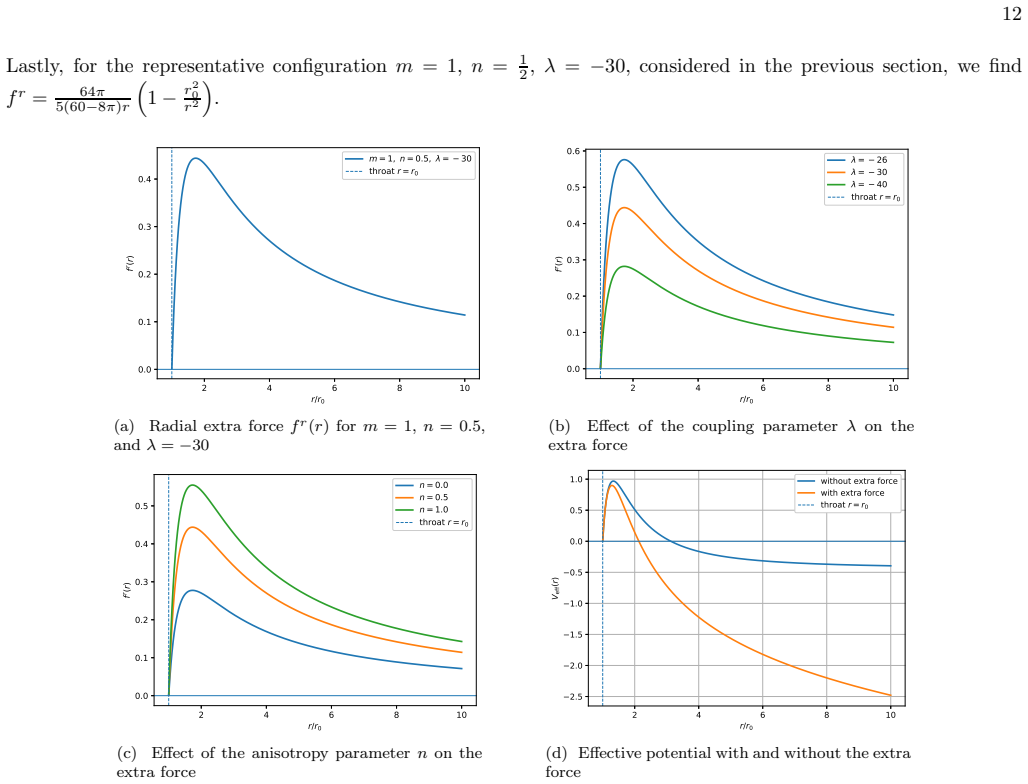
- Particle dynamics include frame dragging and non-geodesic effects from the matter-geometry coupling.
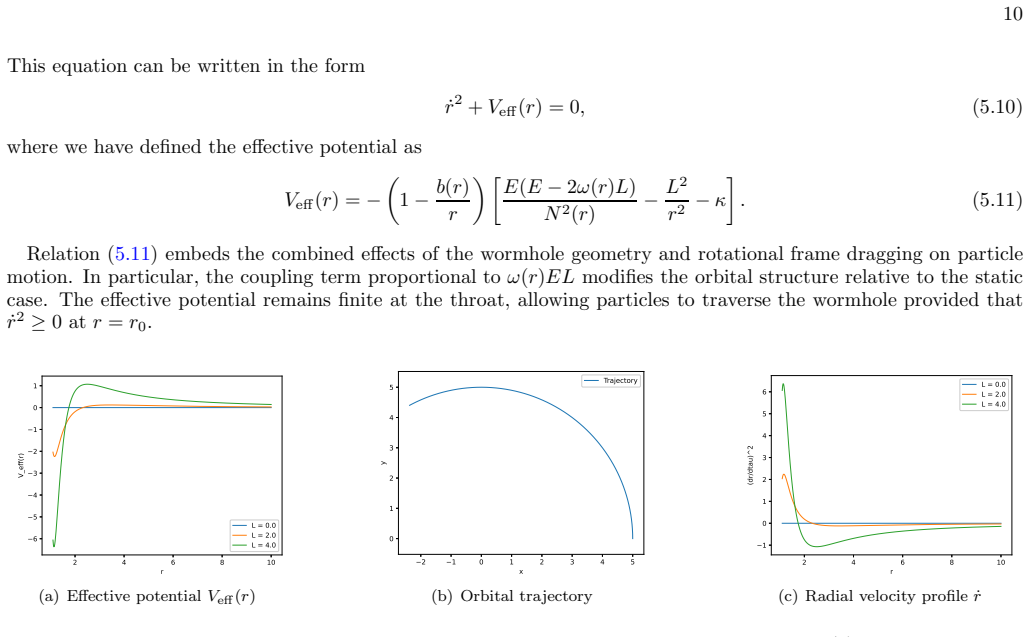
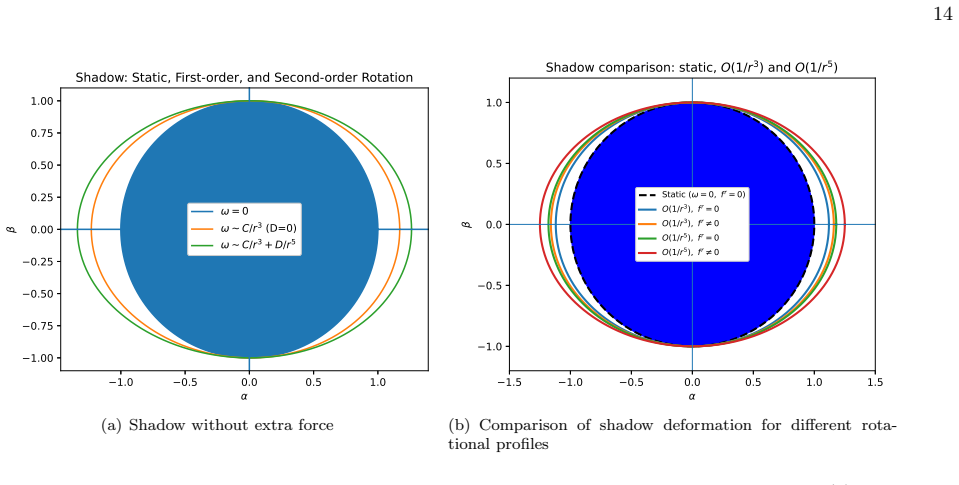
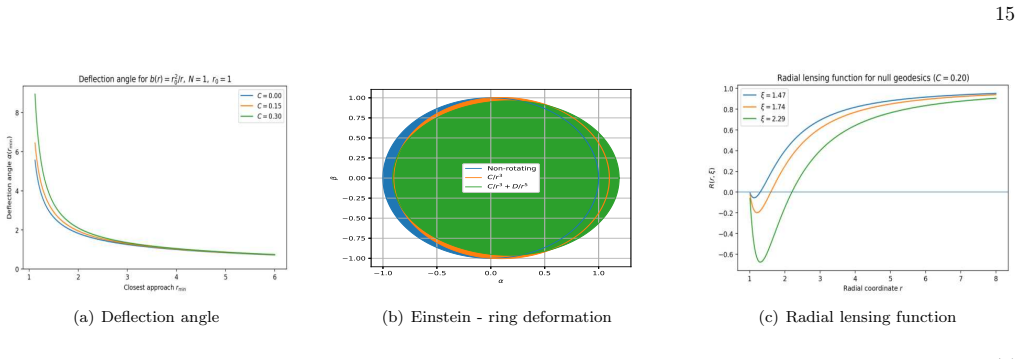
- The solutions exhibit shadow deformation and gravitational lensing signatures due to rotation.
- A preliminary stability analysis based on sound-speed conditions supports physical viability.
Where Pith is reading between the lines
- These wormholes could produce detectable astrophysical signals distinguishable from black holes.
- Extending beyond slow rotation might reveal new effects or instabilities in faster spinning cases.
- Similar constructions could be explored in other modified gravity theories with matter couplings.
Load-bearing premise
The slow-rotation approximation together with chosen metric functions and anisotropic fluid allow the modified field equations to be solved while satisfying the energy conditions.
What would settle it
An explicit computation of the null energy condition for the matter sector that yields a negative value at the throat would falsify the claim that exotic matter is not required.
Figures

read the original abstract
Traversable wormholes are among the most interesting solutions of gravitational theories, but within General Relativity they generally require exotic matter violating the null energy condition. Modified gravity theories with matter-geometry coupling provide a promising framework in which wormhole geometries may instead be supported by effective gravitational contributions. Motivated by this possibility, we investigate rotating traversable wormholes in $f(R,T)$ gravity, where $R$ is the scalar curvature and $T$ is the trace of the energy-momentum tensor, within the slow-rotation approximation. We construct stationary and axisymmetric wormhole solutions supported by an anisotropic fluid and show that the obtained geometries are regular, asymptotically flat, horizonless, and satisfy the flare-out condition at the throat. A central result is that the matter sector satisfies both the null and strong energy conditions, indicating that traversable rotating wormholes can be supported without exotic matter. We further analyze particle motion, frame dragging, and non-geodesic effects arising from matter-geometry coupling, together with shadow deformation and gravitational lensing signatures induced by rotation. A preliminary stability analysis based on sound-speed conditions indicates the physical viability of the solutions. These results demonstrate that rotating wormholes in $f(R,T)$ gravity constitute physically consistent compact configurations with potentially observable astrophysical signatures.
Editorial analysis
A structured set of objections, weighed in public.
Referee Report
Summary. The paper constructs stationary axisymmetric rotating traversable wormhole solutions in f(R,T) gravity in the slow-rotation limit, supported by an anisotropic fluid. The geometries are reported to be regular, asymptotically flat, horizonless, and to satisfy the flare-out condition at the throat. A central result is that the matter sector obeys the null and strong energy conditions. The work further examines particle motion, frame-dragging, non-geodesic effects, shadow deformation, gravitational lensing, and provides a preliminary stability analysis via sound-speed conditions.
Significance. If the derivations are valid and the energy-condition results are not artifacts of the specific ansatz, the work would supply explicit examples of rotating wormholes supported by non-exotic matter in a matter-geometry coupled theory, extending non-rotating f(R,T) constructions and adding astrophysical observables such as deformed shadows and lensing signatures.
major comments (2)
- [Abstract; solution-construction section] Abstract and the solution-construction section: the claim that the matter sector satisfies NEC and SEC is obtained by inserting a slow-rotation metric ansatz, a chosen linear f(R,T), and prescribed anisotropic fluid profiles ρ(r), p_r(r), p_t(r) into the modified field equations and verifying the inequalities. Because these functional forms are selected so that the algebraic expressions for the energy conditions remain non-negative while satisfying the flare-out condition, the result is tied to the modeling choices rather than derived from a general f(R,T) or independent dynamics.
- [Solution-construction section] The slow-rotation approximation together with the specific metric functions and fluid ansatz allow the modified Einstein equations to be solved algebraically while meeting the energy conditions by design. No demonstration is given that the same conclusion holds for a broader class of shape or redshift functions or for a non-linear f(R,T) without retuning the fluid parameters.
minor comments (2)
- Notation for the modified field equations and the explicit form of f(R,T) should be stated at the outset rather than introduced piecemeal.
- The stability analysis based on sound-speed conditions is preliminary; the relevant inequalities and the radial domain over which they hold should be displayed explicitly.
Simulated Author's Rebuttal
We thank the referee for the careful reading of our manuscript and the constructive comments. We address the major comments point by point below, agreeing where clarification is needed and indicating the revisions we will implement.
read point-by-point responses
-
Referee: [Abstract; solution-construction section] Abstract and the solution-construction section: the claim that the matter sector satisfies NEC and SEC is obtained by inserting a slow-rotation metric ansatz, a chosen linear f(R,T), and prescribed anisotropic fluid profiles ρ(r), p_r(r), p_t(r) into the modified field equations and verifying the inequalities. Because these functional forms are selected so that the algebraic expressions for the energy conditions remain non-negative while satisfying the flare-out condition, the result is tied to the modeling choices rather than derived from a general f(R,T) or independent dynamics.
Authors: We agree that the satisfaction of the null and strong energy conditions is demonstrated for the specific slow-rotation metric ansatz, the linear f(R,T) form, and the chosen anisotropic fluid profiles that permit algebraic verification while meeting the flare-out condition. The manuscript presents explicit constructions rather than a general derivation applicable to arbitrary f(R,T) or independent dynamics. To address this, we will revise the abstract and solution-construction section to state explicitly that the energy conditions hold for the constructed solutions under these modeling choices. revision: yes
-
Referee: [Solution-construction section] The slow-rotation approximation together with the specific metric functions and fluid ansatz allow the modified Einstein equations to be solved algebraically while meeting the energy conditions by design. No demonstration is given that the same conclusion holds for a broader class of shape or redshift functions or for a non-linear f(R,T) without retuning the fluid parameters.
Authors: The referee is correct that the slow-rotation limit combined with the chosen metric functions and fluid ansatz enables algebraic solution of the modified field equations. Our work follows the standard practice of constructing explicit analytic solutions within a controlled approximation. We do not claim or demonstrate the result for broader classes of functions or non-linear f(R,T). We will add a remark in the discussion section acknowledging this scope limitation and identifying extensions to other ansatze or non-linear cases as a direction for future work. revision: partial
Circularity Check
Central claim rests on specific ansatz for metric functions, f(R,T), and anisotropic fluid in slow-rotation limit
specific steps
-
fitted input called prediction
[Abstract (construction of solutions)]
"We construct stationary and axisymmetric wormhole solutions supported by an anisotropic fluid and show that the obtained geometries are regular, asymptotically flat, horizonless, and satisfy the flare-out condition at the throat. A central result is that the matter sector satisfies both the null and strong energy conditions, indicating that traversable rotating wormholes can be supported without exotic matter."
The quoted central result is obtained by selecting specific metric functions, f(R,T) form, and anisotropic fluid profiles (rho(r), p_r(r), p_t(r)) in the slow-rotation limit so that the modified Einstein equations close and the algebraic expressions for rho + p_r >= 0 and rho + p_r + 2 p_t >= 0 remain non-negative at the throat. The satisfaction of the energy conditions is therefore enforced by the choice of ansatz rather than derived from a parameter-free or general analysis.
full rationale
The paper constructs explicit wormhole solutions by choosing particular functional forms for the metric (slow-rotation approximation), the f(R,T) model, and the anisotropic fluid densities/pressures. These ansatzes are inserted into the modified field equations, after which the energy conditions are verified to hold. Because the functional profiles are selected precisely so that the flare-out condition, asymptotic flatness, and non-negativity of NEC/SEC expressions are satisfied, the central claim that traversable rotating wormholes can be supported without exotic matter reduces to a consequence of those modeling choices rather than an independent derivation. This matches the fitted-input-called-prediction pattern at the level of the solution construction, warranting a moderate circularity score while acknowledging that explicit constructions are standard in the literature.
Axiom & Free-Parameter Ledger
free parameters (2)
- Slow-rotation parameter
- Shape function parameters
axioms (2)
- standard math Field equations of f(R,T) gravity derived from the variational principle
- domain assumption Slow-rotation approximation is valid for small angular velocities
Reference graph
Works this paper leans on
-
[1]
Quantum Gravity Phenomenology in the multi-messenger approach
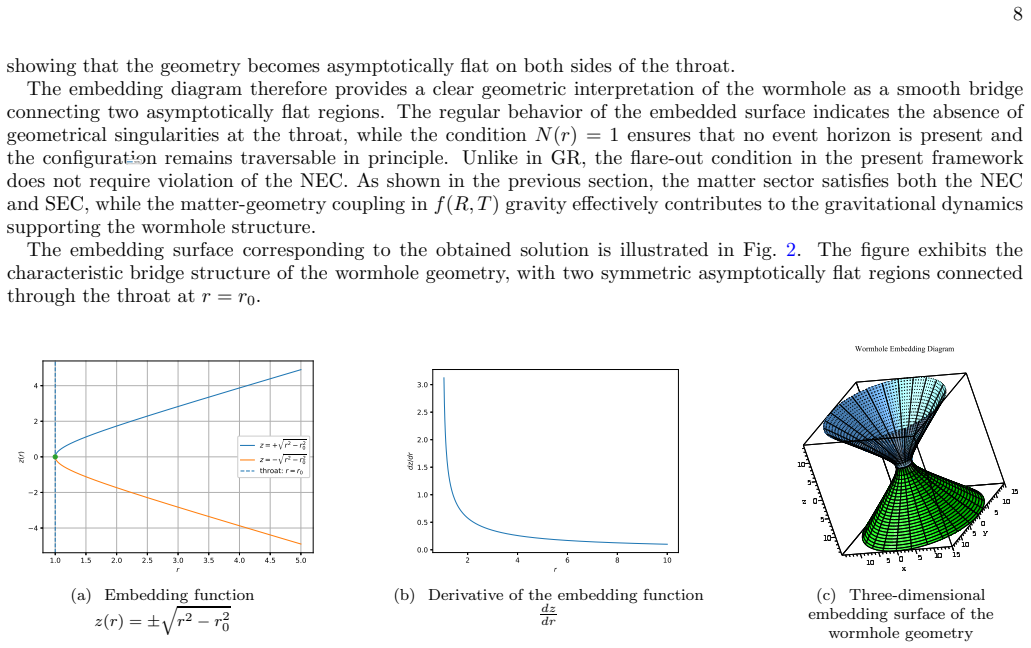
(4.4) Thus, the resulting surface consists of two symmetric branches j oined at the minimum radius r = r0, which defines the wormhole throat. Near the throat, we have dz dr → ∞ , r → r0, (4.5) indicating the characteristic vertical tangent associated with the flare-out behavior. Additionally, for the chosen shape function, we obtain b′(r0) = − 1 < 1, confirm...
1988
-
[2]
Weinberg, Rev
S. Weinberg, Rev. Mod. Phys. 61, 1-23 (1989)
1989
-
[3]
E. Abdalla, G. Franco Abell´ an, A. Aboubrahim, A. Agnell o, O. Akarsu, Y. Akrami, G. Alestas, D. Aloni, L. Amendola and L. A. Anchordoqui, et al. , JHEAp 34, 49 (2022) [ arXiv:2203.06142 [astro-ph.CO] ]
Pith/arXiv arXiv 2022
-
[4]
E. Di Valentino et al. [CosmoVerse Network], Phys. Dark Univ. 49, 101965 (2025) [ arXiv:2504.01669 [astro-ph.CO] ]
Pith/arXiv arXiv 2025
- [5]
-
[6]
E. N. Saridakis et al. [CANTATA], Springer, (2021) [ arXiv:2105.12582 [gr-qc] ]
arXiv 2021
-
[7]
T. Clifton, P. G. Ferreira, A. Padilla and C. Skordis, Phy s. Rept. 513, 1 (2012) [ arXiv:1106.2476 [astro-ph.CO] ]. 18
Pith/arXiv arXiv 2012
-
[8]
S. Nojiri and S. D. Odintsov, Phys. Rept. 505, 59 (2011) [ arXiv:1011.0544 [gr-qc] ]
Pith/arXiv arXiv 2011
-
[9]
S. Capozziello and M. De Laurentis, Phys. Rept. 509, 167 (2011) [ arXiv:1108.6266 [gr-qc] ]
Pith/arXiv arXiv 2011
-
[10]
A. A. Starobinsky, Phys. Lett. B 91, 99 (1980)
1980
-
[11]
A. De Felice and S. Tsujikawa, Living Rev. Rel. 13, 3 (2010) [ arXiv:1002.4928]
Pith/arXiv arXiv 2010
-
[12]
S. Capozziello, Int. J. Mod. Phys. D 11, 483 (2002) [ arXiv:gr-qc/0201033]
Pith/arXiv arXiv 2002
-
[13]
S. Nojiri and S. D. Odintsov, Phys. Lett. B 631, 1 (2005) [ arXiv:hep-th/0508049]
Pith/arXiv arXiv 2005
-
[14]
A. De Felice and S. Tsujikawa, Phys. Lett. B 675, 1-8 (2009) [ arXiv:0810.5712]
Pith/arXiv arXiv 2009
-
[15]
P. Asimakis, S. Basilakos and E. N. Saridakis, Eur. Phys . J. C 84, no.2, 207 (2024) [ arXiv:2212.12494]
arXiv 2024
-
[16]
Lovelock, J
D. Lovelock, J. Math. Phys. 12, 498 (1971)
1971
-
[17]
E. P. Verlinde, JHEP 04, 029 (2011) [ arXiv:1001.0785 [hep-th] ]
Pith/arXiv arXiv 2011
-
[18]
S. M. Carroll and G. N. Remmen, Phys. Rev. D 93, no.12, 124052 (2016) [ arXiv:1601.07558 [hep-th] ]
Pith/arXiv arXiv 2016
-
[19]
G. G. Luciano and E. N. Saridakis, [ arXiv:2602.20004 [gr-qc] ]
-
[20]
M. Leizerovich, S. J. Landau, G. G. Luciano, A. Papatria ntafyllou and E. N. Saridakis, Phys. Dark Univ. 52, 102333 (2026) [ arXiv:2603.03568 [astro-ph.CO] ]
Pith/arXiv arXiv 2026
-
[21]
Y. F. Cai, S. Capozziello, M. De Laurentis and E. N. Sarid akis, Rept. Prog. Phys. 79, 106901 (2016) [arXiv:1511.07586 [gr-qc] ]
Pith/arXiv arXiv 2016
-
[22]
E. V. Linder, Phys. Rev. D 81, 127301 (2010) [erratum: Phys. Rev. D 82, 109902 (2010)] [ arXiv:1005.3039 [astro-ph.CO] ]
Pith/arXiv arXiv 2010
-
[23]
S. H. Chen, J. B. Dent, S. Dutta and E. N. Saridakis, Phys. Rev. D 83, 023508 (2011) [ arXiv:1008.1250 [astro-ph.CO] ]
Pith/arXiv arXiv 2011
-
[24]
J. Beltr´ an Jim´ enez, L. Heisenberg and T. Koivisto, Phys. Rev. D 98, 044048, (2018) [ arXiv:1710.03116 [gr-qc] ]
Pith/arXiv arXiv 2018
-
[25]
L. Heisenberg, Phys. Rept. 1066, 1-78 (2024) [ arXiv:2309.15958 [gr-qc] ]
arXiv 2024
-
[26]
F. K. Anagnostopoulos, S. Basilakos and E. N. Saridakis , Phys. Lett. B 822, 136634 (2021) [ arXiv:2104.15123 [gr-qc] ]
arXiv 2021
-
[27]
T. Harko, F. S. N. Lobo, S. Nojiri and S. D. Odintsov, Phys . Rev. D 84, 024020 (2011) [ arXiv:1104.2669 [gr-qc] ]
Pith/arXiv arXiv 2011
-
[28]
H. Shabani and M. Farhoudi, Phys. Rev. D 88, 044048 (2013) [ arXiv:1306.3164 [gr-qc] ]
Pith/arXiv arXiv 2013
-
[29]
F. G. Alvarenga, A. de la Cruz-Dombriz, M. J. S. Houndjo, M. E. Rodrigues and D. S´ aez-G´ omez, Phys. Rev. D87, 103526 (2013), [erratum: Phys. Rev. D 87, 129905 (2013)] [ arXiv:1302.1866 [gr-qc] ]
Pith/arXiv arXiv 2013
-
[30]
M. Jamil, D. Momeni, M. Raza and R. Myrzakulov, Eur. Phys . J. C 72, 1999 (2012) [ arXiv:1107.5807 [physics.gen-ph] ]
Pith/arXiv arXiv 1999
-
[31]
M. Sharif and M. Zubair, JCAP 03, 028 (2012), [erratum: JCAP 05, E01 (2012)] [ arXiv:1204.0848 [gr-qc] ]
Pith/arXiv arXiv 2012
-
[32]
H. Shabani and M. Farhoudi, Phys. Rev. D 90, 044031 (2014) [ arXiv:1407.6187 [gr-qc] ]
Pith/arXiv arXiv 2014
-
[33]
T. Harko, F. S. N. Lobo, G. Otalora and E. N. Saridakis, JC AP 12, 021 (2014) [ arXiv:1405.0519 [gr-qc] ]
Pith/arXiv arXiv 2014
-
[34]
R. Myrzakulov, Eur. Phys. J. C 72, 2203 (2012) [ arXiv:1207.1039 [gr-qc] ]
Pith/arXiv arXiv 2012
-
[35]
R. Zaregonbadi, M. Farhoudi and N. Riazi, Phys. Rev. D 94, 084052 (2016) [ arXiv:1608.00469 [gr-qc] ]
Pith/arXiv arXiv 2016
-
[36]
P. H. R. S. Moraes, Eur. Phys. J. C 75, 168 (2015) [ arXiv:1502.02593 [gr-qc] ]
Pith/arXiv arXiv 2015
-
[37]
P. H. R. S. Moraes and R. A. C. Correa, Astrophys. Space Sc i. 361, 91 (2016) [ arXiv:1511.08160 [gr-qc] ]
Pith/arXiv arXiv 2016
-
[38]
F. G. Alvarenga, M. J. S. Houndjo, A. V. Monwanou and J. B. C. Orou, J. Mod. Phys. 4, 130 (2013) [arXiv:1205.4678 [gr-qc] ]
Pith/arXiv arXiv 2013
-
[39]
S. Chakraborty, Gen. Rel. Grav. 45, 2039 (2013) [ arXiv:1212.3050 [physics.gen-ph] ]
Pith/arXiv arXiv 2039
-
[40]
M. Z. Bhatti, Z. Yousaf and M. Yousaf, Phys. Dark Univ. 28, 100501 (2020)
2020
-
[41]
E. Barrientos, F. S. N. Lobo, S. Mendoza, G. J. Olmo and D. Rubiera-Garcia, Phys. Rev. D 97, 104041 (2018) [arXiv:1803.05525 [gr-qc] ]
Pith/arXiv arXiv 2018
-
[42]
H. Shabani and A. H. Ziaie, Eur. Phys. J. C 78, 397 (2018) [ arXiv:1708.07874 [gr-qc] ]
Pith/arXiv arXiv 2018
-
[43]
S. K. Maurya, F. Tello-Ortiz and S. Ray, Phys. Dark Univ. 31, 100753 (2021)
2021
-
[44]
M. Gamonal, Phys. Dark Univ. 31, 100768 (2021) [ arXiv:2010.03861 [gr-qc] ]
arXiv 2021
-
[45]
E. H. Baffou, M. J. S. Houndjo, M. E. Rodrigues, A. V. Kpado nou and J. Tossa, Phys. Rev. D 92, 084043 (2015) [arXiv:1504.05496 [gr-qc] ]
Pith/arXiv arXiv 2015
-
[46]
Hansraj and A
S. Hansraj and A. Banerjee, Phys. Rev. D 97, 104020 (2018)
2018
-
[47]
M. Zubair and H. Azmat, Phys. Dark Univ. 28, 100531 (2020) [ arXiv:2012.14552 [gr-qc] ]
arXiv 2020
-
[48]
P. K. Sahoo, B. Mishra and G. Chakradhar Reddy, Eur. Phys . J. Plus 129, 49 (2014)
2014
-
[49]
M. J. S. Houndjo, F. G. Alvarenga, M. E. Rodrigues and D. F . Jardim, Eur. Phys. J. Plus 129, 171 (2014) [arXiv:1207.1646 [gr-qc] ]
Pith/arXiv arXiv 2014
-
[50]
J. K. Singh, Shaily, A. Singh, A. Beesham and H. Shabani, Annals Phys. 455, 169382 (2023) [ arXiv:2304.11578 [gr-qc] ]
arXiv 2023
- [51]
-
[52]
M. A. S. Pinto, T. Harko and F. S. N. Lobo, Phys. Rev. D 106, 044043 (2022) [ arXiv:2205.12545 [gr-qc] ]
arXiv 2022
-
[53]
A. Pradhan, G. Goswami and A. Beesham, JHEAp 38, 12 (2023) [ arXiv:2303.14136 [gr-qc] ]
arXiv 2023
-
[54]
B. Hazarika, A. Baruah and P. Phukon, Phys. Lett. B 875, 140319 (2026) [ arXiv:2508.02213 [gr-qc] ]
arXiv 2026
-
[55]
V. R. Siggia, E. D. Carlson and P. L. Pryor, Class. Quant. Grav. 43, 035012 (2026) [ arXiv:2508.15014 [gr-qc] ]
arXiv 2026
-
[56]
I. S. Farias and P. H. R. S. Moraes, Eur. Phys. J. Plus 141, 153 (2026)
2026
-
[57]
L. Barack, V. Cardoso, S. Nissanke, T. P. Sotiriou, A. As kar, C. Belczynski, G. Bertone, E. Bon, D. Blas and R. Brito, et al., Class. Quant. Grav. 36, 143001 (2019) [ arXiv:1806.05195 [gr-qc] ]
Pith/arXiv arXiv 2019
-
[58]
Einstein and N
A. Einstein and N. Rosen, Phys. Rev. 48, 73-77 (1935)
1935
-
[59]
M. S. Morris and K. S. Thorne, Am. J. Phys. 56, 395-412 (1988)
1988
-
[60]
Visser, Lorentzian Wormholes: From Einstein to Hawking American Institute of Physics, New York (1995)
M. Visser, Lorentzian Wormholes: From Einstein to Hawking American Institute of Physics, New York (1995)
1995
-
[61]
F. S. N. Lobo, Class. Quant. Grav. 23, 1525 (2006) [ arXiv:gr-qc/0508115 [gr-qc] ]
Pith/arXiv arXiv 2006
-
[62]
E. Teo, Phys. Rev. D 58, 024014 (1998) [ arXiv:gr-qc/9803098 [gr-qc] ]
Pith/arXiv arXiv 1998
-
[63]
P. E. Kashargin and S. V. Sushkov, Grav. Cosmol. 14, 80 (2008) [ arXiv:0710.5656 [gr-qc] ]. 19
Pith/arXiv arXiv 2008
-
[64]
P. H. R. S. Moraes, G. Ribeiro and R. A. C. Correa, Astroph ys. Space Sci. 361, 227 (2016) [ arXiv:1602.07159 [hep-th] ]
Pith/arXiv arXiv 2016
-
[65]
M. Zubair, S. Waheed and Y. Ahmad, Eur. Phys. J. C 76, 444 (2016) [ arXiv:1607.05998 [gr-qc] ]
Pith/arXiv arXiv 2016
-
[66]
P. H. R. S. Moraes, W. de Paula and R. A. C. Correa, Int. J. M od. Phys. D 28, 1950098 (2019) [ arXiv:1710.07680 [gr-qc] ]
Pith/arXiv arXiv 2019
-
[67]
D. Deb, F. Rahaman, S. Ray and B. K. Guha, Phys. Rev. D 97, 084026 (2018) [ arXiv:1801.01409 [physics.gen-ph] ]
Pith/arXiv arXiv 2018
-
[68]
P. H. R. S. Moraes and P. K. Sahoo, Eur. Phys. J. C 77, 480 (2017) [ arXiv:1707.01360 [gr-qc] ]
Pith/arXiv arXiv 2017
-
[69]
J. K. Singh, K. Bamba, R. Nagpal and S. K. J. Pacif, Phys. R ev. D 97, 123536 (2018) [ arXiv:1807.01157 [gr-qc] ]
Pith/arXiv arXiv 2018
-
[70]
Sharif and A
M. Sharif and A. Waseem, Eur. Phys. J. C 78, 868 (2018)
2018
-
[71]
A. Das, S. Ghosh, B. K. Guha, S. Das, F. Rahaman and S. Ray, Phys. Rev. D 95, 124011 (2017) [ arXiv:1702.08873 [gr-qc] ]
Pith/arXiv arXiv 2017
-
[72]
Z. Yousaf, M. Z. u. H. Bhatti and M. Ilyas, Eur. Phys. J. C 78, 307 (2018) [ arXiv:1804.04953 [physics.gen-ph] ]
Pith/arXiv arXiv 2018
-
[73]
A. Banerjee, M. K. Jasim and S. G. Ghosh, Annals Phys. 433, 168575 (2021) [ arXiv:2003.01545 [gr-qc] ]
arXiv 2021
-
[74]
Tangphati, S
T. Tangphati, S. Hansraj, A. Banerjee and A. Pradhan, Ph ys. Dark Univ. 35, 100990 (2022)
2022
-
[75]
Azmat, M
H. Azmat, M. Zubair and Z. Ahmad, Annals Phys. 439, 168769 (2022)
2022
-
[76]
Herrera, Phys
L. Herrera, Phys. Lett. A 165, 206 (1992)
1992
-
[77]
H. Abreu, H. Hernandez and L. A. Nunez, Class. Quant. Gra v. 24, 4631 (2007) [ arXiv:0706.3452 [gr-qc] ]
Pith/arXiv arXiv 2007
- [78]
-
[79]
A. A. Ara´ ujo Filho, N. Heidari, I. P. Lobo and V. B. Bezer ra, JCAP 09, 015 (2025), [Erratum: JCAP 01, E01 (2026)] [arXiv:2505.08718 [gr-qc] ]
arXiv 2025
-
[80]
B. Hazarika and P. Phukon, Front. Phys. (Beijing) 20, 35201 (2025) [ arXiv:2410.00606 [gr-qc] ]
arXiv 2025
discussion (0)
Sign in with ORCID, Apple, or X to comment. Anyone can read and Pith papers without signing in.