Probing the imaginary parts and their q² dependences for the tau g-2 and EDM
Pith reviewed 2026-06-28 17:07 UTC · model grok-4.3
The pith
CP-violating interactions generating a non-zero tau EDM also contribute to a_tau through q^2-dependent form factors with imaginary parts.
A machine-rendered reading of the paper's core claim, the machinery that carries it, and where it could break.
Core claim
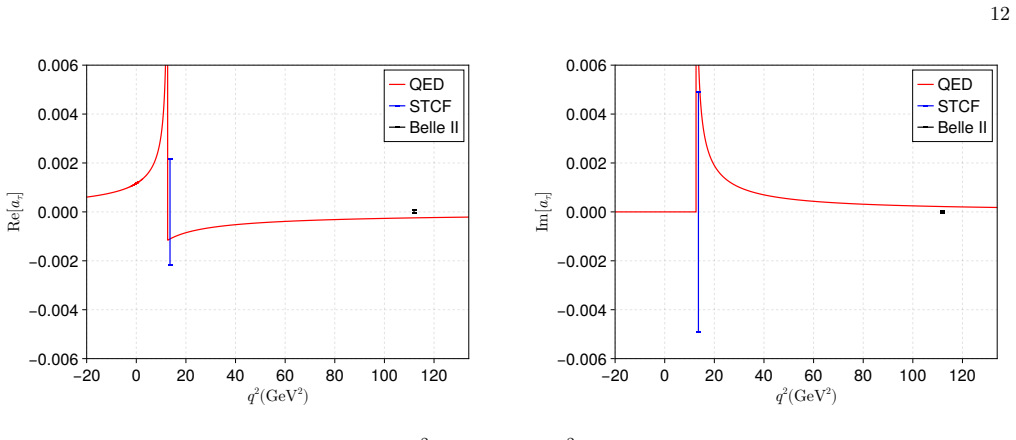
The central claim is that new CP-violating interactions which generate a non-zero d_τ can also generically have non-zero contributions to a_τ. Within the 2HDM, sizable imaginary parts and significant q² running can be generated at levels accessible by e⁺e⁻ colliders. Experimental methods using distinct center-of-mass energies enable extraction of real and imaginary components, improving bounds on a_τ by more than one order of magnitude and providing information on q² evolution.
What carries the argument
The q²-dependent dipole form factors for the tau that acquire absorptive imaginary parts above the tau pair threshold.
If this is right
- CP-violating interactions link a_τ and d_τ studies through shared contributions.
- In 2HDM sizable imaginary parts and q² running are generated accessibly.
- Belle II and STCF improve a_τ bounds by over an order of magnitude.
- Combining data at different energies reveals q² evolution of the form factors.
Where Pith is reading between the lines
- The correlation suggests EDM limits can indirectly constrain a_τ in CP-violating models.
- Multi-energy measurements may apply to other dipole observables.
- q² dependence could affect existing constant-form-factor bounds.
Load-bearing premise
The proposed methods at Belle II and STCF can isolate real and imaginary parts of the dipole form factors at the needed precision.
What would settle it
A lack of improvement in a_τ bounds or no detectable q² dependence in combined collider data at multiple energies would challenge the claims.
Figures
read the original abstract
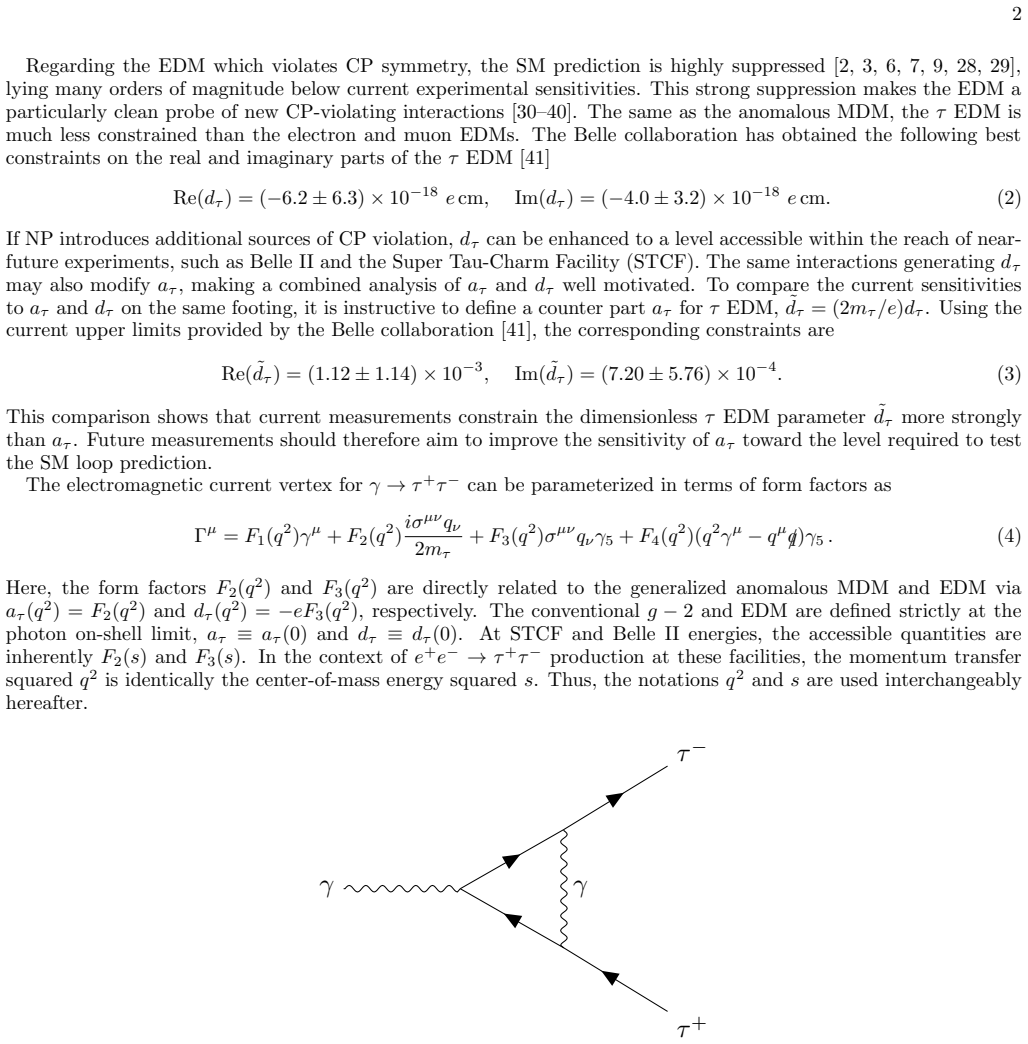
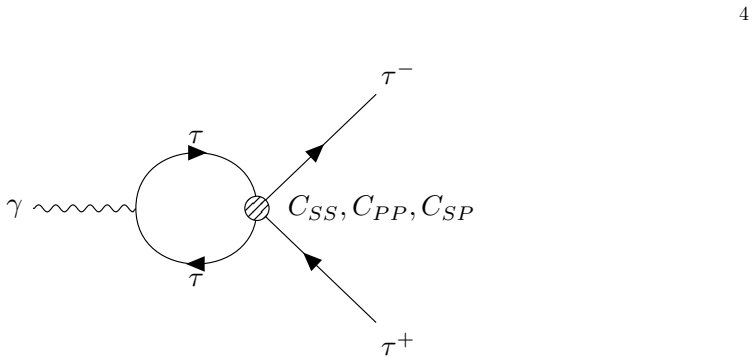
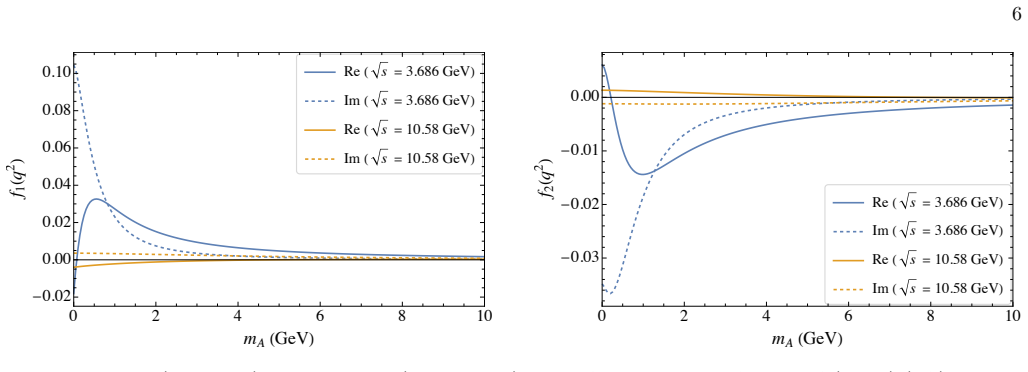
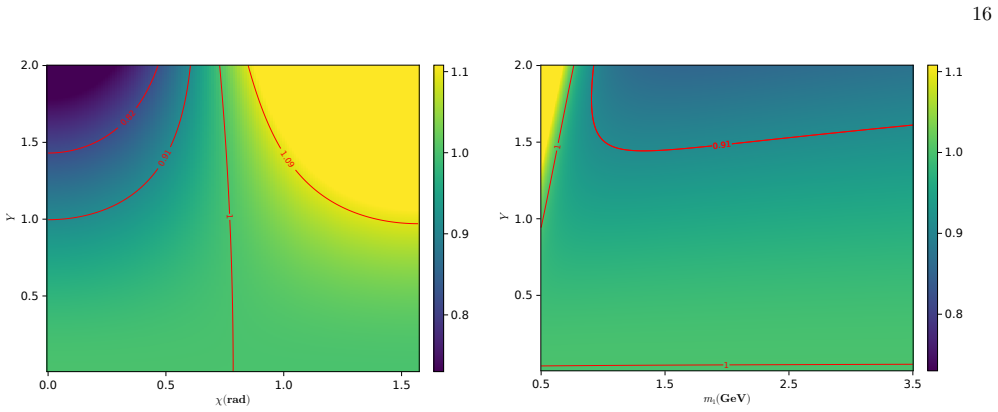
The $\tau$ anomalous magnetic dipole moment (MDM) $a_\tau = (g-2)_\tau/2$ and electric dipole moment (EDM) $d_\tau$, are precision probes of electroweak dynamics and possible new physics sources, yet both remain weakly constrained experimentally. Treated as generalized form factors, these quantities exhibit a generic $q^2$ dependence for an off-shell interacting photon. For timelike momentum transfer above the $\tau^+\tau^-$ threshold, $q^2 = s > 4m_\tau^2$, the form factors can acquire absorptive imaginary parts. We investigate how such a $q^2$ dependence and the associated imaginary parts are generated from two complementary perspectives: the model-independent Standard Model Effective Field Theory (SMEFT) and a UV-complete Two-Higgs-Doublet Model (2HDM). The effective framework reveals the intimate correlation between $a_\tau$ and $d_\tau$. New CP-violating interactions which generate a non-zero $d_{\tau}$, can also generically have non-zero contributions to $a_\tau$, thereby deeply linking their phenomenological studies. Within the 2HDM, we demonstrate that sizable imaginary parts and significant $q^2$ running can be generated at levels accessible by $e^+e^-$ colliders. Motivated by these features, we propose experimental methods to extract both the real and imaginary components of the dipole form factors. Utilizing these techniques, we show that Belle II and the Super Tau-Charm Facility (STCF) can improve current bounds on $a_\tau$ by more than one order of magnitude. Finally, we highlight that combining measurements across the distinct center-of-mass energies of Belle II and STCF provides a unique, previously unexplored avenue to explicitly obtain information about the $q^2$ evolution of these dipole form factors.
Editorial analysis
A structured set of objections, weighed in public.
Referee Report
Summary. The manuscript investigates the q² dependence and imaginary (absorptive) parts of the tau anomalous magnetic moment a_τ and electric dipole moment d_τ above the τ⁺τ⁻ threshold. In SMEFT it identifies a generic correlation arising from CP-violating operators that link non-zero d_τ to contributions in a_τ. In the 2HDM it demonstrates that sizable imaginary parts and q² running can be generated at levels potentially accessible at e⁺e⁻ colliders. The authors propose multi-energy experimental methods to extract real and imaginary components of the dipole form factors and claim that Belle II and STCF can improve existing bounds on a_τ by more than an order of magnitude while also constraining the q² evolution.
Significance. If the experimental extraction methods can be validated, the work would establish a direct phenomenological link between a_τ and d_τ studies, provide a new handle on CP violation in the tau sector, and open a previously unexplored route to mapping the q² dependence of dipole form factors. The model-independent SMEFT correlation is a clear strength; the 2HDM examples illustrate concrete UV realizations that could be tested at upcoming facilities.
major comments (2)
- Experimental proposals section (abstract and main text): The central claim that Belle II and STCF can improve current bounds on a_τ by more than one order of magnitude rests on the feasibility of cleanly separating the real and imaginary parts of the dipole form factors at multiple center-of-mass energies. No quantitative error budget, background-rejection study, Monte-Carlo validation, or statistical/systematic uncertainty analysis is supplied to demonstrate that the required precision—particularly for the absorptive imaginary components above threshold—can be achieved. Without this validation the headline phenomenological result cannot be substantiated.
- 2HDM section: The demonstration that sizable imaginary parts and significant q² running are generated relies on specific parameter choices; the manuscript should explicitly verify that these contributions remain unsuppressed across the viable parameter space and are not canceled by other diagrams or constraints from existing data.
minor comments (1)
- Notation for the generalized dipole form factors (real and imaginary parts) should be introduced with a clear table or equation early in the text to avoid ambiguity when discussing q² dependence.
Simulated Author's Rebuttal
We thank the referee for the thoughtful and constructive report. Below we provide point-by-point responses to the two major comments. We agree that both points identify areas where the manuscript can be strengthened and will incorporate revisions accordingly.
read point-by-point responses
-
Referee: Experimental proposals section (abstract and main text): The central claim that Belle II and STCF can improve current bounds on a_τ by more than one order of magnitude rests on the feasibility of cleanly separating the real and imaginary parts of the dipole form factors at multiple center-of-mass energies. No quantitative error budget, background-rejection study, Monte-Carlo validation, or statistical/systematic uncertainty analysis is supplied to demonstrate that the required precision—particularly for the absorptive imaginary components above threshold—can be achieved. Without this validation the headline phenomenological result cannot be substantiated.
Authors: We acknowledge that the manuscript presents a theoretical proposal for multi-energy extraction of the real and imaginary parts without supplying a full experimental simulation or detailed uncertainty budget. The projected improvement is based on the expected integrated luminosities and the kinematic sensitivity of the dipole contributions to the τ⁺τ⁻ cross section. In the revised manuscript we will add a dedicated subsection with order-of-magnitude statistical uncertainty estimates derived from the expected event yields, together with a qualitative discussion of the dominant systematic effects (beam-energy spread, initial-state radiation, and background rejection). This will make the phenomenological claim more robust while remaining within the scope of a theory paper. revision: yes
-
Referee: 2HDM section: The demonstration that sizable imaginary parts and significant q² running are generated relies on specific parameter choices; the manuscript should explicitly verify that these contributions remain unsuppressed across the viable parameter space and are not canceled by other diagrams or constraints from existing data.
Authors: The benchmark points were selected to lie inside the region allowed by current Higgs, flavor, and electroweak constraints. The imaginary parts arise from the absorptive cuts in the one-loop diagrams involving the additional neutral and charged Higgs bosons. We will revise the section to include a short parameter scan (or additional representative points) showing that the size of the imaginary contributions and the q² slope remain comparable across a broader slice of the viable space and are not canceled by other diagrams once all relevant constraints are imposed. revision: yes
Circularity Check
No circularity; derivation relies on explicit SMEFT/2HDM calculations independent of target observables
full rationale
The paper computes dipole form factor contributions (real and imaginary parts, q² dependence) from SMEFT operators and 2HDM parameters via explicit Feynman diagrams and matching. The experimental extraction proposals at Belle II/STCF are motivated by those computed features but do not reduce to re-fitting or redefining the same observables. No self-citation chains, ansatze smuggled via prior work, or fitted inputs renamed as predictions appear in the derivation. The central phenomenological claims remain externally falsifiable against collider data and are not tautological.
Axiom & Free-Parameter Ledger
Forward citations
Cited by 1 Pith paper
-
Current and future constraints on heavy New Physics from $\tau$ weak dipole moments
Tau weak dipole moments already rank among the leading probes of tau dipole operators and will become dominant at FCC-ee and HL-LHC.
Reference graph
Works this paper leans on
-
[1]
(A6) For simplicity, we can also work in the Higgs basis to show the result
Then the Yukawa interaction can be rewritten by Lh Yukawa =− 3X i=1 mf vsinβ Ri2 + (Y1(Ri1 −cotβR i2)√ 2 ) (hif f) +i( mf cosβ vsinβ − Y1√ 2 sinβ )Ri3(hif f)γ5 . (A6) For simplicity, we can also work in the Higgs basis to show the result. We can do the transformation from the basis we discussed before to Higgs basis [71, 72], where the vev only form the f...
-
[2]
J. S. Schwinger, Phys. Rev.73, 416-417 (1948)
1948
-
[3]
Hoogeveen, Nucl
F. Hoogeveen, Nucl. Phys. B341, 322-340 (1990)
1990
-
[4]
Bernreuther and M
W. Bernreuther and M. Suzuki, Rev. Mod. Phys.63, 313-340 (1991) [erratum: Rev. Mod. Phys.64, 633 (1992)]
1991
-
[5]
Theory of the tau lepton anomalous magnetic moment
S. Eidelman and M. Passera, Mod. Phys. Lett. A22, 159-179 (2007) [arXiv:hep-ph/0701260 [hep-ph]]
work page internal anchor Pith review Pith/arXiv arXiv 2007
-
[6]
F. Jegerlehner and A. Nyffeler, Phys. Rept.477, 1-110 (2009) [arXiv:0902.3360 [hep-ph]]. 17
work page internal anchor Pith review Pith/arXiv arXiv 2009
-
[7]
Electric Dipole Moments of the Atoms, Molecules, Nuclei and Particles
T. Chupp, P. Fierlinger, M. Ramsey-Musolf and J. Singh, Rev. Mod. Phys.91, no.1, 015001 (2019) [arXiv:1710.02504 [physics.atom-ph]]
work page internal anchor Pith review Pith/arXiv arXiv 2019
-
[8]
Y. Yamaguchi and N. Yamanaka, Phys. Rev. Lett.125, 241802 (2020) [arXiv:2003.08195 [hep-ph]]
-
[9]
The anomalous magnetic moment of the muon in the Standard Model
T. Aoyama, N. Asmussen, M. Benayoun, J. Bijnens, T. Blum, M. Bruno, I. Caprini, C. M. Carloni Calame, M. C` e and G. Colangelo,et al.Phys. Rept.887, 1-166 (2020) [arXiv:2006.04822 [hep-ph]]
work page internal anchor Pith review Pith/arXiv arXiv 2020
-
[10]
Y. Yamaguchi and N. Yamanaka, Phys. Rev. D103, no.1, 013001 (2021) [arXiv:2006.00281 [hep-ph]]
-
[11]
R. E. Cutkosky, J. Math. Phys.1, 429-433 (1960)
1960
-
[12]
R. J. Eden, P. V. Landshoff, D. I. Olive and J. C. Polkinghorne, Cambridge Univ. Press, 1966, ISBN 978-0-521-04869-9
1966
-
[13]
Navaset al.[Particle Data Group], Phys
S. Navaset al.[Particle Data Group], Phys. Rev. D110, no.3, 030001 (2024)
2024
-
[14]
G. Aadet al.[ATLAS], Phys. Rev. Lett.131, no.15, 151802 (2023) [arXiv:2204.13478 [hep-ex]]
-
[15]
CP Violation Beyond the Standard Model and Tau Pair Production in $e^+ e^-$ Collisions
W. Bernreuther, A. Brandenburg and P. Overmann, Phys. Lett. B391, 413-419 (1997) [erratum: Phys. Lett. B412, 425-425 (1997)] [arXiv:hep-ph/9608364 [hep-ph]]
work page internal anchor Pith review Pith/arXiv arXiv 1997
-
[16]
Search For Non-Standard Model CP/T violation At Tau-Charm Factory
T. Huang, W. Lu and Z. j. Tao, Phys. Rev. D55, 1643-1652 (1997) [arXiv:hep-ph/9609220 [hep-ph]]
work page internal anchor Pith review Pith/arXiv arXiv 1997
-
[17]
M. Fael, L. Mercolli and M. Passera, Nucl. Phys. B Proc. Suppl.253-255, 103-106 (2014) [arXiv:1301.5302 [hep-ph]]
work page internal anchor Pith review Pith/arXiv arXiv 2014
-
[18]
W. Bernreuther, L. Chen and O. Nachtmann, Phys. Rev. D103, no.9, 096011 (2021) [arXiv:2101.08071 [hep-ph]]
- [19]
- [20]
- [21]
- [22]
- [23]
-
[24]
A. Crivellin, M. Hoferichter and J. M. Roney, Phys. Rev. D106, no.9, 093007 (2022) doi:10.1103/PhysRevD.106.093007 [arXiv:2111.10378 [hep-ph]]
-
[25]
A. Tumasyanet al.[CMS], Phys. Rev. Lett.131, 151803 (2023) doi:10.1103/PhysRevLett.131.151803 [arXiv:2206.05192 [nucl-ex]]
-
[26]
Light new physics and the $\tau$ lepton dipole moments: prospects at Belle II
M. Hoferichter and G. Levati, Phys. Rev. Lett.136, no.18, 181804 (2026) doi:10.1103/d3rt-69rd [arXiv:2510.13966 [hep- ph]]
work page internal anchor Pith review Pith/arXiv arXiv doi:10.1103/d3rt-69rd 2026
-
[27]
Light new physics and the $\tau$ lepton dipole moments
M. Hoferichter and G. Levati, Phys. Rev. D113, no.9, 095002 (2026) doi:10.1103/7rsy-974z [arXiv:2511.03786 [hep-ph]]
work page internal anchor Pith review Pith/arXiv arXiv doi:10.1103/7rsy-974z 2026
-
[28]
Four-fermion operators, $Z$-boson exchange, and $\tau$ lepton dipole moments
J. Gogniat, M. Hoferichter and G. Levati, [arXiv:2604.16598 [hep-ph]]
work page internal anchor Pith review Pith/arXiv arXiv
-
[29]
X. G. He, B. H. J. McKellar and S. Pakvasa, Int. J. Mod. Phys. A4, 5011 (1989) [erratum: Int. J. Mod. Phys. A6, 1063-1066 (1991)]
1989
- [30]
-
[31]
S. M. Barr and A. Zee, Phys. Rev. Lett.65, 21-24 (1990) [erratum: Phys. Rev. Lett.65, 2920 (1990)]
1990
-
[32]
X. G. He, B. H. J. McKellar and S. Pakvasa, Phys. Lett. B283, 348-352 (1992)
1992
-
[33]
M. J. Ramsey-Musolf and S. Su, Phys. Rept.456, 1-88 (2008) [arXiv:hep-ph/0612057 [hep-ph]]
work page internal anchor Pith review Pith/arXiv arXiv 2008
-
[34]
Y. Li, S. Profumo and M. Ramsey-Musolf, JHEP08, 062 (2010) [arXiv:1006.1440 [hep-ph]]
work page internal anchor Pith review Pith/arXiv arXiv 2010
-
[35]
Impact of a CP Violating Higgs: from LHC to Baryogenesis
J. Shu and Y. Zhang, Phys. Rev. Lett.111, no.9, 091801 (2013) [arXiv:1304.0773 [hep-ph]]
work page internal anchor Pith review Pith/arXiv arXiv 2013
-
[36]
Electric Dipole Moments in Two-Higgs-Doublet Models
M. Jung and A. Pich, JHEP04, 076 (2014) [arXiv:1308.6283 [hep-ph]]
work page internal anchor Pith review Pith/arXiv arXiv 2014
-
[37]
CPV Phenomenology of Flavor Conserving Two Higgs Doublet Models
S. Inoue, M. J. Ramsey-Musolf and Y. Zhang, Phys. Rev. D89, no.11, 115023 (2014) [arXiv:1403.4257 [hep-ph]]
work page internal anchor Pith review Pith/arXiv arXiv 2014
-
[38]
Physics of leptoquarks in precision experiments and at particle colliders
I. Dorˇ sner, S. Fajfer, A. Greljo, J. F. Kamenik and N. Koˇ snik, Phys. Rept.641, 1-68 (2016) [arXiv:1603.04993 [hep-ph]]
work page internal anchor Pith review Pith/arXiv arXiv 2016
-
[39]
Electric Dipole Moments from CP-Violating Scalar Leptoquark Interactions
K. Fuyuto, M. Ramsey-Musolf and T. Shen, Phys. Lett. B788, 52-57 (2019) [arXiv:1804.01137 [hep-ph]]
work page internal anchor Pith review Pith/arXiv arXiv 2019
-
[40]
The phenomenology of electric dipole moments in models of scalar leptoquarks
W. Dekens, J. de Vries, M. Jung and K. K. Vos, JHEP01, 069 (2019) [arXiv:1809.09114 [hep-ph]]
work page internal anchor Pith review Pith/arXiv arXiv 2019
- [41]
-
[42]
Inamiet al.[Belle], JHEP04, 110 (2022) [arXiv:2108.11543 [hep-ex]]
K. Inamiet al.[Belle], JHEP04, 110 (2022) [arXiv:2108.11543 [hep-ex]]
- [43]
-
[44]
Dimension-Six Terms in the Standard Model Lagrangian
B. Grzadkowski, M. Iskrzynski, M. Misiak and J. Rosiek, JHEP10, 085 (2010) [arXiv:1008.4884 [hep-ph]]
work page internal anchor Pith review Pith/arXiv arXiv 2010
- [45]
-
[46]
Laporta and E
S. Laporta and E. Remiddi, Phys. Lett. B301, 440-446 (1993)
1993
-
[47]
A. G. Grozin, I. B. Khriplovich and A. S. Rudenko, Phys. Atom. Nucl.72, 1203-1205 (2009) [arXiv:0811.1641 [hep-ph]]
work page internal anchor Pith review Pith/arXiv arXiv 2009
- [48]
- [49]
-
[50]
A. C. Vutha, M. Horbatsch and E. A. Hessels, Phys. Rev. A98, no.3, 032513 (2018) [arXiv:1806.06774 [physics.atom-ph]]
work page internal anchor Pith review Pith/arXiv arXiv 2018
- [51]
-
[52]
A. Hiramoto, T. Masuda, D. G. Ang, C. Meisenhelder, C. Panda, N. Sasao, S. Uetake, X. Wu, D. Demille and J. M. Doyle, et al.Nucl. Instrum. Meth. A1045, 167513 (2023) [arXiv:2210.05727 [physics.ins-det]]
-
[53]
Z. L. Huang, X. Y. Du, X. G. He, C. W. Liu and Z. Y. Zou, Chin. Phys. Lett.43, no.3, 030201 (2026) [arXiv:2510.23348 [hep-ph]]
work page internal anchor Pith review Pith/arXiv arXiv 2026
-
[54]
Y. L. Wu and L. Wolfenstein, Phys. Rev. Lett.73, 1762-1764 (1994) [arXiv:hep-ph/9409421 [hep-ph]]
work page internal anchor Pith review Pith/arXiv arXiv 1994
-
[55]
Ablikimet al.[BESIII] 2023Phys
M. Ablikimet al.[BESIII] 2023Phys. Lett. B838137698
-
[56]
Multi-Photon Production in e+e- collisions at sqrt(s) = 181 - 209 GeV
G. Abbiendiet al.[OPAL], Eur. Phys. J. C26, 331-344 (2003) [arXiv:hep-ex/0210016 [hep-ex]]
work page internal anchor Pith review Pith/arXiv arXiv 2003
-
[57]
Searching for axion-like particles with ultra-peripheral heavy-ion collisions
S. Knapen, T. Lin, H. K. Lou and T. Melia, Phys. Rev. Lett.118, no.17, 171801 (2017) [arXiv:1607.06083 [hep-ph]]
work page internal anchor Pith review Pith/arXiv arXiv 2017
- [58]
-
[59]
L. Beresford, S. Clawson and J. Liu, Phys. Rev. D110, no.9, 092016 (2024) [arXiv:2403.06336 [hep-ph]]
-
[60]
J. Gogniat, M. Hoferichter and Y. Ulrich, JHEP07, 172 (2025) [arXiv:2505.09678 [hep-ph]]
-
[61]
S. Dittmaier, T. Engel, J. L. H. Ariza and M. Pellen, JHEP08, 051 (2025) [arXiv:2504.11391 [hep-ph]]
-
[62]
Probing $\tau$ lepton dipole moments at future Lepton Colliders
D. Buttazzo, G. Levati, Y. Ma, F. Maltoni, P. Paradisi and Z. Wang, [arXiv:2604.14281 [hep-ph]]
work page internal anchor Pith review Pith/arXiv arXiv
- [63]
- [64]
-
[65]
W. Bernreuther, L. Chen and O. Nachtmann, Phys. Rev. D104, no.11, 115002 (2021) [arXiv:2108.13106 [hep-ph]]
-
[66]
E. Kouet al.[Belle-II], PTEP2019, no.12, 123C01 (2019) [erratum: PTEP2020, no.2, 029201 (2020)] [arXiv:1808.10567 [hep-ex]]
-
[67]
Aggarwalet al.[Belle-II], [arXiv:2207.06307 [hep-ex]]
L. Aggarwalet al.[Belle-II], [arXiv:2207.06307 [hep-ex]]
-
[68]
M. Achasov, X. C. Ai, R. Aliberti, L. P. An, Q. An, X. Z. Bai, Y. Bai, O. Bakina, A. Barnyakov and V. Blinov,et al. Front. Phys. (Beijing)19, no.1, 14701 (2024) [arXiv:2303.15790 [hep-ex]]
-
[69]
Complementarity Between Non-Standard Higgs Searches and Precision Higgs Measurements in the MSSM
M. Carena, H. E. Haber, I. Low, N. R. Shah and C. E. M. Wagner, Phys. Rev. D91, no.3, 035003 (2015) [arXiv:1410.4969 [hep-ph]]
work page internal anchor Pith review Pith/arXiv arXiv 2015
-
[70]
P. S. Bhupal Dev and A. Pilaftsis, J. Phys. Conf. Ser.873, no.1, 012008 (2017) [arXiv:1703.05730 [hep-ph]]
work page internal anchor Pith review Pith/arXiv arXiv 2017
- [71]
-
[72]
J. F. Gunion and H. E. Haber, Phys. Rev. D67, 075019 (2003) [arXiv:hep-ph/0207010 [hep-ph]]
work page internal anchor Pith review Pith/arXiv arXiv 2003
-
[73]
S. Davidson and H. E. Haber, Phys. Rev. D72, 035004 (2005) [erratum: Phys. Rev. D72, 099902 (2005)] [arXiv:hep- ph/0504050 [hep-ph]]
-
[74]
A. Tumasyanet al.[CMS], Eur. Phys. J. C83, no.7, 667 (2023) [arXiv:2206.09466 [hep-ex]]
-
[75]
H. E. Haber and D. O’Neil, Phys. Rev. D83, 055017 (2011) [arXiv:1011.6188 [hep-ph]]
work page internal anchor Pith review Pith/arXiv arXiv 2011
-
[76]
G. Aadet al.[ATLAS], Phys. Lett. B842, 137963 (2023) [arXiv:2301.10731 [hep-ex]]
-
[77]
[LEP Higgs Working Group for Higgs boson searches, ALEPH, DELPHI, L3 and OPAL], [arXiv:hep-ex/0107031 [hep-ex]]
work page internal anchor Pith review Pith/arXiv arXiv
-
[78]
Search for Charged Higgs bosons: Combined Results Using LEP Data
G. Abbiendiet al.[ALEPH, DELPHI, L3, OPAL and LEP], Eur. Phys. J. C73, 2463 (2013) [arXiv:1301.6065 [hep-ex]]
work page internal anchor Pith review Pith/arXiv arXiv 2013
- [79]
-
[80]
LHC HXSWG interim recommendations to explore the coupling structure of a Higgs-like particle
A. Davidet al.[LHC Higgs Cross Section Working Group], [arXiv:1209.0040 [hep-ph]]
work page internal anchor Pith review Pith/arXiv arXiv
discussion (0)
Sign in with ORCID, Apple, or X to comment. Anyone can read and Pith papers without signing in.