Markovianity-Based Conditioning Depth Diagnostics for Hidden Confounding in Observational Datasets
Pith reviewed 2026-06-28 16:08 UTC · model grok-4.3
The pith
Inferred causal graphs stabilize with added conditioning depth when the observed time series is approximately Markovian but keep changing if hidden confounding is present.
A machine-rendered reading of the paper's core claim, the machinery that carries it, and where it could break.
Core claim
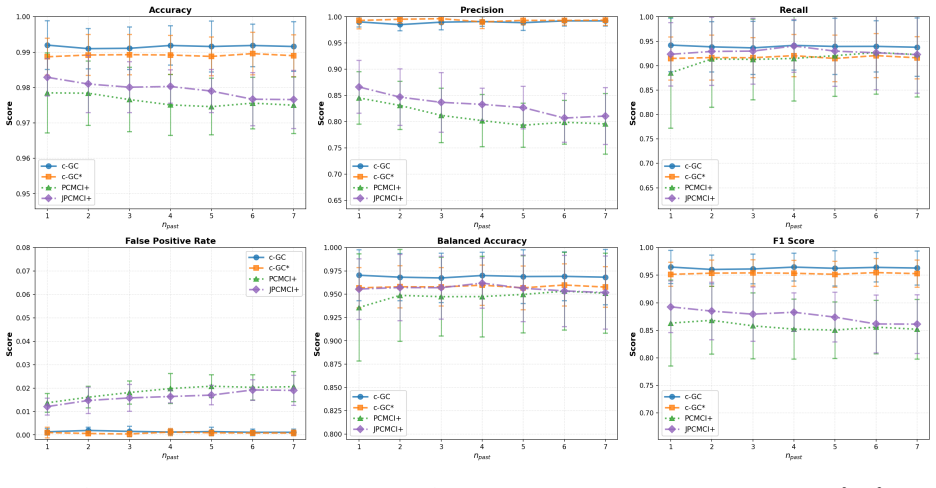
When the observed process is described approximately by a finite-order Markovian representation, inferred graphs should stabilize once sufficient past observations are observed. Hidden confounding and other hidden-memory mechanisms should remain sensitive to depth when the observed state is incomplete. The authors formalize this behavior with graph instability statistics computed over the conditioning-depth grid and evaluate the pattern on both synthetic systems with known ground truth and calcium imaging recordings.
What carries the argument
Graph instability statistics computed over the conditioning-depth grid, which quantify how much the inferred causal graph changes as more past observations are added to the conditioning set.
If this is right
- In synthetic Markovian systems the inferred graphs stabilize after sufficient depth.
- In synthetic systems with hidden memory the graphs remain sensitive to further depth increases.
- c-GC variants produce the clearest separation between Markovian and hidden-memory cases.
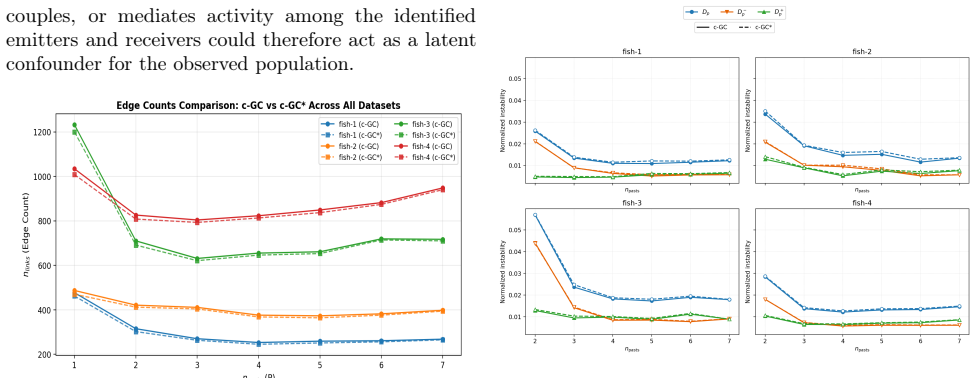
- In real calcium imaging data the number of inferred connections drops sharply then levels off with increasing depth.
Where Pith is reading between the lines
- Practitioners could use the instability measure to select a minimal sufficient conditioning depth before reporting causal claims.
- The diagnostic might be paired with separate tests for stationarity to reduce confusion between confounding and other sources of instability.
- The same depth-sensitivity idea could be applied to score-based or other families of causal discovery algorithms beyond the constraint-based ones tested here.
Load-bearing premise
Observed changes in inferred graphs with conditioning depth are driven primarily by hidden confounding rather than lag-order misspecification, non-stationarity, or measurement error.
What would settle it
A controlled experiment in which a known finite-order Markovian system without hidden variables produces large continued graph changes with depth, or a system with documented hidden confounding produces no sensitivity to depth.
Figures



read the original abstract
Reliable causal discovery in time series depends on whether the conditioning set adequately represents the system state. If relevant history or unobserved processes are omitted, residual dependence can appear as direct causal links. We study this failure mode on promnient constraint-based causal discovery methods through a simple premise: how much does the inferred graph change as conditioning depth increases? When the observed process is described approximately by a finite-order Markovian representation, inferred graphs should stabilize once sufficient past observations are observed. Hidden confounding and other hidden-memory mechanisms should remain sensitive to depth when the observed state is incomplete. We formalise this behavior with graph instability statistics computed over the conditioning-depth grid. The empirical study covers synthetic systems with known ground truth and calcium imaging recordings with unknown causal structure. In simulations, both Markovian and non-Markovian systems relatively upheld our premise. With known ground truth, we evaluate recovery using confusion matrix metrics; while in real data without ground truth, we use descriptive graph instability summaries. Across synthetic Markovian and hidden memory systems, c-GC variants give the clearest separation, while PCMCI variants show weaker compatible trends. In real data, inferred connectivity drops sharply with conditioning depths and then levels off. This method, however, does not recover latent graphs, nor does it clearly separate latent confounding from lag-order misspecification, non-stationarity, measurement error. Its contribution is more modest and practical: and explicit model-checking tool for deciding when causal claims are stable and when they should be treated caustiosly.
Editorial analysis
A structured set of objections, weighed in public.
Referee Report
Summary. The manuscript proposes a conditioning-depth diagnostic for time series causal discovery based on the premise that, under approximate finite-order Markovianity, inferred graphs from constraint-based methods stabilize as the depth of conditioning on past observations increases, while hidden confounding or other hidden-memory effects produce persistent sensitivity. Graph instability statistics are introduced to quantify changes over a grid of conditioning depths. The approach is evaluated on synthetic systems with known ground truth (using confusion-matrix recovery metrics) and on calcium imaging recordings (using descriptive instability summaries). c-GC variants are reported to yield clearer separation than PCMCI variants; the authors explicitly state that the method does not recover latent graphs and cannot isolate confounding from lag-order misspecification, non-stationarity or measurement error, positioning the contribution as a practical model-checking tool for deciding when causal claims are stable.
Significance. If the reported empirical patterns hold, the work supplies a modest but directly usable diagnostic that helps practitioners assess the stability of causal inferences drawn from observational time series—an important practical need given the prevalence of unobserved processes. The study includes both controlled synthetic experiments and real-data application, and the authors are transparent about the method’s scope and limitations. These features make the contribution useful for applied causal discovery even without stronger claims about mechanism identification.
major comments (1)
- [Abstract] Abstract: the statement that simulations 'relatively upheld our premise' with 'clearer separation' for c-GC variants is presented without any reported numerical values of the instability statistics, separation metrics, or statistical tests comparing Markovian versus non-Markovian regimes. Because the central claim rests on these simulations supporting the diagnostic’s utility, the absence of quantitative results weakens the ability to judge the strength of evidence.
minor comments (3)
- [Abstract] Abstract: 'promnient' is a typographical error for 'prominent'.
- [Abstract] Abstract: 'caustiosly' is a typographical error for 'cautiously'.
- [Abstract] Abstract: the phrase 'Its contribution is more modest and practical: and explicit model-checking tool' contains a grammatical error ('and' should be 'an').
Simulated Author's Rebuttal
We thank the referee for the constructive feedback and the recommendation for minor revision. We address the single major comment below.
read point-by-point responses
-
Referee: [Abstract] Abstract: the statement that simulations 'relatively upheld our premise' with 'clearer separation' for c-GC variants is presented without any reported numerical values of the instability statistics, separation metrics, or statistical tests comparing Markovian versus non-Markovian regimes. Because the central claim rests on these simulations supporting the diagnostic’s utility, the absence of quantitative results weakens the ability to judge the strength of evidence.
Authors: We agree that the abstract would be strengthened by including concrete numerical values. The main text reports confusion-matrix metrics and instability statistics for the synthetic experiments (including separation between Markovian and hidden-memory regimes), but these were summarized qualitatively in the abstract to respect length limits. In the revised version we will insert the key quantitative results (e.g., mean instability values and separation gaps for c-GC versus PCMCI) directly into the abstract while keeping the statement within the journal’s word limit. revision: yes
Circularity Check
No significant circularity; diagnostic defined independently of fitted outputs and validated on external synthetic benchmarks
full rationale
The paper states a premise about Markovian stabilization versus depth sensitivity under hidden memory, then defines graph instability statistics over a conditioning-depth grid as a model-checking tool. This definition does not reduce to a fitted parameter or self-referential construction; the statistics are computed directly from inferred graphs at varying depths. Synthetic experiments use known ground truth to evaluate recovery via confusion matrices, providing an external benchmark independent of the diagnostic itself. The abstract explicitly disclaims separation of confounding from misspecification or non-stationarity, confirming the contribution is modest and non-circular. No self-citation load-bearing steps or ansatz smuggling appear in the provided text.
Axiom & Free-Parameter Ledger
axioms (1)
- domain assumption The observed process can be approximated by a finite-order Markovian representation in the absence of hidden confounding.
Reference graph
Works this paper leans on
-
[1]
and Ebert-Uphoff, Imme , title =
Samarasinghe, Savini and Barnes, Elizabeth A. and Ebert-Uphoff, Imme , title =. 8th International Workshop on Climate Informatics , year =
-
[2]
2000 , publisher=
Causation, prediction, and search , author=. 2000 , publisher=
2000
-
[3]
and Ramsey, Joseph D
Raghu, Vineet K. and Ramsey, Joseph D. and Morris, Alison and Manatakis, Dimitrios V. and Sprites, Peter and Chrysanthis, Panos K. and Glymour, Clark and Benos, Panayiotis V. , title =. Applied Network Science , year =
-
[4]
International Conference on Machine Learning , pages=
Time series deconfounder: Estimating treatment effects over time in the presence of hidden confounders , author=. International Conference on Machine Learning , pages=. 2020 , organization=
2020
-
[5]
Statistical science , volume=
Confounding and collapsibility in causal inference , author=. Statistical science , volume=. 1999 , publisher=
1999
-
[6]
arXiv preprint arXiv:2305.19582 , year=
Causal Discovery with Latent Confounders Based on Higher-Order Cumulants , author=. arXiv preprint arXiv:2305.19582 , year=
-
[7]
Advances in neural information processing systems , volume=
Causal effect inference with deep latent-variable models , author=. Advances in neural information processing systems , volume=
-
[8]
Detecting Confounders in Multivariate Time Series using Strength of Causation , journal =
Liu, Yuhao and Cui, Chen and Waxman, Daniel and Butler, Kurt and Djuri. Detecting Confounders in Multivariate Time Series using Strength of Causation , journal =. 2023 , institution =
2023
-
[9]
Machine Learning and Knowledge Discovery in Databases (ECML PKDD 2017) , year =
Jabbari, Fattaneh and Ramsey, Joseph and Spirtes, Peter and Cooper, Gregory , title =. Machine Learning and Knowledge Discovery in Databases (ECML PKDD 2017) , year =
2017
-
[10]
2025 , url =
Wikipedia contributors , title =. 2025 , url =
2025
-
[11]
arXiv preprint arXiv:2510.04263 , year =
Ramsey, Joseph and Andrews, Bryan and Spirtes, Peter , title =. arXiv preprint arXiv:2510.04263 , year =
-
[12]
and Wei, Peng and Xu, Hua and Bernstam, Elmer V
Malec, Scott A. and Wei, Peng and Xu, Hua and Bernstam, Elmer V. and Myneni, Sahiti and Cohen, Trevor , title =. AMIA Summits on Translational Science Proceedings , year =
-
[13]
, title =
Grimmer, Justin and Knox, Dean and Stewart, Brandon M. , title =. Journal of Machine Learning Research , year =
-
[14]
Statistical Methods in Medical Research , year =
Penning de Vries, Bas BL and Groenwold, Rolf HH , title =. Statistical Methods in Medical Research , year =
-
[15]
arXiv preprint arXiv:2507.01700 , year =
Negro, Matteo and Piras, Andrea and Ahsan, Ragib and Arbour, David and Zheleva, Elena , title =. arXiv preprint arXiv:2507.01700 , year =
-
[16]
arXiv preprint arXiv:2510.09109 , year =
Bach, Philipp and Chernozhukov, Victor and Cinelli, Carlos and Jia, Lin and Skotara, Nils and Klaassen, Sven and Spindler, Martin , title =. arXiv preprint arXiv:2510.09109 , year =
-
[17]
and Zhang, Kun and Glymour, Madelyn and Sanchez Romero, Ruben and Huang, Biwei and Ebert-Uphoff, Imme and Samarasinghe, Savini and Barnes, Elizabeth A
Ramsey, Joseph D. and Zhang, Kun and Glymour, Madelyn and Sanchez Romero, Ruben and Huang, Biwei and Ebert-Uphoff, Imme and Samarasinghe, Savini and Barnes, Elizabeth A. and Glymour, Clark , title =. 8th International Workshop on Climate Informatics , year =
-
[18]
Tony and Small, Dylan S
Guo, Zijian and Kang, Hyunseung and Cai, T. Tony and Small, Dylan S. , title =. 2016 , month =
2016
-
[19]
Journal of the American Statistical Association , year =
D’Amour, Alexander , title =. Journal of the American Statistical Association , year =
-
[20]
and Pollmann, Michael , title =
Athey, Susan and Imbens, Guido W. and Pollmann, Michael , title =. Journal of the American Statistical Association , year =
-
[21]
and Shpitser, Ilya and Tchetgen Tchetgen, Eric J
Ogburn, Elizabeth L. and Shpitser, Ilya and Tchetgen Tchetgen, Eric J. , title =. Journal of the American Statistical Association , year =
-
[22]
, title =
Wang, Yixin and Blei, David M. , title =. Journal of the American Statistical Association , year =
-
[23]
2026 , note =
Theoretical and Algorithmic Frontiers in the Detection of Latent Confounding within Observational Systems , author =. 2026 , note =
2026
-
[24]
Re-examining Granger Causality with Causal Bayesian Networks and Reichenbachs Principles
Re-examining Granger Causality with Causal Bayesian Networks and Reichenbach’s Principles , author=. arXiv preprint https://arxiv.org/pdf/2501.02672v2 , year=
work page internal anchor Pith review Pith/arXiv arXiv
-
[25]
Communications Physics , year=
Observational causality by states and interaction type for scientific discovery , author=. Communications Physics , year=
-
[26]
Proceedings of the 2023 ACM Conference on Fairness, Accountability, and Transparency , pages=
The dataset multiplicity problem: How unreliable data impacts predictions , author=. Proceedings of the 2023 ACM Conference on Fairness, Accountability, and Transparency , pages=
2023
-
[27]
arXiv preprint arXiv:2305.10032 , year =
Zanga, Alessio and Ozkirimli, Elif and Stella, Fabio , title =. arXiv preprint arXiv:2305.10032 , year =
- [28]
-
[29]
arXiv preprint arXiv:2209.03427 , year =
Reiser, Christoph , title =. arXiv preprint arXiv:2209.03427 , year =
-
[30]
Detecting confounders in multivariate time series using strength of causation , booktitle =
Liu, Yuchen and Cui, Chengyuan and Waxman, David and Butler, Katherine and Djuri\'. Detecting confounders in multivariate time series using strength of causation , booktitle =
-
[31]
Multivariate Behavioral Research , year =
Loh, Wei Wah and others , title =. Multivariate Behavioral Research , year =
-
[32]
Proceedings of the AAAI Conference on Artificial Intelligence , year =
Chen, Wei and others , title =. Proceedings of the AAAI Conference on Artificial Intelligence , year =
-
[33]
and Cole, Stephen R
Naimi, Ashley I. and Cole, Stephen R. and Kennedy, Edward H. , title =. International Journal of Epidemiology , volume =. 2017 , doi =
2017
-
[34]
arXiv preprint arXiv:2410.21328v2 , year =
Gao, Wentao and Li, Jiuyong and Cheng, Debo and Liu, Lin and Liu, Jixue and Le, Thuc and Du, Xiaojing and Chen, Xiongren and Chen, Yun and Zhao, Yanchang , title =. arXiv preprint arXiv:2410.21328v2 , year =
-
[35]
Proceedings of the 34th International Joint Conference on Artificial Intelligence (IJCAI-25) , year =
Gao, Wentao and Li, Jiuyong and Cheng, Debo and Liu, Lin and Liu, Jixue and Le, Thuc and Du, Xiaojing and Chen, Xiongren and Chen, Yun and Zhao, Yanchang , title =. Proceedings of the 34th International Joint Conference on Artificial Intelligence (IJCAI-25) , year =
-
[36]
and Nguyen, Trang Quynh and Zandi, Peter P
Ringlein, Grace V. and Nguyen, Trang Quynh and Zandi, Peter P. and Stuart, Elizabeth A. , title =. arXiv preprint , month =
-
[37]
Identifying Causal Effects using Instrumental Time Series: Nuisance IV and Correcting for the Past , journal =
Thams, Nikolaj and S. Identifying Causal Effects using Instrumental Time Series: Nuisance IV and Correcting for the Past , journal =
-
[38]
European journal of epidemiology , volume=
Handling unobserved confounding in the relation between prenatal risk factors and child outcomes: a latent variable strategy , author=. European journal of epidemiology , volume=. 2022 , publisher=
2022
-
[39]
Proceedings of the AAAI Conference on Artificial Intelligence , volume =
Cheng, Debo and Xu, Ziqi and Li, Jiuyong and Liu, Lin and Liu, Jixue and Gao, Wentao and Le, Thuc Duy , title =. Proceedings of the AAAI Conference on Artificial Intelligence , volume =. 2024 , doi =
2024
-
[40]
arXiv preprint arXiv:2505.05192v2 , year =
Cai, Ruichu and Wan, Junjie and Chen, Weilin and Yang, Zeqin and Li, Zijian and Zhen, Peng and Guo, Jiecheng , title =. arXiv preprint arXiv:2505.05192v2 , year =
-
[41]
Pharmacoepidemiology and Drug Safety , volume =
Pazzagli, Laura and Linder, Marie and Zhang, Mingliang and Vago, Emese and Stang, Paul and Myers, David and Andersen, Morten and Bahmanyar, Shahram , title =. Pharmacoepidemiology and Drug Safety , volume =. 2018 , doi =
2018
-
[42]
, title =
Liu, Jiewen and Park, Chan and Li, Kendrick and Tchetgen Tchetgen, Eric J. , title =. American Journal of Epidemiology , volume =. 2025 , doi =
2025
-
[43]
Journal of the American Statistical Association , volume =
Imai, Kosuke and Jiang, Zhichao , title =. Journal of the American Statistical Association , volume =. 2019 , doi =
2019
-
[44]
Journal of Biomedical Informatics , year =
Feng, Zheng and Prosperi, Mattia and Guo, Yi and Bian, Jiang , title =. Journal of Biomedical Informatics , year =
-
[45]
Journal of the Royal Statistical Society Series B , volume =
Benjamini, Yoav and Hochberg, Yosef , title =. Journal of the Royal Statistical Society Series B , volume =. 1995 , doi =
1995
-
[46]
Journal of Econometrics , volume =
Eichler, Michael , title =. Journal of Econometrics , volume =. 2007 , doi =
2007
-
[47]
Probability Theory and Related Fields , volume =
Eichler, Michael , title =. Probability Theory and Related Fields , volume =. 2012 , doi =
2012
-
[48]
Philosophical Transactions of the Royal Society A , volume =
Eichler, Michael , title =. Philosophical Transactions of the Royal Society A , volume =. 2013 , doi =
2013
-
[49]
Granger, Clive W. J. , title =. Econometrica , volume =. 1969 , doi =
1969
-
[50]
Advances in Neural Information Processing Systems , volume =
Gerhardus, Andreas and Runge, Jakob , title =. Advances in Neural Information Processing Systems , volume =
-
[51]
The Jackknife and the Bootstrap for General Stationary Observations , journal =
K. The Jackknife and the Bootstrap for General Stationary Observations , journal =. 1989 , doi =
1989
-
[52]
Proceedings of Machine Learning Research , volume =
Malinsky, Daniel and Spirtes, Peter , title =. Proceedings of Machine Learning Research , volume =
-
[53]
and Romano, Joseph P
Politis, Dimitris N. and Romano, Joseph P. , title =. Journal of the American Statistical Association , volume =. 1994 , doi =
1994
-
[54]
Proceedings of Machine Learning Research , volume =
Runge, Jakob , title =. Proceedings of Machine Learning Research , volume =
-
[55]
Journal of the American Statistical Association , volume =
Chen, Li and Li, Chunlin and Shen, Xiaotong and Pan, Wei , title =. Journal of the American Statistical Association , volume =. 2024 , doi =
2024
-
[56]
and Kalisch, Markus and Richardson, Thomas S
Colombo, Diego and Maathuis, Marloes H. and Kalisch, Markus and Richardson, Thomas S. , title =. Annals of Statistics , volume =. 2012 , doi =
2012
-
[57]
D'Amour, Alexander , title =. arXiv preprint arXiv:1902.10286 , year =
work page internal anchor Pith review Pith/arXiv arXiv 1902
-
[58]
Annals of Statistics , volume =
Foygel, Rina and Draisma, Jan and Drton, Mathias , title =. Annals of Statistics , volume =. 2012 , doi =
2012
-
[59]
, title =
Entner, Dorothea and Hoyer, Patrik O. , title =. Proceedings of the Fifth European Workshop on Probabilistic Graphical Models , pages =
-
[60]
Advances in Neural Information Processing Systems , volume =
Gerhardus, Andreas and Runge, Jakob , title =. Advances in Neural Information Processing Systems , volume =. 2020 , url =
2020
-
[61]
and Shimizu, Shohei and Kerminen, Antti J
Hoyer, Patrik O. and Shimizu, Shohei and Kerminen, Antti J. and Palviainen, Markus , title =. International Journal of Approximate Reasoning , volume =. 2008 , doi =
2008
-
[62]
Biometrika , volume =
Kuroki, Manabu and Pearl, Judea , title =. Biometrika , volume =. 2014 , doi =
2014
-
[63]
International Journal of Approximate Reasoning , volume =
Hyttinen, Antti and Plis, Sergey and Jarvisalo, Matti and Eberhardt, Frederick and Danks, David , title =. International Journal of Approximate Reasoning , volume =. 2017 , doi =
2017
-
[64]
Proceedings of the 22nd ACM SIGKDD International Conference on Knowledge Discovery and Data Mining , pages =
Kummerfeld, Erich and Ramsey, Joseph , title =. Proceedings of the 22nd ACM SIGKDD International Conference on Knowledge Discovery and Data Mining , pages =. 2016 , doi =
2016
-
[65]
Epidemiology , volume =
Lipsitch, Marc and Tchetgen Tchetgen, Eric and Cohen, Ted , title =. Epidemiology , volume =. 2010 , doi =
2010
-
[66]
Proceedings of Machine Learning Research , volume =
Malinsky, Daniel and Spirtes, Peter , title =. Proceedings of Machine Learning Research , volume =. 2018 , url =
2018
-
[67]
, title =
Miao, Wang and Geng, Zhi and Tchetgen Tchetgen, Eric J. , title =. Biometrika , volume =. 2018 , doi =
2018
-
[68]
Proceedings of the Eighth International Conference on Probabilistic Graphical Models , pages =
Ogarrio, Juan Miguel and Spirtes, Peter and Ramsey, Joe , title =. Proceedings of the Eighth International Conference on Probabilistic Graphical Models , pages =. 2016 , volume =
2016
-
[69]
Biometrika , volume =
Pearl, Judea , title =. Biometrika , volume =. 1995 , doi =
1995
-
[70]
Pearl, Judea , title =
-
[71]
Peters, Jonas and Janzing, Dominik and Scholkopf, Bernhard , title =
-
[72]
Annals of Statistics , volume =
Richardson, Thomas and Spirtes, Peter , title =. Annals of Statistics , volume =. 2002 , doi =
2002
-
[73]
Chaos: An Interdisciplinary Journal of Nonlinear Science , volume =
Runge, Jakob , title =. Chaos: An Interdisciplinary Journal of Nonlinear Science , volume =. 2018 , doi =
2018
-
[74]
Science Advances , volume =
Runge, Jakob and Nowack, Peer and Kretschmer, Marlene and Flaxman, Seth and Sejdinovic, Dino , title =. Science Advances , volume =. 2019 , doi =
2019
-
[75]
Proceedings of the 36th Conference on Uncertainty in Artificial Intelligence , pages =
Runge, Jakob , title =. Proceedings of the 36th Conference on Uncertainty in Artificial Intelligence , pages =. 2020 , volume =
2020
-
[76]
Causal Discovery for Time Series from Multiple Datasets with Latent Contexts , booktitle =
G. Causal Discovery for Time Series from Multiple Datasets with Latent Contexts , booktitle =. 2023 , editor =
2023
-
[77]
Nature Reviews Earth & Environment , volume =
Runge, Jakob and Gerhardus, Andreas and Varando, Gherardo and Eyring, Veronika and Camps-Valls, Gustau , title =. Nature Reviews Earth & Environment , volume =. 2023 , doi =
2023
-
[78]
, title =
Shi, Xu and Miao, Wang and Tchetgen Tchetgen, Eric J. , title =. Current Epidemiology Reports , volume =. 2020 , doi =
2020
-
[79]
and Tchetgen Tchetgen, Eric J
Shi, Xu and Miao, Wang and Nelson, Jennifer C. and Tchetgen Tchetgen, Eric J. , title =. Journal of the Royal Statistical Society: Series B , volume =. 2020 , doi =
2020
-
[80]
and Hyvarinen, Aapo and Kerminen, Antti , title =
Shimizu, Shohei and Hoyer, Patrik O. and Hyvarinen, Aapo and Kerminen, Antti , title =. Journal of Machine Learning Research , volume =. 2006 , url =
2006
discussion (0)
Sign in with ORCID, Apple, or X to comment. Anyone can read and Pith papers without signing in.