SweetFruit: A Two-Stage Mobile Sensing System for Real-Time Fruit Sugar Estimation
Pith reviewed 2026-06-28 16:35 UTC · model grok-4.3
The pith
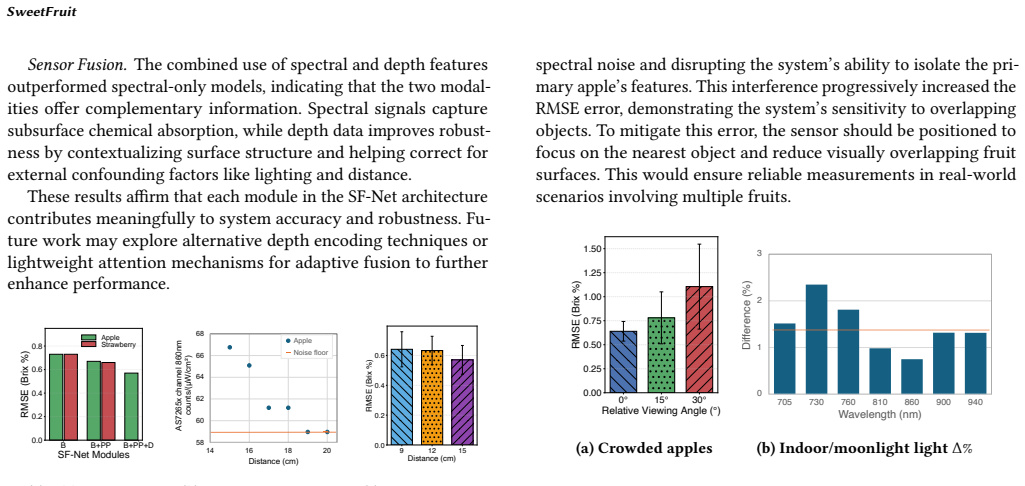
A two-stage system uses depth camera classification and NIR regression to estimate fruit sugar content non-destructively with 0.57 Brix RMSE.
A machine-rendered reading of the paper's core claim, the machinery that carries it, and where it could break.
Core claim
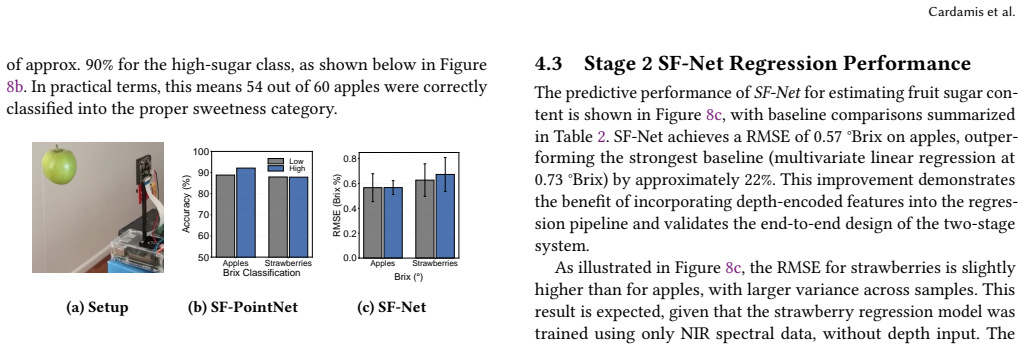
SweetFruit implements a two-stage pipeline where SF-PointNet classifies fruit sugar levels from ToF point clouds and SF-Net regresses Brix values from NIR spectra, delivering over 90 percent classification accuracy and 0.57 Brix RMSE on Granny Smith apples and strawberries.
What carries the argument
The two-stage sensing pipeline with SF-PointNet for point cloud classification and SF-Net for NIR-based regression.
If this is right
- Rapid prescreening becomes possible with high classification accuracy before precise measurement.
- Error in sugar estimation reduces by 22 percent compared to NIR sensing alone.
- The system runs in real time on embedded platforms using low-cost sensors.
- Multimodal sensing improves performance for field-ready agricultural applications.
Where Pith is reading between the lines
- Similar two-stage approaches might improve sensing for other agricultural products like vegetables or grains.
- Deployment across varied lighting or fruit types would likely require additional calibration data.
- Integration with mobile apps could enable widespread farmer use for harvest decisions.
Load-bearing premise
The trained models will perform at the reported accuracy levels on fruit varieties, lighting conditions, or ripeness stages different from the tested Granny Smith apples and strawberries.
What would settle it
Measuring classification accuracy and RMSE on a new set of fruit types or under different field conditions and finding performance below 90 percent accuracy or above 0.57 Brix RMSE would falsify the claim.
Figures
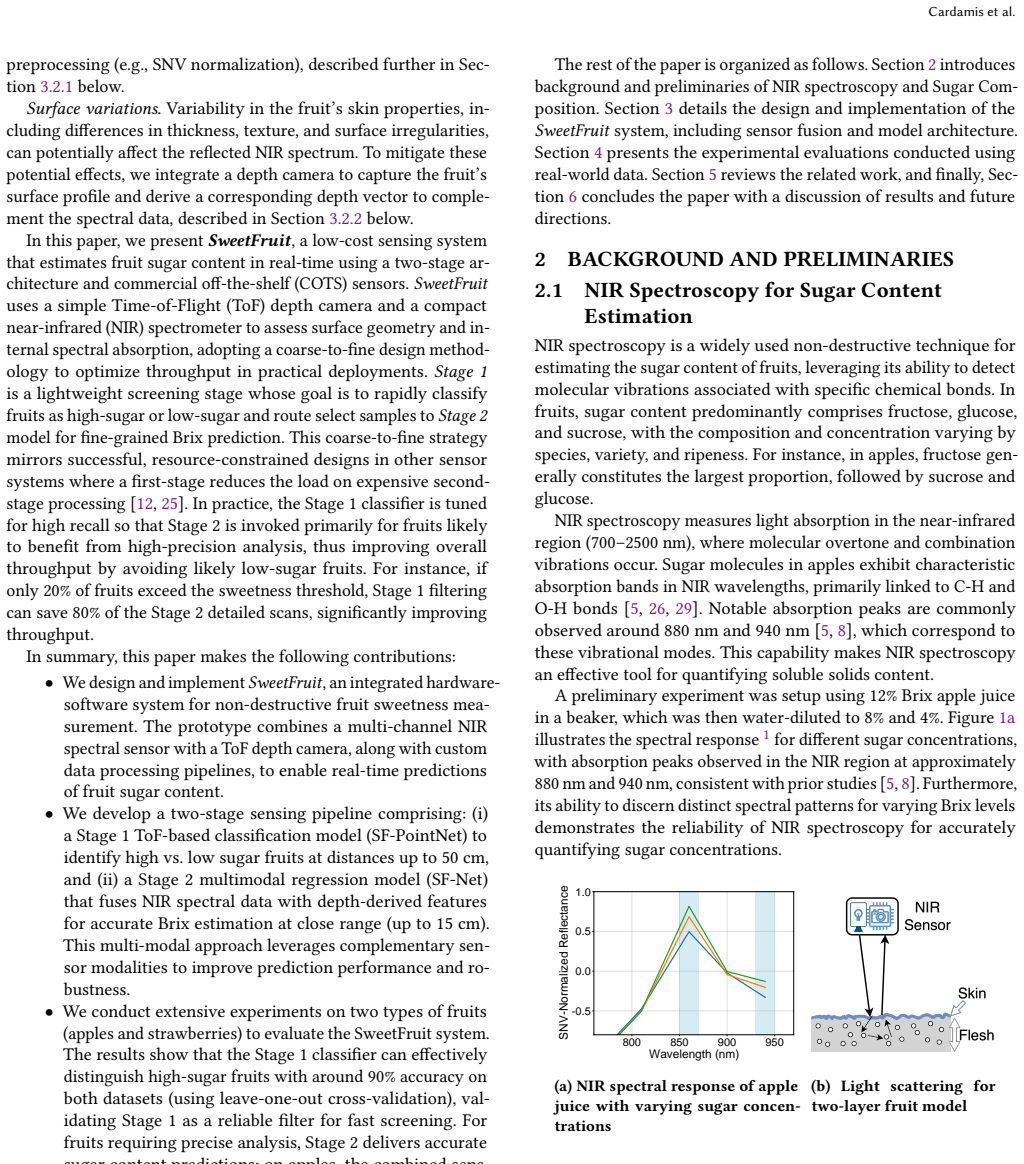
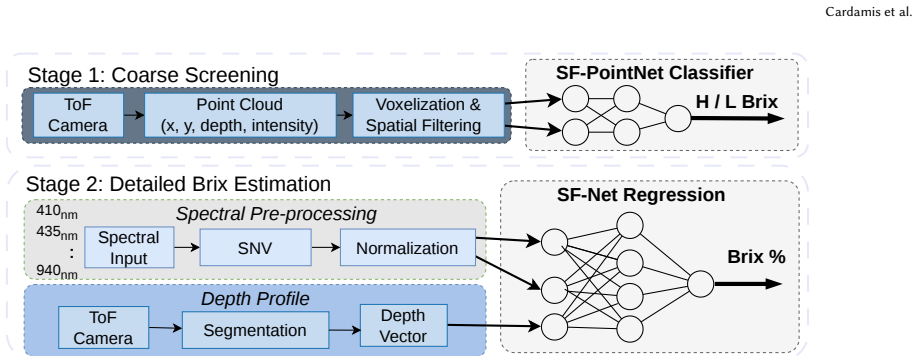
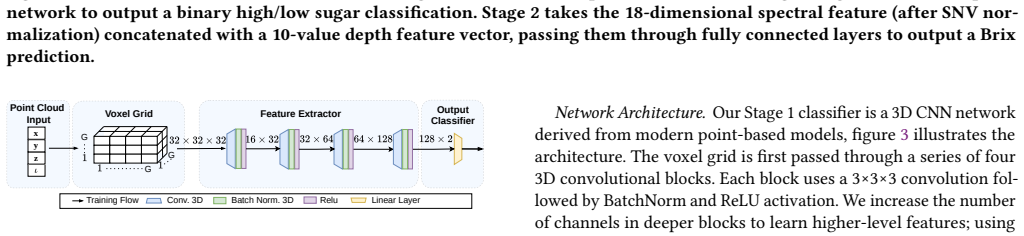
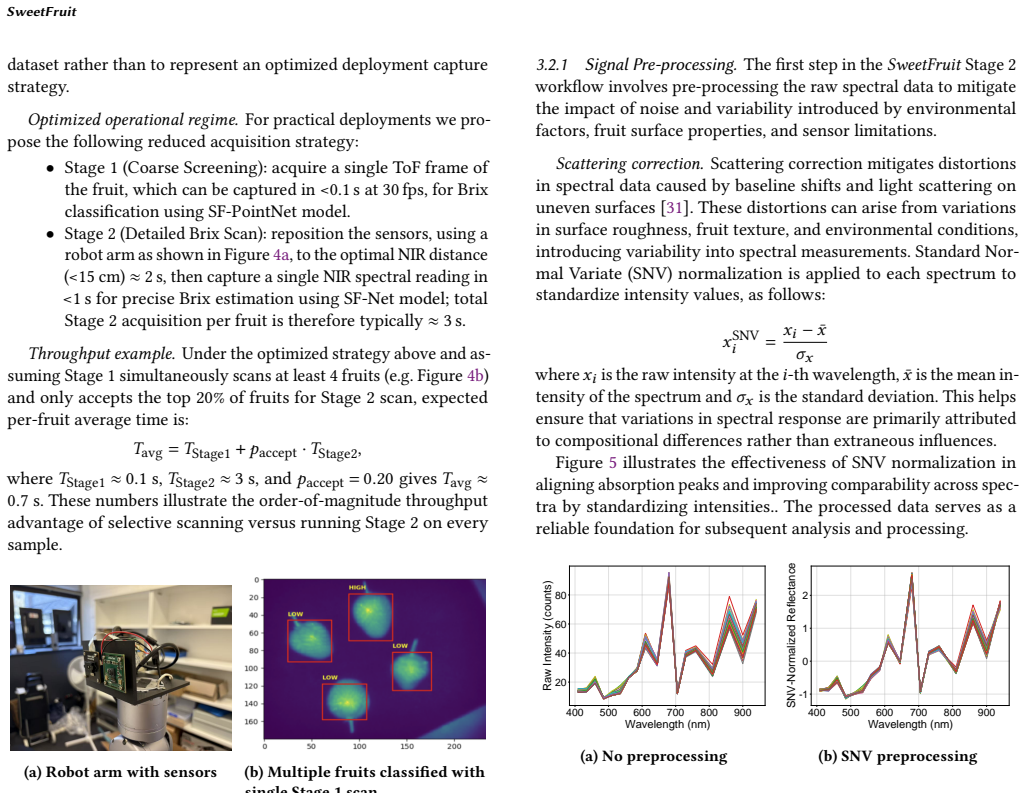
read the original abstract
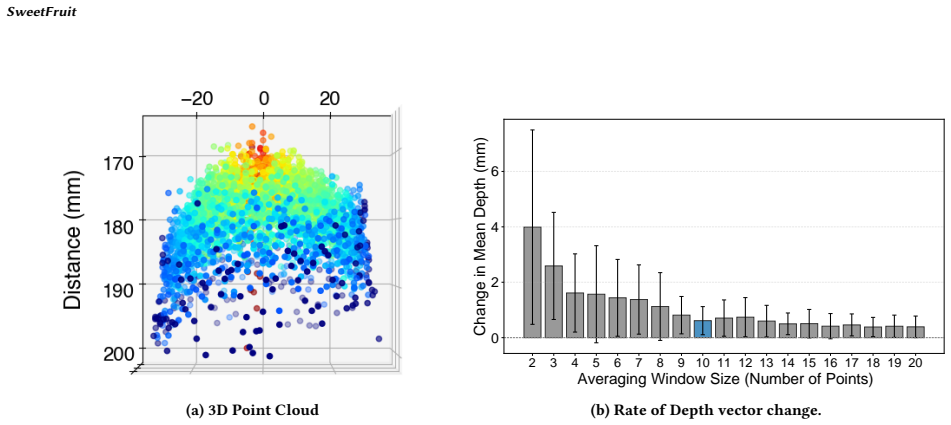
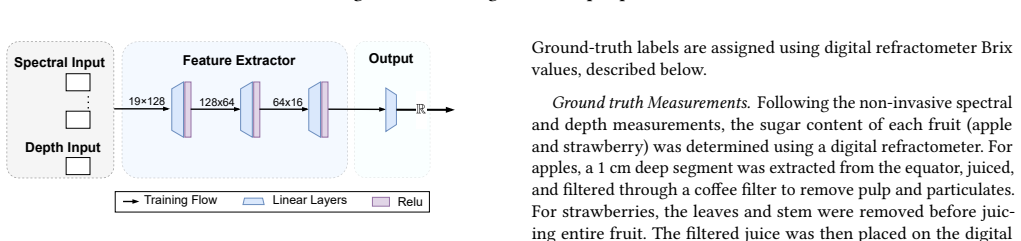
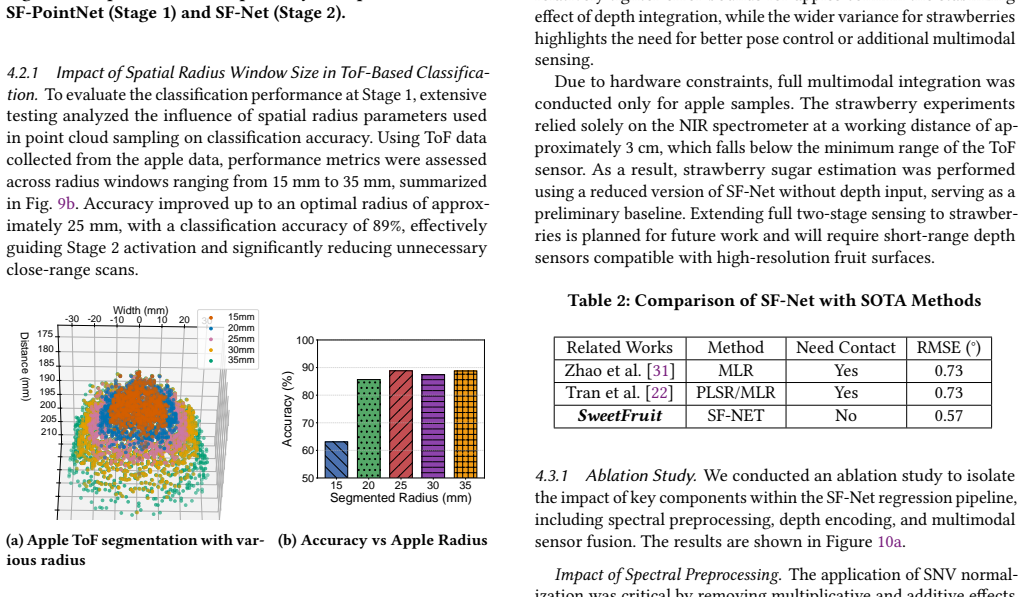
Accurate prediction of fruit sugar content is essential for quality control and market valuation in agriculture. Conventional measurement techniques rely on destructive, time-consuming processes (e.g., juicing and refractometry) or direct contact instruments, which hinder high-throughput operations. This paper introduces SweetFruit, a mobile two-stage system that leverages low-cost sensors to estimate fruit sugar content without contact. In Stage 1, we implement a lightweight 3D deep learning model (SF-PointNet) that uses point clouds from a Time-of-Flight (ToF) depth camera to classify fruit as high or low sugar. In Stage 2, a regression network (SF-Net) predicts the fruit's Brix value using measurements from a compact 18-channel near-infrared (NIR) spectrometer. The system uses simple off-the-shelf sensors (AS7265x NIR and Arducam ToF) with efficient processing pipelines for real-time execution on embedded platforms. Experiments on green 'Granny Smith' apples and strawberries demonstrate the system's effectiveness. Stage 1 achieves over 90% classification accuracy, enabling rapid prescreening, while Stage 2 delivers precise sugar estimates, with a root mean square error (RMSE) of 0.57 Brix, reducing error by 22% compared to using NIR sensing alone. SweetFruit offers a scalable, field-ready solution for rapid fruit quality screening, showcasing the benefits of task-specific multimodal sensing in mobile agricultural applications.
Editorial analysis
A structured set of objections, weighed in public.
Referee Report
Summary. The paper introduces SweetFruit, a two-stage mobile sensing system for non-contact fruit sugar estimation. Stage 1 employs SF-PointNet, a lightweight 3D deep learning model on point clouds from a ToF depth camera, to classify fruit as high or low sugar (>90% accuracy) for prescreening. Stage 2 uses SF-Net, a regression network on 18-channel NIR spectrometer data, to predict Brix values (RMSE 0.57, 22% error reduction vs. NIR alone). The system uses low-cost off-the-shelf sensors (AS7265x and Arducam ToF) for real-time embedded execution and is evaluated on green Granny Smith apples and strawberries, with claims of providing a scalable, field-ready solution for agricultural quality control.
Significance. If the reported performance metrics hold under proper validation and the models demonstrate generalization, the work could advance practical multimodal mobile sensing in agriculture by enabling efficient non-destructive prescreening combined with precise NIR-based regression using commodity hardware. The emphasis on real-time embedded pipelines is a constructive contribution to field-deployable systems.
major comments (2)
- [Abstract] Abstract: The central performance claims (Stage 1 classification accuracy >90%, Stage 2 RMSE of 0.57 Brix with 22% improvement over NIR alone) are stated without any information on dataset size, number of samples, train/test split, cross-validation method, training details, or statistical significance. This absence directly undermines verification of the experimental outcomes that support the two-stage system's effectiveness.
- [Abstract] Abstract: The assertion of a 'scalable, field-ready solution' for general fruit quality screening rests on experiments limited to green Granny Smith apples and strawberries. No cross-variety testing, lighting/ripeness ablation, or transfer evaluation is described, leaving the generalization assumption untested and load-bearing for the scalability claim.
minor comments (1)
- [Abstract] Abstract: The SF-PointNet and SF-Net model architectures are named but not described in terms of layer structure, parameter counts, or input preprocessing, which would aid reproducibility.
Simulated Author's Rebuttal
We thank the referee for the constructive feedback on the abstract. We address the two major comments below and will revise the manuscript to improve clarity and qualification of claims.
read point-by-point responses
-
Referee: [Abstract] Abstract: The central performance claims (Stage 1 classification accuracy >90%, Stage 2 RMSE of 0.57 Brix with 22% improvement over NIR alone) are stated without any information on dataset size, number of samples, train/test split, cross-validation method, training details, or statistical significance. This absence directly undermines verification of the experimental outcomes that support the two-stage system's effectiveness.
Authors: We agree that the abstract would benefit from a concise reference to the evaluation protocol to support the reported metrics. The full experimental details (dataset composition, splits, cross-validation, and training procedures) appear in Sections 4 and 5. In the revision we will add a short clause to the abstract summarizing the validation approach without exceeding length limits. revision: yes
-
Referee: [Abstract] Abstract: The assertion of a 'scalable, field-ready solution' for general fruit quality screening rests on experiments limited to green Granny Smith apples and strawberries. No cross-variety testing, lighting/ripeness ablation, or transfer evaluation is described, leaving the generalization assumption untested and load-bearing for the scalability claim.
Authors: The experiments are indeed restricted to the two named fruit types, and no cross-variety or ablation studies are presented. The term 'scalable' in the abstract primarily refers to the use of commodity hardware and real-time embedded pipelines rather than universal fruit coverage. We will revise the abstract to qualify the claim (e.g., 'demonstrated on Granny Smith apples and strawberries') and add a brief limitations paragraph on generalization. revision: yes
Circularity Check
No significant circularity; claims rest on empirical model evaluation
full rationale
The paper presents an experimental ML system (SF-PointNet for classification on ToF point clouds, SF-Net for NIR regression) trained and tested on data from two specific fruit types. All reported metrics (classification accuracy, RMSE 0.57 Brix) are direct outcomes of data collection, training, and hold-out evaluation. No equations, derivations, or predictions are described that reduce to fitted inputs by construction. No self-citations or uniqueness theorems are invoked as load-bearing steps. The work is self-contained against external benchmarks via its experimental protocol.
Axiom & Free-Parameter Ledger
Reference graph
Works this paper leans on
-
[1]
ams. 2024. AS7265x smart spectral sensor family. https://ams.com/en/as7265x
2024
-
[2]
Arducam. 2024. Time of Flight (ToF) Camera for Raspberry Pi. https://www. arducam.com/time-of-flight-camera-raspberry-pi/
2024
-
[3]
Mohamed Lamine Askoura, Fabrice Vaudelle, and Jean-Pierre L’Huillier. 2016. Multispectral measurement of scattering-angular light distribution in apple skin and flesh samples. Applied Optics 55, 32 (Nov. 2016), 9217. doi:10.1364/AO.55. 009217
-
[4]
Atago. 2024. Pocket IR Brix Meter PAL-HIKARi 5 - Apple. https://atago.net/en/ atagodirect-index.php?key=FAS59195
2024
-
[5]
Shuxiang Fan, Qingyan Wang, Xi Tian, Guiyan Yang, Yu Xia, Jiangbo Li, and Wenqian Huang. 2020. Non-destructive evaluation of soluble solids content of apples using a developed portable Vis/NIR device. Biosystems Engineering 193 (May 2020), 138–148. doi:10.1016/j.biosystemseng.2020.02.017
-
[6]
Justyna Grabska, Krzysztof Beć, Nami Ueno, and Christian Huck. 2023. Ana- lyzing the Quality Parameters of Apples by Spectroscopy from Vis/NIR to NIR Region: A Comprehensive Review. Foods 12, 10 (May 2023), 1946. doi:10.3390/ foods12101946
2023
-
[7]
Yu Han, David Salido-Monzú, and Andreas Wieser. 2022. Comb-based multi- spectral LiDAR providing reflectance and distance spectra. Optics Express 30, 23 (Nov. 2022), 42362. doi:10.1364/OE.473466
-
[8]
Shih-Hao Hua, Chao-Pin Chen, and Pin Han. 2017. Design of a simple non- destructive detection system using P-wave lasers for determining the soluble solids content of apples. Applied Optics 56, 22 (Aug. 2017), 6235. doi:10.1364/AO. 56.006235
work page doi:10.1364/ao 2017
-
[9]
Haowen Huang, Zile Fang, Yuelong Xu, Guosheng Lu, Can Feng, Min Zeng, Jiaju Tian, Yongfu Ping, Zhuolin Han, and Zhigang Zhao. 2024. Stacking and ridge regression-based spectral ensemble preprocessing method and its application in near-infrared spectral analysis. Talanta 276 (Aug. 2024), 126242. doi:10.1016/j. talanta.2024.126242
work page doi:10.1016/j 2024
-
[10]
Ameetha Junaina T. K, R. Kumudham, Ebenezer Abishek B, and Mohamed Shakir
-
[11]
Malaysian Journal of Computer Science 37, 2 (April 2024), 107–123
ENHANCING BRIX VALUE PREDICTION IN STRAWBERRIES USING MA- CHINE LEARNING: A FUSION OF PHYSIOCHEMICAL AND COLOR-BASED FEATURES FOR IMPROVED SWEETNESS ASSESSMENT. Malaysian Journal of Computer Science 37, 2 (April 2024), 107–123. doi:10.22452/mjcs.vol37no2.1
-
[12]
Sumio Kawano, Hisayoshi Watanabe, and Mutsuo Iwamoto. 1992. Determination of Sugar Content in Intact Peaches by Near Infrared Spectroscopy with Fiber Optics in Interactance Mode. Journal of the Japanese Society for Horticultural Science 61, 2 (1992), 445–451. doi:10.2503/jjshs.61.445
-
[13]
Emanuele Lattanzi, Lorenzo Calisti, and Paolo Capellacci. 2023. Lightweight accurate trigger to reduce power consumption in sensor-based continuous human activity recognition. Pervasive and Mobile Computing 96 (Dec. 2023), 101848. doi:10.1016/j.pmcj.2023.101848
-
[14]
Larry Li. 2014. Time-of-Flight Camera – An Introduction. https://www.ti.com/ lit/wp/sloa190b/sloa190b.pdf
2014
-
[15]
Zhiying Li, Abdul Aziz, Patrick Phuoc Do, Phuc Nguyen, and Tianxing Li. 2025. MobiChem: A Ubiquitous Smartphone-Based Toolkit for Practical Fruit Monitor- ing and Analysis. In Proceedings of the 23rd Annual International Conference on Mobile Systems, Applications and Services . ACM, Hilton Anaheim Anaheim CA USA, 1–14. doi:10.1145/3711875.3729135
-
[16]
Lohner, Konni Biegert, Steffen Nothelfer, Ansgar Hohmann, Roy Mc- Cormick, and Alwin Kienle
Stefan A. Lohner, Konni Biegert, Steffen Nothelfer, Ansgar Hohmann, Roy Mc- Cormick, and Alwin Kienle. 2021. Determining the optical properties of apple tissue and their dependence on physiological and morphological characteristics during maturation. Part 1: Spatial frequency domain imaging.Postharvest Biology and Technology 181 (Nov. 2021), 111647. doi:1...
-
[17]
Tomislav Medic, Pabitro Ray, Yu Han, Giovanni Antonio Lodovico Broggini, and Simon Kollaart. 2024. Remotely sensing inner fruit quality using multispectral LiDAR: Estimating sugar and dry matter content in apples. Computers and Electronics in Agriculture 224 (Sept. 2024), 109128. doi:10.1016/j.compag.2024. 109128
-
[18]
Nicolaï, Katrien Beullens, Els Bobelyn, Ann Peirs, Wouter Saeys, Karen I
Bart M. Nicolaï, Katrien Beullens, Els Bobelyn, Ann Peirs, Wouter Saeys, Karen I. Theron, and Jeroen Lammertyn. 2007. Nondestructive measurement of fruit and vegetable quality by means of NIR spectroscopy: A review. Postharvest Biology and Technology 46, 2 (Nov. 2007), 99–118. doi:10.1016/j.postharvbio.2007.06.024
-
[19]
Miguel Noguera, Borja Millan, and José Manuel Andújar. 2022. New, Low- Cost, Hand-Held Multispectral Device for In-Field Fruit-Ripening Assessment. Agriculture 13, 1 (Dec. 2022), 4. doi:10.3390/agriculture13010004
-
[20]
Matthew Smithson, Melanie Po-Leen Ooi, Lauren Gris, Ye Chow Kuang, Merilyn Manley-Harris, and Shen Hin Lim. 2021. Investigating the Use of Low-cost and Low-power Millimeter Wave RADAR to Improve Quality of Tomato Harvesting. In 2021 IEEE International Instrumentation and Measurement Technology Confer- ence (I2MTC). IEEE, Glasgow, United Kingdom, 1–6. doi:...
-
[21]
Kenichiro Tanaka, Yasuhiro Mukaigawa, Takuya Funatomi, Hiroyuki Kubo, Ya- suyuki Matsushita, and Yasushi Yagi. 2019. Material Classification from Time-of- Flight Distortions. IEEE Transactions on Pattern Analysis and Machine Intelligence 41, 12 (Dec. 2019), 2906–2918. doi:10.1109/TPAMI.2018.2869885 Cardamis et al
-
[22]
Reza Tavasoli, Sanjib Sur, and Srihari Nelakuditi. 2023. SugarWave: A Non- destructive Estimation of Fruit Sugar Content Using Millimeter-Wave Sensing. In 2023 IEEE 20th International Conference on Mobile Ad Hoc and Smart Systems (MASS). IEEE, Toronto, ON, Canada, 592–598. doi:10.1109/MASS58611.2023. 00079
-
[23]
Nhut-Thanh Tran and Masayuki Fukuzawa. 2020. A Portable Spectrometric System for Quantitative Prediction of the Soluble Solids Content of Apples with a Pre-calibrated Multispectral Sensor Chipset. Sensors 20, 20 (Oct. 2020), 5883. doi:10.3390/s20205883
-
[24]
University of Agronomic Sciences and Veterinary Medicine of Bucharest, Roma- nia, Georgeta Temocico, Monica Sturzeanu, Viorel Ion, and Stelica Cristea. 2019. Evaluation of strawberry fruit quality for new selections and cultivars.Romanian Biotechnological Letters 24, 4 (Aug. 2019), 742–748. doi:10.25083/rbl/24.4/742.748
-
[25]
Fabrice Vaudelle and Jean-Pierre L’Huillier. 2015. Influence of the size and skin thickness of apple varieties on the retrieval of internal optical properties using Vis/NIR spectroscopy: A Monte Carlo-based study. Computers and Electronics in Agriculture 116 (Aug. 2015), 137–149. doi:10.1016/j.compag.2015.06.009
-
[26]
P. Viola and M. Jones. 2001. Rapid object detection using a boosted cascade of simple features. In Proceedings of the 2001 IEEE Computer Society Conference on Computer Vision and Pattern Recognition. CVPR 2001 , Vol. 1. IEEE Comput. Soc, Kauai, HI, USA, I–511–I–518. doi:10.1109/CVPR.2001.990517
-
[27]
Jin Wang, Yujia Huo, Yutong Wang, Haoyu Zhao, Kai Li, Li Liu, and Yinggang Shi. 2022. Grading detection of “Red Fuji” apple in Luochuan based on machine vision and near-infrared spectroscopy. PLOS ONE 17, 8 (Aug. 2022), e0271352. doi:10.1371/journal.pone.0271352
-
[28]
Lu Wang, Qiqi Wang, Kaixin Chen, Haiyan Hu, Usman Saleh Toro, Yueling Che, Kaishun Wu, and Qian Zhang. 2026. VNiScan-Fruit: A Non-Invasive Visible- Near Infrared Sensing System for Soluble Solids Content Estimation in Fruits. IEEE Transactions on Mobile Computing PP (2026), 1–17. doi:10.1109/TMC.2026. 3667385
-
[29]
Pathak, Mo Sha, Tingting Zhu, Junai Gan, Pengfei Hu, and Prasant Mohapatra
Zhicheng Yang, Parth H. Pathak, Mo Sha, Tingting Zhu, Junai Gan, Pengfei Hu, and Prasant Mohapatra. 2019. On the feasibility of estimating soluble sugar content using millimeter-wave. In Proceedings of the International Conference on Internet of Things Design and Implementation . ACM, Montreal Quebec Canada, 13–24. doi:10.1145/3302505.3310065
-
[30]
Xinyang Yu, Qipeng Lu, Hongzhi Gao, and Haiquan Ding. 2016. Development of a Handheld Spectrometer Based on a Linear Variable Filter and a Complementary Metal-Oxide-Semiconductor Detector for Measuring the Internal Quality of Fruit. Journal of Near Infrared Spectroscopy 24, 1 (Feb. 2016), 69–76. doi:10.1255/jnirs. 1191
-
[31]
Min Zeng, Haowen Huang, Zile Fang, Zhuolin Han, Can Feng, Guosheng Lu, Xudong Luo, Zhigang Zhao, and Peigang Han. 2024. Research on the wavelength intersection union fusion selection method for near-infrared spectroscopy anal- ysis of apple sugar degree. In 2024 International Conference on Optoelectronic Information and Optical Engineering (OIOE 2024) , H...
-
[32]
Xinlong Zhao, Yankun Peng, Yongyu Li, Qinghui Guo, and Bingwei Wang. 2023. A flight sensing detector for apple maturity indexes in orchard. Biosystems Engineering 230 (June 2023), 470–479. doi:10.1016/j.biosystemseng.2023.05.007
discussion (0)
Sign in with ORCID, Apple, or X to comment. Anyone can read and Pith papers without signing in.