Is the Dark Comet 1998 KY₂₆ the Spacecraft Phobos 1?
Pith reviewed 2026-06-28 16:10 UTC · model grok-4.3
The pith
The dark comet 1998 KY26 may be the lost Phobos 1 spacecraft.
A machine-rendered reading of the paper's core claim, the machinery that carries it, and where it could break.
Core claim
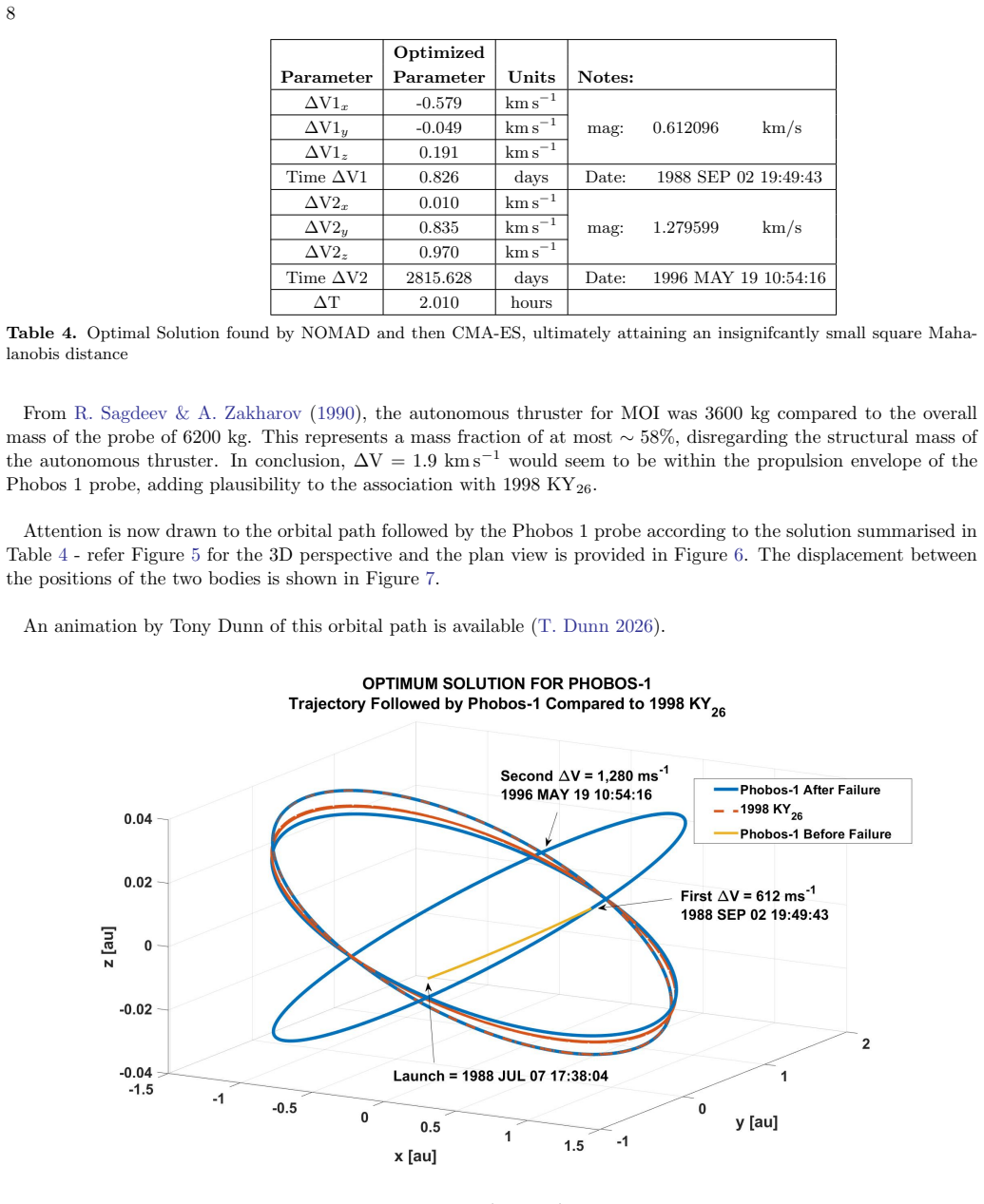
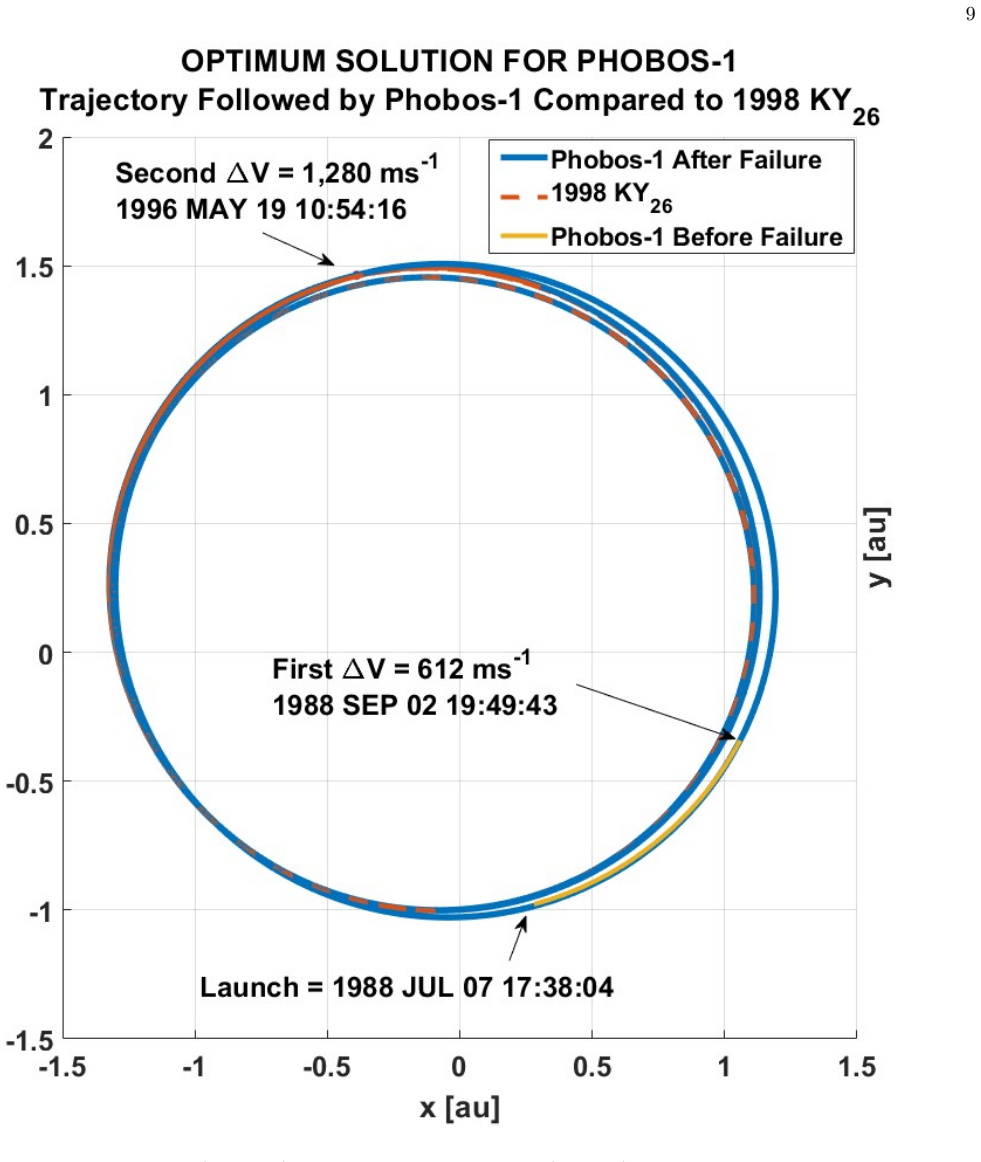
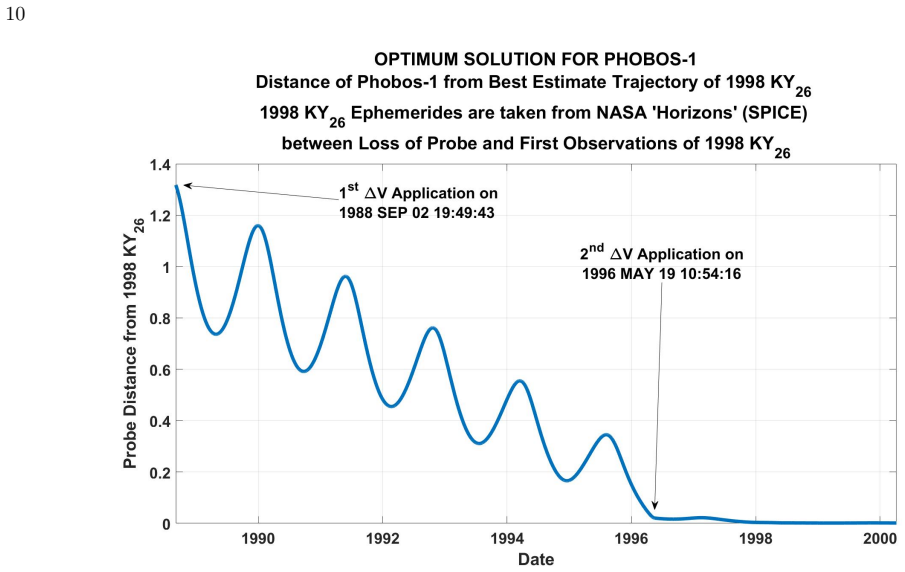
Two propulsive DeltaVs combined at 1.9 km/s, the first just after loss of mission and the second in May 1996, allow the orbits and phases of the two bodies to align, with an arbitrarily low Mahalanobis distance using the covariance of the dark comet in 6D phase space.
What carries the argument
The 6D phase-space match achieved by two impulsive DeltaV burns whose total magnitude is 1.9 km/s.
If this is right
- 1998 KY26 would be reclassified as artificial rather than a natural dark comet.
- The Hayabusa2 encounter would study a spacecraft relic instead of a comet nucleus.
- The same method could be applied to other dark comets to search for additional lost probes.
- It would close the case on the final location of Phobos 1.
Where Pith is reading between the lines
- Spectral or radar data from Hayabusa2 could be checked for signatures of Soviet-era materials to test the match.
- Similar orbital back-tracing might identify other lost spacecraft among known near-Earth objects.
- If confirmed, mission planners would need to adjust sampling and imaging strategies for an artificial target.
Load-bearing premise
The Phobos 1 thruster could deliver a total velocity change of 1.9 km/s after the mission ended.
What would settle it
A spectrum or close image from the 2031 Hayabusa2 encounter that shows only natural rock and ice with no metallic or artificial components.
Figures

read the original abstract
Since the discovery of new kinds of celestial bodies known as $dark~comets$, scientists have speculated about their ontology. A curious hybrid of comet and asteroid, these objects show significant non-gravitational accelerations (NGAs) yet exhibit absolutely no signs of cometary outgassing in the form of a coma or tail. The planned rendezvous of the Hayabusa2 spacecraft with 1998 KY$_{26}$ in July 2031 elevates the question of this so-called dark comet's nature beyond a purely research exercise, as the true nature of the object may have practical implications for the scientific return of the mission. This study examines the hypothesis that 1998 KY$_{26}$ may be of technogenic origin, in fact a relic of a historical Russian mission to Mars, the Phobos 1 probe, which suffered a failure 2 months after the launch in July 1988, due to upload of a faulty command. We find that two propulsive DeltaVs combined at 1.9 km/s, the first just after loss of mission and the second in May 1996, allow the orbits and phases of the two bodies to align, with an arbitrarily low $Mahalanobis~distance$ using the covariance of the dark comet in 6D phase space. There is also evidence that 1.9 km/s was within the performance envelope of Phobos 1, which had a powerful nitric acid and amine-based autonomous thruster for Mars Orbital Insertion (MOI).
Editorial analysis
A structured set of objections, weighed in public.
Referee Report
Summary. The paper claims that the dark comet 1998 KY26 may be the lost Phobos 1 spacecraft. It supports the hypothesis by showing that two impulsive DeltaV maneuvers (one immediately after mission loss in 1988 and one in May 1996) with a combined magnitude of 1.9 km/s can align the 6D orbital states of the two objects to produce an arbitrarily low Mahalanobis distance relative to the dark comet's covariance matrix. The paper further asserts that this total DeltaV lies within the performance envelope of Phobos 1's nitric-acid/amine thruster system originally intended for Mars orbital insertion.
Significance. If the identification were independently confirmed, it would constitute a documented case of a technogenic object masquerading as a dark comet, with direct relevance to the interpretation of non-gravitational accelerations and to the scientific planning for the Hayabusa2 rendezvous in 2031. The present manuscript, however, offers only a constructed orbital match rather than a falsifiable prediction or additional corroborating observables.
major comments (2)
- [Abstract] Abstract: the two propulsive DeltaVs (combined 1.9 km/s, second burn epoch May 1996) are chosen specifically to minimize the Mahalanobis distance in 6D phase space. Once the epochs and total budget are granted as free parameters, an arbitrarily low distance is achieved by construction; no independent dynamical, telemetry, or observational constraint is supplied that would have required the maneuvers to occur at those times.
- [Abstract] Abstract: the physical viability of the hypothesis rests on the assertion that 1.9 km/s remained within the performance envelope of Phobos 1's autonomous MOI thruster years after launch. No quantitative calculation of remaining propellant mass, specific impulse, thruster degradation, or attitude-control overhead is provided to substantiate this claim, which is load-bearing for the entire scenario.
minor comments (1)
- [Abstract] The abstract would be strengthened by an explicit statement that the reported alignment is a fit rather than a prediction from prior information.
Simulated Author's Rebuttal
We thank the referee for their constructive comments. We respond to each major comment below, indicating where the manuscript will be revised to address the concerns raised.
read point-by-point responses
-
Referee: [Abstract] Abstract: the two propulsive DeltaVs (combined 1.9 km/s, second burn epoch May 1996) are chosen specifically to minimize the Mahalanobis distance in 6D phase space. Once the epochs and total budget are granted as free parameters, an arbitrarily low distance is achieved by construction; no independent dynamical, telemetry, or observational constraint is supplied that would have required the maneuvers to occur at those times.
Authors: We agree that the maneuver parameters were optimized to identify a possible match, as the study is an existence proof of dynamical feasibility rather than a claim of a uniquely determined solution. The key scientific point is that the required total DeltaV remains modest. We will revise the abstract to explicitly state that the epochs and magnitudes are chosen to minimize the distance and that no independent constraints on burn timing are provided, thereby clarifying the exploratory nature of the analysis. revision: yes
-
Referee: [Abstract] Abstract: the physical viability of the hypothesis rests on the assertion that 1.9 km/s remained within the performance envelope of Phobos 1's autonomous MOI thruster years after launch. No quantitative calculation of remaining propellant mass, specific impulse, thruster degradation, or attitude-control overhead is provided to substantiate this claim, which is load-bearing for the entire scenario.
Authors: The manuscript currently references the known design specifications of the nitric-acid/amine thruster but does not include the requested quantitative estimates. We will add a dedicated paragraph or short appendix supplying order-of-magnitude calculations based on the documented propellant load, specific impulse, and expected degradation over the relevant time interval to support the performance-envelope claim. revision: yes
Circularity Check
DeltaV epochs and magnitudes fitted to force arbitrarily low Mahalanobis distance
specific steps
-
fitted input called prediction
[Abstract]
"We find that two propulsive DeltaVs combined at 1.9 km/s, the first just after loss of mission and the second in May 1996, allow the orbits and phases of the two bodies to align, with an arbitrarily low Mahalanobis distance using the covariance of the dark comet in 6D phase space."
The two DeltaV vectors and their epochs are chosen specifically so that the final 6D state matches the dark-comet covariance to arbitrarily low Mahalanobis distance. The low distance is therefore guaranteed once the total impulse budget is permitted; it does not constitute an independent test of the identification hypothesis.
full rationale
The paper's key result is obtained by selecting two impulsive burn times and a total 1.9 km/s budget such that the propagated state of Phobos 1 lies inside the 1998 KY26 covariance ellipsoid. The reported 'arbitrarily low' distance is therefore the direct numerical outcome of that parameter choice rather than an independent dynamical constraint or prediction. Once the maneuver budget and epochs are granted, the alignment follows by construction; the remaining load-bearing claim (thruster performance) is asserted separately without additional orbital or telemetry evidence supplied in the text.
Axiom & Free-Parameter Ledger
free parameters (2)
- Combined DeltaV magnitude =
1.9 km/s
- Epoch of second burn =
May 1996
axioms (1)
- domain assumption Phobos 1 retained sufficient propellant and thruster performance after mission loss to execute the burns
Reference graph
Works this paper leans on
-
[1]
2018, Planetary and Space Science, 150, 9, doi: https://doi.org/10.1016/j.pss.2017.02.013
Acton, C., Bachman, N., Semenov, B., & Wright, E. 2018, Planetary and Space Science, 150, 9, doi: https://doi.org/10.1016/j.pss.2017.02.013
-
[2]
Acton, C. H. 1996, Planetary and Space Science, 44, 65, doi: https://doi.org/10.1016/0032-0633(95)00107-7 Astronautix.com. 2026, Fobos 1F, http://www.astronautix.com/f/fobos1f.html#:∼: text=Phobos%201%20%2D%20.,September%201988% 20failed%20to%20occur
-
[3]
G., Delbo, M., et al
Beniyama, J., M¨ uller, T. G., Delbo, M., et al. 2025, The Astronomical Journal, 169, 264
2025
-
[4]
T., Fremling, C., Belyakov, M., et al
Bolin, B. T., Fremling, C., Belyakov, M., et al. 2025, The Astronomical Journal, 169, 303
2025
-
[5]
2026, OrbitSimulator.com,, http://orbitsimulator.com/BA/adam phobos1 f.mp4 ESO
Dunn, T. 2026, OrbitSimulator.com,, http://orbitsimulator.com/BA/adam phobos1 f.mp4 ESO. 1988, Where is Phobos I? https://www.eso.org/sci/publications/messenger/ archive/no.54-dec88/messenger-no54-12-12.pdf
2026
-
[6]
2025, The Astrophysical Journal Letters, 993, L9
Farnocchia, D., Vokrouhlick` y, D., Santana-Ros, T., et al. 2025, The Astrophysical Journal Letters, 993, L9
2025
-
[7]
2025, find orb: Orbit Determination Software,, https://www.projectpluto.com/find orb.htm
Gray, B. 2025, find orb: Orbit Determination Software,, https://www.projectpluto.com/find orb.htm
2025
-
[8]
2023, The CMA Evolution Strategy: A Tutorial, https://arxiv.org/abs/1604.00772
Hansen, N. 2023, The CMA Evolution Strategy: A Tutorial, https://arxiv.org/abs/1604.00772
Pith/arXiv arXiv 2023
-
[9]
2025, CMA-ES/pycma on Github,, https://github.com/CMA-ES/pycma
Hansen, N., Akimoto, Y., & Baudis, P. 2025, CMA-ES/pycma on Github,, https://github.com/CMA-ES/pycma
2025
-
[10]
2001, Evolutionary Computation, 9, 159
Hansen, N., & Ostermeier, A. 2001, Evolutionary Computation, 9, 159
2001
-
[11]
Hein, A. M., Perakis, N., Eubanks, T. M., et al. 2019, Acta Astronaut., 161, 552, doi: 10.1016/j.actaastro.2018.12.042
-
[12]
Hein, A. M., Eubanks, T. M., Lingam, M., et al. 2022, Adv. Space Res., 69, 402, doi: 10.1016/j.asr.2021.06.052
-
[13]
2017, Github repository for OITS., https://github.com/AdamHibberd/ Optimum Interplanetary Trajectory
Hibberd, A. 2017, Github repository for OITS., https://github.com/AdamHibberd/ Optimum Interplanetary Trajectory
2017
-
[14]
2022, arXiv e-prints, arXiv:2205.10220
Hibberd, A. 2022, arXiv e-prints, arXiv:2205.10220. https://arxiv.org/abs/2205.10220
arXiv 2022
-
[15]
2023a, Acta Astronaut., 211, 431, doi: 10.1016/j.actaastro.2023.06.029
Hibberd, A. 2023a, Acta Astronaut., 211, 431, doi: 10.1016/j.actaastro.2023.06.029
-
[16]
2023b, arXiv e-prints, arXiv:2305.03065, doi: 10.48550/arXiv.2305.03065
Hibberd, A. 2023b, arXiv e-prints, arXiv:2305.03065, doi: 10.48550/arXiv.2305.03065
-
[17]
Hibberd, A., & Hein, A. M. 2021, Acta Astronaut., 179, 594, doi: 10.1016/j.actaastro.2020.11.038
-
[18]
Hibberd, A., Hein, A. M., & Eubanks, T. M. 2020, Acta Astronautica, 170, 136, doi: 10.1016/j.actaastro.2020.01.018
-
[19]
Hibberd, A., Perakis, N., & Hein, A. M. 2021, Acta Astronaut., 189, 584, doi: 10.1016/j.actaastro.2021.09.006
-
[20]
1998, in AAS/Division for Planetary Sciences Meeting Abstracts# 30, Vol
Hicks, M., Weissman, P., Rabinowitz, D., et al. 1998, in AAS/Division for Planetary Sciences Meeting Abstracts# 30, Vol. 30, 10–06
1998
-
[21]
Hirabayashi, M., Mimasu, Y., Sakatani, N., et al. 2021, Advances in Space Research, 68, 1533, doi: https://doi.org/10.1016/j.asr.2021.03.030 Le Digabel, S. 2011, ACM Transactions on Mathematical Software (TOMS), 37, 44
-
[22]
2025, arXiv preprint arXiv:2503.03552
Loeb, A., & Cloete, R. 2025, arXiv preprint arXiv:2503.03552
arXiv 2025
-
[23]
Mahalanobis, P. C. 1936, Proceedings of the National Institute of Sciences of India, 2, 49
1936
-
[24]
G., Sekanina, Z., & Yeomans, D
Marsden, B. G., Sekanina, Z., & Yeomans, D. K. 1973, AJ, 78, 211, doi: 10.1086/111402
-
[25]
1998, International Astronomical Union Circular, 6935, 2
Ostro, S., Benner, L., Giorgini, J., Rosema, K., & Yeomans, D. 1998, International Astronomical Union Circular, 6935, 2
1998
-
[26]
J., Pravec, P., Benner, L
Ostro, S. J., Pravec, P., Benner, L. A., et al. 1999, Science, 285, 557
1999
-
[27]
1998, International Astronomical Union Circular, 6941, 2
Pravec, P., & Sarounova, L. 1998, International Astronomical Union Circular, 6941, 2
1998
-
[28]
Rein, H., & Liu, S. F. 2012, A&A, 537, A128, doi: 10.1051/0004-6361/201118085
work page internal anchor Pith review doi:10.1051/0004-6361/201118085 2012
-
[29]
1990, Sov
Sagdeev, R., & Zakharov, A. 1990, Sov. Astron. Lett, 16, 125
1990
-
[30]
2025a, Research Square, doi: https://doi.org/10.21203/rs.3.rs-5821856/v1
Santana-Ros, T., Bartczak, P., Muinonen, K., et al. 2025a, Research Square, doi: https://doi.org/10.21203/rs.3.rs-5821856/v1
-
[31]
2025b, Nature Communications, 16, doi: 10.1038/s41467-025-63697-4
Santana-Ros, T., Bartczak, P., Muinonen, K., et al. 2025b, Nature Communications, 16, doi: 10.1038/s41467-025-63697-4
-
[32]
Z., Farnocchia, D., Micheli, M., et al
Seligman, D. Z., Farnocchia, D., Micheli, M., et al. 2023, in LPI Contributions, Vol. 2851, Asteroids, Comets, Meteors Conference, 2036
2023
-
[33]
Z., Farnocchia, D., Micheli, M., et al
Seligman, D. Z., Farnocchia, D., Micheli, M., et al. 2024, Proceedings of the National Academy of Sciences, 121, doi: 10.1073/pnas.2406424121
-
[34]
2003, in AAS/Division for Planetary Sciences Meeting Abstracts# 35, Vol
Tholen, D. 2003, in AAS/Division for Planetary Sciences Meeting Abstracts# 35, Vol. 35, 31–05
2003
discussion (0)
Sign in with ORCID, Apple, or X to comment. Anyone can read and Pith papers without signing in.