Pitching Cosmic Curveballs: Environmental Effects on Extreme-Mass-Ratio Inspirals with Spinning Secondaries
Pith reviewed 2026-06-28 13:57 UTC · model grok-4.3
The pith
Gas drag breaks the vacuum degeneracy between secondary spin magnitude and inclination in EMRIs.
A machine-rendered reading of the paper's core claim, the machinery that carries it, and where it could break.
Core claim
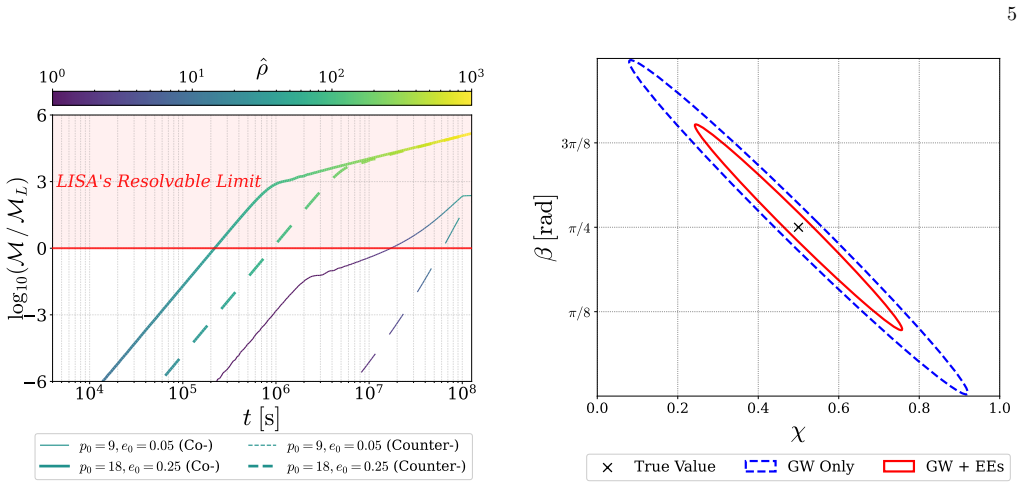
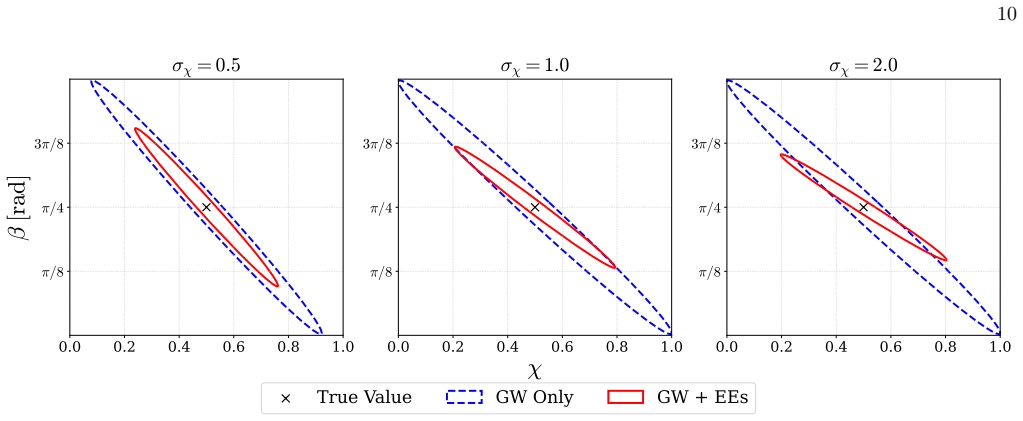
Incorporating Magnus and lift forces together with standard gas drag into the EMRI equations of motion imprints a unique, distinguishable dephasing signature; a Fisher analysis demonstrates that this signature breaks the fundamental vacuum-projection degeneracy between the secondary’s spin magnitude and inclination, thereby tightening the constraints on those parameters.
What carries the argument
Spin-coupled environmental effects (Magnus and lift forces plus drag) that generate an observable dephasing signature used inside a Fisher-matrix parameter-estimation pipeline.
If this is right
- The environmental dephasing allows the secondary’s intrinsic spin to be recovered with smaller uncertainties than in vacuum models.
- Environmental effects become a detectable feature rather than a systematic error in long-duration space-based observations.
- The same forces open a route to using EMRIs as probes of the density and structure of accretion flows around massive black holes.
- Parameter-estimation pipelines that omit these forces will return biased or overly broad spin posteriors.
Where Pith is reading between the lines
- Future waveform templates for LISA-type detectors may need to treat environmental forces as standard rather than optional corrections.
- The breaking of spin degeneracy could be tested by injecting signals with known gas parameters and recovering them with and without the new forces.
- Similar Magnus-type forces might appear in other inspiraling systems that move through dilute media, such as stellar-mass binaries in AGN disks.
Load-bearing premise
The gaseous environment produces Magnus and lift forces that imprint a unique, distinguishable dephasing signature on the GW signal over multi-year observation windows.
What would settle it
A Fisher-matrix run performed on the same EMRI signals but with all environmental forces set to zero recovers the same large uncertainties on spin magnitude and inclination that exist in pure vacuum templates.
Figures

read the original abstract
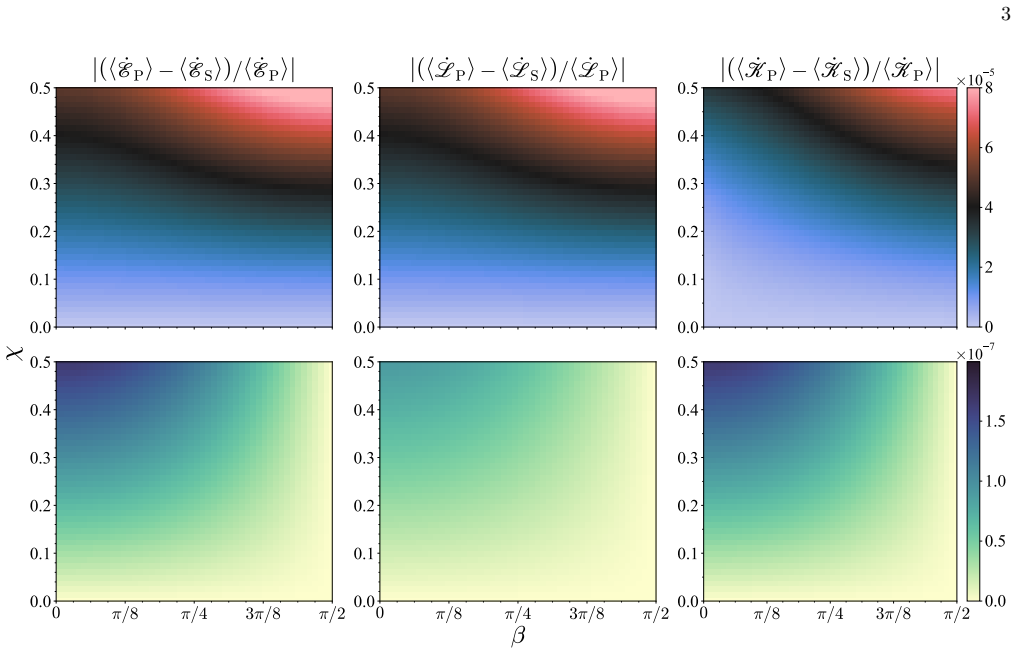
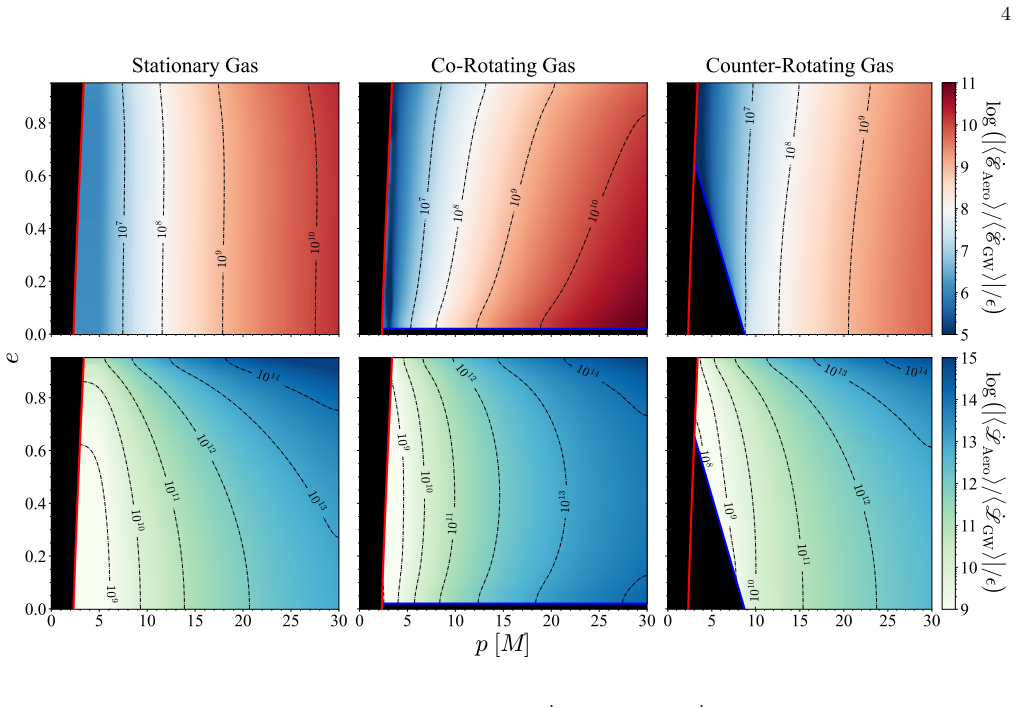
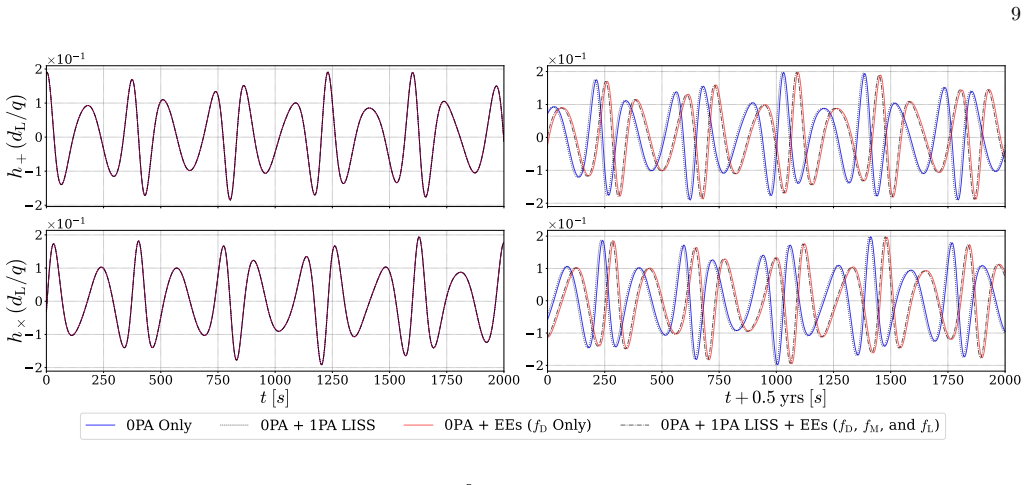
Much like the aerodynamic deflection of a spinning curveball, a rotating secondary in an extreme-mass-ratio inspiral (EMRI) experiences Magnus and lift forces, in addition to the standard drag force, when traversing a gaseous environment. We present the first framework that incorporates these specific spin-coupled environmental effects (EEs) into the evolution of EMRI. Over the multi-year observation windows of space-based gravitational-wave (GW) detectors, these interactions imprint a unique, distinguishable dephasing signature on the signal. Crucially, a Fisher matrix analysis reveals that gas drag breaks the fundamental vacuum-projection degeneracy between the secondary's spin magnitude and inclination, thereby tightening parameter constraints. Thus, accounting for EEs is not merely a modeling necessity, but could potentially be a powerful tool for enhancing the detectability of the secondary's intrinsic spin, and could serve as a novel probe of accretion flows harboring massive black holes.
Editorial analysis
A structured set of objections, weighed in public.
Referee Report
Summary. The manuscript develops the first framework incorporating Magnus and lift forces (in addition to drag) arising from a spinning secondary in a gaseous EMRI. It derives the resulting dephasing imprinted on the GW waveform over multi-year observations and performs a Fisher-matrix analysis claiming that these spin-coupled environmental effects break the vacuum degeneracy between secondary spin magnitude and inclination, thereby tightening constraints and offering a probe of accretion flows.
Significance. If the central Fisher result survives marginalization over environmental parameters, the work supplies both a necessary modeling extension for realistic EMRIs and a potential new observable for secondary spins, which would be valuable for LISA science. The introduction of a concrete framework for these specific EEs is a clear modeling contribution.
major comments (1)
- [Fisher matrix analysis] Fisher matrix analysis (central claim paragraph and associated section): the reported breaking of the spin-magnitude/inclination degeneracy is load-bearing for the main result. It is not stated whether the gas density (or normalization of the Magnus/lift coefficients) is included as a free parameter and marginalized over, or held fixed. If the latter, the apparent tightening is not guaranteed to survive marginalization, as the new environmental parameter could absorb the dephasing signature and restore the degeneracy. This must be clarified or the analysis repeated with floating environmental parameters.
minor comments (1)
- The abstract states that the dephasing is 'unique' and 'distinguishable' but does not quantify the magnitude of the effect relative to other environmental or spin-induced terms; a brief comparison in the text would aid readability.
Simulated Author's Rebuttal
We thank the referee for their careful reading and constructive feedback. We address the single major comment below and will revise the manuscript accordingly to strengthen the presentation of the Fisher analysis.
read point-by-point responses
-
Referee: [Fisher matrix analysis] Fisher matrix analysis (central claim paragraph and associated section): the reported breaking of the spin-magnitude/inclination degeneracy is load-bearing for the main result. It is not stated whether the gas density (or normalization of the Magnus/lift coefficients) is included as a free parameter and marginalized over, or held fixed. If the latter, the apparent tightening is not guaranteed to survive marginalization, as the new environmental parameter could absorb the dephasing signature and restore the degeneracy. This must be clarified or the analysis repeated with floating environmental parameters.
Authors: We acknowledge that the manuscript does not explicitly state the treatment of environmental parameters in the Fisher analysis. The reported results were obtained with gas density and the normalizations of the Magnus and lift coefficients held fixed at fiducial values, in order to isolate and demonstrate the distinctive dephasing signature arising from the spin-coupled forces. We agree that this leaves open the question of whether the degeneracy breaking survives marginalization. We will therefore repeat the Fisher-matrix calculation with the gas density (and, where appropriate, the force normalizations) promoted to free parameters, perform the marginalization, and update the central claim paragraph, the associated section, and any relevant figures or tables. This revision will clarify the robustness of the result. revision: yes
Circularity Check
No significant circularity in derivation chain
full rationale
The paper introduces a framework for spin-coupled environmental effects (Magnus/lift forces) on EMRIs and applies a standard Fisher matrix analysis to demonstrate breaking of the vacuum spin-magnitude/inclination degeneracy. No equations or steps in the abstract reduce by construction to fitted inputs renamed as predictions, self-definitional relations, or load-bearing self-citations. The central result is an application of an external statistical tool to a new physical model; the derivation chain remains independent of its own outputs.
Axiom & Free-Parameter Ledger
Reference graph
Works this paper leans on
-
[1]
Chandrasekhar, Astrophys
S. Chandrasekhar, Astrophys. J.97, 255 (1943)
1943
-
[2]
E. C. Ostriker, Astrophys. J.513, 252 (1999)
1999
-
[3]
Escala, R
A. Escala, R. B. Larson, P. S. Coppi, and D. Mardones, Astrophys. J.607, 765 (2004)
2004
-
[4]
Kim and W.-T
H. Kim and W.-T. Kim, Astrophys. J.665, 432 (2007)
2007
-
[5]
Barausse and L
E. Barausse and L. Rezzolla, Phys. Rev. D77, 104027 (2008)
2008
-
[6]
Kocsis, N
B. Kocsis, N. Yunes, and A. Loeb, Phys. Rev. D84, 024032 (2011)
2011
-
[7]
Yunes, B
N. Yunes, B. Kocsis, A. Loeb, and Z. Haiman, Phys. Rev. Lett.107, 171103 (2011)
2011
-
[8]
Derdzinski, D
A. Derdzinski, D. D’Orazio, P. Duffell, Z. Haiman, and A. MacFadyen, Monthly Notices of the Royal Astronom- ical Society501, 3540 (2021)
2021
-
[9]
Traykova, K
D. Traykova, K. Clough, T. Helfer, E. Berti, P. G. Fer- reira, and L. Hui, Phys. Rev. D104, 103014 (2021)
2021
-
[10]
Traykova, R
D. Traykova, R. Vicente, K. Clough, T. Helfer, E. Berti, P. G. Ferreira, and L. Hui, Phys. Rev. D108, L121502 (2023)
2023
-
[11]
Zwick, K
L. Zwick, K. Hendriks, D. O’Neill, J. Tak´ atsy, P. Kirke- berg, C. Tiede, J. Stegmann, J. Samsing, and D. J. D’Orazio, Phys. Rev. D112, 063005 (2025)
2025
-
[12]
L. F. O. Costa, R. Franco, and V. Cardoso, Phys. Rev. D98, 024026 (2018)
2018
-
[13]
Z. Wang, T. Helfer, D. Traykova, K. Clough, and E. Berti, Phys. Rev. D110, 024009 (2024)
2024
-
[14]
Dyson, J
C. Dyson, J. Redondo-Yuste, M. van de Meent, and V. Cardoso, Phys. Rev. D109, 104038 (2024)
2024
-
[15]
T. K. Karydas, R. Vicente, and G. Bertone, Phys. Rev. D113, 043057 (2026)
2026
-
[16]
P. Amaro-Seoane, H. Audley, S. Babak, J. Baker, E. Ba- rausse, P. Bender, E. Berti, P. Binetruy, M. Born, D. Bortoluzzi,et al., Laser interferometer space antenna (2017), arXiv:1702.00786 [astro-ph.IM]
Pith/arXiv arXiv 2017
-
[17]
Babaket al., Phys
S. Babaket al., Phys. Rev. D95, 103012 (2017)
2017
-
[18]
Barack and C
L. Barack and C. Cutler, Phys. Rev. D75, 042003 (2007)
2007
-
[19]
Amaro-Seoane, Living Reviews in Relativity21, 10.1007/s41114-018-0013-8 (2018)
P. Amaro-Seoane, Living Reviews in Relativity21, 10.1007/s41114-018-0013-8 (2018)
-
[20]
P. A. Seoaneet al.(LISA), Living Rev. Rel.26, 2 (2023)
2023
-
[21]
K. G. Arunet al.(LISA), Living Rev. Rel.25, 4 (2022)
2022
-
[22]
L. C. W. W. Group, N. Afshordi, S. Ak¸ cay, P. A. Seoane, A. Antonelli, J. C. Aurrekoetxea, L. Barack, E. Ba- rausse, R. Benkel, L. Bernard,et al., Waveform mod- elling for the laser interferometer space antenna (2023), arXiv:2311.01300 [gr-qc]
Pith/arXiv arXiv 2023
-
[23]
M. Colpi, K. Danzmann, M. Hewitson, K. Holley- Bockelmann, P. Jetzer, G. Nelemans, A. Petiteau, D. Shoemaker, C. Sopuerta, R. Stebbins,et al., LISA Definition Study Report (2024), arXiv:2402.07571 [astro-ph.CO]
Pith/arXiv arXiv 2024
-
[24]
Luoet al.(TianQin), Class
J. Luoet al.(TianQin), Class. Quant. Grav.33, 035010 (2016)
2016
-
[25]
Meiet al., Progress of Theoretical and Experimental Physics2021, 05A107 (2021)
J. Meiet al., Progress of Theoretical and Experimental Physics2021, 05A107 (2021)
2021
-
[26]
Liet al., arXiv e-prints , arXiv:2409.19665 (2024)
E.-K. Liet al., arXiv e-prints , arXiv:2409.19665 (2024)
arXiv 2024
-
[27]
Torres-Orjuela, S.-J
A. Torres-Orjuela, S.-J. Huang, Z.-C. Liang, S. Liu, H.- T. Wang, C.-Q. Ye, Y.-M. Hu, and J. Mei, Science China Physics, Mechanics, and Astronomy67, 259511 (2024)
2024
-
[28]
Gonget al., inJournal of Physics Conference Series, Journal of Physics Conference Series, Vol
X. Gonget al., inJournal of Physics Conference Series, Journal of Physics Conference Series, Vol. 610 (2015) p. 012011, arXiv:1410.7296 [gr-qc]
Pith/arXiv arXiv 2015
-
[29]
Ruan, Z.-K
W.-H. Ruan, Z.-K. Guo, R.-G. Cai, and Y.-Z. Zhang, Int. J. Mod. Phys. A35, 2050075 (2020)
2020
-
[30]
S. A. Teukolsky, Phys. Rev. Lett.29, 1114 (1972)
1972
-
[31]
S. A. Teukolsky, Astrophys. J.185, 635 (1973)
1973
-
[32]
S. A. Teukolsky and W. H. Press, Astrophys. J.193, 443 (1974)
1974
-
[33]
Chandrasekhar and S
S. Chandrasekhar and S. Detweiler, Proceedings of the Royal Society of London Series A344, 441 (1975)
1975
-
[34]
Poisson, Phys
E. Poisson, Phys. Rev. D47, 1497 (1993)
1993
-
[35]
Cutler, L
C. Cutler, L. S. Finn, E. Poisson, and G. J. Sussman, Phys. Rev. D47, 1511 (1993)
1993
-
[36]
Apostolatos, D
T. Apostolatos, D. Kennefick, A. Ori, and E. Poisson, Phys. Rev. D47, 5376 (1993). 7
1993
-
[37]
Poisson, Phys
E. Poisson, Phys. Rev. D48, 1860 (1993)
1993
-
[38]
Poisson and M
E. Poisson and M. Sasaki, Phys. Rev. D51, 5753 (1995)
1995
-
[39]
S. Mano, H. Suzuki, and E. Takasugi, Progress of The- oretical Physics95, 1079 (1996)
1996
-
[40]
Mano and E
S. Mano and E. Takasugi, Progress of Theoretical Physics97, 213 (1997)
1997
-
[41]
Campanelli and C
M. Campanelli and C. O. Lousto, Phys. Rev. D56, 6363 (1997)
1997
-
[42]
S. A. Hughes, Phys. Rev. D62, 044029 (2000)
2000
-
[43]
R. K. L. Lo, Phys. Rev. D110, 124070 (2024)
2024
-
[45]
L. V. Drummond, P. Lynch, A. G. Hanselman, D. R. Becker, and S. A. Hughes, Phys. Rev. D109, 064030 (2024)
2024
-
[46]
Skoup´ y and V
V. Skoup´ y and V. Witzany, Phys. Rev. Lett.134, 171401 (2025)
2025
-
[47]
G. A. Piovano, Phys. Rev. D113, 064024 (2026)
2026
-
[48]
Skoup´ y, G
V. Skoup´ y, G. Lukes-Gerakopoulos, L. V. Drummond, and S. A. Hughes, Phys. Rev. D108, 044041 (2023)
2023
-
[49]
G. A. Piovano, C. Pantelidou, J. Mac Uilliam, and V. Witzany, Phys. Rev. D111, 044009 (2025)
2025
-
[50]
Skoup´ y, G
V. Skoup´ y, G. A. Piovano, and V. Witzany, Phys. Rev. D112, 124054 (2025)
2025
-
[51]
L. V. Drummond, S. A. Hughes, V. Skoup´ y, P. Lynch, and G. A. Piovano, arXiv e-prints , arXiv:2603.12189 (2026)
arXiv 2026
-
[52]
V. Skoup´ y, A new approach to the calculation of extreme-mass-ratio inspirals with a spinning secondary (2026), arXiv:2603.13482 [gr-qc]
arXiv 2026
-
[53]
E. A. Huerta, J. R. Gair, and D. A. Brown, Phys. Rev. D85, 064023 (2012)
2012
-
[54]
G. A. Piovano, R. Brito, A. Maselli, and P. Pani, Phys. Rev. D104, 124019 (2021)
2021
-
[55]
Cui, W.-B
Q. Cui, W.-B. Han, and Z. Pan, Phys. Rev. D111, 103044 (2025)
2025
-
[56]
Burke, G
O. Burke, G. A. Piovano, N. Warburton, P. Lynch, L. Speri, C. Kavanagh, B. Wardell, A. Pound, L. Durkan, and J. Miller, Phys. Rev. D109, 124048 (2024)
2024
-
[57]
N. Dai, Y. Gong, T. Jiang, and D. Liang, Phys. Rev. D 106, 064003 (2022)
2022
-
[58]
N. Dai, Y. Gong, Y. Zhao, and T. Jiang, Phys. Rev. D 110, 084080 (2024)
2024
-
[59]
Mitra, N
S. Mitra, N. Speeney, S. Chakraborty, and E. Berti, Phys. Rev. D112, 044030 (2025)
2025
-
[60]
Vicente, T
R. Vicente, T. K. Karydas, and G. Bertone, Phys. Rev. Lett.135, 211401 (2025)
2025
-
[61]
L. Lui, A. Torres-Orjuela, R. K. Chowdhury, and L. Dai, Gravitational Wave Signatures of Quasi-Periodic Erup- tions: LISA Detection Prospects for RX J1301.9+2747 (2025), arXiv:2508.07961 [astro-ph.HE]
Pith/arXiv arXiv 2025
-
[62]
A. H. K. R., C. F. Gammie, and N. Yunes, A relativistic treatment of accretion disk torques on extreme mass- ratio inspirals around non-spinning black holes (2026), arXiv:2509.20457 [gr-qc]
arXiv 2026
-
[63]
A. H. K. R., C. F. Gammie, and N. Yunes, A rela- tivistic treatment of accretion disk torques on extreme mass ratio inspirals around spinning black holes (2026), arXiv:2510.03564 [gr-qc]
arXiv 2026
-
[64]
Papapetrou, Proceedings of the Royal Society of Lon- don Series A209, 248 (1951)
A. Papapetrou, Proceedings of the Royal Society of Lon- don Series A209, 248 (1951)
1951
-
[65]
W. G. Dixon, Proc. Roy. Soc. Lond. A319, 509 (1970)
1970
-
[66]
Mathisson, Gen
M. Mathisson, Gen. Rel. Grav.42, 1011 (2010)
2010
-
[67]
Witzany, J
V. Witzany, J. Steinhoff, and G. Lukes-Gerakopoulos, Classical and Quantum Gravity36, 075003 (2019)
2019
-
[68]
Witzany and G
V. Witzany and G. A. Piovano, Phys. Rev. Lett.132, 171401 (2024)
2024
-
[69]
Witzany, V
V. Witzany, V. Skoup´ y, L. C. Stein, and S. Tanay, Phys. Rev. D111, 044032 (2025)
2025
-
[70]
Ramond and S
P. Ramond and S. Isoyama, Phys. Rev. D111, 064027 (2025)
2025
-
[71]
R. P. Kerr, Phys. Rev. Lett.11, 237 (1963)
1963
-
[72]
Pound and E
A. Pound and E. Poisson, Phys. Rev. D77, 044013 (2008)
2008
-
[73]
J. R. Gair, ´E. ´E. Flanagan, S. Drasco, T. Hinderer, and S. Babak, Phys. Rev. D83, 044037 (2011)
2011
-
[74]
Skoup´ y and G
V. Skoup´ y and G. Lukes-Gerakopoulos, Phys. Rev. D 103, 104045 (2021)
2021
-
[75]
Carter, Phys
B. Carter, Phys. Rev.174, 1559 (1968)
1968
-
[76]
Mino, Phys
Y. Mino, Phys. Rev. D67, 084027 (2003)
2003
-
[77]
Drasco and S
S. Drasco and S. A. Hughes, Phys. Rev. D69, 044015 (2004)
2004
-
[78]
Drasco and S
S. Drasco and S. A. Hughes, Phys. Rev. D73, 024027 (2006)
2006
-
[79]
Isoyama, R
S. Isoyama, R. Fujita, H. Nakano, N. Sago, and T. Tanaka, Progress of Theoretical and Experimental Physics2019, 013E01 (2019)
2019
-
[80]
N. Sago, R. Fujita, S. Isoyama, and H. Nakano, arXiv e-prints , arXiv:2603.27941 (2026)
arXiv 2026
-
[81]
Y. Yin, R. K. L. Lo, and X. Chen, Phys. Rev. D (2026)
2026
discussion (0)
Sign in with ORCID, Apple, or X to comment. Anyone can read and Pith papers without signing in.