TLG: Temporal-Logic Grounding for Video Question Answering via Source-Annotation Reconstruction and Category-Targeted Reasoning
Pith reviewed 2026-06-28 15:28 UTC · model grok-4.3
The pith
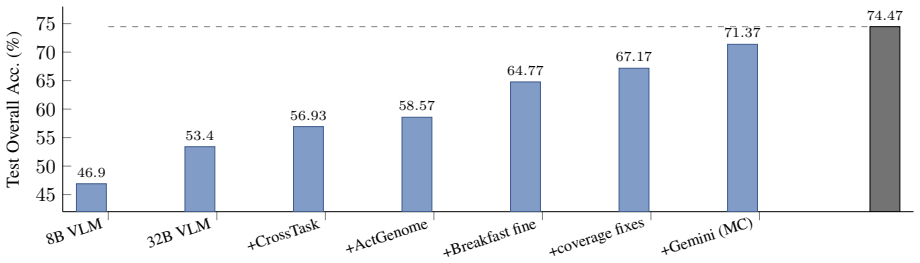
Reconstructing action timelines from source annotations enables deterministic execution of temporal logic and raises video QA accuracy from 46.9% to 71.37%.
A machine-rendered reading of the paper's core claim, the machinery that carries it, and where it could break.
Core claim
TLG reconstructs each video's action timeline from the public source-dataset annotations the benchmark was generated from, parses every question into a temporal-logic program, and executes it deterministically; it falls back to a strong open VLM where no annotation exists and routes only the question categories where the VLM is empirically weakest to a frontier reasoning model, raising test accuracy from a 46.9% VLM baseline to 71.37%.
What carries the argument
The three-tier TLG pipeline that reconstructs action timelines from source annotations and executes parsed temporal-logic programs (16 operators including before, after, until, since, always, co-occur, ordering).
If this is right
- Temporal grounding is the main performance bottleneck for VLMs on temporal-logic video tasks.
- Real annotations drive accuracy more than larger models or end-to-end training.
- Model-based timeline reconstruction variants all underperform a holistic VLM.
- The method reaches within three points of the current leaderboard top score.
Where Pith is reading between the lines
- Benchmarks generated from public source annotations can be solved by hybrid systems that exploit those annotations rather than by scaling neural models alone.
- Improving automatic timeline reconstruction to match annotation quality would be a high-leverage research direction.
- The same annotation-driven approach could be applied to other video benchmarks whose questions depend on precise action ordering and co-occurrence.
Load-bearing premise
The public source-dataset annotations supply complete and error-free action timelines that permit deterministic execution of all 16 temporal logic operators without missing relations or reconstruction errors.
What would settle it
Replacing the source annotations with noisy or incomplete timelines and observing accuracy fall below the 46.9% VLM baseline would falsify the claim that annotations are the irreducible driver of performance.
Figures


read the original abstract
The TimeLogic Challenge evaluates formal temporal-logic reasoning over video - 16 operators (before, after, until, since, always, co-occur, ordering, ...) in boolean and 4-way multiple-choice form. End-to-end video-language models (VLMs) hover near chance on this task because they treat video as a bag of frames and cannot localize when actions occur. We present TLG (Temporal-Logic Grounding), a three-tier system that (i) reconstructs each video's action timeline from the public source-dataset annotations the benchmark was generated from, parses every question into a temporal-logic program, and executes it deterministically; (ii) falls back to a strong open VLM where no annotation exists; and (iii) routes only the question categories where the VLM is empirically weakest to a frontier reasoning model. TLG raises test accuracy from a 46.9% VLM baseline to 71.37%, a +24.5 absolute gain, reaching within 3 points of the leaderboard top. We report extensive ablations, including three model-based timeline-reconstruction variants that all underperform a holistic VLM, isolating temporal grounding as the irreducible bottleneck and showing that real annotations - not larger models - drive accuracy.
Editorial analysis
A structured set of objections, weighed in public.
Referee Report
Summary. The paper claims that TLG, a three-tier system, reconstructs each video's action timeline from public source-dataset annotations, parses questions into temporal-logic programs for deterministic execution, falls back to a strong open VLM where annotations are absent, and routes only empirically weak question categories to a frontier reasoning model. This yields a test accuracy of 71.37% on the TimeLogic Challenge (+24.5 points over the 46.9% VLM baseline) while ablations show model-based reconstruction variants underperform, isolating temporal grounding as the irreducible bottleneck.
Significance. If the central claims hold, the work demonstrates that source annotations can overcome VLM limitations on formal temporal reasoning far more effectively than scaling models, with the ablations providing concrete empirical support for the bottleneck claim. This has implications for video QA benchmarks and the role of auxiliary annotation data.
major comments (2)
- [Abstract] Abstract: the +24.5 point accuracy claim and the attribution to 'real annotations - not larger models' rests on deterministic execution of all 16 operators from reconstructed timelines. The manuscript provides no coverage statistics, per-operator completeness analysis, or reconstruction error rates, leaving open the possibility that missing relations (e.g., for until/since/always) cause silent failures or incorrect boolean outputs.
- [Ablations] Ablations (abstract): the claim that three model-based timeline-reconstruction variants 'all underperform a holistic VLM' is used to isolate the annotation contribution, but without reported numbers, implementation details of the variants, or a comparison table, the fairness and robustness of this isolation cannot be evaluated.
minor comments (1)
- The abstract is information-dense; a short parenthetical listing the 16 operators or a citation to the TimeLogic benchmark paper would improve readability.
Simulated Author's Rebuttal
We thank the referee for the detailed and constructive comments. We address each major comment below and agree that additional transparency is warranted.
read point-by-point responses
-
Referee: [Abstract] Abstract: the +24.5 point accuracy claim and the attribution to 'real annotations - not larger models' rests on deterministic execution of all 16 operators from reconstructed timelines. The manuscript provides no coverage statistics, per-operator completeness analysis, or reconstruction error rates, leaving open the possibility that missing relations (e.g., for until/since/always) cause silent failures or incorrect boolean outputs.
Authors: We agree the abstract lacks these supporting statistics. The revised manuscript will add coverage statistics for all 16 operators, a per-operator completeness breakdown, and reconstruction error rates against held-out annotations. These additions will directly address concerns about potential silent failures on operators such as until, since, and always. revision: yes
-
Referee: [Ablations] Ablations (abstract): the claim that three model-based timeline-reconstruction variants 'all underperform a holistic VLM' is used to isolate the annotation contribution, but without reported numbers, implementation details of the variants, or a comparison table, the fairness and robustness of this isolation cannot be evaluated.
Authors: The full manuscript reports these ablation results in the experiments section, but the abstract presents the claim without supporting numbers or a table. We will add a summary comparison table together with key implementation details of the three variants in the revised version to allow direct evaluation of the isolation claim. revision: yes
Circularity Check
Central accuracy gain reduces to deterministic execution on benchmark-generating source annotations by construction
specific steps
-
self definitional
[Abstract]
"reconstructs each video's action timeline from the public source-dataset annotations the benchmark was generated from, parses every question into a temporal-logic program, and executes it deterministically"
The benchmark questions and their ground-truth answers are generated from these same annotations; deterministic execution on the reconstructed timelines therefore yields the benchmark answers by definition rather than through independent temporal reasoning or prediction.
-
fitted input called prediction
[Abstract]
"TLG raises test accuracy from a 46.9% VLM baseline to 71.37%, a +24.5 absolute gain... isolating temporal grounding as the irreducible bottleneck and showing that real annotations - not larger models - drive accuracy"
The reported accuracy is obtained by direct use of the source annotations that define the test distribution; the gain is therefore the statistical consequence of substituting the benchmark's own generative inputs rather than an emergent property of the three-tier system.
full rationale
The paper's primary result (+24.5 points) is obtained by reconstructing timelines from the exact public source annotations used to generate the benchmark questions, then executing the parsed temporal-logic programs deterministically. This produces correct answers by construction for any question derived from those timelines. The ablations against model-based reconstruction supply limited independent content, but the load-bearing performance claim still collapses to replay of the benchmark construction process.
Axiom & Free-Parameter Ledger
axioms (1)
- standard math The 16 temporal logic operators possess standard, deterministic semantics that can be executed exactly once a timeline is available.
Reference graph
Works this paper leans on
-
[1]
Sirnam et al.TimeLogic: A Temporal Logic Benchmark for Video QA
S. Sirnam et al.TimeLogic: A Temporal Logic Benchmark for Video QA. arXiv:2501.07214, 2025
-
[2]
Zhang et al.Vinoground: Dense Temporal Reasoning with Short Videos
J. Zhang et al.Vinoground: Dense Temporal Reasoning with Short Videos. arXiv:2410.02763, 2024
-
[3]
Liu et al.TempCompass: Do Video LLMs Really Under- stand Videos?ACL Findings, 2024
Y . Liu et al.TempCompass: Do Video LLMs Really Under- stand Videos?ACL Findings, 2024
2024
-
[4]
Zhukov et al.Cross-task Weakly Supervised Learning from Instructional Videos
D. Zhukov et al.Cross-task Weakly Supervised Learning from Instructional Videos. CVPR, 2019
2019
-
[5]
Kuehne, A
H. Kuehne, A. Arslan, T. Serre.The Language of Actions: Re- covering the Syntax and Semantics of Goal-Directed Human Activities. CVPR, 2014
2014
-
[6]
Sigurdsson et al.Hollywood in Homes: Crowdsourc- ing Data Collection for Activity Understanding (Charades)
G. Sigurdsson et al.Hollywood in Homes: Crowdsourc- ing Data Collection for Activity Understanding (Charades). ECCV , 2016
2016
-
[7]
Ji et al.Action Genome: Actions as Compositions of Spatio- Temporal Scene Graphs
J. Ji et al.Action Genome: Actions as Compositions of Spatio- Temporal Scene Graphs. CVPR, 2020
2020
-
[8]
Wu et al.STAR: A Benchmark for Situated Reasoning in Real-World Videos
B. Wu et al.STAR: A Benchmark for Situated Reasoning in Real-World Videos. NeurIPS, 2021
2021
-
[9]
Grunde-McLaughlin et al.AGQA: A Benchmark for Com- positional Spatio-Temporal Reasoning
M. Grunde-McLaughlin et al.AGQA: A Benchmark for Com- positional Spatio-Temporal Reasoning. CVPR, 2021
2021
-
[10]
Qwen Team.Qwen2.5-VL Technical Report. arXiv:2502.13923, 2025
work page internal anchor Pith review Pith/arXiv arXiv 2025
-
[11]
Technical report, 2026
Google DeepMind.Gemini 3 Model Family. Technical report, 2026
2026
-
[12]
NeuS-QA: Grounding Long-Form Video Understand- ing in Temporal Logic and Neuro-Symbolic Reasoning. arXiv:2509.18041, 2025
-
[13]
J. F. Allen.Maintaining Knowledge about Temporal Intervals. Comm. ACM, 1983
1983
discussion (0)
Sign in with ORCID, Apple, or X to comment. Anyone can read and Pith papers without signing in.