Uncertainty-Calibrated Diffusion for Reliable 3D Molecular Graph Generation
Pith reviewed 2026-06-28 15:54 UTC · model grok-4.3
The pith
Calibrating epistemic uncertainty in the reverse diffusion process corrects variance inflation and improves 3D molecular graph generation.
A machine-rendered reading of the paper's core claim, the machinery that carries it, and where it could break.
Core claim
By analyzing how epistemic uncertainty propagates through diffusion inference, the paper shows that explicit calibration of the reverse steps for this uncertainty reduces the distribution mismatch and yields more reliable, chemically valid 3D molecular graphs.
What carries the argument
UCD (Uncertainty-Calibrated Diffusion), a procedure that adjusts the reverse diffusion trajectory using epistemic uncertainty estimates from the denoiser to counteract variance inflation.
If this is right
- Generated 3D molecular graphs exhibit higher chemical validity because deviations that violate constraints are reduced.
- The same calibration step improves sampling quality when added to multiple existing diffusion architectures without requiring new model designs.
- State-of-the-art performance is reached on standard 3D molecular generation benchmarks.
- High-precision generation becomes more feasible because small geometric errors are less likely to accumulate.
Where Pith is reading between the lines
- The same uncertainty-interaction problem may appear in diffusion models for other geometrically constrained structures, suggesting the calibration could transfer.
- Better alignment of simulated and target distributions could lower the fraction of samples that require expensive post-filtering or rejection.
- Explicit treatment of epistemic-aleatoric interactions might be worth testing in non-diffusion generative models that also add noise during sampling.
Load-bearing premise
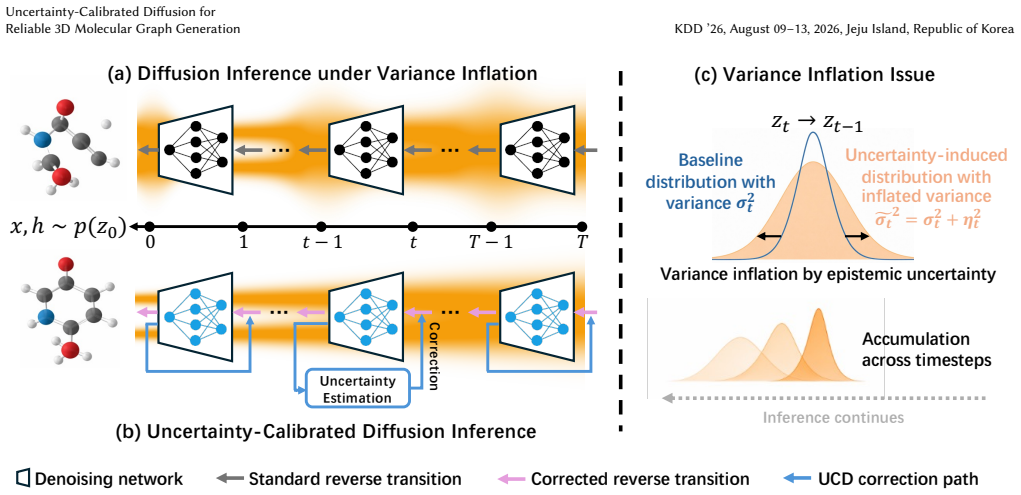
Epistemic uncertainty from the denoiser combines with injected aleatoric noise to produce systematic variance inflation and a mismatch between true and simulated molecular distributions.
What would settle it
Applying UCD to any baseline diffusion model on a 3D molecular benchmark and observing no reduction in distribution mismatch or no improvement in validity and quality metrics relative to the uncalibrated baseline.
Figures
read the original abstract
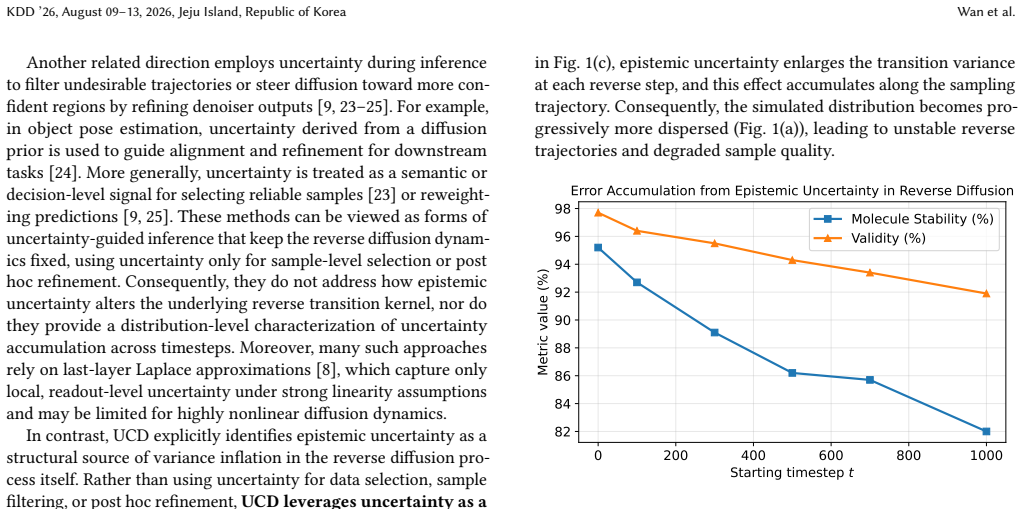
Bayesian inference provides a principled framework for modeling epistemic uncertainty in neural networks by treating predictions as distributions rather than deterministic values. Meanwhile, diffusion-based models for 3D molecular graph generation operate on fragile geometric structures governed by strict chemical constraints, making inference highly sensitive to uncertainty miscalibration. A largely overlooked issue is that epistemic uncertainty arising from the learned denoiser interacts with the aleatoric uncertainty intentionally injected during reverse diffusion, leading to systematic variance inflation and a mismatch between the true distribution and the simulated distribution. This effect is particularly detrimental for high-precision molecular generation, where even small deviations can violate chemical validity. In this work, we provide a theoretical and empirical analysis of how epistemic uncertainty propagates through diffusion inference and degrades sampling quality. Building on this investigation, we propose UCD (Uncertainty-Calibrated Diffusion), a simple yet effective method that calibrates the reverse diffusion process to account for epistemic uncertainty. Extensive experiments on standard 3D molecular benchmarks demonstrate that UCD consistently improves sampling quality across diverse baseline methods, establishing new state-of-the-art performance for 3D molecular diffusion. The code is available at https://github.com/jiuguaiwf/UCD.
Editorial analysis
A structured set of objections, weighed in public.
Referee Report
Summary. The paper claims that epistemic uncertainty from the learned denoiser in diffusion models for 3D molecular graph generation interacts with aleatoric uncertainty injected during reverse diffusion, producing systematic variance inflation and a mismatch between true and simulated distributions. This degrades sampling quality, especially for chemically valid high-precision molecules. The authors provide a theoretical and empirical analysis of this propagation effect and introduce UCD (Uncertainty-Calibrated Diffusion), a calibration method for the reverse process that accounts for epistemic uncertainty. Experiments show consistent improvements over diverse baselines on standard 3D molecular benchmarks, establishing new state-of-the-art performance; code is released.
Significance. If the interaction analysis and calibration hold under scrutiny, the work could meaningfully improve reliability of diffusion-based generative models for structured geometric data, where small uncertainty miscalibrations violate chemical constraints. This is relevant to applications in drug discovery and materials design. The explicit treatment of epistemic-aleatoric interaction and code release are strengths, though the abstract provides no equations or experimental details to assess whether the calibration is parameter-free or post-hoc.
major comments (2)
- [Abstract] Abstract: the central claim that epistemic uncertainty interacts with aleatoric noise to produce variance inflation is presented without any equations, derivations, or propagation analysis. This prevents evaluation of whether the effect is load-bearing for the SOTA claim or if the proposed calibration corrects it by construction.
- [Abstract] Abstract: no specific benchmarks, metrics (e.g., validity, uniqueness, RMSD), or baseline methods are named, making it impossible to assess whether the reported improvements are robust or if post-hoc choices affect results.
minor comments (1)
- The abstract states that UCD is 'simple yet effective' but provides no indication of added hyperparameters or implementation overhead; this should be quantified in the methods section.
Simulated Author's Rebuttal
We thank the referee for the comments. The abstract is intentionally high-level, but we address the concerns point-by-point below and will revise it where appropriate.
read point-by-point responses
-
Referee: [Abstract] Abstract: the central claim that epistemic uncertainty interacts with aleatoric noise to produce variance inflation is presented without any equations, derivations, or propagation analysis. This prevents evaluation of whether the effect is load-bearing for the SOTA claim or if the proposed calibration corrects it by construction.
Authors: The abstract provides a concise summary without equations to maintain accessibility and length constraints. The full theoretical derivation of the epistemic-aleatoric interaction, variance inflation effect, and propagation analysis appears in Section 3 of the manuscript, with the UCD calibration derived directly from this analysis to correct the mismatch by construction. We will revise the abstract to include a brief reference to the key theoretical result. revision: partial
-
Referee: [Abstract] Abstract: no specific benchmarks, metrics (e.g., validity, uniqueness, RMSD), or baseline methods are named, making it impossible to assess whether the reported improvements are robust or if post-hoc choices affect results.
Authors: We agree the abstract would benefit from greater specificity. The experiments use standard 3D molecular benchmarks with metrics including validity, uniqueness, and RMSD, and compare against multiple diffusion baselines. We will revise the abstract to name the primary benchmarks, metrics, and representative baselines. revision: yes
Circularity Check
No significant circularity detected
full rationale
The paper motivates UCD via analysis of epistemic-aleatoric uncertainty interaction in diffusion reverse processes, then proposes a calibration method and validates it on external 3D molecular benchmarks. No equations, self-definitional reductions, fitted-input predictions, or load-bearing self-citations appear in the abstract or described content. The central claim rests on empirical improvements rather than internal redefinitions or self-referential derivations, rendering the chain self-contained.
Axiom & Free-Parameter Ledger
Reference graph
Works this paper leans on
-
[1]
Michael S Albergo, Nicholas M Boffi, and Eric Vanden-Eijnden. 2023. Stochastic interpolants: A unifying framework for flows and diffusions.arXiv preprint arXiv:2303.08797(2023)
work page internal anchor Pith review Pith/arXiv arXiv 2023
-
[2]
Simon Axelrod and Rafael Gomez-Bombarelli. 2022. GEOM, energy-annotated molecular conformations for property prediction and molecular generation.Sci- entific Data9, 1 (2022), 185
2022
- [3]
-
[4]
1995.Neural networks for pattern recognition
Christopher M Bishop. 1995.Neural networks for pattern recognition. Oxford university press
1995
- [5]
-
[6]
Seungyeon Choi, Hwanhee Kim, Chihyun Park, Dahyeon Lee, Seungyong Lee, Yoonju Kim, Hyoungjoon Park, Sein Kwon, Youngwan Jo, and Sanghyun Park
- [7]
-
[8]
Merlise Clyde and Edward I George. 2004. Model uncertainty. (2004)
2004
-
[9]
Erik Daxberger, Agustinus Kristiadi, Alexander Immer, Runa Eschenhagen, Matthias Bauer, and Philipp Hennig. 2021. Laplace redux-effortless bayesian deep learning.Advances in neural information processing systems34 (2021), 20089–20103
2021
-
[10]
Michele De Vita and Vasileios Belagiannis. 2025. Diffusion model guided sam- pling with pixel-wise aleatoric uncertainty estimation. In2025 IEEE/CVF Winter Conference on Applications of Computer Vision (W ACV). IEEE, 3844–3854
2025
- [11]
-
[12]
Zhekai Du and Jingjing Li. 2023. Diffusion-based probabilistic uncertainty esti- mation for active domain adaptation.Advances in Neural Information Processing Systems36 (2023), 17129–17155
2023
-
[13]
Shikun Feng, Yuyan Ni, Zhi-Ming Ma, Wei-Ying Ma, Yanyan Lan, et al . 2025. Unigem: A unified approach to generation and property prediction for molecules. InInternational conference on learning representations, Vol. 2025. 12824–12849
2025
-
[14]
Yarin Gal and Zoubin Ghahramani. 2016. Dropout as a bayesian approximation: Representing model uncertainty in deep learning. Ininternational conference on machine learning. PMLR, 1050–1059
2016
-
[15]
Wenhan Gao, Jingxiang Qu, and Yi Liu. 2026. Scaling the Prior: Size-Consistent Geometric Diffusion for 3D Molecular Generation. InProceedings of the 43rd International Conference on Machine Learning
2026
-
[16]
Victor Garcia Satorras, Emiel Hoogeboom, Fabian Fuchs, Ingmar Posner, and Max Welling. 2021. E (n) equivariant normalizing flows.Advances in Neural Information Processing Systems34 (2021), 4181–4192
2021
-
[17]
Jakob Gawlikowski, Cedrique Rovile Njieutcheu Tassi, Mohsin Ali, Jongseok Lee, Matthias Humt, Jianxiang Feng, Anna Kruspe, Rudolph Triebel, Peter Jung, Ribana Roscher, et al. 2023. A survey of uncertainty in deep neural networks. Artificial Intelligence Review56, Suppl 1 (2023), 1513–1589
2023
-
[18]
Niklas Gebauer, Michael Gastegger, and Kristof Schütt. 2019. Symmetry-adapted generation of 3d point sets for the targeted discovery of molecules.Advances in neural information processing systems32 (2019)
2019
- [19]
-
[20]
Jonathan Ho, Ajay Jain, and Pieter Abbeel. 2020. Denoising diffusion probabilistic models.Advances in neural information processing systems33 (2020), 6840–6851
2020
-
[21]
Emiel Hoogeboom, Vıctor Garcia Satorras, Clément Vignac, and Max Welling
-
[22]
InInternational confer- ence on machine learning
Equivariant diffusion for molecule generation in 3d. InInternational confer- ence on machine learning. PMLR, 8867–8887
-
[23]
Peiyan Hu, Xiaowei Qian, Wenhao Deng, Rui Wang, Haodong Feng, Ruiqi Feng, Tao Zhang, Long Wei, Yue Wang, Zhi-Ming Ma, et al. [n. d.]. From Uncertain to Safe: Conformal Adaptation of Diffusion Models for Safe PDE Control. In Forty-second International Conference on Machine Learning
-
[24]
Eyke Hüllermeier and Willem Waegeman. 2021. Aleatoric and epistemic uncer- tainty in machine learning: An introduction to concepts and methods.Machine learning110, 3 (2021), 457–506
2021
- [25]
- [26]
- [27]
-
[28]
Maksim Kulichenko, Kipton Barros, Nicholas Lubbers, Ying Wai Li, Richard Messerly, Sergei Tretiak, Justin S Smith, and Benjamin Nebgen. 2023. Uncertainty- driven dynamics for active learning of interatomic potentials.Nature computa- tional science3, 3 (2023), 230–239
2023
-
[29]
Xufeng Liu, Dongsheng Luo, Wenhan Gao, and Yi Liu. 2025. 3DGraphX: Explain- ing 3D Molecular Graph Models via Incorporating Chemical Priors. InProceedings of the 31st ACM SIGKDD Conference on Knowledge Discovery and Data Mining V
2025
-
[30]
Yi Liu, Limei Wang, Meng Liu, Yuchao Lin, Xuan Zhang, Bora Oztekin, and Shui- wang Ji. 2022. Spherical message passing for 3D molecular graphs. InInternational Conference on Learning Representations
2022
-
[31]
Eric Martin and Eddie Cao. 2015. Euclidean chemical spaces from molecular fingerprints: Hamming distance and Hempel’s ravens.Journal of computer-aided molecular design29, 5 (2015), 387–395
2015
- [32]
- [33]
-
[34]
Jingxiang Qu, Wenhan Gao, Ruichen Xu, and Yi Liu. 2026. GAGA: Gaussianity- Aware Gaussian Approximation for Efficient 3D Molecular Generation. In The Fourteenth International Conference on Learning Representations. https: //openreview.net/forum?id=Q9gz8lVyAi
2026
-
[35]
Jingxiang Qu, Wenhan Gao, Jiaxing Zhang, Xufeng Liu, Hua Wei, Haibin Ling, and Yi Liu. 2025. RISE: Radius of Influence based Subgraph Extraction for 3D Molecular Graph Explanation. InInternational Conference on Machine Learning. PMLR, 50744–50761
2025
-
[36]
Raghunathan Ramakrishnan, Pavlo O Dral, Matthias Rupp, and O Anatole Von Lilienfeld. 2014. Quantum chemistry structures and properties of 134 kilo molecules.Scientific data1, 1 (2014), 1–7
2014
-
[37]
Jean-Louis Reymond, Lars Ruddigkeit, Lorenz Blum, and Ruud Van Deursen
-
[38]
The enumeration of chemical space.Wiley Interdisciplinary Reviews: Computational Molecular Science2, 5 (2012), 717–733
2012
-
[39]
Robin Rombach, Andreas Blattmann, Dominik Lorenz, Patrick Esser, and Björn Ommer. 2021. High-Resolution Image Synthesis with Latent Diffusion Models. arXiv:2112.10752 [cs.CV]
work page internal anchor Pith review Pith/arXiv arXiv 2021
- [40]
-
[41]
Martin Simonovsky and Nikos Komodakis. 2018. Graphvae: Towards generation of small graphs using variational autoencoders. InInternational conference on artificial neural networks. Springer, 412–422
2018
-
[42]
Justin S Smith, Ben Nebgen, Nicholas Lubbers, Olexandr Isayev, and Adrian E Roitberg. 2018. Less is more: Sampling chemical space with active learning.The Journal of chemical physics148, 24 (2018)
2018
-
[43]
Jiaming Song, Chenlin Meng, and Stefano Ermon. 2020. Denoising Diffusion Implicit Models.arXiv:2010.02502(October 2020). https://arxiv.org/abs/2010. 02502
work page internal anchor Pith review Pith/arXiv arXiv 2020
-
[44]
Yang Song, Conor Durkan, Iain Murray, and Stefano Ermon. 2021. Maximum like- lihood training of score-based diffusion models.Advances in neural information processing systems34 (2021), 1415–1428
2021
-
[45]
Yuxuan Song, Jingjing Gong, Hao Zhou, Mingyue Zheng, Jingjing Liu, and Wei- Ying Ma. 2024. Unified generative modeling of 3d molecules with bayesian flow networks. InThe Twelfth International Conference on Learning Representations
2024
-
[46]
Yang Song, Jascha Sohl-Dickstein, Diederik P Kingma, Abhishek Kumar, Stefano Ermon, and Ben Poole. 2020. Score-based generative modeling through stochastic differential equations.arXiv preprint arXiv:2011.13456(2020)
work page internal anchor Pith review Pith/arXiv arXiv 2020
-
[47]
Ronast Subedi, Lu Wei, Wenhan Gao, Shayok Chakraborty, and Yi Liu. 2024. Empowering active learning for 3D molecular graphs with geometric graph isomorphism.Advances in Neural Information Processing Systems37 (2024), 55507–55537
2024
-
[48]
Aik Rui Tan, Shingo Urata, Samuel Goldman, Johannes CB Dietschreit, and Rafael Gómez-Bombarelli. 2023. Single-model uncertainty quantification in neural network potentials does not consistently outperform model ensembles. npj Computational Materials9, 1 (2023), 225
2023
-
[49]
Limei Wang, Haoran Liu, Yi Liu, Jerry Kurtin, and Shuiwang Ji. 2023. Learning Hierarchical Protein Representations via Complete 3D Graph Networks. InThe Eleventh International Conference on Learning Representations. https://openreview. net/forum?id=9X-hgLDLYkQ
2023
-
[50]
Limei Wang, Yi Liu, Yuchao Lin, Haoran Liu, and Shuiwang Ji. 2022. ComENet: Towards Complete and Efficient Message Passing for 3D Molecular Graphs. In The 36th Annual Conference on Neural Information Processing Systems. 650–664
2022
-
[51]
Joe Watson, Jihao Andreas Lin, Pascal Klink, Joni Pajarinen, and Jan Peters. 2021. Latent derivative Bayesian last layer networks. InInternational Conference on Artificial Intelligence and Statistics. PMLR, 1198–1206
2021
-
[52]
Watson, David Juergens, Nathaniel R
Joseph L. Watson, David Juergens, Nathaniel R. Bennett, Brian L. Trippe, Ja- son Yim, Helen E. Eisenach, Woody Ahern, Andrew J. Borst, Robert J. Ragotte, Lukas F. Milles, Basile I. M. Wicky, Nikita Hanikel, Samuel J. Pellock, Alexis Courbet, William Sheffler, Jue Wang, Preetham Venkatesh, Isaac Sappington, Uncertainty-Calibrated Diffusion for Reliable 3D ...
-
[53]
Minkai Xu, Alexander S Powers, Ron O Dror, Stefano Ermon, and Jure Leskovec
-
[54]
InInterna- tional Conference on Machine Learning
Geometric latent diffusion models for 3d molecule generation. InInterna- tional Conference on Machine Learning. PMLR, 38592–38610
-
[55]
Keqiang Yan, Yi Liu, Yuchao Lin, and Shuiwang Ji. 2022. Periodic Graph Trans- formers for Crystal Material Property Prediction. InThe 36th Annual Conference on Neural Information Processing Systems. 15066–15080
2022
-
[56]
Xuan Zhang, Limei Wang, Jacob Helwig, Youzhi Luo, Cong Fu, Yaochen Xie, Meng Liu, Yuchao Lin, Zhao Xu, Keqiang Yan, Keir Adams, Maurice Weiler, Xiner Li, Tianfan Fu, Yucheng Wang, Haiyang Yu, YuQing Xie, Xiang Fu, Alex Strasser, Shenglong Xu, Yi Liu, Yuanqi Du, Alexandra Saxton, Hongyi Ling, Han- nah Lawrence, Hannes Stärk, Shurui Gui, Carl Edwards, Nicho...
discussion (0)
Sign in with ORCID, Apple, or X to comment. Anyone can read and Pith papers without signing in.