Overcoming Challenges in Agile and DevOps Integration: A Qualitative Study
Pith reviewed 2026-06-28 14:00 UTC · model grok-4.3
The pith
Interviews with six professionals identify four challenge categories and four solution domains for Agile-DevOps integration.
A machine-rendered reading of the paper's core claim, the machinery that carries it, and where it could break.
Core claim
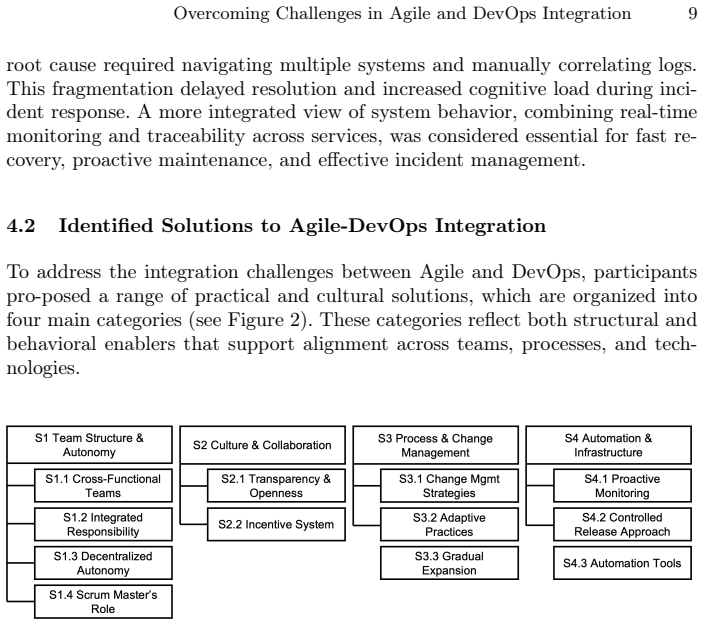
Based on interviews with six industry professionals experienced in both Agile and DevOps across Brazil and Germany, the study identifies four core categories of integration challenges: Cultural & Organizational Barriers, Structural Constraints, Process & Method Complexity, and Technical Limitations. It also offers four major solution domains: Team Structure & Autonomy, Culture & Collaboration, Process & Change Management, and Automation & Infrastructure. The findings emphasize cultural alignment, proactive monitoring, and automation as key to reducing friction during the transition.
What carries the argument
The four challenge categories and four solution domains derived from thematic analysis of the interview transcripts.
If this is right
- Teams that adjust their structure to increase autonomy can reduce structural constraints in the integration.
- Building shared culture and collaboration practices directly addresses cultural barriers.
- Targeted process changes and change management lower the complexity of combining the two methods.
- Investing in automation and supporting infrastructure overcomes many technical limitations.
Where Pith is reading between the lines
- The identified categories could serve as a diagnostic checklist for organizations starting an Agile-DevOps transition.
- Future work might test whether the solution domains produce measurable improvements in delivery speed when applied together.
- The small sample size leaves open the question of how challenges differ by company scale or sector.
Load-bearing premise
That the views of six professionals from Brazil and Germany capture the main patterns of Agile-DevOps integration challenges across the broader software industry.
What would settle it
A larger set of interviews from additional countries and company types that consistently reports different or additional challenge categories would show the four categories do not generalize.
Figures

read the original abstract
In response to the growing reliance on Agile and DevOps methodologies for enhancing software delivery speed and quality, this study investigates the persistent challenges and viable solutions associated with their integration. Although Agile promotes iterative development and customer responsiveness, and DevOps emphasizes automation and operational efficiency, their convergence in practice often presents significant organizational, structural, and technical hurdles. This research employs a qualitative methodology grounded in semi-structured interviews with six seasoned industry professionals across Brazil and Germany, each with extensive experience in both Agile and DevOps domains. The study identifies four core categories of integration challenges: Cultural & Organizational Barriers, Structural Constraints, Process \& Method Complexity, and Technical Limitations. Additionally, it offers four major solution domains: Team Structure & Autonomy, Culture & Collaboration, Process & Change Management, and Automation & Infrastructure. The findings underscore the importance of cultural alignment, proactive monitoring, automation, and other practices in mitigating integration friction. The results contribute to a deeper understanding of the Agile-DevOps interface and offer practical insights for software organizations seeking to navigate this complex transition effectively.
Editorial analysis
A structured set of objections, weighed in public.
Referee Report
Summary. The manuscript reports a qualitative study employing semi-structured interviews with six seasoned professionals from Brazil and Germany to examine challenges and solutions in integrating Agile and DevOps methodologies. Through thematic analysis, it identifies four core challenge categories (Cultural & Organizational Barriers, Structural Constraints, Process & Method Complexity, Technical Limitations) and four solution domains (Team Structure & Autonomy, Culture & Collaboration, Process & Change Management, Automation & Infrastructure), emphasizing cultural alignment, proactive monitoring, and automation as key mitigators of integration friction.
Significance. If the thematic categories prove robust, the work supplies practitioner-sourced qualitative data on a prevalent software engineering issue, offering practical guidance for organizations navigating Agile-DevOps transitions and contributing to the literature on methodology integration. The collection of primary interview data across two countries represents a modest strength in capturing cross-regional perspectives.
major comments (2)
- [Abstract and Methods] Abstract and Methods (study design description): No details are supplied on the thematic analysis process, including code development, saturation criteria, inter-rater reliability assessment, or steps taken to address researcher bias. These omissions are load-bearing because the four 'core categories' are derived directly from this analysis of N=6 interviews.
- [Findings and Discussion] Findings and Discussion: The manuscript presents the four challenge categories and four solution domains as 'core' without bounding their generalizability or providing evidence (e.g., saturation across additional sites or explicit limitation statements) that the themes transcend the specific sample of six professionals in Brazil and Germany; this directly affects the central claim of industry-wide applicability.
minor comments (1)
- [Abstract] Abstract: The phrase 'Process \& Method Complexity' contains a LaTeX escape sequence that should be rendered as 'Process & Method Complexity' for clarity in the final version.
Simulated Author's Rebuttal
We thank the referee for the constructive comments on methodological transparency and the scope of our claims. We address each point below and have prepared revisions accordingly.
read point-by-point responses
-
Referee: [Abstract and Methods] Abstract and Methods (study design description): No details are supplied on the thematic analysis process, including code development, saturation criteria, inter-rater reliability assessment, or steps taken to address researcher bias. These omissions are load-bearing because the four 'core categories' are derived directly from this analysis of N=6 interviews.
Authors: We agree that the original manuscript omitted key details on the thematic analysis. In the revised version we will expand the Methods section with a dedicated subsection describing the inductive code development process, the saturation criteria applied after the sixth interview, the inter-rater reliability procedure (independent coding by two authors with resolution of discrepancies), and the steps taken to address researcher bias (reflexive memos and peer debriefing). revision: yes
-
Referee: [Findings and Discussion] Findings and Discussion: The manuscript presents the four challenge categories and four solution domains as 'core' without bounding their generalizability or providing evidence (e.g., saturation across additional sites or explicit limitation statements) that the themes transcend the specific sample of six professionals in Brazil and Germany; this directly affects the central claim of industry-wide applicability.
Authors: We accept that the phrasing 'core categories' and 'major solution domains' requires explicit qualification. The revised manuscript will add a Limitations subsection and revise the Discussion to state that the themes are based on six professionals from two countries, that no claim of industry-wide applicability is made, and that further multi-site studies are needed to assess transferability. The abstract and findings sections will be updated to remove any implication of broader generalizability. revision: yes
Circularity Check
No circularity detected; claims rest on primary interview data without self-referential loops.
full rationale
The paper derives its four challenge categories and four solution domains directly from thematic analysis of semi-structured interviews with six professionals. No equations, fitted parameters, predictions, or first-principles derivations are present that could reduce to inputs by construction. No self-citations are invoked as load-bearing for uniqueness theorems or ansatzes. The derivation chain is self-contained in standard qualitative methodology and does not exhibit any of the enumerated circularity patterns.
Axiom & Free-Parameter Ledger
axioms (1)
- domain assumption Thematic analysis of a small set of semi-structured interviews yields representative categories of industry challenges
Reference graph
Works this paper leans on
-
[1]
In: Systems, Software and Services Process Improvement
Acevedo, D., Muñoz, M., Galvan, S., Mejía, J., Robles, B.D.V.: Toward the im- plementation of devops: A guide of tools, practices and activities. In: Systems, Software and Services Process Improvement. pp. 106–123 (2026) Overcoming Challenges in Agile and DevOps Integration 15
2026
-
[2]
In: 2018 International Conference on Advances in Computing and Communication Engineering (ICACCE)
Agarwal, A., Gupta, S., Choudhury, T.: Continuous and integrated software development using devops. In: 2018 International Conference on Advances in Computing and Communication Engineering (ICACCE). pp. 290–293 (2018). https://doi.org/10.1109/ICACCE.2018.8458052
-
[3]
https://doi.org/10.1016/j.infsof.2024.107583
Amaro,R.,Pereira,R.,daSilva,M.M.:Mappingdevopscapabilitiestothesoftware lifecycle:Asystematicliteraturereview.InformationandSoftwareTechnology177 (2025). https://doi.org/10.1016/j.infsof.2024.107583
-
[4]
Anderson, D.J.: Kanban - Successful Evolutionary Change for your Technology Business (2010)
2010
-
[5]
Information and Software Technology177(2025)
Aouni, F.E., Moumane, K., Idri, A., Najib, M., Jan, S.U.: A systematic literature review on agile, cloud, and devops integration: Challenges, benefits. Information and Software Technology177(2025). https://doi.org/10.1016/j.infsof.2024.107569
-
[6]
https://doi.org/10.5281/zenodo.19486542
authors, A.: Research protocol (2025). https://doi.org/10.5281/zenodo.19486542
-
[7]
European Journal of Information Systems31(5), 548–567 (2022)
Gall, M., Pigni, F.: Taking devops mainstream: a critical review and concep- tual framework. European Journal of Information Systems31(5), 548–567 (2022). https://doi.org/10.1080/0960085X.2021.1997100
-
[8]
In: 2023 International Research Confer- ence on Smart Computing and Systems Engineering (SCSE)
Jayakody, J., Wijayanayake, W.M.J.I.: Process improvement framework for de- vops adoption in software development. In: 2023 International Research Confer- ence on Smart Computing and Systems Engineering (SCSE). vol. 6, pp. 1–7 (2023). https://doi.org/10.1109/SCSE59836.2023.10214992
-
[9]
Forum Qualitative Sozialforschung / Forum: Qualitative Social Research1(2) (2000)
Mayring, P.: Qualitative content analysis. Forum Qualitative Sozialforschung / Forum: Qualitative Social Research1(2) (2000). https://doi.org/10.17169/fqs- 1.2.1089
-
[10]
Mayring, P., Fenzl, T.: Qualitative Inhaltsanalyse, pp. 691–706 (2022). https://doi.org/10.1007/978-3-658-37985-8_43
-
[11]
In: 2024 4th International Conference on Advanced Research in Computing (ICARC)
Nayanajith, A., Wickramarachchi, R.: Challenges affecting the successful adop- tion of devops practices: A systematic literature review. In: 2024 4th International Conference on Advanced Research in Computing (ICARC). pp. 311–315 (2024). https://doi.org/10.1109/ICARC61713.2024.10499735
-
[12]
Indian Journal of Information Sources and Services14(3), 175–185 (2024)
Panchal, B.Y., Shah, A., Shah, P., Bhatt, P., Tiwari, M., Yadav, A.: Exploring synergies, differences, and impacts of agile and devops on software development ef- ficiency. Indian Journal of Information Sources and Services14(3), 175–185 (2024). https://doi.org/10.51983/ijiss-2024.14.3.23
-
[13]
In: Systems, Software and Services Process Improvement
Ramaj, X., Colomo-Palacios, R., Sánchez-Gordón, M., Gkioulos, V.: Towards a devsecops-enabled framework for risk management of critical infrastructures. In: Systems, Software and Services Process Improvement. pp. 47–58 (2023)
2023
-
[14]
In: Proceedings of the 53rd Hawaii International Conference on System Sciences (HICSS)
Saltz, J., Sutherland, A.: Ski: A new agile framework that supports devops, con- tinuous delivery, and lean hypothesis testing. In: Proceedings of the 53rd Hawaii International Conference on System Sciences (HICSS). pp. 6217–6226 (2020). https://doi.org/10.24251/HICSS.2020.761
-
[15]
In: 2017 Seventeenth International Conference on Advances in ICT for Emerging Regions (ICTer)
Samarawickrama, S.S., Perera, I.: Continuous scrum: A framework to en- hance scrum with devops. In: 2017 Seventeenth International Conference on Advances in ICT for Emerging Regions (ICTer). pp. 1–7 (2017). https://doi.org/10.1109/ICTER.2017.8257808
-
[16]
Schwaber, K., Sutherland, J.: The scrum guide (2020), https://scrumguides.org/scrum-guide.html
2020
-
[17]
In: Proceedings of the 22nd Inter- national Conference on Evaluation and Assessment in Software Engineering
Senapathi, M., Buchan, J., Osman, H.: Devops capabilities, practices, and challenges: Insights from a case study. In: Proceedings of the 22nd Inter- national Conference on Evaluation and Assessment in Software Engineering
-
[18]
p. 57–67. EASE ’18, Association for Computing Machinery (2018). https://doi.org/10.1145/3210459.3210465 16 J. Fraislebem et al
-
[19]
Smeds, J., Nybom, K., Porres, I.: Devops: A definition and perceived adoption im- pediments.In:AgileProcessesinSoftwareEngineeringandExtremeProgramming. pp. 166–177 (2015). https://doi.org/10.1007/978-3-319-18612-2_14
-
[20]
Information and Organiza- tion33(3) (2023)
Wiedemann, A., Wiesche, M., Gewald, H., Krcmar, H.: Integrating development and operations teams: A control approach for devops. Information and Organiza- tion33(3) (2023). https://doi.org/10.1016/j.infoandorg.2023.100474
discussion (0)
Sign in with ORCID, Apple, or X to comment. Anyone can read and Pith papers without signing in.