Probing pair production of long-lived scalars via an off-shell Standard-Model-like Higgs boson at the LHC
Pith reviewed 2026-06-28 14:28 UTC · model grok-4.3
The pith
Off-shell Higgs production of long-lived scalar pairs is already excluded up to 230 GeV by ATLAS displaced-vertex data.
A machine-rendered reading of the paper's core claim, the machinery that carries it, and where it could break.
Core claim
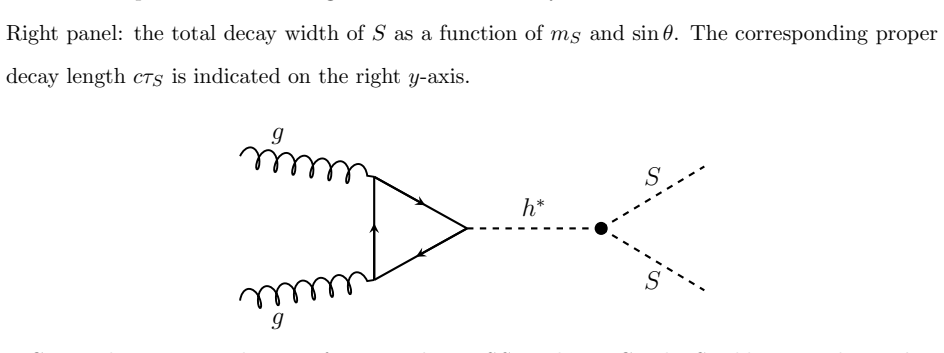
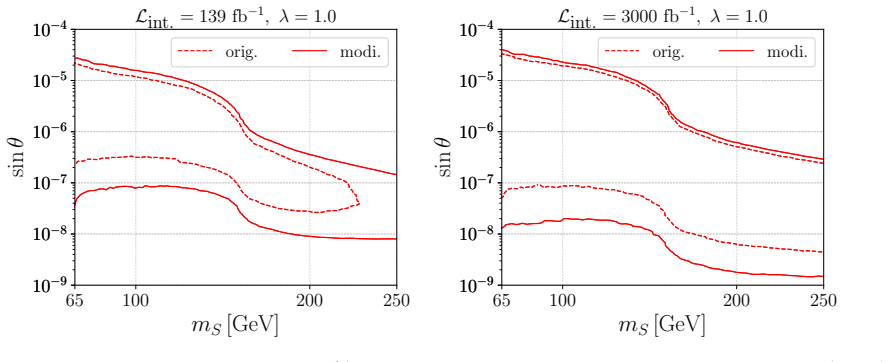
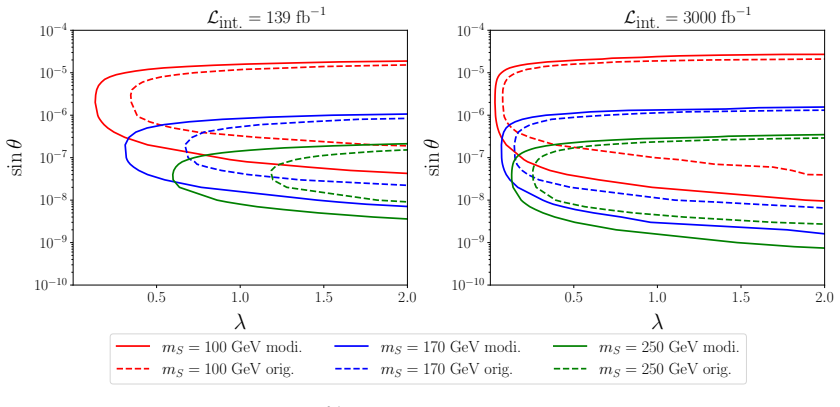
The channel gg → h* → SS, with h* an off-shell Standard-Model-like Higgs boson, generates long-lived scalars whose decays produce displaced vertices accompanied by jets. Reinterpretation of an ATLAS DV-plus-jets search in this topology excludes scalar masses up to roughly 230 GeV for a benchmark hSS coupling λv of 246 GeV; a modified analysis and high-luminosity LHC projections extend the sensitivity across wider ranges of mass and lifetime.
What carries the argument
The gg → h* → SS production process mediated by an off-shell SM-like Higgs boson, which yields displaced-vertex signatures from the subsequent decays of the long-lived scalars S.
If this is right
- Existing ATLAS data already rules out scalar masses up to 230 GeV for the benchmark coupling value.
- A modified analysis strategy based on the same search improves sensitivity across a broader mass-lifetime region.
- High-luminosity LHC projections further enlarge the excluded parameter space.
- The off-shell channel accesses scalar masses above the kinematic limit of on-shell Higgs decay h → SS.
Where Pith is reading between the lines
- The same recast technique could be applied to other final states or other long-lived particles produced through the Higgs portal.
- Limits derived here would translate directly into upper bounds on the Higgs-scalar mixing angle in any model that generates the hSS vertex.
- If the exclusions survive more detailed detector modeling, they would narrow the viable parameter space for scalar extensions that rely on small mixing to achieve long lifetimes.
Load-bearing premise
The recast of the ATLAS DV-plus-jets search accurately reproduces the signal efficiency and background rates for the specific off-shell Higgs-mediated topology and decay kinematics of S.
What would settle it
A dedicated full-detector simulation of gg → h* → SS events that returns signal efficiencies or background compositions substantially different from those assumed in the recast would remove the claimed exclusions.
Figures


read the original abstract
We study the collider phenomenology of a long-lived scalar particle $S$ that arises from Higgs mixing in a broad class of Standard-Model (SM) extensions. When the mixing angle is sufficiently small, $S$ becomes long-lived, while its pair production via the Higgs portal can remain sizable. We focus on the production channel $gg \to h^* \to SS$ at the LHC, mediated by an \textit{off-shell} SM-like Higgs boson. This mechanism provides a complementary probe of $S$ in the mass region above the kinematic threshold of the conventional on-shell decay $h \to SS$, thereby extending the accessible parameter space to heavier scalars. The long-lived $S$ particles can decay inside the inner detector, leading to displaced vertices (DVs) accompanied by jets. We perform a detailed Monte Carlo simulation and reinterpret an existing recast of an ATLAS search for DV-plus-jets signatures in this scenario. We also consider a modified analysis strategy based on the same search to assess potential improvements in sensitivity. We find that the current ATLAS search already excludes a significant region of the parameter space, reaching scalar masses up to $m_S \sim 230$ GeV for a benchmark $hSS$ coupling $\lambda v$ of $246$ GeV. The modified analysis and projections to the high-luminosity LHC further extend the sensitivity to wider regions of the mass--lifetime parameter space.
Editorial analysis
A structured set of objections, weighed in public.
Referee Report
Summary. The manuscript studies long-lived scalars S produced in pairs via off-shell Higgs mediation (gg → h* → SS) at the LHC. Using Monte Carlo simulation, it reinterprets an existing ATLAS displaced-vertex-plus-jets search and claims that current data excludes m_S up to ~230 GeV for λv = 246 GeV, with further reach from modified strategies and HL-LHC projections.
Significance. If validated, the result provides a complementary probe of the Higgs portal for long-lived particles in a mass range inaccessible to on-shell h → SS decays. It leverages existing experimental data through recasting, which is a strength for timely constraints on new physics.
major comments (1)
- [Monte Carlo simulation and reinterpretation] The headline exclusion (m_S ∼ 230 GeV at λv = 246 GeV) depends on the signal efficiency in the recast of the ATLAS DV+jets search. Because the mediator is off-shell, the SS invariant-mass spectrum is continuous and the boost and decay-length distributions differ from on-shell benchmarks. The manuscript provides no cut-flow tables, efficiency versus m_S curves, or cross-checks confirming that the recast remains valid for this topology within the precision needed to support the quoted mass reach.
Simulated Author's Rebuttal
We thank the referee for their careful reading of the manuscript and for highlighting the need for greater transparency in the Monte Carlo reinterpretation. We address the major comment below.
read point-by-point responses
-
Referee: [Monte Carlo simulation and reinterpretation] The headline exclusion (m_S ∼ 230 GeV at λv = 246 GeV) depends on the signal efficiency in the recast of the ATLAS DV+jets search. Because the mediator is off-shell, the SS invariant-mass spectrum is continuous and the boost and decay-length distributions differ from on-shell benchmarks. The manuscript provides no cut-flow tables, efficiency versus m_S curves, or cross-checks confirming that the recast remains valid for this topology within the precision needed to support the quoted mass reach.
Authors: We agree that the off-shell nature of the mediator produces a continuous m_SS spectrum and distinct boost/decay-length distributions relative to on-shell benchmarks, and that explicit validation material is needed to support the quoted reach. Our Monte Carlo generation already incorporates the full off-shell kinematics via the Higgs portal, but the manuscript does not present cut-flow tables or efficiency curves versus m_S. We will add these in the revised version, together with a short discussion of the kinematic differences and a statement on the applicability of the ATLAS recast to this topology. revision: yes
Circularity Check
No circularity; exclusion derived from external ATLAS recast via MC simulation
full rationale
The paper's central result—an exclusion reaching m_S ~230 GeV—is obtained by generating gg→h*→SS events with Monte Carlo, then feeding them into a pre-existing recast of an ATLAS displaced-vertex-plus-jets search. No equation defines a quantity in terms of itself, no fitted parameter is relabeled as a prediction, and the load-bearing step (signal efficiency and background rates) rests on external experimental data rather than internal self-citation or ansatz. The derivation chain is therefore self-contained against benchmarks outside the paper.
Axiom & Free-Parameter Ledger
free parameters (1)
- λv (hSS coupling)
axioms (1)
- domain assumption S arises from Higgs mixing in a broad class of SM extensions with small mixing angle yielding long lifetime
invented entities (1)
-
long-lived scalar S
no independent evidence
Reference graph
Works this paper leans on
-
[1]
Fiducial volume: 4 mm< R xy <300 mm and|z|<300 mm, whereR xy and|z|are the absolute distance of the DV to the IP in the transverse and longitudinal directions, respectively
-
[2]
Transverse impact parameter: the DV should have at least one associated track with its absolute transverse impact parameter larger than 2 mm:|d 0|>2 mm
-
[3]
(b) The transverse momentump T and the electric chargeqof the decay product should fulfillp T /|q|>1 GeV
Selected decay products: the DV should have at least 5 massive decay products passing two conditions: (a) The decay product should be a track with a transverse decay length in the lab- 9 oratory frame (β T γcτ) longer than 520 mm, whereβ T is its absolute speed in the transverse direction,γis its Lorentz boost factor, andcτis its proper decay length. (b) ...
-
[4]
Afterwards, we apply the parameterized efficiency functions mentioned above onto the events that have passed both the event- and vertex-level acceptances described above
DV invariant mass:m DV >10 GeV, wherem DV is reconstructed with the decay prod- ucts passing the conditions described above where such decay products are assumed to be a charged pion. Afterwards, we apply the parameterized efficiency functions mentioned above onto the events that have passed both the event- and vertex-level acceptances described above. In...
-
[5]
G. Aadet al.(ATLAS), Phys. Lett. B716, 1 (2012), arXiv:1207.7214 [hep-ex]
Pith/arXiv arXiv 2012
-
[6]
S. Chatrchyanet al.(CMS), Phys. Lett. B716, 30 (2012), arXiv:1207.7235 [hep-ex]
Pith/arXiv arXiv 2012
-
[7]
W. Liu, A. Yang, and H. Sun, Phys. Rev. D105, 115040 (2022), arXiv:2205.08205 [hep-ph]
arXiv 2022
-
[8]
L. Wang, J. M. Yang, and Y. Zhang, Commun. Theor. Phys.74, 097202 (2022), arXiv:2203.07244 [hep-ph]
arXiv 2022
- [9]
- [10]
-
[11]
W. Liu, L. Wang, and Y. Zhang, Phys. Rev. D110, 015016 (2024), arXiv:2403.16623 [hep-ph]
arXiv 2024
-
[12]
L. Shan, L. Wang, J. M. Yang, and R. Zhu, JHEP10, 193 (2024), arXiv:2408.07366 [hep-ph]
arXiv 2024
-
[13]
J. Kim, D. Kim, S. Lee, and J. Song, Phys. Lett. B868, 139759 (2025), arXiv:2504.19693 [hep-ph]
arXiv 2025
-
[14]
X. Qi, H. Song, and W. Su, (2025), arXiv:2508.12309 [hep-ph]
arXiv 2025
-
[15]
L. Wang, Z. S. Wang, and H. Xu, (2025), arXiv:2510.05525 [hep-ph]
arXiv 2025
-
[16]
C.-T. Lu, X. Wang, X. Wei, and Y. Wu, JHEP02, 149 (2025), arXiv:2410.19561 [hep-ph]
arXiv 2025
-
[17]
Y. Fang, W. Su, X. Wang, Y. Wu, and Y. Zhang, (2025), arXiv:2512.19151 [hep-ph]
arXiv 2025
-
[18]
G. Burdman, Z. Chacko, H.-S. Goh, and R. Harnik, JHEP02, 009 (2007), arXiv:hep- ph/0609152
arXiv 2007
-
[19]
Z. Chacko, H.-S. Goh, and R. Harnik, Phys. Rev. Lett.96, 231802 (2006), arXiv:hep- ph/0506256
arXiv 2006
-
[20]
N. Craig, A. Katz, M. Strassler, and R. Sundrum, JHEP07, 105 (2015), arXiv:1501.05310 [hep-ph]
Pith/arXiv arXiv 2015
-
[21]
H. Cai, H.-C. Cheng, and J. Terning, JHEP05, 045 (2009), arXiv:0812.0843 [hep-ph]
Pith/arXiv arXiv 2009
- [22]
-
[23]
H.-C. Cheng, L. Li, E. Salvioni, and C. B. Verhaaren, JHEP05, 057 (2018), arXiv:1803.03651 [hep-ph]
Pith/arXiv arXiv 2018
-
[24]
U. Ellwanger, C. Hugonie, and A. M. Teixeira, Phys. Rept.496, 1 (2010), arXiv:0910.1785 [hep-ph]
Pith/arXiv arXiv 2010
-
[25]
J. Cao, F. Ding, C. Han, J. M. Yang, and J. Zhu, JHEP11, 018 (2013), arXiv:1309.4939 [hep-ph]
Pith/arXiv arXiv 2013
-
[26]
A. Adhikary, R. K. Barman, B. Bhattacherjee, A. De, R. M. Godbole, and S. Kulkarni, Phys. Rev. D108, 035020 (2023), arXiv:2207.00600 [hep-ph]
arXiv 2023
-
[27]
G. Aadet al.(ATLAS), Phys. Rev. D102, 112006 (2020), arXiv:2005.12236 [hep-ex]
arXiv 2020
-
[28]
Aadet al.(ATLAS), JHEP08, 013 (2024), arXiv:2404.18986 [hep-ex]
G. Aadet al.(ATLAS), JHEP08, 013 (2024), arXiv:2404.18986 [hep-ex]
arXiv 2024
-
[29]
Hayrapetyanet al.(CMS), JHEP06, 097 (2024), arXiv:2403.10341 [hep-ex]
A. Hayrapetyanet al.(CMS), JHEP06, 097 (2024), arXiv:2403.10341 [hep-ex]
arXiv 2024
-
[30]
Tumasyanet al.(CMS), JHEP05, 316 (2024), arXiv:2310.01643 [hep-ex]
A. Tumasyanet al.(CMS), JHEP05, 316 (2024), arXiv:2310.01643 [hep-ex]
arXiv 2024
-
[31]
M. Aaboudet al.(ATLAS), Eur. Phys. J. C79, 481 (2019), arXiv:1902.03094 [hep-ex]
arXiv 2019
-
[32]
G. Aadet al.(ATLAS), Phys. Rev. D112, 092001 (2025), arXiv:2503.20445 [hep-ex]
arXiv 2025
-
[33]
A. Hayrapetyanet al.(CMS), Rept. Prog. Phys.88, 037801 (2025), arXiv:2409.10806 [hep-ex]
arXiv 2025
-
[34]
A. Hayrapetyanet al.(CMS), Phys. Rev. D110, 032007 (2024), arXiv:2402.01898 [hep-ex]
arXiv 2024
-
[35]
J. Alimenaet al., J. Phys. G47, 090501 (2020), arXiv:1903.04497 [hep-ex]
arXiv 2020
-
[36]
L. Lee, C. Ohm, A. Soffer, and T.-T. Yu, Prog. Part. Nucl. Phys.106, 210 (2019), [Erratum: Prog. Part. Nucl. Phys. 122, 103912 (2022)], arXiv:1810.12602 [hep-ph]
Pith/arXiv arXiv 2019
-
[37]
D. Curtinet al., Rept. Prog. Phys.82, 116201 (2019), arXiv:1806.07396 [hep-ph]
arXiv 2019
-
[38]
J. Beachamet al., J. Phys. G47, 010501 (2020), arXiv:1901.09966 [hep-ex]
arXiv 2020
- [39]
-
[40]
Alimenaet al., inLHCb FIP Physics Workshop 2025(2025) arXiv:2510.05257 [hep-ph]
J. Alimenaet al., inLHCb FIP Physics Workshop 2025(2025) arXiv:2510.05257 [hep-ph]
arXiv 2025
-
[41]
S. Alipour-Fard, N. Craig, M. Jiang, and S. Koren, Chin. Phys. C43, 053101 (2019), arXiv:1812.05588 [hep-ph]
Pith/arXiv arXiv 2019
-
[42]
A. Filimonova, R. Sch¨ afer, and S. Westhoff, Phys. Rev. D101, 095006 (2020), arXiv:1911.03490 [hep-ph]
arXiv 2020
-
[43]
K. Cheung and Z. S. Wang, Phys. Rev. D101, 035003 (2020), arXiv:1911.08721 [hep-ph]
arXiv 2020
-
[44]
Z. S. Wang, Phys. Rev. D110, 055033 (2024), arXiv:2406.16281 [hep-ph]
arXiv 2024
-
[45]
M. Cepeda, S. Gori, V. M. Outschoorn, and J. Shelton, (2021), 10.1146/annurev-nucl-102319- 024147, arXiv:2111.12751 [hep-ph]. 17
-
[46]
K. Cheung, F.-T. Chung, G. Cottin, and Z. S. Wang, JHEP07, 209 (2024), arXiv:2404.06126 [hep-ph]
arXiv 2024
-
[48]
C.-Y. Chen, M. Freid, and M. Sher, Phys. Rev. D89, 075009 (2014), arXiv:1312.3949 [hep- ph]
Pith/arXiv arXiv 2014
-
[49]
M. Muhlleitner, M. O. P. Sampaio, R. Santos, and J. Wittbrodt, JHEP03, 094 (2017), arXiv:1612.01309 [hep-ph]
arXiv 2017
-
[50]
J. F. Gunion, R. Vega, and J. Wudka, Phys. Rev. D42, 1673 (1990)
1990
-
[51]
L. Wang and X.-F. Han, JHEP03, 010 (2014), arXiv:1303.4490 [hep-ph]
Pith/arXiv arXiv 2014
-
[52]
D. Eriksson, J. Rathsman, and O. Stal, Comput. Phys. Commun.181, 189 (2010), arXiv:0902.0851 [hep-ph]
Pith/arXiv arXiv 2010
-
[53]
A. collaboration, “Recast instructions and materials for the ATLAS DV+jets search in 2301.13866.https://www.hepdata.net/record/ins2628398, 2025,”
arXiv 2025
- [54]
-
[55]
R. Beltr´ an, G. Cottin, J. G¨ unther, M. Hirsch, A. Titov, and Z. S. Wang, JHEP05, 238 (2025), [Erratum: JHEP 08, 204 (2025)], arXiv:2501.09065 [hep-ph]
arXiv 2025
-
[56]
G. Aadet al.(ATLAS), Phys. Rev. D92, 072004 (2015), arXiv:1504.05162 [hep-ex]
Pith/arXiv arXiv 2015
-
[57]
T. Sj¨ ostrand, S. Ask, J. R. Christiansen, R. Corke, N. Desai, P. Ilten, S. Mrenna, S. Pres- tel, C. O. Rasmussen, and P. Z. Skands, Comput. Phys. Commun.191, 159 (2015), arXiv:1410.3012 [hep-ph]
Pith/arXiv arXiv 2015
-
[58]
C. Bierlichet al., SciPost Phys. Codeb.2022, 8 (2022), arXiv:2203.11601 [hep-ph]
Pith/arXiv arXiv 2022
-
[59]
M. Cacciari, G. P. Salam, and G. Soyez, Eur. Phys. J. C72, 1896 (2012), arXiv:1111.6097 [hep-ph]
Pith/arXiv arXiv 2012
-
[60]
B. C. Allanach, M. Badziak, G. Cottin, N. Desai, C. Hugonie, and R. Ziegler, Eur. Phys. J. C76, 482 (2016), arXiv:1606.03099 [hep-ph]
Pith/arXiv arXiv 2016
-
[61]
N. D. Christensen and C. Duhr, Comput. Phys. Commun.180, 1614 (2009), arXiv:0806.4194 [hep-ph]
Pith/arXiv arXiv 2009
-
[62]
A. Alloul, N. D. Christensen, C. Degrande, C. Duhr, and B. Fuks, Comput. Phys. Commun. 185, 2250 (2014), arXiv:1310.1921 [hep-ph]
Pith/arXiv arXiv 2014
-
[63]
C. Degrande, Comput. Phys. Commun.197, 239 (2015), arXiv:1406.3030 [hep-ph]. 18
Pith/arXiv arXiv 2015
-
[64]
J. Alwall, R. Frederix, S. Frixione, V. Hirschi, F. Maltoni, O. Mattelaer, H. S. Shao, T. Stelzer, P. Torrielli, and M. Zaro, JHEP07, 079 (2014), arXiv:1405.0301 [hep-ph]
Pith/arXiv arXiv 2014
-
[65]
R. Frederix, S. Frixione, V. Hirschi, D. Pagani, H. S. Shao, and M. Zaro, JHEP07, 185 (2018), [Erratum: JHEP 11, 085 (2021)], arXiv:1804.10017 [hep-ph]
arXiv 2018
-
[66]
B. Hespel, D. Lopez-Val, and E. Vryonidou, JHEP09, 124 (2014), arXiv:1407.0281 [hep-ph]
Pith/arXiv arXiv 2014
-
[67]
J. Alwallet al., Comput. Phys. Commun.176, 300 (2007), arXiv:hep-ph/0609017. 19
Pith/arXiv arXiv 2007
discussion (0)
Sign in with ORCID, Apple, or X to comment. Anyone can read and Pith papers without signing in.