Doping- and temperature-dependent electronic structure and spin dynamics in the Hubbard model on a square lattice within cluster perturbation theory
Pith reviewed 2026-06-28 12:54 UTC · model grok-4.3
The pith
Cluster perturbation theory on the Hubbard model shows short-range antiferromagnetism forming the pseudogap seen in cuprates.
A machine-rendered reading of the paper's core claim, the machinery that carries it, and where it could break.
Core claim
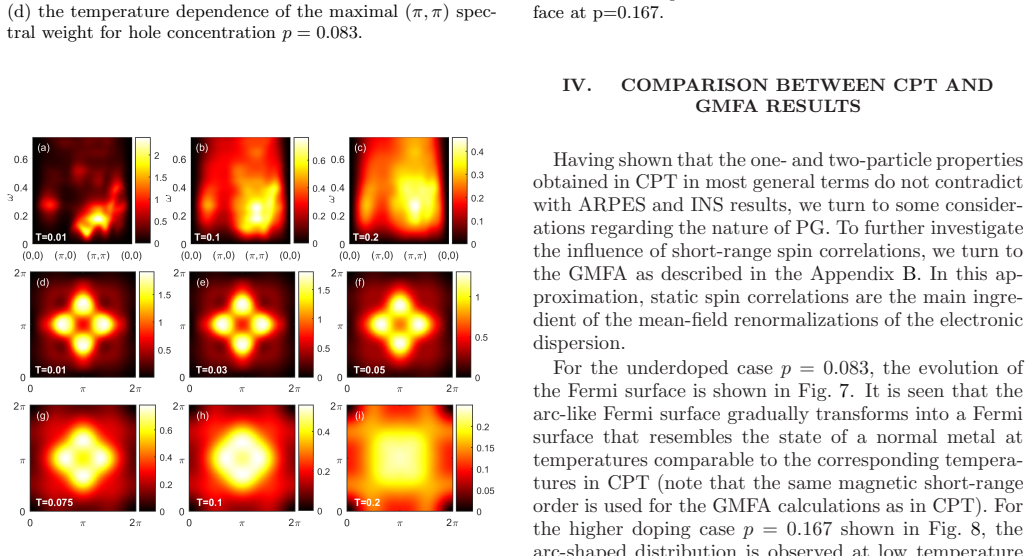
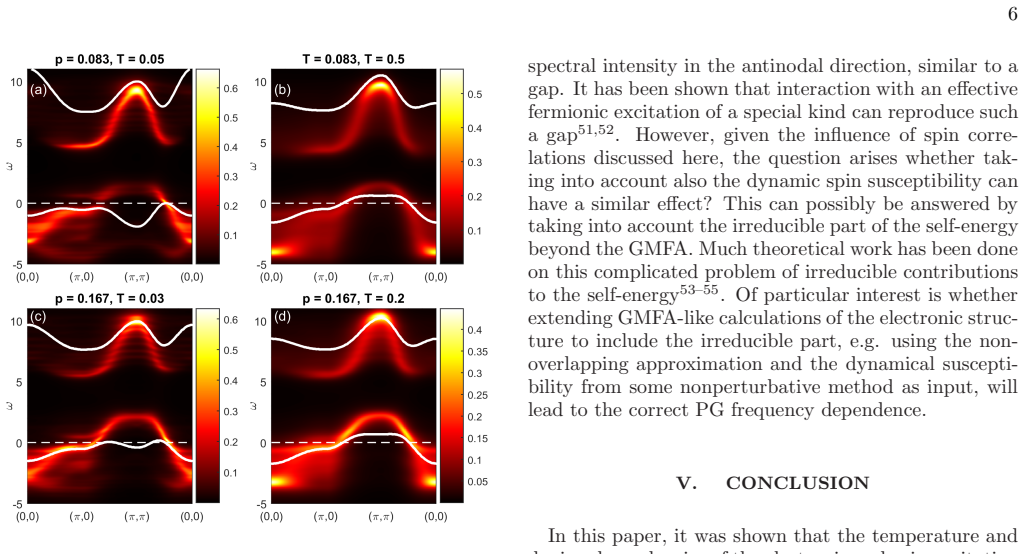
Within cluster perturbation theory the Hubbard model produces electronic and spin spectra whose most general features agree qualitatively with cuprate data, and generalized mean-field calculations that insert the static short-range magnetic correlations obtained from CPT reproduce the pseudogap, thereby identifying short-range antiferromagnetism as its origin.
What carries the argument
Cluster perturbation theory (CPT), which solves small clusters exactly and treats inter-cluster hopping perturbatively to approximate the infinite lattice.
If this is right
- Short-range antiferromagnetic correlations alone suffice to open the pseudogap without long-range order.
- Doping and temperature enter the spectra through the same short-range magnetic correlations that CPT extracts.
- The dynamic spin susceptibility obtained from CPT matches the momentum and energy scales seen in cuprate neutron scattering.
- Generalized mean-field theory built on CPT correlations reproduces the main CPT electronic features, confirming the dominant role of static magnetism.
Where Pith is reading between the lines
- If the CPT pseudogap persists when cluster size is increased, the mechanism would be robust against finite-size artifacts.
- The same short-range correlations could be tested in related models such as the t-J model to check whether the Hubbard interaction is essential.
- Temperature dependence in the CPT spin susceptibility offers a concrete route to predict the doping at which the pseudogap closes.
Load-bearing premise
The cluster perturbation theory approximation at the chosen cluster size and interaction strength faithfully captures the doping- and temperature-dependent physics responsible for the pseudogap without requiring additional longer-range correlations.
What would settle it
A direct comparison in which the CPT spectral function at a given doping and temperature deviates markedly from ARPES measurements on a cuprate compound in the pseudogap regime would falsify the agreement claim.
Figures


read the original abstract
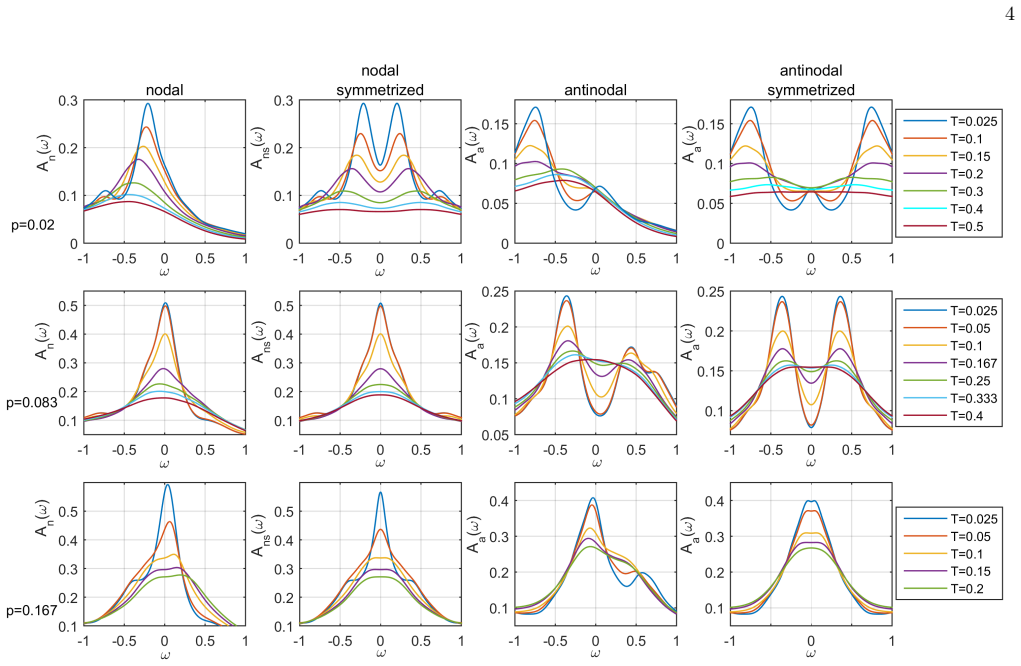
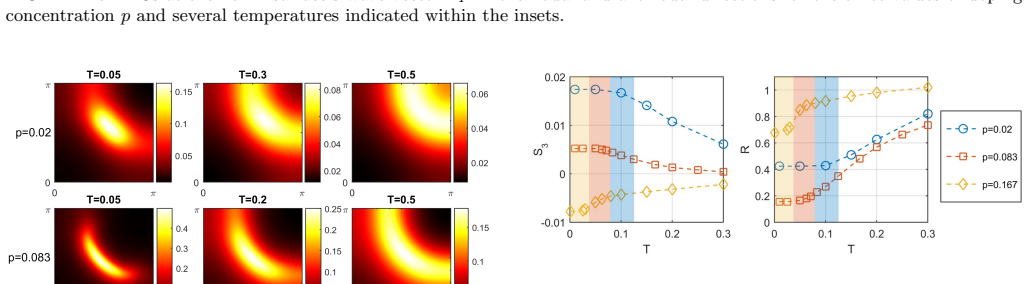
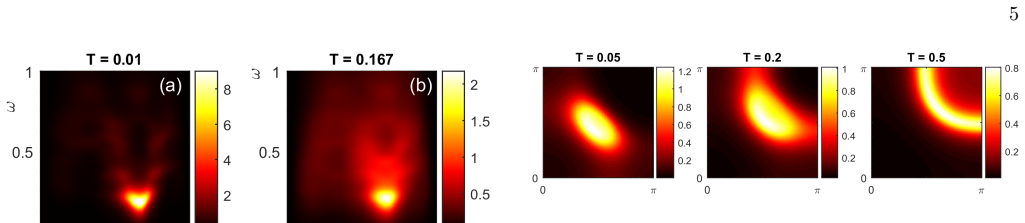
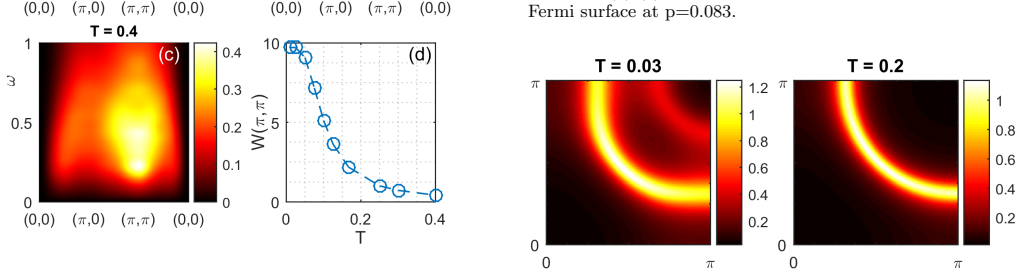
The doping and temperature dependencies of the electronic structure and the dynamic spin susceptibility of the Hubbard model on a square lattice are studied within cluster perturbation theory (CPT). The most general features of both electronic and spin spectra qualitatively agree with the experimental data on cuprates. Generalized mean-field calculations of the electronic structure using static short-range magnetic correlations from CPT are also implemented and compared with the results of CPT, allowing us to discuss the role of short-range antiferromagnetism in the formation of the pseudogap.
Editorial analysis
A structured set of objections, weighed in public.
Referee Report
Summary. The manuscript applies cluster perturbation theory (CPT) to the Hubbard model on the square lattice to compute the doping- and temperature-dependent single-particle spectral function and dynamic spin susceptibility. It reports that the most general features of both spectra are in qualitative agreement with cuprate experiments and implements a generalized mean-field reconstruction of the electronic structure that uses only the static short-range magnetic correlations extracted from CPT, thereby attributing the pseudogap to short-range antiferromagnetism.
Significance. If the CPT spectra and the mean-field comparison are robust, the work supplies a concrete diagnostic separating the effects of static short-range AF order from dynamical fluctuations in the formation of the pseudogap. The approach is parameter-free once U/t and t'/t are fixed and directly links a microscopic model to experimental phenomenology without additional fitting.
major comments (2)
- [Methods / Results (cluster-size dependence)] The central claim that short-range AF correlations from CPT suffice to produce the observed pseudogap doping dependence rests on the faithfulness of the chosen finite cluster. No cluster-size convergence data (e.g., comparison of 2×2 versus 4×4 or larger clusters) or error estimates on the spectral features are provided, leaving open the possibility that the reported pseudogap is an artifact of the truncation of longer-range correlations.
- [Comparison of CPT and mean-field results] The generalized mean-field calculation is presented as evidence that static short-range correlations dominate the pseudogap. However, without a quantitative metric (e.g., integrated spectral weight or gap magnitude versus doping) comparing the full CPT spectrum to the mean-field reconstruction, it is unclear how much of the CPT pseudogap is actually captured by the static approximation alone.
minor comments (1)
- The abstract states qualitative agreement but the manuscript should include at least one table or figure quantifying the doping range over which the pseudogap is observed in CPT versus experiment.
Simulated Author's Rebuttal
We thank the referee for the careful review and constructive comments on our manuscript. We provide point-by-point responses to the major comments below.
read point-by-point responses
-
Referee: The central claim that short-range AF correlations from CPT suffice to produce the observed pseudogap doping dependence rests on the faithfulness of the chosen finite cluster. No cluster-size convergence data (e.g., comparison of 2×2 versus 4×4 or larger clusters) or error estimates on the spectral features are provided, leaving open the possibility that the reported pseudogap is an artifact of the truncation of longer-range correlations.
Authors: CPT calculations on the square lattice Hubbard model conventionally employ the 2×2 cluster, as it is the minimal size that incorporates the antiferromagnetic correlations relevant to our study. The perturbative treatment of inter-cluster hopping accounts for longer-range effects. The close correspondence between the CPT spectra and the generalized mean-field results based on the extracted static correlations indicates that the pseudogap arises from these short-range features rather than being an artifact. We have included additional text in the Methods section discussing the cluster size choice and its justification. revision: partial
-
Referee: The generalized mean-field calculation is presented as evidence that static short-range correlations dominate the pseudogap. However, without a quantitative metric (e.g., integrated spectral weight or gap magnitude versus doping) comparing the full CPT spectrum to the mean-field reconstruction, it is unclear how much of the CPT pseudogap is actually captured by the static approximation alone.
Authors: The comparison is illustrated in the relevant figures by overlaying or juxtaposing the spectra. To address the request for a quantitative metric, we have added an analysis of the doping-dependent pseudogap size, defined as the energy range with suppressed spectral weight near the Fermi level, for both the full CPT and the mean-field reconstruction in the revised manuscript. revision: yes
Circularity Check
No significant circularity in CPT application to Hubbard model
full rationale
The paper applies the established cluster perturbation theory method to the Hubbard Hamiltonian on a square lattice to obtain electronic and spin spectra as functions of doping and temperature. These are compared qualitatively to cuprate data, with an additional generalized mean-field step that takes static short-range correlations directly from the CPT calculation for explicit comparison. No parameters are fitted to the target experimental spectra, no self-definitional loops appear in the method, and no load-bearing self-citations or ansatzes reduce the reported spectra to the inputs by construction. The derivation chain remains self-contained within the CPT approximation.
Axiom & Free-Parameter Ledger
axioms (1)
- domain assumption The square-lattice Hubbard model with nearest-neighbor hopping and on-site repulsion adequately describes the low-energy physics of cuprates.
Reference graph
Works this paper leans on
-
[1]
and Berger, Helmuth and Arnold, Gerald B
Li, Haoxiang and Zhou, Xiaoqing and Parham, Stephen and Reber, Theodore J. and Berger, Helmuth and Arnold, Gerald B. and Dessau, Daniel S. , journal =. Coherent organization of electronic correlations as a mechanism to enhance and stabilize high-. 2018 , month =. doi:10.1038/s41467-017-02422-2 , url =
-
[2]
Pseudogap problem in high-temperature superconductors , author =. Physics-Uspekhi , volume =. 2021 , publisher =. doi:10.3367/UFNe.2020.12.038896 , url =
-
[3]
Energy gaps in high-transition-temperature cuprate superconductors , author =. Nature Physics , volume =. 2014 , month =. doi:10.1038/nphys3009 , url =
-
[4]
Entanglement in the pseudogap regime of cuprate superconductors , author =. Phys. Rev. B , volume =. 2025 , month =. doi:10.1103/xk42-b9cx , url =
-
[5]
npj Quantum Materials , volume =
Unraveling the nature of spin excitations disentangled from charge contributions in a doped cuprate superconductor , author =. npj Quantum Materials , volume =. 2022 , month =. doi:10.1038/s41535-022-00528-5 , url =
-
[6]
Lipscombe, O. J. and Hayden, S. M. and Vignolle, B. and McMorrow, D. F. and Perring, T. G. , journal =. Persistence of High-Frequency Spin Fluctuations in Overdoped Superconducting. 2007 , month =. doi:10.1103/PhysRevLett.99.067002 , url =
-
[7]
Lipscombe, O. J. and Vignolle, B. and Perring, T. G. and Frost, C. D. and Hayden, S. M. , journal =. Emergence of Coherent Magnetic Excitations in the High Temperature Underdoped. 2009 , month =. doi:10.1103/PhysRevLett.102.167002 , url =
-
[8]
npj Quantum Materials , volume =
Gapped commensurate antiferromagnetic response in a strongly underdoped model cuprate superconductor , author =. npj Quantum Materials , volume =. 2025 , month =. doi:10.1038/s41535-025-00804-0 , url =
-
[9]
The European Physical Journal B , volume =
Dual features of magnetic susceptibility in superconducting cuprates: a comparison to inelastic neutron scattering , author =. The European Physical Journal B , volume =. 2012 , publisher =. doi:10.1140/epjb/e2012-20539-y , url =
-
[10]
Reznik, D. and Ismer, J.-P. and Eremin, I. and Pintschovius, L. and Arai, M. and Endoh, Y. and Masui, T. and Tajima, S. , journal =. Local moment fluctuations in an optimally-doped high-. 2008 , month =. doi:10.1103/PhysRevB.78.132503 , url =
-
[11]
Spin dynamics in the pseudogap state of a high-temperature superconductor , author =. Nature Physics , volume =. 2007 , month =. doi:10.1038/nphys720 , url =
-
[12]
Chan, M. K. and Tang, Y. and Dorow, C. J. and Jeong, J. and Mangin-Thro, L. and Veit, M. J. and Ge, Y. and Abernathy, D. L. and Sidis, Y. and Bourges, P. and Greven, M. , journal =. Hourglass Dispersion and Resonance of Magnetic Excitations in the Superconducting State of the Single-Layer Cuprate. 2016 , month =. doi:10.1103/PhysRevLett.117.277002 , url =
-
[13]
Chan, M. K. and Dorow, C. J. and Mangin-Thro, L. and Tang, Y. and Ge, Y. and Veit, M. J. and Yu, G. and Zhao, X. and Christianson, A. D. and Park, J. T. and Sidis, Y. and Steffens, P. and Abernathy, D. L. and Bourges, P. and Greven, M. , journal =. Commensurate antiferromagnetic excitations as a signature of the pseudogap in the tetragonal high-. 2016 , m...
-
[14]
Reviews of Modern Physics , volume =
Diagrammatic routes to nonlocal correlations between electrons in solids , author =. Reviews of Modern Physics , volume =. 2018 , month =. doi:10.1103/RevModPhys.90.025003 , url =
-
[15]
Reviews of Modern Physics , volume =
Quantum cluster approximations , author =. Reviews of Modern Physics , volume =. 2005 , month =. doi:10.1103/RevModPhys.77.1027 , url =
-
[16]
Resistivity phase diagram of cuprates revisited , author =. Physical Review B , volume =. 2020 , month =. doi:10.1103/PhysRevB.102.075114 , url =
-
[17]
Ovchinnikov, S. G. and Val'kov, V. V. , year =. doi:10.1142/9781860946059 , url =
-
[18]
Emergence of quasiparticles in a doped
Wang, Yao and He, Yu and Wohlfeld, Krzysztof and Hashimoto, Makoto and Huang, Edwin W and Lu, Donghui and Mo, Sung-Kwan and Komiya, Seiki and Jia, Chunjing and Moritz, Brian and others , journal=. Emergence of quasiparticles in a doped. 2020 , doi =
2020
-
[19]
S\'en\'echal, D. and Perez, D. and Pioro-Ladri\`ere, M. , journal =. Spectral. 2000 , month =. doi:10.1103/PhysRevLett.84.522 , url =
-
[20]
Cluster perturbation theory for
S\'en\'echal, David and Perez, Danny and Plouffe, Dany , journal =. Cluster perturbation theory for. 2002 , month =. doi:10.1103/PhysRevB.66.075129 , url =
-
[21]
S\'en\'echal, David and Tremblay, A.-M. S. , journal =. Hot. 2004 , month =. doi:10.1103/PhysRevLett.92.126401 , url =
-
[22]
Seki, Kazuhiro and Shirakawa, Tomonori and Yunoki, Seiji , journal =. Variational cluster approach to thermodynamic properties of interacting fermions at finite temperatures: A case study of the two-dimensional single-band. 2018 , month =. doi:10.1103/PhysRevB.98.205114 , url =
-
[23]
Kuz'min, V. I. and Visotin, M. A. and Nikolaev, S. V. and Ovchinnikov, S. G. , journal =. Doping and temperature evolution of pseudogap and spin-spin correlations in the two-dimensional. 2020 , month =. doi:10.1103/PhysRevB.101.115141 , url =
-
[24]
Crucial role of thermal fluctuations and vertex corrections for the magnetic pseudogap , author =. Phys. Rev. B , volume =. 2023 , month =. doi:10.1103/PhysRevB.108.L081118 , url =
-
[25]
On the theory of superconductivity in the extended
Plakida, Nikolay M and Oudovenko, Viktor S , journal=. On the theory of superconductivity in the extended. 2013 , publisher=. doi:10.1140/epjb/e2013-31157-6 , url=
-
[26]
Zubarev, D. N. , journal=. Double-time. 1960 , publisher=. doi:10.1070/PU1960v003n03ABEH003275 , url=
-
[27]
Progress of Theoretical Physics , volume=
A continued-fraction representation of the time-correlation functions , author=. Progress of Theoretical Physics , volume=. 1965 , publisher=. doi:10.1143/PTP.34.399 , url=
-
[28]
Korshunov, MM and Ovchinnikov, SG , journal=. Doping-dependent evolution of low-energy excitations and quantum phase transitions within an effective model for high-. 2007 , publisher=. doi:10.1140/epjb/e2007-00179-2 , url=
-
[29]
Polaron transformations in the realistic model of the strongly correlated electron system , author =. Phys. Rev. B , volume =. 2020 , month =. doi:10.1103/PhysRevB.101.235114 , url =
-
[30]
Werner, Philipp and Gull, Emanuel and Parcollet, Olivier and Millis, Andrew J. , journal =. Momentum-sector-selective metal-insulator transition in the eight-site dynamical mean-field approximation to the. 2009 , month =. doi:10.1103/PhysRevB.80.045120 , url =
-
[31]
Gull, E. and Ferrero, M. and Parcollet, O. and Georges, A. and Millis, A. J. , journal =. Momentum-space anisotropy and pseudogaps: A comparative cluster dynamical mean-field analysis of the doping-driven metal-insulator transition in the two-dimensional. 2010 , month =. doi:10.1103/PhysRevB.82.155101 , url =
-
[32]
Reports on Progress in Physics , volume=
The pseudogap in high-temperature superconductors: an experimental survey , author=. Reports on Progress in Physics , volume=. 1999 , publisher=. doi:10.1088/0034-4885/62/1/002 , url=
-
[33]
Reports on Progress in Physics , volume=
Anomalies in the pseudogap phase of the cuprates: competing ground states and the role of umklapp scattering , author=. Reports on Progress in Physics , volume=. 2019 , publisher=. doi:10.1088/1361-6633/ab31ed , url=
-
[34]
Pseudogaps in strongly correlated metals: A generalized dynamical mean-field theory approach , author =. Phys. Rev. B , volume =. 2005 , month =. doi:10.1103/PhysRevB.72.155105 , url =
-
[35]
Electronic structure and properties of high-
Shneyder, EI and Ovchinnikov, Sergei Gennad'evich and Korshunov, Maxim Mikhailovich and Nikolaev, Sergey Viktorovich , journal=. Electronic structure and properties of high-. 2012 , publisher=. doi:10.1134/S0021364012170146 , url=
-
[36]
Nature , volume=
Strong electron--phonon coupling in magic-angle twisted bilayer graphene , author=. Nature , volume=. 2024 , publisher=. doi:0.1038/s41586-024-08227-w , url=
2024
-
[37]
Yang, Chun and Feiguin, Adrian E. , journal =. Spectral function of the two-dimensional. 2016 , month =. doi:10.1103/PhysRevB.93.081107 , url =
-
[38]
and Ding, Shuhan and Liu, Jiarui and Wang, Yao , journal =
Huang, Edwin W. and Ding, Shuhan and Liu, Jiarui and Wang, Yao , journal =. Determinantal quantum. 2022 , month =. doi:10.1103/PhysRevResearch.4.L042015 , url =
-
[39]
Chen, Bin-Bin and Chen, Ziyu and Gong, Shou-Shu and Sheng, D. N. and Li, Wei and Weichselbaum, Andreas , journal =. Quantum spin liquid with emergent chiral order in the triangular-lattice. 2022 , month =. doi:10.1103/PhysRevB.106.094420 , url =
-
[40]
Correlated Lattice Fermions in d=
Metzner, Walter and Vollhardt, Dieter , journal =. Correlated Lattice Fermions in d=. 1989 , month =. doi:10.1103/PhysRevLett.62.324 , url =
-
[41]
Dynamical mean-field theory of strongly correlated fermion systems and the limit of infinite dimensions , author =. Rev. Mod. Phys. , volume =. 1996 , month =. doi:10.1103/RevModPhys.68.13 , url =
-
[42]
and Kotliar, Gabriel , journal =
Stanescu, Tudor D. and Kotliar, Gabriel , journal =. Fermi arcs and hidden zeros of the. 2006 , month =. doi:10.1103/PhysRevB.74.125110 , url =
-
[43]
Electron correlations in narrow energy bands , author =. J. Proc. Roy. Soc. A , volume =. 1963 , doi =
1963
-
[44]
Zaitsev, R. O. , title =. Soviet Physics JETP , year =
-
[45]
Kuz'min, V. I. and Korshunov, M. M. and Nikolaev, S. V. and Ovchinnikova, T. M. and Ovchinnikov, S. G. , title =. JETP Letters , year =. doi:10.1134/S0021364024601945 , url =
-
[46]
Kr\"uger, F. and Wilson, S. D. and Shan, L. and Li, Shiliang and Huang, Y. and Wen, H.-H. and Zhang, S.-C. and Dai, Pengcheng and Zaanen, J. , journal =. Magnetic fluctuations in n -type high-. 2007 , month =. doi:10.1103/PhysRevB.76.094506 , url =
-
[47]
and Huang, Edwin W
Wang, Wen O. and Huang, Edwin W. and Moritz, Brian and Devereaux, Thomas P. , journal =. Probing the pseudogap and beyond: examining single-particle properties of the hole- and electron-doped. 2025 , url =
2025
-
[48]
Composite-Fermion Theory for Pseudogap,
Yamaji, Youhei and Imada, Masatoshi , journal =. Composite-Fermion Theory for Pseudogap,. 2011 , month =. doi:10.1103/PhysRevLett.106.016404 , url =
-
[49]
Sakai, Shiro and Civelli, Marcello and Imada, Masatoshi , journal =. Hidden-fermion representation of self-energy in pseudogap and superconducting states of the two-dimensional. 2016 , month =. doi:10.1103/PhysRevB.94.115130 , url =
-
[50]
Journal of Experimental and Theoretical Physics , volume=
Electron spectrum in high-temperature cuprate superconductors , author=. Journal of Experimental and Theoretical Physics , volume=. 2007 , publisher=. doi:10.1134/S1063776107020082 , url=
-
[51]
Electronic spectrum and superconductivity in the extended
Nguen. Electronic spectrum and superconductivity in the extended. Physica C: Superconductivity and its Applications , volume =. 2021 , issn =. doi:https://doi.org/10.1016/j.physc.2021.1353900 , url =
-
[52]
Journal of Experimental and Theoretical Physics , volume =
On the spectral function of carriers in the pseudogap state , author =. Journal of Experimental and Theoretical Physics , volume =. 2016 , publisher =. doi:10.1134/S1063776116070141 , url =
-
[53]
and Werner, P
Gull, E. and Werner, P. and Wang, X. and Troyer, M. and Millis, A. J. , journal =. Superconducting and pseudogap phases of the. 2008 , doi =
2008
-
[54]
Gull, Emanuel and Parcollet, Olivier and Werner, Philipp and Millis, Andrew J. , journal =. Momentum-sector-selective metal-insulator transition in the eight-site dynamical mean-field approximation to the. 2009 , month =. doi:10.1103/PhysRevB.80.245102 , url =
-
[55]
and Nikolaev, Sergey V
Kuz’min, Valerii I. and Nikolaev, Sergey V. and Korshunov, Maxim M. and Ovchinnikov, Sergey G. , TITLE =. Materials , VOLUME =. 2023 , NUMBER =
2023
-
[56]
K A Chao and J Spalek and A M Oles , title =. 1977 , month =. doi:10.1088/0022-3719/10/10/002 , url =
-
[57]
Physica C: Superconductivity , volume =
Zero field. Physica C: Superconductivity , volume =. 1988 , issn =. doi:https://doi.org/10.1016/0921-4534(88)90757-5 , url =
-
[58]
J Friedel , title =. 1989 , month =. doi:10.1088/0953-8984/1/42/001 , url =
-
[59]
Quasilowdimensionality in the weak coupling limit , journal =. 1988 , note =. doi:https://doi.org/10.1016/0921-4534(88)90431-5 , url =
-
[60]
Spin fluctuations associated with the collapse of the pseudogap in a cuprate superconductor , author =. Nat. Phys. , volume =. 2023 , month =. doi:10.1038/s41567-022-01825-3 , url =
-
[61]
Alloul, H. and Ohno, T. and Mendels, P. , journal =. ^. 1989 , month =. doi:10.1103/PhysRevLett.63.1700 , url =
-
[62]
Journal of Superconductivity and Novel Magnetism , year =
Alloul, Henri , title =. Journal of Superconductivity and Novel Magnetism , year =. doi:10.1007/s10948-012-1472-x , url =
-
[63]
Magnetic scaling in cuprate superconductors , author =. Phys. Rev. B , volume =. 1995 , month =. doi:10.1103/PhysRevB.52.13585 , url =
-
[64]
Kordyuk, A. A. , title =. Low Temperature Physics , volume =. 2015 , month =. doi:10.1063/1.4919371 , url =
-
[65]
A. G. Loeser and Z.-X. Shen and D. S. Dessau and D. S. Marshall and C. H. Park and P. Fournier and A. Kapitulnik , title =. Science , volume =. 1996 , doi =
1996
-
[66]
Weak Pseudogap Behavior in the Underdoped Cuprate Superconductors , author =. Phys. Rev. Lett. , volume =. 1998 , month =. doi:10.1103/PhysRevLett.80.3839 , url =
-
[67]
Temperature variation of the pseudogap in underdoped cuprates , author =. Phys. Rev. B , volume =. 1998 , month =. doi:10.1103/PhysRevB.57.R11085 , url =
-
[68]
A. V. Chubukov , title =. Europhysics Letters (. 1998 , month =. doi:10.1209/epl/i1998-00522-9 , url =
-
[69]
Millis, A. J. and Monien, Hartmut and Pines, David , journal =. Phenomenological model of nuclear relaxation in the normal state of. 1990 , month =. doi:10.1103/PhysRevB.42.167 , url =
-
[70]
Microscopic theory of weak pseudogap behavior in the underdoped cuprate superconductors: General theory and quasiparticle properties , author =. Phys. Rev. B , volume =. 1999 , month =. doi:10.1103/PhysRevB.60.667 , url =
-
[71]
Vladimirov, A. A. and Ihle, D. and Plakida, N. M. , journal =. Dynamic spin susceptibility in the t-. 2009 , month =. doi:10.1103/PhysRevB.80.104425 , url =
discussion (0)
Sign in with ORCID, Apple, or X to comment. Anyone can read and Pith papers without signing in.