HS3: A Descriptive, Interoperable Serialization Standard for Statistical Models in High-Energy Physics
Pith reviewed 2026-06-28 12:03 UTC · model grok-4.3
The pith
HS3 represents statistical models in high-energy physics as extensible computational graphs of named distributions, functions, datasets, domains, and analysis prescriptions.
A machine-rendered reading of the paper's core claim, the machinery that carries it, and where it could break.
Core claim
HS3 is an implementation-agnostic, human-readable, and extensible serialization format for statistical models. Likelihoods are represented as computational graphs composed of named distributions, functions, datasets, domains, and analysis prescriptions. It supports binned and unbinned likelihoods as well as hierarchical composite models, is convertible from and to ROOT/RooFit, and is a superset of pyhf. Inference procedures and implementation-specific execution details remain the responsibility of downstream frameworks.
What carries the argument
The HS3 serialization format, which encodes likelihoods as computational graphs composed of named distributions, functions, datasets, domains, and analysis prescriptions to separate model description from execution.
If this is right
- Models become exchangeable between frameworks such as ROOT/RooFit and pyhf without format-specific rewriting.
- Public likelihoods on HEPData can be stored and reused in a standardized, machine-readable form.
- Cross-framework validation of statistical models becomes possible through a common representation.
- Long-term preservation of analyses is supported because the model description is decoupled from any single software version.
Where Pith is reading between the lines
- The graph structure may allow automated tools to combine or compare models from different experiments once multiple frameworks adopt the format.
- The explicit separation of model description from inference could be tested for use in domains outside high-energy physics that rely on likelihood-based inference.
Load-bearing premise
The design principles and structure of HS3 will be sufficient to capture all relevant statistical constructs in HEP models while remaining backward-compatible through extensions.
What would settle it
A concrete LHC statistical model that cannot be fully serialized in HS3 without information loss or a non-backward-compatible change to the format.
Figures
read the original abstract
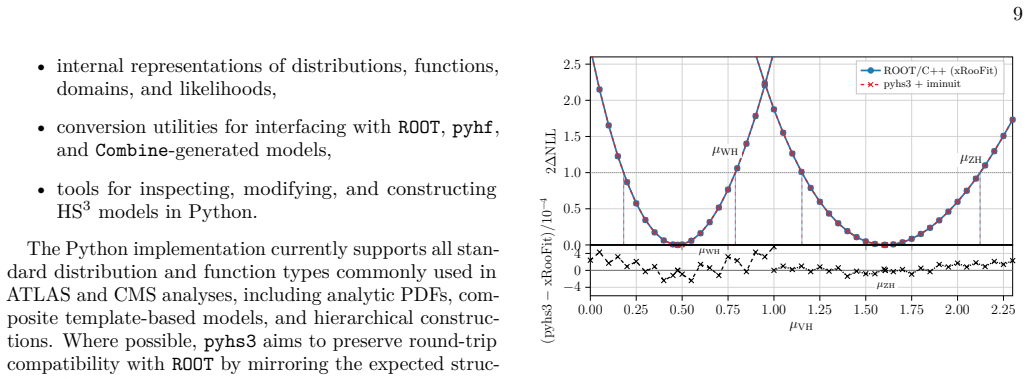
Statistical models in high-energy physics formally encode the relationship between observed data, physics parameters of interest, and experimental and theoretical uncertainties. Likelihood-based inference is the central tool for precision measurements, effective field theory fits, and cross-analysis combinations. Consequently, there is an increasing need for machine-readable, descriptive, and portable model representations. Existing formats such as ROOT workspaces, pyhf JSON, and CMS DataCards provide valuable capabilities but remain tied to specific software stacks and offer no universal standard for exchange, validation, or long-term preservation. We introduce HS3, the High-Energy Physics Statistics Serialization Standard, an implementation-agnostic, human-readable, and extensible serialization format for statistical models. HS3 is designed such that new statistical constructs can be incorporated through backward-compatible extensions, while inference procedures and implementation-specific execution details remain the responsibility of downstream frameworks. HS3 represents likelihoods as computational graphs composed of named distributions, functions, datasets, domains, and analysis prescriptions. It supports binned and unbinned likelihoods as well as hierarchical composite models. HS3 is convertible from and to ROOT/RooFit and is a superset of pyhf. We describe the design principles, structure, and semantics of HS3 and summarize existing implementations in C++, Python, and Julia. We also present early applications to public likelihoods on HEPData, cross-framework validation, and reproducibility efforts. HS3 provides a foundation for FAIR (Findable, Accessible, Interoperable, Reusable), long-lived statistical models at the LHC and beyond. The standard is intended to serve the broader scientific community and to evolve over time for application across a wide range of domains.
Editorial analysis
A structured set of objections, weighed in public.
Referee Report
Summary. The manuscript proposes HS3, an implementation-agnostic, human-readable, and extensible serialization format for statistical models in high-energy physics. Likelihoods are represented as computational graphs composed of named distributions, functions, datasets, domains, and analysis prescriptions. The format supports binned and unbinned likelihoods as well as hierarchical composite models, is convertible to and from ROOT/RooFit, and is positioned as a superset of pyhf. Design principles emphasize backward-compatible extensions, with inference details left to downstream frameworks. The paper summarizes implementations in C++, Python, and Julia, along with early applications to public likelihoods on HEPData, cross-framework validation, and reproducibility efforts, with the goal of enabling FAIR, long-lived models.
Significance. If the design proves sufficient and is adopted, HS3 would address a genuine need for portable, machine-readable statistical models that facilitate interoperability, validation, and long-term preservation across software stacks in HEP. The graph-based representation, extensibility mechanism, and explicit multi-language implementations with conversion paths to existing formats (ROOT, pyhf) are concrete strengths that support the interoperability claim. Early applications to HEPData likelihoods further indicate practical utility.
major comments (1)
- [Abstract] Abstract (applications paragraph): the description of 'cross-framework validation' is high-level and does not include quantitative metrics, specific test cases, or coverage statistics for the set of public likelihoods converted; without these details it remains unclear whether the graph representation fully supports all required HEP constructs (e.g., certain nuisance-parameter correlations or unbinned components) without gaps, which is load-bearing for the central claim of being a superset of pyhf and a general foundation.
Simulated Author's Rebuttal
We thank the referee for their positive evaluation of the HS3 proposal and for recommending minor revision. We address the single major comment below.
read point-by-point responses
-
Referee: [Abstract] Abstract (applications paragraph): the description of 'cross-framework validation' is high-level and does not include quantitative metrics, specific test cases, or coverage statistics for the set of public likelihoods converted; without these details it remains unclear whether the graph representation fully supports all required HEP constructs (e.g., certain nuisance-parameter correlations or unbinned components) without gaps, which is load-bearing for the central claim of being a superset of pyhf and a general foundation.
Authors: We agree that the abstract's reference to cross-framework validation is high-level. The manuscript body (sections describing the C++/Python/Julia implementations, conversion paths, and early HEPData applications) contains the concrete test cases, coverage details for public likelihoods, and explicit checks for constructs including nuisance-parameter correlations and unbinned components. In the revised version we will expand the applications paragraph of the abstract to incorporate the key quantitative metrics and coverage statistics from those sections, thereby strengthening the substantiation of the superset claim. revision: yes
Circularity Check
No significant circularity
full rationale
The paper is a standards proposal that defines the HS3 serialization format for statistical models, including its graph-based representation of likelihoods, extensibility rules, and claimed conversions to existing tools. No derivations, predictions, fitted parameters, or mathematical results are claimed or presented; the text consists entirely of design descriptions, structure definitions, and implementation summaries. Consequently there are no load-bearing steps that could reduce to self-definition, fitted inputs, or self-citation chains.
Axiom & Free-Parameter Ledger
axioms (1)
- domain assumption Statistical models in HEP can be represented as computational graphs of named distributions, functions, datasets, domains, and analysis prescriptions.
Reference graph
Works this paper leans on
-
[1]
PublicLikelihoodCombination
for unfolded results – reflected the need for flexibility, but further exacerbated the lack of a common descriptive format. Cross-experiment combinations (ATLAS–CMS [6, 7], later CMS–LHCb [19]) would remain tied to the ROOT ecosystem, as it remained the dominant toolkit, but required increasingly close collaboration, with modeling components (e.g. CMS Com...
-
[2]
James, Y
F. James, Y. Perrin, and L. Lyons, eds.,Workshop on confidence limits, CERN, Geneva, Switzerland, 17-18 Jan 2000: Proceedings, CERN Yellow Reports: Conference Proceedings (2000)
2000
-
[3]
Brun and F
R. Brun and F. Rademakers, ROOT: An object oriented data analysis framework, Nucl. Instrum. Meth. A389, 81 (1997)
1997
-
[4]
W. Verkerke and D. P. Kirkby, The RooFit toolkit for data modeling, eConfC0303241, MOLT007 (2003), arXiv:physics/0306116
Pith/arXiv arXiv 2003
-
[5]
ATLAS Collaboration, Observation of a new particle in the search for the Standard Model Higgs boson with the ATLAS detector at the LHC, Phys. Lett. B716, 1 (2012), arXiv:1207.7214 [hep-ex]
Pith/arXiv arXiv 2012
-
[6]
CMS Collaboration, Observation of a New Boson at a Mass of 125 GeV with the CMS Experiment at the LHC, Phys. Lett. B716, 30 (2012), arXiv:1207.7235 [hep-ex]
Pith/arXiv arXiv 2012
-
[7]
ATLAS & CMS Collaborations, Combined Measurement 12 of the Higgs Boson Mass inpp Collisions at √s = 7and 8 TeV with the ATLAS and CMS Experiments, Phys. Rev. Lett.114, 191803 (2015), arXiv:1503.07589 [hep-ex]
Pith/arXiv arXiv 2015
-
[8]
ATLAS & CMS Collaborations, Measurements of the Higgs boson production and decay rates and constraints on its couplings from a combined ATLAS and CMS anal- ysis of the LHC pp collision data at√s = 7and 8 TeV, JHEP08, 045, arXiv:1606.02266 [hep-ex]
-
[9]
Cranmer, G
K. Cranmer, G. Lewis, L. Moneta, A. Shibata, and W. Verkerke (ROOT Collaboration),HistFactory: A tool for creating statistical models for use with RooFit and RooStats, Tech. Rep. (New York U., New York, 2012)
2012
-
[10]
CMS Collaboration, The CMS Statistical Analysis and Combination Tool: Combine, Comput. Softw. Big Sci.8, 19 (2024), arXiv:2404.06614 [physics.data-an]
arXiv 2024
-
[11]
M. Aly, T. Dado, A. Held, M. Pinamonti, and L. Valery, Trexfitter (2025)
2025
-
[12]
Heinrich, M
L. Heinrich, M. Feickert, and G. Stark, pyhf
-
[13]
Heinrich, M
L. Heinrich, M. Feickert, G. Stark, and K. Cranmer, pyhf: pure-pythonimplementationofhistfactorystatisticalmod- els, Journal of Open Source Software6, 2823 (2021)
2021
-
[14]
Eschle, A
J. Eschle, A. Puig Navarro, R. Silva Coutinho, and N. Serra, zfit: Scalable pythonic fitting, SoftwareX11, 100508 (2020)
2020
-
[15]
Schulz, F
O. Schulz, F. Beaujean, A. Caldwell, C. Grunwald, V. Hafych, K. Kröninger, S. L. Cagnina, L. Röhrig, and L. Shtembari, Bat.jl: A julia-based tool for bayesian in- ference, SN Computer Science2, 210 (2021)
2021
-
[16]
Eschleet al., Potential of the Julia Programming Language for High Energy Physics Computing, Comput
J. Eschleet al., Potential of the Julia Programming Language for High Energy Physics Computing, Comput. Softw. Big Sci.7, 10 (2023), arXiv:2306.03675 [hep-ph]
arXiv 2023
-
[17]
M. Stanitzki and J. Strube, Performance of Julia for High Energy Physics Analyses, Comput. Softw. Big Sci.5, 10 (2021), arXiv:2003.11952 [physics.comp-ph]
arXiv 2021
-
[18]
G. A. Stewartet al., Julia in HEP, EPJ Web Conf.337, 01266 (2025), arXiv:2503.08184 [hep-ex]
arXiv 2025
-
[19]
L. Lista, Combination of measurements and the BLUE method, EPJ Web Conf.137, 11006 (2017), arXiv:1610.00422 [physics.data-an]
Pith/arXiv arXiv 2017
-
[20]
C. . L. Collaborations, Observation of the rareB0 s → µ+µ− decay from the combined analysis of CMS and LHCb data, Nature522, 68 (2015), arXiv:1411.4413 [hep- ex]
Pith/arXiv arXiv 2015
-
[21]
S. O. Bradner, Key words for use in RFCs to Indicate Requirement Levels, RFC 2119 (1997)
1997
-
[22]
Barlow and C
R. Barlow and C. Beeston, Fitting using finite monte carlo samples, Computer Physics Communications77, 219 (1993)
1993
-
[23]
ATLAS Collaboration, Measurements of the production cross-sections of a Higgs boson in association with a vector boson and decaying intoWW ∗ with the ATLAS detector at √s = 13TeV, JHEP08, 034, arXiv:2503.19420 [hep- ex]
-
[24]
ATLAS Collaboration (ATLAS), Measurements of Higgs boson production via gluon–gluon fusion and vector-boson fusion usingH→WW ∗ →ℓνℓνdecays in pp collisions with the ATLAS detector and their effective field the- ory interpretations, Eur. Phys. J. C85, 1403 (2025), arXiv:2504.07686 [hep-ex]
arXiv 2025
-
[25]
ATLAS Collaboration, A search for triple Higgs boson production in the 6b final state with the ATLAS detector, Phys. Rev. D111, 032006 (2025), arXiv:2411.02040 [hep- ex]
arXiv 2025
-
[26]
ATLAS Collaboration, Search for four-top-quark produc- tion in the single-lepton channel at√s = 13TeV with the ATLAS detector, JHEP06, 063, arXiv:2304.01532 [hep-ex]
-
[27]
ATLAS Collaboration, Search for heavy right-handed Majorana neutrinos in the decay of top quarks pro- duced in proton-proton collisions at√s = 13TeV with the ATLAS detector, Phys. Rev. D110, 112004 (2024), arXiv:2408.05000 [hep-ex]
arXiv 2024
-
[28]
ATLAS Collaboration, Measurement of top-quark pair production in association with charm quarks in proton- proton collisions at√s = 13TeV with the ATLAS detec- tor, Phys. Lett. B860, 139177 (2025), arXiv:2409.11305 [hep-ex]
arXiv 2025
-
[29]
ATLASCollaboration,Measurementofthe t¯tcrosssection and its ratio to theZ production cross section usingpp collisions at √s = 13.6TeV with the ATLAS detector, Phys. Lett. B848, 138376 (2024), arXiv:2308.09529 [hep- ex]
arXiv 2024
-
[30]
ATLAS Collaboration, Observation oft¯tγγproduction at√s = 13TeV with the ATLAS detector, CERN-EP-2025- 125 (2025), arXiv:2506.05018 [hep-ex]
arXiv 2025
-
[31]
ATLAS Collaboration, Inclusive and differential cross- section measurements oft¯tZ production inpp collisions at √s = 13TeV with the ATLAS detector, including EFT and spin-correlation interpretations, JHEP07, 163, arXiv:2312.04450 [hep-ex]
-
[32]
ATLAS Collaboration, Inclusive and differential cross- section measurements oft¯tW production inpp collisions at √s = 13TeV with the ATLAS detector, JHEP05, 131, arXiv:2401.05299 [hep-ex]
-
[33]
ATLAS Collaboration, Measurements of inclusive and differential cross-sections oft¯tγproduction inpp collisions at √s = 13TeV with the ATLAS detector, JHEP10, 191, arXiv:2403.09452 [hep-ex]
-
[34]
ATLAS Collaboration, Observation oft¯t production in the lepton+jets and dilepton channels inp+Pb collisions at √sNN = 8.16TeV with the ATLAS detector, JHEP 11, 101, arXiv:2405.05078 [hep-ex]
-
[35]
ATLAS Collaboration, Search for same-charge top-quark pair production inpp collisions at √s = 13TeV with the ATLAS detector, JHEP02, 084, arXiv:2409.14982 [hep-ex]
-
[36]
ATLAS Collaboration, Measurement of the charge asym- metry in top-quark pair production in association with a photon with the ATLAS experiment, Phys. Lett. B843, 137848 (2023), arXiv:2212.10552 [hep-ex]. Appendix A: Minimal HS3 Examples This appendix provides two minimal but illustrative examples of statistical models encoded in the HS3 format. The first ...
arXiv 2023
-
[37]
analyses
A simple univariate Gaussian model The model below describes a single Gaussian measure- ment of an observablex with known standard deviation 13 σ= 1and an unknown mean parameter µserving as the parameter of interest. The HS3 representation speci- fies the Gaussian distribution, the dataset containing the observed value, and an analysis object that links t...
-
[38]
analyses
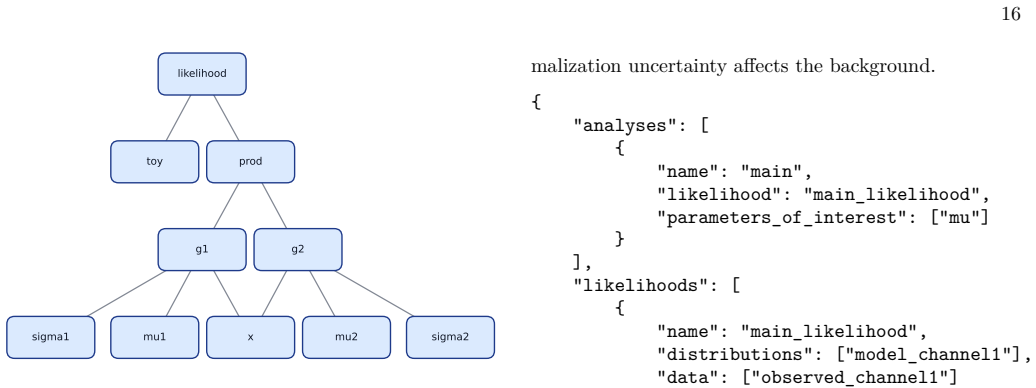
A product of two Gaussian distributions The model below describes a product of two Gaussian measurements. The HS3 representation contains the com- plete model, similar to the case above, but now including the product. { "analyses": [ { "domains": [ "nuisance_parameters", "parameters_of_interest" ], "likelihood": "likelihood", "name": "my_analysis", "param...
-
[39]
analyses
A minimal HistFactory-style model The following example illustrates a compact, single- channel HistFactory model represented through the histfactory_dist high-level node. The channel con- tains two samples, one signal and one background, both with template-based yields in three bins. A single nor- malization uncertainty affects the background. { "analyses...
discussion (0)
Sign in with ORCID, Apple, or X to comment. Anyone can read and Pith papers without signing in.