Flow-Transformed Implicit Processes for Function-Space Variational Inference
Pith reviewed 2026-06-28 15:59 UTC · model grok-4.3
The pith
Normalizing flows over combination weights produce more expressive function-space posteriors than Gaussians for implicit process models.
A machine-rendered reading of the paper's core claim, the machinery that carries it, and where it could break.
Core claim
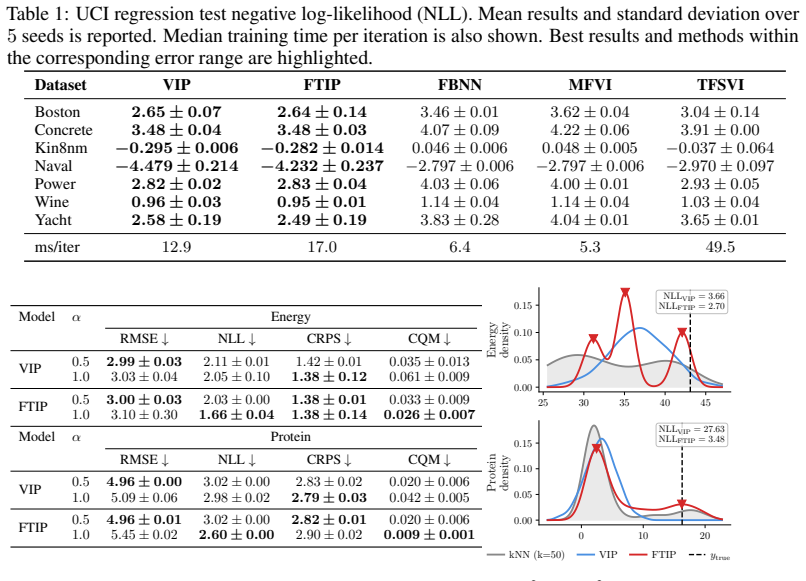
Flow-Transformed Implicit Processes (FTIP) define the variational distribution over the combination weights of sampled prior functions via a normalizing flow rather than a Gaussian. This construction induces a flexible posterior distribution over functions from the implicit-process prior, and the model is trained with a Black-Box α objective that supports both mass-covering and mode-seeking regimes. Experiments demonstrate that the resulting posteriors capture asymmetric and multimodal structure in function space where Gaussian coefficient approximations tend to smooth or collapse it.
What carries the argument
Normalizing flow transformation of the variational distribution over linear combination weights in the finite-dimensional approximation of an implicit process prior.
If this is right
- Posterior uncertainty over functions can be asymmetric or multimodal without sacrificing tractable gradients.
- The black-box alpha objective permits explicit control over mass-covering versus mode-seeking behavior in the same framework.
- Function-space models using implicit priors become viable for tasks where Gaussian approximations fail to represent complex uncertainty.
- Optimization remains feasible because the flow is applied only to the finite weight vector rather than directly to functions.
Where Pith is reading between the lines
- The same flow transformation could be inserted into other finite-sample variational schemes for Gaussian processes or deep kernel models to test whether multimodality gains generalize.
- If the number of prior samples is increased, the flow might need to be deeper to maintain expressivity, creating a direct trade-off between sample count and flow capacity that could be measured on fixed compute budgets.
- In settings with known ground-truth multimodal functions, predictive log-likelihood on test points that lie in secondary modes would serve as a direct quantitative check on whether the richer variational family improves calibration.
Load-bearing premise
A finite collection of functions sampled from the prior is sufficient to represent the induced function-space distributions for variational inference.
What would settle it
A controlled regression task whose true posterior over functions is known to be bimodal; if FTIP recovers both modes in held-out predictive distributions while the Gaussian baseline collapses to one, the claim holds, otherwise the improvement is not realized.
Figures




read the original abstract
Implicit-process priors define distributions over functions through flexible generative mechanisms, making them attractive for Bayesian function-space modelling. However, performing posterior inference with such priors is challenging because their induced function-space distributions are typically not available in closed form. One practical strategy is to approximate the prior using a finite collection of sampled functions, and then represent posterior functions as learned combinations of these samples. Existing approaches commonly place a Gaussian variational distribution over the combination weights. While tractable, this choice limits the shapes of posterior uncertainty that can be represented, especially when the true posterior is asymmetric, heavy-tailed, or multimodal. We propose Flow-Transformed Implicit Processes (FTIP), a variational inference method that makes this finite-dimensional function-space approximation more expressive. Instead of using a Gaussian distribution over the combination weights, FTIP uses a normalizing flow to define a richer variational distribution. This induces a flexible posterior distribution over functions while preserving tractable optimization. We train the model using a Black-Box {\alpha} objective, allowing us to compare mass-covering and mode-seeking variational behaviour. Experiments show that FTIP captures asymmetric and multimodal posterior structure in function space that Gaussian coefficient approximations tend to smooth or collapse.
Editorial analysis
A structured set of objections, weighed in public.
Referee Report
Summary. The manuscript proposes Flow-Transformed Implicit Processes (FTIP) for variational inference with implicit-process priors. The prior is approximated by a finite set of sampled functions; posterior functions are expressed as linear combinations of these samples, with a normalizing flow placed on the combination weights instead of a Gaussian. The resulting variational family is optimized with a Black-Box α objective. Experiments are reported to show that FTIP captures asymmetric and multimodal structure in function space that Gaussian weight approximations smooth or collapse.
Significance. If the central approximation and optimization claims hold, the work supplies a concrete, tractable route to richer function-space variational families for implicit priors. The explicit comparison of mass-covering versus mode-seeking behavior via the α-objective is a useful diagnostic contribution.
major comments (1)
- [§3] §3 (method) and the finite-sample construction: every posterior function is confined to the linear span of the M fixed prior samples. The normalizing flow acts only on the coefficients; therefore the claimed gain in posterior flexibility is strictly limited by the choice of samples. No error bounds, convergence rates with M, or sensitivity experiments appear in the reported results, leaving the load-bearing assumption unexamined.
minor comments (3)
- [§2] Notation for the implicit-process prior and the finite-sample approximation should be introduced with a single consistent symbol set early in §2.
- Figure captions should state the number of prior samples M used in each panel so that the dependence on this hyper-parameter is immediately visible.
- [§4] The Black-Box α objective is referenced but its precise form (including the value of α) should be written explicitly rather than left to the citation.
Simulated Author's Rebuttal
We thank the referee for the constructive feedback. We address the single major comment below.
read point-by-point responses
-
Referee: [§3] §3 (method) and the finite-sample construction: every posterior function is confined to the linear span of the M fixed prior samples. The normalizing flow acts only on the coefficients; therefore the claimed gain in posterior flexibility is strictly limited by the choice of samples. No error bounds, convergence rates with M, or sensitivity experiments appear in the reported results, leaving the load-bearing assumption unexamined.
Authors: We agree that every posterior function lies in the linear span of the M fixed prior samples and that the normalizing flow only enriches the distribution over the coefficients within this fixed span. This finite-sample construction is the standard practical approximation for implicit-process priors and is shared by the Gaussian-weight baselines we compare against; the contribution of FTIP is to show that a richer distribution over those coefficients yields better capture of multimodal and asymmetric structure in function space. We acknowledge that the manuscript provides neither theoretical error bounds nor convergence rates with respect to M, nor sensitivity experiments on M. We will revise §3 to discuss this limitation explicitly and add sensitivity experiments varying M in the experimental section. revision: yes
Circularity Check
No circularity: finite-sample approximation is explicit input, flow adds expressivity within it
full rationale
The paper explicitly adopts a finite collection of prior samples as a practical approximation strategy and places the variational distribution (Gaussian or flow) only on the linear combination weights. The central claim is that replacing the Gaussian with a normalizing flow yields a richer distribution over those weights and thus over functions in the fixed span. This is a standard, non-circular methodological substitution with no equations reducing the result to a fitted parameter by construction, no self-citation load-bearing the uniqueness of the approach, and no renaming of known results. The finite-sample restriction is stated upfront rather than derived, so the derivation chain remains self-contained against external benchmarks.
Axiom & Free-Parameter Ledger
axioms (1)
- domain assumption The prior can be approximated by a finite collection of sampled functions for variational purposes.
Reference graph
Works this paper leans on
-
[1]
Long-lived TeV-scale right-handed neutrino production at the LHC in gauged U(1) X model,
Implicit Processes for Learning with Uncertainty , author =. arXiv preprint arXiv:1906.04132 , year =
-
[2]
Proceedings of the International Conference on Machine Learning , year =
Variational Implicit Processes , author =. Proceedings of the International Conference on Machine Learning , year =
-
[3]
Proceedings of the International Conference on Machine Learning , year =
Variational Inference with Normalizing Flows , author =. Proceedings of the International Conference on Machine Learning , year =
-
[4]
International Conference on Learning Representations , year =
Density Estimation Using Real NVP , author =. International Conference on Learning Representations , year =
-
[5]
Neural Computation , volume =
A Practical Bayesian Framework for Backpropagation Networks , author =. Neural Computation , volume =. 1992 , doi =
1992
-
[6]
1996 , doi =
Bayesian Learning for Neural Networks , author =. 1996 , doi =
1996
-
[7]
Proceedings of the 32nd International Conference on Machine Learning , series =
Weight Uncertainty in Neural Network , author =. Proceedings of the 32nd International Conference on Machine Learning , series =. 2015 , publisher =
2015
-
[8]
Proceedings of the 32nd International Conference on Machine Learning , series =
Probabilistic Backpropagation for Scalable Learning of Bayesian Neural Networks , author =. Proceedings of the 32nd International Conference on Machine Learning , series =. 2015 , publisher =
2015
-
[9]
Proceedings of the 33rd International Conference on Machine Learning , series =
Dropout as a Bayesian Approximation: Representing Model Uncertainty in Deep Learning , author =. Proceedings of the 33rd International Conference on Machine Learning , series =. 2016 , publisher =
2016
-
[10]
International Conference on Learning Representations , year =
Functional Variational Bayesian Neural Networks , author =. International Conference on Learning Representations , year =
-
[11]
arXiv preprint arXiv:2011.09421 , year=
Understanding Variational Inference in Function-Space , author =. arXiv preprint arXiv:2011.09421 , year =
-
[12]
Advances in Neural Information Processing Systems , volume =
Generalized Variational Inference in Function Spaces: Gaussian Measures Meet Bayesian Deep Learning , author =. Advances in Neural Information Processing Systems , volume =
-
[13]
Advances in Neural Information Processing Systems , volume =
Tractable Function-Space Variational Inference in Bayesian Neural Networks , author =. Advances in Neural Information Processing Systems , volume =
-
[14]
Proceedings of the 36th International Conference on Machine Learning , series =
Variational Implicit Processes , author =. Proceedings of the 36th International Conference on Machine Learning , series =. 2019 , publisher =
2019
-
[15]
International Conference on Learning Representations , year =
Deep Variational Implicit Processes , author =. International Conference on Learning Representations , year =
-
[16]
2017 , institution =
Dua, Dheeru and Graff, Casey , title =. 2017 , institution =
2017
-
[17]
Bertin-Mahieux, Thierry and Ellis, Daniel P. W. and Whitman, Brian and Lamere, Paul , title =. Proceedings of the 12th International Society for Music Information Retrieval Conference , year =
-
[18]
Proceedings of the IEEE International Conference on Computer Vision , year =
Pellegrini, Stefano and Ess, Andreas and Schindler, Konrad and Van Gool, Luc , title =. Proceedings of the IEEE International Conference on Computer Vision , year =
-
[19]
Computer Graphics Forum , year =
Lerner, Alon and Chrysanthou, Yiorgos and Lischinski, Dani , title =. Computer Graphics Forum , year =
-
[20]
Nature Communications , year =
Baldi, Pierre and Sadowski, Peter and Whiteson, Daniel , title =. Nature Communications , year =
-
[21]
Fashion-MNIST: a Novel Image Dataset for Benchmarking Machine Learning Algorithms
Xiao, Han and Rasul, Kashif and Vollgraf, Roland , title =. arXiv preprint arXiv:1708.07747 , year =
work page internal anchor Pith review Pith/arXiv arXiv
-
[22]
Krizhevsky, Alex , title =
-
[23]
Management Science , volume =
Scoring Rules for Continuous Probability Distributions , author =. Management Science , volume =. 1976 , doi =
1976
-
[24]
Journal of Machine Learning Research , volume =
Normalizing Flows for Probabilistic Modeling and Inference , author =. Journal of Machine Learning Research , volume =
-
[25]
Advances in Neural Information Processing Systems , volume =
Neural Spline Flows , author =. Advances in Neural Information Processing Systems , volume =
-
[26]
Advances in Neural Information Processing Systems , volume =
Glow: Generative Flow with Invertible 1x1 Convolutions , author =. Advances in Neural Information Processing Systems , volume =
-
[27]
Proceedings of the 33rd International Conference on Machine Learning , series =
Black-Box Alpha Divergence Minimization , author =. Proceedings of the 33rd International Conference on Machine Learning , series =. 2016 , publisher =
2016
-
[28]
Variational
Ortega, Luis A and Rodr. Variational. International Conference on Machine Learning , pages=. 2024 , organization=
2024
discussion (0)
Sign in with ORCID, Apple, or X to comment. Anyone can read and Pith papers without signing in.