What Do EROIs Measure? Implications for Energy Transition Assessment
Pith reviewed 2026-06-28 12:00 UTC · model grok-4.3
The pith
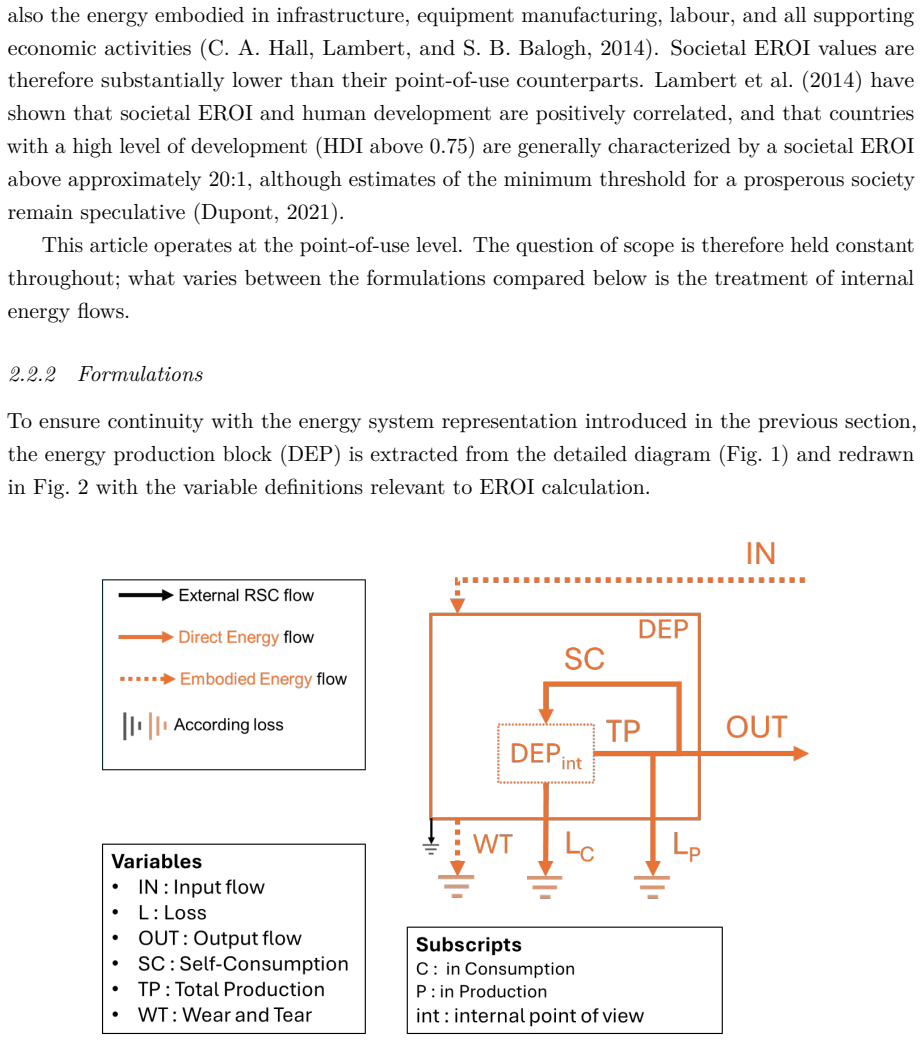
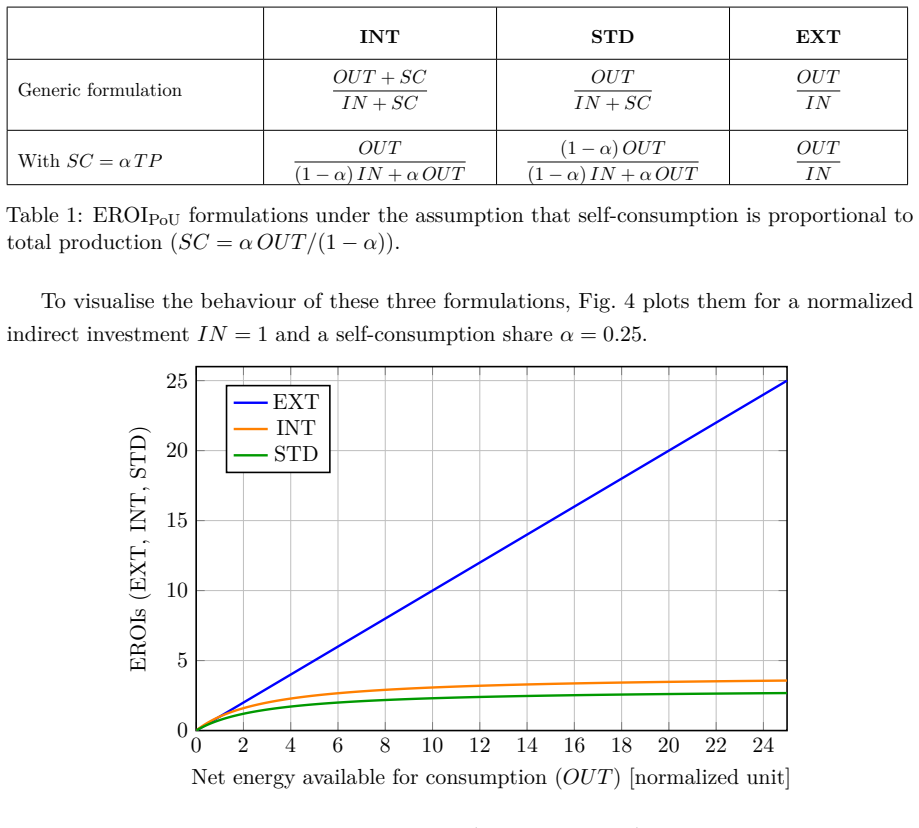
Only the external EROI variant measures the net energy surplus available to society; the others measure internal process efficiency.
A machine-rendered reading of the paper's core claim, the machinery that carries it, and where it could break.
Core claim
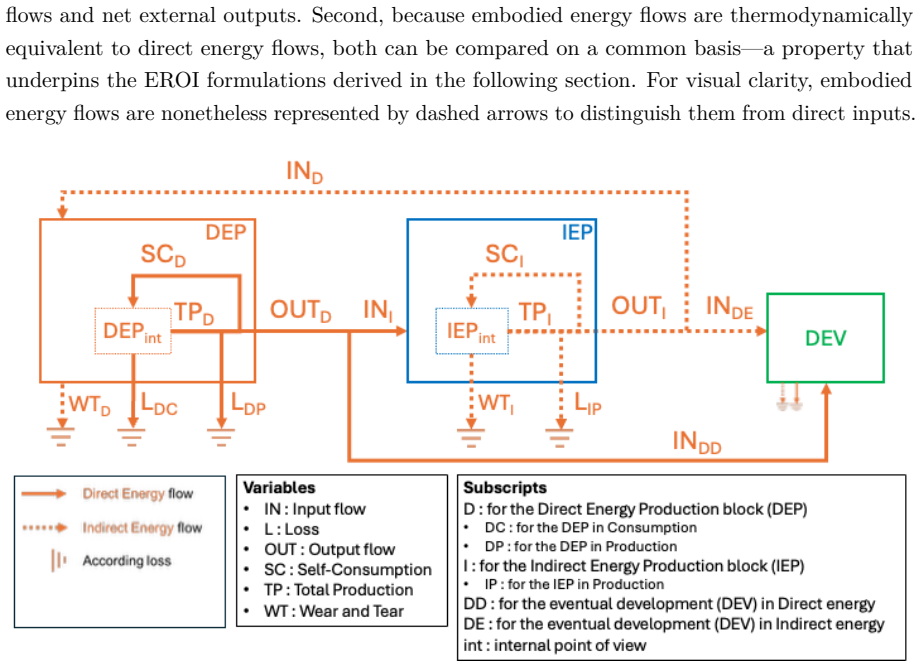
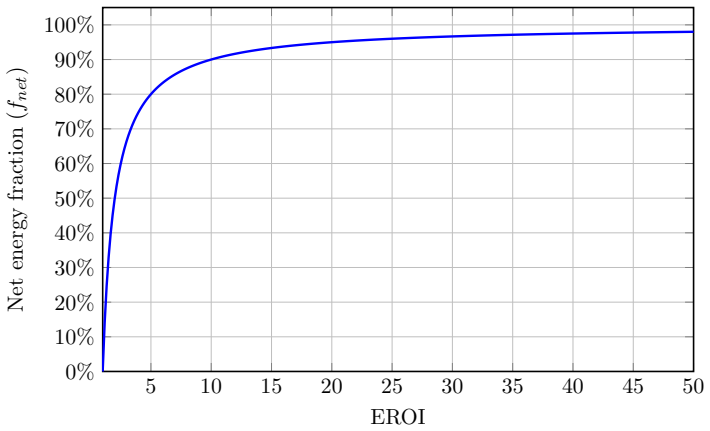
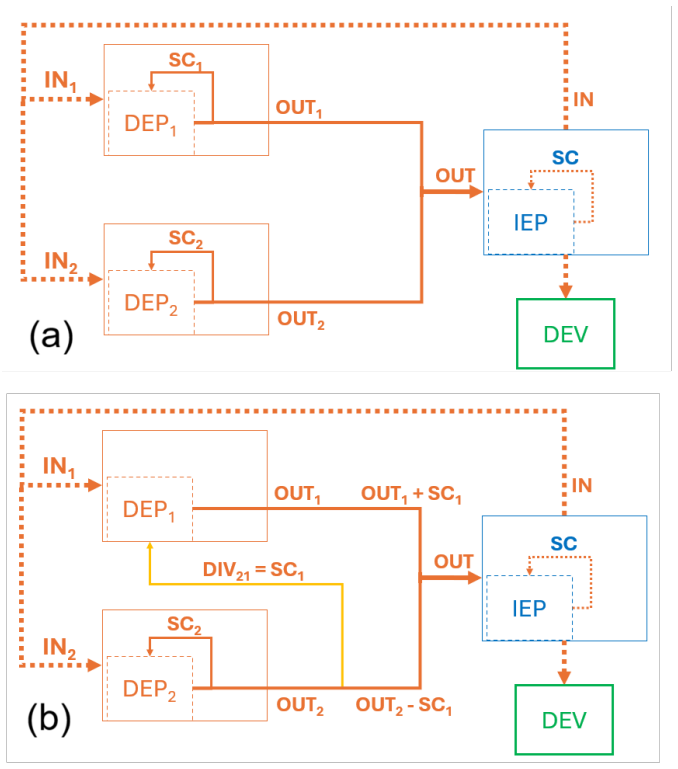
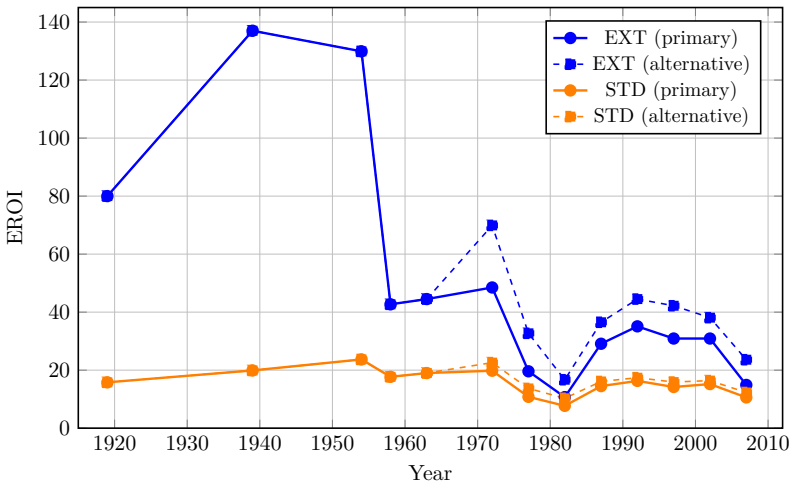
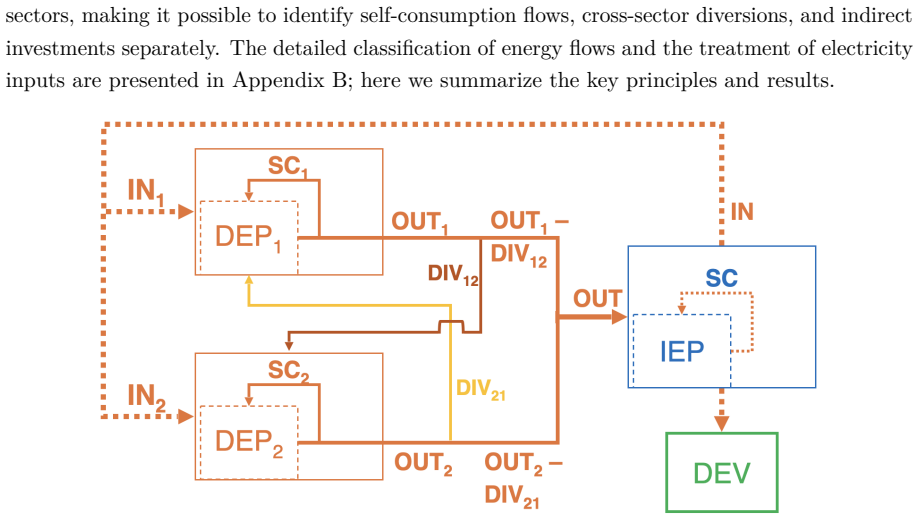
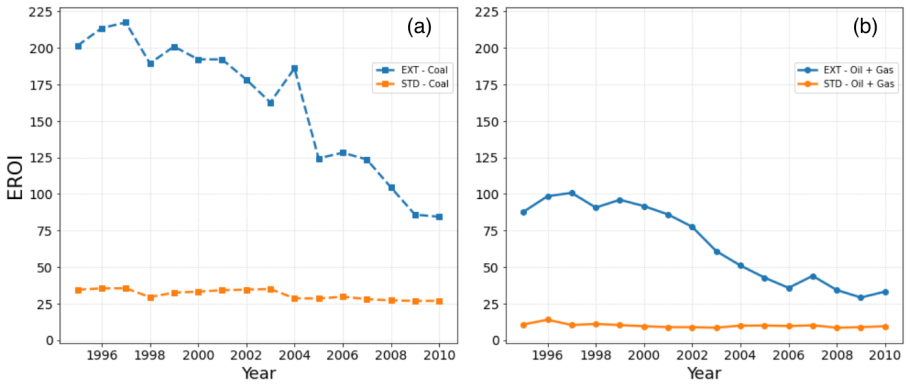
By comparing the three formulations against theoretical extremes, only the external (EXT) variant correctly quantifies the net energy surplus available to society. The internal (INT) and standard (STD) variants converge to measures of conversion efficiency within the production process. In systems with multiple sources exchanging direct energy, flows must first be converted to upstream embodied-energy equivalents; a derived reallocation formula achieves unique consistency under aggregation. When applied to historical U.S. oil and gas and Chinese fossil-fuel data, the revised values are systematically higher and can shift a given physical system across the net-energy cliff boundary.
What carries the argument
Benchmarking against theoretical limit cases that distinguishes net-surplus measurement from internal-efficiency measurement, together with a reallocation formula that converts direct energy flows to embodied-energy equivalents to preserve aggregation consistency.
If this is right
- The choice of EROI variant determines whether a source registers as delivering net surplus or merely internal efficiency.
- Multi-source systems require conversion of direct flows to embodied equivalents before aggregation.
- Revised calculations on real sectors produce higher EROI values that can cross net-energy thresholds.
- Energy-transition assessments can reach opposite conclusions depending on the variant adopted.
Where Pith is reading between the lines
- Models that rely on non-external EROI may systematically underestimate the net contribution of sources with substantial internal recycling.
- The reallocation step could be applied to other multi-energy economies to check consistency.
- Dynamic transition scenarios may need recalibration if self-consumption treatment alters projected energy balances.
Load-bearing premise
Benchmarking the three formulations against theoretical limit cases correctly reveals which one tracks net societal surplus instead of internal efficiency.
What would settle it
An independent accounting of net energy delivered to the economy, drawn from national energy balances that exclude self-consumption, would match only the external-variant EROI values if the claim is correct.
Figures
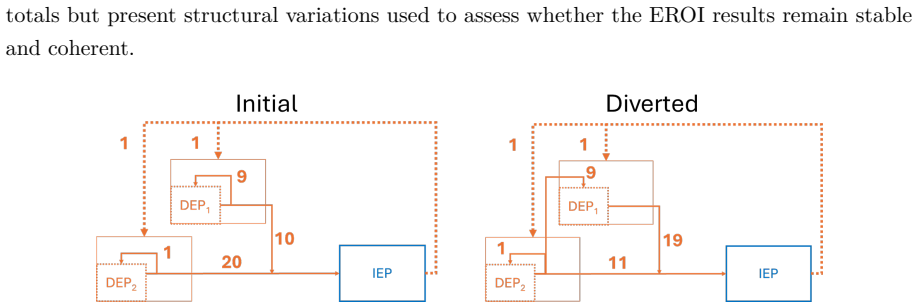
read the original abstract
Multiple formulations of the Energy Return on Investment (EROI) coexist in the literature, differing mainly in their treatment of self-consumption and external direct energy inputs. This article shows that these differences are not merely conventional: they determine whether EROI measures the net energy surplus available to society or the internal conversion efficiency of the production process. By benchmarking three established formulations against theoretical limit cases, we demonstrate that only the external variant (EXT), which excludes self-consumed energy from the investment term, correctly measures the net energy surplus available to society. The internal (INT) and standard (STD) variants instead converge toward measures of process efficiency. We further show that, in multi-source systems exchanging direct energy flows, consistency requires converting these flows into their upstream embodied energy equivalents before including them in the energy investment term. A generic reallocation formula is derived and shown to uniquely preserve aggregation consistency. Applied to U.S. oil and gas production (1919--2007) and China's fossil fuel sectors (1995--2010), the revised framework yields systematically higher EROI values than standard formulations, potentially placing the same physical system on opposite sides of the net energy cliff, with direct implications for energy transition assessment and policy.
Editorial analysis
A structured set of objections, weighed in public.
Referee Report
Summary. The manuscript examines three EROI variants (STD, INT, EXT) differing in treatment of self-consumption and external inputs. It claims that benchmarking against theoretical limit cases shows only EXT measures net societal energy surplus while INT and STD measure process efficiency. A generic reallocation formula is derived and proven unique for preserving aggregation consistency when converting direct energy flows to embodied equivalents in multi-source systems. Empirical application to U.S. oil/gas (1919-2007) and China fossil fuels (1995-2010) yields higher EROI values than standard methods, potentially shifting systems relative to net-energy thresholds with policy implications.
Significance. If the central distinction and uniqueness result hold, the work clarifies an important ambiguity in the EROI literature and supplies a consistency-preserving framework for multi-source assessments. The explicit uniqueness proof for the reallocation formula and the falsifiable empirical predictions on historical datasets are strengths that would support the assessment of energy-transition viability.
major comments (2)
- [benchmarking against theoretical limit cases] Benchmarking against theoretical limit cases (abstract and the dedicated benchmarking section): the demonstration that only EXT measures net surplus assumes the limit cases (self-consumption fraction →0 or →1, zero external inputs) unambiguously map to known societal-surplus values. If these cases are defined solely in terms of the same energy-flow partitions used to distinguish EXT/INT/STD, the test reduces to internal consistency rather than independent validation, undermining the claim that differences in self-consumption treatment determine surplus versus efficiency.
- [reallocation formula derivation] Derivation of the reallocation formula and uniqueness claim (the section presenting the generic reallocation formula): the uniqueness result is stated to preserve aggregation consistency, but the stress-test concern applies directly—if the aggregation-consistency criterion is itself motivated by the preference for EXT, the uniqueness proof may embed the same interpretive choice rather than derive it from an independent axiom set.
minor comments (2)
- [empirical applications] The abstract and empirical sections refer to 'systematically higher EROI values' without quantifying the magnitude or providing error bands on the reallocated flows for the U.S. and China datasets; adding these would strengthen the policy-implication statements.
- [introduction of variants] Notation for the three variants (STD, INT, EXT) is introduced without an explicit comparison table early in the text; a compact table summarizing the investment-term definitions would improve readability.
Simulated Author's Rebuttal
We thank the referee for the constructive comments, which help clarify the logical structure of our arguments. We respond to each major comment below, maintaining that the benchmarking and uniqueness results rest on independent physical and mathematical criteria rather than circularity.
read point-by-point responses
-
Referee: Benchmarking against theoretical limit cases (abstract and the dedicated benchmarking section): the demonstration that only EXT measures net surplus assumes the limit cases (self-consumption fraction →0 or →1, zero external inputs) unambiguously map to known societal-surplus values. If these cases are defined solely in terms of the same energy-flow partitions used to distinguish EXT/INT/STD, the test reduces to internal consistency rather than independent validation, undermining the claim that differences in self-consumption treatment determine surplus versus efficiency.
Authors: The limit cases are anchored in independent physical boundary conditions: when self-consumption fraction approaches zero, all output is delivered externally by definition of energy balance, yielding net societal surplus; when it approaches one, no net delivery occurs. These expectations derive from the conceptual distinction between energy available to society versus energy retained internally for process operation, which precedes the algebraic definitions of EXT/INT/STD. The variants are then tested against these fixed physical expectations, showing differential convergence rather than tautological consistency. revision: no
-
Referee: Derivation of the reallocation formula and uniqueness claim (the section presenting the generic reallocation formula): the uniqueness result is stated to preserve aggregation consistency, but the stress-test concern applies directly—if the aggregation-consistency criterion is itself motivated by the preference for EXT, the uniqueness proof may embed the same interpretive choice rather than derive it from an independent axiom set.
Authors: Aggregation consistency is an independent axiom drawn from energy conservation: the sum of embodied-energy investments across sources must equal the aggregate investment without residual or double-counting when direct flows are reallocated. This requirement holds for any multi-source accounting system regardless of EROI variant and follows from the need to maintain additive energy balances. The uniqueness proof demonstrates that only one linear reallocation operator satisfies this axiom for arbitrary exchange networks, thereby deriving the necessity of embodied conversion from the conservation principle itself. revision: no
Circularity Check
No significant circularity; derivation relies on independent limit-case benchmarking and explicit consistency criterion.
full rationale
The paper benchmarks EROI variants against theoretical limit cases (self-consumption fractions of 0 or 1, zero external inputs) to identify which measures net societal surplus versus internal efficiency, then derives a reallocation formula shown to preserve aggregation consistency in multi-source systems. These steps use external physical definitions of energy flows rather than presupposing the EXT preference or fitting parameters to the target result. No self-citation chain, self-definitional loop, or reduction of a prediction to a fitted input is present in the provided text. The central claim therefore remains independent of its inputs.
Axiom & Free-Parameter Ledger
Reference graph
Works this paper leans on
-
[1]
Nature Energy , volume=
Estimation of useful-stage energy returns on investment for fossil fuels and implications for renewable energy systems , author=. Nature Energy , volume=. 2024 , doi =
2024
-
[2]
2018 , publisher=
Oil, Power, and War: A Dark History , author=. 2018 , publisher=
2018
-
[3]
Energy return on investment (
Brandt, Adam R and Sun, Yuchi and Bharadwaj, Sharad and Livingston, David and Tan, Eugene and Gordon, Deborah , journal=. Energy return on investment (. 2015 , publisher=
2015
-
[4]
Estimation of global final-stage energy-return-on-investment for fossil fuels with comparison to renewable energy sources , author=. Nature Energy , volume=. doi:10.1038/s41560-019-0425-z , year=
-
[5]
1995--2010 , publisher =
China Energy Statistical Yearbook (CESY) , author =. 1995--2010 , publisher =
1995
-
[6]
1995--2010 , publisher =
China Statistic Yearbook (CSY) , author =. 1995--2010 , publisher =
1995
-
[7]
economy: a biophysical perspective , author=
Energy and the U.S. economy: a biophysical perspective , author=. Science , volume=. 1984 , publisher=
1984
-
[8]
Long-term estimates of the energy-return-on-investment (
Court, Victor and Fizaine, Florian , journal=. Long-term estimates of the energy-return-on-investment (. 2017 , publisher=
2017
-
[9]
Emerging consensus on net energy paves the way for improved integrated assessment modeling
Delannoy, Louis and Auzanneau, Matthieu and Andrieu, Baptiste and Vidal, Olivier and Longaretti, Pierre-Yves and Prados, Emmanuel and Murphy, David J and Bentley, Roger W and Carbajales-Dale, Michael and Raugei, Marco and others. Emerging consensus on net energy paves the way for improved integrated assessment modeling. Energy Environ. Sci. 2024. doi:10.1...
-
[10]
Sustainability , VOLUME =
Dupont, Elise and Germain, Marc and Jeanmart, Herv\'e , TITLE =. Sustainability , VOLUME =. 2021 , NUMBER =
2021
-
[11]
Southern Economic Journal , volume=
Energy and Economic Myths , author=. Southern Economic Journal , volume=
-
[12]
Economics for the future--Beyond the superorganism , journal =. 2020 , issn =. doi:10.1016/j.ecolecon.2019.106520 , author =
-
[13]
1986 , publisher=
Energy and Resource Quality: The Ecology of the Economic Process , author=. 1986 , publisher=
1986
-
[14]
2018 , publisher=
Energy and the Wealth of Nations: An Introduction to Biophysical Economics , author=. 2018 , publisher=
2018
-
[15]
Nature Energy , volume =
Improving calculations of energy return on investment , author=. Nature Energy , volume =. 2025 , doi=
2025
-
[16]
World Energy Outlook 2012 , year =
2012
-
[17]
Energies , volume=
Comparing World Economic and Net Energy Metrics, Part 3: Macroeconomic Historical and Future Perspectives , author=. Energies , volume=. 2015 , publisher=
2015
-
[18]
Ecological Economics , volume =
Economic growth and quality of life: a threshold hypothesis , author =. Ecological Economics , volume =. 1995 , publisher =
1995
-
[19]
Environ Dev Sustain , author=
New perspectives on the energy return on (energy) investment (EROI) of corn ethanol , year=. Environ Dev Sustain , author=
-
[20]
Nature Sustainability , volume =
A good life for all within planetary boundaries , author =. Nature Sustainability , volume =. 2018 , publisher =
2018
-
[21]
2018 , publisher=
Order out of chaos: Man's new dialogue with nature , author=. 2018 , publisher=
2018
-
[22]
Earth beyond six of nine planetary boundaries , author=. Science advances , volume=. doi:10.1126/sciadv.adh2458 , year=
-
[23]
2016 , publisher=
The thermodynamics of evolution , author=. 2016 , publisher=
2016
-
[24]
2019 , publisher=
Energy in world history , author=. 2019 , publisher=
2019
-
[25]
2017 , publisher=
Energy and civilization: a history , author=. 2017 , publisher=
2017
-
[26]
Social Policy & Administration , volume =
Starke, Peter , title =. Social Policy & Administration , volume =. doi:10.1111/j.1467-9515.2006.00479.x , year =
-
[27]
Energy Return on Investment (
Hu, Yan and Hall, Charles AS and Wang, Jianliang and Feng, Lianyong and Poisson, Alexandre , journal=. Energy Return on Investment (. 2013 , publisher=
2013
-
[28]
Time series
Poisson, Alexandre and Hall, Charles AS , journal=. Time series. 2013 , publisher=
2013
-
[29]
Energies , volume=
Energy return on investment of Canadian oil sands extraction from 2009 to 2015 , author=. Energies , volume=. 2017 , publisher=
2009
-
[30]
2014 , publisher=
Lambert, Jessica G and Hall, Charles AS and Balogh, Stephen and Gupta, Ajay and Arnold, Michelle , journal=. 2014 , publisher=
2014
-
[31]
Energy return on investment for
Grandell, Leena and Hall, Charles AS and H. Energy return on investment for. Sustainability , volume=. 2011 , publisher=
2011
-
[32]
2011 , publisher=
Murphy, David J and Hall, Charles AS and Dale, Michael and Cleveland, Cutler , journal=. 2011 , publisher=
2011
-
[33]
2011 , publisher=
Murphy, David J and Hall, Charles AS and Powers, Bobby , journal=. 2011 , publisher=
2011
-
[34]
GCB Bioenergy , volume=
Colla, Martin and de Chambost, Etienne and Merceron, Louis and Blondeau, Julien and Jeanmart, Herv. GCB Bioenergy , volume=. 2024 , publisher=
2024
-
[35]
2022 , publisher=
Murphy, David J and Raugei, Marco and Carbajales-Dale, Michael and Rubio Estrada, Brenda , journal=. 2022 , publisher=
2022
-
[36]
Frontiers in Energy Research , volume=
An Explanation of Energy Return on Investment From an Entropy Perspective , author=. Frontiers in Energy Research , volume=. 2021 , publisher=
2021
-
[37]
What is the minimum
Hall, Charles AS and Balogh, Stephen and Murphy, David JR , journal=. What is the minimum. 2009 , publisher=
2009
-
[38]
The Decline of Global Energy Return on Energy Invested (
Gon. The Decline of Global Energy Return on Energy Invested (. Preprint , year=
-
[39]
2014 , publisher=
Hall, Charles AS and Lambert, Jessica G and Balogh, Stephen B , journal=. 2014 , publisher=
2014
-
[40]
Electricity storage needs for the energy transition: An
Limpens, Gauthier and Jeanmart, Herv. Electricity storage needs for the energy transition: An. Energy , volume=. 2018 , publisher=
2018
-
[41]
Renewable and Sustainable Energy Reviews , volume=
Energy Ratio analysis and accounting for renewable and non-renewable electricity generation: A review , author=. Renewable and Sustainable Energy Reviews , volume=. 2018 , publisher=
2018
-
[42]
Dynamic Energy Return on Energy Investment (
Capell. Dynamic Energy Return on Energy Investment (. Energy strategy reviews , volume=. 2019 , publisher=
2019
-
[43]
Sustainability , volume=
Relating financial and energy return on investment , author=. Sustainability , volume=. 2011 , publisher=
2011
-
[44]
International Journal of Global Sustainability , volume=
Mobile Modular Hydrogen Power Generation a Zero Carbon Energy System , author=. International Journal of Global Sustainability , volume=. 2023 , publisher=
2023
-
[45]
Energy Policy , volume=
A comprehensive assessment of the energy performance of the full range of electricity generation technologies deployed in the United Kingdom , author=. Energy Policy , volume=. 2016 , publisher=
2016
-
[46]
Energy return on energy, carbon, and water investment in oil and gas resource extraction: Methods and applications to the
Huang, Chen and Gu, Baihe and Chen, Yingchao and Tan, Xianchun and Feng, Lianyong , journal=. Energy return on energy, carbon, and water investment in oil and gas resource extraction: Methods and applications to the. 2019 , publisher=
2019
-
[47]
2007 , publisher=
Environment, power, and society for the twenty-first century: the hierarchy of energy , author=. 2007 , publisher=
2007
-
[48]
The Economic Journal , volume=
Economies of scale in theory and practice , author=. The Economic Journal , volume=. 1972 , publisher=
1972
-
[49]
The Journal of Law and Economics , volume=
The economies of scale , author=. The Journal of Law and Economics , volume=. 1958 , publisher=
1958
-
[50]
2018 , publisher=
Big is beautiful: Debunking the myth of small business , author=. 2018 , publisher=
2018
-
[51]
1895 , publisher=
The first six chapters of the principles of political economy and taxation of David Ricardo, 1817 , author=. 1895 , publisher=
-
[52]
1979 , publisher=
Samuelson, Paul A , journal=. 1979 , publisher=
1979
-
[53]
Journal of Economic Perspectives , volume=
Retrospectives: The law of diminishing returns , author=. Journal of Economic Perspectives , volume=. 1993 , publisher=
1993
-
[54]
Nature , volume=
A safe operating space for humanity , author=. Nature , volume=. 2009 , publisher=
2009
-
[55]
Science , volume=
Planetary boundaries: Guiding human development on a changing planet , author=. Science , volume=. 2015 , publisher=
2015
-
[56]
and Just, T
Zhao, L. and Just, T. , title =. Journal of Chinese Economic and Business Studies , year =
-
[57]
Sustainability , volume=
A new long term assessment of energy return on investment (EROI) for US oil and gas discovery and production , author=. Sustainability , volume=. 2011 , publisher=
2011
-
[58]
2021 , school=
Potential of wind and solar resources and macroeconomic implications of the energy transition , author=. 2021 , school=
2021
discussion (0)
Sign in with ORCID, Apple, or X to comment. Anyone can read and Pith papers without signing in.