PerBite: A Curated Diagnostic Workflow for Bite-Aware Food Volume Estimation
Pith reviewed 2026-06-28 14:54 UTC · model grok-4.3
The pith
A workflow that reconstructs scaled 3D food meshes from before-and-after photos ranks first in the MetaFood challenge with 33.87 percent state-level volume MAPE and zero monotonicity violations.
A machine-rendered reading of the paper's core claim, the machinery that carries it, and where it could break.
Core claim
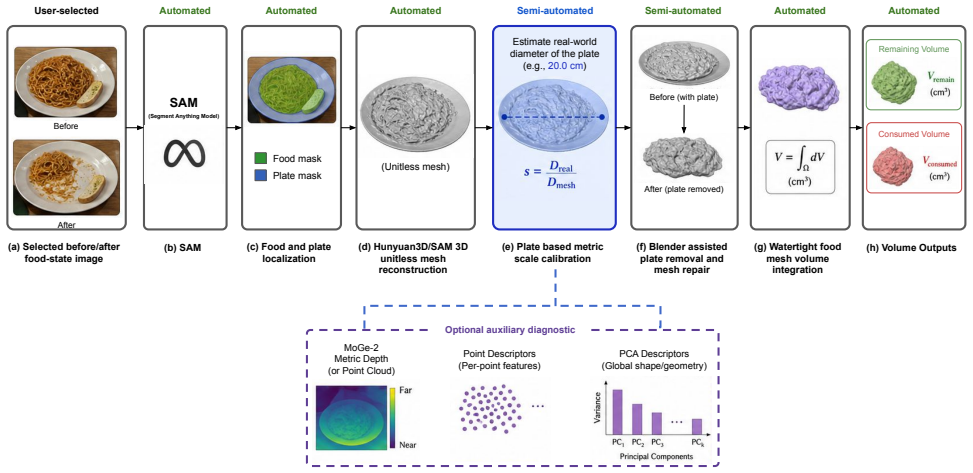
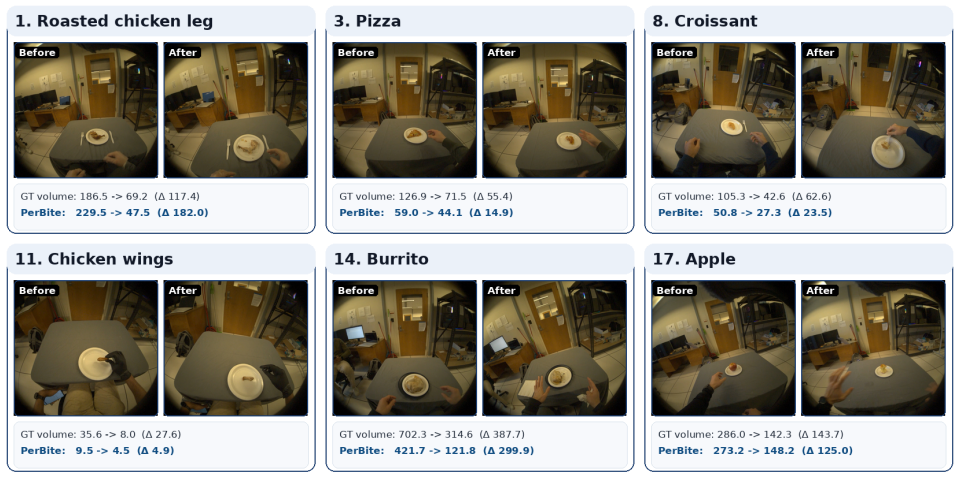
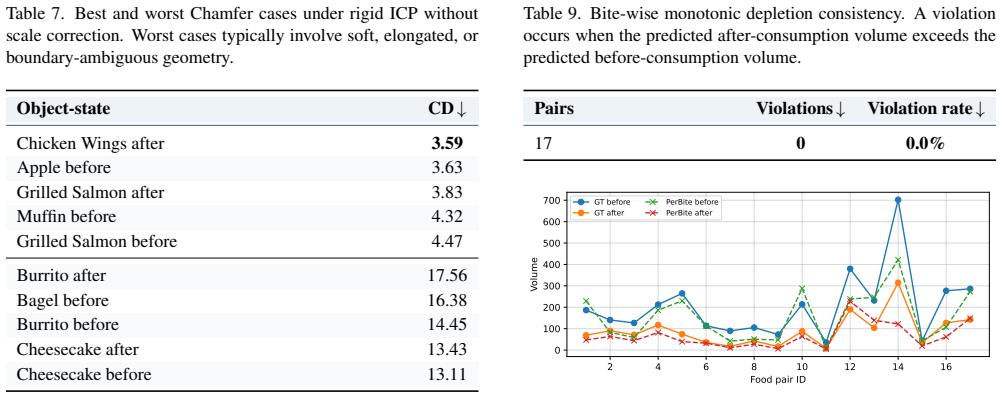
The submitted workflow that segments with SAM~3, generates dimensionless meshes with Hunyuan3D, applies plate-diameter scaling, removes plate geometry in Blender, fills holes to produce watertight meshes, and integrates volume achieves first place, recording an average Chamfer distance of 8.31 across 34 meshes, 33.87 percent state-level volume MAPE, zero monotonicity violations on 17 before-after pairs, and 53.74 percent consumed-volume MAPE.
What carries the argument
Plate-diameter scaled, Blender-cleaned watertight mesh whose volume is obtained by direct integration after Hunyuan3D reconstruction and SAM~3 segmentation.
If this is right
- Metric scale derived from plate diameter converts dimensionless meshes into usable volume numbers for dietary tracking.
- Separate scoring of mesh fidelity, scale accuracy, and monotonicity consistency identifies which pipeline stage limits overall performance.
- Zero monotonicity violations across all tested pairs show the method preserves the expected direction of volume change after eating.
- Higher error on the consumed-volume difference indicates that subtracting two state estimates does not automatically yield low error on the difference itself.
Where Pith is reading between the lines
- Mobile dietary apps could adopt the same plate-scaling step to turn ordinary phone photos into volume estimates without extra hardware.
- Running the same diagnostic checks on larger and more varied food datasets would show whether plate-based scaling remains reliable when plates are partially occluded or non-circular.
- If hole-filling after plate removal introduces consistent over- or under-estimation, adding a small calibration object of known volume could correct the bias.
- Extending the workflow to continuous video frames instead of static pairs might allow real-time tracking of bite-by-bite consumption.
Load-bearing premise
Plate diameter supplies an accurate metric scale and the cleaned mesh volume after plate removal and hole filling matches true food volume without systematic bias from reconstruction errors or occlusion.
What would settle it
Direct comparison of workflow volume estimates against independently measured consumed food mass or displacement on a new set of before-after image pairs that include known ground-truth volumes.
Figures

read the original abstract
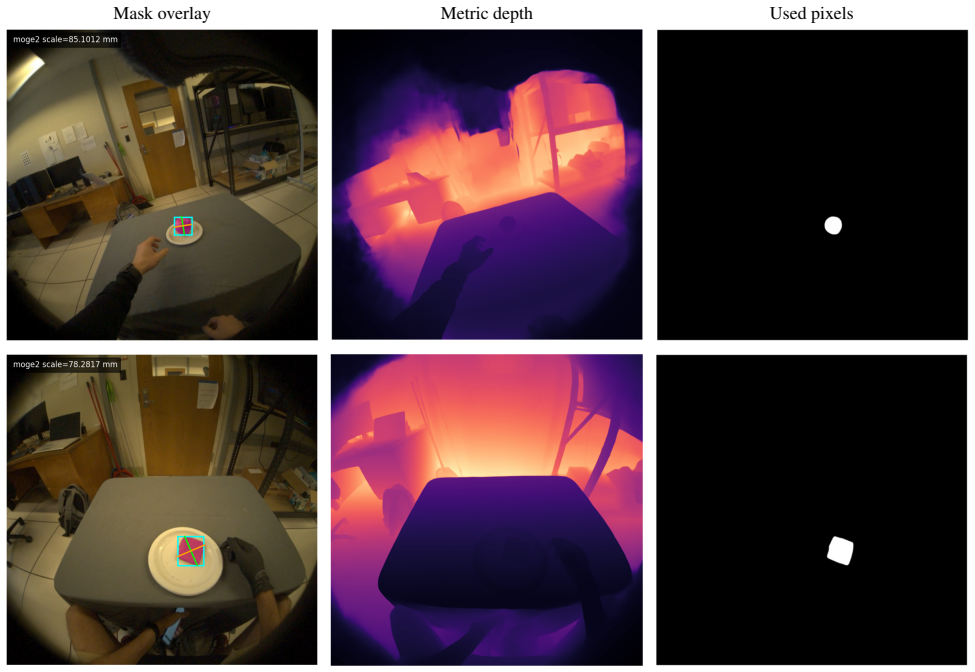
Can a visually plausible food mesh be trusted to estimate the volume of consumed food? \method investigates this question using selected paired before- and after-consumption states from the MetaFood CVPR 2026 Continuous 3D Reconstruction While Eating Challenge. The submitted workflow follows a curated reconstruction protocol: SAM~3 segments the food and plate regions; Hunyuan3D/SAM~3D generates a dimensionless food mesh; the plate diameter provides the metric scale; the plate geometry is removed in Blender; and the remaining mesh is hole-filled, made watertight, and integrated to estimate volume. MoGe-2 is used only as an auxiliary cue for initial dish-diameter estimation when direct plate measurement is uncertain; it is not the primary scale source for the reported challenge result. \method ranks first, with an average Chamfer distance of 8.31 across 34 meshes using rigid ICP without scale correction. On 17 before- and after-pairs, it achieves 33.87\% state-level volume MAPE and zero monotonicity violations, while consumed-volume MAPE remains 53.74\%. The results show that surface reconstruction, metric scale, controlled mesh cleanup, watertight volume integration, and physical depletion consistency should be evaluated separately for dietary assessment. Source code and evaluation scripts will be available at \href{https://github.com/GCVCG/PerBite-CVPR-MetaFood-2026}{github.com/GCVCG/PerBite-CVPR-MetaFood-2026}.
Editorial analysis
A structured set of objections, weighed in public.
Referee Report
Summary. The paper presents PerBite, a curated workflow for estimating consumed food volume from paired before/after images in the MetaFood CVPR 2026 challenge. It uses SAM~3 to segment food and plate, Hunyuan3D/SAM~3D to generate a dimensionless mesh, measured plate diameter for metric scaling, Blender for plate removal and hole-filling to create a watertight mesh, and volume integration; MoGe-2 serves only as an auxiliary cue. The workflow ranks first with average Chamfer distance 8.31 on 34 meshes, 33.87% state-level volume MAPE and zero monotonicity violations on 17 pairs, and 53.74% consumed-volume MAPE, concluding that surface reconstruction, metric scale, mesh cleanup, watertight integration, and physical consistency should be evaluated separately.
Significance. If the volume estimates prove unbiased, the work offers a practical, component-wise diagnostic protocol for 3D food reconstruction in dietary assessment, with the public code release enabling direct reproducibility and further ablation on challenge data.
major comments (2)
- [Abstract / Methods] Abstract and methods: the reported state-level (33.87%) and consumed-volume (53.74%) MAPE values rest on the untested assumption that plate-diameter scaling supplies an error-free metric and that Blender plate removal + hole-filling produces a volume faithful to the true food geometry; no sensitivity analysis on diameter measurement error or comparison of filled vs. unfilled meshes against ground-truth volumes is supplied, which directly affects attribution of the MAPE figures to reconstruction quality rather than post-processing artifacts.
- [Results] Results: the claim of first-place ranking and the specific Chamfer / MAPE numbers are presented without error bars, ablation studies on the impact of the post-hoc mesh edits, or occlusion-specific controls, leaving the central performance claim load-bearing on unquantified systematic bias from the scaling and cleanup steps.
minor comments (2)
- [Abstract] Abstract: the statement that MoGe-2 is used only as an auxiliary cue should be accompanied by a brief quantitative note on how often direct plate measurement was available versus when the auxiliary cue was invoked.
- [Methods] The manuscript would benefit from an explicit statement of the exact volume integration method (e.g., signed tetrahedron summation or voxelization) used after watertight conversion.
Simulated Author's Rebuttal
We thank the referee for the constructive feedback highlighting the assumptions in our evaluation protocol. We address each major comment below, proposing targeted textual revisions to improve transparency while preserving the manuscript's focus on a diagnostic workflow.
read point-by-point responses
-
Referee: [Abstract / Methods] Abstract and methods: the reported state-level (33.87%) and consumed-volume (53.74%) MAPE values rest on the untested assumption that plate-diameter scaling supplies an error-free metric and that Blender plate removal + hole-filling produces a volume faithful to the true food geometry; no sensitivity analysis on diameter measurement error or comparison of filled vs. unfilled meshes against ground-truth volumes is supplied, which directly affects attribution of the MAPE figures to reconstruction quality rather than post-processing artifacts.
Authors: We agree that the reported MAPE values incorporate the combined effects of plate-diameter scaling and Blender mesh cleanup rather than isolating reconstruction quality. The manuscript frames PerBite explicitly as a curated diagnostic workflow whose results are intended to motivate separate evaluation of each component (surface reconstruction, metric scaling, mesh cleanup, watertight integration, and physical consistency). No sensitivity analysis on diameter error or filled-versus-unfilled comparisons was performed, as the challenge supplies only final volume targets and the submitted work did not include controlled perturbations. We will revise the Methods section to state the scaling assumption explicitly and add a limitation paragraph in the Discussion noting that post-processing artifacts remain unquantified. revision: partial
-
Referee: [Results] Results: the claim of first-place ranking and the specific Chamfer / MAPE numbers are presented without error bars, ablation studies on the impact of the post-hoc mesh edits, or occlusion-specific controls, leaving the central performance claim load-bearing on unquantified systematic bias from the scaling and cleanup steps.
Authors: The first-place ranking and numerical results (Chamfer distance 8.31, state-level MAPE 33.87 %, consumed-volume MAPE 53.74 %) are taken verbatim from the official MetaFood challenge leaderboard, which provides only point estimates. Ablation studies on post-hoc edits and occlusion-specific controls were not conducted because the workflow is presented as an integrated diagnostic sequence rather than an ablated modular system; the paper's own conclusion calls for such component-wise evaluations. We acknowledge that this leaves the performance figures dependent on the full pipeline. We will add a clarifying statement in the Results section indicating that the metrics reflect the complete workflow and that systematic bias from scaling and cleanup steps is not separately quantified. revision: partial
Circularity Check
No circularity: workflow metrics are direct pipeline outputs on external challenge data
full rationale
The paper describes an applied reconstruction pipeline (SAM segmentation, Hunyuan3D mesh generation, plate-diameter scaling, Blender cleanup, watertight integration) evaluated on MetaFood CVPR 2026 challenge pairs. Reported values (Chamfer distance 8.31, state MAPE 33.87%, consumed MAPE 53.74%, zero monotonicity violations) are computed outputs of this pipeline on held-out data, not quantities derived from fitted parameters or self-referential equations within the paper. No self-citations, ansatzes, or uniqueness theorems are invoked as load-bearing steps for any derivation. The plate-diameter scaling and hole-filling steps are explicit methodological choices whose bias is acknowledged as an open question but do not create definitional circularity. This matches the default non-circular case for an engineering workflow paper.
Axiom & Free-Parameter Ledger
axioms (1)
- domain assumption The physical plate is a flat circular object whose diameter can be directly measured to provide absolute scale for the reconstructed mesh.
Reference graph
Works this paper leans on
-
[1]
arXiv preprint arXiv:2407.01717 (2024)
Ahmad AlMughrabi, Umair Haroon, Ricardo Marques, and Petia Radeva. V oleta: One- and few-shot food volume esti- mation.arXiv preprint arXiv:2407.01717, 2024. 2, 3
-
[2]
Foodmem: Near real-time and precise food 11 video segmentation.Pattern Recognition Letters, 192:59– 64, 2025
Ahmad AlMughrabi, Adrian Galan, Ricardo Marques, and Petia Radeva. Foodmem: Near real-time and precise food 11 video segmentation.Pattern Recognition Letters, 192:59– 64, 2025. 3, 5
2025
-
[3]
V oltex: Food volume estimation using text- guided segmentation and neural surface reconstruction
Ahmad AlMughrabi, Umair Haroon, Ricardo Marques, and Petia Radeva. V oltex: Food volume estimation using text- guided segmentation and neural surface reconstruction. In 2025 IEEE/CVF Conference on Computer Vision and Pat- tern Recognition Workshops (CVPRW), 2025. 2, 3
2025
-
[4]
V oleta++: Neural framework for food 3d reconstruction and volume estimation
Ahmad AlMughrabi, Ricardo Marques, and Petia Radeva. V oleta++: Neural framework for food 3d reconstruction and volume estimation. SSRN preprint, 2025. 3
2025
-
[5]
Ahmad AlMughrabi, Guillermo Rivo, Carlos Jimenez- Farfan, Umair Haroon, Farid Al-Areqi, Hyunjun Jung, Ben- jamin Busam, Ricardo Marques, and Petia Radeva. Bench- seg: A large-scale dataset and benchmark for multi-view food video segmentation.arXiv preprint arXiv:2601.07581,
-
[6]
SAM 3: Segment Anything with Concepts
Nicolas Carion, Laura Gustafson, Yuan-Ting Hu, Shoub- hik Debnath, Ronghang Hu, Didac Suris, Chaitanya Ryali, Kalyan Vasudev Alwala, Haitham Khedr, Andrew Huang, et al. Sam 3: Segment anything with concepts.arXiv preprint arXiv:2511.16719, 2025. 3, 5
work page internal anchor Pith review Pith/arXiv arXiv 2025
-
[7]
Lo, and Benny P
Anqi Gao, Frank P.-W. Lo, and Benny P. L. Lo. Food volume estimation for quantifying dietary intake with a wearable camera.2018 IEEE 15th International Conference on Wear- able and Implantable Body Sensor Networks (BSN), pages 110–113, 2018. 3
2018
-
[8]
V ole++: A text-guided point-cloud framework for food 3d reconstruction and volume estimation
Umair Haroon, Ahmad AlMughrabi, Ricardo Marques, and Petia Radeva. V ole++: A text-guided point-cloud framework for food 3d reconstruction and volume estimation. InCom- puter Analysis of Images and Patterns, pages 386–397. 2025. 3
2025
-
[9]
V ole: A point-cloud framework for food 3d reconstruction and volume estima- tion.Scientific Reports, 16:8648, 2026
Umair Haroon, Ahmad AlMughrabi, Thanasis Zoumpekas, Ricardo Marques, and Petia Radeva. V ole: A point-cloud framework for food 3d reconstruction and volume estima- tion.Scientific Reports, 16:8648, 2026. 2, 3
2026
-
[10]
Jiangpeng He, Yuhao Chen, Gautham Vinod, Talha Ibn Mah- mud, Fengqing Zhu, Edward Delp, Alexander Wong, Pengcheng Xi, Ahmad AlMughrabi, Umair Haroon, Ricardo Marques, Petia Radeva, et al. Metafood cvpr 2024 challenge on physically informed 3d food reconstruction: Methods and results.arXiv preprint arXiv:2407.09285, 2024. 3
-
[11]
Accuracy of food portion size estimation from digital pic- tures acquired by a chest-worn camera.Public health nutri- tion, 17(8):1671–1681, 2014
Wenyan Jia, Hsin-Chen Chen, Yaofeng Yue, Zhaoxin Li, John Fernstrom, Yicheng Bai, Chengliu Li, and Mingui Sun. Accuracy of food portion size estimation from digital pic- tures acquired by a chest-worn camera.Public health nutri- tion, 17(8):1671–1681, 2014. 3
2014
-
[12]
SAM 3D: 3Dfy Anything in Images
SAM 3D Team, Xingyu Chen, Fu-Jen Chu, Pierre Gleize, Kevin J. Liang, Alexander Sax, Hao Tang, Weiyao Wang, Michelle Guo, Thibaut Hardin, et al. Sam 3d: 3dfy anything in images.arXiv preprint arXiv:2511.16624, 2025. 3
work page internal anchor Pith review Pith/arXiv arXiv 2025
-
[13]
MoGe-2: Accurate Monocular Geometry with Metric Scale and Sharp Details
Ruicheng Wang, Sicheng Xu, Yue Dong, Yu Deng, Jianfeng Xiang, Zelong Lv, Guangzhong Sun, Xin Tong, and Jiaolong Yang. Moge-2: Accurate monocular geometry with metric scale and sharp details.arXiv preprint arXiv:2507.02546,
work page internal anchor Pith review Pith/arXiv arXiv
-
[14]
Hunyuan3D 2.0: Scaling Diffusion Models for High Resolution Textured 3D Assets Generation
Zibo Zhao, Zeqiang Lai, Qingxiang Lin, Yunfei Zhao, Haolin Liu, Shuhui Yang, Yifei Feng, Mingxin Yang, Sheng Zhang, Xianghui Yang, et al. Hunyuan3d 2.0: Scaling diffu- sion models for high resolution textured 3d assets generation. arXiv preprint arXiv:2501.12202, 2025. 3 12
work page internal anchor Pith review Pith/arXiv arXiv 2025
discussion (0)
Sign in with ORCID, Apple, or X to comment. Anyone can read and Pith papers without signing in.