Realistic noise synthesis reduces bias and improves tissue microstructure estimation with supervised machine learning
Pith reviewed 2026-06-28 15:41 UTC · model grok-4.3
The pith
Incorporating realistic noise synthesis into simulated training data eliminates systematic bias in supervised machine learning estimates of tissue microstructure from diffusion MRI.
A machine-rendered reading of the paper's core claim, the machinery that carries it, and where it could break.
Core claim
Incorporating the Rician expectation and the effective post-processing noise variance into simulated training signals substantially reduces bias in supervised microstructure parameter estimation to the level of noise-aware nonlinear least-squares fitting, with further precision gains from effective variance modeling.
What carries the argument
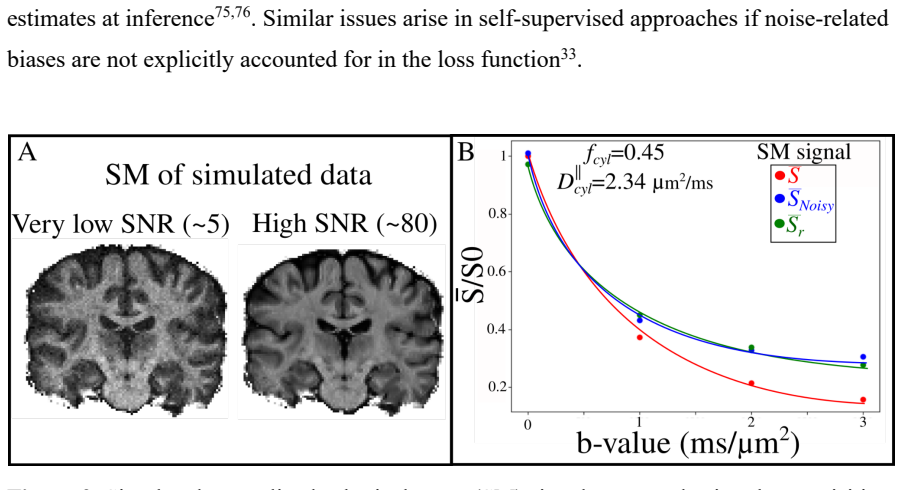
Realistic noise synthesis (RNS) framework that adds the Rician expectation modeled from MPPCA noise estimates and the effective standard deviation from spherical harmonic residuals to simulated signals.
If this is right
- Ignoring magnitude-induced noise effects during training produces systematic, SNR-dependent parameter bias, especially at low SNR.
- Adding the Rician expectation alone brings bias down to the level of noise-aware nonlinear least-squares fitting.
- Modeling the effective standard deviation on top of the Rician expectation further improves precision.
- Bias reduction and precision gains are largely independent of the choice of regression architecture.
- Performance remains sensitive to the accuracy of the noise estimates used in synthesis.
Where Pith is reading between the lines
- Supervised models can reach unbiased performance in high-b-value or high-resolution regimes once noise characteristics are aligned.
- The same noise-synthesis step could be tested on other imaging modalities that produce Rician or non-central chi signals.
- Repeated-acquisition experiments provide a direct way to measure residual bias after RNS is applied.
Load-bearing premise
The main source of bias is the mismatch in noise statistics between simulated and acquired signals, and the MPPCA and residual-based estimates are accurate enough to remove that mismatch without other simulation-reality differences.
What would settle it
Training an identical supervised model with deliberately inaccurate noise estimates in the RNS step and observing whether bias remains as large as in the unmatched-noise case would test the claim.
Figures
read the original abstract
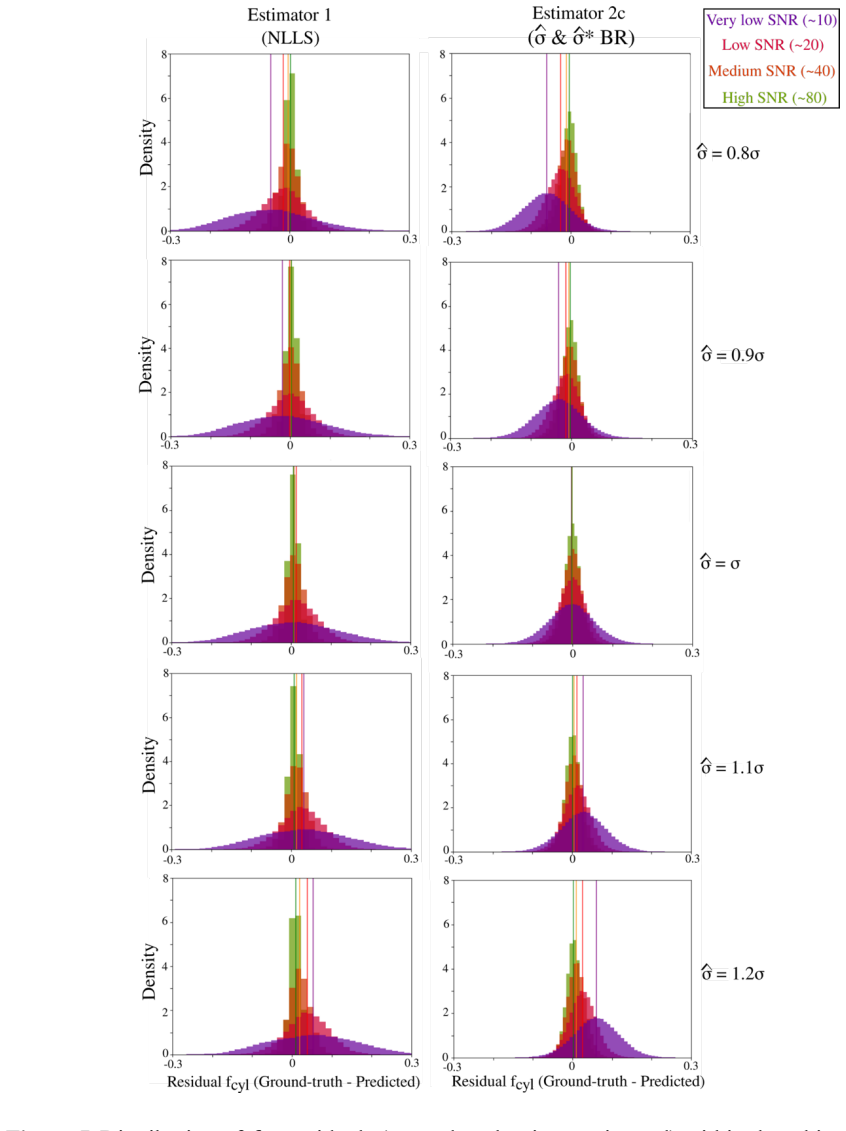
Diffusion MRI enables non-invasive probing of tissue microstructure, but accurate parameter estimation is challenged by noise-related effects. In supervised machine learning frameworks trained on simulated data, discrepancies between the noise characteristics of simulated and acquired signals introduce a form of covariate shift, whereby the input signal distribution differs between training and inference. We investigated the impact of this mismatch on microstructure parameter estimation and propose a realistic noise synthesis (RNS) framework to mitigate it. RNS incorporates both the Rician expectation and the effective post-processing noise variance into simulated training signals. The Rician expectation was modelled using a noise standard deviation estimated with MPPCA, while the effective standard deviation was derived from spherical harmonic residuals of preprocessed data. The method was evaluated using the cylinder-zeppelin and the SANDI models on simulated datasets across multiple SNR levels and on in vivo diffusion data with repeated acquisitions. Sensitivity to noise misestimation was also assessed. Ignoring magnitude-induced noise effects during training produced systematic, SNR-dependent parameter bias, particularly at low SNR. Incorporating the Rician expectation substantially reduced bias to the level of noise-aware nonlinear least-squares fitting. Modelling the effective standard deviation further improved precision. Performance was largely independent of regression architecture but sensitive to accurate noise estimation. These findings demonstrate that realistic noise modelling in simulated training data mitigates signal-domain covariate shift and is essential for unbiased supervised microstructure estimation, particularly in low-SNR regimes associated with high b-values or high spatial resolution.
Editorial analysis
A structured set of objections, weighed in public.
Referee Report
Summary. The manuscript proposes a realistic noise synthesis (RNS) framework to address covariate shift in supervised ML for dMRI microstructure estimation. It claims that modeling the Rician expectation (via MPPCA-estimated σ) and effective post-processing noise variance (via spherical-harmonic residuals) in simulated training signals reduces parameter bias for the cylinder-zeppelin and SANDI models to the level achieved by noise-aware nonlinear least-squares fitting, with additional precision gains; the approach is evaluated on simulated data at multiple SNR levels and on in vivo repeated-acquisition data, with an accompanying sensitivity analysis to noise misestimation.
Significance. If the central claim holds, the work shows that explicit noise-characteristic matching in simulation-based training can eliminate a major source of bias in supervised microstructure estimation without altering network architecture, achieving parity with established NLLS methods while improving precision. The use of external, non-circular noise estimators (MPPCA, SH residuals) and the explicit sensitivity test are strengths that increase the result's practical utility for high-b or high-resolution regimes.
major comments (3)
- [Abstract] Abstract: the central claim that RNS 'substantially reduced bias to the level of noise-aware nonlinear least-squares fitting' is stated without any numerical values, error bars, statistical tests, or effect-size metrics for either simulated or in vivo experiments, making it impossible to verify the magnitude or reliability of the reported bias reduction.
- [Evaluation] Evaluation sections (simulated and in vivo): the claim that bias reaches NLLS levels rests on the assumption that the two scalar noise parameters fully capture the post-preprocessing magnitude distribution; the manuscript does not report a direct validation (e.g., comparison of MPPCA/SH-derived σ against empirical variance from repeated acquisitions or ground-truth simulations) that would rule out residual mismatches from eddy currents, gradient nonlinearity, or non-stationarity.
- [Sensitivity analysis] Sensitivity analysis: while the abstract states that performance is 'sensitive to accurate noise estimation,' no quantitative thresholds or failure modes (e.g., bias increase when MPPCA σ is perturbed by 10-20 %) are provided, leaving the robustness claim unquantified.
minor comments (2)
- [Methods] The distinction between the Rician expectation parameter and the effective post-processing variance should be given explicit symbols and a short derivation in the Methods to avoid reader confusion.
- [Figures] Figure captions for the in vivo results should state the number of repeated acquisitions and the exact metric used to quantify 'precision gains.'
Simulated Author's Rebuttal
We thank the referee for their constructive and detailed review. We address each major comment below and will revise the manuscript to incorporate quantitative metrics, additional validation, and expanded sensitivity results.
read point-by-point responses
-
Referee: [Abstract] Abstract: the central claim that RNS 'substantially reduced bias to the level of noise-aware nonlinear least-squares fitting' is stated without any numerical values, error bars, statistical tests, or effect-size metrics for either simulated or in vivo experiments, making it impossible to verify the magnitude or reliability of the reported bias reduction.
Authors: We agree that the abstract would be strengthened by explicit quantitative support. In the revised version we will insert specific bias values (e.g., mean absolute bias for each model parameter at representative SNR levels), direct numerical comparison to the NLLS baseline, and references to the error-bar and statistical-test results already present in the evaluation sections. revision: yes
-
Referee: [Evaluation] Evaluation sections (simulated and in vivo): the claim that bias reaches NLLS levels rests on the assumption that the two scalar noise parameters fully capture the post-preprocessing magnitude distribution; the manuscript does not report a direct validation (e.g., comparison of MPPCA/SH-derived σ against empirical variance from repeated acquisitions or ground-truth simulations) that would rule out residual mismatches from eddy currents, gradient nonlinearity, or non-stationarity.
Authors: The referee correctly identifies that we did not include an explicit head-to-head comparison of the MPPCA- and SH-derived σ estimates against empirical variance measured from the repeated in vivo acquisitions. We will add this validation (or a clear statement of its limitations) in the revised manuscript to address possible residual mismatches. revision: yes
-
Referee: [Sensitivity analysis] Sensitivity analysis: while the abstract states that performance is 'sensitive to accurate noise estimation,' no quantitative thresholds or failure modes (e.g., bias increase when MPPCA σ is perturbed by 10-20 %) are provided, leaving the robustness claim unquantified.
Authors: We acknowledge that the existing sensitivity analysis demonstrates dependence on noise accuracy but does not supply the requested numerical thresholds. We will expand the section with explicit perturbation experiments (including ±10 % and ±20 % errors in σ) and report the resulting changes in bias and precision to quantify robustness and failure modes. revision: yes
Circularity Check
No significant circularity; derivation is self-contained
full rationale
The paper's central contribution is an empirical framework (RNS) that augments simulated training signals with Rician expectation (via MPPCA-estimated σ) and effective post-processing variance (via SH residuals). Bias reduction is demonstrated by direct comparison to noise-aware NLLS on held-out simulated data and repeated in vivo acquisitions, with explicit sensitivity tests to noise misestimation. No equations reduce a claimed prediction to a fitted parameter by construction, no load-bearing premise rests on self-citation chains, and external benchmarks (NLLS, repeated scans) remain independent of the training distribution. The method therefore does not derive its result from its own inputs.
Axiom & Free-Parameter Ledger
axioms (2)
- domain assumption Magnitude diffusion MRI signals follow a Rician distribution whose expectation can be modeled from an estimated noise standard deviation.
- domain assumption Spherical harmonic residuals of preprocessed data provide an accurate measure of effective post-processing noise variance.
Reference graph
Works this paper leans on
-
[1]
(𝑆(𝑏,𝒈6;𝚯),𝜎')=𝜎'P𝜋2 𝐿
Methods In this section we present our proposed two-step RNS framework that models both the Rician mean offset and the post-processing standard deviation to make supervised dMRI training data statistically closer to the signals encountered at inference. We present application to multi-compartment biophysical signal models for microstructure imaging with d...
-
[2]
(𝑆(b,𝒈6;𝚯),𝜎'))− 𝑆̅((𝑏)]$- 5'
For each SNR level, add complex Gaussian noise to the noiseless signal. Specifically, for each b-value, compute the magnitude signal 𝑆-./0*(𝑏,𝒈6;𝚯)=.Re(𝑆(𝑏,𝒈6;𝚯))$+Im(𝑆(𝑏,𝒈6;𝚯))$, with: Re(𝑆(𝑏,𝒈6;𝚯))=𝑆(𝑏,𝒈6;𝚯)+ 𝜀(, Im(𝑆(𝑏,𝒈6;𝚯))=𝜀/, where 𝜀( ~ 𝑁(0,𝜎) and 𝜀/ ~ 𝑁(0,𝜎) are independent Gaussian noise terms. 4. For each SNR level, compute the spherical mean si...
-
[3]
Validation of the SH-based noise estimate We first assessed whether the SH-based estimate 𝜎'∗ accurately reflects the standard deviation of the post-processed magnitude signal
Results 3.1. Validation of the SH-based noise estimate We first assessed whether the SH-based estimate 𝜎'∗ accurately reflects the standard deviation of the post-processed magnitude signal. Using controlled simulations, we compared the empirically measured standard deviation of the processed signals with the corresponding SH-based estimates. As shown in F...
-
[4]
Discussion In this work, we demonstrate that noise characteristics critically influence microstructural parameter estimation in diffusion MRI using supervised ML, particularly in low-SNR regimes arising for example from high b-values or high spatial resolution. The bias introduced by Rician noise has been described previously in microstructure modeling st...
-
[5]
Diffusion Tensor MRI in Multiple Sclerosis
Rovaris M, Filippi M. Diffusion Tensor MRI in Multiple Sclerosis. Journal of Neuroimaging. 2007;17(s1). doi:10.1111/j.1552-6569.2007.00133.x 16. Inglese M, Bester M. Diffusion imaging in multiple sclerosis: research and clinical implications. NMR in Biomedicine. 2010;23(7):865-872. doi:10.1002/nbm.1515 17. Lakhani DA, Schilling KG, Xu J, Bagnato F. Advanc...
-
[6]
Squashing peanuts and smashing pumpkins
Aja-Fernández S, Vegas-Sánchez-Ferrero G. The problem of noise in MRI. In: Statistical Analysis of Noise in MRI: Modeling, Filtering and Estimation. Springer International Publishing; 2016:1-6. doi:10.1007/978-3-319-39934-8_1 30. Constantinides CD, Atalar E, McVeigh ER. Signal-to-noise measurements in magnitude images from NMR phased arrays. Magnetic Reso...
-
[7]
SDnDTI: Self-supervised deep learning-based denoising for diffusion tensor MRI
Tian Q, Li Z, Fan Q, et al. SDnDTI: Self-supervised deep learning-based denoising for diffusion tensor MRI. NeuroImage. 2022;253:119033. doi:10.1016/j.neuroimage.2022.119033 43. Veraart J, Rajan J, Peeters RR, Leemans A, Sunaert S, Sijbers J. Comprehensive framework for accurate diffusion MRI parameter estimation. Magnetic Resonance in Med. 2013;70(4):972...
-
[8]
Robust and Fast Markov Chain Monte Carlo Sampling of Diffusion MRI Microstructure Models
Harms RL, Roebroeck A. Robust and Fast Markov Chain Monte Carlo Sampling of Diffusion MRI Microstructure Models. Front Neuroinform. 2018;12:97. doi:10.3389/fninf.2018.00097 55. Liu H, Xiang QS, Tam R, et al. Myelin water imaging data analysis in less than one minute. NeuroImage. 2020;210:116551. doi:10.1016/j.neuroimage.2020.116551 56. Yu T, Canales-Rodrí...
-
[9]
Monte Carlo study of a two-compartment exchange model of diffusion
Fieremans E, Novikov DS, Jensen JH, Helpern JA. Monte Carlo study of a two-compartment exchange model of diffusion. NMR Biomed. 2010;23(7):711-724. doi:10.1002/nbm.1577 69. Callaghan R, Alexander DC, Palombo M, Zhang H. ConFiG: Contextual Fibre Growth to generate realistic axonal packing for diffusion MRI simulation. NeuroImage. 2020;220:117107. doi:10.10...
-
[10]
The Dmipy Toolbox: Diffusion MRI Multi-Compartment Modeling and Microstructure Recovery Made Easy
Fick RHJ, Wassermann D, Deriche R. The Dmipy Toolbox: Diffusion MRI Multi-Compartment Modeling and Microstructure Recovery Made Easy. Frontiers in Neuroinformatics. 2019;13. doi:10.3389/fninf.2019.00064 83. Pedregosa F, Varoquaux G, Gramfort A, et al. Scikit-learn: Machine learning in Python. Journal of Machine Learning Research. 2011;12:2825-2830. 84. Ki...
discussion (0)
Sign in with ORCID, Apple, or X to comment. Anyone can read and Pith papers without signing in.