Private Learning in Bilateral Trade
Pith reviewed 2026-06-28 12:27 UTC · model grok-4.3
The pith
Smooth valuation distributions allow near-optimal differentially private learning of bilateral trade mechanisms.
A machine-rendered reading of the paper's core claim, the machinery that carries it, and where it could break.
Core claim
Assuming the agents' valuation distribution is σ-smooth, the paper constructs polynomial-time algorithms that, with high probability, output an α-optimal ε-differentially private mechanism for profit maximization using Õ(1/(σ ε α²)) samples and an α-optimal ε-differentially private mechanism for gain-from-trade maximization using Õ(1/(ε α) + 1/α²) samples; both bounds are essentially tight in the accuracy parameter α.
What carries the argument
The σ-smoothness assumption on the valuation distribution (a regularity condition that limits how sharply the density can change), which controls the sensitivity of empirical estimates and thereby permits low-sample private learning while preserving approximation guarantees.
If this is right
- An α-optimal ε-differentially private mechanism for profit can be learned in polynomial time from Õ(1/(σ ε α²)) samples when valuations are σ-smooth.
- An α-optimal ε-differentially private mechanism for gain from trade can be learned in polynomial time from Õ(1/(ε α) + 1/α²) samples under the same assumption.
- At least Ω(1/α²) samples are necessary for α-optimality even without the privacy requirement.
- The positive results do not extend to arbitrary (non-smooth) distributions.
Where Pith is reading between the lines
- The same smoothness-based technique may yield private learning algorithms for other two-sided market settings such as double auctions.
- When real-world valuation data can be shown to satisfy a smoothness bound, these algorithms give a concrete way to release privacy-preserving trading rules.
- If empirical valuations in a given market turn out to be far from smooth, the impossibility result implies that either privacy or near-optimality must be sacrificed.
Load-bearing premise
The distribution from which buyer and seller valuations are drawn is σ-smooth.
What would settle it
An explicit σ-smooth distribution together with a dataset size smaller than the stated bound for which no polynomial-time ε-differentially private algorithm outputs an α-optimal mechanism for either objective would falsify the sample-complexity claims.
Figures

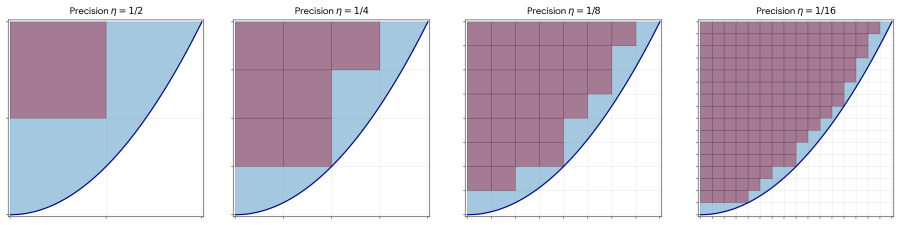
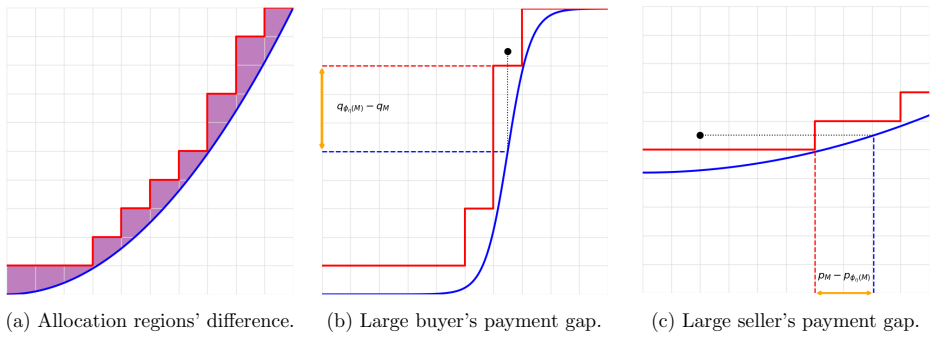


read the original abstract
Bilateral trade models one of the most fundamental economic interactions: the intermediation between two strategic agents, a seller and a buyer, willing to trade a good. We consider the learning version of the problem, where the goal is to learn a mechanism from a sampled dataset of agents' valuations to maximize either profit or economic efficiency. While known learning algorithms are characterized by high sensitivity to the input dataset, we specifically study this problem through the lens of differential privacy, ensuring that each data point does not significantly affect the probability of learning any specific mechanism. For our results, we adopt the PAC-learning framework: with high probability, the learning algorithm should output a mechanism that is at most an additive $\alpha$ away from optimal, in a $\varepsilon$-differentially private way. As a first result, we show that differential privacy and (near)-optimality are not achievable for general distributions. Surprisingly, assuming that the distribution underlying the agents' valuations is $\sigma$-smooth, we recover nearly optimal sample-complexity bounds for both economic efficiency and profit. For profit, we show how to construct in polynomial time an $\alpha$-optimal and $\varepsilon$-differentially private mechanism using $\tilde\Theta(\frac{1}{\sigma\varepsilon\alpha^2})$ samples. For efficiency, measured by the gain from trade, we achieve the same result using $\tilde\Theta(\frac{1}{\varepsilon\alpha}+\frac{1}{\alpha^2})$ samples. Notably, these bounds are essentially tight in the precision parameter $\alpha$, since achieving $\alpha$-optimality (ignoring differential privacy) requires at least $\frac{1}{\alpha^2}$ samples.
Editorial analysis
A structured set of objections, weighed in public.
Referee Report
Summary. The paper examines differentially private learning of mechanisms for bilateral trade, where the goal is to output an α-optimal mechanism (for profit or gain-from-trade efficiency) from samples of buyer/seller valuations while satisfying ε-differential privacy. It proves an impossibility result showing that DP and near-optimality cannot be achieved simultaneously for arbitrary distributions. Under the additional assumption that the valuation distribution is σ-smooth, it gives polynomial-time algorithms achieving nearly optimal sample complexities: Õ(1/(σ ε α²)) samples suffice for profit and Õ(1/(ε α) + 1/α²) samples suffice for efficiency; both bounds are shown to be tight in α (matching the non-private lower bound of Ω(1/α²)).
Significance. If the technical claims hold, the work supplies the first tight sample-complexity results for private mechanism learning in bilateral trade, cleanly separating the impossibility regime from the tractable σ-smooth regime and recovering the optimal dependence on α. The explicit polynomial-time constructions and the matching lower bound (even without privacy) are notable strengths.
major comments (3)
- [§4.2, Theorem 4.3] §4.2, Algorithm 2 and Theorem 4.3: the claimed polynomial runtime for the profit mechanism relies on an efficient implementation of the private empirical risk minimization step; the reduction from the continuous σ-smooth case to a finite discretization is only sketched and the discretization error term is not bounded explicitly in the main theorem statement.
- [§5, Theorem 5.1] §5, Theorem 5.1: the efficiency (gain-from-trade) upper bound uses an additive decomposition into a 1/α² term and a 1/(ε α) privacy term; it is not shown whether the privacy term can be improved to match the profit bound’s 1/(σ ε α²) dependence or whether the extra 1/α factor is necessary under smoothness.
- [§3.1, Lemma 3.4] §3.1, Lemma 3.4: the impossibility result for general distributions is proved via a reduction to a packing argument; the construction of the hard distribution family does not explicitly verify that the same family remains hard once σ-smoothness is imposed, leaving the separation between the two regimes slightly informal.
minor comments (2)
- [§2] The notation for the smoothness parameter σ is introduced only in the abstract and the paragraph beginning “Surprisingly, assuming…”, but is never restated in the formal model section; a single sentence definition in §2 would improve readability.
- [Table 1] Table 1 (sample-complexity summary) lists the bounds but omits the dependence on the number of agents or the support size; adding these parameters would make the comparison with prior work clearer.
Simulated Author's Rebuttal
We thank the referee for their thorough review and valuable feedback, which highlights several points that will improve the clarity and rigor of the manuscript. We address each major comment below and are happy to incorporate the suggested revisions.
read point-by-point responses
-
Referee: [§4.2, Theorem 4.3] §4.2, Algorithm 2 and Theorem 4.3: the claimed polynomial runtime for the profit mechanism relies on an efficient implementation of the private empirical risk minimization step; the reduction from the continuous σ-smooth case to a finite discretization is only sketched and the discretization error term is not bounded explicitly in the main theorem statement.
Authors: We agree that the discretization argument in Section 4.2 requires more detail to fully substantiate the polynomial runtime claim. In the revision we will expand the analysis to include an explicit bound on the discretization error (showing it is absorbed into the Õ notation for the given sample complexity) and provide a self-contained description of the private ERM implementation over the finite grid, confirming that the overall procedure remains polynomial-time. revision: yes
-
Referee: [§5, Theorem 5.1] §5, Theorem 5.1: the efficiency (gain-from-trade) upper bound uses an additive decomposition into a 1/α² term and a 1/(ε α) privacy term; it is not shown whether the privacy term can be improved to match the profit bound’s 1/(σ ε α²) dependence or whether the extra 1/α factor is necessary under smoothness.
Authors: The current analysis yields the stated additive bound; we do not claim that the 1/(ε α) privacy term is optimal with respect to α under σ-smoothness. We will add a remark in the revised manuscript explicitly noting this gap and discussing why the decomposition arises from the current proof technique, while leaving open the possibility of a tighter dependence. revision: partial
-
Referee: [§3.1, Lemma 3.4] §3.1, Lemma 3.4: the impossibility result for general distributions is proved via a reduction to a packing argument; the construction of the hard distribution family does not explicitly verify that the same family remains hard once σ-smoothness is imposed, leaving the separation between the two regimes slightly informal.
Authors: The hard distributions constructed for Lemma 3.4 have unbounded density and therefore violate σ-smoothness for any fixed σ > 0. We will add a short verification in the revised version confirming that these instances lie outside the σ-smooth regime, thereby making the separation between the impossibility result and the positive results under smoothness fully explicit. revision: yes
Circularity Check
No significant circularity in derivation chain
full rationale
The paper explicitly separates cases by conditioning all positive sample-complexity results on the σ-smoothness assumption for the valuation distribution, while proving an impossibility result that applies when this regularity fails. The stated bounds (Õ(1/(σ ε α²)) for profit and Õ(1/(ε α) + 1/α²) for efficiency) are derived under the assumption and shown to be tight in α via a matching lower bound that holds even without differential privacy. No self-definitional reductions, fitted inputs renamed as predictions, load-bearing self-citations, or ansatzes smuggled via citation are present in the abstract or context. The derivation is therefore self-contained against external benchmarks.
Axiom & Free-Parameter Ledger
axioms (1)
- domain assumption The distribution over agents' valuations is σ-smooth
Reference graph
Works this paper leans on
-
[1]
Counterspeculation, auctions, and competitive sealed tenders , author=. J. Finance , volume=
-
[2]
The gains from trade under fixed price mechanisms , author=. Appl. Econ. Res. Bull. , volume=
-
[3]
1981 , journal =
Optimal Auction Design , author =. 1981 , journal =
1981
-
[4]
1983 , author =
Efficient mechanisms for bilateral trading , journal =. 1983 , author =
1983
-
[5]
1987 , issn =
Robust trading mechanisms , journal =. 1987 , issn =
1987
-
[6]
Yuan Deng and Jieming Mao and Balasubramanian Sivan and Kangning Wang , title =
-
[7]
Approximately Efficient Double Auctions with Strong Budget Balance , booktitle =
Riccardo Colini. Approximately Efficient Double Auctions with Strong Budget Balance , booktitle =
-
[8]
Johannes Brustle and Yang Cai and Fa Wu and Mingfei Zhao , title =
-
[9]
Gonczarowski , title =
Moshe Babaioff and Kira Goldner and Yannai A. Gonczarowski , title =. 2020 , pages =
2020
-
[10]
Games Econ
Liad Blumrosen and Shahar Dobzinski , title =. Games Econ. Behav. , volume =
-
[11]
Fixed-Price Approximations in Bilateral Trade , booktitle =
Zi Yang Kang and Francisco Pernice and Jan Vondr. Fixed-Price Approximations in Bilateral Trade , booktitle =
-
[12]
Efficient Two-Sided Markets with Limited Information , journal =
D\". Efficient Two-Sided Markets with Limited Information , journal =
-
[13]
Zhengyang Liu and Zeyu Ren and Zihe Wang , title =
-
[14]
Yang Cai and Jinzhao Wu , title =
-
[15]
Ilya Hajiaghayi and MohammadTaghi Hajiaghayi and Gary Peng and Suho Shin , title =
-
[16]
SODA 2021 , pages =
Yang Cai and Kira Goldner and Steven Ma and Mingfei Zhao , title =. SODA 2021 , pages =
2021
-
[17]
SODA , pages =
Anna Lunghi and Matteo Castiglioni and Alberto Marchesi , title =. SODA , pages =
-
[18]
Martino Bernasconi and Matteo Castiglioni and Andrea Celli and Federico Fusco , title =
-
[19]
EC , pages =
Deng, Yuan and Mao, Jieming and Sivan, Balasubramanian and Wang, Kangning and Wu, Jinzhao , title =. EC , pages =. 2025 , publisher =
2025
-
[20]
Yossi Azar and Amos Fiat and Federico Fusco , title =. Artif. Intell. , volume =
-
[21]
Regret Analysis of Bilateral Trade with a Smoothed Adversary , journal =
Nicol. Regret Analysis of Bilateral Trade with a Smoothed Adversary , journal =
-
[22]
Anupam Gupta and Robert Krauthgamer and James R. Lee , title =. 44th Symposium on Foundations of Computer Science,. 2003 , url =. doi:10.1109/SFCS.2003.1238226 , timestamp =
-
[23]
Bilateral Trade:
Nicol. Bilateral Trade:. Math. Oper. Res. , volume =
-
[24]
Nearly Tight Regret Bounds for Profit Maximization in Bilateral Trade , booktitle =
Simone. Nearly Tight Regret Bounds for Profit Maximization in Bilateral Trade , booktitle =
-
[25]
Econometrica , volume =
Cesa-Bianchi, Nicolò and Colomboni, Roberto and Kasy, Maximilian , title =. Econometrica , volume =
-
[26]
Naveen Durvasula and Nika Haghtalab and Manolis Zampetakis , title =
-
[27]
SODA 2024 , pages =
Khashayar Gatmiry and Thomas Kesselheim and Sahil Singla and Yifan Wang , title =. SODA 2024 , pages =
2024
-
[28]
Richard Cole and Tim Roughgarden , title =
-
[29]
Jamie Morgenstern and Tim Roughgarden , title =
-
[30]
Devanur and Zhiyi Huang and Christos
Nikhil R. Devanur and Zhiyi Huang and Christos. The sample complexity of auctions with side information , booktitle =
-
[31]
Yang Cai and Constantinos Daskalakis , title =
-
[32]
Gonczarowski and S
Yannai A. Gonczarowski and S. Matthew Weinberg , title =. J
-
[33]
Chenghao Guo and Zhiyi Huang and Zhihao Gavin Tang and Xinzhi Zhang , title =
-
[34]
Avrim Blum and Vijay Kumar and Atri Rudra and Felix Wu , title =
-
[35]
Kleinberg and Frank Thomson Leighton , title =
Robert D. Kleinberg and Frank Thomson Leighton , title =
-
[36]
Regret Minimization for Reserve Prices in Second-Price Auctions , journal =
Nicol. Regret Minimization for Reserve Prices in Second-Price Auctions , journal =
-
[37]
Warmuth , title =
Eiji Takimoto and Manfred K. Warmuth , title =. J. Mach. Learn. Res. , volume =
-
[38]
Nika Haghtalab and Tim Roughgarden and Abhishek Shetty , title =. J
-
[39]
Gagan Aggarwal and Ashwinkumar Badanidiyuru and Paul Duetting and Federico Fusco , title =
-
[40]
Hsu , title =
Kamalika Chaudhuri and Daniel J. Hsu , title =
-
[41]
Haim Kaplan and Katrina Ligett and Yishay Mansour and Moni Naor and Uri Stemmer , title =
-
[42]
Noga Alon and Mark Bun and Roi Livni and Maryanthe Malliaris and Shay Moran , title =. J
-
[43]
Noga Alon and Roi Livni and Maryanthe Malliaris and Shay Moran , title =
-
[44]
Katrina Ligett and Seth Neel and Aaron Roth and Bo Waggoner and Zhiwei Steven Wu , title =
-
[45]
Rachel Cummings and Katrina Ligett and Kobbi Nissim and Aaron Roth and Zhiwei Steven Wu , title =
-
[46]
Sarwate , title =
Kamalika Chaudhuri and Claire Monteleoni and Anand D. Sarwate , title =. J. Mach. Learn. Res. , volume =
-
[47]
Vadhan , title =
Mark Bun and Kobbi Nissim and Uri Stemmer and Salil P. Vadhan , title =
-
[48]
NeurIPS , pages =
Raef Bassily and Abhradeep Guha Thakurta and Om Dipakbhai Thakkar , title =. NeurIPS , pages =
-
[49]
Smith and Thomas Steinke and Uri Stemmer and Jonathan R
Raef Bassily and Kobbi Nissim and Adam D. Smith and Thomas Steinke and Uri Stemmer and Jonathan R. Ullman , title =
-
[50]
Algorithmica , volume =
Amos Beimel and Kobbi Nissim and Uri Stemmer , title =. Algorithmica , volume =
-
[51]
Avrim Blum and Cynthia Dwork and Frank McSherry and Kobbi Nissim , title =
-
[52]
Cynthia Dwork , title =
-
[53]
Lee and Kobbi Nissim and Sofya Raskhodnikova and Adam D
Shiva Prasad Kasiviswanathan and Homin K. Lee and Kobbi Nissim and Sofya Raskhodnikova and Adam D. Smith , title =
-
[54]
Amos Beimel and Kobbi Nissim and Uri Stemmer , title =. J. Mach. Learn. Res. , volume =
-
[55]
Cynthia Dwork and Aaron Roth , title =. Found. Trends Theor. Comput. Sci. , volume =
-
[56]
Frank McSherry and Kunal Talwar , title =
-
[57]
Smith , title =
Cynthia Dwork and Frank McSherry and Kobbi Nissim and Adam D. Smith , title =. J. Priv. Confidentiality , volume =
-
[58]
Zhiyi Huang and Sampath Kannan , title =
-
[59]
and Panconesi, Alessandro , year=
Dubhashi, Devdatt P. and Panconesi, Alessandro , year=. Concentration of Measure for the Analysis of Randomized Algorithms , publisher=
-
[60]
2014 , publisher=
Upper and lower bounds for stochastic processes , author=. 2014 , publisher=
2014
-
[61]
Theory of Probability and its Applications , volume=
On the Uniform Convergence of Relative Frequencies of Events to Their Probabilities , author=. Theory of Probability and its Applications , volume=. 1971 , publisher=
1971
-
[62]
2019 , publisher=
High-dimensional statistics: A non-asymptotic viewpoint , author=. 2019 , publisher=
2019
-
[63]
Boucheron, Stéphane and Lugosi, Gábor and Massart, Pascal , title =
-
[64]
Dehardt , journal =
J. Dehardt , journal =. Generalizations of the Glivenko-Cantelli Theorem , volume =
-
[65]
2025 , note =
Roman Vershynin , title =. 2025 , note =
2025
-
[66]
Pai and Aaron Roth , title =
Mallesh M. Pai and Aaron Roth , title =. SIGecom Exch. , volume =
-
[67]
Kobbi Nissim and Rann Smorodinsky and Moshe Tennenholtz , title =
-
[68]
Kash and Tal Moran and Salil P
Yiling Chen and Stephen Chong and Ian A. Kash and Tal Moran and Salil P. Vadhan , title =
-
[69]
SIGecom Exch
Aaron Roth , title =. SIGecom Exch. , volume =
-
[70]
Resnick, Sidney I. , title =. 1987 , isbn =. doi:10.1007/978-0-387-75953-1 , edition =
-
[71]
2000 , publisher=
Real analysis , author=. 2000 , publisher=
2000
-
[72]
2016 , publisher=
Theory of Functions of a Real Variable , author=. 2016 , publisher=
2016
-
[73]
Mathematical Methods of Operations Research , volume=
A note on generalized inverses , author=. Mathematical Methods of Operations Research , volume=. 2013 , publisher=
2013
discussion (0)
Sign in with ORCID, Apple, or X to comment. Anyone can read and Pith papers without signing in.