p-Robust Trace Liftings for Discrete Harmonic Extensions and Boundary-Preserving hp Interpolation on Tetrahedral Meshes
Pith reviewed 2026-06-28 13:41 UTC · model grok-4.3
The pith
p-robust trace liftings extend continuous piecewise polynomial boundary data into tetrahedral meshes while keeping degree and p-independent estimates.
A machine-rendered reading of the paper's core claim, the machinery that carries it, and where it could break.
Core claim
There exist p-robust polynomial trace liftings on tetrahedral meshes. Given a continuous piecewise polynomial function on a boundary face patch, with all tetrahedra touching the patch sharing one common degree, a lifting supported in the corresponding boundary layer can be constructed that is degree-preserving and satisfies both an H^1 estimate and a scaled boundary-layer L^2 estimate with constants independent of the mesh size and the polynomial degree. The construction proceeds locally by combining tetrahedral polynomial liftings, face-gluing arguments, and nonsingular vertex patches. As direct consequences, p-robust discrete harmonic extensions are obtained, including an H^1-seminorm-stab
What carries the argument
The p-robust trace lifting, constructed locally by combining tetrahedral polynomial liftings with face-gluing arguments on nonsingular vertex patches.
If this is right
- p-robust discrete harmonic extensions exist, including an H^1-seminorm-stable extension for the pure diffusion energy.
- A boundary-preserving hp interpolation operator exists that reproduces piecewise polynomial Dirichlet data exactly.
- Standard local approximation estimates are retained by the interpolation operator.
- All constructions remain local and supported only in the boundary layer.
Where Pith is reading between the lines
- The same local construction may supply stable extensions for other elliptic problems whose energy norms are equivalent to the H^1 seminorm.
- The degree-preserving property could simplify the design of adaptive hp-refinement strategies that must respect given boundary data.
- If the vertex-patch nonsingularity condition holds uniformly, the method may extend to locally refined meshes without introducing additional p-dependent factors.
Load-bearing premise
Nonsingular vertex patches exist and local liftings can be glued while keeping the constants independent of the polynomial degree.
What would settle it
A sequence of meshes and polynomial degrees for which the constants in the H^1 or scaled L^2 estimates grow with the degree.
Figures
read the original abstract
We construct p-robust polynomial trace liftings on three-dimensional tetrahedral meshes. The prescribed trace is a continuous piecewise polynomial function on a boundary face patch; the tetrahedra touching this patch have one common degree, while the interior degrees may be arbitrary. The lifting is degree-preserving, supported in the corresponding boundary layer, and satisfies both an H^1 estimate and a scaled boundary-layer L^2 estimate with constants independent of the mesh size and the polynomial degree. The construction is local and combines tetrahedral polynomial liftings, face-gluing arguments, and nonsingular vertex patches. As consequences of the construction, we obtain p-robust discrete harmonic extensions, including an H^1-seminorm-stable extension for the pure diffusion energy, and a boundary-preserving hp interpolation operator that keeps piecewise polynomial Dirichlet data exactly while retaining standard local approximation estimates.
Editorial analysis
A structured set of objections, weighed in public.
Referee Report
Summary. The manuscript constructs p-robust polynomial trace liftings on three-dimensional tetrahedral meshes. The prescribed trace is a continuous piecewise polynomial function on a boundary face patch; the tetrahedra touching this patch have one common degree, while the interior degrees may be arbitrary. The lifting is degree-preserving, supported in the corresponding boundary layer, and satisfies both an H^1 estimate and a scaled boundary-layer L^2 estimate with constants independent of the mesh size and the polynomial degree. The construction is local and combines tetrahedral polynomial liftings, face-gluing arguments, and nonsingular vertex patches. As consequences of the construction, the authors obtain p-robust discrete harmonic extensions, including an H^1-seminorm-stable extension for the pure diffusion energy, and a boundary-preserving hp interpolation operator that keeps piecewise polynomial Dirichlet data exactly while retaining standard local approximation estimates.
Significance. If the p-independence of the constants holds, the result supplies a useful technical tool for the analysis of hp-finite element methods on unstructured tetrahedral meshes. The local, degree-preserving construction with explicit support in the boundary layer directly enables stable discrete harmonic extensions and exact boundary-data preservation in interpolation operators. The combination of tetrahedral liftings with gluing on nonsingular vertex patches is a concrete strength when the constants remain p-independent.
major comments (1)
- [construction via face-gluing on vertex patches] The face-gluing step on nonsingular vertex patches (the load-bearing assembly step described after the individual tetrahedral liftings) must be shown to preserve p-independence of both the H^1 and scaled L^2 constants. Any factor arising from vertex valence, local geometry, or the number of tetrahedra meeting at the vertex must be bounded independently of p; otherwise the overall estimates lose robustness even if each local lifting is p-robust.
minor comments (1)
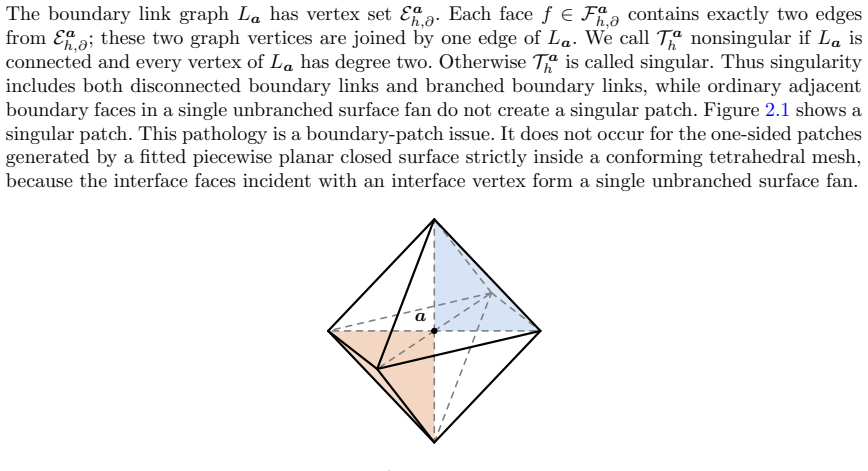
- The definition of the scaled boundary-layer L^2 norm and the precise meaning of 'nonsingular vertex patches' would benefit from an additional sentence or diagram for readers unfamiliar with the notation.
Simulated Author's Rebuttal
We thank the referee for the constructive comment on the face-gluing construction. We address the major comment below.
read point-by-point responses
-
Referee: [construction via face-gluing on vertex patches] The face-gluing step on nonsingular vertex patches (the load-bearing assembly step described after the individual tetrahedral liftings) must be shown to preserve p-independence of both the H^1 and scaled L^2 constants. Any factor arising from vertex valence, local geometry, or the number of tetrahedra meeting at the vertex must be bounded independently of p; otherwise the overall estimates lose robustness even if each local lifting is p-robust.
Authors: The nonsingular vertex patches are defined so that local valence and shape-regularity constants are bounded independently of both h and p; the gluing step is a convex combination whose weights depend only on these geometric quantities. Consequently the multiplicative factor contributed by gluing is independent of p and the p-robustness of the individual tetrahedral liftings is preserved. We agree, however, that an explicit statement of this bound is desirable for clarity and will add a short lemma (or remark) in the revised manuscript that records the p-independent gluing constant. revision: yes
Circularity Check
Direct mathematical construction with no reduction to inputs by definition or self-citation
full rationale
The paper presents an explicit local construction of p-robust trace liftings by combining tetrahedral polynomial liftings, face-gluing, and nonsingular vertex patches. No equations, parameters, or estimates are shown to be fitted to data and then renamed as predictions; the H^1 and L^2 bounds are derived as consequences of the construction rather than tautological. No self-citation chain is invoked as the sole justification for the central p-independence claim, and the argument remains self-contained against external mathematical verification without reducing to prior fitted results or self-defined quantities.
Axiom & Free-Parameter Ledger
axioms (2)
- standard math Polynomial finite element spaces on tetrahedra admit local liftings with standard approximation properties
- domain assumption Nonsingular vertex patches exist on the given tetrahedral mesh
Forward citations
Cited by 2 Pith papers
-
Owner-selected bubble transforms and coefficient-robust Schwarz preconditioners for variable-degree $hp$ finite elements
Owner-selected Falk-Winther bubble transforms provide L2- and H1-stable, degree-preserving decompositions for variable-degree hp finite elements, enabling hp-uniform additive Schwarz preconditioners for conforming rea...
-
Stable Triangle Projections for Variable-Degree Tetrahedral Spaces and Uniform IPDG Preconditioning
Develops stable variable-degree projections on triangles and tetrahedra to obtain h-p-uniform preconditioners for conforming and symmetric IPDG Laplace operators whose constants depend only on local degree bounds, mes...
Reference graph
Works this paper leans on
-
[1]
and Winther, Ragnar , year = 2016, month = feb, journal =
Falk, Richard S. and Winther, Ragnar , year = 2016, month = feb, journal =. The Bubble Transform: A New Tool for Analysis of Finite Element Methods , shorttitle =. doi:10.1007/s10208-015-9252-1 , urldate =
-
[2]
SIAM Journal on Numerical Analysis , volume =
Polynomial Liftings on a Tetrahedron and Applications to the H-p Version of the Finite Element Method in Three Dimensions , author =. SIAM Journal on Numerical Analysis , volume =. doi:10.1137/S0036142994267552 , urldate =
-
[3]
Polynomial Extension Operators. Part I , author =. SIAM Journal on Numerical Analysis , volume =. doi:10.1137/070698786 , langid =
-
[4]
SIAM Journal on Numerical Analysis , volume =
hp-Interpolation of Nonsmooth Functions and an Application to hp-a Posteriori Error Estimation , author =. SIAM Journal on Numerical Analysis , volume =. doi:10.1137/S0036142903432930 , urldate =
-
[5]
Mathematics of Computation , volume =
On Commuting p -Version Projection-Based Interpolation on Tetrahedra , author =. Mathematics of Computation , volume =. doi:10.1090/mcom/3454 , langid =
-
[6]
Approximation by Finite Element Functions Using Local Regularization , author =. RAIRO. Analyse Num
-
[7]
ESAIM: Mathematical Modelling and Numerical Analysis , volume =
On Interpolation Spaces of Piecewise Polynomials on Mixed Meshes , author =. ESAIM: Mathematical Modelling and Numerical Analysis , volume =. doi:10.1051/m2an/2024069 , langid =
-
[8]
Elliptic Problems in Nonsmooth Domains , author =
-
[9]
p - and hp -Finite Element Methods: Theory and Applications in Solid and Fluid Mechanics , author =
-
[10]
doi:10.1007/b137868 , langid =
Domain Decomposition Methods: Algorithms and Theory , author =. doi:10.1007/b137868 , langid =
-
[11]
SIAM Journal on Numerical Analysis , volume =
Efficient Preconditioning for the P-Version Finite Element Method in Two Dimensions , author =. SIAM Journal on Numerical Analysis , volume =. doi:10.1137/0728034 , urldate =. 2157721 , eprinttype =
-
[12]
Pavarino, Luca F. , year = 1994, journal =. Additive. doi:10.1007/BF01385709 , langid =
-
[13]
Guo, Benqi and Cao, Weiming , year = 1998, journal =. An Additive. doi:10.1137/S0036142996299435 , langid =
-
[14]
Sch. Additive. IMA Journal of Numerical Analysis , volume =. doi:10.1093/imanum/drl046 , langid =
-
[15]
SIAM Journal on Numerical Analysis , volume =
Preconditioning the Mass Matrix for High Order Finite Element Approximation on Triangles , author =. SIAM Journal on Numerical Analysis , volume =. doi:10.1137/18M1182450 , langid =
-
[16]
SIAM Journal on Scientific Computing , volume =
Preconditioning the Mass Matrix for High Order Finite Element Approximation on Tetrahedra , author =. SIAM Journal on Scientific Computing , volume =. doi:10.1137/20M1333018 , langid =
-
[17]
Uniform Substructuring Preconditioners for High Order
Ainsworth, Mark and Jiang, Shuai , year = 2024, journal =. Uniform Substructuring Preconditioners for High Order. doi:10.1137/23M1561920 , langid =
-
[18]
An Unfitted Finite Element Method, Based on
Hansbo, Anita and Hansbo, Peter , year = 2002, journal =. An Unfitted Finite Element Method, Based on. doi:10.1016/S0045-7825(02)00524-8 , langid =
-
[19]
Robust Flux Error Estimation of an Unfitted
Burman, Erik and Guzm. Robust Flux Error Estimation of an Unfitted. IMA Journal of Numerical Analysis , volume =. doi:10.1093/imanum/drx017 , langid =
-
[20]
Foundations of Computational Mathematics , volume =
Stable Liftings of Polynomial Traces on Tetrahedra , author =. Foundations of Computational Mathematics , volume =. doi:10.1007/s10208-024-09670-x , langid =
-
[21]
Li, Situan and Zheng, Weiying , year = 2026, note =
2026
-
[22]
Babu s ka, A
I. Babu s ka, A. Craig, J. Mandel, and J. Pitk \"a ranta , Efficient preconditioning for the p-version finite element method in two dimensions , SIAM Journal on Numerical Analysis, 28 (1991), pp. 624--661
1991
-
[23]
Burman, J
E. Burman, J. Guzm \'a n, M. A. S \'a nchez, and M. Sarkis , Robust flux error estimation of an unfitted Nitsche method for high-contrast interface problems , IMA Journal of Numerical Analysis, 38 (2018), pp. 646--668
2018
-
[24]
Demkowicz, J
L. Demkowicz, J. Gopalakrishnan, and J. Sch \"o berl , Polynomial extension operators. part i , SIAM Journal on Numerical Analysis, 46 (2008), pp. 3006--3031
2008
-
[25]
R. S. Falk and R. Winther , The bubble transform: A new tool for analysis of finite element methods , Foundations of Computational Mathematics, 16 (2016), pp. 297--328
2016
-
[26]
Grisvard , Elliptic Problems in Nonsmooth Domains , vol
P. Grisvard , Elliptic Problems in Nonsmooth Domains , vol. 24 of Monographs and Studies in Mathematics, Pitman, Boston, 1985
1985
-
[27]
Hansbo and P
A. Hansbo and P. Hansbo , An unfitted finite element method, based on Nitsche 's method, for elliptic interface problems , Computer Methods in Applied Mechanics and Engineering, 191 (2002), pp. 5537--5552
2002
-
[28]
J. M. Melenk , hp-interpolation of nonsmooth functions and an application to hp-a posteriori error estimation , SIAM Journal on Numerical Analysis, 43 (2005), pp. 127--155
2005
-
[29]
J. M. Melenk and C. Rojik , On commuting p -version projection-based interpolation on tetrahedra , Mathematics of Computation, 89 (2020), pp. 45--87
2020
-
[30]
R. Mu \ n oz-Sola , Polynomial liftings on a tetrahedron and applications to the h-p version of the finite element method in three dimensions , SIAM Journal on Numerical Analysis, 34 (1997), pp. 282--314
1997
-
[31]
Parker and E
C. Parker and E. S \"u li , Stable liftings of polynomial traces on tetrahedra , Foundations of Computational Mathematics, 25 (2025), pp. 1397--1461
2025
-
[32]
C. Schwab , p - and hp -Finite Element Methods: Theory and Applications in Solid and Fluid Mechanics , Numerical Mathematics and Scientific Computation, Oxford University Press, Oxford, 1998
1998
-
[33]
Toselli and O
A. Toselli and O. Widlund , Domain Decomposition Methods: Algorithms and Theory , vol. 34 of Springer Series in Computational Mathematics, Springer, 2005
2005
discussion (0)
Sign in with ORCID, Apple, or X to comment. Anyone can read and Pith papers without signing in.