AstroSkyFlow: an astronomical sky image flow simulator for time domain survey validation and machine learning
Pith reviewed 2026-06-28 12:36 UTC · model grok-4.3
The pith
AstroSkyFlow produces time-series sky images whose noise and point spread functions match real observations more closely than SkyMaker does.
A machine-rendered reading of the paper's core claim, the machinery that carries it, and where it could break.
Core claim
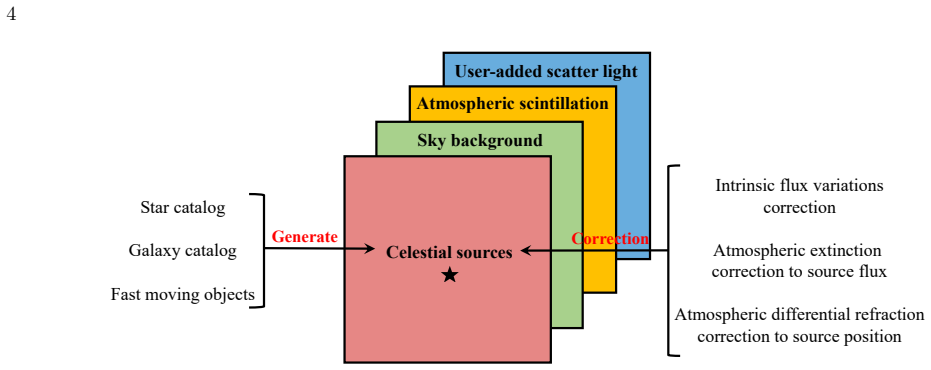
AstroSkyFlow is a modular sky-image simulator that generates on-demand, time-dependent flux variations and models the full observing stack from celestial sources and atmospheric effects to sensor response. Given a simulated observing schedule it produces multi-epoch images with realistic noise and variability. Compared with real observational data it reproduces noise characteristics and point spread function properties more accurately than SkyMaker, and it recovers injected photometric and motion signals such as exoplanet transits and asteroid trails.
What carries the argument
AstroSkyFlow's modular architecture that integrates separate models for celestial sources, atmospheric effects, and sensor response to output time-series images.
If this is right
- High-fidelity labeled datasets can be generated on demand for training machine-learning models without depending only on scarce real observations.
- Analysis pipelines can be validated through systematic injection and recovery of signals such as transits and trails before deployment on survey data.
- Time-dependent observing schedules can be tested directly by producing matching image sequences for different survey strategies.
Where Pith is reading between the lines
- If the accuracy claim holds across more instruments, the simulator could reduce the volume of real data needed during early pipeline development.
- The same modular structure might be extended to other wavelength regimes or telescope designs by swapping the sensor and atmosphere modules.
- Direct comparison of simulated variability statistics against additional public survey archives would provide an independent check on the recovery results.
Load-bearing premise
The modular models for celestial sources, atmospheric effects, and sensor response are close enough to real conditions that the generated images can be used reliably for injection-recovery tests and machine-learning training.
What would settle it
A side-by-side comparison in which the noise power spectrum or point spread function shape in AstroSkyFlow images deviates measurably from the same quantities measured on real images from a time-domain survey.
Figures







read the original abstract
Modern time-domain optical surveys produce massive data volumes that require robust, high-fidelity simulated datasets for developing and validating automated pipelines and machine-learning models. We present AstroSkyFlow, a modular sky-image simulator that generates on-demand, time-dependent flux variations and models the full observing stack, from celestial sources and atmospheric effects to sensor response. Given a simulated observing schedule, AstroSkyFlow produces multi-epoch, time-series images with realistic noise and variability. Compared to real observational data, AstroSkyFlow reproduces noise characteristics and point spread function properties more accurately than the widely used SkyMaker simulator. In addition, AstroSkyFlow successfully recovers injected photometric and motion signals, such as exoplanet transits and asteroid trails. AstroSkyFlow enables the generation of labeled, high-fidelity datasets essential for training machine-learning pipelines and conducting rigorous injection-recovery tests for analysis pipelines for next-generation time-domain surveys.
Editorial analysis
A structured set of objections, weighed in public.
Referee Report
Summary. The paper presents AstroSkyFlow, a modular simulator for generating multi-epoch time-series sky images that incorporates celestial sources, atmospheric effects, and sensor response. It claims that, when compared to real observational data, AstroSkyFlow reproduces noise characteristics and point-spread-function properties more accurately than the SkyMaker simulator, and that injection-recovery tests successfully recover photometric signals such as exoplanet transits and motion signals such as asteroid trails. The simulator is positioned as a tool for producing labeled datasets for machine-learning pipelines and for validating analysis methods in time-domain surveys.
Significance. If the accuracy claims are substantiated with quantitative metrics, AstroSkyFlow would address a practical need for high-fidelity, on-demand simulations in large-scale time-domain surveys. The modular design and explicit support for time-dependent variability and injection tests are potentially useful strengths for ML training and pipeline validation.
major comments (1)
- [Abstract] Abstract: The central claims of superior noise and PSF reproduction relative to SkyMaker and of successful signal recovery are stated without any quantitative metrics (e.g., residual RMS, power-spectrum comparisons, or statistical tests), error bars, dataset descriptions, or implementation details. This absence makes it impossible to evaluate whether the modular models meet the accuracy threshold required for the stated applications.
Simulated Author's Rebuttal
We thank the referee for their review and for identifying a clear opportunity to strengthen the abstract. We address the single major comment below.
read point-by-point responses
-
Referee: [Abstract] Abstract: The central claims of superior noise and PSF reproduction relative to SkyMaker and of successful signal recovery are stated without any quantitative metrics (e.g., residual RMS, power-spectrum comparisons, or statistical tests), error bars, dataset descriptions, or implementation details. This absence makes it impossible to evaluate whether the modular models meet the accuracy threshold required for the stated applications.
Authors: We agree that the abstract as submitted lacks the quantitative support needed to substantiate its central claims. The body of the manuscript reports the relevant comparisons (noise power spectra, PSF FWHM and ellipticity residuals, transit and trail recovery fractions with uncertainties) together with the exact datasets and SkyMaker configuration used. In the revised manuscript we will expand the abstract to include the key numerical results (e.g., RMS noise ratios, Kolmogorov-Smirnov or χ^{2} statistics, recovery rates with error bars) and a concise statement of the comparison datasets, while remaining within the journal’s length limit. This change will make the abstract self-contained for the purpose of evaluating the simulator’s claimed accuracy. revision: yes
Circularity Check
No circularity: simulator claims rest on external comparisons
full rationale
The paper describes a modular simulator for generating time-series sky images from models of sources, atmosphere, and sensors. All performance claims (noise/PSF fidelity vs. real data and SkyMaker; successful injection-recovery of transits and trails) are framed as comparisons against independent external references rather than any fitted parameters, self-referential predictions, or derivation steps that reduce to the simulator's own inputs by construction. No equations, uniqueness theorems, or ansatzes are invoked that would create self-definition or load-bearing self-citation. The work is therefore self-contained against external benchmarks.
Axiom & Free-Parameter Ledger
Reference graph
Works this paper leans on
-
[1]
Atmospheric Scintillation in Astronomical Photometry
Atmospheric scintillation in astronomical photometry. , keywords =. doi:10.1093/mnras/stv1400 , archivePrefix =. 1506.06921 , primaryClass =
work page internal anchor Pith review Pith/arXiv arXiv doi:10.1093/mnras/stv1400
-
[2]
Photometric error analysis. VI. Confirmation of Reiger's theory of scintillation , author=. The Astronomical Journal , year=
-
[3]
Andrew T. Young , journal =. Air mass and refraction , volume =. 1994 , url =. doi:10.1364/AO.33.001108 , abstract =
-
[4]
A Model of the Brightness of Moonlight. , keywords =. doi:10.1086/132921 , adsurl =
-
[5]
Night Sky Brightness at Observatories and Sites. , keywords =. doi:10.1086/132436 , adsurl =
-
[6]
Moon night sky brightness simulation for Xinglong station
Moon night sky brightness simulation for the Xinglong station. Research in Astronomy and Astrophysics , keywords =. doi:10.1088/1674-4527/13/10/013 , archivePrefix =. 1304.7107 , primaryClass =
work page internal anchor Pith review Pith/arXiv arXiv doi:10.1088/1674-4527/13/10/013
-
[7]
batman: BAsic Transit Model cAlculatioN in Python
batman: BAsic Transit Model cAlculatioN in Python. , keywords =. doi:10.1086/683602 , archivePrefix =. 1507.08285 , primaryClass =
work page internal anchor Pith review Pith/arXiv arXiv doi:10.1086/683602
-
[8]
Physics Of Eclipsing Binaries. II. Toward the Increased Model Fidelity. , keywords =. doi:10.3847/1538-4365/227/2/29 , archivePrefix =. 1609.08135 , primaryClass =
work page internal anchor Pith review Pith/arXiv arXiv doi:10.3847/1538-4365/227/2/29
-
[9]
New Grids of ATLAS9 Model Atmospheres
New Grids of ATLAS9 Model Atmospheres. Modelling of Stellar Atmospheres , year = 2003, editor =. doi:10.48550/arXiv.astro-ph/0405087 , archivePrefix =. astro-ph/0405087 , primaryClass =
work page internal anchor Pith review Pith/arXiv arXiv doi:10.48550/arxiv.astro-ph/0405087 2003
-
[10]
Llamaradas Estelares: Modeling the Morphology of White-light Flares. , keywords =. doi:10.3847/1538-3881/ac6fe6 , archivePrefix =. 2205.05706 , primaryClass =
-
[11]
GalSim: The modular galaxy image simulation toolkit
GALSIM: The modular galaxy image simulation toolkit. Astronomy and Computing , keywords =. doi:10.1016/j.ascom.2015.02.002 , archivePrefix =. 1407.7676 , primaryClass =
work page internal anchor Pith review Pith/arXiv arXiv doi:10.1016/j.ascom.2015.02.002 2015
-
[12]
Barbary, Kyle and Bailey, Stephen and Barentsen, Geert and Barclay, Tom and Biswas, Rahul and Boone, Kyle and Craig, Matt and Feindt, Ulrich and Friesen, Brian and Goldstein, Danny and Jha, Saurabh W. and Jones, David O. and Mondon, Florian and Papadogiannakis, Seméli and Perrefort, Daniel and Pierel, Justin and Rodney, Steve and Rose, Benjamin and Saunde...
-
[13]
High-level numerical simulations of noise in CCD and CMOS photosensors: review and tutorial
High-level numerical simulations of noise in CCD and CMOS photosensors: review and tutorial. arXiv e-prints , keywords =. doi:10.48550/arXiv.1412.4031 , archivePrefix =. 1412.4031 , primaryClass =
work page internal anchor Pith review Pith/arXiv arXiv doi:10.48550/arxiv.1412.4031
-
[14]
and Amano, A
Asada, N. and Amano, A. and Baba, M. , booktitle=. Photometric calibration of zoom lens systems , year=
-
[15]
The Fourth Paradigm -- Data-Intensive Scientific Discovery
Hey, Tony. The Fourth Paradigm -- Data-Intensive Scientific Discovery. E-Science and Information Management. 2012
2012
-
[16]
The Zwicky Transient Facility: Data Processing, Products, and Archive. , keywords =. doi:10.1088/1538-3873/aae8ac , archivePrefix =. 1902.01872 , primaryClass =
work page internal anchor Pith review Pith/arXiv arXiv doi:10.1088/1538-3873/aae8ac 1902
-
[18]
Problems with twilight/supersky flat-field for wide-field robotic telescopes and the solution
Problems with twilight/supersky flat-field for wide-field robotic telescopes and the solution. Observatory Operations: Strategies, Processes, and Systems V , year = 2014, editor =. doi:10.1117/12.2055459 , archivePrefix =. 1407.8283 , primaryClass =
work page internal anchor Pith review Pith/arXiv arXiv doi:10.1117/12.2055459 2014
-
[19]
and Agmy, R.M
Nawar, S. and Agmy, R.M. and Gad, Gad and Elgohary, Samar , year =. Sky twilight brightness at zenith expressed in magnitudes , volume =. NRIAG Journal of Astronomy and Geophysics , doi =
-
[20]
Kepler Planet-Detection Mission: Introduction and First Results. Science , keywords =. doi:10.1126/science.1185402 , adsurl =
-
[21]
Journal of the Optical Society of America (1917-1983) , keywords =
Zernike polynomials and atmospheric turbulence. Journal of the Optical Society of America (1917-1983) , keywords =. doi:10.1364/JOSA.66.000207 , adsurl =
-
[22]
An Accurate Method for Computing Atmospheric Refraction. , keywords =. doi:10.1086/133831 , adsurl =
-
[23]
Journal of the Optical Society of America A , keywords =
Time-delay-induced mean-square error in adaptive optics. Journal of the Optical Society of America A , keywords =. doi:10.1364/JOSAA.7.001224 , adsurl =
-
[24]
Larry Bradley and Brigitta Sipocz and Thomas Robitaille and Erik Tollerud and Zé Vinícius and Christoph Deil and Kyle Barbary and Ivo Busko and Hans Moritz Günther and Mihai Cara and Tom J Wilson and Simon Conseil and Michael Droettboom and Azalee Bostroem and E. M. Bray and Lars Andersen Bratholm and Matt Craig and Geert Barentsen and Sergio Pascual and ...
-
[25]
ascl:1812.013 , adsurl =
Lightkurve: Kepler and TESS time series analysis in Python. ascl:1812.013 , adsurl =
-
[26]
Acta Astronomica Sinica , keywords =
Tianyu-Search for the Second Solar System and Explore the Dynamic Univers. Acta Astronomica Sinica , keywords =. doi:10.15940/j.cnki.0001-5245.2024.04.001 , archivePrefix =. 2404.07149 , primaryClass =
-
[27]
Spine-sheath layer radiative interplay in subparsec-scale jets and the TeV emission from M87.Mon
A new algorithm for difference image analysis. , keywords =. doi:10.1111/j.1745-3933.2008.00464.x , archivePrefix =. 0802.1273 , primaryClass =
-
[28]
Architecture of the Tianyu Software: Relative Photometry as a Case Study. , keywords =. doi:10.1088/1538-3873/add6d9 , archivePrefix =. 2505.09107 , primaryClass =
-
[29]
Real-bogus classification for the Zwicky Transient Facility using deep learning. , keywords =. doi:10.1093/mnras/stz2357 , archivePrefix =. 1907.11259 , primaryClass =
-
[30]
Detection and Classification of Astronomical Targets with Deep Neural Networks in Wide-field Small Aperture Telescopes. , keywords =. doi:10.3847/1538-3881/ab800a , archivePrefix =. 2002.09211 , primaryClass =
-
[31]
Simulation of Astronomical Images from Optical Survey Telescopes Using a Comprehensive Photon Monte Carlo Approach. , keywords =. doi:10.1088/0067-0049/218/1/14 , archivePrefix =
-
[32]
, keywords =
SkyMaker: astronomical image simulations made easy. , keywords =
-
[33]
SkyMaker: Astronomical Image Simulations Made Easy
-
[34]
Image analysis for cosmology: results from the GREAT10 Galaxy Challenge. , keywords =. doi:10.1111/j.1365-2966.2012.21095.x , archivePrefix =. 1202.5254 , primaryClass =
-
[35]
AstroImageJ: Image Processing and Photometric Extraction for Ultra-precise Astronomical Light Curves. , keywords =. doi:10.3847/1538-3881/153/2/77 , archivePrefix =. 1701.04817 , primaryClass =
work page internal anchor Pith review Pith/arXiv arXiv doi:10.3847/1538-3881/153/2/77
-
[36]
Skyfield: High precision research-grade positions for planets and Earth satellites generator
-
[37]
The GAPS Programme with HARPS-N at TNG . XIV. Investigating giant planet migration history via improved eccentricity and mass determination for 231 transiting planets. , keywords =. doi:10.1051/0004-6361/201629882 , archivePrefix =. 1704.00373 , primaryClass =
work page internal anchor Pith review Pith/arXiv arXiv doi:10.1051/0004-6361/201629882
-
[38]
The First Photometric and Spectroscopic Studies of ASASSN-V J015428.67+204247.2 and its Relation to the Population of Low Mass Ratio Contact Binaries. , keywords =. doi:10.1088/1538-3873/acc7cb , adsurl =
-
[39]
Array programming with NumPy. , keywords =. doi:10.1038/s41586-020-2649-2 , archivePrefix =. 2006.10256 , primaryClass =
work page internal anchor Pith review Pith/arXiv arXiv doi:10.1038/s41586-020-2649-2 2006
-
[40]
doi:10.5281/zenodo.3509134 , url =
The pandas development team , title =. doi:10.5281/zenodo.3509134 , url =
-
[41]
Astropy: A Community Python Package for Astronomy
Astropy: A community Python package for astronomy. , keywords =. 2013. doi:10.1051/0004-6361/201322068 , archivePrefix =. 1307.6212 , primaryClass =
work page internal anchor Pith review Pith/arXiv arXiv doi:10.1051/0004-6361/201322068 2013
-
[42]
astroquery: An Astronomical Web-Querying Package in Python
astroquery: An Astronomical Web-querying Package in Python. , keywords =. doi:10.3847/1538-3881/aafc33 , archivePrefix =. 1901.04520 , primaryClass =
work page internal anchor Pith review Pith/arXiv arXiv doi:10.3847/1538-3881/aafc33 1901
-
[43]
Hunter, J. D. , Title =. Computing in Science & Engineering , Volume =
-
[44]
SciPy 1.0--Fundamental Algorithms for Scientific Computing in Python
SciPy 1.0: fundamental algorithms for scientific computing in Python. Nature Medicine , keywords =. doi:10.1038/s41592-019-0686-2 , archivePrefix =. 1907.10121 , primaryClass =
work page internal anchor Pith review Pith/arXiv arXiv doi:10.1038/s41592-019-0686-2 1907
-
[45]
doi:10.5281/zenodo.5517697 , version =
tqdm: A fast, Extensible Progress Bar for Python and CLI. doi:10.5281/zenodo.5517697 , version =
-
[46]
, year = 1969, month = dec, volume =
A Theoretical Investigation of Focal Stellar Images in the Photographic Emulsion and Application to Photographic Photometry. , year = 1969, month = dec, volume =
1969
-
[47]
Boletin de la Asociacion Argentina de Astronomia La Plata Argentina , year = 1963, month = feb, volume =
Influence of the atmospheric and instrumental dispersion on the brightness distribution in a galaxy. Boletin de la Asociacion Argentina de Astronomia La Plata Argentina , year = 1963, month = feb, volume =
1963
-
[48]
Least-Squares Frequency Analysis of Unequally Spaced Data. , keywords =. doi:10.1007/BF00648343 , adsurl =
-
[49]
Proceedings of the Royal Society of London Series A , year = 1938, month = feb, volume =
The Spectrum of Turbulence. Proceedings of the Royal Society of London Series A , year = 1938, month = feb, volume =. doi:10.1098/rspa.1938.0032 , adsurl =
-
[50]
, title =
Bradski, G. , title =. Dr. Dobb's Journal of Software Tools , year =
-
[51]
Stellar occultations by small bodies - Diffraction effects. , keywords =. doi:10.1086/114438 , adsurl =
-
[52]
Detectability of Occultation of Stars by Objects in the Kuiper Belt and Oort Cloud
Detectability of Occultations of Stars by Objects in the Kuiper Belt and Oort Cloud. , keywords =. doi:10.1086/521396 , archivePrefix =. astro-ph/0703460 , primaryClass =
work page internal anchor Pith review Pith/arXiv arXiv doi:10.1086/521396
-
[53]
A Weak Lensing Study of X-ray Groups in the Cosmos Survey: Form and Evolution of the Mass-Luminosity Relation. , keywords =. doi:10.1088/0004-637X/709/1/97 , archivePrefix =. 0910.5219 , primaryClass =
work page internal anchor Pith review Pith/arXiv arXiv doi:10.1088/0004-637x/709/1/97
-
[54]
Astrophysically motivated bulge-disc decompositions of Sloan Digital Sky Survey galaxies. , keywords =. doi:10.1111/j.1365-2966.2012.20450.x , archivePrefix =. 1201.0763 , primaryClass =
-
[55]
Exoplanet Transits and Occultations. Exoplanets , year = 2010, editor =. doi:10.48550/arXiv.1001.2010 , adsurl =
work page internal anchor Pith review Pith/arXiv arXiv doi:10.48550/arxiv.1001.2010 2010
-
[56]
, title =
Kallrath, Josef and Milone, Eugene F. , title =. 2009 , doi =
2009
-
[57]
Living Reviews in Solar Physics , keywords =
Stellar flares. Living Reviews in Solar Physics , keywords =. doi:10.1007/s41116-024-00039-4 , archivePrefix =. 2402.07885 , primaryClass =
-
[58]
SORA: Stellar occultation reduction and analysis. , keywords =. doi:10.1093/mnras/stac032 , archivePrefix =. 2201.01799 , primaryClass =
-
[59]
, year = 1997, month = jan, volume =
Optical Spectra of Supernovae. , year = 1997, month = jan, volume =. doi:10.1146/annurev.astro.35.1.309 , adsurl =
-
[60]
Orbital Modulation Induced by a Third Component in the Overcontact Binary V0554 Dra. , keywords =. doi:10.3847/1538-4357/ae200c , adsurl =
-
[61]
Kepler Mission Design, Realized Photometric Performance, and Early Science
Kepler Mission Design, Realized Photometric Performance, and Early Science. , keywords =. doi:10.1088/2041-8205/713/2/L79 , archivePrefix =. 1001.0268 , primaryClass =
work page internal anchor Pith review Pith/arXiv arXiv doi:10.1088/2041-8205/713/2/l79 2041
-
[62]
The Derivation, Properties and Value of Kepler's Combined Differential Photometric Precision
The Derivation, Properties, and Value of Kepler s Combined Differential Photometric Precision. , keywords =. doi:10.1086/668847 , archivePrefix =. 1208.0595 , primaryClass =
work page internal anchor Pith review Pith/arXiv arXiv doi:10.1086/668847
-
[63]
The Rate of Core Collapse Supernovae to Redshift 2.5 From The CANDELS and CLASH Supernova Surveys
The Rate of Core Collapse Supernovae to Redshift 2.5 from the CANDELS and CLASH Supernova Surveys. , keywords =. doi:10.1088/0004-637X/813/2/93 , archivePrefix =. 1509.06574 , primaryClass =
work page internal anchor Pith review Pith/arXiv arXiv doi:10.1088/0004-637x/813/2/93
-
[64]
Numerical Recipes: The Art of Scientific Computing
-
[65]
A Measurement of the Rate of Type Ia Supernovae at Redshift z 0.1 from the First Season of the SDSS-II Supernova Survey. , keywords =. doi:10.1086/587733 , archivePrefix =. 0801.3297 , primaryClass =
work page internal anchor Pith review Pith/arXiv arXiv doi:10.1086/587733
-
[66]
doi:10.5281/zenodo.19733852 , url =
Li, Kexin and Rui, Yicheng and Feng, Fabo and Zheng, Shuyue and Anton, Pomazan and Guo, Yiyang and Zheng, Jie and Jiang, Lin-Qiao , title =. doi:10.5281/zenodo.19733852 , url =
discussion (0)
Sign in with ORCID, Apple, or X to comment. Anyone can read and Pith papers without signing in.