REVIEW 2 major objections 2 minor 1 cited by
On the Generalization in Topology Optimization via Sensitivity-Conditioned Bernoulli Flow Matching
T0 review · 2 major / 2 minor · reviewed 2026-06-28 · grok-4.3
Pith's one-line read The adjoint sensitivity field is the information-theoretically optimal conditioning signal for topology optimization surrogate models.
desk verdict Sensitivity conditioning boosts OOD generalization in TO flow-matching surrogates with released code, but the information-theoretic optimality claim depends on an unverified Markov chain assumption for the DPI step. read the letter →
The pith
A machine-rendered reading of the paper's core claim, the machinery that carries it, and where it could break.
The reading
What carries the argument
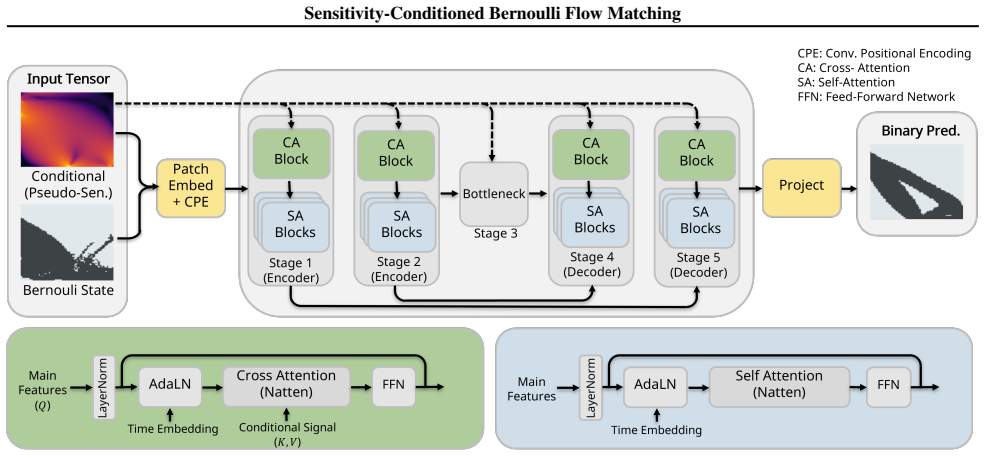
The causal Markov chain abstraction of the topology optimization pipeline together with the Data Processing Inequality, which ranks the sensitivity field as the optimal conditioner and is realized in a sensitivity-conditioned Bernoulli flow-matching generator.
What would settle it
An experiment in which a conditioning field with demonstrably lower mutual information to the adjoint sensitivity nevertheless produces higher out-of-distribution accuracy than sensitivity conditioning on the same benchmarks would falsify the optimality claim.
Extended reading notes
Core claim
The paper claims that because the topology optimization pipeline forms a causal Markov chain, the Data Processing Inequality implies that the adjoint sensitivity field carries strictly more information about the optimal topology than any other physical field; a Bernoulli flow-matching generator conditioned on this field therefore achieves superior generalization when loads or boundary conditions shift.
Load-bearing premise
The topology optimization process forms a causal Markov chain to which the Data Processing Inequality applies directly.
Editorial extensions
If this is right
- Surrogate models conditioned on sensitivities or their pseudo-sensitivity approximations outperform models conditioned on raw parameters or distant physical fields under load and boundary shifts.
- Performance of any conditioning signal degrades monotonically as its informational distance from the true sensitivity increases.
- Pseudo-sensitivities obtained from monotone transformations of common physical fields provide usable substitutes when exact adjoint sensitivities are unavailable.
- The same sensitivity-conditioning advantage appears in both structural topology optimization and the new CFD topology dataset under multi-outlet boundary shifts.
Reading between the lines
- The Markov-chain argument supplies a testable prediction: mutual information between candidate fields and the adjoint sensitivity should correlate directly with observed out-of-distribution accuracy across additional optimization problems.
- If the information-theoretic ranking holds, analogous conditioning strategies could be applied to surrogate modeling in other PDE-constrained inverse or design tasks.
- Efficient on-the-fly approximation of sensitivities would be required to deploy the method at inference time without recomputing full adjoints.
Editorial analysis
A structured set of objections, weighed in public.
Referee Report
Summary. The paper claims that OOD generalization in surrogate models for topology optimization is governed by the mutual information preserved by the conditioning signal about the adjoint sensitivity field. Modeling the TO pipeline as a causal Markov chain, the Data Processing Inequality is invoked to establish that the sensitivity field is information-theoretically optimal for topology prediction. The authors introduce pseudo-sensitivities to rank physical fields by their proximity to this optimum and empirically validate the hypothesis using a sensitivity-conditioned Bernoulli flow-matching generator, which achieves state-of-the-art OOD performance on structural TO benchmarks under load shifts and a new CFD-TO dataset under boundary-condition shifts. Code and datasets are released.
Significance. If the results hold, the work supplies a principled information-theoretic account of why conditioning choices affect generalization in physics-constrained generative models for TO, with direct implications for surrogate design in structural and fluid optimization. The public release of code, a new CFD-TO benchmark, and reproducible experiments constitute clear strengths. The contribution would be strengthened by addressing the foundational modeling assumption.
major comments (2)
- [Abstract] Abstract: The central claim that the Data Processing Inequality establishes the sensitivity field as 'information-theoretically optimal' rests on modeling the TO pipeline (design variables → physical fields → sensitivities → optimal topology) as a causal Markov chain. No derivation of the required conditional independence properties, nor any empirical check (e.g., testing whether physical fields are independent of topology given sensitivity), is supplied; the abstraction is posited without further justification. This assumption is load-bearing for the optimality ranking of pseudo-sensitivities and the subsequent empirical predictions.
- [Theoretical development (assumed §2)] The manuscript does not report any verification that the adjoint computation or the mapping from physical fields to sensitivities preserves the Markov property; if non-Markovian dependencies exist (e.g., via the adjoint solver), the DPI ranking no longer applies directly and the theoretical optimality statement does not follow.
minor comments (2)
- [Methods] The definition and computation of pseudo-sensitivities via monotone transformations should be stated formally with an equation in the methods section to allow reproducibility.
- [Results] Figure captions and axis labels in the OOD performance plots should explicitly state the distribution-shift type (load vs. boundary condition) for each panel to improve clarity.
Simulated Author's Rebuttal
We thank the referee for the constructive report and for highlighting the importance of the modeling assumptions. We respond point-by-point to the major comments below.
read point-by-point responses
-
Referee: [Abstract] The central claim that the Data Processing Inequality establishes the sensitivity field as 'information-theoretically optimal' rests on modeling the TO pipeline as a causal Markov chain. No derivation of the required conditional independence properties, nor any empirical check, is supplied; the abstraction is posited without further justification.
Authors: The Markov-chain abstraction follows the standard sequential structure of topology optimization (design variables determine physical fields via the forward solver; fields determine adjoint sensitivities; sensitivities determine the topology update). The DPI is applied under this modeling choice to rank conditioning signals by preserved mutual information with the sensitivity field. While a formal derivation of the conditional independences and an explicit test (e.g., conditional independence of physical fields and topology given sensitivities) are not supplied, the subsequent empirical ranking via pseudo-sensitivities and the observed OOD performance of the sensitivity-conditioned generator provide supporting evidence for the hypothesis. We will add a clarifying sentence in the revised abstract and introduction stating that the optimality claim holds under the posited Markov structure. revision: partial
-
Referee: [Theoretical development] The manuscript does not report any verification that the adjoint computation or the mapping from physical fields to sensitivities preserves the Markov property; if non-Markovian dependencies exist, the DPI ranking no longer applies directly.
Authors: In the continuous adjoint formulation the sensitivity is the exact reduced gradient obtained via the chain rule through the governing equations, which is consistent with the Markov property under the modeling abstraction. Discrete adjoint implementations or solver-specific numerics could in principle introduce additional dependencies; no explicit verification of the Markov property is reported in the manuscript. We will add a short limitations paragraph acknowledging this modeling assumption and noting that the empirical results remain consistent with the DPI-based predictions across both structural and CFD benchmarks. revision: partial
Circularity Check
No significant circularity; derivation relies on standard DPI under posited model
full rationale
The paper models the TO pipeline as a causal Markov chain and invokes the Data Processing Inequality (a standard external theorem) to rank conditioning signals by preserved mutual information. This is a modeling assumption plus theorem application, not a self-referential reduction. Pseudo-sensitivities are introduced as a formalization of observed monotone approximations, with empirical OOD tests on structural and CFD-TO benchmarks serving as independent confirmation rather than a fit renamed as prediction. No self-citations, ansatzes smuggled via prior work, or uniqueness theorems from the authors appear as load-bearing steps. The derivation chain is self-contained against external information-theoretic benchmarks.
Assumptions & free parameters
assumptions (1)
- domain assumption The topology optimization pipeline can be modeled as a causal Markov chain.
invented entities (1)
-
pseudo-sensitivities
Cite this review
Pith. "Pith review of On the Generalization in Topology Optimization via Sensitivity-Conditioned Bernoulli Flow Matching." pith.science (2026). https://pith.science/paper/AKU7L7EH
@misc{pith2026260602179,
  author       = {Pith},
  title        = {Pith review of: On the Generalization in Topology Optimization via Sensitivity-Conditioned Bernoulli Flow Matching},
  year         = {2026},
  howpublished = {\url{https://pith.science/paper/AKU7L7EH}},
  note         = {Machine review of arXiv:2606.02179}
}
read the original abstract
Surrogate models for topology optimization (TO) exhibit highly variable out-of-distribution (OOD) generalization under distribution shifts such as changing loads or boundary conditions, yet the source of this variability remains unclear. We hypothesize that OOD performance is governed by how much information the conditioning signal preserves about the adjoint sensitivity (reduced gradient) that drives classical TO. Modeling the TO pipeline as a causal Markov chain, the Data Processing Inequality establishes that, under this abstraction, the sensitivity field is an information-theoretically optimal conditioning signal for topology prediction. However, computing exact adjoint sensitivities can be expensive or unavailable in practice; we observe that certain physical fields can approximate sensitivities through monotone transformations. To formalize this, we introduce \textbf{pseudo-sensitivities} to characterize which fields enable generalization versus those that are information-poor. We then show that a sensitivity-conditioned Bernoulli flow-matching generator empirically confirms these predictions: conditioning on sensitivities yields state-of-the-art OOD performance, while increasingly distant physical fields degrade toward raw parameter conditioning. Results hold across structural TO benchmarks under load shifts and our new CFD-TO dataset under boundary-condition shifts such as multi-outlet configurations. Code and datasets are available at https://tum-pbs.github.io/topotransformer/ .
Figures


Figures from the paper (13 more)


Forward citations
Cited by 1 Pith paper
-
Trajectory-Aware Flow Matching for Topology Optimisation
A trajectory-aware flow matching method that builds its training path from volume-fraction-indexed BESO states generates feasible topologies in about 20 Euler steps and beats a diffusion baseline on compliance, volume...
Reference graph
Works this paper leans on
-
[1]
Girshick and Pieter Noordhuis and Lukasz Wesolowski and Aapo Kyrola and Andrew Tulloch and Yangqing Jia and Kaiming He , bibsource =
Priya Goyal and Piotr Dollár and Ross B. Girshick and Pieter Noordhuis and Lukasz Wesolowski and Aapo Kyrola and Andrew Tulloch and Yangqing Jia and Kaiming He , bibsource =. Accurate, Large Minibatch SGD: Training ImageNet in 1 Hour. , url =. CoRR , timestamp =
-
[2]
Diffusion models beat GANs on image synthesis , volume =
Dhariwal, Prafulla and Nichol, Alexander , booktitle =. Diffusion models beat GANs on image synthesis , volume =
-
[3]
Argmax flows and multinomial diffusion: Learning categorical distributions , volume =
Hoogeboom, Emiel and Nielsen, Didrik and Jaini, Priyank and Forr. Argmax flows and multinomial diffusion: Learning categorical distributions , volume =. NeurIPS , pages =
-
[4]
Mlejnek, H. P. , journal =. Some aspects of the genesis of structures , volume =
-
[5]
Neighborhood Attention Transformer , year =
Ali Hassani and Steven Walton and Jiachen Li and Shen Li and Humphrey Shi , booktitle =. Neighborhood Attention Transformer , year =
-
[6]
Classifier-free diffusion guidance , year =
Ho, Jonathan and Salimans, Tim , booktitle =. Classifier-free diffusion guidance , year =
-
[7]
Diffusing the Optimal Topology: A Generative Optimization Approach
Giorgio Giannone and Faez Ahmed , bibsource =. Diffusing the Optimal Topology: A Generative Optimization Approach. , url =. doi:10.48550/arxiv.2303.09760 , journal =
-
[8]
Aerodynamic design via control theory , volume =
Jameson, Antony , journal =. Aerodynamic design via control theory , volume =
Show all 35 references
-
[9]
Scalable Diffusion Models with Transformers
William Peebles and Saining Xie , bibsource =. Scalable Diffusion Models with Transformers. , url =. doi:10.1109/iccv51070.2023.00387 , journal =
2023 doi
-
[10]
An introduction to the adjoint approach to design , volume =
Giles, Michael B and Pierce, Niles A , journal =. An introduction to the adjoint approach to design , volume =
-
[11]
and Giannakoglou, Kyriakos C
Papoutsis-Kiachagias, Evangelos M. and Giannakoglou, Kyriakos C. , title =. Archives of Computational Methods in Engineering , volume =. 2016 , publisher =
2016
-
[12]
and Sigmund, Ole , publisher =
Bendsøe, Martin P. and Sigmund, Ole , publisher =. Topology
-
[13]
Improving direct physical properties prediction of heterogeneous materials from imaging data via convolutional neural network and a morphology-aware generative model , journal =
Ruijin Cang and Hechao Li and Hope Yao and Yang Jiao and Yi Ren , keywords =. Improving direct physical properties prediction of heterogeneous materials from imaging data via convolutional neural network and a morphology-aware generative model , journal =. 2018 , issn =. doi:h...
2018 doi
-
[14]
Diffusion models beat
Maz. Diffusion models beat. Proceedings of the AAAI Conference on Artificial Intelligence , number =
-
[15]
Hao Mo and Ajian Liu and Liying Yang and Shumin Yao and Yanyan Liang , year=
-
[16]
Amin Heyrani Nobari and Lyle Regenwetter and Giorgio Giannone and Faez Ahmed , bibsource =. Trans. Mach. Learn. Res. , timestamp =
-
[17]
Flow matching for generative modeling , year =
Lipman, Yaron and Chen, Ricky TQ and Ben-Hamu, Heli and Nickel, Maximilian and Le, Matthew , booktitle =. Flow matching for generative modeling , year =
-
[18]
Holzschuh and Qiang Liu and Georg Kohl and Nils Thuerey , bibsource =
Benjamin J. Holzschuh and Qiang Liu and Georg Kohl and Nils Thuerey , bibsource =. PDE-Transformer: Efficient and Versatile Transformers for Physics Simulations , url =. ICML , publisher =
-
[19]
Topology optimization approaches , volume =
Sigmund, Ole and Maute, Kurt , journal =. Topology optimization approaches , volume =
-
[20]
Structural and Multidisciplinary Optimization , volume=
Accelerated topology optimization by means of deep learning , author=. Structural and Multidisciplinary Optimization , volume=. 2020 , publisher=
2020
-
[21]
and Rozvany, G
Zhou, M. and Rozvany, G. I. N. , journal =. The
-
[22]
Neural networks for topology optimization , volume =
Sosnovik, Ivan and Oseledets, Ivan , booktitle =. Neural networks for topology optimization , volume =
-
[23]
A hybrid adjoint approach applied to RANS equations , year =
Palacios, Francisco and Alonso, Juan J and Duraisamy, Karthikeyan and others , journal =. A hybrid adjoint approach applied to RANS equations , year =
-
[24]
1989 , publisher=
Optimal shape design as a material distribution problem , journal=. 1989 , publisher=
1989
-
[25]
Adjoint equations in CFD: duality, boundary conditions and solution behaviour , year =
Giles, Michael B and Pierce, Niles A , booktitle =. Adjoint equations in CFD: duality, boundary conditions and solution behaviour , year =
-
[26]
Topology optimization of turbulent flows , volume =
Dilgen, Cetin Bahadir and Dilgen, Sumer Bahadir and Fuhrman, David R and Sigmund, Ole and Lazarov, Boyan S , journal =. Topology optimization of turbulent flows , volume =
-
[27]
U-DiTs: Downsample Tokens in U-Shaped Diffusion Transformers , url =
Yuchuan Tian and Zhijun Tu and Hanting Chen and Jie Hu and Chao Xu and Yunhe Wang , bibsource =. U-DiTs: Downsample Tokens in U-Shaped Diffusion Transformers , url =. NeurIPS , timestamp =
-
[28]
The method of moving asymptotes—a new method for structural optimization , volume =
Svanberg, Krister , journal =. The method of moving asymptotes—a new method for structural optimization , volume =
-
[29]
Adjoint-based shape optimization constrained by the Reynolds-averaged Navier-Stokes equations , year =
K. Adjoint-based shape optimization constrained by the Reynolds-averaged Navier-Stokes equations , year =
-
[30]
Structured denoising diffusion models in discrete state-spaces , volume =
Austin, Jacob and Johnson, Daniel D and Ho, Jonathan and Tarlow, Daniel and Van Den Berg, Rianne , booktitle =. Structured denoising diffusion models in discrete state-spaces , volume =
-
[31]
Denoising diffusion probabilistic models , volume =
Ho, Jonathan and Jain, Ajay and Abbeel, Pieter , booktitle =. Denoising diffusion probabilistic models , volume =
-
[32]
Computer methods in applied mechanics and engineering , volume=
Generating optimal topologies in structural design using a homogenization method , author=. Computer methods in applied mechanics and engineering , volume=. 1988 , publisher=
1988
-
[33]
On the handling of turbulence equations in RANS adjoint solvers , volume =
Marta, Andrea C and Shankaran, Sriram , journal =. On the handling of turbulence equations in RANS adjoint solvers , volume =
-
[34]
TopologyGAN: Topology optimization using generative adversarial networks based on physical fields over the initial domain , volume =
Nie, Zhenguo and Lin, Tong and Jiang, Haoliang and Kara, Levent Burak , journal =. TopologyGAN: Topology optimization using generative adversarial networks based on physical fields over the initial domain , volume =
-
[35]
Improved denoising diffusion probabilistic models , year =
Nichol, Alex Q and Dhariwal, Prafulla , booktitle =. Improved denoising diffusion probabilistic models , year =
Reviewed June 28, 2026 · model on record in the stance chip above.
Discussion (0). Sign in to comment.