AI as a Tool for Simulation-Based Experiments in Literary Studies
Pith reviewed 2026-06-28 14:52 UTC · model grok-4.3
The pith
Generative AI enables controlled simulations of literary production by generating texts that reflect specified cultural constraints.
A machine-rendered reading of the paper's core claim, the machinery that carries it, and where it could break.
Core claim
Existing research on AI proxies for humans, narrative properties of generated text, stability of multiagent simulations, and methods to alter AI knowledge can be combined to support AI-based modeling of cultural systems of literary production. Experiments on literary text generation provide the first demonstration of limited in-distribution outputs by AI models when compared to high-status human-authored novels.
What carries the argument
Use of generative AI systems as proxies for human populations within multiagent, multiturn simulations to model cultural constraints on literary production.
If this is right
- Literary scholars gain the ability to run controlled, grounded, large-scale experiments on questions of cultural production at low cost.
- Comparisons between AI-generated and human-authored novels become feasible for testing narrative and stylistic properties.
- Full counterfactual literary-historical simulations become possible once the component techniques are combined.
- Technical methods for predictably altering AI behavior can be applied to study how stylistic features arise under different constraints.
Where Pith is reading between the lines
- Such simulations could be extended to test specific historical hypotheses about how external events influence literary output.
- Validation against existing digital humanities datasets of real texts might strengthen claims about simulation fidelity.
- If stability improves, the approach could scale to longer narratives and more complex multiagent cultural dynamics.
Load-bearing premise
Separate lines of research on AI as human proxies, properties of generated text, stability of multiagent simulations, and techniques for altering AI knowledge can be integrated to yield reliable simulations that reflect arbitrarily specified cultural constraints or stylistic features.
What would settle it
An experiment in which multiagent AI simulations lose coherence before producing texts or in which generated outputs cannot be steered to match specified stylistic or cultural features even after applying known knowledge-alteration methods.
Figures


read the original abstract
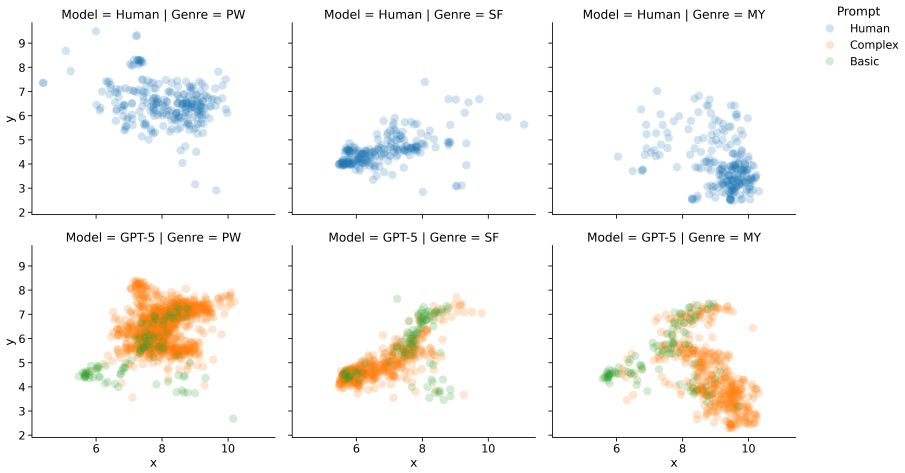
Generative artificial intelligence (AI) systems open new possibilities for experimentation in literary studies via controlled, grounded, large-scale, low-cost simulations of cultural production. Current systems have not yet been shown to produce high-quality, book-length narrative texts that reliably reflect arbitrarily specified cultural constraints or stylistic features. But there exists substantial relevant research on each of the components required for literary-historical simulation. These include the use and validation of AI systems as proxies for differentiable human populations; the narrative and stylistic properties of AI-generated texts; the stability and coherence of multiagent, multiturn AI simulations of human actors; and technical methods through which to alter in predictable ways the knowledge and behavior of generative systems. Together, these areas could provide a starting point for more ambitious AI-based modeling of cultural systems of literary production. We describe the possibilities and challenges of simulation-based experiments in literary studies, summarize the current state of the art in relevant fields, and explain key technical aspects of the work. To provide an example directly relevant to literary scholars, we present the results of experiments on literary text generation, including comparisons to high-status, human-authored novels. Our results include the first demonstration of (limited) in-distribution outputs by AI models in this domain. We conclude with a description of future work on full counterfactual literary-historical simulations using AI.
Editorial analysis
A structured set of objections, weighed in public.
Referee Report
Summary. The paper claims that generative AI systems enable new simulation-based experiments in literary studies via controlled, grounded, large-scale, low-cost modeling of cultural production. It summarizes relevant prior work on AI as proxies for human populations, narrative/stylistic properties of generated text, stability of multiagent simulations, and techniques for predictably altering AI knowledge/behavior. The authors state that they present experimental results on literary text generation (with comparisons to high-status human-authored novels) constituting the first demonstration of limited in-distribution outputs by AI models in this domain, and they outline future work on full counterfactual literary-historical simulations.
Significance. If the claimed experimental results hold under proper documentation and validation, the work would be significant as a methodological bridge between AI and literary studies, offering a framework for testing hypotheses about cultural constraints and stylistic features at scales infeasible with traditional methods. The synthesis of component research areas provides a useful starting point for interdisciplinary modeling even if full simulations remain prospective.
major comments (1)
- [Abstract] Abstract: the central empirical claim of 'the first demonstration of (limited) in-distribution outputs by AI models in this domain' (with comparisons to human-authored novels) supplies no operational definition of 'in-distribution,' experimental protocol, datasets, metrics, baselines, or quantitative outcomes. This renders the novelty assertion unevaluable and is load-bearing for the paper's stated contribution.
minor comments (1)
- [Abstract] Abstract: the phrasing that the summarized research areas 'could provide a starting point' for ambitious modeling is appropriately hedged but leaves unclear which specific integrations have been implemented versus proposed for future work.
Simulated Author's Rebuttal
We thank the referee for their thoughtful review and positive assessment of the paper's potential significance. We address the single major comment below and agree that revisions to the abstract are warranted to make the central empirical claim fully evaluable.
read point-by-point responses
-
Referee: [Abstract] Abstract: the central empirical claim of 'the first demonstration of (limited) in-distribution outputs by AI models in this domain' (with comparisons to human-authored novels) supplies no operational definition of 'in-distribution,' experimental protocol, datasets, metrics, baselines, or quantitative outcomes. This renders the novelty assertion unevaluable and is load-bearing for the paper's stated contribution.
Authors: We agree that the abstract does not supply the requested operational details and that this weakens the evaluability of the novelty claim. In the revised manuscript we will expand the abstract to include: (1) an operational definition of 'in-distribution' as outputs whose feature distributions (stylistic n-gram frequencies, sentence-length statistics, and embedding-space proximity) fall inside the 95% confidence intervals derived from the human novel corpus; (2) a concise statement of the experimental protocol (prompt construction, temperature settings, and post-generation filtering); (3) the specific datasets (public-domain 19th-century novels used for both training constraints and comparison); (4) the metrics and baselines employed (perplexity against a fine-tuned GPT-2 reference, cosine similarity on sentence-BERT embeddings, and human-novel inter-text distances); and (5) the key quantitative outcomes (e.g., mean similarity scores and statistical tests). These elements already appear in the methods and results sections; the revision will ensure the abstract summarizes them at the required level of specificity without altering the paper's core contribution. revision: yes
Circularity Check
No circularity; proposal paper with no derivations or fitted predictions
full rationale
The paper is a high-level proposal summarizing existing research components for AI-based literary simulations and deferring full experiments to future work. It contains no equations, parameters, derivations, or quantitative models. The claim of 'first demonstration of (limited) in-distribution outputs' is presented as an empirical result from experiments but is not supported by any self-referential definitions, fitted inputs renamed as predictions, or load-bearing self-citations that reduce the argument to its own inputs. No steps match the enumerated circularity patterns.
Axiom & Free-Parameter Ledger
axioms (1)
- domain assumption AI systems can serve as proxies for differentiable human populations
Reference graph
Works this paper leans on
-
[1]
Almaatouq, Abdullah and Griffiths, Thomas L. and Suchow, Jordan W. and Whiting, Mark E. and Evans, James and Watts, Duncan J. , date =. Beyond Playing 20 Questions with Nature:. 2024 , journal =. doi:10.1017/S0140525X22002874 , url =
-
[2]
Anthis, Jacy Reese and Liu, Ryan and Richardson, Sean M. and Kozlowski, Austin C. and Koch, Bernard and Evans, James and Brynjolfsson, Erik and Bernstein, Michael , date =. 2025 , eprint =. doi:10.48550/arXiv.2504.02234 , url =
-
[3]
Argyle, Lisa P. and Busby, Ethan C. and Fulda, Nancy and Gubler, Joshua R. and Rytting, Christopher and Wingate, David , date =. Out of. 2023 , journal =. doi:10.1017/pan.2023.2 , url =
-
[4]
Contextualizing Ancient Texts with Generative Neural Networks , author =. 2025 , journal =. doi:10.1038/s41586-025-09292-5 , url =
-
[5]
Atari, Mohammad and Henrich, Joseph , date =. Historical. 2023 , journal =. doi:10.1177/09637214221149737 , url =
-
[6]
Baek, Jinheon and Jauhar, Sujay Kumar and Cucerzan, Silviu and Hwang, Sung Ju , editor =. Proceedings of the 2025. 2025 , pages =. doi:10.18653/v1/2025.naacl-long.342 , url =
-
[7]
and Jia, Hengrui and Travers, Adelin and Zhang, Baiwu and Lie, David and Papernot, Nicolas , date =
Bourtoule, Lucas and Chandrasekaran, Varun and Choquette-Choo, Christopher A. and Jia, Hengrui and Travers, Adelin and Zhang, Baiwu and Lie, David and Papernot, Nicolas , date =. Machine. 2020 , eprint =. doi:10.48550/arXiv.1912.03817 , url =
-
[8]
Chakrabarty, Tuhin and Laban, Philippe and Agarwal, Divyansh and Muresan, Smaranda and Wu, Chien-Sheng , date =. Art or. Proceedings of the 2024. 2024 , series =. doi:10.1145/3613904.3642731 , url =
-
[9]
Chen, Ruizhe and Zhang, Xiaotian and Luo, Meng and Chai, Wenhao and Liu, Zuozhu , date =. 2024 , eprint =. doi:10.48550/arXiv.2410.04070 , url =
-
[10]
Chen, Yuqi and Li, Sixuan and Li, Ying and Atari, Mohammad , date =. Surveying the. Proceedings of the 2024. 2024 , eprint =. doi:10.18653/v1/2024.emnlp-main.151 , url =
-
[11]
Chen, Jiaao and Yang, Diyi , date =. Unlearn. 2023 , eprint =. doi:10.48550/arXiv.2310.20150 , url =
-
[12]
2024 , eprint =
Chiu, Yu Ying and Jiang, Liwei and Lin, Bill Yuchen and Park, Chan Young and Li, Shuyue Stella and Ravi, Sahithya and Bhatia, Mehar and Antoniak, Maria and Tsvetkov, Yulia and Shwartz, Vered and Choi, Yejin , date =. 2024 , eprint =
2024
-
[13]
Cohen, Myke C. and Su, Zhe and Kao, Hsien-Te and Nguyen, Daniel and Lynch, Spencer and Sap, Maarten and Volkova, Svitlana , date =. Exploring. 2025 , eprint =. doi:10.48550/arXiv.2506.15928 , url =
-
[14]
Dillion, Danica and Tandon, Niket and Gu, Yuling and Gray, Kurt , date =. Can. 2023 , journal =. doi:10.1016/j.tics.2023.04.008 , url =. 37173156 , eprinttype =
-
[15]
TinyStories: How Small Can Language Models Be and Still Speak Coherent English?
Eldan, Ronen and Li, Yuanzhi , date =. 2023 , eprint =. doi:10.48550/arXiv.2305.07759 , url =
work page internal anchor Pith review Pith/arXiv arXiv doi:10.48550/arxiv.2305.07759 2023
-
[16]
Eldan, Ronen and Russinovich, Mark , date =. Who's. 2023 , eprint =. doi:10.48550/arXiv.2310.02238 , url =
-
[17]
Applying Sparse Autoencoders to Unlearn Knowledge in Language Models , author =. 2024 , eprint =. doi:10.48550/arXiv.2410.19278 , url =
-
[18]
Feder, Amir and Keith, Katherine A. and Manzoor, Emaad and Pryzant, Reid and Sridhar, Dhanya and Wood-Doughty, Zach and Eisenstein, Jacob and Grimmer, Justin and Reichart, Roi and Roberts, Margaret E. and Stewart, Brandon M. and Veitch, Victor and Yang, Diyi , date =. Causal. 2022 , journal =. doi:10.1162/tacl_a_00511 , url =
-
[19]
Fittschen, Elisabeth and Li, Sabrina and Lippincott, Tom and Choshen, Leshem and Messner, Craig , date =. Pretraining. 2025 , eprint =. doi:10.48550/arXiv.2504.05523 , url =
-
[20]
Fleisig, Eve and Blodgett, Su Lin and Klein, Dan and Talat, Zeerak , editor =. The. Proceedings of the 2024. 2024 , pages =. doi:10.18653/v1/2024.naacl-long.126 , url =
-
[21]
Massively
Fung, Yi and Zhao, Ruining and Doo, Jae and Sun, Chenkai and Ji, Heng , date =. Massively. 2024 , eprint =
2024
-
[22]
Gandikota, Rohit and Materzyńska, Joanna and Fiotto-Kaufman, Jaden and Bau, David , date =. Erasing. 2023. 2023 , pages =. doi:10.1109/ICCV51070.2023.00230 , url =
-
[23]
Gao, Chen and Lan, Xiaochong and Lu, Zhihong and Mao, Jinzhu and Piao, Jinghua and Wang, Huandong and Jin, Depeng and Li, Yong , date =. S3:. 2023 , eprint =. doi:10.48550/arXiv.2307.14984 , url =
work page internal anchor Pith review Pith/arXiv arXiv doi:10.48550/arxiv.2307.14984 2023
-
[24]
and Maini, Pratyush and Raghunathan, Aditi , date =
Ghosal, Gaurav R. and Maini, Pratyush and Raghunathan, Aditi , date =. Memorization. 2025 , eprint =. doi:10.48550/arXiv.2507.09937 , url =
-
[25]
Grossmann, Igor and Feinberg, Matthew and Parker, Dawn C. and Christakis, Nicholas A. and Tetlock, Philip E. and Cunningham, William A. , date =. 2023 , journal =. doi:10.1126/science.adi1778 , langid =. 37319216 , eprinttype =
-
[26]
Gurung, Alexander and Lapata, Mirella , date =. Learning to. 2025 , eprint =. doi:10.48550/arXiv.2503.22828 , url =
-
[27]
Hewitt, John and Chen, Sarah and Xie, Lanruo Lora and Adams, Edward and Liang, Percy and Manning, Christopher D. , date =. Model. 2024 , eprint =. doi:10.48550/arXiv.2402.06155 , url =
-
[28]
Large Language Models as Simulated Economic Agents: What Can We Learn from Homo Silicus?
Horton, John J and Filippas, Apostolos and Manning, Benjamin S. Large Language Models as Simulated Economic Agents: What Can We Learn from Homo Silicus?. 2023
2023
-
[29]
Hou, Zhaoyi Joey and Zhang, Bowei Alvin and Lu, Yining and Baghel, Bhiman Kumar and Brei, Anneliese and Lu, Ximing and Jiang, Meng and Brahman, Faeze and Chaturvedi, Snigdha and Chang, Haw-Shiuan and Khashabi, Daniel and Li, Xiang Lorraine , date =. 2025 , eprint =. doi:10.48550/arXiv.2510.20091 , url =
-
[30]
Ilharco, Gabriel and Ribeiro, Marco Tulio and Wortsman, Mitchell and Gururangan, Suchin and Schmidt, Ludwig and Hajishirzi, Hannaneh and Farhadi, Ali , date =. Editing. 2023 , eprint =. doi:10.48550/arXiv.2212.04089 , url =
work page internal anchor Pith review Pith/arXiv arXiv doi:10.48550/arxiv.2212.04089 2023
-
[31]
Ji, Ke and Xu, Jiahao and Liang, Tian and Liu, Qiuzhi and He, Zhiwei and Chen, Xingyu and Liu, Xiaoyuan and Wang, Zhijie and Chen, Junying and Wang, Benyou and Tu, Zhaopeng and Mi, Haitao and Yu, Dong , date =. The. 2025 , eprint =. doi:10.13140/RG.2.2.33772.07043 , url =
-
[32]
Jinxin, Shi and Jiabao, Zhao and Yilei, Wang and Xingjiao, Wu and Jiawen, Li and Liang, He , date =. 2023 , eprint =. doi:10.48550/arXiv.2308.12503 , url =
-
[33]
Joshi, Brihi and Venkatapathy, Sriram and Bansal, Mohit and Peng, Nanyun and Chang, Haw-Shiuan , date =. 2025 , eprint =. doi:10.48550/arXiv.2503.17136 , url =
-
[34]
Generating the
Karell, Daniel and Shu, Matthew and Davidson, Thomas and Okura, Keitaro , date =. Generating the. 2025 , journal =
2025
-
[35]
Keith, Katherine and Jensen, David and O’Connor, Brendan , date =. Text and. Proceedings of the 58th. 2020 , pages =. doi:10.18653/v1/2020.acl-main.474 , url =
-
[36]
2024 , eprint=
In Silico Sociology: Forecasting COVID-19 Polarization with Large Language Models , author=. 2024 , eprint=
2024
-
[37]
2025 , url =
Societal and Technological Progress as Sewing an Ever-Growing, Ever-Changing, Patchy, and Polychrome Quilt , author =. 2025 , url =
2025
-
[38]
Lin, Jiaju and Zhao, Haoran and Zhang, Aochi and Wu, Yiting and Ping, Huqiuyue and Chen, Qin , date =. 2023 , eprint =. doi:10.48550/arXiv.2308.04026 , url =
-
[39]
Measuring the
Lin, Jinkun and Zhang, Anqi and Lecuyer, Mathias and Li, Jinyang and Panda, Aurojit and Sen, Siddhartha , date =. Measuring the. 2022 , eprint =
2022
-
[40]
Li, Chao and Su, Xing and Han, Haoying and Xue, Cong and Zheng, Chunmo and Fan, Chao , date =. Quantifying the. 2023 , eprint =. doi:10.48550/arXiv.2308.03313 , url =
-
[41]
Liu, Hao and Sferrazza, Carmelo and Abbeel, Pieter , date =. Chain of. 2023 , eprint =. doi:10.48550/arXiv.2302.02676 , url =
-
[42]
Liu, Zhuozhuo Joy and Samir, Farhan and Bhatia, Mehar and Nelson, Laura K. and Shwartz, Vered , date =. Is. 2025 , eprint =. doi:10.48550/arXiv.2505.18322 , url =
-
[43]
Liu, Ken Ziyu , date =. Machine. 2024 , url =
2024
-
[44]
Liu, Alisa and Han, Xiaochuang and Wang, Yizhong and Tsvetkov, Yulia and Choi, Yejin and Smith, Noah A , date =. Tuning. 2024 , location =
2024
-
[45]
TOFU: A Task of Fictitious Unlearning for LLMs
Maini, Pratyush and Feng, Zhili and Schwarzschild, Avi and Lipton, Zachary C. and Kolter, J. Zico , date =. 2024 , eprint =. doi:10.48550/arXiv.2401.06121 , url =
work page internal anchor Pith review Pith/arXiv arXiv doi:10.48550/arxiv.2401.06121 2024
-
[46]
Locating and Editing Factual Associations in
Meng, Kevin and Bau, David and Andonian, Alex and Belinkov, Yonatan , booktitle =. Locating and Editing Factual Associations in
-
[47]
Meng, Kevin and Sharma, Arnab Sen and Andonian, Alex and Belinkov, Yonatan and Bau, David , date =. Mass-. 2023 , eprint =. doi:10.48550/arXiv.2210.07229 , url =
work page internal anchor Pith review Pith/arXiv arXiv doi:10.48550/arxiv.2210.07229 2023
-
[48]
Morris, John X. and Rush, Alexander M. , date =. Contextual. 2024 , year = 2024, eprint =. doi:10.48550/arXiv.2410.02525 , url =
-
[49]
and Hajishirzi, Hannaneh and Koh, Pang Wei and Dodge, Jesse and Dasigi, Pradeep , date =
Morrison, Jacob and Smith, Noah A. and Hajishirzi, Hannaneh and Koh, Pang Wei and Dodge, Jesse and Dasigi, Pradeep , date =. Merge to. 2024 , eprint =
2024
-
[50]
Muscato, Benedetta and Mala, Chandana Sree and Marchiori Manerba, Marta and Gezici, Gizem and Giannotti, Fosca , editor =. An. Proceedings of the 3rd. 2024 , pages =
2024
-
[51]
Navarro, Alejandro Leonardo García and Koneva, Nataliia and Sánchez-Macián, Alfonso and Hernández, José Alberto and Goyanes, Manuel , date =. Designing. 2024 , eprint =. doi:10.48550/arXiv.2411.07038 , url =
-
[52]
Descent-to-
Neel, Seth and Roth, Aaron and Sharifi-Malvajerdi, Saeed , date =. Descent-to-. Proceedings of the 32nd. 2021 , pages =
2021
-
[53]
Empirically Evaluating Commonsense Intelligence in Large Language Models with Large-Scale Human Judgments , author =. 2025 , eprint =. doi:10.48550/arXiv.2505.10309 , url =
-
[54]
Papadimitriou, Isabel and Jurafsky, Dan , date =. Learning. 2020 , eprint =. doi:10.48550/arXiv.2004.14601 , url =
-
[55]
Park, Joon Sung and O'Brien, Joseph and Cai, Carrie Jun and Morris, Meredith Ringel and Liang, Percy and Bernstein, Michael S. , date =. Generative. Proceedings of the 36th. 2023 , pages =. doi:10.1145/3586183.3606763 , url =
-
[56]
Survey of
Pawar, Siddhesh and Park, Junyeong and Jin, Jiho and Arora, Arnav and Myung, Junho and Yadav, Srishti and Haznitrama, Faiz Ghifari and Song, Inhwa and Oh, Alice and Augenstein, Isabelle , date =. Survey of. 2024 , langid =
2024
-
[57]
Pawelczyk, Martin and Neel, Seth and Lakkaraju, Himabindu , date =. In-. 2024 , eprint =. doi:10.48550/arXiv.2310.07579 , url =
-
[58]
and Agarwal, Divyansh and Huang, Kung-Hsiang and Tan, Sarah and Peng, Nanyun and Wu, Chien-Sheng , date =
Qiu, Haoyi and Fabbri, Alexander R. and Agarwal, Divyansh and Huang, Kung-Hsiang and Tan, Sarah and Peng, Nanyun and Wu, Chien-Sheng , date =. Evaluating. 2024 , eprint =
2024
-
[59]
Roland, Edwin and So, Richard and Long, Hoyt , date =. The Social. 2025 , journal =. doi:10.1007/s00146-025-02790-0 , url =
-
[60]
Sorensen, Taylor and Moore, Jared and Fisher, Jillian and Gordon, Mitchell and Mireshghallah, Niloofar and Rytting, Christopher Michael and Ye, Andre and Jiang, Liwei and Lu, Ximing and Dziri, Nouha and Althoff, Tim and Choi, Yejin , date =. A. 2024 , eprint =
2024
-
[61]
Templeton, Adley , date =. Scaling. 2024 , institution =
2024
-
[62]
Thaker, Pratiksha and Maurya, Yash and Hu, Shengyuan and Wu, Zhiwei Steven and Smith, Virginia , date =. Guardrail. 2024 , eprint =. doi:10.48550/arXiv.2403.03329 , url =
-
[63]
Underwood, Ted and Nelson, Laura K. and Wilkens, Matthew , date =. Can. 2025 , eprint =. doi:10.48550/arXiv.2505.00030 , url =
-
[64]
and Narayanan, Arvind , date =
Veselovsky, Veniamin and Argin, Berke and Stroebl, Benedikt and Wendler, Chris and West, Robert and Evans, James and Griffiths, Thomas L. and Narayanan, Arvind , date =. Localized. 2025 , eprint =. doi:10.48550/arXiv.2504.10191 , url =
-
[65]
Wallach, Hanna and Desai, Meera and Cooper, A. Feder and Wang, Angelina and Atalla, Chad and Barocas, Solon and Blodgett, Su Lin and Chouldechova, Alexandra and Corvi, Emily and Dow, P. Alex and Garcia-Gathright, Jean and Olteanu, Alexandra and Pangakis, Nicholas and Reed, Stefanie and Sheng, Emily and Vann, Dan and Vaughan, Jennifer Wortman and Vogel, Ma...
-
[66]
Walsh, Melanie and Preus, Anna and Gronski, Elizabeth , date =. Does. 2024 , eprint =. doi:10.48550/arXiv.2410.15299 , url =
-
[67]
A Survey on Large Language Model Based Autonomous Agents , author =. 2024 , journal =. doi:10.1007/s11704-024-40231-1 , url =
-
[68]
and Zhang, Chiyuan and Zettlemoyer, Luke and Li, Kai and Henderson, Peter , date =
Wei, Boyi and Shi, Weijia and Huang, Yangsibo and Smith, Noah A. and Zhang, Chiyuan and Zettlemoyer, Luke and Li, Kai and Henderson, Peter , date =. Evaluating. 2024 , eprint =. doi:10.48550/arXiv.2406.18664 , url =
-
[69]
Xi, Zhiheng and Chen, Wenxiang and Guo, Xin and He, Wei and Ding, Yiwen and Hong, Boyang and Zhang, Ming and Wang, Junzhe and Jin, Senjie and Zhou, Enyu and Zheng, Rui and Fan, Xiaoran and Wang, Xiao and Xiong, Limao and Zhou, Yuhao and Wang, Weiran and Jiang, Changhao and Zou, Yicheng and Liu, Xiangyang and Yin, Zhangyue and Dou, Shihan and Weng, Rongxia...
2023
-
[70]
2024 , origdate =
Xi, Zhiheng , date =. 2024 , origdate =
2024
-
[71]
Xu, Weijia and Jojic, Nebojsa and Rao, Sudha and Brockett, Chris and Dolan, Bill , date =. Echoes in. 2025 , journal =. doi:10.1073/pnas.2504966122 , url =
-
[72]
Yang, Jiashu and Wang, Ningning and Zhao, Yian and Feng, Chaoran and Du, Junjia and Pang, Hao and Fang, Zhirui and Cheng, Xuxin , date =. Kongzi:. 2025 , eprint =. doi:10.48550/arXiv.2504.09488 , url =
-
[73]
Zhang, Jinghan and Chen, Shiqi and Liu, Junteng and He, Junxian , date =. Composing. 2023 , eprint =. doi:10.48550/arXiv.2306.14870 , url =
-
[74]
Zhang, Xuanming and Chen, Yuxuan and Yeh, Min-Hsuan and Li, Yixuan , date =. 2025 , eprint =. doi:10.48550/arXiv.2505.18943 , url =
-
[75]
Negative Preference Optimization: From Catastrophic Collapse to Effective Unlearning
Zhang, Ruiqi and Lin, Licong and Bai, Yu and Mei, Song , date =. Negative. 2024 , eprint =. doi:10.48550/arXiv.2404.05868 , url =
work page internal anchor Pith review Pith/arXiv arXiv doi:10.48550/arxiv.2404.05868 2024
-
[76]
Zhang, Yiming and Diddee, Harshita and Holm, Susan and Liu, Hanchen and Liu, Xinyue and Samuel, Vinay and Wang, Barry and Ippolito, Daphne , date =. 2025 , eprint =. doi:10.48550/arXiv.2504.05228 , url =
-
[77]
Zhao, Yang and Du, Li and Ding, Xiao and Xiong, Kai and Sun, Zhouhao and Jun, Shi and Liu, Ting and Qin, Bing , editor =. Deciphering the. Findings of the. 2024 , pages =. doi:10.18653/v1/2024.findings-acl.559 , url =
-
[78]
and Potts, Christopher and Chen, Danqi , date =
Zhong, Zexuan and Wu, Zhengxuan and Manning, Christopher D. and Potts, Christopher and Chen, Danqi , date =. 2024 , eprint =. doi:10.48550/arXiv.2305.14795 , url =
-
[79]
Zhou, Jiaxu and Huang, Jen-tse and Zhou, Xuhui and Lam, Man Ho and Wang, Xintao and Zhu, Hao and Wang, Wenxuan and Sap, Maarten , date =. The. 2025 , eprint =. doi:10.48550/arXiv.2509.18052 , url =
work page internal anchor Pith review Pith/arXiv arXiv doi:10.48550/arxiv.2509.18052 2025
-
[80]
2026 , langid =
Zhou, Xuhui and Liu, Jiarui and Yerukola, Akhila and Kim, Hyunwoo and Sap, Maarten , date =. 2026 , langid =
2026
discussion (0)
Sign in with ORCID, Apple, or X to comment. Anyone can read and Pith papers without signing in.