VEDAL: Variational Error-Driven Asynchronous Learning for 3D Gaussian Splatting Pruning
Pith reviewed 2026-06-28 15:04 UTC · model grok-4.3
The pith
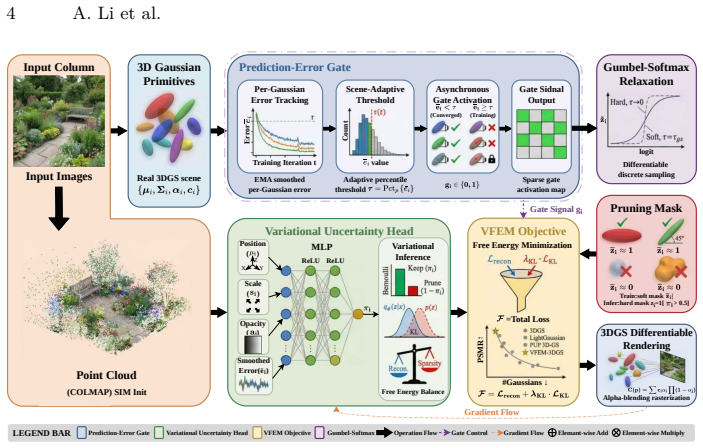
VEDAL treats 3D Gaussian pruning as variational free energy minimization to cut memory use while preserving rendering quality.
A machine-rendered reading of the paper's core claim, the machinery that carries it, and where it could break.
Core claim
The central claim is that formulating Gaussian pruning as variational free energy minimization, with a prediction-error gating mechanism and a variational uncertainty head that treats pruning decisions as latent variables with learnable priors, yields more stable training and better compression-quality trade-offs than heuristic importance scores or synchronous batch updates.
What carries the argument
The variational uncertainty head that models each pruning decision as a latent variable equipped with a learnable prior, together with the prediction-error gate that activates pruning asynchronously per Gaussian.
If this is right
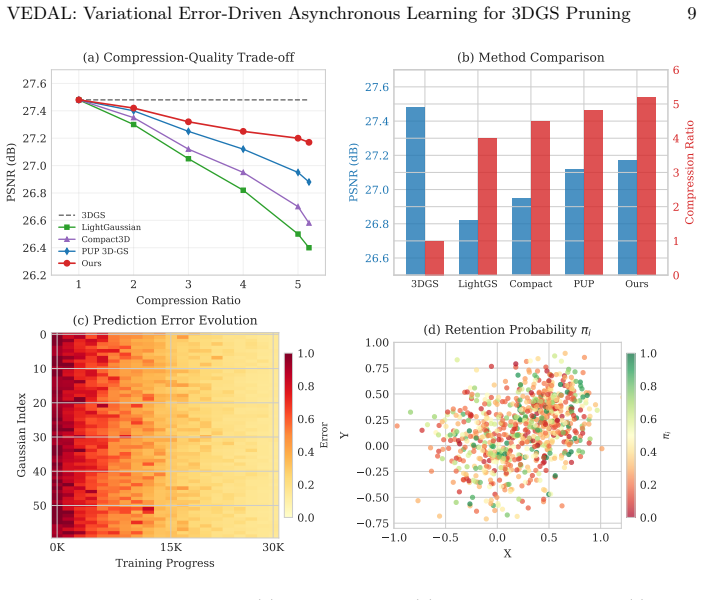
- Models can be stored and transmitted with roughly one-fifth the memory while keeping real-time rendering speeds.
- Training becomes more stable because pruning decisions are made asynchronously rather than in synchronous batches.
- The same free-energy balance can be applied to other dense primitive representations that suffer from over-parameterization.
- Downstream tasks such as mobile AR or large-scale scene reconstruction become feasible with lower hardware requirements.
Where Pith is reading between the lines
- The asynchronous gating could be combined with streaming data pipelines to prune on the fly during online reconstruction.
- Because the priors are learnable, the framework might adapt automatically when the input changes from static to dynamic scenes.
- The information-theoretic view suggests a direct link to rate-distortion theory that could be used to set compression targets without grid search.
Load-bearing premise
The free energy objective with learnable priors will produce stable training and better compression without requiring post-hoc tuning or causing instability.
What would settle it
Running the same Mip-NeRF 360, Tanks&Temples, and Deep Blending experiments and finding that VEDAL fails to exceed PUP 3D-GS by 0.05 dB or LightGaussian by 0.35 dB at the reported compression ratios would falsify the performance claim.
Figures


read the original abstract
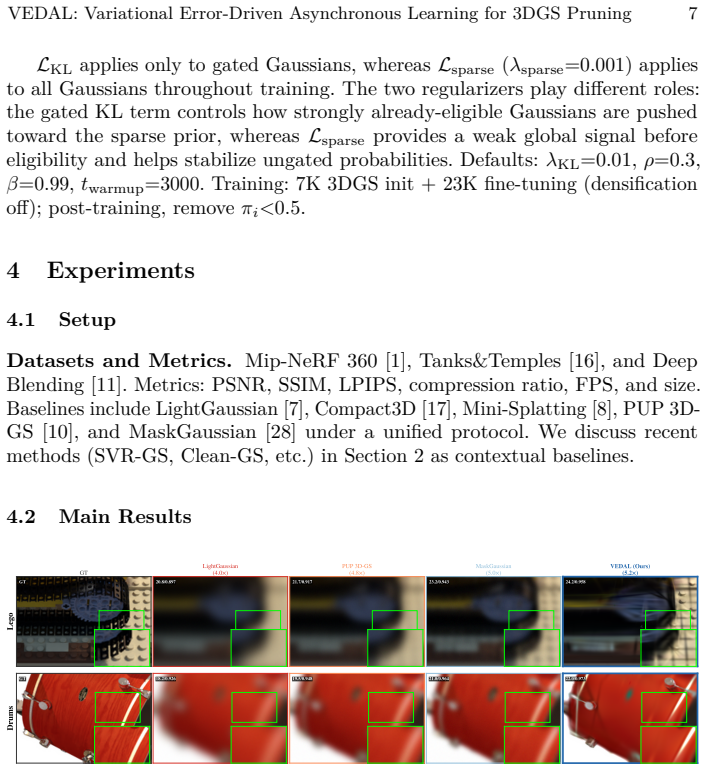
3D Gaussian Splatting (3DGS) achieves remarkable novel view synthesis quality with real-time rendering, yet suffers from excessive memory consumption due to millions of Gaussian primitives. Existing pruning methods rely on heuristic importance scores or synchronous batch updates, leading to suboptimal compression and training instability. We propose VEDAL, a principled framework that formulates Gaussian pruning as variational free energy minimization. Our approach introduces (1) a prediction-error gating mechanism that asynchronously activates pruning based on per-Gaussian reconstruction uncertainty, and (2) a variational uncertainty head that models pruning decisions as latent variables with learnable priors. The free energy objective naturally balances reconstruction fidelity against model complexity through an information-theoretic lens. Extensive experiments on Mip-NeRF 360, Tanks&Temples, and Deep Blending demonstrate that VEDAL achieves 5.2x compression with only 0.31 dB PSNR drop, outperforming PUP 3D-GS by +0.05 dB at a higher compression ratio and LightGaussian by +0.35 dB at comparable quality, while maintaining real-time rendering at 185 FPS.
Editorial analysis
A structured set of objections, weighed in public.
Referee Report
Summary. The paper proposes VEDAL, a framework for pruning 3D Gaussian Splatting that formulates pruning decisions as variational free energy minimization. It introduces a prediction-error gating mechanism for asynchronous activation based on per-Gaussian reconstruction uncertainty and a variational uncertainty head that models pruning decisions as latent variables with learnable priors. Experiments on Mip-NeRF 360, Tanks&Temples, and Deep Blending report 5.2x compression with a 0.31 dB PSNR drop, outperforming PUP 3D-GS (+0.05 dB at higher compression) and LightGaussian (+0.35 dB at comparable quality) while sustaining 185 FPS real-time rendering.
Significance. If the variational formulation and asynchronous gating produce stable training and the reported compression-quality trade-off without post-hoc tuning, the work would supply a principled information-theoretic alternative to heuristic pruning scores in 3DGS, with potential to generalize to other explicit radiance-field representations.
major comments (2)
- [Abstract] Abstract: the central performance claims (5.2x compression, 0.31 dB PSNR drop, outperformance margins) rest on an un-derived free-energy objective and an unspecified inference approximation for the latent pruning variables; without the explicit objective, the reparameterization or relaxation used, or an ablation isolating the uncertainty head from the gating mechanism, it is impossible to verify that the gains arise from the claimed information-theoretic balance rather than hyper-parameter search or instability artifacts.
- [Abstract] Abstract: the assumption that modeling pruning as latent variables with learnable priors plus prediction-error gating yields stable training is load-bearing for all reported results, yet no evidence (gradient-variance statistics, mode-collapse checks, or training-curve comparisons) is supplied to address the known instability of variational inference on discrete decisions.
Simulated Author's Rebuttal
We thank the referee for the constructive feedback. We address each major comment below and commit to revisions that clarify the variational formulation and provide additional evidence for training stability.
read point-by-point responses
-
Referee: [Abstract] Abstract: the central performance claims (5.2x compression, 0.31 dB PSNR drop, outperformance margins) rest on an un-derived free-energy objective and an unspecified inference approximation for the latent pruning variables; without the explicit objective, the reparameterization or relaxation used, or an ablation isolating the uncertainty head from the gating mechanism, it is impossible to verify that the gains arise from the claimed information-theoretic balance rather than hyper-parameter search or instability artifacts.
Authors: The free-energy objective is explicitly derived in Section 3.1, with the reparameterization and variational relaxation for the latent pruning variables detailed in Section 3.2; the inference uses a standard mean-field approximation via the uncertainty head. We agree the abstract is too concise to convey these elements. We will revise the abstract to briefly reference the derivation and sections, and we will add an ablation isolating the uncertainty head from the gating mechanism in the revised experiments section. These changes will make the information-theoretic basis of the gains verifiable from the manuscript. revision: yes
-
Referee: [Abstract] Abstract: the assumption that modeling pruning as latent variables with learnable priors plus prediction-error gating yields stable training is load-bearing for all reported results, yet no evidence (gradient-variance statistics, mode-collapse checks, or training-curve comparisons) is supplied to address the known instability of variational inference on discrete decisions.
Authors: We acknowledge that explicit diagnostics for stability under variational inference on discrete latents are important. While the reported results across three benchmarks show consistent convergence without divergence, we did not include gradient-variance statistics, mode-collapse checks, or training-curve comparisons. We will add these analyses (training curves and gradient-norm statistics) to the revised manuscript or supplementary material to substantiate the stability claim. revision: yes
Circularity Check
No significant circularity detected
full rationale
The abstract presents VEDAL as formulating pruning via variational free energy minimization with an uncertainty head and gating mechanism, but supplies no equations, derivations, or self-citations that can be inspected for reduction to inputs by construction. No fitted parameters are renamed as predictions, no uniqueness theorems are invoked, and no ansatz is smuggled via citation. The performance numbers are reported as experimental outcomes on standard benchmarks rather than derived claims. Per the rules, absence of quotable circular steps requires score 0.
Axiom & Free-Parameter Ledger
Reference graph
Works this paper leans on
-
[1]
In: CVPR
Barron, J.T., Mildenhall, B., Verbin, D., Srinivasan, P.P., Hedman, P.: Mip-NeRF 360: Unbounded anti-aliased neural radiance fields. In: CVPR. pp. 5470–5479 (2022)
2022
-
[2]
Journal of the American Statistical Association112(518), 859–877 (2017)
Blei, D.M., Kucukelbir, A., McAuliffe, J.D.: Variational inference: A review for statisticians. Journal of the American Statistical Association112(518), 859–877 (2017)
2017
-
[3]
arXiv (2026)
Chen, Y., Li, J., Wang, J., Lin, J., Zeng, Z., Shi, Y.: Transsplat: Unbalanced semantic transport for language-driven 3dgs editing. arXiv (2026)
2026
-
[4]
In: ICLR (2025)
Chen, Y., Wu, Q., Li, M., Lin, W., Harandi, M., Cai, J.: Fast feedforward 3d gaussian splatting compression. In: ICLR (2025)
2025
-
[5]
In: ECCV (2024)
Chen, Y., Wu, Q., Xu, J., Zhan, W., Sheng, K., Li, Z., Liu, Y., Chen, X.: HAC: Hash-grid assisted context for 3d gaussian splatting compression. In: ECCV (2024)
2024
-
[6]
arXiv (2025)
Deng, X., Yu, Q., Diao, C., Li, M., Xu, D.: Gradient-driven natural selection for compact 3d gaussian splatting. arXiv (2025)
2025
-
[7]
In: NeurIPS (2023)
Fan, Z., Wang, K., Wen, K., Zhu, Z., Xu, D., Wang, Z.: LightGaussian: Unbounded 3d gaussian compression with 15x reduction and 200+ fps. In: NeurIPS (2023)
2023
-
[8]
arXiv (2024)
Fang, G., Wang, B., Chen, Y., Wang, H.: Mini-Splatting: Representing scenes with a constrained number of gaussians. arXiv (2024)
2024
-
[9]
In: ECCV (2024)
Girish, S., Shrivastava, K.G.A.: EAGLES: Efficient accelerated 3d gaussians with lightweight encodings. In: ECCV (2024)
2024
-
[10]
arXiv (2024) VEDAL: Variational Error-Driven Asynchronous Learning for 3DGS Pruning 11
Hanson, A., Allen, K., Wang, X., Silvestri, G., Wu, D., Salehi, B.: PUP 3D-GS: Principled uncertainty pruning for 3d gaussian splatting. arXiv (2024) VEDAL: Variational Error-Driven Asynchronous Learning for 3DGS Pruning 11
2024
-
[11]
ACM Transactions on Graphics 37(6), 1–15 (2018)
Hedman, P., Philip, J., Price, T., Frahm, J.M., Drettakis, G., Brostow, G.: Deep blending for free-viewpoint image-based rendering. ACM Transactions on Graphics 37(6), 1–15 (2018)
2018
-
[12]
In: ACM SIGGRAPH (2024)
Huang, B., Yu, Z., Chen, A., Geiger, A., Gao, S.: 2D Gaussian Splatting for geometrically accurate radiance fields. In: ACM SIGGRAPH (2024)
2024
-
[13]
Msystems5(1), 10–1128 (2020)
Jiang, H., Li, S., Liu, W., Zheng, H., Liu, J., Zhang, Y.: Geometry-aware cell detection with deep learning. Msystems5(1), 10–1128 (2020)
2020
-
[14]
Computational and Structural Biotechnology Journal19, 1391–1399 (2021)
Jiang, H., Tang, S., Liu, W., Zhang, Y.: Deep learning for covid-19 chest ct (computed tomography) image analysis: A lesson from lung cancer. Computational and Structural Biotechnology Journal19, 1391–1399 (2021)
2021
-
[15]
ACM Transactions on Graphics42(4), 1–14 (2023)
Kerbl, B., Kopanas, G., Leimk¨ uhler, T., Drettakis, G.: 3D Gaussian Splatting for real-time radiance field rendering. ACM Transactions on Graphics42(4), 1–14 (2023)
2023
-
[16]
In: ACM Transactions on Graphics
Knapitsch, A., Park, J., Zhou, Q.Y., Koltun, V.: Tanks and Temples: Benchmarking large-scale scene reconstruction. In: ACM Transactions on Graphics. vol. 36, pp. 1–13 (2017)
2017
-
[17]
In: ECCV (2024)
Lee, K.N., Turber, K.P., Mirzaei, H., Peng, S., Tulyakov, S., Keuper, J., Shi, J.: Compact3D: Compressing gaussian splat radiance field models with vector quantization. In: ECCV (2024)
2024
-
[18]
In: ACM MM
Li, H., Liu, W., Liu, J., Tang, Z., Pun, C.M., Miao, Q., Xu, F., Gao, H.: Motionre- finenet: Fine-grained pose sequence smoothing and refinement. In: ACM MM. pp. 5–14 (2025)
2025
-
[19]
IEEE Transactions on Circuits and Systems for Video Technology32(11), 7692–7705 (2022)
Li, H., Pun, C.M.: Monocular robust 3d human localization by global and body- parts depth awareness. IEEE Transactions on Circuits and Systems for Video Technology32(11), 7692–7705 (2022)
2022
-
[20]
In: AAAI
Li, H., Pun, C.M.: Cee-net: complementary end-to-end network for 3d human pose generation and estimation. In: AAAI. vol. 37, pp. 1305–1313 (2023)
2023
-
[21]
In: ICASSP
Li, H., Zheng, F., Liu, Y., Xiong, J., Zhang, W., Hu, H., Gao, H.: Adaptive skeleton prompt tuning for cross-dataset 3d human pose estimation. In: ICASSP. pp. 1–5. IEEE (2025)
2025
-
[22]
Liu, W., Cun, X., Pun, C.M.: Dh-gan: Image manipulation localization via a dual homology-aware generative adversarial network. PR p. 110658 (2024)
2024
-
[23]
In: AAAI
Liu, W., Cun, X., Pun, C.M., Xia, M., Zhang, Y., Wang, J.: Coordfill: Efficient high-resolution image inpainting via parameterized coordinate querying. In: AAAI. vol. 37, pp. 1746–1754 (2023)
2023
-
[24]
In: CVPR
Liu, W., Shen, X., Li, H., Bi, X., Liu, B., Pun, C.M., Cun, X.: Depth-aware test-time training for zero-shot video object segmentation. In: CVPR. pp. 19218–19227 (2024)
2024
-
[25]
In: CVPR
Liu, W., Shen, X., Pun, C.M., Cun, X.: Explicit visual prompting for low-level structure segmentations. In: CVPR. pp. 19434–19445 (2023)
2023
-
[26]
arXiv (2024)
Liu, W., Shen, X., Pun, C.M., Cun, X.: Forgeryttt: Zero-shot image manipulation localization with test-time training. arXiv (2024)
2024
-
[27]
TPAMI (2025)
Liu, W., Shen, X., Pun, C.M., Cun, X.: Explicit visual prompting for universal foreground segmentations. TPAMI (2025)
2025
-
[28]
In: CVPR
Liu, Y., Zhong, Z., Zhan, Y., Xu, S., Sun, X.: Maskgaussian: Adaptive 3d gaussian representation from probabilistic masks. In: CVPR. pp. 681–690 (2025)
2025
-
[29]
In: NeurIPS
Louizos, C., Ullrich, K., Welling, M.: Bayesian compression for deep learning. In: NeurIPS. pp. 3288–3298 (2017)
2017
-
[30]
arXiv (2026)
Lu, L., Chen, X., Guo, M., Li, S., Wang, J., Shi, Y.: Chordedit: One-step low-energy transport for image editing. arXiv (2026)
2026
-
[31]
In: CVPR (2024) 12 A
Lu, T., Yu, M., Xu, L., Xiangli, Y., Wang, L., Lin, D., Dai, B.: Scaffold-GS: Structured 3d gaussians for view-adaptive rendering. In: CVPR (2024) 12 A. Li et al
2024
-
[32]
In: ICLR (2017)
Maddison, C.J., Mnih, A., Teh, Y.W.: The concrete distribution: A continuous relaxation of discrete random variables. In: ICLR (2017)
2017
-
[33]
arXiv (2026)
Mishra, S.: Clean-GS: Semantic mask-guided pruning for 3d gaussian splatting. arXiv (2026)
2026
-
[34]
In: ICML
Molchanov, D., Ashukha, A., Vetrov, D.: Variational dropout sparsifies deep neural networks. In: ICML. pp. 2498–2507 (2017)
2017
-
[35]
In: ECCV (2024)
Navaneet, K., Turber, K.P., Mirzaei, H., Peng, S., Tulyakov, S., Keuper, J.: Compact- 3DGS: Compressing gaussian splat radiance field models with vector quantization. In: ECCV (2024)
2024
-
[36]
In: ECCV (2024)
Ren, K., Jiang, L., Lu, T., Yu, M., Xu, L., Ni, Z., Dai, B.: Octree-GS: Towards consistent real-time rendering with lod-structured 3d gaussians. In: ECCV (2024)
2024
-
[37]
MMErroR: A Benchmark for Erroneous Reasoning in Vision-Language Models
Shi, Y., Xie, Y., Guo, M., Lu, L., Huang, M., Wang, J., Zhu, Z., Xu, B., Huang, Z.: Mmerror: A benchmark for erroneous reasoning in vision-language models. arXiv preprint arXiv:2601.03331 (2026)
work page internal anchor Pith review Pith/arXiv arXiv 2026
-
[38]
In: ICASSP
Song, J., Pun, C.M., Li, H., Lan, R., Xie, J.C., Gao, H.: Local optimization networks for multi-view multi-person human posture estimation. In: ICASSP. pp. 3995–3999. IEEE (2024)
2024
-
[39]
arXiv (2025)
Taghipour, A., Naghshin, V., Southwell, B., Boussaid, F., Laga, H., Bennamoun, M.: SVR-GS: Spatially variant regularization for probabilistic masks in 3d gaussian splatting. arXiv (2025)
2025
-
[40]
In: ICLR (2024)
Tang, J., Ren, J., Zhou, H., Liu, Z., Zeng, G.: DreamGaussian: Generative gaussian splatting for efficient 3d content creation. In: ICLR (2024)
2024
-
[41]
In: ACM MM
Tian, B., Gao, Q., Xianyu, S., Cui, X., Zhang, M.: Flexgaussian: Flexible and cost-effective training-free compression for 3d gaussian splatting. In: ACM MM. pp. 7287–7296 (2025)
2025
-
[42]
arXiv (2025)
Tu, A., Ying, H., Hanson, A., Lee, Y., Goldstein, T., Zwicker, M.: Speedy deformable 3d gaussian splatting: Fast rendering and compression of dynamic scenes. arXiv (2025)
2025
-
[43]
In: ACM MM (2024)
Wei, J., Zhang, X.: Dopra: Decoding over-accumulation penalization and re- allocation in specific weighting layer. In: ACM MM (2024)
2024
-
[44]
In: CVPR (2024)
Wu, G., Yi, T., Fang, J., Xie, L., Zhang, X., Wei, W., Liu, W., Tian, Q., Wang, X.: 4D Gaussian Splatting for real-time dynamic scene rendering. In: CVPR (2024)
2024
-
[45]
In: ICME
Yan, X., Pun, C.M., Li, H., Liu, M., Gao, H.: Hierarchical local temporal feature enhancing for transformer-based 3d human pose estimation. In: ICME. pp. 1–6. IEEE (2024)
2024
-
[46]
In: CVPR (2024)
Yang, Z., Gao, X., Zhou, W., Jiao, S., Zhang, Y., Jin, X.: Deformable 3d gaussians for high-fidelity monocular dynamic scene reconstruction. In: CVPR (2024)
2024
-
[47]
In: CVPR (2024)
Yu, Z., Chen, A., Huang, B., Sattler, T., Geiger, A.: Mip-Splatting: Alias-free 3d gaussian splatting. In: CVPR (2024)
2024
-
[48]
Computational and Structural Biotechnology Journal20, 1957–1966 (2022)
Zhang, C., Jiang, H., Liu, W., Li, J., Tang, S., Juhas, M., Zhang, Y.: Correction of out-of-focus microscopic images by deep learning. Computational and Structural Biotechnology Journal20, 1957–1966 (2022)
1957
-
[49]
In: EMNLP
Zhang, X., Quan, Y., Gu, C., Shen, C., Yuan, X., Yan, S., Cheng, H., Wu, K., Ye, J.: Shallow focus, deep fixes: Enhancing shallow layers vision attention sinks to alleviate hallucination in lvlms. In: EMNLP. pp. 3512–3534 (2025)
2025
-
[50]
NAACL (2024)
Zhang, X., Shen, C., Yuan, X., Yan, S., Xie, L., Wang, W., Gu, C., Tang, H., Ye, J.: From redundancy to relevance: Enhancing explainability in multimodal large language models. NAACL (2024)
2024
-
[51]
Neural Networks p
Zhang, X., Zeng, F., Gu, C.: Simignore: Exploring and enhancing multimodal large model complex reasoning via similarity computation. Neural Networks p. 107059 (2024)
2024
discussion (0)
Sign in with ORCID, Apple, or X to comment. Anyone can read and Pith papers without signing in.