Revisiting ram pressure stripping in Wolf-Lundmark-Melotte: No evidence for stripped HI with LGLBS
Pith reviewed 2026-06-28 13:55 UTC · model grok-4.3
The pith
New HI observations of WLM find no evidence for ram pressure stripped gas, contrary to prior MeerKAT claims
A machine-rendered reading of the paper's core claim, the machinery that carries it, and where it could break.
Core claim
LGLBS HI 21-cm observations of WLM show no off-galaxy atomic gas emission; the data are sensitive to the flux, velocity, and spatial distribution reported in prior MeerKAT work, implying that an uncorrected observational flaw produced the earlier apparent detection and removing the need for high local intergalactic medium densities.
What carries the argument
Sensitivity demonstration that directly compares LGLBS observations against the specific flux, velocity, and spatial distribution of the off-galaxy emission claimed in MeerKAT data
If this is right
- The intergalactic medium density around WLM does not need to be uncharacteristically high.
- Ram pressure stripping is not operating on WLM at the level previously inferred.
- The geometry previously attributed to stripping must be re-evaluated or discarded.
- Similar potential artifacts should be checked in other MeerKAT HI maps of faint extended emission.
Where Pith is reading between the lines
- If MeerKAT data contain uncorrected artifacts at this level, other reports of faint extended HI in dwarfs may also require independent verification.
- Cross-telescope confirmation becomes essential for any claim of low-surface-brightness gas features in nearby galaxies.
- Environmental gas-loss models for Local Group dwarfs can be tested without assuming elevated intergalactic medium densities in this region.
Load-bearing premise
The LGLBS data reduction contains no analogous uncorrected artifacts and its quoted sensitivity is sufficient to exclude the specific flux, velocity, and spatial distribution reported in the prior MeerKAT study.
What would settle it
Independent re-detection of off-galaxy HI emission at the exact flux level, velocities, and spatial scales reported from the MeerKAT study would falsify the no-stripped-gas claim.
Figures



read the original abstract
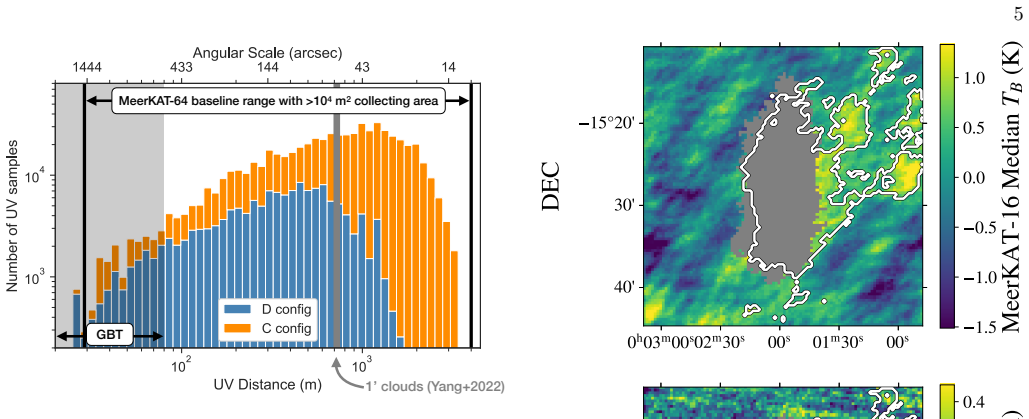
We analyze HI 21-cm observations of the Local Group dwarf galaxy Wolf-Lundmark-Melotte (WLM) from the Local Group L-Band Survey to search for evidence of ram pressure stripping. While previous MeerKAT-16 observations of WLM showed evidence for off-galaxy atomic gas emission with a geometry suggestive of ram pressure stripping, our observations find no evidence for this stripped gas. We demonstrate that our observations would be sensitive to the claimed detections and suggest that an uncorrected observational flaw with the MeerKAT data led to the apparent off-galaxy emission. The lack of off-galaxy emission obviates the need for uncharacteristically high values of the density of the intergalactic medium in this region.
Editorial analysis
A structured set of objections, weighed in public.
Referee Report
Summary. The manuscript re-examines HI 21-cm data for the Local Group dwarf WLM from the LGLBS survey and reports a non-detection of the off-galaxy atomic gas previously claimed from MeerKAT-16 observations. The authors argue that their data would have recovered the reported emission if present, attribute the earlier detection to an uncorrected MeerKAT artifact, and conclude that no unusually high IGM density is required to explain ram-pressure stripping in this system.
Significance. If the sensitivity and artifact-free character of the LGLBS reduction are confirmed, the result removes an apparent outlier in ram-pressure studies of Local Group dwarfs and underscores the need for rigorous cross-validation of extended low-surface-brightness HI features between independent interferometric datasets. The work supplies an independent observational constraint rather than a new theoretical derivation.
major comments (2)
- [Abstract and sensitivity demonstration] Abstract and sensitivity section: the statement that LGLBS 'would be sensitive to the claimed detections' is central to the non-detection conclusion, yet the text provides no quantitative demonstration (e.g., signal-injection recovery tests, direct comparison of rms noise, synthesized beam, and velocity resolution against the MeerKAT-reported flux, spatial scale, and velocity width). Without these checks the exclusion of the prior detection remains only partially verifiable.
- [Data reduction and comparison to MeerKAT] Data-reduction and artifact discussion: the suggestion of an 'uncorrected observational flaw' in the MeerKAT data is offered as the explanation for the earlier off-galaxy emission, but no specific diagnostic (e.g., comparison of dirty vs. cleaned cubes, baseline coverage differences, or residual maps) is shown to substantiate that the LGLBS reduction is demonstrably free of analogous artifacts at the relevant surface-brightness level.
minor comments (2)
- [Figures] Figure captions should explicitly state the contour levels, beam size, and velocity range used for the LGLBS moment maps so readers can directly compare them to the MeerKAT parameters cited in the text.
- [Observational parameters] The manuscript would benefit from a short table listing the key observational parameters (rms, beam, channel width, integration time) for both LGLBS and MeerKAT datasets side-by-side.
Simulated Author's Rebuttal
We thank the referee for the constructive report. The two major comments correctly identify places where the original manuscript would benefit from additional quantitative support and diagnostics. We address each point below and have incorporated the requested material into a revised version of the manuscript.
read point-by-point responses
-
Referee: [Abstract and sensitivity demonstration] Abstract and sensitivity section: the statement that LGLBS 'would be sensitive to the claimed detections' is central to the non-detection conclusion, yet the text provides no quantitative demonstration (e.g., signal-injection recovery tests, direct comparison of rms noise, synthesized beam, and velocity resolution against the MeerKAT-reported flux, spatial scale, and velocity width). Without these checks the exclusion of the prior detection remains only partially verifiable.
Authors: We agree that the original text lacked an explicit quantitative demonstration. In the revised manuscript we have added a dedicated subsection that reports signal-injection recovery tests. Synthetic sources matching the MeerKAT-reported integrated flux, spatial extent, and velocity width were inserted into the LGLBS dirty and cleaned cubes; these sources are recovered at >5 sigma significance. We also include a direct comparison table of rms noise per channel, synthesized beam parameters, and velocity resolution between the LGLBS and MeerKAT-16 datasets at the relevant surface-brightness level. revision: yes
-
Referee: [Data reduction and comparison to MeerKAT] Data-reduction and artifact discussion: the suggestion of an 'uncorrected observational flaw' in the MeerKAT data is offered as the explanation for the earlier off-galaxy emission, but no specific diagnostic (e.g., comparison of dirty vs. cleaned cubes, baseline coverage differences, or residual maps) is shown to substantiate that the LGLBS reduction is demonstrably free of analogous artifacts at the relevant surface-brightness level.
Authors: We accept that the original discussion of the possible MeerKAT artifact would be strengthened by explicit diagnostics. The revised manuscript now contains (i) side-by-side dirty and cleaned LGLBS channel maps at the location of the claimed off-galaxy emission, (ii) a quantitative comparison of uv-coverage and baseline lengths between LGLBS and MeerKAT-16, and (iii) residual maps after subtraction of the galaxy model that show no residual features above the local noise at the surface brightness of the MeerKAT claim. These additions support our statement that the LGLBS reduction is free of analogous artifacts. revision: yes
Circularity Check
No circularity: direct empirical comparison of independent HI datasets
full rationale
The manuscript contains no equations, derivations, fitted parameters, ansatzes, or uniqueness theorems. Its central claim is an observational statement: LGLBS data show no off-galaxy HI emission at the location, flux, and velocity reported by prior MeerKAT observations, and the LGLBS sensitivity is stated to be sufficient to have detected that emission. This is a straightforward data-to-data comparison with no reduction of any result to its own inputs by construction. No self-citation load-bearing steps or renamings of known results appear. The paper is self-contained against external benchmarks (the two telescope datasets) and receives the default non-finding.
Axiom & Free-Parameter Ledger
Reference graph
Works this paper leans on
-
[1]
Astropy Collaboration, Robitaille, T. P., Tollerud, E. J., et al. 2013, A&A, 558, A33, doi: 10.1051/0004-6361/201322068 Astropy Collaboration, Price-Whelan, A. M., Sip˝ ocz, B. M., et al. 2018, AJ, 156, 123, doi: 10.3847/1538-3881/aabc4f Astropy Collaboration, Price-Whelan, A. M., Lim, P. L., et al. 2022, ApJ, 935, 167, doi: 10.3847/1538-4357/ac7c74
-
[2]
2002, AJ, 123, 1316, doi: 10.1086/338899
Bureau, M., & Carignan, C. 2002, AJ, 123, 1316, doi: 10.1086/338899
-
[3]
2019, radio-astro-tools/spectral-cube: Release v0.4.5, v0.4.5 Zenodo, doi: 10.5281/zenodo.3558614
Ginsburg, A., Koch, E., Robitaille, T., et al. 2019, radio-astro-tools/spectral-cube: Release v0.4.5, v0.4.5 Zenodo, doi: 10.5281/zenodo.3558614
-
[4]
, year = 1972, month = aug, volume = 176, pages =
Gunn, J. E., & Gott, III, J. R. 1972, ApJ, 176, 1, doi: 10.1086/151605 Humaran Humaran, Y., & Minchin, R. 2025, in American Astronomical Society Meeting Abstracts, Vol. 245, American Astronomical Society Meeting Abstracts #245, 472.04
-
[5]
Ianjamasimanana, R., Namumba, B., Ramaila, A. J. T., et al. 2020, MNRAS, 497, 4795, doi: 10.1093/mnras/staa1967
-
[6]
Kepley, A. A., Wilcots, E. M., Hunter, D. A., & Nordgren, T. 2007, AJ, 133, 2242, doi: 10.1086/513716
-
[7]
Koch, E. W., Leroy, A. K., Rosolowsky, E. W., et al. 2025, arXiv e-prints, arXiv:2506.11792, doi: 10.48550/arXiv.2506.11792
-
[8]
2026, A&A, 707, A309, doi: 10.1051/0004-6361/202557380
Kolhe, N., Hammer, F., Yang, Y., et al. 2026, A&A, 707, A309, doi: 10.1051/0004-6361/202557380
-
[9]
Lee, A. J., Freedman, W. L., Madore, B. F., et al. 2021, ApJ, 907, 112, doi: 10.3847/1538-4357/abd253
-
[10]
Luber, N., Stierwalt, S., Privon, G. C., et al. 2025, ApJL, 993, L14, doi: 10.3847/2041-8213/ae0b5e
-
[11]
McConnachie, A. W., Venn, K. A., Irwin, M. J., Young, L. M., & Geehan, J. J. 2007, ApJL, 671, L33, doi: 10.1086/524887
-
[12]
Pingel, N. M., Pisano, D. J., Heald, G., et al. 2018, ApJ, 865, 36, doi: 10.3847/1538-4357/aad816
-
[13]
Gibson, B. K., & Barnes, D. G. 2003, ApJ, 586, 170, doi: 10.1086/344477
-
[14]
2022, A&A, 660, L11, doi: 10.1051/0004-6361/202243307
Yang, Y., Ianjamasimanana, R., Hammer, F., et al. 2022, A&A, 660, L11, doi: 10.1051/0004-6361/202243307
-
[15]
Zhu, J., & Putman, M. E. 2023, MNRAS, 521, 3765, doi: 10.1093/mnras/stad695
discussion (0)
Sign in with ORCID, Apple, or X to comment. Anyone can read and Pith papers without signing in.